
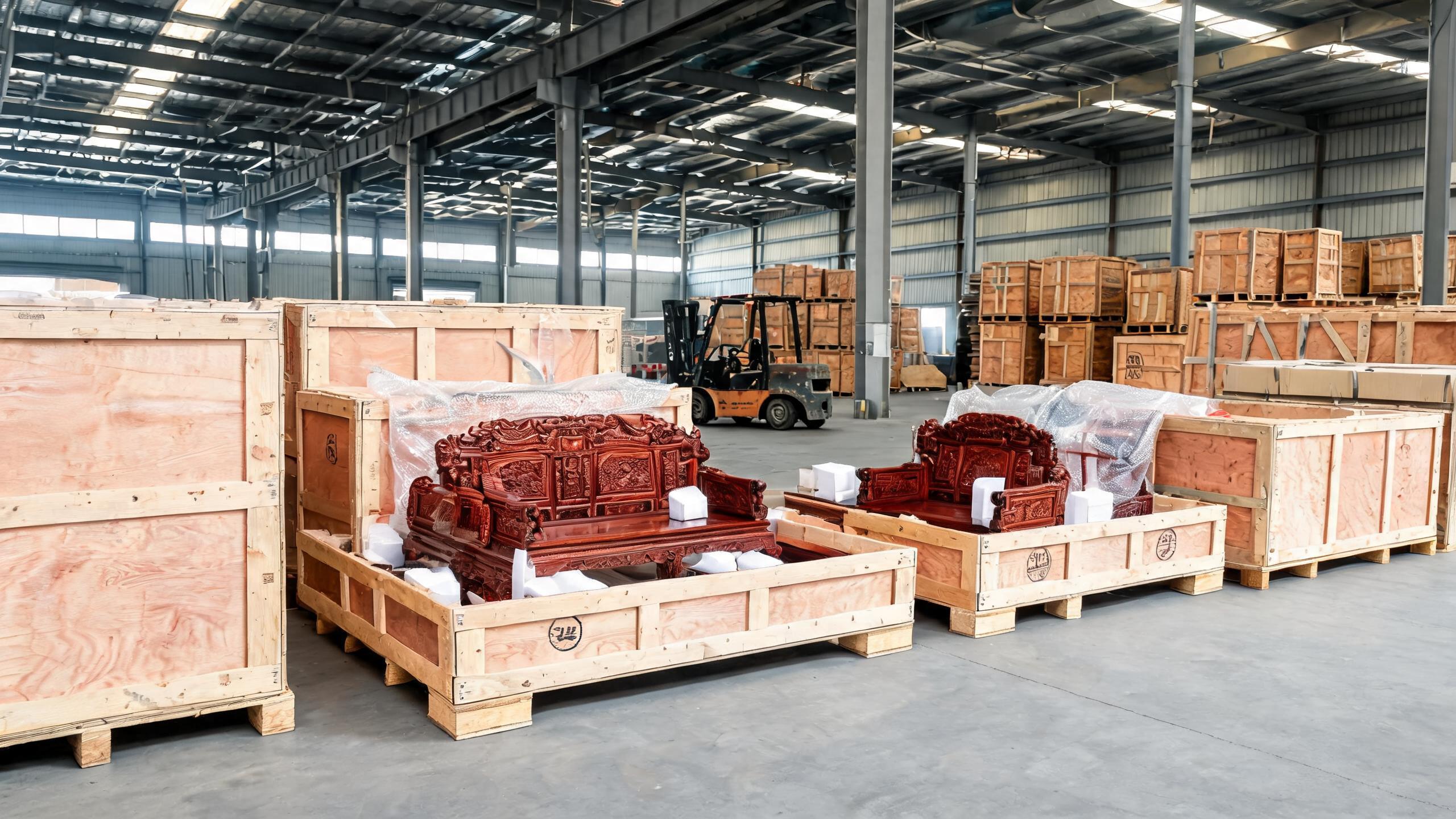
A practical guide for importers and buyers on how rosewood furniture export packaging protects carved, high-value pieces during ocean freight. Learn why ISPM-15 heat-treated crating is non-negotiable, how moisture barriers prevent mildew and warping, and how foam bracing absorbs the shock of container handling. Includes a packaging spec checklist, cost factors, and questions to ask your supplier.
BUYER GUIDE — OCEAN FREIGHT PACKAGING
Rosewood Furniture Export Packaging: How ISPM-15 Crating, Moisture Barriers, and Foam Bracing Protect Carved Furniture During Ocean Freight
If you are importing carved rosewood or redwood furniture, the container journey is where most damage happens — not in the workshop. A 40-foot container crosses the equator, spends days at a transshipment hub in tropical heat, and gets dropped by spreader bars onto a chassis. Temperature swings of 30°C and humidity shifts from 40% to 95% RH are normal. Without the right rosewood furniture export packaging, you are not shipping furniture — you are shipping a claim.
This guide covers the three layers that determine whether a carved piece arrives intact: ISPM-15 heat-treated crating (compliance), moisture barriers (climate control), and foam bracing (mechanical protection). It also includes a packaging spec checklist you can send to any supplier.
- ISPM-15 is a mandatory phytosanitary standard for wood packaging — no compliant stamp, no entry at most borders.
- Rosewood's density (often 800–950 kg/m³) makes it heavy and prone to splitting at corners; bracing must protect edges, not just surfaces.
- A moisture barrier (poly sheeting + desiccant) prevents mildew and checking cracks during the humidity swings of ocean transit.
- Foam bracing with 2–3 cm closed-cell foam at contact points absorbs vibration and shock better than loose fill or paper.
- Ask your supplier for a packaging spec sheet and photos of the crating process before you book the container.
Why Rosewood Furniture Needs Different Packaging Than Other Wood Furniture
Rosewood (Dalbergia species) and related redwood furniture are not ordinary hardwood pieces. Three physical properties change how they must be packed:
- High density: Rosewood is one of the heaviest commercial woods. A single carved chair can weigh 25–40 kg. High mass means higher inertial forces during handling — a drop that merely scuffs pine can crack a rosewood leg.
- Carved, thin sections: Intricate carvings create thin, unsupported sections (spindles, armrests, backrests) that act as stress concentrators. These break before flat panels do.
- Moisture sensitivity: Dense hardwoods still absorb and release moisture. Rapid humidity change causes checking (surface cracks) and, worse, glue-line failure in joints. A sealed moisture barrier is not optional — it is structural protection.
Because of this, standard export packaging — a cardboard carton with bubble wrap — is insufficient. Rosewood furniture export packaging requires engineered crating, climate control, and shock absorption working together.
Layer 1: ISPM-15 Heat-Treated Crating — The Compliance Backbone
ISPM-15 (International Standards for Phytosanitary Measures No. 15) is a global standard regulating wood packaging material (WPM) used in international trade. Its purpose is to prevent the spread of pests and diseases through raw wood. It applies to all solid wood packaging — crates, pallets, dunnage — but not to the furniture itself (furniture is regulated separately under CITES for rosewood species).
What ISPM-15 Requires
All wood packaging must be either:
- Heat-treated (HT): Heated to a core temperature of 56°C for at least 30 minutes in a certified kiln. This is the most common method and the one you should specify.
- Methyl bromide fumigated (MB): Chemically treated. Less common now due to environmental restrictions in many countries.
After treatment, each piece of wood packaging must bear the official IPPC (International Plant Protection Convention) mark — a stamp showing the country code, the treatment facility's registration number, and the HT or MB code. For example: CN-12345-HT.
Why This Matters for Your Shipment
Without the ISPM-15 mark on every wooden component of the crate, your container can be:
- Rejected at the destination port and forced to return or be destroyed.
- Subject to costly re-export or treatment at your expense.
- Delayed for inspection, which cascades into demurrage charges.
When you request a quote for rosewood furniture ocean freight, ask for the supplier's ISPM-15 certificate and a photo of the IPPC stamp on the actual crate. A reputable export crating service will provide both without hesitation.
| Packaging Component | ISPM-15 Requirement | Common Non-Compliance |
|---|---|---|
| Solid wood frame (crate) | HT or MB + IPPC mark on each piece | Untreated lumber used for internal bracing |
| Plywood panels | Exempt if manufactured (glued, veneered) | Mislabeling solid wood as plywood |
| Pallet base | HT + IPPC mark | Reused pallets without valid marks |
| Dunnage / blocking | HT + IPPC mark | Scrap wood used as filler |
Rule of thumb: if it is solid wood and it touches the shipment, it must carry the IPPC mark. If a supplier says "it's just a small block," that small block can stop your container.
Layer 2: Moisture Barriers — Protecting Against Condensation and Humidity
Ocean freight exposes cargo to extreme humidity. A container sitting on a ship deck in the tropics heats up during the day and cools at night. This thermal cycling causes container rain — condensation that forms on the steel roof and drips onto the cargo. For rosewood furniture, this is catastrophic:
- Mildew and mold on finished surfaces, especially in carved crevices where moisture pools.
- Checking cracks as the wood surface dries rapidly after absorbing moisture.
- Glue-line failure in joints, loosening legs and armrests.
The Barrier Specification
A proper moisture barrier for redwood furniture shipping protection includes:
- Vapor barrier: A 100–150 micron (4–6 mil) polyethylene sheet wrapped completely around the furniture piece before crating. The sheet must be sealed — taped or heat-sealed — to create a closed envelope.
- Desiccant: Silica gel or clay desiccant pouches placed inside the barrier. Dosage depends on volume and expected transit time; a typical range is 200–500 grams per cubic meter of enclosed space. Ask your supplier for their calculation.
- Ventilation or sealed? Two schools exist. Sealed barriers protect against external humidity but trap internal moisture. Ventilated barriers (with small vents) allow air exchange but let in humidity. For carved furniture with high moisture content, a sealed barrier with adequate desiccant is usually safer.
- Poly sheet thickness (should be ≥ 100 microns, not thin cling film).
- Desiccant type and quantity per piece.
- Whether the barrier is sealed before the crate is assembled.
- Whether the furniture is pre-conditioned (dried to a stable moisture content, typically 8–12%) before packing.
Layer 3: Foam Bracing — Absorbing Shock and Preventing Movement
No matter how well the crate is built, the container will be subject to impacts: forklift handling, ship motion, and container stacking. The crate's job is to keep the furniture from moving, and the foam's job is to absorb the energy of that movement.
Foam Types and Placement
- Closed-cell polyethylene foam (PE foam): The workhorse. It does not absorb water, has good shock absorption, and does not outgas chemicals that could damage finishes. Thickness of 20–30 mm is standard for contact points.
- Polyurethane foam (PU foam): Softer, used for conforming to complex carved shapes. Often used as a second layer over PE foam.
- Expanded polystyrene (EPS / styrofoam): Rigid and cheap, but brittle. It can crack and is less effective at vibration damping. Acceptable for flat surfaces, not for carved sections.
Where Foam Must Be Placed
For carved rosewood furniture, the critical contact points are:
- Carved spindles and backrests: These are the first to break. Foam must be shaped or layered to support the entire carved section, not just touch the high points.
- Legs and feet: The base takes the most impact. Foam blocks under the feet, plus bracing to prevent lateral sliding.
- Armrests and protruding elements: Any part that extends beyond the furniture's main footprint needs foam protection on all sides.
- Corners: The crate's corners are where impact forces concentrate. Foam corner blocks, 5 cm or thicker, are essential.
A common mistake is wrapping the furniture in bubble wrap and calling it done. Bubble wrap protects against scratches, not impacts. For furniture export crating, the standard is: moisture barrier → foam layer at all contact points → rigid crate with internal blocking that prevents movement in all six directions (up, down, left, right, forward, backward).
The Complete Crating Specification — A Checklist for Buyers
When you request a quote for rosewood furniture export packaging, send this checklist. A supplier who can answer all points is one who has done this before.
| Item | Specification | Why It Matters |
|---|---|---|
| Crate material | Plywood (≥ 9 mm) or solid wood frame with ISPM-15 mark | Structural strength and compliance |
| Crate construction | Nailed and glued; corner blocks reinforced | Prevents racking (twisting) during handling |
| Moisture barrier | 100–150 micron poly sheet, sealed with desiccant | Prevents condensation damage |
| Foam thickness | 20–30 mm closed-cell PE at contact points; 50 mm at corners | Shock absorption |
| Internal blocking | Wood or foam blocks preventing movement in all directions | Prevents shifting during transit |
| Furniture pre-conditioning | Moisture content 8–12% before packing | Prevents post-shipment warping |
| ISPM-15 documentation | Certificate + photos of IPPC stamp | Ensures smooth customs clearance |
| Loading plan | How pieces are arranged in the container; weight distribution | Prevents overloading and damage during loading |
Cost Factors in Rosewood Furniture Ocean Freight Packaging
Packaging costs are typically 3–8% of the furniture's FOB value for well-engineered crating. Here is what drives the cost:
- Crate size: Carved furniture rarely nests efficiently. Each piece needs its own crate, and crates are charged by volume (cubic meters).
- ISPM-15 certification: The treatment and certification add a small per-crate cost, but non-compliance costs far more in port charges and delays.
- Desiccant quantity: Longer transit times (e.g., 30–40 days to Europe or the US East Coast) require more desiccant.
- Custom foam cutting: Shaped foam for complex carvings costs more than flat sheets but is the difference between intact and broken.
If a supplier quotes significantly below market on packaging, ask what they are skipping. Usually, it is the foam bracing or the desiccant — the two items that prevent the most damage.
Common Packaging Mistakes to Avoid
- Using untreated wood for internal bracing. Even if the main crate is ISPM-15 compliant, a single untreated block can trigger a customs hold.
- Wrapping in plastic without desiccant. A sealed plastic bag without desiccant traps moisture and creates a greenhouse effect — worse than no barrier at all.
- Foam only on flat surfaces. Carved sections need shaped or multi-layer foam, not a flat sheet laid on top.
- Overpacking the container. When crates are wedged too tightly, the pressure transfers impact forces directly to the furniture. Crates should be secured with lashing, not jammed.
- Skipping the pre-shipment photo. Always ask for photos of the packed furniture before the container is sealed. This is your evidence if a claim arises.
Questions to Ask Your Supplier Before Booking
Before you confirm the order, ask these five questions directly:
- Can you provide your ISPM-15 certificate and a photo of the IPPC stamp on the actual crate?
- What thickness of poly sheeting and how many grams of desiccant do you use per cubic meter?
- What foam thickness do you use at contact points, and how do you protect carved sections?
- Can you provide photos of the crating process for a recent rosewood shipment?
- What is the moisture content of the furniture at the time of packing?
A supplier who answers with specific numbers and photos is a supplier who has shipped carved furniture successfully. A supplier who gives vague assurances is a risk you do not need.
Final Thoughts
Rosewood furniture export packaging is not a commodity service — it is an engineering decision. ISPM-15 heat-treated crating keeps your shipment legal, moisture barriers keep it stable, and foam bracing keeps it intact. When all three are specified correctly, the container journey becomes a non-event. When any one is missing, you are gambling with high-value, irreplaceable pieces.
For your next shipment, use the checklist above as part of your purchase order terms. Specify the packaging requirements in writing, request photos, and confirm the ISPM-15 documentation before the container leaves the factory. The 30 minutes it takes to review these details will save you weeks of claims processing and the cost of replacing a carved rosewood chair that cannot be replicated.
Need a packaging specification template for your supplier? Most experienced furniture export crating services can provide one on request — ask for it when you request your next quote.