
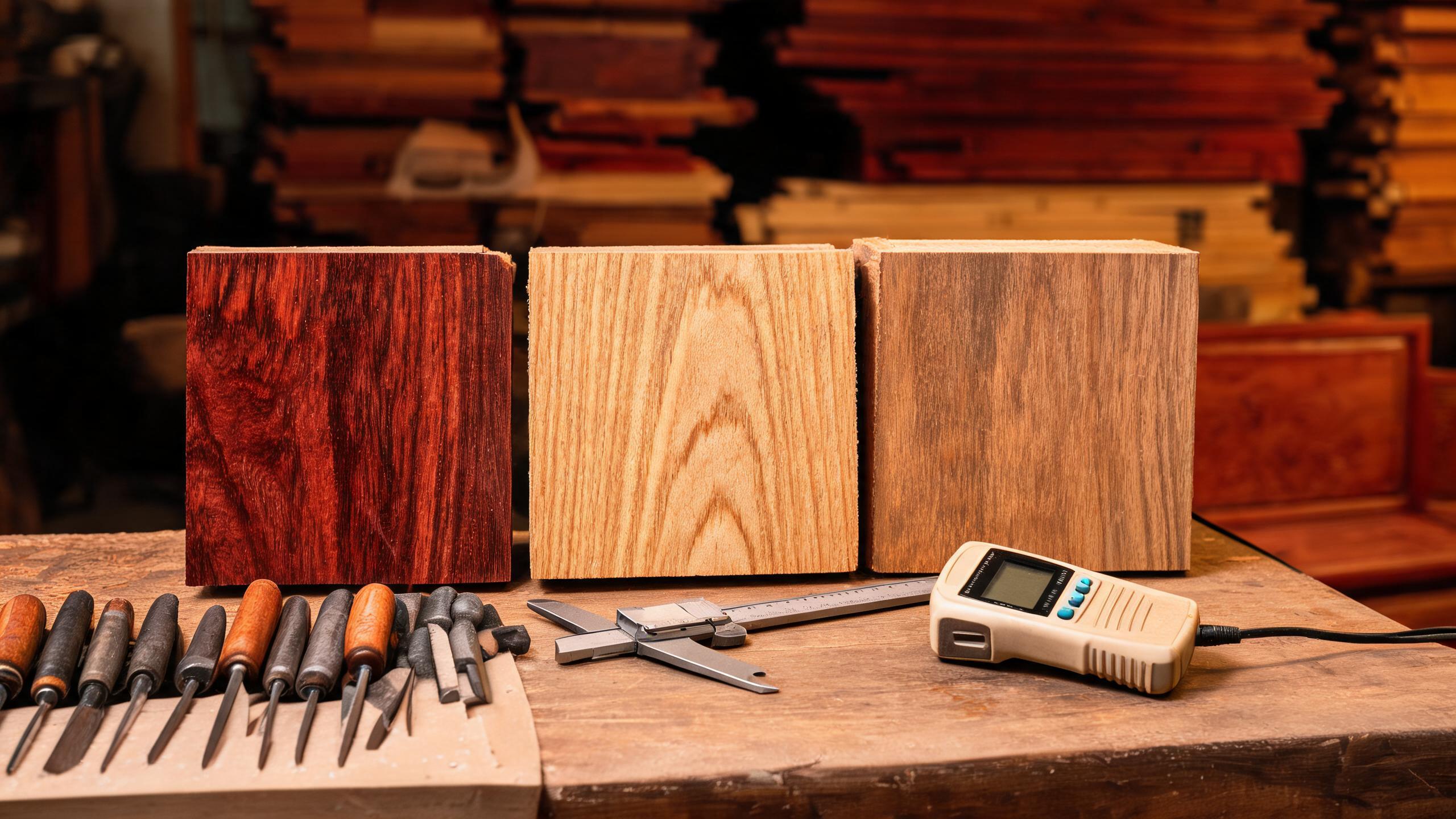
A practical B2B guide to rosewood furniture material grading. Learn how to identify Dalbergia cochinchinensis (Siamese rosewood), understand solid wood grading systems, verify CITES compliance, and ask suppliers the right questions before placing bulk orders.
BUYER GUIDE · WOOD SPECIES & GRADING
Why Material Identification Matters More Than the Design
When you source rosewood furniture for a hotel project, a showroom fit-out, or a residential collection, the first question is rarely about the carving style. It is about what the wood actually is, how it was graded, and whether the shipment will pass customs at your port.
This guide covers the three things a B2B buyer needs before signing a contract: how to distinguish Siamese rosewood wood species from lookalikes, how redwood furniture material grading works in practice, and what documentation you must request for Dalbergia cochinchinensis furniture under CITES. It is written for procurement managers and importers who need to verify claims, not for retail shoppers.
- Dalbergia cochinchinensis (Siamese rosewood) is a CITES Appendix II species — every shipment needs export permits and often import documentation. Confirm before you commit.
- Grading is not standardized across suppliers. You must define your own acceptance criteria for color, grain, and defect tolerance in the contract.
- Nanmu (Phoebe spp.) is not rosewood. It is a separate premium hardwood often confused with rosewood in export listings. Verify the botanical name, not the trade name.
- Solid wood grading differs from veneer grading. Ask for the cut, the board thickness, and the percentage of heartwood vs. sapwood in each container.
Siamese Rosewood Wood Species: What You Are Actually Buying
Siamese rosewood is the trade name for Dalbergia cochinchinensis, a hardwood native to Thailand, Cambodia, Laos, and Vietnam. It is also called Thai rosewood or tracwood. The heartwood ranges from a deep orange-brown to a rich reddish-brown, often with darker black-brown streaks. The grain is typically interlocked, and the texture is fine and uniform.
Why does this matter for a B2B buyer? Because the same common name is applied to several different species with very different legality, stability, and price profiles. If your supplier writes "rosewood" on the commercial invoice without a botanical name, you cannot verify what you are paying for.
Common Species Sold Under the "Rosewood" Name
| Trade Name | Botanical Name | CITES Status | Typical Use |
|---|---|---|---|
| Siamese rosewood / Thai rosewood | Dalbergia cochinchinensis | Appendix II | High-end furniture, veneer, musical instruments |
| Burmese rosewood | Dalbergia oliveri | Appendix II | Furniture, flooring, decorative veneer |
| Cambodian rosewood | Dalbergia cambodiana | Appendix II (check current listings) | Small furniture, turned goods |
| Nanmu (often mislabeled as rosewood) | Phoebe bournei, Phoebe zhennan | Not CITES-listed (verify source country rules) | Premium furniture, interior paneling |
The key point: Dalbergia cochinchinensis furniture is regulated. The species has been on CITES Appendix II since 2013, which means international trade requires a valid export permit from the country of origin. Some countries also require import permits. This is not optional paperwork — customs will hold shipments without it.
How to Identify Siamese Rosewood at the Factory
You do not need to be a wood scientist to spot the difference between Siamese rosewood and a lookalike. But you do need to look at the right features. Here is a practical checklist to use during factory visits or when reviewing pre-shipment photos.
Visual Identification Checklist
- Color: Fresh-cut heartwood is a vivid orange-brown that deepens to a darker reddish-brown with age and light exposure. If the wood is uniformly pale or greyish, it is likely a different species or young plantation stock.
- Grain: Siamese rosewood typically shows an interlocked or slightly wavy grain. Straight, uniform grain with no variation is more typical of plantation-grown substitutes.
- Weight: The wood is dense. A small block should feel noticeably heavier than common hardwoods like oak or rubberwood. If a sample feels light, question the species claim.
- Odor: When cut or sanded, Dalbergia cochinchinensis has a mild, slightly sweet smell. It is not pungent. A strong, sour, or resinous odor suggests a different species.
- End grain: Look at the cut end. Rosewood has distinct, fine pores that are evenly distributed. Large, open pores or a coarse texture indicate a different hardwood.
This checklist is a first-line filter, not a lab test. For high-value orders, consider requesting a wood identification report from an independent laboratory. This is common practice for large B2B orders and is worth the cost.
Redwood Furniture Material Grading: How to Set Your Own Standard
Here is a truth about the industry: there is no single, universally accepted grading system for rosewood furniture. Unlike plywood (which has clear international grades), solid wood furniture grading is set by each factory, and the terms they use can vary significantly.
This is where redwood furniture material grading gets tricky for buyers. One factory's "A-grade" might be another factory's "B-grade." If you do not define your acceptance criteria in the contract, you are relying on the supplier's interpretation.
The Grading Dimensions That Matter
| Grading Factor | What to Specify | Why It Matters |
|---|---|---|
| Heartwood vs. sapwood | Maximum allowable sapwood percentage (e.g., "no sapwood visible on exposed surfaces") | Sapwood is lighter, less durable, and visually inconsistent. High sapwood content lowers the value significantly. |
| Color consistency | Acceptable color range across a single piece and across a set | Rosewood color varies naturally. If you need a matched set, you must specify it. |
| Defect tolerance | Allowable size and number of knots, checks, or mineral streaks per board | Small checks can be filled; large knots on visible surfaces are often rejected for premium projects. |
| Moisture content | Target MC range (typically 8–12% for interior furniture) | Wood that is too wet will warp and crack after shipping. Ask for the kiln-drying specification. |
| Cut type | Plain-sawn, quarter-sawn, or rift-sawn | Quarter-sawn boards are more stable and show a straighter grain but yield less from the log, so they cost more. |
How to Write Grading Requirements Into Your Contract
Do not accept "A-grade" or "first-class" as a standalone term. Instead, write a short, measurable clause. For example:
"All exposed surfaces must be heartwood, free of sapwood, with no knots larger than 5 mm. Color must be uniform within each piece and across each set. Moisture content must be 8–12% at the time of packing."
This gives the factory a clear target and gives you a legal basis for rejection if the goods do not match.
Nanmu: The Premium Hardwood That Is Not Rosewood
If you are sourcing from China, you will encounter Nanmu (also written as nan mu or phoebe wood). Nanmu refers to several species in the Phoebe genus, most notably Phoebe zhennan and Phoebe bournei. It is a highly regarded wood in Chinese furniture making, valued for its straight grain, fine texture, and resistance to insects.
Nanmu is sometimes marketed in the same conversation as rosewood because both are premium hardwoods used in high-end Chinese furniture. But they are not the same. Nanmu is typically lighter in color — ranging from a pale yellow-brown to a golden brown — and it does not have the dark, dramatic streaks of rosewood. It is also generally less dense than Dalbergia cochinchinensis.
For a B2B buyer, the risk is mislabeling. A supplier might list "rosewood" on a quote when the actual material is nanmu, either because of translation confusion or deliberate substitution. Always ask for the botanical name on the commercial invoice and the packing list. If the supplier cannot provide it, that is a red flag.
Solid Wood Furniture Grading: Veneer vs. Solid, and Why It Changes the Price
One of the most common disputes in solid wood furniture grading is the difference between solid wood and veneer construction. Both can look identical in a photo. The price difference, however, is substantial.
Solid wood means the board is cut from a single log. Veneer means a thin layer of premium wood (often 0.6 mm to 3 mm thick) is glued onto a substrate, which could be plywood, MDF, or a cheaper hardwood. Veneer is not inherently bad — it is more stable and more sustainable — but it is not the same product as solid rosewood.
How to Verify Solid Construction
- Check the edges: Look at the end grain of a drawer front or tabletop. Solid wood shows a continuous grain pattern across the thickness. Veneer shows a thin line of premium wood over a different substrate.
- Check the back: The back of a solid wood panel usually shows the same species, though it may be a lower grade. If the back is a completely different wood, it is a veneer or a composite.
- Ask about the core: For tabletops, ask whether the core is solid boards, finger-jointed boards, or plywood. Finger-jointed cores are common in mid-range furniture and are perfectly functional, but they are not the same as a single solid board.
- Weigh it: A solid rosewood tabletop is very heavy. If the piece feels surprisingly light, question the construction.
CITES and Documentation: What to Request from Your Supplier
For Dalbergia cochinchinensis furniture, the paperwork is not a formality. Without the correct CITES export permit, the shipment will be detained or confiscated at the destination port. You may also face fines.
Here is the documentation checklist to request before you pay a deposit:
- CITES export permit issued by the exporting country's management authority.
- CITES import permit if your country requires one (check with your local authority).
- Commercial invoice with the full botanical name (Dalbergia cochinchinensis) and the CITES appendix number.
- Packing list with the same species information.
- Phytosanitary certificate (required by most countries for any wood product).
- Fumigation certificate if the wood is not kiln-dried or if the destination country requires it.
Ask your supplier to send scanned copies of the CITES permit before you arrange the balance payment. If they cannot provide it, do not ship. The risk is entirely on the importer.
Practical Supplier Evaluation Checklist
Before you place an order, use this short list to evaluate a rosewood furniture factory. It is designed to surface the issues that cause shipment delays and quality disputes.
- Can the supplier name the botanical species on the invoice? If they say "rosewood," ask which one.
- Can they provide a CITES export permit for a recent shipment? Ask to see a sample (with customer details redacted).
- What is their moisture content specification? Do they kiln-dry in-house or outsource it?
- What is their grading standard? Ask them to define "A-grade" in writing.
- What is their defect tolerance for knots and sapwood? Get it in the contract.
- Can they provide a wood identification report from an independent lab for a large order?
- What is their process for color matching across a set? Do they use a single log for matched pieces?
Frequently Asked Questions
Is Siamese rosewood the same as Thai rosewood?
Yes. Siamese rosewood and Thai rosewood are common trade names for Dalbergia cochinchinensis. The term "Siamese" refers to the historical name for Thailand.
Can I import Dalbergia cochinchinensis furniture without a CITES permit?
No. The species is listed in CITES Appendix II. An export permit from the country of origin is required for international trade. Many destination countries also require an import permit. Confirm with your local CITES authority before shipping.
What is the difference between nanmu and rosewood?
Nanmu is from the Phoebe genus, while rosewood is from the Dalbergia genus. They are different species with different colors, densities, and grain patterns. Nanmu is typically lighter in color and less dense than Siamese rosewood.
How do I know if my furniture is solid wood or veneer?
Check the end grain, the back of the panel, and the weight. Solid wood shows continuous grain across the thickness. Veneer shows a thin premium layer over a different substrate. When in doubt, ask the supplier to state the construction in writing.
What is a reasonable moisture content for exported rosewood furniture?
For interior furniture, a moisture content of 8–12% is the common target. This reduces the risk of warping and cracking during shipping and after arrival. Ask the supplier for their kiln-drying specification.
Final Advice for Importers
The rosewood furniture market rewards buyers who ask precise questions and penalizes those who rely on vague trade names. Define the species, define the grade, and define the documentation before you sign. A supplier who cannot answer these questions clearly is not the right partner for a large order — regardless of how good the product photos look.
If you are evaluating a specific factory or a specific quote, prepare a written specification sheet with the points above and send it to the supplier before the deposit. The response you get will tell you more about their reliability than any sales pitch.