
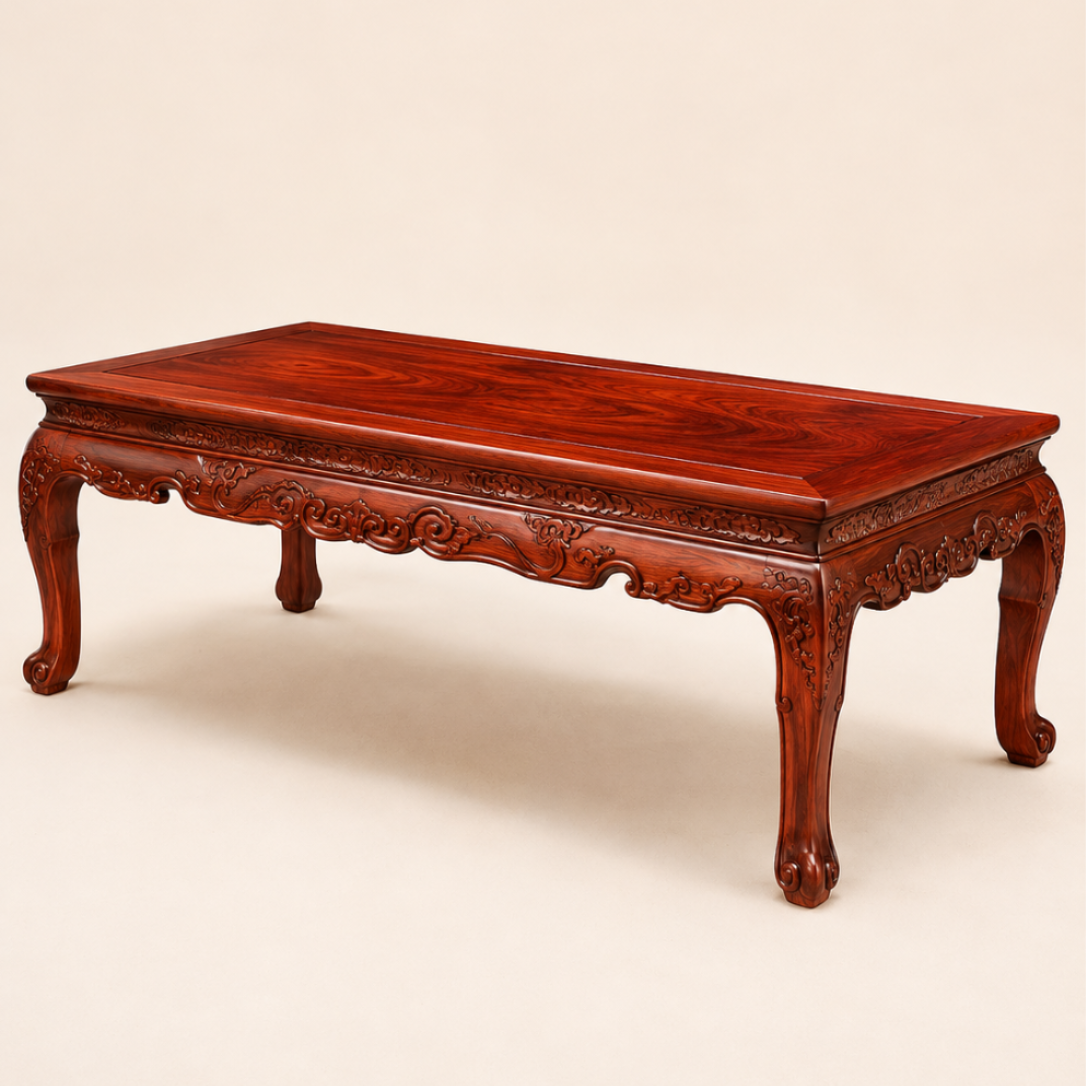
A practical B2B sourcing guide for importers, interior designers, and hospitality buyers looking to source classical Chinese carved rosewood tea tables and coffee tables. Covers wood types, carving quality assessment, size selection, supplier evaluation, shipping considerations, and common pitfalls — written for buyers who need actionable criteria, not marketing fluff.
BUYER GUIDE · FURNITURE SOURCING
# Rosewood Tea Table & Coffee Table B2B Sourcing Guide If you are sourcing classical Chinese carved rosewood tea tables for a living room collection, a tea house fit-out, or a boutique hotel project, the challenge is not finding suppliers — it is finding a supplier who can deliver consistent quality at a price that leaves you margin. This guide walks through the decisions that matter: wood identification, carving quality, sizing, finish, supplier evaluation, and shipping.
Key takeaways:
## Why Rosewood Tea Tables Are a Growing Import Category
The demand for classical Chinese furniture has moved beyond ethnic decor stores. Mainstream furniture retailers, interior designers, and hospitality buyers now specify rosewood tea tables and coffee tables for:
- **Living room collections** — as statement pieces that anchor a room.
- **Tea rooms and wellness spaces** — where the low height and natural material fit the aesthetic.
- **Boutique hotels and resorts** — where a single carved piece can define a lobby or suite.
The buying logic is straightforward: a well-made rosewood table is durable, visually distinctive, and carries a story that mass-produced veneer furniture cannot match. For buyers, the margin potential is significant — but only if you source correctly.
## Step 1: Understand What "Rosewood" Actually Means
The term "rosewood" covers multiple species with very different price points. This is the first thing to clarify with any supplier.
- Not all "rosewood" is the same — verify the actual wood species and whether it is solid or veneered.
- Carving quality is the single biggest differentiator between a €300 table and a €3,000 table. Know what to look for.
- Size and proportion must be matched to your target market's living room dimensions, not Chinese standard sizes.
- Ask for photos of the same production batch, not just finished showroom pieces.
- Shipping weight and crating are major cost factors — get them quoted upfront.
| Common Name | Botanical / Trade Name | Typical Use in Tea Tables | Relative Price |
|---|---|---|---|
| Huanghuali | Dalbergia odorifera | High-end antique reproductions | Very high |
| Hongmu / Red Rosewood | Dalbergia cochinchinensis (Thai rosewood) or related | Classical carved tables, high-end | High |
| Pterocarpus (Burmese / Vietnamese rosewood) | Pterocarpus macrocarpus | Mid-to-high range carved tables | Medium-high |
| African rosewood / Padauk | Pterocarpus soyauxii | Budget "rosewood" alternatives | Low-medium |
A good rule of thumb: if the carving looks flat in a photo, it will look worse in person. Ask for a close-up video at an angle, not a straight-on photo.
## Step 3: Size and Proportion for Your Market
Chinese tea tables are typically lower than Western coffee tables. Standard Chinese tea table heights range from 380mm to 450mm, designed for use with low seating or floor cushions. If your target market uses standard sofas (seat height 420–480mm), a 380mm table will feel too low.
**Consider these dimensions:**
| Type | Typical Height | Typical Length | Best For |
|---|---|---|---|
| Traditional Chinese tea table | 380–450 mm | 900–1200 mm | Tea rooms, floor seating |
| Living room coffee table (Western) | 400–500 mm | 1000–1400 mm | Standard sofas |
| Console / side table | 500–700 mm | 800–1200 mm | Entryways, hotel lobbies |
| Checklist Item | What to Look For |
|---|---|
| Wood sourcing transparency | Supplier can name the exact species and show CITES documentation if required. |
| Production photos | Ask for photos of the same batch, in the workshop, before finishing. |
| Carving close-ups | Video of carving detail at an angle, not just front-facing shots. |
| MOQ flexibility | Can they do a mixed container (tea tables + coffee tables + consoles)? |
| Lead time | Typical production time for a 40ft container: 25–45 days, depending on carving complexity. |
| Export experience | Have they shipped to your region before? Ask for a bill of lading sample (redacted). |
| After-sales policy | What happens if pieces arrive damaged? Who covers the claim? |
Cost reality check: A mid-range carved rosewood tea table (solid Pterocarpus, machine-carved with hand finishing) might be quoted FOB at $300–$600. The same table in a boutique hotel showroom can retail at $2,000–$4,000. The margin exists — but only if you control freight, damage, and quality consistency.
## Step 7: Compliance and CITES — Do Not Skip This
Many rosewood species are listed under CITES (Convention on International Trade in Endangered Species). This is not optional paperwork — shipping CITES-listed wood without the correct permits can result in seizure and fines.
**Practical guidance:**
- Ask your supplier whether the specific species requires a CITES export permit.
- If it does, confirm they can provide it and factor 2–4 weeks into the lead time.
- For the EU and US markets, check whether the species is restricted or banned for import.
- If your supplier is vague about CITES, treat it as a red flag and move on.
## FAQ — Common Questions from Buyers
**Q: What is the difference between a rosewood tea table and a rosewood coffee table?**
A: Primarily height and proportion. Tea tables are lower (380–450mm) and often more compact, designed for tea ceremony use. Coffee tables are taller (400–500mm) and sized for Western sofas. Many suppliers use the same base design for both, adjusting height and top dimensions.
**Q: Can I get a custom size or carving pattern?**
A: Yes, most workshops offer customization. Expect a longer lead time and a higher per-unit cost for non-standard carvings. Minimum order quantities for custom designs are typically higher — confirm with the supplier.
**Q: How do I verify the wood is solid, not veneer?**
A: Ask for a photo of the edge grain and the underside of the tabletop. Solid wood shows continuous grain on the edge; veneer shows a thin line of wood over a lighter core. Also check the weight — solid rosewood is noticeably heavy.
**Q: What is the typical lead time for a 40ft container?**
A: For standard designs, 25–40 days after deposit. For heavily carved or custom pieces, 45–60 days. Always add 2–3 weeks for CITES paperwork and export documentation if applicable.
**Q: Can the supplier provide a sample before bulk order?**
A: Most will, but expect to pay for the sample and freight. A single tea table sample is a reasonable investment before committing to a container.
**Q: What if the goods arrive damaged?**
A: This should be agreed in the contract before shipping. Common practice: supplier covers replacement parts or a discount on the next order, while the buyer claims transit damage from the freight insurer. Get this in writing.
## Next Steps — What to Prepare Before You Contact Suppliers
To get accurate quotes quickly, prepare this information before reaching out:
1. **Target market and dimensions** — sofa height, room size, typical customer preference.
2. **Quantity and mix** — how many tea tables, coffee tables, consoles per container.
3. **Style reference** — photos of the carving style and wood color you want.
4. **Finish preference** — wax, lacquer, or natural.
5. **Your port of destination** — this determines freight quotes.
A supplier who receives this level of detail will quote you more accurately and faster than one who has to ask follow-up questions.
---
**Need help evaluating a specific supplier or preparing a sourcing list?** Contact our team with your target market, quantities, and any supplier quotes you have received — we can help you compare offers and identify the right specification for your project.