
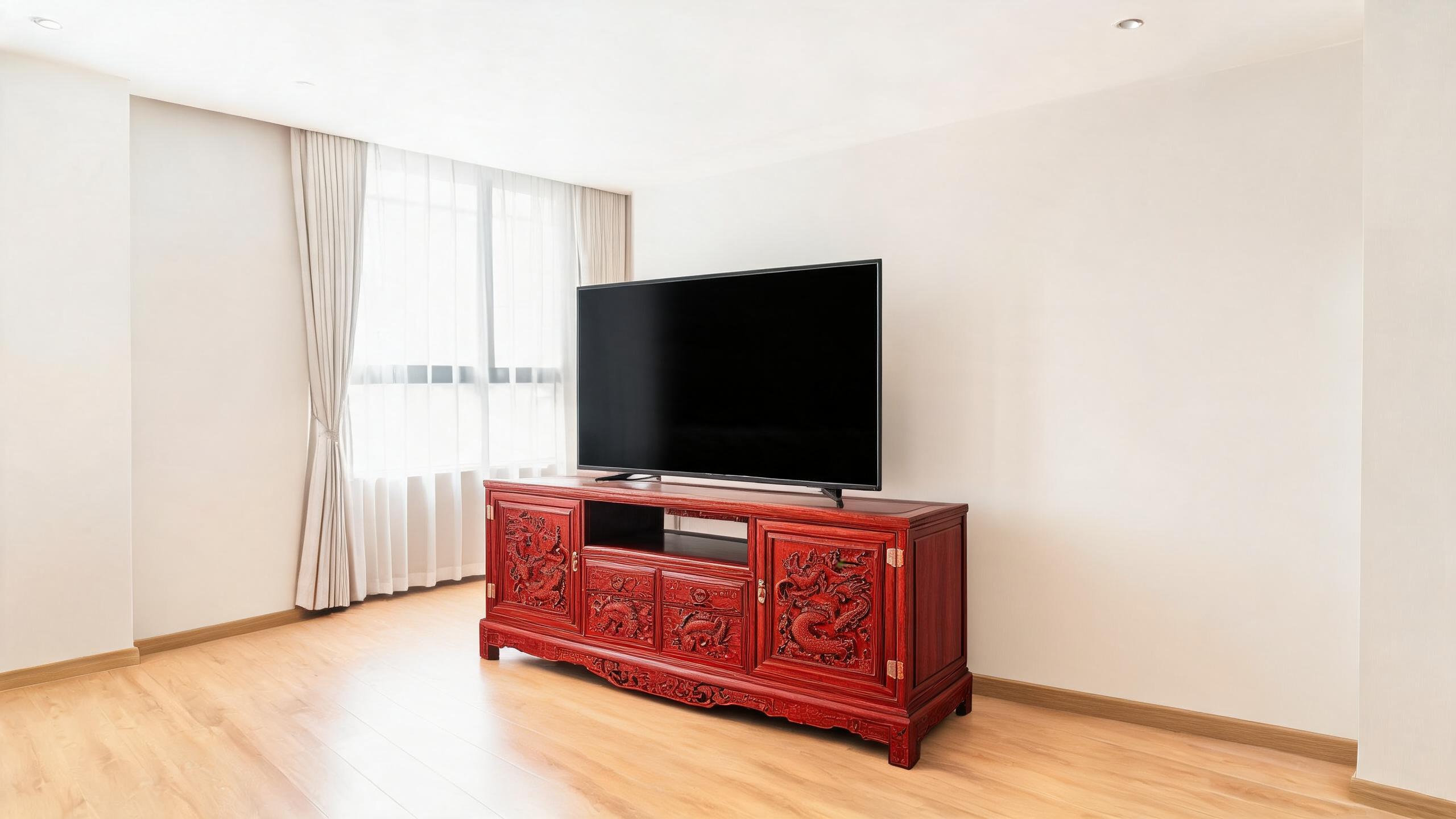
A practical sourcing guide for importers, wholesalers, and interior contractors looking to buy carved rosewood TV consoles, TV cabinets, and entertainment centers. Covers material verification, carving quality assessment, structural integrity checks, finishing standards, MOQ and lead time considerations, and how to evaluate suppliers for long-term partnership.
BUYER GUIDE · CARVED ROSEWOOD MEDIA FURNITURE
# Rosewood TV Console & Entertainment Center: A B2B Sourcing Guide for Classical Carved Rosewood Media Cabinets A carved rosewood TV console is not a commodity purchase. It is a high-value, low-volume item that sits in a living room for decades, often as the visual anchor of the entire space. For importers, interior contractors, and boutique furniture retailers, the buying decision carries real risk: get the wood species wrong, and the piece fails customs inspection; get the carving quality wrong, and your client rejects the delivery. This guide walks through what actually matters when sourcing a rosewood entertainment center from overseas suppliers—material identification, carving and joinery standards, finishing, compliance, and the practical questions to put in your next RFQ.
Key takeaways for buyers:
## Why "Rosewood" Needs to Be Defined in Every Contract
The term "rosewood" is used loosely in the furniture trade. In the classical carved furniture segment, it typically refers to one of several species:
- Confirm the exact wood species in writing—"rosewood" covers Dalbergia species under CITES control and non-CITES lookalikes; your import paperwork depends on it.
- Judge carving quality by depth, undercutting, and pattern continuity—not by photos alone. Request video close-ups or a pre-shipment inspection.
- Check structural joinery (mortise-and-tenon vs. staples) and back-panel construction; these determine whether the cabinet survives shipping and daily use.
- Clarify finish system (PU vs. NC lacquer) and VOC compliance for your target market before placing the order.
- Plan for lead times of 30–60 days for carved pieces; rush orders often mean compromised carving detail.
| Common Trade Name | Typical Origin | CITES Status | Typical Use in Furniture |
|---|---|---|---|
| Dalbergia spp. (e.g., Siamese rosewood, Brazilian rosewood) | Southeast Asia, South America | Listed (restricted trade) | High-end classical carving |
| Pterocarpus spp. (e.g., Burmese padauk, African padauk) | Africa, Southeast Asia | Partially listed | Carved cabinets, veneers |
| Dalbergia sissoo (Indian rosewood) | South Asia | Not CITES-listed | Solid furniture, carving |
| Millettia laurentii (Wenge) | Central Africa | Not CITES-listed | Modern and classical pieces |
A carved rosewood TV console is judged at arm's length, not from across the room. The buyer who inspects carving depth, seam continuity, and sanding quality before ordering avoids the most common quality disputes.
## Structural Integrity: What Holds a Rosewood Media Cabinet Together
A rosewood entertainment center is heavy. Solid rosewood-class hardwoods can weigh 600–900 kg per cubic meter. A full-size TV cabinet with solid panels can easily exceed 80–120 kg. That weight puts stress on joints, especially during ocean freight.
Key structural points to verify:
- **Joinery:** Mortise-and-tenon or dowel joints are the standard for quality furniture. Avoid pieces where visible panels are attached with staples or glue alone. Ask the supplier to describe the joinery method for the frame, doors, and legs.
- **Back panel:** A solid wood back panel adds rigidity. Thin plywood or MDF backs are cheaper but reduce stability, especially for tall cabinets.
- **Door hinges and slides:** For a media cabinet, doors and drawers get daily use. Confirm the hinge type (soft-close is common now) and the drawer slide rating. These are replaceable parts, but they affect the user experience and your after-sales liability.
- **Weight distribution:** A TV console must support the TV's weight plus media equipment. Confirm the load rating for the top surface and internal shelves. A typical 55–65 inch TV weighs 20–35 kg, but buyers often place speakers and other gear on top as well.
## Finish and Coating: More Than Just Looks
The finish on a carved rosewood TV stand serves two purposes: it protects the wood and it defines the look. Two things matter for B2B buyers:
**Finish type.** Most Chinese factories use either PU (polyurethane) or NC (nitrocellulose) lacquer. PU is more durable and moisture-resistant; NC gives a more traditional, softer sheen but is less resistant to heat and scratches. Some buyers for the EU or North America also ask about water-based finishes for lower VOC content. Specify your preference in the RFQ.
**Color consistency.** Rosewood varies in color from reddish-brown to darker chocolate tones, depending on species and cut. If you are ordering a container of matching pieces, ask how the factory handles color matching across batches. A reputable supplier will sort panels for color before assembly.
**What to request:** A finished sample panel (approx. 20×20 cm) showing the actual wood, carving style, and finish. This is the single most useful reference for approving production.
## Compliance and Documentation for Import
For a carved rosewood entertainment center, documentation is not optional. Depending on your market, you may need:
- **Wood species declaration** (botanical name, not just "rosewood")
- **Fumigation certificate** (ISPM 15) for solid wood packaging
- **CITES permit** if the species is listed
- **Country-of-origin certificate**
- **Commercial invoice and packing list** with accurate weight and dimensions
Ask the supplier upfront which documents they can provide. If they hesitate on the species declaration, move on. The cost of a customs hold on a container of heavy wooden furniture far exceeds the effort of verifying documentation early.
## MOQ, Lead Time, and Sampling
Carved rosewood TV consoles are not mass-production items. Typical MOQs from Chinese factories range from 5 to 20 pieces per design, depending on the factory's production schedule. Lead times for carved pieces are longer than for plain furniture—expect 30 to 60 days from order confirmation to shipment, plus transit time.
**Sampling strategy for B2B buyers:**
1. **Start with an existing design.** Factories are more willing to produce samples of designs they already make. Custom designs usually require a sample fee and longer lead time.
2. **Order one finished sample first.** Approve the carving, finish, and dimensions before committing to a container.
3. **Use a pre-shipment inspection.** For a first order, hire a third-party inspection service (e.g., SGS, Bureau Veritas, or a local inspector) to check the pieces against your approved sample. The cost is small relative to the risk of a rejected shipment.
## Common Mistakes When Sourcing Rosewood TV Cabinets
- **Buying on photos alone.** Carving depth and finish quality cannot be judged from a flat image. Get video or a physical sample.
- **Assuming "rosewood" means one thing.** Confirm the species and its CITES status before signing.
- **Ignoring weight and packaging.** A heavy carved cabinet needs proper internal bracing and export-grade cartons. Ask about the factory's export packaging standard.
- **Skipping the finish spec.** If you do not specify the finish type and color, the factory will use whatever they have in stock—and the result may not match your catalog photos.
- **Ordering custom designs without a sample.** Custom carving is expensive to get wrong. Always approve a sample first.
## Questions to Ask a Potential Supplier
Use this checklist in your first communication with a factory:
- What is the exact wood species (botanical name) and origin?
- Is the piece solid wood, veneer, or a combination? Where is each used?
- What carving method is used (CNC rough + hand finish, or fully hand-carved)?
- What joinery method is used for the frame, doors, and legs?
- What finish system is used (PU, NC, water-based)? What is the VOC content?
- What is the MOQ per design?
- What is the lead time from order confirmation to shipment?
- What export documentation can you provide (species declaration, CITES, fumigation, COO)?
- Can you produce a finished sample before bulk production?
- What is your export packaging standard for heavy furniture?