
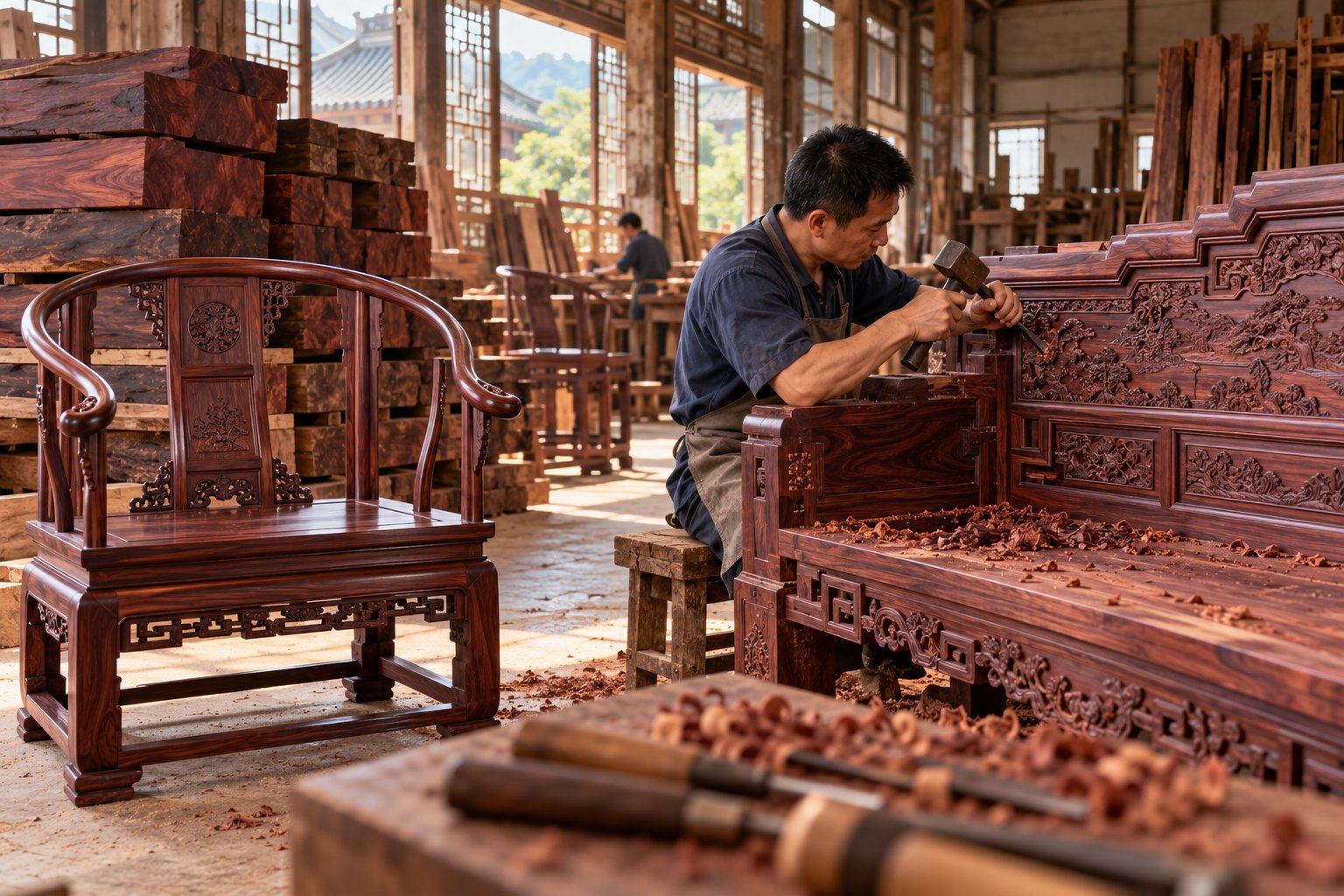
Panduan B2B praktikal untuk membeli perabot terus daripada pengeluar, dibina atas empat jenis bukti kilang yang boleh disahkan — pengeringan kelembapan malar selama 36 hari, pertukangan tanggam dan tenon tanpa paku logam, kemasan lilin lebah dan lakuer di bawah jangkaan EU REACH dan US CARB, serta dokumentasi FSC, CITES dan ISPM-15 bagi setiap penghantaran.
Most B2B furniture buyers have asked the same question at some point in their sourcing career: is it actually possible to buy furniture direct from a manufacturer, and if so, what should I look for before I commit a container order? The question sounds simple. In practice, answering it well separates buyers who build long-term supply relationships from buyers who spend years paying for information they never receive.
This article answers the question the way a buyer needs it answered: not with slogans about cutting out the middleman, but with the concrete, verifiable evidence a factory can show you — drying records, joinery methods, finishing systems, and export documentation — and the decisions those pieces of evidence let you make before money changes hands. The examples throughout come from one real factory, Yunxiao Rosewood Furniture Co., Ltd, founded in 2008 and operating a 12,000-square-meter facility in Xianyou County, Putian City, Fujian Province, a region widely regarded as the hometown of traditional Chinese hardwood craftsmanship. Whether you source from this factory or another, the checklist logic applies anywhere.
The Question Behind the Search: How to Buy Furniture Direct from a Manufacturer
When a buyer types a question like how to buy furniture direct from manufacturer into a search bar, the intent behind it is rarely academic. It is usually one of three situations. A buyer has just received a quote from a trading company and suspects part of that quote is margin rather than cost. A buyer has been burned by an intermediary who could not answer basic technical questions about the product being shipped. Or a buyer is planning a first order and wants to structure the sourcing process correctly from the start, rather than reverse-engineering it after a problem appears.
All three situations share one underlying need: verifiability. Buying direct is not primarily about the price printed on a quotation. It is about whether the party you negotiate with actually controls the decisions that determine whether your furniture survives an overseas climate, passes your customer's inspection, and arrives with the paperwork your customs broker needs. When you negotiate directly with the factory, you can ask the people who run the drying kilns about humidity schedules. You can ask the workshop supervisor how a frame is reinforced at stress points. You can ask the export team which documents accompany which shipment. When you negotiate through an intermediary, you can only ask whether the intermediary will pass the question along.
That distinction — asking the decision-maker versus asking a messenger — is the real reason the direct-from-manufacturer question matters for B2B buyers in 2026. Everything else in this article builds on it.
What "Buying Direct" Actually Means in Furniture Sourcing
The phrase "buy direct from manufacturer" is used loosely in the furniture trade, so it is worth defining precisely. Buying direct means the entity that signs your purchase contract also owns or directly controls the production line on which your furniture is made. Three consequences follow from that definition, and they matter more than any single discount.
1. Technical questions get technical answers
When the organization you talk to also runs the workshop, a question about moisture content stops being a matter of opinion and becomes a matter of record. At a direct manufacturer, the answer to "what moisture content is the timber before assembly?" can be traced to the kiln operator's own records rather than guessed. For classical rosewood furniture in particular, where solid hardwood panels and frames react visibly to humidity swings, the difference between an anecdote and a measurement is the difference between a shipment that performs and one that generates claims.
2. Changes stop being negotiations with a third party
Suppose your project requires a dining table with a slightly deeper apron, or a sofa set with a carving motif adapted to your market's taste. When you buy direct, that request goes to the people holding the chisels and the drawings. The feedback loop — your requirement, their feasibility judgment, a revised specification — runs in days rather than weeks, because there is no intermediate layer translating your drawings into someone else's interpretation of your drawings.
3. Accountability has an address
If a panel cracks or a joint loosens, a direct manufacturer investigates within its own facility: the timber batch, the drying log, the assembly station, the finishing pass. A trading company can only forward your complaint and negotiate on your behalf. This does not mean direct manufacturers never have problems — every factory does. It means when a problem occurs, the diagnosis happens where the evidence is.
None of this argues that trading companies have no role. For some buyers, especially those consolidating many product categories, a good trading company earns its margin. But if your core category is solid wood classical furniture — where material behavior, joinery, and finishing determine product performance — the case for buying direct from a rosewood furniture manufacturer is unusually strong, and the rest of this article shows why with verifiable factory evidence.
The Middle Layer: What a Trading Company Adds, and What It Costs You in Visibility
To make a fair decision, a buyer needs to understand precisely what an intermediary contributes and what it obscures. Trading companies genuinely add value in three areas: market access and language coverage across multiple suppliers, consolidation of small or mixed orders, and sometimes local financing or payment terms a small factory cannot extend. If those are the capabilities you lack, an intermediary earns its fee.
What the same layer costs you is visibility into four things that decide classical hardwood furniture performance:
- Material selection. Which timber lots were chosen for your order, how they were graded, and what was rejected. A direct manufacturer can show you the grade criteria and, for many orders, the actual boards before assembly.
- Process parameters. Drying schedules, workshop humidity, adhesive and dowel choices, and finishing layers. These are internal records at a factory; through an intermediary they become verbal assurances.
- Quality checkpoints. Where in the production flow an inspection happens, what it tests, and what happens when a piece fails. Direct manufacturers can name their own inspectors; intermediaries can name their own agents.
- Documentation chain. Which certificates and packing standards apply to your shipment, issued by whom. When the factory issues its own FSC and CITES paperwork and its own ISPM-15 treated packaging, the chain is one link long. When a third party "arranges" documents, the chain is longer, and every extra link is a place where information can degrade.
A useful way to think about it: every intermediary between you and the workshop is a translation layer. Translation layers are excellent at languages and logistics. They are structurally incapable of improving the drying record, the joint tolerance, or the lacquer chemistry of the piece in the crate. Buying direct removes the translation layer from the technical conversation — which is exactly where a rosewood buyer most needs it removed.
Evidence One: Drying — What a 36-Day Constant-Humidity Process Tells a Buyer
If you take one technical criterion away from this article, take this one: in solid rosewood furniture, nearly every long-term structural complaint traces back to moisture. Cracked panels, open joints, warped doors, and misaligned drawers are, overwhelmingly, the visible end of timber that was not dried and conditioned properly before assembly. This is why the drying process is the first piece of factory evidence a direct buyer should examine.
Yunxiao subjects each product to a 36-day constant humidity drying process before assembly. For a buyer evaluating a direct manufacturer, three features of that claim are worth unpacking, because they illustrate what to ask any factory — not just this one.
Duration is a commitment, not a slogan
Thirty-six days means the workshop plans production around a fixed conditioning window for every order. A buyer hearing "we dry our wood" is hearing a claim; a buyer hearing "36 days of constant humidity drying per product" is hearing a production constraint the factory has budgeted time and capacity for. The second claim is checkable in a way the first is not: it can be confirmed against production schedules, and its cost shows up in lead times rather than in marketing copy.
"Constant humidity" describes a controlled process, not a room
Ambient drying in a warehouse is whatever the weather decides. Constant humidity drying means the environment around the timber is held within a defined range while the wood equalizes. For B2B buyers exporting to Europe, North America, Southeast Asia, and Australia — markets with dramatically different indoor climates — this matters twice: once at the factory, where the wood is brought to a stable state, and again at destination, where the wood meets your customer's heating or air-conditioning. Ask a direct manufacturer how timber is conditioned relative to destination climate; at Yunxiao, timber is audited to a moisture content range of roughly 8–14% and conditioned toward the destination climate before shipment. That pairing — a measured range plus destination-aware conditioning — is the kind of answer only the factory side of the table can give with specificity.
What a buyer should verify, wherever they buy
- Ask what moisture content the timber reaches before assembly, and how it is measured (meter type, sampling frequency, who records it).
- Ask whether conditioning targets differ by destination market, and how.
- Ask what happens when a board tests outside the target: re-dried, rejected, or passed with a note?
None of these questions is exotic. All of them are answerable in one sentence by a kiln operator, which is exactly why a buyer who can ask them directly holds better information than a buyer who waits for the answer to travel through a third party.
Evidence Two: Joinery — Why "No Metal Nails" Is a Factory-Level Claim
Classical Chinese furniture construction is famous for mortise-and-tenon joinery, and buyers hear the phrase so often it risks becoming wallpaper. It should not. The joinery decision is one of the clearest markers of whether a manufacturer is invested in how the product performs years after delivery, and it is a claim whose depth only the factory can demonstrate.
Yunxiao assembles its furniture with classic mortise-and-tenon techniques and without metal nails in the primary structure — joints are cut, fitted, and reinforced with wooden pins (in several product lines, bamboo dowel pins) rather than screws or nails. For a B2B buyer deciding whether to buy direct from a rosewood furniture manufacturer, this construction choice carries four practical implications.
Metal and hardwood react differently to climate
Solid hardwood expands and contracts across seasons and climates. A rigid metal fastener embedded in a moving material creates localized stress: over time, the wood around the fastener can split or the fastener can loosen. Traditional joinery lets the joint itself move with the wood — tenons seat into mortises and wooden pins flex with the frame. This is not folklore; it is the engineering reason classical furniture built this way has survived centuries of seasonal movement in unheated buildings. It is also why the claim "no metal nails" signals a construction philosophy, not a cosmetic detail.
Repairability at destination
A mortise-and-tenon frame can be disassembled, adjusted, and reassembled by a competent local technician — relevant for hotel and villa projects where furniture may be reconfigured across rooms and buildings. A glued, screwed frame typically cannot be serviced the same way. A buyer planning long-life commercial or residential installations should weigh this more heavily than the joinery's romantic appeal.
Joints reveal the workshop
Tolerances in mortise-and-tenon work cannot be faked at the final inspection stage: a loose joint shows, a tight joint shows, and the consistency across a hundred-piece order reflects the skill distribution of the actual carvers and assemblers on the line. Xianyou County's multi-generational carving tradition is the reason factories like Yunxiao can staff that skill base; a buyer visiting or video-auditing the workshop sees the same hands that will cut their joints. This is one more piece of evidence that only becomes evidence when you are talking to the factory.
The questions to ask any joinery claim
- Where are metal fasteners (if anywhere) used, and where are they deliberately excluded?
- What reinforces stress joints — wooden pins, bamboo dowels, glue, or a combination?
- Can assembly and disassembly be repeated, and what does reassembly require?
A direct manufacturer answers from its own process sheets. That difference — answering versus relaying — is the whole theme of this article appearing again in miniature.
Evidence Three: Finishing — Beeswax and Lacquer Under EU REACH and US CARB Expectations
Finishing is where material quality becomes visible and where compliance obligations begin. For export buyers, a finishing system must satisfy two different audiences at once: the end customer, who judges by touch, sheen, and aging behavior; and the regulatory environment of the destination market, which judges by chemistry.
Yunxiao finishes its furniture with eco-friendly beeswax and lacquer systems that meet EU REACH and US CARB standards. A B2B buyer reading that sentence should extract three operational points.
Why raw lacquer and beeswax suit solid hardwood
Traditional Chinese raw lacquer finishes are penetrating rather than purely film-forming: they sit with the wood's own movement instead of sealing it into a rigid shell. Combined with beeswax, the finish preserves the tactile depth buyers of classical furniture expect — the reason a Ming-style armchair feels different from a polyester-coated reproduction. For a sourcing decision, the point is not aesthetic nostalgia; it is that a finish engineered to move with the wood is consistent with the drying and joinery philosophy described above. The three systems — drying, joinery, finishing — are coherent as a set, and coherence is something you can only judge when you see all three from the same factory.
Why REACH and CARB references matter commercially
EU REACH governs the registration and restriction of chemical substances, and US CARB rules limit formaldehyde emissions from composite wood products. A factory stating its finishing meets both standards is telling you its chemistry has been selected with your destination market's rules in mind — including, in the case of GB 18584-aligned testing on specific product lines, formaldehyde and benzene emission testing with current test reports provided with quotations for verification before ordering. That last detail deserves emphasis: reports provided with the quotation, before ordering, is what pre-sale verification looks like. Ask any manufacturer you evaluate whether test documentation is available at quotation stage or only after payment.
Finishing questions worth asking
- How many coats, of what, applied how — and how are coats timed relative to workshop humidity?
- Which emissions or chemical standards does the finish meet, and which test reports document that?
- How does the finish age in dry heated interiors versus humid coastal ones?
A trading company can repeat a factory's compliance statement. A direct manufacturer can hand you the report behind it. When the product you are buying will sit in a European villa or a North American showroom, that difference in evidence quality is not academic.
Evidence Four: Documentation — FSC, CITES, and ISPM-15 as Working Tools
The fourth piece of factory evidence moves from the workshop to the shipping document folder, and it is where buying direct often produces the most immediate, most practical payoff for an importer. Three document families matter for hardwood furniture export, and each one answers a different question.
FSC certification: where did the wood come from?
Forest Stewardship Council chain-of-custody certification documents that timber in your shipment comes from responsibly managed sources, tracked through each change of ownership. For buyers supplying institutional customers, hospitality groups, or government-adjacent projects, FSC documentation has shifted over recent years from a differentiator to a baseline expectation. Yunxiao provides FSC chain-of-custody certificates per shipment — meaning the certificate attaches to the goods you actually receive, not to the factory in the abstract.
CITES permits: is the species legal to trade?
CITES Appendix II listings cover many rosewoods traded internationally. Export permits confirm that the specific species in your order clears the legal framework for international trade. For a direct manufacturer, permit preparation is an internal workflow connected to the timber intake records described earlier. For an intermediary, it is a document request forwarded to someone else. Both can work; only one can answer your follow-up questions about species identification without a phone call in between.
ISPM-15 packaging: will the crate clear your border?
ISPM-15 is the international standard requiring wood packaging material to be heat-treated and marked to prevent pest transmission. Yunxiao ships in ISPM-15 heat-treated export crates. The practical question for a buyer is not whether the standard exists — it is who is responsible for the treatment, the marking, and the crate engineering for heavy, carved, finished furniture. When the crate is built and stamped by the shipping factory, the answer to all three is one organization.
What this evidence means for your decision
Documentation is where "buy direct" stops being a sourcing philosophy and becomes an operational advantage you can measure: fewer questions at customs, faster answers when a broker asks for a clarification, and a single responsible party when paperwork and goods must match. A buyer comparing suppliers should ask each one: which documents accompany the shipment, who issues them, and may I see samples of each document type before ordering? Direct manufacturers answer easily. That ease is itself diagnostic.
Direct Sourcing Across Destination Markets
The direct-buying logic in this article applies everywhere, but the evidence a buyer emphasizes shifts with the destination market. Because Yunxiao exports to Europe, North America, Southeast Asia, and Australia, it is worth spelling out how the same four kinds of factory evidence map onto each region's priorities.
Europe
European buyers typically carry the densest documentation expectations. Due-diligence duties under the EU Timber Regulation ask importers to demonstrate that timber was harvested legally, which makes the FSC chain-of-custody and CITES paperwork described above part of the compliance file rather than optional marketing. Chemistry expectations center on REACH, which is why the finishing question — what the lacquer system contains and which reports document it — belongs in the first conversation, not the last. Indoors, much of Europe heats through long winters; interior air runs dry, and solid hardwood responds. A buyer in Germany or the Netherlands is entitled to ask exactly how a factory conditions timber for a dry heated interior and how a penetrating beeswax-and-lacquer finish behaves there.
North America
North American programs add their own documentation layer: US CARB formaldehyde limits and Lacey Act species declarations make accurate species identification and test documentation a commercial requirement for volume importers. Showroom and retail buyers importing at container scale also care about repeatability — whether the twentieth container matches the first in timber grade, finish depth, and joinery feel. That repeatability is a factory-side property: it comes from the same moisture records, the same carving benches, and the same finishing line producing every order, which is visible only when you negotiate with the producer itself.
Southeast Asia
Buyers in Southeast Asia face the opposite climate challenge: sustained humidity rather than winter dryness. The relevant questions run in the other direction — how does timber conditioned to a moderate range perform when it arrives into tropical humidity, and what does the export packing do to buffer the transition? Custom crating with moisture barriers and bracing, built by the shipping factory, is the practical answer to protect carved components in transit. A direct manufacturer can also discuss placement and ventilation guidance with the local team installing the furniture, which matters in lobby and villa settings where air-conditioning cycles differ from European heating cycles.
Australia
Australian imports are shaped by strict biosecurity controls on timber and wood packaging, which makes ISPM-15 heat treatment and clean, well-documented crating a practical entry requirement rather than a formality. Dry interior climates in much of the country then put the emphasis back on conditioning and joinery: a frame assembled from properly dried timber with mortise-and-tenon joints and no metal fasteners has the best structural starting point for a dry, seasonally moving environment. Buyers who ask these two questions — packaging discipline and conditioning targets — in the same first call are usually talking to the factory, because intermediaries rarely hold both answers.
How Direct Access Changes Your Decisions Before the First Order
Everything above describes what a factory can show. This section describes what you, the buyer, can do differently once you are negotiating with the manufacturer rather than about it. The difference shows up in four decisions that every serious furniture importer makes.
Decision one: reading the product line as a system, not a catalog
When you review a direct manufacturer's range — carved sofa sets in Qing dynasty style, Ming-style grand living room sets, banqueting dining sets seating up to twelve — you are not just choosing SKUs. You are reading the factory's production depth: which carving styles its artisans execute fluently, which frame constructions repeat across product lines, and how configuration flexibility works across sofa, dining, and bedroom categories. A buyer working through an intermediary sees photographs. A buyer working direct sees the logic of the workshop behind the photographs, and can ask which pieces the workshop considers its strongest work — a question that reliably produces a more honest answer than any product page. Two good starting points for such a review are the Qing Dynasty Style Carved Redwood Sofa 5-Piece Set, whose construction pairs lattice-and-phoenix carving with mortise-and-tenon joinery, and the Ming Style Siamese Rosewood Sofa 9-Piece Grand Living Room Set, which shows how a single factory sustains one material and finish system across a full configuration. For project buyers weighing banquet-scale seating, the Square Redwood Dining Table 12-Seat Banqueting Set demonstrates the same construction logic scaled to commercial use.
Decision two: structuring verification before payment
Direct access lets you sequence verification in the order a professional would: factory evidence first (drying records, joinery samples, finishing reports), then document evidence (FSC, CITES, ISPM-15 samples), then commercial terms. An intermediary relationship often reverses that order out of necessity — commercial negotiation happens first because technical verification cannot happen at all. Structuring your own process this way is one of the quiet benefits of buying direct: it is not that factories are more trustworthy, it is that direct access makes verification possible at the moment it is most useful.
Decision three: matching the factory to the project, honestly
A candid direct manufacturer will tell you what it does not do. That candor is valuable. If your project needs capabilities outside a factory's demonstrated range, knowing early — from the factory itself — saves both sides months. Buyers sometimes assume direct relationships require forcing every requirement onto one supplier; in practice, the opposite happens. Because the conversation is technical rather than purely commercial, scope boundaries emerge from evidence rather than from optimistic sales language. Related reading for buyers building this evaluation skill: our guide to conducting a virtual factory audit before ordering and our checklist for choosing a rosewood sofa set for an import business.
Decision four: planning the relationship, not just the transaction
Furniture import businesses run on repeat orders, and repeat orders run on institutional memory. A factory that made your first container remembers what your market rejected, which carving details needed adjustment, and how your climate conditioning was set. When your second and third orders go through the same people who built the first, that memory compounds. When they go through a new intermediary each time, it evaporates. This is the least quantifiable benefit of buying direct and often, five years in, the one buyers cite first.
What a Productive Direct Conversation Sounds Like
Buyers new to direct sourcing sometimes ask what a genuine factory conversation actually sounds like, compared with an intermediary handling the same call. The pattern is consistent enough to describe: factory answers contain numbers, records, named internal roles, and voluntary caveats. Relayed answers contain reassurance. Neither pattern is good or bad in itself — but only one of them gives you anything to verify.
Consider how the same question lands in each setting:
- "How is the timber dried?" A factory answer cites a process with a duration and a measurement — for example, constant-humidity drying over 36 days, audited to a defined moisture range, with conditioning toward the destination climate. A relayed answer cites confidence: "very good drying, no problem."
- "Where do you use metal fasteners?" A factory answer states the construction rule and its exceptions — mortise-and-tenon primary frames with no metal nails, wooden or bamboo dowel reinforcement at stress joints, and a plain statement of any place fasteners do appear. A relayed answer generalizes: "traditional craftsmanship."
- "Which documents come with the shipment?" A factory answer lists the documents it issues itself — FSC chain-of-custody per shipment, CITES export permits for listed species, ISPM-15 marked packaging — and offers samples. A relayed answer promises to "check with the factory."
- "What does your factory not do well?" A direct manufacturer can answer this from self-knowledge: which styles it rarely builds, which markets it does not serve, which timelines it would decline. An intermediary has no equivalent answer, because the question is about someone else's workshop.
A buyer does not need to conduct an interrogation to use this pattern. Two or three of these questions, asked naturally in a first call, will usually reveal which side of the table you are on. And the reveal costs nothing: a factory confident in its own operations welcomes specificity, because specificity is where its advantage lives.
A Buyer's Checklist for Judging a Direct Manufacturer
The following checklist condenses this article into questions you can put to any manufacturer — during a video call, a factory visit, or a written RFQ. It is deliberately organized around evidence you can see or verify, not assurances you must trust.
| Area | Ask for | What a strong answer looks like |
|---|---|---|
| Identity | Proof the seller is the maker | Factory address you can verify, production photos of current orders, willingness to video-walk the workshop |
| Drying | Moisture process and records | A stated process (e.g., 36-day constant humidity drying), a measured target range (e.g., 8–14%), and destination-climate conditioning practice |
| Joinery | Construction details | Mortise-and-tenon primary frames, explicit statement of where fasteners are and are not used, pin/dowel reinforcement policy |
| Finishing | Chemistry and compliance | Named finish system (e.g., beeswax and raw lacquer), standards referenced (e.g., EU REACH, US CARB), test reports available at quotation stage |
| Documentation | Export paperwork | FSC chain-of-custody per shipment, CITES export permits where species require, ISPM-15 heat-treated and marked packaging |
| Accountability | Problem pathway | Named internal roles for inspection and after-shipment response, not a hotline that routes to a third party |
| Candor | Scope limits | Clear statements of what the factory does not produce or does not recommend for your market |
Notice what the checklist does not include: lowest price, fastest quote, or the most enthusiastic presentation. Those signals are easy to manufacture. Moisture records, joint tolerances, and stamped crates are not. For more on the inspection side of this process, see our pre-shipment inspection checklist for importers, and for the service side of a long-term supply relationship, our overview of after-sales service and warranty support.
Frequently Asked Questions
Is buying furniture direct from a manufacturer always cheaper?
Not always, and price is the wrong primary test. A direct quotation removes an intermediary margin layer, but an honest factory quotation reflects real production costs — including, for classical rosewood furniture, processes like 36-day drying that some competitors quietly skip. The meaningful comparison is between quotations of equal technical content: if one price is lower because the timber was conditioned for fewer days, the saving is a loan against future claims. Buy direct to gain verifiability and accountability; let verified specifications drive the price judgment.
Do I need to visit the factory in person to buy direct?
In-person visits remain valuable, but they are no longer required for competent verification. A structured video audit — workshop floor, drying facility, finishing area, packing line — plus document samples and pre-shipment inspection covers most of what a visit would confirm. What matters is that the party on the video call is the factory. If the "factory" on the call cannot answer a kiln or joinery question without checking with someone else, you have learned something important about who you are actually buying from.
What documents should a rosewood furniture export include?
At minimum for most destinations: commercial invoice and packing list, bill of lading, FSC chain-of-custody documentation where specified, CITES export permits for listed species, and ISPM-15 compliant wood packaging. Buyers in the EU and US should additionally expect chemical compliance documentation — for example, test reports for finish emissions — and should ask for samples of each document type before the first order, not after.
How is buying direct different from buying through a marketplace listing?
A marketplace listing is a storefront, not a supply chain disclosure. Some listings are factories; many are not. The verification method described in this article works identically in both cases: ask technical questions that only the production side can answer, and request document samples tied to your shipment. The advantage of an established direct relationship is that these answers arrive from named people with records, rather than from an account that may change hands.
Can a direct factory handle a buyer's first, smaller order?
Many factories, including Yunxiao, support trial orders such as single sets so a buyer can evaluate real goods against real specifications before scaling. The key is to run the same verification checklist on a trial order as on a container: same questions, same document samples, same inspection standard. A trial order is not a discount on diligence — it is a rehearsal of it.
I have only ever bought through agents. How do I start buying direct?
Start with a comparison rather than a confrontation. Send one live specification — a sofa set, a dining set, or a project layout — to a manufacturer directly, alongside the channel you already use. Ask both sides the same four questions from this article: drying process and records, joinery construction, finishing chemistry and reports, and documentation per shipment. Then compare the answers on paper. In most cases the difference in specificity is obvious within one exchange, and the factory relationship can grow at its own pace — starting with a trial set if you want real goods before scale — without requiring you to abandon existing arrangements overnight.
What should I prepare before contacting a manufacturer directly?
Three inputs make a first conversation productive. First, your specification or a reference product from the factory's own range, so the discussion starts from a concrete object. Second, your destination market and its climate profile — dry heated interiors, tropical humidity, or a dry southern-hemisphere climate — because conditioning and finishing advice depends on it. Third, the compliance requirements your customers or regulators impose, such as REACH or CARB documentation, FSC chain of custody, or CITES permits for listed species. Buyers who arrive with these three inputs receive specific answers in the first exchange, because each one maps directly to a factory-side record.
What if my market has specific climate challenges?
Destination climate is a technical conversation a direct manufacturer can actually have: which moisture conditioning targets apply to your region, how the finish behaves in your humidity profile, and what packaging protects carved components across your transit route. Raise your climate specifics in the first conversation. The quality of the answers — measured ranges versus general reassurance — will tell you more about the factory than any brochure.
Where a Direct Conversation Leads Next
Buying furniture direct from a manufacturer is not, in the end, a purchasing tactic. It is a decision about which side of the information asymmetry you want to stand on. The four kinds of evidence described here — drying process, joinery, finishing chemistry, and export documentation — are available from any factory confident in its own operations, and their absence from a negotiation is itself information.
Yunxiao Rosewood Furniture has operated its Xianyou workshop since 2008, and the questions in this article are the ones its export team answers daily for wholesalers, hotel project buyers, and design firms across Europe, North America, Southeast Asia, and Australia. If you are evaluating a direct supply relationship for classical rosewood furniture — sofa sets, dining sets, bedroom suites, or project-scale configurations — put this checklist to work: send your specification and destination market, ask the drying and documentation questions first, and request document samples with your quotation. The answers will show you whether the party across the table owns the workshop that will build your order. Most buyers find that when it does, everything downstream — pricing conversations, quality disputes, repeat planning — becomes simpler, because the people making the furniture are finally in the conversation.