
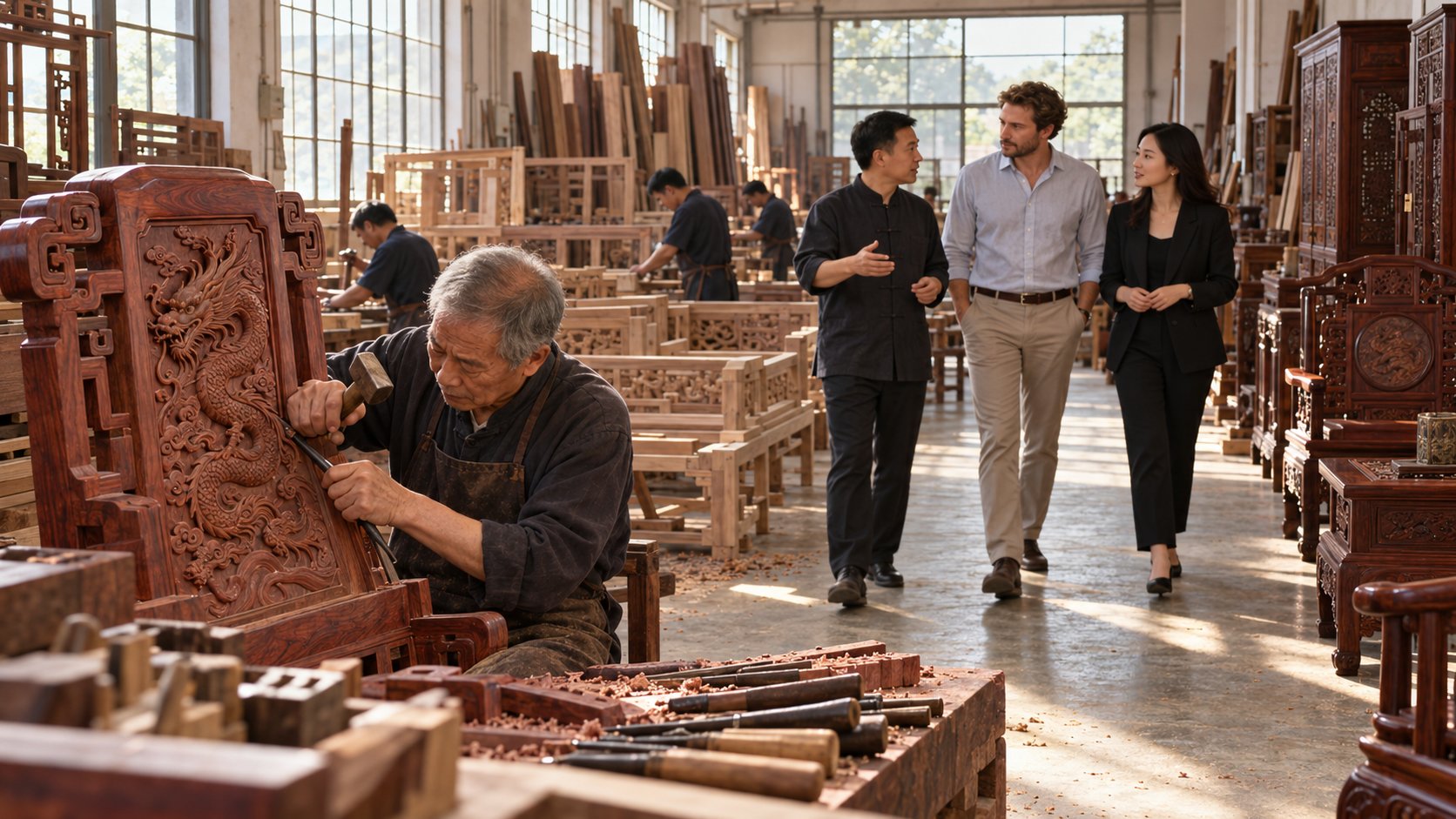
Yes — Yunxiao welcomes B2B factory visits before you order. This guide walks through the full factory tour route in Xianyou, Fujian, the showroom, the sample room, what to bring and ask, and how an on-site visit strengthens supplier verification for rosewood furniture sourcing.
Every week, our export team answers the same practical question from wholesalers, hotel procurement managers, interior designers and furniture distributors across Europe, North America, Australia and Southeast Asia: can we visit your rosewood furniture factory before we place an order? It is one of the most reasonable questions in B2B furniture sourcing China, and it deserves a direct answer instead of a sales brochure. Classical solid rosewood furniture is a high-value, craft-intensive product. A container of carved sofa sets, dining suites or bedroom collections can represent a significant capital commitment, and buyers rightly want to verify who will build it, how the timber is selected, what the carving actually looks like in person, and whether the finishing and packing will survive an ocean shipment.
This article answers that question from the perspective of the factory itself. Yunxiao Rosewood Furniture Co., Ltd has manufactured and exported full sets of classical solid redwood furniture since 2008, supplying global wholesalers, hotels and designers from a 12,000-square-metre factory in Xianyou County, Putian City, Fujian Province — a region widely known as the hometown of traditional hardwood craft in China. In the sections below, we walk through what a real B2B factory tour involves: how to get here, how to schedule a Chinese furniture manufacturer visit, what you will see at each stage of production, how our showroom and sample room fit into the visit, and how an on-site tour strengthens the supplier audit work every serious importer should be doing anyway.
Whether you are a first-time importer testing a new rosewood furniture supplier or an established distributor comparing several factories before consolidating your supply base, the goal of this guide is simple: to show you exactly what happens during a factory tour here, so you can decide whether visiting is worth the flight — and how to get the most out of it if you come.
Why B2B Buyers Ask to Visit a Rosewood Furniture Factory Before Ordering
Furniture is not electronics. Two chairs with identical dimensions and nearly identical photographs can be separated by a wide gap in timber grade, joinery quality, carving depth and finishing durability. In classical Chinese furniture this gap is even wider than in mass-market categories, because the value of the product is concentrated in things a camera does not capture well: the density and color consistency of the heartwood, the precision of the mortise-and-tenon joints, the depth of hand-carved relief, and the number of cured lacquer coats rubbed into the surface.
Importers who have been in this trade for years tend to develop a healthy skepticism toward catalog photos and factory videos. They know that a polished video can be filmed anywhere, that a trading company can present a borrowed workshop, and that the sample on the showroom floor may not represent the actual output that ships six months later. That is precisely why the request to visit a rosewood furniture factory in person remains the single most trusted verification step in B2B furniture sourcing from China. A factory tour compresses weeks of remote due diligence into one or two days of direct observation: you can touch the timber, watch a carver work, inspect joints from an arm's length away, and judge the atmosphere of a working production floor — whether it is disciplined and busy or chaotic and idle.
There is also a relationship dimension that remote communication cannot replace. Chinese furniture manufacturing is a craft business, and much of the knowledge that matters — which patterns carve cleanly, which batches of timber suit which projects, how to sequence a mixed container so that carved pieces and plain pieces dry and finish together — lives in conversations, not in documents. Buyers who visit in person build the kind of direct working relationship with the production team that makes custom projects smoother, negotiations faster and problem-solving far more practical when something unexpected happens mid-order.
Finally, the question itself has become more common for a structural reason: classical rosewood furniture has been gaining ground in Western hospitality and high-end residential projects over the last few years. More first-time buyers are entering the category, and they are arriving with the same instinct that experienced importers already hold — that before you wire a deposit for a container of hand-carved solid wood furniture, you should stand in the workshop where it will be made.
The Short Answer: Yes — Yunxiao Welcomes Factory Tours Before You Commit
Yes. Yunxiao Rosewood Furniture genuinely welcomes B2B visitors, and we say so plainly because a factory that hides its production floor is a factory you should be cautious about. We are the manufacturer: the workshop, the carving benches, the drying operation and the packing line you would visit are the same ones that would produce your order. There is no separate "show factory" and "real factory." What you see on a tour here is the operation you would be buying from.
We recommend visits at two moments in particular. The first is before a first container order, when the visit functions as the decisive stage of supplier selection: you verify the craft with your own eyes, meet the export team who will handle your documents, and leave with the confidence — or the doubts — that no amount of email exchange can produce. The second is before a large custom project, such as a full set of carved reception furniture for a hotel lobby or a whole-house program of matching sofa, dining and bedroom sets, where seeing the sample room and discussing timber selection face to face materially reduces the risk of misunderstanding a custom specification.
It is worth being honest about what a factory tour can and cannot settle. A visit verifies craft capability, working conditions, material quality and the professionalism of the team. It does not, by itself, verify every document — certificates, chain-of-custody paperwork and export permits still need to be checked in writing, ideally before and after the visit. The strongest verification combines an on-site rosewood furniture factory visit with document review and a proper pre-shipment inspection. We encourage buyers to do all three, and we will point you to the related guides on our News page at the end of this article.
Where the Factory Is: Getting to Xianyou County, Putian, Fujian
Our 12,000-square-metre factory is located in Xianyou County, Putian City, in Fujian Province, on the southeast coast of China. For anyone familiar with the geography of Chinese furniture manufacturing, the location is not incidental. Xianyou and the surrounding Putian region have been centers of classical hardwood furniture production for generations; the area concentrates deep benches of specialized craft knowledge — carvers, joiners, finishing masters and timber traders — that simply does not exist at scale elsewhere. Sourcing in Fujian means your furniture is made inside a living craft ecosystem, where specialized skills have been passed down through families and workshops for decades.
Getting here is straightforward by Chinese domestic standards. Most international buyers fly into Xiamen Gaoqi International Airport or Fuzhou Changle International Airport, both of which have direct international connections and frequent domestic flights. From either airport, the factory is reachable in roughly two to three hours by high-speed rail and car; Xiamen is the more common gateway for buyers combining the visit with sourcing trips through southern Fujian. If you are already in China for the Canton Fair in Guangzhou or one of the major furniture fairs in Shanghai, a side trip to Putian is typically a two-to-three-day commitment including travel, which is why many buyers plan their Chinese furniture manufacturer visit in the days immediately before or after a major trade show. Our team regularly helps visiting buyers plan realistic itineraries, and if your schedule is tight we will tell you candidly whether a one-day visit is enough for your purposes or whether two days would serve you better.
A practical note on timing: the most informative visits happen while production is running at full pace, which means ordinary weekdays are better than holidays. Chinese national holidays — particularly the Spring Festival period in late January or February and the National Day week in early October — shut down or slow most manufacturing, and a visit during those weeks would show you a quiet workshop rather than a working one. If your travel dates are flexible, avoid the holiday weeks; if they are not, we will arrange what can realistically be seen and supplement it with a showroom session and a sample review.
How to Plan a Chinese Furniture Manufacturer Visit: Timing, Scheduling and Preparation
A useful factory tour is planned, not improvised. Buyers who get the most value from a visit to our rosewood furniture factory generally follow the same sequence, which we share here so you can copy it.
Step one: start the conversation two to four weeks ahead. Contact our export team through the inquiry form on this website with your intended travel window, your product interests (sofa sets, dining sets, bedroom suites, tea tables, display cabinets), and whether you are evaluating us for a first order, a custom project or a long-term supply program. This lets us make sure the right people are available — the production manager for technical questions, the export team for commercial ones — and that a sample room session is reserved for you.
Step two: send your questions in advance. This single habit separates productive visits from wasted ones. If you send us your list of concerns — timber species and documentation, drying process, joinery standards, finishing compliance, packing methods, production lead times, OEM and ODM capability — before you arrive, we can prepare the relevant materials and make sure you see the specific workstations that answer your questions. A tour that only follows a generic route tells you less than one built around your actual decision.
Step three: bring your project data. Floor plans, target room dimensions, hotel brand standards, the style references your own customers respond to, photos of pieces you already sell — all of it helps. Many of the most valuable conversations happen in the showroom when a buyer points at a full-size set and says "this, but 15 centimeters wider, and in the darker timber." Those conversations turn a factory visit into working design time.
Step four: plan the visa and logistics early. Depending on your nationality, China's visa and entry policies change from year to year, and some nationalities currently benefit from visa-free transit or entry arrangements for short business stays; check the current rules for your passport well before booking. Where a formal business visa is needed, ask our export team about the supporting invitation documentation we can prepare as part of scheduling your visit — confirm the exact paperwork with us when you set the date, because requirements differ by country and consular district. Book refundable flights and hotels in Xiamen, Fuzhou or Putian; both the number of high-speed rail connections and the driving time from each city are easy to confirm with our team when you schedule.
Step five: allow at least one full working day on site. A rushed two-hour stopover lets you see a workshop; a full day lets you see a factory. In our experience a productive single-day visit covers the production route in the morning, the showroom and sample room after lunch, and a working session with the export team before you leave. Buyers evaluating multiple suppliers sometimes compress this; we would rather you came for a proper day than drew conclusions from a glance.
Inside the Tour Route: From Timber Yard to Export Packing
So what do you actually see when you walk through the factory? The route below follows the same sequence your furniture will follow in production. We deliberately show visitors the whole chain, because quality in classical furniture is cumulative — a problem introduced at the timber stage does not disappear by the finishing stage.
Timber selection and storage. The visit usually begins where production itself begins: the timber. We work in legally certified Machilus nanmu, aged red wood and Grade-A tropical hardwood, with Siamese rosewood (Dalbergia cochinchinensis) as the signature material for our classical ranges. Visitors see boards graded by density and grain orientation — in practice, timber for structural components is sorted to a density range of roughly 0.90 to 1.00 g/cm³, and boards whose grain runs more than about four degrees off the length axis are diverted to shorter components where that deviation does not compromise strength. This is also where documentation questions belong: FSC chain-of-custody certification and, for rosewood species governed by international convention, CITES Appendix II export permits are part of every shipment we prepare, and the export team can walk you through how the paperwork attaches to each order. Ask to see timber stock and compare boards side by side; the difference between properly selected heartwood and mixed material is visible to the naked eye once someone shows you what to look for.
Drying and conditioning. From timber selection the route moves to drying — the stage most often skipped in cheap production and the one that most determines whether furniture survives an overseas climate. Every component in our production passes through a 36-day constant-humidity drying process, and timber is conditioned to a moisture content of roughly 8 to 12 percent with an equalization period before use. When you stand in the drying area and hear those numbers, you are hearing the main reason a Ming-style dining table will not develop seasonal cracks in a heated North American dining room or an air-conditioned hotel lobby in the Gulf. Buyers who have experienced warping or cracking from other suppliers immediately understand why we spend so much time on this stage.
The carving workshop. For most visitors this is the emotional center of the tour. Classical Chinese furniture is defined by its carved surfaces — dragon and cloud aprons, ruyi-sceptre armrests, phoenix-and-peony backrest panels, bamboo motifs, lattice doors — and every one of those surfaces in our production is carved by hand. Master artisans chisel each motif into solid rosewood using traditional tools and generations-old regional techniques. On a typical tour you will watch a carver working a backrest panel and be able to ask him directly how long a panel takes; the honest answers vary by motif complexity, but as reference points, a carved ruyi armrest panel represents roughly 18 hours of carving work, a bamboo-motif chair backrest around 16 hours, and a deep phoenix-and-peony reception-panel set around 35 hours per panel. Nothing communicates the difference between hand carving and machine carving faster than watching it happen. If you want to go deeper on this topic before visiting, our article on how Yunxiao crafts classical rosewood furniture from timber to finished piece walks through the production process stage by stage.
Joinery and assembly. The next station answers the question that defines classical furniture engineering: how the piece holds together. Our furniture is assembled with traditional mortise-and-tenon joinery reinforced with wooden and bamboo dowels — the primary frame contains no metal fasteners. Visitors routinely ask why, in an age of screws and brackets, we still build this way, and the answer is practical rather than romantic. Metal and wood move at different rates with temperature and humidity; over years of seasonal change in an overseas climate, metal fasteners work loose and split the surrounding wood, while a well-cut mortise-and-tenon joint flexes with the material it is made from. On the assembly floor you can examine joints on pieces at every stage — including partially assembled frames where the joinery is fully exposed, which is something no finished showroom photograph can show you.
Finishing. From assembly the route moves to finishing, where surfaces receive their final character and their compliance credentials. Our finishing combines traditional beeswax and lacquer techniques with eco-friendly coating formulations that meet EU REACH and US CARB standards. Depending on the product, finishing runs to six or eight hand-rubbed coats of raw lacquer, each coat cured before the next — a process measured in days, not hours, and one of the main reasons our production lead times are what they are. Buyers exporting to Europe or North America should use this station to ask the specific compliance questions that matter to their market: what the coating formulation standards are, how documentation is provided per shipment, and what the finish will look like after three years of hotel housekeeping. The honest answer to the last question is that the deep satin sheen of hand-rubbed lacquer ages by developing patina rather than by peeling — but you should also ask to see finished pieces that have been in use, and we keep them around specifically so visitors can judge for themselves.
Quality control and export packing. The tour ends where your risk does: QC and packing. Pieces pass in-house checks before they are cleared for packing — as one example of the kind of procedure behind that statement, dining chairs in our dining-set production are individually load-tested with a 100-kilogram static weight for 24 hours as part of internal QC. Then come the crates: export packing uses ISPM 15 heat-treated wood, custom crating with moisture barriers and bracing protocols designed specifically for relief-carved furniture, because a carved apron or a projected cornice that ships loose in a general-purpose crate will arrive damaged no matter how well it was made. If you have read our guide on planning container loading for carved sets, the packing line is where you will see those principles physically applied. Visitors are welcome to inspect the crating for an order in progress — it is the last thing that protects your investment for five weeks at sea.
The Yunxiao Showroom: Judging Full Sets at Real Scale
Production discipline explains whether a factory can build furniture; the showroom shows you what that capability looks like when it is finished. Our showroom displays complete classical sets at full scale, arranged the way they would live in a real interior rather than lined up warehouse-style, and for most buyers this is where the buying decision actually forms.
The reason scale matters is simple: photographs compress furniture. A nine-piece grand living room set in a photo looks like an arrangement of similar objects; standing in front of it, you perceive the actual footprint, the sight lines of the carved backrests, how the arm heights relate to the seat, and whether the proportions of the coffee table feel right against the sofa. This is why we encourage buyers to bring their floor plans. A hotel procurement manager can pace out a lobby arrangement against the displayed sets; a distributor can compare the compact footprint of a three-piece urban sofa set against the commanding presence of a ten-seat imperial dragon carved sofa and see immediately which one fits which customer profile in their market.
The showroom also lets you compare across our ranges efficiently. In one visit you can move from a Ming-style round redwood dining table for eight, to a rectangular 12-seat banqueting set with carved chairs, to a classical four-poster bedroom suite, to a Qing-dynasty-style carved sofa set — and feel the stylistic distance between Ming restraint and Qing ornament in person rather than inferring it from product pages. Distributors building a catalog use this hour to shortlist the series they want quotations for; hotel project buyers use it to identify which sets can anchor a lobby, a suite and a restaurant with a coherent design language. Interior proportions, timber color under real light, carving depth under a raking hand — these judgments take minutes in a showroom and are effectively impossible through a screen.
One practical suggestion: photograph everything you are seriously considering, and note the exact product names, so that your follow-up quotation request references real pieces rather than approximations. Our export team will match your notes to current models and prepare pricing, timber options and customization quotes against specific items — which makes the entire post-visit quotation cycle faster and more precise.
The Sample Room: Where Custom Ideas Become Reviewable Prototypes
For buyers with customization requirements — OEM sizing, ODM pattern development, hotel project programs — the third stop is the one that most differentiates a real manufacturer from an assembly shop: the sample room. This is where reference samples, in-progress prototypes and material boards live, and where a custom conversation stops being abstract.
Here is how sampling typically works for a custom order. You arrive with a requirement — say, a hotel reception program that needs the proportions of our phoenix-carved six-piece reception set but resized for a specific lobby, or a dining chair in a hybrid of two existing carved motifs. In the sample room, the discussion moves from words to objects: you handle the actual timber samples, compare lacquer sheens side by side, look at carving samples at the intended depth, and review past prototype pieces that show how similar custom requests were resolved. Our design and production team can then translate the decisions made in that room into drawings and a sampling plan. For projects, we prepare free layout drawings; for products, the sample process ends with a physical sample or prototype that you review before mass production begins. Samples are refundable against the production order, which is worth confirming in writing during your visit — it is standard practice for us precisely because we want serious buyers to verify before they commit.
The sample room is also where the honest limits of customization get discussed, and this matters. Not every carving pattern scales to every piece; some motifs lose clarity at small panel sizes, and some structural changes to a set affect the joinery in ways that need the production team's judgment, not just a designer's. A buyer who has stood in the sample room and had those conversations leaves with a custom specification that is actually buildable — which protects both sides from the classic failure mode of custom furniture: a beautiful rendering that production discovers is impractical only after the deposit is paid.
Buyers who cannot visit in person can still run a version of this process remotely — our guide on how a rosewood furniture factory develops samples and prototypes for custom B2B orders describes the remote sampling workflow in detail. But there is no substitute for making these decisions with the timber in your hands, and buyers who visit consistently tell us the sample room session changed at least one decision in their custom specification for the better.
What to Bring and What to Ask During Your Factory Tour
A factory tour rewards preparation. Based on hundreds of visits, here is the short version of what experienced buyers bring and what they ask.
Bring: your floor plans or room dimensions; your target market's compliance requirements in writing (for the EU: REACH and timber regulation documentation expectations; for the US: CARB and Lacey Act documentation expectations); photos or links of products you currently sell; your budget range per set or per container; and a written list of the questions that will actually decide the order. Bring a phone with plenty of storage — you will take more photos than you expect, and our team will point out which shots are welcome.
Ask about timber and materials: Which species and grades go into the sets I am considering? How is density and grain sorted? What is the moisture content at assembly? Which components are solid wood throughout, and where are floating panels used to handle seasonal wood movement? A confident manufacturer answers these precisely because the answers are built into its process; our own numbers — density sorting around 0.90 to 1.00 g/cm³ for structural timber, 8 to 12 percent moisture content, 36-day constant-humidity drying — are the same whether you read them here or hear them on the production floor.
Ask about craft and process: How long does this carving pattern take per panel? Who carves — employees or outsourced workshops? How are the lacquer coats cured? What in-house QC procedures run before packing? You do not need to be a furniture engineer to judge the answers; consistency and specificity are the tells. Vague answers about the stages you care most about are the clearest signal in supplier evaluation, on-site or remote.
Ask about documentation and export: FSC chain-of-custody per shipment; CITES export permits for the species in your order; ISPM 15 packing; full export documentation handled by the internal team; and how compliance certificates are provided with each order. For buyers in Europe and North America, also ask how the finishing coatings meet EU REACH and US CARB and what documentation supports that.
Ask about commercial terms: production lead times — container orders run 45 to 60 working days after deposit; whether trial single sets are available before a full container; the sample refund policy; partial shipment arrangements for long-term partners; and the OEM/ODM process, minimums and timelines for the kind of customization you have in mind.
Finally, ask the people questions. Who exactly will manage my account? Who handles my documents? Who do I call when something goes wrong mid-order? A factory tour is the only chance to meet those people in person before you depend on them.
How an On-Site Visit Fits Your Supplier Audit Checklist
Many buyers arrive having already read our article on how to audit a rosewood furniture factory before a first container order — and the question naturally follows: if I can audit remotely, is an on-site visit redundant? Our honest view is that they do different jobs, and the strongest verification uses both.
A structured remote audit verifies systems: business licenses, certificates, production capacity claims, reference checks, document trails. It is efficient and it covers ground that a two-day visit cannot — no visitor inspects every certificate original or calls every reference customer in person. But a remote audit is only as good as the documents and videos a supplier chooses to show. An on-site visit verifies reality: that the workshop is what it claims to be, at the claimed scale, with the claimed craft happening in front of you. The two failure modes they catch are different. Documents can be misleading about reality; a visit can be misleading about systems. Together, they are difficult to fool.
Practically, we suggest this sequence for a serious first engagement with any Chinese furniture manufacturer: run the document-level audit first, including business registration and certificate verification, because it is cheap and it eliminates unsuitable candidates before you spend travel money. Then visit the one or two finalists on your shortlist, structured around the checklist you developed in the audit stage. Then place a trial order — a single set or a mixed small container — with a pre-shipment inspection. Buyers who follow that sequence almost never experience the catastrophic version of supplier failure, and the ones who skip steps are usually the ones who later write the cautionary posts in importer forums.
The audit-article checklist maps directly onto our tour route: timber verification happens at the timber yard, drying claims are checked in the drying area, craft claims at the carving benches, QC claims at the inspection station, packing claims at the crates. If you bring the checklist, we will walk it station by station — that is the most useful way to spend a visit, from our side as well as yours.
Cannot Travel Right Now? Reliable Alternatives to an On-Site Visit
Not every buyer can cross the Pacific or Eurasia for every supplier decision, and we would rather help you verify remotely than see you skip verification entirely. There are three workable alternatives, in descending order of strength.
A live virtual factory tour. A scheduled video call where we walk you through the workshop in real time, on request focusing on the stations that matter for your order — timber, drying, carving, joinery, finishing, packing — is a reasonable middle ground. Our guide on conducting a virtual factory audit of a rosewood furniture factory covers how to structure one so it actually verifies rather than merely presents: ask for unedited walkthroughs, request specific shots on the spot, and check timestamps and backgrounds. The key is that you direct the camera.
Third-party inspection. Independent inspection companies operate throughout Fujian's furniture belt and will attend a factory on your behalf, verify an order against your specification, and report with photos. A third-party pre-shipment inspection is something we expect and accommodate as routine for any buyer who requests it; for buyers we have not yet worked with, combining a virtual tour before ordering with an independent inspection before shipment covers both ends of the risk window.
The trial order itself. Ultimately, a trial single set or a mixed small container, produced and shipped and inspected, is the most decisive verification available to a buyer who cannot travel: it tests documentation, production, packing, freight and after-sales in one low-stakes transaction. This is why we keep trial single sets available for new partners — a buyer should be able to test the relationship with modest capital before committing container-scale budgets.
None of these fully replaces standing in the workshop, and we say that as the party asking for your trust. But the combination of a live virtual tour, verified documentation, a refundable sample and a trial order gets a careful buyer most of the way, at a fraction of the cost of travel. For many of our long-term partners, that combination was exactly how the relationship began before the first visit happened.
From Factory Tour to First Container: Quotations, Samples and Lead Times
A good visit ends with a concrete plan, not a stack of business cards. Here is what typically follows a tour at our rosewood furniture factory, so you can plan your timeline backwards from your project dates.
Within a few days of your visit, our export team consolidates the showroom notes and sample room decisions into formal quotations: item-by-item pricing against the exact products and configurations you shortlisted, timber options, customization costs if any, and packing details. If sampling is part of your program, the sampling plan starts immediately — sample production timelines vary by piece and by season, and the team will quote the realistic schedule in writing. Samples are refundable against your production order, as described above.
Once an order is confirmed and the deposit received, production of container orders runs 45 to 60 working days, with the drying, carving and finishing sequences described in this article all inside that window. For long-term partners, partial shipments are available — a useful arrangement for hotel projects with phased installation schedules or for distributors managing inventory across seasons. The internal export team prepares the full document set with each shipment: commercial documents, FSC chain-of-custody, CITES export permits where the species requires them, and ISPM 15-compliant packing declarations. Buyers rarely think about documents until their broker asks for them; on our side, they are part of the order from day one, which is one of the practical advantages of buying from a manufacturer that handles its own exports rather than a workshop that sells through intermediaries.
If your visit was prompted by a project deadline — a hotel opening, a showroom launch — tell us the date at the start. Production scheduling for projects with fixed installation dates gets priority treatment in planning, and the honest conversation about whether a date is achievable happens on day one, not in week nine.
Frequently Asked Questions About Visiting Yunxiao
Is there any cost or obligation involved in a factory visit?
No. A factory tour, showroom session and sample room review are part of how we do business with serious B2B buyers, at no charge and with no obligation. The travel costs are yours; the verification is ours to provide.
How much time should I plan for the visit?
One full working day covers the production route, showroom and sample room comfortably, with a working session before or after lunch. If you are evaluating custom or OEM/ODM work with detailed specifications, plan a second day or a follow-up video session — specification conversations go better when they are not squeezed into the last hour of a travel day.
Can I visit during the Canton Fair or a furniture fair week?
Yes, and many buyers do exactly that — a Putian visit pairs naturally with the major fairs. Reach out as early as possible during fair season, because those weeks book up; the earlier your dates are fixed, the better we can plan the right people around your visit.
What if I need an invitation letter for my business visa?
Check the current entry rules for your nationality first, since China's visa-free and transit arrangements have expanded for many countries. Where a business visa with invitation documentation is required, ask our export team when scheduling and we will confirm what we can prepare for your consular district — requirements vary by country, so we handle these case by case.
Can I see orders for other customers in production?
You will see the production floor and processes, including work in progress; specific customer orders are handled with the discretion every supplier owes every buyer. The craft, the materials, the QC procedures and the packing standards are the same across orders, which is precisely why observing them on any order in progress tells you what your own order will receive.
Do I need an interpreter?
Our export team works with international buyers in English daily, and an English-speaking team member accompanies factory visits. If your team is more comfortable in another language, let us know in advance and we will plan accordingly.
Can I bring my own inspector or agent to the factory?
Yes. Buyers frequently combine their visit with a third-party inspector or their sourcing agent, and we are used to working with both. If your inspector has a standard checklist, send it ahead so the relevant stations and records are ready.
What happens after the visit if I decide to proceed?
You will receive consolidated quotations against the specific products you shortlisted, followed by sampling if applicable, and then order confirmation with a written production schedule. Container orders run 45 to 60 working days after deposit, with document sets prepared per shipment as standard.
Plan Your Rosewood Furniture Factory Tour
So — can you visit a rosewood furniture factory before ordering? At Yunxiao, the answer is yes, and the invitation stands. You will walk the same route described in this article: timber yard to drying, carving benches to joinery, finishing to the packing line, then the showroom and sample room where your own project takes shape in full-size sets and real material samples. Whether you come before a first container, before a hotel program or as the start of a distributor relationship, you will leave with what every importer ultimately needs and no catalog can supply: first-hand knowledge of exactly who is building your furniture, how, and to what standard.
To schedule a visit, send us your travel window, your product interests and any specification questions through the inquiry form on this website or the contact page. Our export team will reply with a proposed itinerary, the people you should meet, and the documents worth reviewing before you fly. And if travel is not in this quarter's budget, start with a virtual factory tour and a refundable sample — the verification process can begin this week.
Related reading for buyers planning their sourcing: our guides to auditing a rosewood furniture factory before your first container order, conducting a virtual factory audit, developing samples and prototypes for custom B2B orders, and testing a rosewood furniture supplier before a full container order — all on our News page, alongside our product guides to the Ming-style dining sets, carved sofa collections, canopy bedroom suites and display cabinets linked throughout this article.