
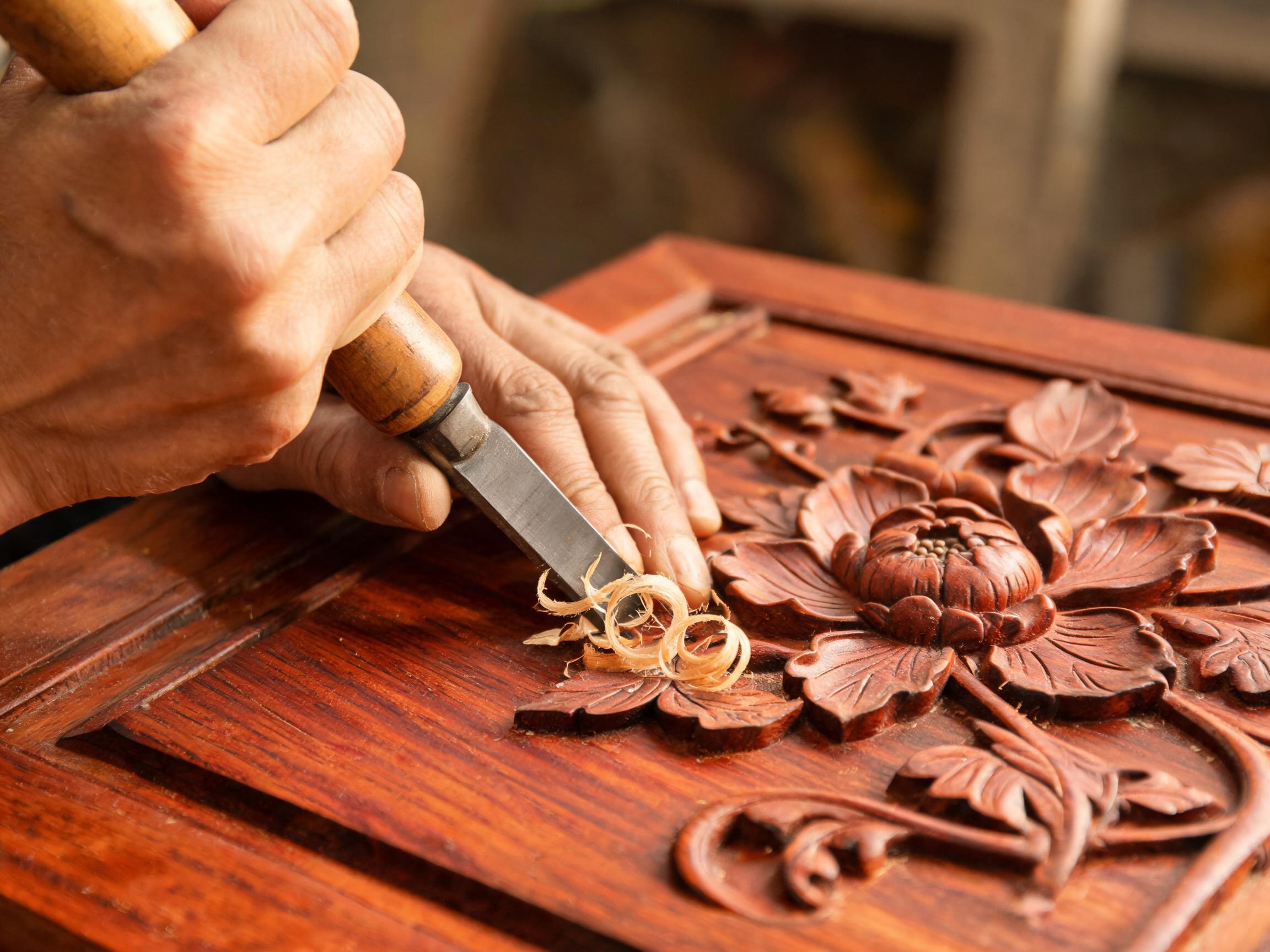
A practical guide for international buyers on how to distinguish authentic hand-carved redwood furniture from machine-carved imitations, covering tool mark analysis, wood grain patterns, depth variation, carving transitions, and supplier verification methods.
Why Does the Difference Between Hand-Carved and Machine-Carved Redwood Furniture Matter for Buyers?
When sourcing hand-carved redwood furniture from China, international buyers face a critical challenge: distinguishing genuine hand-carved pieces from machine-carved furniture imitations. The price gap between the two can be 40 to 60 percent, yet the visual difference is often subtle to the untrained eye. For European wholesalers, North American retailers, and hospitality project buyers, paying hand-carved prices for machine-carved products erodes margins and damages reputation when end customers discover the difference.
The distinction goes beyond aesthetics. Hand-carved redwood furniture carries cultural and artistic value that machine production cannot replicate. Each hand-carved panel has subtle variations in depth, tool marks, and texture that reflect the individual artisan's skill and style. Machine-carved panels, by contrast, have a uniform, mechanical precision that lacks the organic quality of traditional carving craftsmanship. Understanding how to tell them apart is an essential skill for any buyer investing in classical Chinese furniture.
What Tools and Techniques Distinguish Hand Carving from Machine Carving?
Traditional carving craftsmanship in the Xianyou production cluster uses a specific set of hand tools that leave identifiable marks on the finished piece. Carvers use flat chisels for background removal, gouges of varying sweeps for curved surfaces, V-parting tools for line work, and small knives for fine detailing. Each tool leaves a characteristic mark that differs fundamentally from the marks left by CNC router bits.
Hand chisels cut wood fibers by shearing, creating a slightly textured surface with microscopic ridges along the cut line. When viewed under raking light, hand-carved surfaces show a subtle pattern of tool strokes that follow the carver's hand movements. The depth of cut varies slightly from stroke to stroke, creating natural variations that give the carving a living, organic quality.
CNC routers, by contrast, use spinning bits that mill away material. The resulting surface has a uniform, slightly burnished texture with circular or linear tool paths that are consistent in depth and spacing. Under raking light, machine-carved surfaces show parallel lines or concentric arcs that follow the tool path, not the carver's hand. The transitions between different carved areas tend to be sharper and more geometric in machine work, while hand-carved transitions are softer and more gradual.
How Can You Use Wood Grain Pattern to Identify Authentic Hand Carving?
The wood grain pattern provides one of the most reliable clues for furniture authentication. Hand carvers work with the grain, adjusting their tool angle and direction based on how the wood fibers run. This means that in a hand-carved panel, the carved details follow and respect the natural grain direction of the wood. A skilled carver will rotate the panel as they work, approaching each section from the optimal angle relative to the grain.
In machine-carved furniture, the CNC program follows a fixed tool path regardless of grain direction. This results in carved details that sometimes cut across the grain at unfavorable angles, creating small tear-outs, fuzzy edges, or rough patches where the bit tore fibers instead of slicing them cleanly. These defects are often filled and sanded away during finishing, but close inspection under magnification reveals the underlying problem.
To test this, examine the carved recesses with a 10x loupe or jeweler's magnifier. In hand-carved work, the bottom of the carved areas shows clean, smooth cuts that follow the grain. In machine-carved work, you may see tiny rough spots, cross-grain tear-outs, or a uniform milling texture at the bottom of the recesses that does not correspond to the natural grain direction.
What Role Does Depth Variation Play in Furniture Authentication?
Depth variation is another key indicator that separates hand-carved redwood furniture from machine-carved furniture. A hand carver adjusts the depth of each cut based on the design, the wood density, and the desired visual effect. This creates natural variations in depth across the panel. A peony petal may be 8 millimeters deep at one end and 5 millimeters at the other, creating a sense of movement and dimensionality that draws the eye.
CNC machines, by contrast, cut to a programmed depth with consistent precision. Every instance of the same design element has the same depth, the same profile, and the same contour. While this consistency is a manufacturing virtue, it is an artistic limitation. A machine-carved panel with 20 peony petals will have 20 identical petals, each with the same depth and shape. A hand-carved panel will have 20 petals that are similar but individually varied, each with subtle differences that reflect the carver's real-time artistic decisions.
Run your fingertips lightly over the carved surface. Hand-carved work has a tactile quality with slight depth variations that your fingers can detect. Machine-carved work feels more uniform and predictable, with repetitive elements that feel identical to the touch. This tactile test is especially effective for furniture authentication because even the best finishing cannot fully mask the underlying difference between hand-cut and machine-milled surfaces.
How Do Carving Transitions and Edge Quality Reveal the Method?
The transitions between carved and uncarved areas are where carving craftsmanship is most clearly revealed. A hand carver creates transitions using a technique called stepping down, where the carved area gradually reduces in depth toward the uncarved surface. This creates a smooth, natural transition that blends the carved design into the flat background. The edge of the carved area has a slightly rounded, organic quality because the carver uses a gouge or chisel to blend the transition by hand.
Machine-carved transitions tend to be sharper and more defined. The CNC bit creates a distinct shoulder where the carved area meets the uncarved surface, often with a slight vertical wall or a consistent radius that follows the bit geometry. This creates a cleaner but more mechanical look that lacks the soft, hand-blended quality of traditional carving.
Examine the edges of carved motifs under raking light from multiple angles. Hand-carved edges show slight irregularities, varying widths of the transition zone, and occasional tool marks that the carver left as part of the artistic process. Machine-carved edges are uniform in width, consistent in profile, and free of tool marks because the sanding and finishing process removes all traces of the cutting tool.
What Quality Indicators Should Buyers Check on the Back and Hidden Surfaces?
One of the most effective furniture authentication techniques is to inspect the back and hidden surfaces of carved panels. The front of a machine-carved panel is carefully finished and sanded to disguise the manufacturing method, but the back is often left in a rawer state that reveals the truth.
On hand-carved hand-carved redwood furniture, the back of a carved panel shows the chisel marks where the carver removed background material. These marks are irregular, varying in direction and depth, and may include small stepping marks where the carver worked from different angles. The surface is slightly rough and has the characteristic texture of hand-tool work.
On machine-carved panels, the back may show the vacuum hold-down marks, reference pin holes, or the smooth, milled surface left by the CNC spoilboard. You may also see the characteristic cross-hatch pattern of a fly cutter or the parallel lines of a planer that the factory used to prepare the blank before CNC carving. These are telltale signs of machine production that are absent from genuinely hand-carved work.
How Does the Repeating Pattern Reveal Machine Production?
When a furniture set includes multiple carved panels with the same design, the repeating pattern provides clear evidence of the production method. Hand-carved panels, even when following the same design template, will have subtle differences in each panel. The carver may position the template slightly differently, apply different pressure on certain cuts, or make small adjustments based on the wood's characteristics. These variations are visible when you place two supposedly identical panels side by side.
Machine-carved panels produced from the same CNC program are pixel-perfect identical. Every curve, every depth change, every contour matches precisely. While this seems like a quality advantage, it is actually the strongest evidence of machine production. No human carver, no matter how skilled, can produce two panels that are perfectly identical down to the millimeter. If you are examining a 6-chair dining set and every chair back has a carved panel that is exactly identical, you are looking at machine-carved furniture.
To test this, photograph two carved panels from the same set using the same camera angle and distance. Overlay the two images in any photo editing software with 50 percent opacity. If the panels are hand-carved, the overlay will show slight misalignments in the carved details. If they are machine-carved, the overlay will show a near-perfect match.
What Should Buyers Ask Suppliers to Verify Hand Carving?
Beyond visual inspection, buyers should ask suppliers specific questions and request documentation that verifies the carving craftsmanship method. A reputable factory that produces genuine hand-carved redwood furniture will be transparent about their process and willing to provide evidence.
Request carving process photos or videos. Ask the factory to photograph or video the carving workshop with artisans actively working on pieces. Look for hand tools, workbenches, and the characteristic environment of a hand-carving studio. Be cautious of factories that only show finished products without any process documentation.
Ask about the carver team size and training. A factory producing genuine hand-carved furniture will have a team of trained carvers, not just one or two workers. The Xianyou tradition requires years of apprenticeship, and a legitimate factory will be able to describe their carver training program and team structure.
Request a carved sample panel. Order a small carved panel by air freight for hands-on inspection. Use the techniques described above, including raking light examination, loupe inspection of carved recesses, tactile depth testing, and back-surface inspection. A 200 USD sample panel is a small investment compared to a 20,000 USD container order.
How Does Yunxiao Ensure Authentic Hand-Carved Quality?
At Yunxiao Rosewood Furniture, every carved piece is produced by artisans trained in the Xianyou tradition of carving craftsmanship. Our carvers use traditional hand tools including flat chisels, gouges, V-parting tools, and detail knives. While we use precision machinery for initial stock preparation and dimensional cutting, all carving work, from rough background removal to fine detail finishing, is done by hand.
We welcome buyer visits to our carving workshop and can provide process photos and videos on request. Each carved panel is signed by the carver on the back surface, creating a record of the individual artisan's work. We also offer sample carved panels by air freight so buyers can perform their own furniture authentication before placing a container order.
Our commitment to genuine hand carving is part of our broader quality philosophy. We believe that the value of classical redwood furniture lies not just in the material but in the human skill that transforms it. When you purchase hand-carved redwood furniture from Yunxiao, you are investing in a piece of living craft tradition that no machine can replicate. Our 36-day kiln drying, mortise-and-tenon joinery, and eco-friendly finishing complete a production process that delivers furniture worthy of the classical Chinese tradition to buyers across Europe, North America, Australia, and Southeast Asia.