
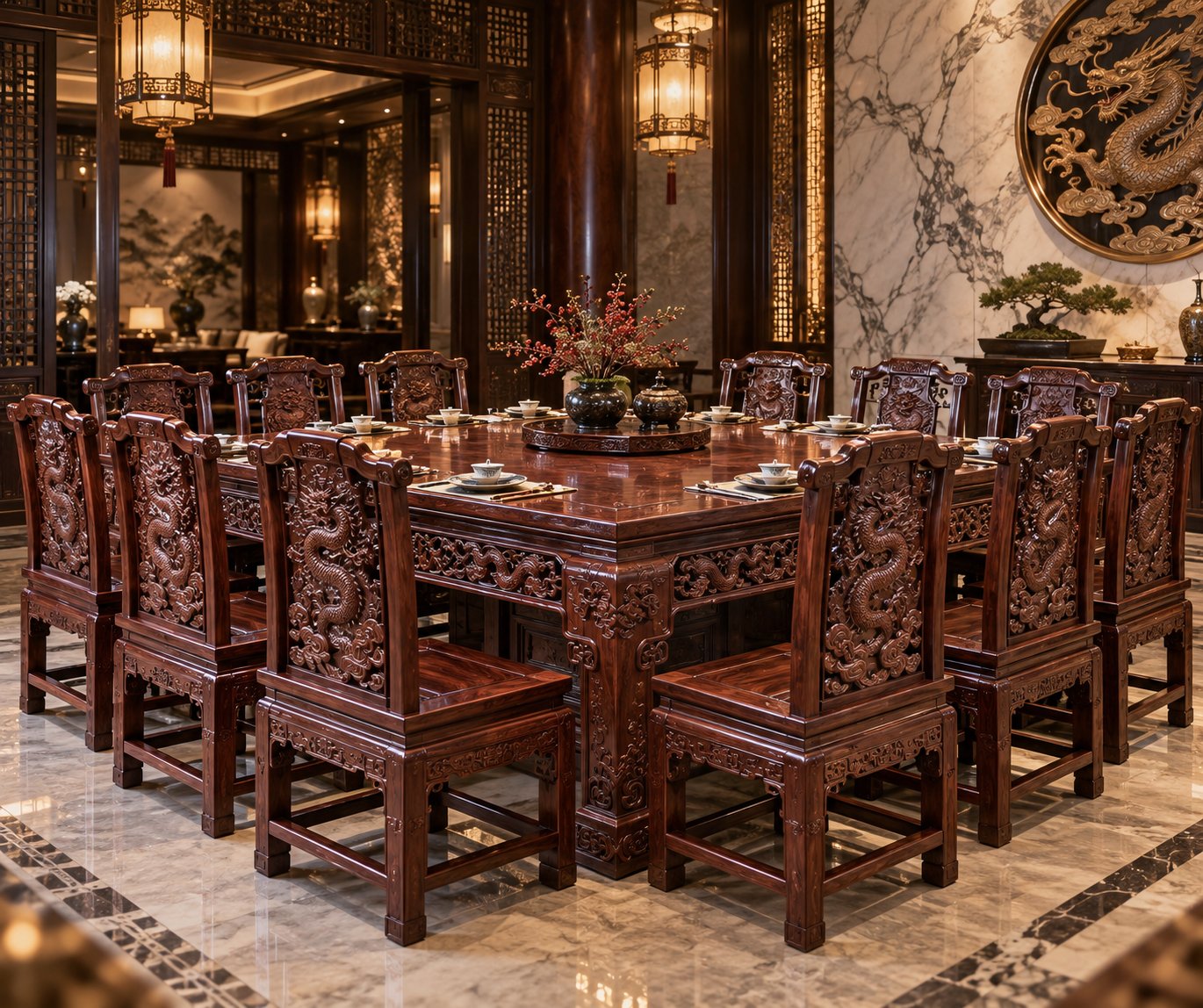
Why Restaurants and Banquet Halls Are Turning to Rosewood Furniture
Restaurant and banquet hall operators face a constant tension: they need furniture that looks prestigious enough to justify premium pricing, yet durable enough to survive years of daily service, heavy traffic, spills, and repeated cleaning. For hospitality buyers across Southeast Asia, Australia, North America, and Europe, classical rosewood furniture has become an increasingly attractive answer. Solid rosewood is one of the densest and hardest commercial hardwoods in the world, which means it resists dents, scratches, and warping far better than softwoods or veneered panels. At the same time, its deep reddish-brown grain and hand-carved detailing give a dining room or banquet hall a sense of permanence and cultural richness that mass-produced furniture cannot match.
This article is written for procurement managers, interior designers, hotel and restaurant owners, and importers who are evaluating rosewood furniture for a restaurant or banquet hall project. We will walk through the real selection criteria that matter in a commercial food-service environment: seating capacity and table geometry, structural integrity under heavy use, food-contact and finish compliance, moisture and climate stability, maintenance and cleaning, customization and OEM/ODM options, documentation and compliance, packaging and shipping, and total cost of ownership. By the end, you will have a practical checklist you can take to any supplier, including the questions you should ask before you place an order.
Understanding the Commercial Environment Before You Choose
A restaurant or banquet hall is not a private home. The furniture in a commercial dining space is used far more intensively, cleaned more aggressively, and expected to last for many years while still looking presentable. Before you compare specific rosewood pieces, it is worth defining the operating conditions your furniture will face, because those conditions determine which specifications actually matter.
Traffic Volume and Seating Rotation
A busy restaurant may turn its tables two, three, or even four times per evening. Each turn means chairs are pulled out, pushed back, and sat on by different guests. A banquet hall hosting weddings and corporate events may seat hundreds of people at once, with staff moving furniture between configurations. This means every joint, every leg, and every chair connection is stressed repeatedly. Furniture built with weak joinery or thin panels will loosen, wobble, and eventually fail within a year or two of commercial use.
Food, Spills, and Cleaning Chemicals
Commercial dining furniture is exposed to food, beverages, sauces, and cleaning agents every day. The finish on the tabletop and chair surfaces must be able to withstand wiping, sanitizing, and occasional spills without staining, blistering, or peeling. This is why food-contact compliance and finish quality are not optional considerations for a restaurant project; they are central to whether the furniture will survive its first year.
Climate and Humidity
Solid wood is a natural material that responds to changes in humidity. A restaurant in a humid tropical city such as Bangkok, Jakarta, or Manila faces very different conditions from a banquet hall in a dry, air-conditioned building in Sydney or Toronto. If the wood has not been properly dried and conditioned, it can crack, warp, or develop gaps when it moves between environments. Understanding how your supplier dries and conditions the timber is therefore essential.
Design and Brand Image
Finally, the furniture must support the identity of the venue. A high-end Chinese restaurant, a luxury hotel banquet hall, a wedding venue, or a heritage-style private dining room each has a different visual language. Rosewood furniture is available in a range of styles, from the clean, restrained lines of Ming dynasty design to the more ornate carving of Qing dynasty pieces. Choosing the right style is as much a branding decision as a practical one.
Why Rosewood: Understanding the Material
Before you can choose the right rosewood furniture, it helps to understand what makes rosewood a premium material for commercial dining spaces. Rosewood is a collective name for several dense, dark-colored hardwoods, and the most prized for classical furniture is Siamese rosewood, known botanically as Dalbergia cochinchinensis. This wood is valued for its rich color, fine grain, and exceptional hardness.
Hardness and Density
Rosewood is one of the hardest woods used in furniture making. On the Janka hardness scale, which measures a wood's resistance to denting and wear, Siamese rosewood scores in the range of roughly 2,430 pounds-force, which places it well above most common furniture woods. This hardness means the surface resists dents from dropped cutlery, scratches from plates, and the general wear of daily commercial use. For a restaurant or banquet hall where furniture is handled constantly, this durability is a decisive advantage.
Stability and Resistance to Movement
Dense hardwoods are generally more dimensionally stable than softwoods, meaning they are less prone to warping and twisting as humidity changes. When combined with proper kiln drying and moisture conditioning, rosewood furniture can maintain its shape and joinery across very different climates. This is why rosewood has been used for centuries in furniture that is expected to last for generations.
Natural Beauty and Aging
Rosewood has a deep, warm reddish-brown color with a distinctive grain that becomes more beautiful with age. Over time, the surface develops a rich patina that adds character and value. For a venue that wants to project permanence and quality, this natural aging is a feature, not a drawback. Unlike painted or veneered furniture that fades or peels, a well-finished rosewood piece looks better the longer it is cared for.
Comparing Rosewood with Other Commercial Materials
It is useful to compare rosewood with the other materials commonly used in commercial dining furniture. Teak is another durable hardwood, but it has a lighter, more golden color and a different grain, and it is often used for outdoor furniture. Oak is strong and widely available, but it lacks the deep color and cultural character of rosewood. Veneered and particle-board furniture is inexpensive but cannot be refinished, does not last, and does not convey the same quality. For a venue that wants a premium, culturally rich, and long-lasting look, solid rosewood is difficult to beat.
Seating Capacity and Table Geometry: Matching the Room
The first practical decision is how many people the room must seat and what table shapes and sizes will achieve that efficiently. Rosewood dining sets are commonly available in configurations from four seats up to twelve seats, and the geometry of the table determines how many guests can be seated comfortably and how the room flows.
Round Tables for Banquet and Wedding Halls
Round tables are the traditional choice for Chinese banquet halls and many wedding venues because they encourage communal dining and maximize seating around a central point. A large round table can seat ten to twelve guests, which is ideal for family-style service. The key specification to check is the table diameter and the pedestal design. A table with a central pedestal rather than four corner legs allows chairs to be placed all the way around without obstruction, which is critical for a twelve-seat configuration.
Square and Rectangular Tables for Flexible Layouts
Square and rectangular tables are easier to arrange in rows or grids, which makes them well suited to restaurants that need to maximize capacity in a defined floor plan. A square twelve-seat table, for example, offers a large central surface that works well for shared dishes, while a rectangular ten-seat table suits a long dining room or a private dining suite. The choice between round, square, and rectangular depends on the shape of the room, the service style, and how many guests you need to seat per table.
Matching Table Size to Chair Count
When you evaluate a dining set, always confirm that the table dimensions genuinely support the stated chair count. A twelve-seat table needs enough edge length and clearance for twelve chairs to be pulled out and occupied comfortably. If the table is too small for the number of chairs, guests will feel cramped and the room will feel crowded. Ask the supplier for the exact table dimensions and the chair seat height so you can verify the fit against your floor plan.
Planning the Floor Plan
Before you order, it is wise to create a floor plan that shows how the tables and chairs will be arranged. Consider the width of the aisles between tables, the clearance needed for chairs to be pulled out, and the flow of staff and guests. A supplier that offers free layout drawings can help you plan the space and avoid costly mistakes. For a banquet hall that hosts events of different sizes, consider whether the tables can be reconfigured to accommodate different group sizes.
Structural Integrity: Why Joinery Matters in Commercial Use
The single most important quality factor in commercial rosewood furniture is how the pieces are joined. In a restaurant or banquet hall, furniture is moved, bumped, and loaded heavily, so weak joints are the most common point of failure.
Mortise-and-Tenon Joinery
Traditional Chinese furniture is assembled using mortise-and-tenon joinery, in which a projecting tenon on one piece fits into a matching mortise, or hole, on another piece. This creates a mechanical lock that is extremely strong and, importantly, does not rely on metal screws or nails that can loosen over time. When a mortise-and-tenon joint is properly fitted and reinforced with wooden dowels, it can actually become stronger than the surrounding wood. For commercial furniture that will be used daily for years, this type of joinery is a major advantage.
Why Metal Fasteners Are a Warning Sign
Furniture assembled primarily with metal screws, nails, or brackets is more likely to loosen under repeated stress. Metal fasteners can also corrode or create stress points that lead to cracking, especially in a humid environment. A reputable rosewood furniture factory assembles its primary frames without metal hardware, relying instead on precision joinery. When you evaluate a supplier, ask specifically whether the main frame uses mortise-and-tenon joinery and wooden dowels, and whether any metal fasteners are used in the primary structure.
Large-Span Tables Need Reinforced Construction
Large dining tables, especially those seating ten or twelve people, span a considerable distance and must support significant weight across that span. A twelve-seat table with a dual-pedestal base distributes the load more evenly than a single central support and eliminates corner-leg obstruction. Through-wedged mortise-and-tenon stretcher joints provide additional structural integrity for large-span tables, preventing the frame from racking or twisting under load. These are the kinds of engineering details that separate commercial-grade furniture from residential pieces.
Testing and Quality Control
A reliable factory subjects its furniture to quality control checks before shipment. This may include inspecting every joint, checking the finish for defects, and testing the stability of tables and chairs. Some factories even test their export crates with drop tests to ensure the furniture arrives undamaged. When you choose a supplier, ask about their quality control process and whether they can provide test reports.
Food-Contact and Finish Compliance
Because restaurant and banquet hall furniture comes into direct contact with food, beverages, and cleaning chemicals, the finish on the surfaces must meet food-contact safety standards. This is a compliance issue as well as a durability issue.
Food-Contact Compliant Lacquer
For dining surfaces, the finish should be food-contact compliant. In the United States, the Food and Drug Administration sets requirements for materials that come into contact with food under FDA 21 CFR 175.300. A glossy lacquer that meets this requirement is safe for direct food contact and is also durable enough to withstand repeated wiping and sanitizing. When you source rosewood dining furniture for a restaurant, ask the supplier whether the lacquer finish meets the relevant food-contact standard for your market.
Environmental and Emission Compliance
Beyond food contact, the finish and the wood itself should meet environmental and emission standards. Eco-friendly beeswax and lacquer finishes that meet EU REACH and US CARB requirements are a good sign, because they indicate that the finish does not release harmful levels of formaldehyde or other volatile organic compounds. Some factories also test their products against national emission standards such as GB 18584 for formaldehyde and benzene emissions. For a commercial venue that will be occupied by staff and guests for many hours a day, low-emission finishes are important for indoor air quality.
Finish Durability in a Commercial Setting
A finish that is safe but fragile is not enough. The lacquer must also resist heat, moisture, and abrasion. A high-quality hand-rubbed lacquer finish, applied in multiple cured coats, creates a hard, breathable surface that protects the wood while allowing it to respond to humidity changes. This combination of safety and durability is what makes a finish suitable for commercial dining use.
Moisture and Climate Stability
Solid wood moves with changes in humidity, and this is one of the most common causes of problems in exported furniture. A rosewood dining table that performs perfectly in a dry factory showroom can develop cracks or gaps after it is installed in a humid tropical restaurant or a dry air-conditioned banquet hall.
Kiln Drying and Moisture Content
The key to climate stability is proper drying. A reputable factory conditions its timber to a specific moisture content range, typically around 8 to 12 percent, before it is machined and assembled. This ensures the wood is stable enough to travel across climates without excessive movement. Some factories use a 36-day constant-humidity drying process, which slowly brings the wood to the target moisture level and reduces internal stress. When you evaluate a supplier, ask about their drying process and the target moisture content of the finished furniture.
Conditioning for Destination Climate
The best suppliers go a step further and condition the finished furniture to the destination climate before shipment. This means the wood is allowed to adjust to the humidity of the region where it will be installed, reducing the risk of cracking or warping after arrival. For a restaurant in a humid tropical city, this is a meaningful quality signal.
Floating-Panel and Movement-Aware Construction
Good furniture design also accommodates wood movement. Floating-panel construction, in which a panel is allowed to expand and contract within a frame, prevents the panel from cracking as the wood moves with humidity. This is the kind of detail that makes furniture last for decades in a commercial environment rather than failing within a few seasons.
Maintenance and Cleaning in Daily Service
Commercial dining furniture is cleaned constantly, so ease of maintenance is a practical concern that affects both labor costs and the long-term appearance of the venue.
Choosing a Finish That Cleans Easily
A smooth, sealed lacquer surface is much easier to wipe clean than a raw or porous surface. Food and beverage spills should be wiped away promptly, and the finish should not absorb stains. A high-quality lacquer finish provides this protection while still allowing the natural beauty of the rosewood grain to show through.
Daily Care Routine
For daily care, a soft, dry cloth is usually sufficient for dusting, and a slightly damp cloth can be used for spills. Harsh chemical cleaners, abrasive pads, and excessive water should be avoided, as they can damage the finish over time. For a commercial venue, it is worth training staff on the correct cleaning routine so the furniture retains its appearance for years.
Periodic Maintenance
Over time, a high-traffic dining surface may develop minor wear. A quality lacquer finish can be refreshed or touched up by a professional, and the solid wood construction means the piece can be repaired and refinished rather than replaced. This is a significant advantage over veneered or particle-board furniture, which cannot be refinished and must be discarded when damaged.
Style Selection: Ming, Qing, and Custom Design
Rosewood furniture is available in several classical styles, and the choice affects both the look of the venue and the impression it makes on guests.
Ming Style: Clean and Restrained
Ming dynasty furniture is known for its clean lines, balanced proportions, and restrained ornamentation. It emphasizes the natural beauty of the wood and the elegance of simple, well-proportioned forms. Ming style is a good fit for venues that want a refined, understated, contemporary-classical look that does not overwhelm the space.
Qing Style: Ornate and Majestic
Qing dynasty furniture is more ornate, with elaborate carving, heavier proportions, and a more imposing presence. Dragon, phoenix, cloud, and lattice motifs are common. Qing style suits venues that want a grand, luxurious, and culturally rich atmosphere, such as a high-end Chinese restaurant, a wedding banquet hall, or a heritage-style private dining room.
Custom and OEM/ODM Design
Many restaurant and banquet hall projects require custom sizes, patterns, or configurations to fit a specific floor plan or brand identity. A factory that offers OEM and ODM services can produce furniture to your exact specifications, including custom dimensions, carving patterns, and finishes. This is especially valuable for a project that needs a cohesive look across a large space or a signature piece that reflects the venue's identity.
Documentation, Compliance, and Legal Timber
Importing rosewood furniture involves regulatory compliance that a commercial buyer cannot afford to overlook. Rosewood species are regulated under international agreements, and the documentation must be correct to clear customs and to protect your business from legal risk.
CITES and FSC Documentation
Many rosewood species, including Siamese rosewood (Dalbergia cochinchinensis), are listed under CITES Appendix II, which regulates international trade. A compliant shipment must include a CITES export permit issued by the relevant authority. In addition, FSC chain-of-custody certification demonstrates that the timber was sourced from legally and sustainably managed forests. A reputable factory supplies both FSC chain-of-custody and CITES export documentation with each shipment, which protects the importer and ensures the furniture can clear customs in the destination country.
EU Timber Regulation and US Lacey Act
Buyers importing into the European Union must comply with the EU Timber Regulation, which requires due diligence to ensure the timber was legally harvested. Buyers importing into the United States must comply with the Lacey Act, which prohibits trade in illegally sourced plant products. Having proper documentation from the supplier is the foundation of this due diligence. A factory that prepares full export documents and provides the necessary certificates makes the import process significantly smoother.
Why Compliance Matters for Commercial Projects
For a restaurant or banquet hall, the furniture is a long-term investment, and a compliance failure at customs can delay the entire project and create legal exposure. Working with a supplier that provides complete, verifiable documentation is therefore not just a convenience; it is a risk-management decision.
Packaging, Shipping, and Lead Times
Rosewood furniture is heavy and often features delicate carved details, so packaging and shipping are critical to delivering the pieces in perfect condition.
ISPM-15 Heat-Treated Packaging
For international shipments, wood packaging material must comply with ISPM 15, an international standard that requires heat treatment to prevent the spread of pests. A factory that uses ISPM-15 heat-treated export crates ensures that the packaging meets customs requirements and protects the furniture during ocean freight.
Protective Crating for Carved Pieces
Carved rosewood furniture needs custom crating with moisture barriers and bracing to protect the delicate relief carving during transit. A factory that has engineered its packing protocols for carved furniture is more likely to deliver pieces without damage. Ask the supplier how they protect carved surfaces and whether they test their crates for durability.
Lead Times and Partial Shipments
Container orders of rosewood furniture typically take 45 to 60 working days after the deposit is received. For a restaurant or banquet hall project with a fixed opening date, it is important to plan the order well in advance. Some factories offer partial shipments for long-term partners, which can help if you need to phase the delivery of a large project.
Total Cost of Ownership and Budget Planning
Rosewood furniture is a premium product, and the upfront cost is higher than mass-produced alternatives. However, for a commercial venue, the total cost of ownership over the life of the furniture is what matters.
Durability Reduces Replacement Costs
Because solid rosewood furniture is extremely durable and can be repaired and refinished, it lasts far longer than veneered or particle-board furniture. A banquet hall that invests in quality rosewood dining sets may not need to replace its furniture for decades, whereas cheaper furniture may need to be replaced every few years. Over a ten-year horizon, the premium rosewood option can be the more economical choice.
Brand Value and Guest Perception
Rosewood furniture also contributes to the perceived value of the venue. A high-end restaurant or banquet hall that is furnished with hand-carved solid rosewood can command higher prices and attract guests who value craftsmanship and cultural authenticity. This brand value is difficult to quantify but is a real economic benefit.
Budgeting for Samples and Trial Orders
Before committing to a full container order, many buyers start with a trial single set or a refundable sample. This allows you to verify the quality, finish, and dimensions in person before making a large investment. A supplier that offers trial sets and refundable samples demonstrates confidence in its product and reduces your risk.
Working with a Rosewood Furniture Factory
Choosing the right factory is as important as choosing the right furniture. For a commercial project, you want a partner that can deliver consistent quality, complete documentation, and reliable service.
Factory Capability and Craftsmanship
Look for a factory with a genuine carving workshop and experienced artisans. The quality of hand carving is what distinguishes authentic rosewood furniture from machine-made imitations. A factory located in a region with a tradition of hardwood craft, such as Xianyou County in Fujian, China, is more likely to have the skilled labor needed for high-quality work.
Service and Support
For a restaurant or banquet hall project, service matters. A good supplier offers remote installation guidance, free layout drawings to help you plan the space, and support throughout the ordering process. These services reduce the burden on your team and help ensure the project goes smoothly.
Verifying Quality Before Ordering
Finally, verify the quality before you commit. Ask for the exact specifications, request test reports and documentation, and if possible, inspect a sample. A reputable factory will provide the information you need to make an informed decision.
A Practical Supplier Checklist for Restaurant and Banquet Projects
To bring everything together, here is a concise checklist you can use when evaluating rosewood furniture and a supplier for a restaurant or banquet hall project.
- Confirm the operating conditions: expected seating rotation, cleaning routine, and climate of the destination.
- Verify the table geometry and dimensions genuinely support the stated chair count.
- Ask whether the primary frame uses mortise-and-tenon joinery and wooden dowels, with no metal fasteners in the main structure.
- Confirm the finish is food-contact compliant for dining surfaces, such as FDA 21 CFR 175.300.
- Check that the finish meets environmental and emission standards such as EU REACH, US CARB, or GB 18584.
- Ask about the kiln drying process and the target moisture content of the finished furniture.
- Confirm the supplier conditions the furniture for the destination climate.
- Request FSC chain-of-custody and CITES export documentation with each shipment.
- Confirm the packaging complies with ISPM 15 and protects carved surfaces.
- Clarify the lead time, typically 45 to 60 working days for a container order, and whether partial shipments are available.
- Ask about trial sets, refundable samples, remote installation guidance, and free layout drawings.
- Verify the factory's carving capability and quality control process.
Frequently Asked Questions
Is rosewood furniture suitable for a busy restaurant?
Yes. Solid rosewood is one of the hardest and most durable commercial hardwoods, and furniture built with mortise-and-tenon joinery and a durable lacquer finish is well suited to heavy daily use. The key is to choose commercial-grade construction and a food-contact-compliant finish.
What finish should I choose for dining surfaces?
For dining surfaces, choose a food-contact-compliant lacquer, such as one that meets FDA 21 CFR 175.300 requirements. This ensures the surface is safe for direct food contact and durable enough to withstand cleaning.
How many seats can a rosewood dining table accommodate?
Rosewood dining sets are available in configurations from four seats up to twelve seats. A twelve-seat table typically needs a large surface and a pedestal design that allows chairs to be placed all the way around without obstruction.
What documentation do I need to import rosewood furniture?
You will need CITES export documentation for regulated rosewood species, FSC chain-of-custody certification, and compliance with the EU Timber Regulation or US Lacey Act depending on your market. A reputable factory supplies these documents with each shipment.
How long does a container order take?
Container orders of rosewood furniture typically take 45 to 60 working days after the deposit is received. Plan your order well in advance of your project opening date.
Can I get custom sizes and designs for my restaurant?
Yes. Many factories offer OEM and ODM services, producing furniture to your exact specifications, including custom dimensions, carving patterns, and finishes. This is valuable for creating a cohesive look across a large space.
How do I protect rosewood furniture from humidity damage?
Choose furniture that has been properly kiln dried and conditioned to a stable moisture content, and ask whether the supplier conditions the pieces for your destination climate. Avoid placing furniture directly in front of air-conditioning vents or in areas with extreme humidity swings.
Is rosewood furniture more expensive than other options?
Rosewood furniture has a higher upfront cost than mass-produced alternatives, but its durability and ability to be refinished mean it lasts far longer. Over the life of the furniture, it can be the more economical choice for a commercial venue.
Your Next Step
Choosing rosewood furniture for a restaurant or banquet hall is a significant investment, and the right choice depends on matching the furniture to your operating conditions, your brand, and your compliance requirements. By focusing on joinery, finish compliance, moisture stability, documentation, and factory capability, you can select pieces that will serve your venue for decades.
If you are planning a restaurant or banquet hall project and would like to discuss your requirements, contact us with your floor plan, seating capacity, and design preferences. Our team can provide layout drawings, samples, and guidance to help you choose the right rosewood furniture for your space.
Choosing the Right Pieces for Different Venue Types
Not every restaurant or banquet hall needs the same furniture. The configuration you choose should reflect the type of venue, the service style, and the atmosphere you want to create. Here is how the selection differs across common venue types.
Private Dining Rooms
A private dining room is typically a smaller, more intimate space used for business dinners, family celebrations, or VIP guests. Because the room is smaller and the furniture is used less intensively, you have more freedom to choose ornate, statement pieces. A round rosewood dining table with carved chairs, paired with a matching sideboard or display cabinet, creates a refined and welcoming atmosphere. The focus here is on craftsmanship and visual impact rather than maximum seating density.
Main Dining Halls
The main dining hall of a restaurant needs to balance capacity with comfort. Here, the priority is efficient seating and durable construction. Square or rectangular tables that can be arranged in rows or grids maximize the number of covers, while a durable finish and strong joinery ensure the furniture survives daily service. For a main dining hall, choose pieces that are elegant but practical, and consider how the tables can be reconfigured for different group sizes.
Wedding and Banquet Halls
A wedding or banquet hall hosts large events, often with hundreds of guests seated at many tables. Round tables are the traditional and most practical choice because they seat large groups comfortably and encourage communal dining. A twelve-seat round or square table with a pedestal base is ideal. Because these halls host events frequently, the furniture must be exceptionally durable and easy to clean. The visual impact is also important, as the furniture sets the tone for the event.
Hotel Restaurants and Lounges
A hotel restaurant or lounge serves both hotel guests and outside diners, often across breakfast, lunch, and dinner. The furniture must be versatile, durable, and consistent with the hotel's brand. Rosewood furniture can create a cohesive, premium look across a hotel's dining spaces, and matching pieces such as sofas, tea tables, and sideboards can extend the design into lounges and lobbies.
Real Product Configurations for Restaurant and Banquet Projects
To make the selection process concrete, it helps to look at the types of rosewood dining sets that are commonly used in commercial projects. These configurations are representative of what a factory can supply.
Twelve-Seat Banqueting Sets
For a large banquet hall or wedding venue, a twelve-seat dining set is a strong choice. A square twelve-seat table with a dual-pedestal base provides a large central surface for shared dishes and eliminates corner-leg obstruction, allowing twelve chairs to be placed comfortably around it. Hand-carved chairs with decorative backrests add a ceremonial, luxurious feel. This configuration is well suited to events where guests are seated in large groups.
Ten-Seat Rectangular Sets
A rectangular ten-seat dining set suits a long dining room or a private dining suite. The rectangular shape works well in a defined floor plan and can be arranged in rows for larger events. Carved chairs and a matching table create a cohesive, elegant look.
Six-Seat Oval Sets
An oval six-seat dining set is a versatile choice for a mid-sized private dining room or a smaller restaurant. The oval shape is welcoming and allows easy conversation, while the six-seat capacity suits family-style dining. This configuration is a good balance of intimacy and capacity.
Four-Seat Compact Sets
For a small restaurant, a café, or a compact private dining room, a four-seat square dining set is practical and space-efficient. It allows you to maximize seating in a small footprint while still offering the quality and beauty of solid rosewood.
Complementary Pieces
Beyond dining tables and chairs, a restaurant or banquet hall often needs complementary pieces such as sideboards for serving and storage, display cabinets for showcasing items, and tea tables for lounges and waiting areas. A factory that offers a full range of matching pieces can help you create a cohesive design across the entire venue.
Project Planning and Sourcing Timeline
Furnishing a restaurant or banquet hall with rosewood furniture is a project that benefits from careful planning. Here is a typical timeline to keep in mind.
Define the Scope and Budget
Start by defining the scope of the project: how many tables and chairs you need, what styles and sizes, and what your budget is. This will guide your conversations with suppliers and help you compare options.
Request Samples and Layout Drawings
Before committing to a full order, request a sample or a trial set so you can verify the quality, finish, and dimensions in person. Ask the supplier for layout drawings to confirm the furniture fits your floor plan. This step reduces the risk of costly mistakes.
Place the Order and Plan for Lead Time
Once you have confirmed the specifications, place the order and plan for the lead time, which is typically 45 to 60 working days for a container order. If your project has a fixed opening date, work backward from that date to ensure the furniture arrives in time. For a large project, consider whether partial shipments can help you phase the delivery.
Prepare for Installation
When the furniture arrives, plan for installation. A good supplier offers remote installation guidance to help your team assemble and place the pieces correctly. This ensures the furniture is set up properly and ready for service.