
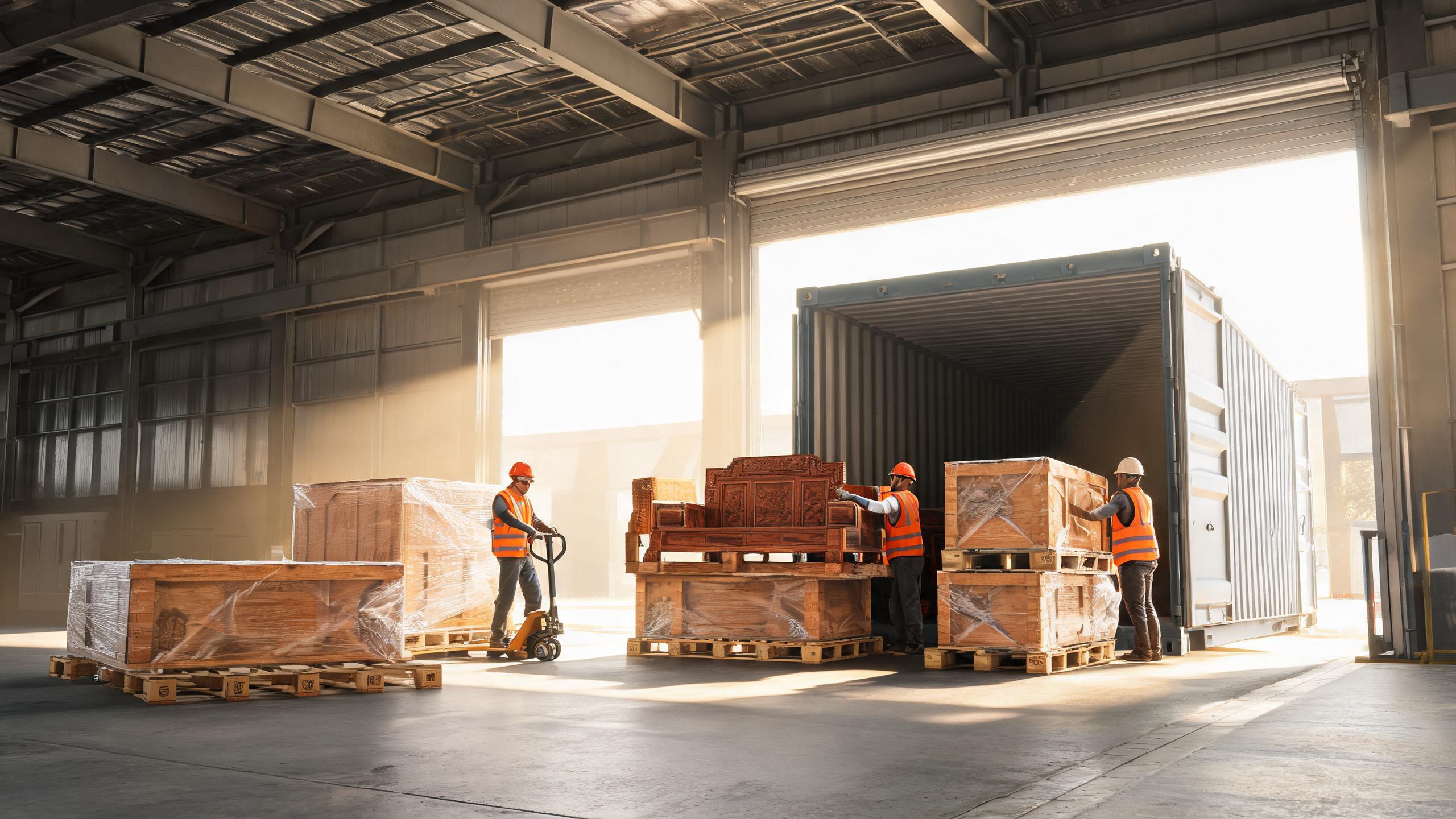
A practical B2B guide to planning container loading for rosewood furniture exports: timber readiness, crate engineering, moisture control, loading sequence, documentation and damage prevention for carved classical sets.
Introduction: Why Container Loading Is the Make-or-Break Stage for Rosewood Furniture Exporters
Every importer of classical rosewood furniture eventually learns the same lesson: the quality of a shipment is decided long before the vessel sails. A beautifully carved sofa set that survives forty days of humidity swings, salt air, and port handling is not the product of luck. It is the product of a loading plan — the way crates are built, the order in which they enter the container, the moisture barriers wrapped around each piece, and the bracing that stops thousands of kilograms of hardwood from shifting when a ship rolls in heavy seas. For B2B buyers in Southeast Asia, Australia, Europe, and North America, understanding how a Chinese rosewood furniture factory plans container loading is one of the most practical ways to judge whether a supplier can be trusted with a full-container order.
This guide answers the question that serious importers ask every season: how do you plan container loading for rosewood furniture exports without damaging carved sets? It walks through the entire process from the factory floor to the destination warehouse — timber preparation, crate engineering, moisture control, container selection, loading sequences, weight distribution, documentation, insurance, and arrival inspection. The goal is to give wholesale buyers, hotel project managers, and furniture distributors a working checklist they can use to audit any supplier, including us, before committing to a container order.
The stakes are real. A single 40-foot high cube container of classical rosewood furniture routinely represents tens of thousands of US dollars of FOB value, and the retail or project value behind it is often three to five times higher. A cracked apron on a hand-carved armchair, a split tabletop caused by uncontrolled moisture, or a chipped lacquer surface from crate friction is not a small defect — it can derail a hotel handover schedule or force a retailer to discount an entire product line. Loading damage is also one of the most common sources of disputes between importers and factories, precisely because it happens after the goods have passed final inspection inside the workshop. The only reliable protection is a loading process that is engineered, documented, and repeatable.
It is worth pausing on why loading deserves its own procurement discipline rather than being treated as a logistics detail delegated entirely to the freight forwarder. The freight forwarder controls the container booking and the vessel; the factory controls the crates, the bracing, and the loading crew. When damage occurs, the boundary between these two responsibilities becomes the battleground of the claim. Buyers who define that boundary in advance — through packing specifications, loading documentation requirements, and clear inspection protocols — resolve claims in days. Buyers who leave it undefined can spend months in disputes where every party points at another. This guide is written to help buyers define that boundary clearly, using the same standards professional rosewood exporters apply to their own shipments.
Why Rosewood Furniture Is Uniquely Vulnerable During Ocean Freight
Solid rosewood — including Siamese rosewood (Dalbergia cochinchinensis) and other dense tropical hardwoods — is among the heaviest and hardest furniture materials in commercial use. Density is an advantage in the finished product: it gives carved furniture its weight, resonance, and durability that buyers associate with heirloom quality. But the same density creates specific risks in transit. Heavy components concentrate enormous inertia forces; when a container moves, a poorly secured wardrobe door or a loose table leg becomes a battering ram against neighboring crates. Unlike upholstered or flat-pack furniture, classical carved pieces cannot be disassembled without destroying their value, so every component must travel protected as a shaped, three-dimensional object.
Moisture is the second and less visible enemy. Hardwood equilibrates with the humidity of its environment. Furniture kiln-dried and finished in the humid subtropical climate of southern Fujian will slowly lose or gain moisture as it crosses climate zones — from tropical Southeast Asian ports to the dry interiors of North America or the heated rooms of a European winter. If the wood was not properly dried and sealed before packing, this moisture migration causes checking, warping, and joint stress. If the packaging traps condensation against the wood, the result can be mold staining or finish blistering. Professional exporters therefore treat moisture management as a continuous chain: kiln drying, humidity equilibration, sealing finishes, vapor barriers inside the crate, and desiccants — each stage reducing the moisture differential the furniture will experience in transit.
Carving adds a third layer of fragility. Deep relief carving — dragon motifs, cloud aprons, lattice panels — creates protruding edges that are strong in compression but vulnerable to point impacts. A crate that is adequate for a flat panel can fail a carved crest rail if the internal bracing allows even a few centimeters of movement. This is why experienced rosewood factories build custom crates around the actual geometry of each piece rather than using standard-sized boxes, and why the loading plan matters as much as the crate itself: the best-built crate in the world still fails if a forklift driver stacks a two-ton pallet of dining table tops on top of it.
There is also a commercial dimension to this vulnerability that buyers should weigh when comparing quotations. A lower-priced quote that uses thinner crate lumber, skips vapor barriers, or loads without bracing plans is not a discount — it is an unpriced risk transferred to the buyer. When importers compare supplier quotations, they should normalize for packing specifications exactly as they normalize for timber grade and carving depth. The cheapest container is the one that arrives with nothing to claim.
Step One: Verify the Wood Is Ready Before Anything Is Packed
A responsible loading plan begins weeks before the container arrives at the factory gate. The first gate is moisture content. Professional practice for export hardwood furniture targets a moisture content appropriate to the destination climate — commonly in the range of eight to twelve percent for most destination markets, with the exact target adjusted for whether the furniture is bound for humid Southeast Asia or the drier, heated interiors of Europe and North America. Reputable factories kiln-dry components in constant-humidity chambers and verify moisture with pin meters at multiple points on each major component, not just once per batch. Buyers should ask to see moisture readings recorded against piece numbers; a factory that cannot produce them is asking you to trust the weather.
The second gate is equilibration time. After finishing — whether traditional raw lacquer hand-rubbed in multiple cured coats or eco-friendly lacquer systems compliant with EU REACH and US CARB expectations — components should rest in a controlled environment so the surface finish and the wood core reach stability before crating. Packing furniture the same day it leaves the finishing room traps a moisture gradient inside the crate. The third gate is assembly verification: every mortise-and-tenon joint, wooden dowel, and floating panel should be checked for proper fit before packing, because a joint that was slightly loose in the workshop will arrive visibly loose after forty days of vibration. Disassembly for packing — removing legs, aprons, or tops from classical sets — should follow a documented sequence with photographed reference points so destination crews can reassemble correctly.
Buyers conducting pre-shipment inspection should add three checks specific to loading readiness: confirm desiccant quantities are packed per crate, verify vapor barrier integrity at seams, and photograph the moisture meter readings. These checks cost minutes; they prevent the majority of transit-related claims.
It also pays to understand how drying time shapes the production calendar. At our own facility, components undergo 36-day constant-humidity drying before assembly and finishing. For a buyer planning a hotel handover or a seasonal retail launch, this means the drying schedule — not the carving schedule — is often the true critical path. Factories that compress drying to meet an unrealistic delivery promise are quietly transferring cracking risk to the destination market, where dry heating seasons will find every moisture gradient the workshop left behind. Asking a supplier how drying time is protected inside the lead time is one of the most revealing questions a buyer can ask.
Step Two: Crate Engineering — Building the Armor Around Each Set
The crate is the primary defense, and its design should be proportional to the value and fragility of the contents. For classical rosewood furniture, professional crate engineering includes several non-negotiable elements. First, all crate lumber must be ISPM 15 heat-treated and stamped, a phytosanitary requirement for solid wood packaging in virtually all destination markets. Second, every carved or finished surface must be separated from crate wood by an inert layer — foam sheeting, corrugated wrap, or soft board — because direct contact between hardwood components and rough-sawn crate lumber transfers impact directly and can abrade lacquer surfaces during vibration.
Third, internal bracing must immobilize the contents in all three axes. The piece should not be able to shift more than a centimeter in any direction when the crate is tilted or shaken. For heavy components such as bed posts, table pedestals, and wardrobe bodies, bracing blocks screwed into the crate frame — never nailed into the furniture itself — hold the piece against foam-lined rails. Fourth, vapor barriers: a six-mil polyethylene or foil laminate liner sealed with tape around the furniture, with silica gel desiccant bags calculated by crate volume, keeps the internal humidity stable. Fifth, edge and corner protection: carved finials, apron corners, and mirror frames receive molded foam corners or built-up cardboard edges, because corners are where nearly all impact damage begins.
Crate weight and dimensions should be recorded on a packing list that matches the loading plan. A factory that can tell you the exact crate count, dimensions, and gross weights for your order before the container arrives is a factory that has actually planned the loading — not one that will discover the space problem on loading day.
Crate design also differs by furniture category, and buyers reviewing a supplier's packing specification should expect to see that differentiation. Sofa sets with deep carved armrests travel in crates with shaped internal supports that hold armrests away from crate walls. Dining table tops travel flat on edge-support rails that distribute weight across the apron rather than the center of the panel. Wardrobes and display cabinets with floating panel doors travel with doors braced closed and panels relieved of racking stress. Bed posts with carved finials travel in dedicated post crates with individual slots. A single generic crate specification for all furniture types is a warning sign that the packing process has never been engineered — only repeated.
Step Three: Choosing the Right Container and Preparing It
Container selection is a genuine engineering decision, not a default. For classical rosewood furniture sets, the 40-foot high cube container is the industry workhorse because its extra internal height accommodates tall wardrobes, four-poster bed components, and display cabinets upright, and its internal capacity matches the cube-out profile of furniture shipments — furniture usually runs out of volume before it runs out of weight allowance. A 20-foot container suits partial orders or trial single-set shipments, but its lower internal height forces tall pieces to travel at angles that complicate bracing.
Container condition matters more than most buyers realize. Before loading, the container should be inspected for: floor integrity (soft or splintered flooring cannot hold crate nails and screws securely), wall and roof punctures that admit water, door seal condition, residual odor from previous cargo (chemical contamination can penetrate unfinished wood interiors such as cabinet backs and drawer bottoms), and overall cleanliness. A professional loading crew sweeps the floor, lays kraft paper or moisture barrier sheeting across the flooring, and checks that drain holes are clear. In monsoon season or high-humidity ports, some exporters add container desiccant poles or hanging desiccant bags — products designed to capture the significant volume of moisture that evaporates from wooden cargo and packaging inside a sealed steel box during an ocean crossing, where temperature swings between day and night drive condensation cycles known as container rain.
Buyers booking under FOB terms should specify in the purchase contract that the factory inspects and documents container condition with photographs before loading. Under CIF terms, this responsibility sits with the exporter, and asking for the photo record is a reasonable, standard request.
Container age and type also deserve attention on high-value shipments. Newer containers with intact door gaskets and undamaged flooring provide measurably better moisture performance than worn units. Where the freight market allows, buyers can request newer containers or specify that the container be inspected and approved before the loading appointment. These are ordinary commercial requests in the furniture trade, and a factory or forwarder who treats them as unreasonable is signaling how they handle less visible quality issues as well.
Step Four: The Loading Sequence — Order, Orientation, and Weight Distribution
Loading a container of rosewood furniture is a three-dimensional planning exercise. The guiding principles are: heavy low, light high; long items along the length; no point loads on crate roofs; and a floor plan drawn before the first crate moves. Professional crews begin with the heaviest, most rigid crates — dining table pedestals, wardrobe bodies, bed frames — placed floor-first across the front half of the container, spread to keep the center of gravity near the container's longitudinal center and below its mid-height. Concentrating all heavy crates at one end creates an axle-weight imbalance that can trigger road transport fines at the port and, in extreme cases, handling problems at the terminal.
Orientation follows crate design: crates built to travel on their base are loaded base-down; tall wardrobe crates stand upright against the wall, strapped to lashing rings; long components such as bed side rails and table tops travel in horizontal layers on top of the base layer, separated by slip sheets. Every layer is braced before the next begins — airbags (dunnage bags) inflated between crate rows, timber cross-braces screwed to container wall posts, and lashing straps tensioned to immobilize the load. A properly loaded container has no free space that allows movement; empty gaps near the doors are filled with void fillers or braced with lumber so the last crates cannot slide backward when the doors close and the ship pitches.
The loading sequence also plans the destination: crates needed first at the destination — often the ones containing assembly hardware kits, layout drawings, and installation tools — are loaded last, nearest the doors. For hotel and villa projects where containers move directly to site, coordinating this unloading order with the project's installation schedule saves days of on-site shuffling.
Weight distribution deserves one further note for hardwood furniture specifically. Dense rosewood means a container can approach its payload limit while still looking half-empty by volume. Loading crews must track cumulative weight as they load, not only cube. A floor plan that ignores weight can produce a legal-looking load plan that is overweight at the port, forcing repacking under time pressure — exactly the rushed conditions in which damage happens. Professional loading plans record both the cube and the weight of every crate position.
Step Five: Moisture and Climate Control Inside the Container
Even with perfect crating, the container interior is a climate challenge. A sealed steel box crossing the Pacific or Indian Ocean experiences temperature swings of fifteen to twenty degrees Celsius between day and night; every degree drop drives relative humidity upward, and moisture evaporating from crate lumber, pallet wood, and any residual dampness condenses on the container ceiling and drips or runs down the walls — the phenomenon exporters call container rain. The defense is layered: thoroughly dried crate lumber and pallets, vapor barriers inside each crate, kraft or barrier sheeting on the container floor, and container desiccants sized to the voyage. For high-value carved shipments, some exporters specify moisture-absorbing blanket liners that hang from the container ceiling and capture condensation before it can reach cargo.
Buyers should also understand the seasonal dimension. Shipments leaving southern China in the summer monsoon months face the highest humidity exposure; shipments in the dry winter months face less. This does not mean avoiding certain seasons — it means adjusting desiccant quantities and verifying barrier integrity more rigorously in high-humidity months. A supplier who can explain this seasonal logic demonstrates the operational maturity that separates professional rosewood exporters from general traders.
Destination climate completes the moisture equation. A container bound for the tropical humidity of Southeast Asia arrives into an environment where the wood will gain moisture; a container bound for a North American winter arrives into heated interiors where the wood will dry further. The packing system must be tuned to the direction of travel of the moisture, not just to the voyage. This is one reason experienced exporters ask about the final destination and the installation environment, not merely the destination port: a hotel in coastal Queensland and a residence in central Canada impose opposite moisture demands on the same carved sofa set.
Step Six: Documentation That Travels With the Container
Loading is incomplete until the paperwork matches the physical reality. The core document set for a rosewood furniture container includes: the commercial invoice and packing list (crate-by-crate, with dimensions and weights), the bill of lading, marine cargo insurance certificate, the ISPM 15 declaration for wood packaging, and — critical for rosewood specifically — CITES Appendix II export permits and re-export certificates for the Dalbergia species, plus FSC chain-of-custody documentation where the buyer's market or project certification requires it. European importers additionally manage EU Timber Regulation due diligence files; US importers manage Lacey Act declarations with species and harvest-country information.
A loading plan document itself is increasingly standard among professional factories: a diagram of the container floor plan, a crate manifest cross-referenced to product SKUs and piece counts, photographs of each crate before loading, and photographs of the container at key loading stages — empty, half-loaded, full, and sealed with the container seal number recorded. This photo-and-document trail serves three purposes: it lets the buyer verify the shipment remotely without flying in, it supports insurance claims with objective evidence if transit damage occurs, and it demonstrates the factory's process discipline. Buyers evaluating suppliers should ask for a sample loading documentation pack from a previous shipment; the quality of that pack predicts the quality of the loading operation far better than any sales brochure.
Documentation accuracy also protects the buyer at customs. Descriptions on the commercial invoice and packing list must match the bill of lading and the CITES permit line items; discrepancies between species names, quantities, or values are among the most common causes of customs delays in the furniture trade. A factory whose export team prepares full document sets in-house — as ours does for wholesale and project clients — can keep these records consistent from the first proforma invoice through to the final permit, which is far harder to achieve when documentation is scattered across a trader, a forwarder, and a factory.
Step Seven: Insurance, Liability, and Risk Allocation
Even perfectly planned loading cannot eliminate every transit risk — a vessel in heavy weather, a terminal strike, a truck accident on the destination leg. The loading plan's role in risk allocation is to make the factory's responsibility legible. Under FOB terms, risk transfers to the buyer once goods pass the ship's rail at the origin port; under CIF, the exporter arranges and pays for insurance to the destination port, though risk still transfers at origin. In both cases, the buyer's protection depends on the quality of the packing and loading evidence: an insurer assessing a damage claim will ask whether the goods were professionally crated, whether the loading was documented, and whether the damage pattern is consistent with inadequate packing. A factory with crate engineering standards, loading photographs, and moisture control records gives its buyers a defensible claim; a factory with none of these leaves the buyer arguing with the insurer alone.
Practical recommendations for buyers: insure at invoice value plus a margin covering freight and anticipated project value; photograph the container seal and condition at destination before opening; open crates in the presence of the delivery driver or a third-party inspector when possible; and report any damage to the carrier and insurer within the policy's notification window — typically days, not weeks. Importers who build these steps into their receiving SOP recover transit losses that importers without a process simply absorb.
Common Loading Failures and How to Prevent Them
Across hundreds of furniture container shipments, the same failure patterns recur. The most common is inadequate bracing: crates shift, corners impact, and carved aprons chip. Prevention is dunnage bags and cross-bracing at every layer, verified before the doors close. The second is moisture staining from container rain: water marks on crate tops and, in bad cases, mold spotting on unfinished wood surfaces inside cabinets. Prevention is floor barrier sheeting, container desiccants, and dry crate lumber. The third is crushing: lighter crates stacked under heavier ones, or forklift tines piercing crate bases. Prevention is a written stacking plan with maximum stack heights and crate weight classes marked on each crate. The fourth is door-area damage: the last crates loaded near the doors take the brunt of door-closing pressure and handling shocks; prevention is braced void fill and never loading fragile carved components in the door zone.
The fifth failure is human: rushed loading. When a container must leave to catch a vessel cutoff, crews are tempted to skip bracing steps or stack without a plan. Professional factories protect against this by scheduling loading with buffer time before vessel cutoffs and by assigning a loading supervisor who signs off each stage. Buyers can reinforce this by asking when the container will be loaded relative to the vessel cutoff and requesting the loading photo set within 24 hours of completion — a simple request that keeps the process honest.
A sixth pattern deserves mention because it is invisible until the destination: fastener and hardware migration. Assembly bolts, brackets, and spare tenons packed loose inside a crate become projectiles that dent finished surfaces over thousands of kilometers of vibration. Professional practice seals hardware in labeled, taped pouches attached to the crate wall or packed in a dedicated hardware crate — never loose in the same compartment as finished components. Buyers who have ever opened a crate to find a stray bolt rattling inside a carved cabinet will recognize immediately why this rule exists.
What B2B Buyers Should Put in Their Purchase Contracts
Loading quality is contractible. Buyers moving serious volumes should specify, in writing: crate standards (ISPM 15 stamped lumber, vapor barriers, desiccant quantities, foam separation of finished surfaces), a loading plan submitted for approval before loading day, loading photographs at defined stages delivered within a set time, container condition inspection before loading, moisture content readings for major components, and the documentation set (CITES, FSC where applicable, ISPM 15 declaration) provided with the shipment. These clauses cost the supplier little if they already operate professionally — and that is precisely their value: they cost an unprofessional supplier a great deal, which is why suppliers sometimes resist them. Resistance to standard loading documentation is itself a screening signal.
Buyers should also agree on the inspection protocol at destination: the timeframe for reporting transit damage, the evidence required (photos of crate condition before opening, damage photos with crate labels visible), and the remedy structure — replacement parts, credit notes, or factory-supplied repair guidance. Factories confident in their loading process accept these terms readily, because their claim rates are low. At our own factory in Xianyou County, Fujian, the combination of 36-day constant-humidity drying, mortise-and-tenon construction without metal fasteners in primary frames, ISPM 15 heat-treated crating, and documented loading sequences exists precisely to keep those claim rates near zero for our wholesale, hotel, and design-firm partners across Europe, North America, Australia, and Southeast Asia.
Special Considerations for Hotel, Villa, and Whole-House Projects
Project shipments — a hotel lobby furnished with reception sofa sets, a villa fitted with complete bedroom and dining suites — add coordination requirements to the loading plan. Quantities are larger and mixed: sofa sets, dining sets for ten or twelve covers, bedroom suites, tea tables, sideboards, and display cabinets travel in the same containers, and the installation sequence on site rarely matches the packing sequence in the factory. Professional exporters handle this by tagging every crate with room and phase codes agreed with the project contractor, so site crews can route crates directly to floors and wings as containers are unloaded. Layout drawings and installation guides travel in clearly marked crates loaded last.
Project shipments also compress schedules: a hotel handover date is immovable, so transit damage that would be an inconvenience for a retail order becomes a crisis for a project. This is why project buyers should insist on higher insurance margins, container-level desiccant systems, and — for the most critical phases — split shipments across two containers so a single transit incident cannot stall an entire installation. Factories experienced in hospitality exports, including partial shipment arrangements for long-term partners, can structure these splits without complicating documentation.
Custom and OEM/ODM project work adds one more layer: one-off pieces have no spare inventory at the destination. If a custom-carved reception desk panel is damaged in transit, the remedy is a factory remake measured in weeks, not a replacement pulled from a warehouse. For projects built around custom sizes and patterns, buyers should therefore weight the loading specification even more heavily, and consider pre-shipment inspection at the factory as standard practice rather than an optional extra. The cost of an inspector's visit is trivial against the cost of delaying a hotel opening by a month.
How to Evaluate a Supplier's Loading Capability Remotely
Most B2B buyers will not witness loading in person. Remote evaluation is therefore a core procurement skill, and it rests on five verifiable artifacts. First, a sample loading documentation pack from a recent shipment — floor plan, crate manifest, staged photographs. Second, crate specifications in writing: lumber treatment, barrier materials, desiccant quantities per crate volume. Third, moisture control records: kiln schedules and piece-level moisture readings. Fourth, references or case history: ask specifically about shipments to your climate zone — a factory that ships well to humid Southeast Asia has proven one skill set; shipping to the dry, heated interiors of North America proves another. Fifth, responsiveness to your contract clauses: a professional supplier will refine your loading clauses with specifics rather than resist them.
Video calls during loading are increasingly common and reasonable to request for first orders: a ten-minute live walkthrough of the container at half-load tells a buyer more than a month of email exchanges. Third-party inspection services in China offer loading supervision for a few hundred US dollars, photographing and reporting each stage; for first container orders with a new supplier, this cost is trivial insurance. As trust builds and loading documentation proves consistent, buyers typically reduce supervision to spot checks — the normal maturation of a sourcing relationship.
Buyers can also read a supplier's loading maturity from smaller signals: whether quotations itemize packing as a line with specifications, whether the sales team can answer moisture and bracing questions without checking with the workshop, and whether sample documents carry real crate numbers and seal numbers rather than blank templates. None of these signals is conclusive alone; together they form a reliable picture within a single sourcing cycle.
A Practical Pre-Loading Checklist for Importers
To close the operational loop, here is a condensed checklist buyers can adapt directly into their sourcing SOP. Before production: confirm the drying schedule is protected inside the agreed lead time, and agree the moisture target for your destination climate. Before packing: request the crate specification sheet, including lumber treatment, barrier materials, and desiccant quantities. Before loading day: require the container condition photo set, the draft loading plan with crate positions, and confirmation that loading is scheduled with buffer before the vessel cutoff. During loading: request a live video walkthrough or third-party loading supervision for first orders. Within 24 hours after loading: receive the staged photo set, the final crate manifest, and the container seal number. With the document set: verify invoice, packing list, bill of lading, ISPM 15 declaration, CITES permits, and FSC documentation where applicable are consistent line by line. At destination: photograph the seal and container condition before opening, inspect crates before unsealing, and report any damage within the notification window. A buyer who runs this checklist on every container — and whose supplier meets it without friction — has effectively converted loading from an unmanaged risk into a controlled process.
Conclusion: Loading as the Final Act of Craftsmanship
Classical rosewood furniture is the product of months of skilled work: timber selection, months-long drying, hand carving, mortise-and-tenon assembly, lacquer finishing. Container loading is the last act of that craftsmanship, and it deserves the same engineering seriousness. For buyers, the message is straightforward: ask the questions this guide raises, demand the documentation, and treat a supplier's loading process as a direct window into its overall operational quality. A factory that plans container loading with the same care it applies to carving will deliver furniture that arrives as it left the workshop — and that, ultimately, is what a B2B buyer is paying for.
For importers, hotel project managers, and distributors evaluating rosewood furniture suppliers, we welcome questions about our packing standards, loading documentation, CITES and FSC documentation, and OEM/ODM project support. The best time to audit a supplier's loading process is before your first full-container order — not after your first claim.