
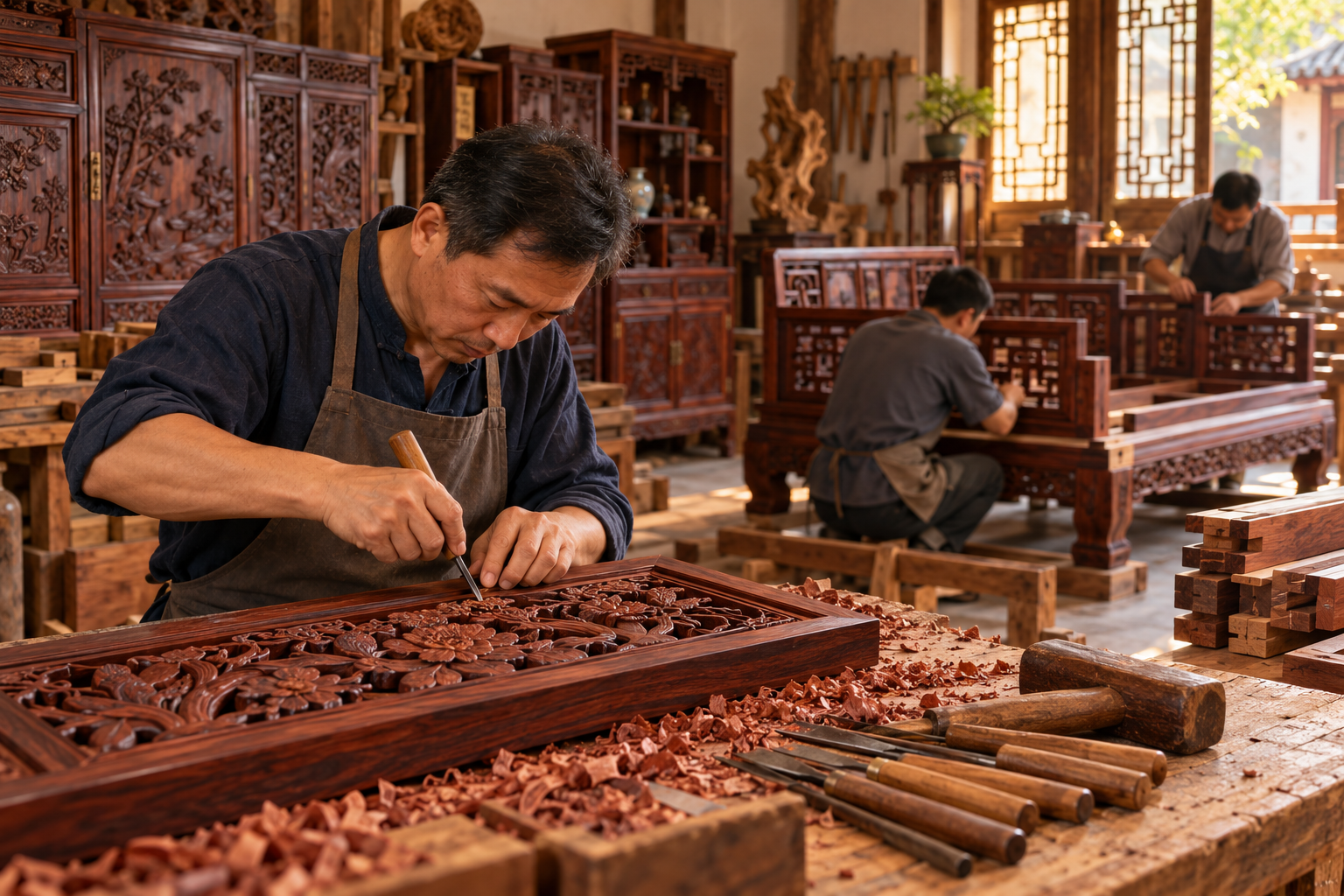
A stage-by-stage guide for B2B buyers on tracking a custom rosewood furniture order through timber selection, 36-day drying, hand carving, finishing, pre-shipment inspection, ISPM 15 packaging and shipping documents.
Why Order Visibility Matters More for Rosewood Furniture Than for Standard Furniture
If you have imported flat-pack or panel furniture before, you may be used to a simple rhythm: confirm the order, wait quietly, receive the container. Rosewood furniture does not work that way, and treating it the same way is where most import problems begin.
A carved solid rosewood dining set is not picked from a shelf. The timber for your order is selected, dried for weeks, carved by hand, joined without a single nail, finished in multiple coats of lacquer or wax, and then packed for a sea voyage. At Yunxiao Rosewood Furniture, a full container order takes 45 to 60 working days after the deposit, and much of that time is deliberate: wood that is rushed through production cracks in transit or in your warehouse, and cracked rosewood is almost impossible to sell at wholesale prices.
For you as a B2B buyer, the long production window creates a specific risk. When you cannot see what is happening inside the factory, you discover problems too late to fix them cheaply. A carving pattern you never approved in detail is already cut into the wood. A finish that does not match the sample is already applied to forty pieces. A delay you learn about in week eight is a delay you cannot recover from before your hotel project handover. This is why order visibility matters more here than in almost any other furniture category: the product is high value, made to order, and largely irreversible once each stage is complete.
We write this as a manufacturer. Yunxiao has been producing classical solid rosewood furniture since 2008 from a 12,000 square metre factory in Xianyou County, Putian City, Fujian, a region with generations of hardwood craft behind it. We supply full sets to wholesalers, hotels, and designers in Europe, North America, Australia, and Southeast Asia, and over the years we have learned that the buyers who never have a bad experience are the ones who track their order stage by stage, not the ones who simply hope for the best. If you want the timeline math first, our guide to production lead times for custom rosewood furniture breaks down where the 45 to 60 working days actually go.
This article walks you through all seven stages of a custom rosewood furniture order, from deposit to container departure. For each stage we explain what happens on the factory floor, what you should receive from a serious supplier, and what to ask for if you are not receiving it. Whether you buy from us or from another rosewood furniture factory, the checkpoints below will help you hold any supplier accountable.
The Seven Stages of a Custom Rosewood Furniture Order at a Glance
Before we go deep into each phase, here is the full journey. Use this as a mental map; when a supplier tells you where your order is, you should be able to place it on this list immediately.
- Stage 1: Order confirmation, drawings and deposit. Specifications are fixed in writing, layout drawings are produced for project orders, samples are settled, and the deposit is paid.
- Stage 2: Timber selection and 36-day drying. Your material is chosen and dried to a stable moisture level in constant-humidity kilns before a single cut is made.
- Stage 3: Carving and mortise-and-tenon joinery. Hand-carving artisans shape the decorative elements while joiners cut traditional mortise-and-tenon joints, with no metal nails anywhere in the frame.
- Stage 4: Assembly, sanding and finishing. Pieces are dry-fitted, assembled, sanded, and finished in beeswax or raw lacquer, with curing time between coats.
- Stage 5: Pre-shipment quality inspection. Every piece is checked against the confirmed specifications, and you receive inspection reports with photos and video.
- Stage 6: ISPM 15 export packaging. Furniture is wrapped in moisture barriers, corner-protected, and crated in heat-treated wood.
- Stage 7: Shipping documents and container departure. Commercial invoice, packing list, FSC certificates and the bill of lading are prepared, and the container leaves the factory.
Notice the proportion: two of the seven stages happen before any carving begins. That surprises buyers used to stock furniture, but it is the nature of solid hardwood work. Get the material and the specifications right, and the rest of the production schedule tends to run on time. Get them wrong, and no amount of chasing in week nine will save the delivery date.
One more note before Stage 1: the stages below describe a full container order, which is the most common format for our wholesale and hotel clients. If your volumes are smaller or you want to mix categories in one container, that changes the sequence slightly at the confirmation stage, and we cover the details in our article on minimum order quantities and mixing a container.
Stage 1: Order Confirmation, Drawings and Deposit
Everything that goes wrong later in a custom order usually traces back to a weak Stage 1. This is the stage where ambiguity is cheapest to remove, because nothing has been cut yet.
What happens at this stage
When you send us an inquiry, the first real work is specification, not pricing. For a wholesale order, that means fixing the exact models, dimensions, materials, carving depth, finish type, and quantity for each item. For a hotel or villa project, we also produce free layout drawings showing how the pieces sit in your rooms, which matters more than most buyers expect; a sofa set that measures correctly on paper can still block a doorway or crowd a lobby, and drawings catch this before the wood is touched.
Many first-time buyers of classical Chinese furniture are not sure whether the style will suit their market, or whether a particular model fits their showroom. This is why we offer trial single sets: you can order one complete set first, see the carving, the finish, and the packing quality with your own eyes, and then commit to volume. We also provide refundable samples, so the cost of evaluating us comes back to you when the main order proceeds. Both options exist because we would rather prove the quality on a small order than argue about it on a large one.
What to confirm in writing before you pay the deposit
A good supplier will put everything in a proforma invoice or order confirmation document. Before you transfer the deposit, make sure the document states all of the following:
- Material specification by botanical or trade name. "Rosewood" alone is not enough. Our signature material is Siamese rosewood (Dalbergia cochinchinensis); we also produce in Machilus Nanmu, aged red wood, and Grade-A tropical hardwood. The confirmation should name the exact material for your order, because price and appearance differ significantly between them.
- Dimensions of every piece. Not "standard size" but actual measurements, especially for project furniture where the layout drawings must match the production sheets.
- Finish type. Beeswax or raw lacquer, and the expected colour tone. These two finishes look and feel different, and the choice affects both the price and the curing schedule.
- Lead time in working days and the delivery window. Agree on 45 to 60 working days after deposit for a container order, and clarify whether that means production complete or container loaded.
- Payment terms and balance timing. Know exactly when the balance is due relative to inspection and shipment, which we discuss further in Stage 7.
If a supplier resists putting any of this in writing, treat it as information about the supplier. At Yunxiao, the written confirmation is the document our own production schedule is built from; there is one version, and you receive the same one we work from.
Sample and drawing checkpoints
Two things should reach you before the deposit stage closes. First, if you requested samples, they should be approved and the refund terms confirmed in the order document. Second, for any project order, the layout drawings should be signed off by your side. Keep both in your order file. When Stage 5 inspection arrives, these documents become the reference against which your goods are checked, and having them saves weeks of argument if a detail is ever disputed.
Stage 2: Timber Selection and 36-Day Drying
Stage 2 is invisible from the outside and decisive for everything that follows. Solid rosewood furniture lives or dies on the stability of the wood, and wood stability is determined before the first joint is cut.
Choosing the timber for your order
Material selection is not a formality. Within the same species, boards differ in colour, grain direction, density, and the presence of natural character marks. For classical furniture, a good factory selects and matches boards so that a dining table top reads as one consistent surface and a cabinet's doors show balanced grain. This selection takes skilled eyes and time, and it is one of the reasons a genuine solid wood order cannot be turned around in a fortnight.
Your material choice, fixed in Stage 1, determines what happens here. Siamese rosewood (Dalbergia cochinchinensis) is our signature material for classical sets: dense, richly coloured, and well suited to deep carving. Machilus Nanmu offers a lighter, elegant tone popular with European and Australian clients. Aged red wood and Grade-A tropical hardwood serve buyers who want the classical look at a more accessible price point. Each material dries and behaves differently, which is why the drying schedule below is calibrated per batch rather than applied blindly.
The 36-day constant-humidity drying process
At Yunxiao, every batch of timber for production goes through a 36-day constant-humidity drying cycle before it enters the workshop. This is not optional preparation; it is the single biggest defence against the two classic failures of exported solid wood furniture: cracking and deformation.
The logic is simple. Hardwood harvested and sawn in southern China carries moisture that must be brought down to a level compatible with the destination climate. If wood enters production too wet, it shrinks after assembly; joints loosen, panels split, and doors warp. If it is dried too fast, internal stresses build up and the damage shows months later, often after the furniture has crossed an ocean. Constant-humidity drying brings the moisture down gradually and evenly, which is slower but produces wood that stays stable in a heated European apartment or an air-conditioned hotel in Singapore.
If you want the technical detail, we have written a full guide on kiln drying and why moisture control matters in rosewood furniture. The practical takeaway for your tracking purposes: ask any supplier at what moisture level their wood enters production and how long their drying cycle runs. A factory that cannot answer that question precisely is a factory whose furniture you should inspect very carefully before shipment.
What you should see from Stage 2
Honest factories do not hide this stage. When we send production updates, buyers of long-standing receive photos of their timber batch and drying racks, because it is easier to show than to argue about later. You should be able to ask for, and receive, confirmation of when your batch entered drying and when it exited. If a supplier tells you your order is "already in carving" one week after your deposit, the wood either was not properly dried or was not selected for you at all; neither scenario works in your favour.
Stage 3: Carving and Mortise-and-Tenon Joinery
This is the stage where classical rosewood furniture becomes what it is. It is also the longest single phase of the production schedule, and the one where a buyer's eyes on the process add the most value.
Hand carving by experienced artisans
The carved panels, aprons, and motifs on classical Chinese furniture are shaped by hand. Our carving artisans in Xianyou come from a region where this craft has been practised for generations, and the difference between experienced hands and rushed work shows in the depth of the relief, the sharpness of the edges, and the way the pattern flows across a piece without interruption.
For you as a buyer, the important fact is that carving is where specification disagreements become expensive. If the confirmed drawings show a certain motif or carving depth, this is the moment to verify it. Once the panel is carved, changing your mind means starting the piece again, not sanding something back. This is why we encourage buyers to request photos at the start of carving, not just at the end: a photo of the first carved panel of your sofa set, compared against the approved drawing, settles any question while the remaining thirty pieces are still on the bench.
Mortise-and-tenon joinery, no metal nails
Alongside the carving, joiners cut the structural joints. Traditional Chinese furniture is assembled with mortise-and-tenon joinery, in which shaped projections on one piece fit into matching cavities on another, locked by geometry and wood expansion rather than by fasteners. At Yunxiao, our frames contain no metal nails at all, and we do this for a practical reason, not a romantic one: metal and wood expand and contract at different rates, and over years of temperature and humidity swings, nails work loose and split the wood around them. Properly cut mortise-and-tenon joints move with the wood, which is why pieces built this way survive decades of use and why the method reduces cracking and deformation over the furniture's life.
For buyers, this stage has a verifiable output. Ask your supplier how the joinery is done, and ask for a photo of a joint during dry-fitting. A factory confident in its joinery will show you a clean, tight mortise-and-tenon connection without hesitation.
What photos at this stage should show
If your supplier sends progress updates, this is what worthwhile Stage 3 documentation looks like:
- The first carved panel or apron of your order, photographed straight-on and in raking light so you can judge depth and edge quality.
- A dry-fit assembly shot, showing the frame standing together without glue or clamps, which proves the joints were cut accurately.
- A close-up of an open joint, so you can see the fit between tenon and mortise.
- The batch of pieces in progress, so you can confirm quantity matches your order sheet rather than discovering a shortage at packing time.
We cover what comprehensive documentation should look like at every checkpoint in our guide to rosewood furniture quality control for B2B buyers, but the principle is worth stating here: photos during production are not a courtesy, they are your quality system. A rosewood furniture factory that volunteers them at each stage is showing you how it works; one that promises "everything will be perfect at shipment" is asking you to buy on faith, and at these order values, you should not.
By the end of Stage 3, your order exists as carved and jointed components: the hard geometry of the furniture is fixed, the decorative surfaces are cut, and the pieces are ready for assembly and finishing. In Part 2, we pick up from there with the finishing line, pre-shipment inspection, export packaging, and the documents that get your container across the border.
Stage 4: Assembly, Sanding and the Lacquer Finishing Process
By the time your order reaches the assembly floor, every component has already passed through two demanding stages: timber selection with a 36-day constant-humidity drying cycle, and hand carving paired with mortise-and-tenon joinery. Stage 4 is where those components become furniture you would recognize in a showroom photograph. It is also the stage where many B2B buyers assume nothing can go wrong, which is a mistake. Finishing defects are among the most common reasons rosewood furniture gets rejected at destination, and most of them are preventable if you know what to ask for during this window.
Assembly in a traditional rosewood furniture factory looks different from a modern panel-furniture line. At Yunxiao, our artisans fit each mortise-and-tenon joint by hand, testing the fit dry before any adhesive is introduced. Because the entire structure relies on joinery rather than metal nails, a joint that is even slightly loose or overly tight will show up now, not after shipping. This is a genuine advantage for you as a buyer: structural problems surface while the piece is still on our bench, where correction costs us time rather than costing you a claim.
Once the frame is dry-fitted and approved, the piece goes through progressive sanding. On solid rosewood and Grade-A tropical hardwood, sanding is done in multiple grits, and the artisans work with the grain to avoid swirl marks that would become visible under lacquer. A useful benchmark: if you request photos at this stage, ask for a close-up of a flat panel under raking light. Any sanding inconsistency will reveal itself immediately.
Beeswax and Raw Lacquer: What Actually Goes Onto Your Furniture
Finishing on classical Chinese rosewood furniture typically falls into two camps: wax finishing and lacquer finishing. Many factories offer one or the other; at Yunxiao we work with both eco-friendly beeswax and traditional raw lacquer, and the choice depends on the style of the piece and your market's expectations. European buyers often prefer the natural matte depth of beeswax, which lets the grain of Siamese rosewood speak for itself. Hotel and villa projects in humid climates frequently specify raw lacquer for its harder, more water-resistant surface.
Raw lacquer application is not a single coat. A proper finish is built up in multiple thin layers, with each coat needing curing time before the next one is applied. Rushing this sequence produces a finish that clouds, craze-cracks, or stays tacky in transit, especially inside a sealed shipping container where temperatures swing widely. This is why finishing occupies a meaningful share of the overall production schedule, and why a factory quoting an implausibly short lead time is often planning to compress exactly this stage.
For importers into Europe and North America, the compliance question matters as much as the aesthetic one. Our beeswax and raw lacquer finishing is formulated to meet EU REACH standards and US CARB requirements, so you are not left navigating chemical compliance alone after the container lands. If you sell into multiple markets, confirm in writing which standard applies to your order and ask that it be noted on the order confirmation. A good supplier will do this without being pushed; if you have to ask twice, take note.
What to Request During Stage 4
- Finish samples before full production. If you have not already approved a physical sample, ask for a finished offcut or a small component in your specified material and finish. Our trial single sets and refundable samples exist precisely so that finish and material decisions are made on real wood, not on a screen.
- Mid-finishing photos. A photo taken after the second or third lacquer coat will show surface preparation honestly. Polished final photos under showroom lighting will not.
- Curing confirmation. Ask when the final coat was applied relative to the planned packing date. Adequate curing time between the last coat and crating protects you from finish damage in the container.
One practical note for project buyers ordering full sets for hotels or villas: request that pieces from the same set be finished in the same batch. Batch consistency in lacquer tone is far easier to achieve when the work runs consecutively on the same bench, and it is the difference between a dining set that reads as a single commission and one where the chairs are visibly a shade apart from the table.
Stage 5: Pre-Shipment Quality Inspection
Stage 5 is the checkpoint that determines whether everything before it translated into furniture you can actually sell or install. It is also the stage where you have the most leverage, provided you exercise it before the goods are packed, not after. Once a crate is sealed and a container is stuffed, every defect becomes an argument about freight claims instead of a fifteen-minute fix on the factory floor.
At Yunxiao, every piece goes through an internal inspection before it is cleared for packing. Our in-house team checks joint tightness, structural stability, surface finish, drawer and door operation, and dimensional accuracy against the approved drawings. For B2B buyers, we document this process and share the results, because an inspection you cannot see is an inspection you cannot rely on. We have written in detail about how our quality control process works for B2B buyers, and we would encourage you to read it before comparing suppliers, because QC practices vary enormously across rosewood furniture factories.
What You Should Receive from a Pre-Shipment Inspection
A trustworthy supplier will provide, at minimum, the following before asking for your balance payment:
- An inspection report listing each item in the order, its dimensions against the approved drawings, and any deviations with an explanation.
- Photographs of every piece, including close-ups of joints, carvings, and finish under neutral lighting, plus photos of undersides and drawer interiors. Any factory that only sends beauty shots is telling you something.
- Video footage of drawers sliding, doors opening, and tables being checked for level. Movement reveals problems that static photos hide.
- A packing preview, showing how pieces will be disassembled (where applicable) and crated.
On larger orders, we also encourage buyers to commission a third-party inspection. Independent inspectors based in China can usually reach Xianyou County within a few days' notice, and a good factory welcomes them. If a supplier resists third-party inspection outright, treat that as significant information. Reputable manufacturers have nothing to fear from a professional set of eyes on the goods, and many buyers in Europe and Australia make third-party inspection a standing condition on every container order.
There is a structured way to approach this stage rather than relying on ad-hoc photo exchanges, and we have published a dedicated pre-shipment inspection checklist for importers that walks through what to check and in what order. Use it whether your goods come from us or from another factory; the defects it covers, loose tenons, uneven lacquer, mismatched grain across a set, are industry-wide, not specific to any one workshop.
Timing the Inspection Against Your Balance Payment
For most export orders in this industry, the balance payment is due after production is complete and before shipment. That sequencing is normal, but it means the inspection is your last point of real leverage. Our recommendation, which we follow in our own process: complete the inspection, share the full documentation, give the buyer a defined window to review and raise issues, and only then request the balance. If a supplier pushes you for balance payment before you have seen any inspection evidence, you should slow the transaction down until the evidence arrives.
Stage 6: ISPM 15 Export Packaging
Packaging is the least glamorous stage of a custom rosewood furniture order and one of the most consequential. Solid wood furniture is heavy, dense, and vulnerable in specific ways: corner impact during handling, moisture absorption inside a container crossing the equator, and abrasion between adjacent pieces. A beautifully finished cabinet that arrives with a split corner or a water-stained panel has failed at Stage 6, not at Stage 5.
For export shipments, packaging must also satisfy a regulatory requirement that many first-time importers overlook: ISPM 15. This is the international standard governing wood packaging material in international trade. Any solid wood crate or bearer used in the shipment must be heat-treated and stamped to certify it, or customs authorities in the destination country can hold, treat, or reject the container. At Yunxiao, all export crating uses ISPM 15 heat-treated packaging as standard, and the treatment marks are verifiable on the wood itself. If you are sourcing from other factories, ask directly whether their crates are ISPM 15 compliant and whether they can show the stamp; it is a question that costs nothing and prevents expensive port-side surprises.
How Solid Rosewood Furniture Should Be Packed
A proper export pack for classical rosewood furniture typically follows this sequence:
- Surface wrapping. Each piece is wrapped in a soft protective layer, then a moisture barrier film. Solid wood continues to respond to humidity even after a 36-day drying cycle, so the barrier matters for containers crossing tropical or equatorial routes, particularly for buyers in Southeast Asia and Australia.
- Corner and edge protection. Dense foam or board protection on every corner and protruding element, since carved details are the most vulnerable points in handling.
- Crating. Pieces are secured inside heat-treated wooden crates with internal bracing so they cannot shift. Heavy pieces like solid rosewood dining tables are crated individually; chairs and smaller components may share a crate with internal dividers.
- Container planning. Crates are loaded and braced within the container so weight is distributed and nothing moves under acceleration at sea.
Our in-house export team handles this packing in-house rather than outsourcing it, which means the people crating your furniture are the same people accountable for the documents and the booking. We have documented our approach in a full guide to packaging and shipping rosewood furniture for export, which covers crate construction, container loading, and the moisture protections in more detail than we can give here.
What should you request at this stage? Photos of each crated piece before container loading, and photos or video of the container loading itself, showing the stamped crates and the bracing. Two minutes of video shot on a phone at the factory gate is worth more than any clause in a sales contract when a question arises about when damage occurred.
Stage 7: Shipping Documents and Container Departure
The final stage is paperwork, and in B2B furniture export, paperwork is not an afterthought. A container of rosewood furniture that arrives at port without correct documentation can sit in a bonded warehouse accruing charges while you chase corrected papers halfway around the world. The quality of this stage is determined largely by whether the factory has a genuine in-house export function or depends on external agents who have never seen your goods.
At Yunxiao, our in-house team prepares the full export document set for every shipment. For a typical container order, that includes:
- Commercial invoice, matching the agreed order values and terms.
- Packing list, itemizing crates and contents so your customs broker and warehouse can reconcile the shipment on arrival.
- FSC certificates for the relevant materials, documenting legal sourcing, which is increasingly required by importers in Europe and North America and by project tenders for hotels.
- Bill of lading, issued once the container is loaded, which triggers the final step of your tracking: the ocean transit.
Legally certified material matters here beyond compliance. Our range spans Machilus Nanmu, aged red wood, Grade-A tropical hardwood, and our signature Siamese rosewood (Dalbergia cochinchinensis), and protected species documentation requirements differ by destination. A supplier with established export experience to your specific market will know which certificates your customs authority expects; one without that experience will find out at your expense.
Partial Shipments for Long-Term Partners
Container orders from us take 45-60 working days after deposit, and for long-term partners we offer partial shipments. This deserves a moment of explanation, because it changes how you track your order. If you are furnishing a hotel in phases or feeding a retail program rather than a single delivery, we can split production and ship completed portions as they finish, rather than holding everything until the full order is done. For you, that means earlier milestone payments align with earlier revenue, warehouse space is used more efficiently, and a delay in one production batch does not hold an entire container hostage. If your business model involves ongoing replenishment, raise partial shipments during order confirmation, not at Stage 7, so the production schedule is planned around them from the start.
Once the container departs, the bill of lading number becomes your tracking key. From that point, visibility shifts from the factory to the shipping line, and your freight forwarder takes over. A well-run handoff at this point means you receive the document set promptly and the tracking reference the same day the vessel sails.
How to Set Up a Tracking Rhythm with Your Supplier
Everything above describes what happens at each stage. What determines whether you experience it calmly or anxiously is the tracking rhythm you establish before the deposit changes hands. In our years handling export orders, the difference between smooth B2B relationships and troubled ones rarely comes down to production problems, every factory has them. It comes down to whether the buyer found out about the problem in week three or week nine.
Agree on a Weekly Update
For a 45-60 working day production cycle, a weekly update is the right cadence: frequent enough to catch problems early, not so frequent that it becomes a box-ticking exercise. At Yunxiao we send weekly progress updates on every active order, with photos tied to the current stage. When you are qualifying suppliers, ask them directly: what updates will I receive, how often, and in what format? A factory that answers vaguely before the order will answer worse after it.
Define Milestone Gates
Weekly updates tell you what is happening. Milestone gates tell you whether the schedule is holding. Define four or five fixed checkpoints tied to your order, and make each one a decision point for you:
- Gate 1: Materials confirmed and drying started (Stage 2), with photos of the timber allocated to your order.
- Gate 2: Carving and joinery underway (Stage 3), with photos of a representative piece.
- Gate 3: Finishing underway (Stage 4), with the finishing batch date noted.
- Gate 4: Pre-shipment inspection documentation delivered (Stage 5), before balance payment.
- Gate 5: Packing and container loading evidence (Stages 6-7), before vessel departure.
Each gate should carry a simple rule: no documented evidence, no next payment or next approval. Suppliers who understand B2B export will accept this structure readily, because it protects them from vague dissatisfaction as much as it protects you from surprises.
Insist on a Named Contact and an Escalation Path
"Sales team" is not a contact. Before you pay a deposit, get the name, direct email, and messaging app handle of one person accountable for your order, and one person above them for escalation. In Chinese factories, communication often runs through WeChat, and having a named salesperson who knows your order without opening a file is the difference between a five-minute answer and a three-day wait. If your contact goes quiet for more than a few working days during an active order, escalate immediately, do not wait for the next scheduled update. Silence during production is never a neutral signal.
Red Flags When a Supplier Goes Silent (and What to Do)
Even with a rhythm in place, you should know what trouble looks like. These are the patterns we would treat as warnings, based on what we see buyers encounter across the industry:
- Photos that never show your specific order. Generic factory shots or catalog images in place of pieces with your order's wood grain and carving pattern mean either the work has not started or the salesperson cannot reach the workshop. Ask for a photo of a component with your order number written on a card beside it. Every serious factory will do this on request.
- Stage-skipping updates. If your order was in "carving" last week and "packing" this week on a 45-60 working day schedule, the updates are fiction. Drying alone takes 36 days of constant-humidity treatment before production even begins, so the calendar has to add up.
- Balance payment pressure before inspection evidence. As covered in Stage 5, inspection documentation should precede any balance request. Pressure to pay earlier is the single most reliable red flag in this trade.
- Refusal of third-party inspection. An established rosewood furniture factory expecting an independent inspection is routine. Refusal is not.
- Schedule slippage communicated late or not at all. Delays happen, timber can be re-graded, lacquer curing can extend in humid weather, port congestion can shift bookings. A good supplier tells you at the moment the delay is identified, with a revised date. A poor one tells you when you ask, or lets you discover it through your freight forwarder.
And what should you actually do when a supplier goes silent? First, escalate through the named path you established, in writing, asking for a specific deliverable: photos of your order with the order number visible, within 48 hours. Second, if silence continues, consider engaging a local third-party inspector to visit the factory physically; the cost is modest against the value of a container order, and the visit itself usually prompts a response. Third, document everything in writing from the start, because your eventual leverage, whether through payment terms, dispute channels, or trade assurance mechanisms, depends entirely on the paper trail you built before trouble started.
One honest caveat: none of this is a substitute for choosing the right supplier in the first place. A factory with a documented process, in-house export capability, and a track record of long-term B2B partners rarely goes silent, because its whole business depends on not doing so.
A Simple Order Tracking Checklist for B2B Buyers
Here is the whole discipline compressed into one table. Copy it into your order file and mark each row off as the evidence arrives.
| Stage | Timing | Evidence to Request | Your Action |
|---|---|---|---|
| 1. Confirmation and deposit | Before production | Signed order confirmation, approved drawings, material and finish specification in writing | Confirm named contact and escalation path; set weekly update schedule |
| 2. Timber selection and drying | Weeks 1-5 | Photos of timber allocated to your order; drying start confirmation | Verify material matches contract (e.g. Siamese rosewood, Machilus Nanmu) |
| 3. Carving and joinery | Weeks 6-10 | Photos of a representative piece, order number visible; joint close-ups | Approve carving detail before full set proceeds |
| 4. Assembly and finishing | Weeks 10-14 | Mid-finishing photos; final coat date vs. planned packing date | Confirm finish standard (EU REACH / US CARB) noted on file |
| 5. Pre-shipment inspection | Before balance payment | Inspection report, full photo set, video of moving parts; third-party inspection if commissioned | Review within agreed window; raise issues in writing; then release balance |
| 6. Export packaging | Before loading | Photos of crated pieces; ISPM 15 stamp visible on crates | Confirm heat-treated packaging and moisture barriers per order |
| 7. Documents and departure | At vessel departure | Commercial invoice, packing list, FSC certificates, bill of lading number | Forward document set to customs broker; track via bill of lading |
If you want the deeper detail behind the two most defect-prone rows, our guides on pre-shipment inspection for importers and export packaging and shipping expand each checklist item into the reasoning behind it.
Frequently Asked Questions
How often will I get updates during production?
At Yunxiao, weekly progress updates with stage-appropriate photos are standard on every order, tied to the milestone gates described above. For buyers who want closer visibility, for example on large hotel projects, we can agree a more frequent cadence at key stages such as finishing or packing. What matters more than frequency is that updates contain evidence of your specific order rather than generic factory activity, and that any schedule change is communicated the day it is identified.
Can I visit the factory or join a video call mid-production?
Yes. We welcome factory visits in Xianyou County, Putian City, Fujian, and for buyers who cannot travel, scheduled video calls from the production floor work well. A live call during carving or assembly lets you see the joinery and carving quality directly and ask questions in real time. Agree the call date in advance with your named contact so the relevant pieces are accessible and the right artisan or supervisor is available.
Can a third-party inspector visit the factory?
Yes, and we are used to working with independent inspection companies. Give us the inspector's name and planned date, and we will ensure the goods, documentation, and workshop access are ready. If you are evaluating other suppliers, note their reaction to this question carefully: a refusal or an offer to "send you our own inspection instead" tells you what their internal inspection is worth.
What happens if production is delayed?
Container orders take 45-60 working days after deposit, and that window already accounts for the 36-day drying cycle and proper lacquer curing. Genuine delays, usually material re-grading, humidity-related curing extensions, or shipping schedule changes, should be communicated with a revised completion date as soon as they are known. For long-term partners we can also use partial shipments to release completed portions on schedule rather than delaying everything together. Build a modest buffer into your project timeline rather than planning delivery for the day after the earliest possible completion.
Can I change details mid-production?
It depends on the stage, and the answer is why the milestone gates matter. Changes to finish, hardware, or minor dimensions are usually workable during carving and assembly. Once lacquer coats begin or packing starts, changes become costly for both sides. If you think a change is likely, raise it as early as possible, and get the revised specification and any cost or lead-time impact confirmed in writing before we proceed.
When do I pay the balance?
The standard structure in this industry is deposit on confirmation, balance after production is complete and before shipment. At Yunxiao the sequence is deliberately ordered: internal inspection is completed, full documentation and photos are shared with you, you have a defined review window, and only then is the balance requested, followed by packing and loading. Never release a balance before you have seen inspection evidence, whichever factory you buy from.
Track Your Next Rosewood Furniture Order with Yunxiao
You now have the full picture: seven stages, a tracking rhythm, the red flags, and a checklist you can apply to any supplier. What we offer at Yunxiao Rosewood Furniture is a factory where that structure is already built in, founded in 2008, operating a 12,000 sqm facility in Xianyou County, and shipping full sets of classical solid rosewood furniture to wholesalers, hotels, and designers across Europe, North America, Australia, and Southeast Asia.
If you are testing a new supplier relationship or qualifying us alongside your current sources, start small and see the process work. We offer trial single sets and refundable samples, so you can evaluate our Siamese rosewood construction, our beeswax and raw lacquer finishing, and our communication rhythm on a modest commitment before scaling. For hotel and villa projects, we provide free layout drawings to help you plan room sets and container allocation, and once your furniture arrives, our team provides remote installation guidance so your local crew assembles the mortise-and-tenon pieces correctly. Our in-house export team handles every shipment, with FSC certificates and ISPM 15 heat-treated packaging as standard, and partial shipments are available for long-term partners.
If you are planning a custom rosewood furniture order, send us an inquiry with your project details, target quantities, and destination market. Tell us what you are furnishing and when you need it, and we will come back with a realistic production schedule, a material and finish recommendation, and a clear picture of what your order tracking will look like from deposit to departure. The first message costs you nothing and usually saves you weeks of guesswork.