
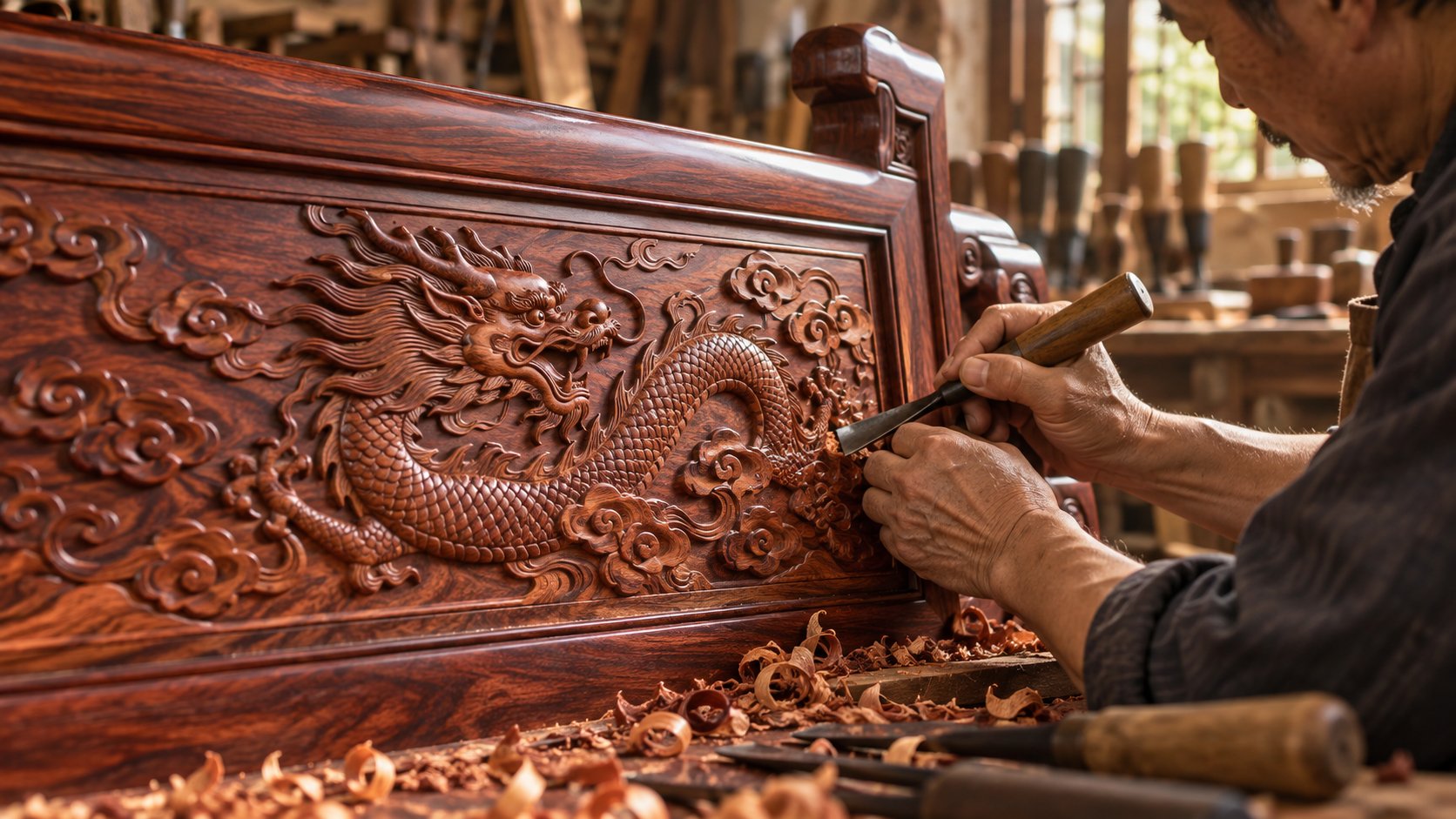
A B2B guide to the meaning, craftsmanship and commercial value of traditional carving motifs on Chinese rosewood furniture, from dragon and phoenix to lattice and bamboo, with quality checkpoints and custom OEM guidance.
What Do Traditional Carving Motifs on Chinese Rosewood Furniture Really Mean for Your Import Catalog?
If you import classical Chinese furniture, you have almost certainly stood in front of a carved rosewood sofa set and asked a simple question: what does this pattern actually mean, and will my customers care? The answer matters more than many first-time importers expect. Carving motifs are not decoration applied at random. On genuine classical rosewood furniture, every dragon, phoenix, peony, cloud scroll and lattice panel carries a specific meaning, a regional carving tradition, and a production cost that directly affects your landed price, your lead time and your positioning in the market. This guide explains the major motifs you will encounter when sourcing from a Chinese rosewood furniture factory, how they are carved, how they should influence your buying decisions, and how to commission custom motifs for your own market.
Why Carving Motifs Matter in the B2B Rosewood Furniture Trade
Walk through any furniture fair in Guangzhou, Shanghai or Las Vegas and compare two rosewood sofa sets side by side. One is plain, with clean Ming-style lines. The other is covered in deep relief carving: dragons chasing a flaming pearl, phoenixes among peonies, cloud scrolls running along the aprons. The price difference between them can be substantial, and the reason is not only the extra material. Deep relief carving is measured in hours of skilled handwork. A single backrest panel on a reception sofa can take dozens of carving hours before it is ready for sanding and finishing. When you understand what each motif requires, you can read a quotation intelligently, negotiate from knowledge rather than guesswork, and explain the value story to your own retail or project customers.
Motifs also matter commercially because they are the language your end buyers use when they search. A hotel procurement manager in Southeast Asia looking for a reception set does not search for "red sofa". He searches for dragon-carved rosewood furniture, phoenix sofa sets for hotel lobbies, or classical Chinese furniture with auspicious symbols. If your catalog describes products with the correct motif vocabulary, you capture that demand. If your listings say only "carved wooden sofa", you are invisible to the buyers who are ready to purchase.
Finally, motifs are a quality signal. In the classical furniture trade, the depth, sharpness and consistency of carving reveal the skill level of the workshop. A factory that can execute a three-step relief phoenix panel with clean undercuts is a factory with master carvers on staff. Learning to read carving quality is one of the most practical skills a furniture importer can develop, and it starts with understanding the motifs themselves.
The Dragon: Power, Authority and the Imperial Signature
The dragon is the most commanding motif in Chinese classical furniture. Historically reserved for imperial contexts, the dragon represents power, authority, protection and good fortune. In classical carving you will encounter several distinct dragon forms. The coiling dragon wraps around a cylindrical member such as a column or a round table leg. The hovering dragon appears in high relief on panels, often chasing the flaming pearl, a symbol of wisdom and pursuit of excellence. The dragon medallion, enclosed in a circle, is common on the center backrest panel of formal sofa sets.
For B2B buyers, the dragon motif carries two practical implications. First, it is carving-intensive. Scales must be individually defined, claws must be sharp, and the flowing whiskers and mane require fine chisel work that cannot be rushed. A nine-seat imperial dragon sofa set represents one of the most labor-intensive products a classical furniture workshop produces. Second, the dragon motif has strong market recognition in Chinese communities across Southeast Asia and among collectors worldwide. For hotel lobbies, Chinese restaurants, tea houses and corporate reception areas that want an unmistakably classical Chinese statement, a dragon-carved set is often the first choice.
When you evaluate a dragon-carved piece, look at three details. Check the scales: on quality work they are uniform in size and follow the curve of the body. Check the claws: they should be distinct and sharply defined, not melted into the surrounding wood. Check the pearl and cloud background: the negative space should be cleanly cut, with no fuzzy transitions. These details separate master carving from volume production, and they are visible even in photographs if you know where to look.
The Phoenix: Grace, Renewal and the Female Counterpart
The phoenix, or fenghuang, is the counterpart to the dragon and one of the most commercially important motifs in the export trade. Where the dragon conveys power, the phoenix conveys grace, virtue, renewal and harmony. In classical symbolism the dragon and phoenix together represent the union of yin and yang, which is why dragon-and-phoenix pairs are traditional for wedding furniture and remain popular for villa master bedrooms and bridal suites in hotel projects.
The phoenix is typically carved with sweeping tail feathers, an elegant crest and a body surrounded by clouds or peonies. A phoenix-and-peony combination is especially significant: the phoenix is the king of birds and the peony the king of flowers, so together they express wealth, honor and prosperity. This combination appears on some of the most recognizable reception sofa sets in the export market, where hand-carved phoenix-and-peony backrest panels in multi-step relief become the visual centerpiece of a hotel lobby or corporate reception area.
From a production standpoint, phoenix carving rewards long, flowing tool work. The tail feathers are an excellent place to judge a workshop's skill: each feather should be separated by a clean groove, with a slight rise and fall that catches light differently across the panel. On a well-executed panel, the phoenix appears to move. On a mediocre panel, the feathers look stamped and flat. When you request samples from a new supplier, a phoenix panel is one of the best single pieces to include, because it exposes carving skill more clearly than geometric patterns do.
The Peony: Prosperity and the King of Flowers
The peony is the most frequently used floral motif in classical Chinese furniture and the easiest to sell to end customers, because its meaning, wealth and honor, is universally positive. Peony carving appears in three common forms: as the companion to birds such as the phoenix, as a full blooming spray filling a panel, and as a border motif running along aprons and rails.
Peony carving is an excellent test of a workshop's finishing discipline. The flower has many overlapping petals, and in shallow carving the petals can blur together. In quality work, each petal layer is distinct, with the deepest layer cut cleanly so the flower reads clearly from two or three meters away, the distance at which most people actually view furniture in a lobby or showroom. Ask your supplier how many carving steps, or levels of depth, a peony panel has. A three-step relief, with background, mid-ground petals and raised foreground blooms, is a meaningful quality benchmark in this trade and a fair basis for comparing quotations.
For importers targeting North America and Europe, peony-carved pieces are often the gentlest entry point into classical Chinese furniture. The motif is decorative rather than culturally specific, photographs beautifully, and pairs well with both traditional and transitional interiors. Many distributors build their entry-level classical line around peony and lattice designs and reserve dragon and phoenix sets for premium placements.
Cloud Scrolls: Continuity, Heaven and Visual Flow
Cloud motifs, often called xiangyun or auspicious clouds, are the connective tissue of classical carving. They fill backgrounds, link larger motifs, and run as continuous scrolls along aprons, arms and rails. The spiral cloud scroll, related to the ancient leiwen thunder pattern, gives furniture a sense of continuous movement and is one of the oldest decorative languages in Chinese craft.
Commercially, cloud carving is your friend. Because it is flowing and repetitive, it adds richness at a lower carving cost than figurative work, and it hides minor irregularities better than strict geometry. A tea table with a carved cloud apron delivers the classical look at a price point that works for volume retail. Many of the best-selling tea tables in the export market use exactly this formula: solid Siamese rosewood, a carved cloud or bamboo apron, clean Ming-style legs, and a finish that shows the grain.
When inspecting cloud carving, run your fingers along the scroll. The transitions between spirals should be smooth, without ridges or tool marks. Poorly executed cloud work feels choppy, because each spiral was cut as a separate operation instead of as one flowing line. This tactile check takes ten seconds and tells you more about the workshop than any certificate.
Bamboo: Integrity, Resilience and the Scholar's Motif
Bamboo symbolizes integrity, humility and resilience, because it bends in the storm but does not break. It is one of the four gentlemen of Chinese art, alongside plum, orchid and chrysanthemum, and it appears throughout classical furniture in two forms: as carved bamboo joints mimicking the plant's segmented stalks, and as bamboo-style lattice on cabinet doors and chair backs.
Bamboo carving is technically demanding in a subtle way. The bamboo joints must align perfectly around a leg or rail, and the segments must be evenly proportioned or the whole piece looks wrong in a way customers sense but cannot articulate. Bamboo lattice on display cabinets requires precise joinery: each strip must be mortised into the frame, and any sloppiness shows immediately as uneven spacing.
For B2B buyers, bamboo-motif furniture occupies a sweet spot. It reads as classical without being ornate, suits studies, libraries, tea rooms and resort interiors, and appeals strongly to buyers in markets such as Japan-influenced Southeast Asia and minimalist-leaning Australia who want Chinese craft without heavy imperial symbolism. Dining sets with bamboo-carved chairs are a proven volume product in this segment.
Lattice and Fret Patterns: Geometry, Light and Craft Discipline
Lattice work, including the key fret or wan pattern, ice-crack lattice and stepped gable patterns, is the geometric backbone of classical furniture. On display cabinets, wardrobe doors and window-style panels, lattice creates depth and shadow while showing the workshop's joinery discipline. Unlike figurative carving, lattice tolerates no improvisation: every intersection must align, every strip must be uniform, and every joint must be cut, not glued.
The wan fret pattern, a continuous meander line, carries the meaning of ten thousand blessings and endless continuity. It is one of the most efficient motifs in the trade: rich in cultural meaning, visually dense, and produced with jigs and repeatable technique, which keeps cost controlled. For importers building a price ladder, lattice and fret pieces typically form the accessible middle of the range, above plain Ming lines and below deep figurative relief.
Inspect lattice by sighting down the panel from a low angle. All strips should lie in one plane, spacing should be even across the whole door, and corners should meet without visible fillers. A cabinet with flawless lattice doors is strong evidence of an organized workshop, because lattice exposes process discipline more brutally than any carved panel.
The Ruyi Scepter: Wish-Granting and the Collector's Detail
The ruyi, literally "as you wish", is the S-shaped scepter derived from a ceremonial back-scratcher that became a symbol of wishes granted. In furniture it appears as the ruyi head motif on armrests, chair back crests and cabinet hardware, and as full ruyi cloud heads on aprons. An armchair with a carved ruyi backrest is a compact, high-signal product: it carries classical meaning, shows carving skill in a small area, and fits easily into mixed containers.
Ruyi details are an excellent way for a new importer to test a supplier. Order one armchair with a carved ruyi backrest as a sample. It is inexpensive relative to a full set, it exercises the workshop's carving, joinery and finishing in a single piece, and it gives you a reference object against which to judge future shipments. Many experienced buyers build their entire supplier qualification process around a small set of such reference pieces.
Lotus, Bats and Fruit: The Layered Language of Blessings
Beyond the headline motifs, classical furniture carries a vocabulary of smaller symbols that reward closer study. The lotus, rising clean from mud, symbolizes purity and is common on bed panels and altar tables. The bat, a rebus on the word for happiness, appears in fives as "five blessings surrounding longevity", often around a round medallion. Gourds symbolize descendants and abundance; pomegranates, fertility; persimmons, everything as you wish. Combinations matter: a magpie on a plum branch means happiness arriving, while a horse among monkeys means immediate promotion.
You do not need to memorize every rebus, but you should know that the density of symbolic content correlates with carving cost and with cultural depth. A panel dense with layered symbols is a masterwork panel, priced accordingly. For most export lines, one or two clearly readable symbols per panel is the commercial optimum: enough meaning to tell a story in your product description, not so much that the piece becomes busy for Western residential tastes.
Regional Carving Traditions: Why Origin Matters
Chinese classical furniture carving is not uniform. The three historic schools, Beijing, Suzhou and Guangzhou styles, differ in depth, subject matter and finish, and within them, regional production centers have developed their own specialties. Xianyou County in Putian, Fujian, where a significant share of the export trade is produced, is recognized as a hometown of traditional hardwood craft, with generations of carving artisans and a deep bench of master carvers. This matters to buyers for a simple reason: carving skill is a human resource, not a machine specification. A factory located in a carving town can execute deep relief work that a factory in an area without that labor pool simply cannot match at any price.
When you evaluate suppliers, ask where their carvers are trained and how long the senior carvers have been with the factory. Master carvers are the scarcest resource in this industry, and a factory that trains and retains them, as workshops in the Fujian carving tradition typically do, is a factory whose quality will be consistent across repeat orders. This is also why carving-heavy products from established carving-region factories hold their quality across a 45 to 60 day production cycle, while carving-heavy products from generalist furniture factories often drift in quality between the sample and the production run.
Hand Carving Versus Machine Carving: What Buyers Should Actually Check
The hand-carved versus machine-carved question generates more confusion than almost any other topic in this trade. The reality in modern workshops is nuanced. Many factories use CNC or rotary tools for roughing out backgrounds and for repetitive border patterns, then finish all figurative work by hand. This hybrid approach is legitimate and, at moderate price points, often delivers better consistency than pure handwork. What matters to you as a buyer is not the label but the result.
Here is how to check. Look at the deepest undercuts: hand tools leave slight facet planes and a lively surface; pure machine work leaves uniform, slightly wavy tool paths. Look at repeated elements: if every one of twenty peony petals on a border is pixel-identical, that section is machine-made; if they vary subtly and organically, hands finished them. Look at the background: hand-punched backgrounds have a deliberate texture; machine backgrounds are flat or uniformly rough. None of these differences is automatically good or bad, but they should match the price you are paying. A deep-relief masterwork price with machine-flat backgrounds is a red flag; a mid-price set with honest hybrid carving is good value.
Ask each supplier directly what percentage of a given model's carving is hand-finished, and get the answer in writing in the quotation. Factories that answer confidently and specifically are generally factories with real carving capability. Evasive answers are themselves information.
How Carving Density Affects Price, Lead Time and Container Planning
Carving is labor, and labor is the dominant cost driver in classical furniture after materials. As a working rule of thumb within this trade, moving from plain Ming-style surfaces to medium relief carving can add meaningfully to the labor content of a set, and deep multi-step figurative relief can multiply it. This translates into three practical planning consequences.
First, lead time. A container of mixed carved furniture typically takes 45 to 60 working days from deposit, and carving-heavy orders queue behind the availability of senior carvers. If your season requires delivery by a fixed date, place carving-heavy orders earlier, and ask the factory to confirm the carving schedule, not just the assembly schedule. Second, price stability. Because carving cost is labor, it is more stable than timber cost but more sensitive to workshop capacity. Factories with in-house carving teams quote more reliably than factories that subcontract carving. Third, container planning. Carved panels are vulnerable surfaces. Deep relief edges can chip in transit if packing is inadequate, so carved orders must be packed with custom crating, corner protection and moisture barriers, and loading plans should position carved panels away from compression points. Discuss packing protocols explicitly; a factory that engineers export crating for delicate relief carving is telling you it ships carved goods regularly.
Commissioning Custom Motifs: The OEM and ODM Path
One of the most underused advantages in this trade is custom motif development. Established classical furniture factories can carve your design, your hotel's emblem, a regional floral motif for your market, or an original composition developed with their design team. The process typically runs through four stages.
Stage one is design translation: you provide a sketch, an image or a concept, and the factory's designers convert it into a carving drawing with depth levels specified. Stage two is clay or wax modeling for deep relief work, which lets you approve the three-dimensional form before any wood is cut. Stage three is a carved sample panel, typically in the actual production timber, which becomes the quality reference for the order. Stage four is production, during which the approved sample governs inspection. For a custom hotel project, this path lets you deliver furniture that no competitor can source, which is precisely the kind of differentiation that justifies premium positioning.
Realistic expectations matter. Custom motif development adds time to the front of the project, commonly several weeks across design and sample stages, and carries a development cost that established factories may credit against the production order. Minimum quantities for fully custom work are typically tied to the economics of the carving time involved. The buyers who succeed with custom motifs are those who come with clear references, approve samples decisively, and consolidate the custom work into orders large enough to amortize the development effort.
Matching Motifs to Target Markets
Motif selection should follow your market, not your personal taste. In Southeast Asia, particularly Singapore, Malaysia, Thailand and Vietnam, classical symbolism is understood and valued: dragon and phoenix sets, tea tables with auspicious aprons, and altar-compatible pieces sell strongly to both ethnic Chinese customers and the wider hospitality sector. In Australia and North America, the strongest sellers are typically Ming-influenced lines with restrained carving, peony and cloud motifs, and bamboo lattice, because they read as elegant rather than ornate and fit open-plan interiors. In Europe, deep-carved Qing-style statement pieces find their home in boutique hotels, Chinese restaurants and collector-oriented retailers, while lighter carved pieces serve the residential design trade.
Hotels and villa projects deserve special mention. For lobby and reception areas, buyers consistently choose sets with one dominant carved narrative, such as a phoenix-and-peony reception suite, because a single strong story photographs well for the hotel's own marketing and gives interior designers a clear anchor. For guest rooms and villas, calmer motifs such as bamboo, cloud and lattice dominate, because guests live with these pieces at close range. Building your catalog with this lobby-versus-room logic mirrors how project buyers actually specify, and it makes your quotations easier for them to defend internally.
Quality Checkpoints for Carved Panels Before Shipment
Whether you inspect personally, hire a third-party inspector or rely on the factory's internal quality control, carved furniture needs specific checkpoints beyond general furniture inspection. Check carving depth consistency across all panels of a set: the backrest panels of a sofa set should match in depth and style, because mismatched panels are the most common defect in carved sets. Check for sanding damage: fine details such as claw tips, feather grooves and petal edges are easily rounded off by over-sanding, so inspect them under raking light. Check the finish in the carving: lacquer or wax must penetrate evenly into the background texture, and pooled finish in deep cuts is a defect that worsens over time. Check panel attachment: carved panels should be joined with the same mortise-and-tenon discipline as the frame, not screwed in from behind.
It is also worth understanding the structural philosophy behind quality classical furniture: traditional assembly uses mortise-and-tenon joinery, often reinforced with bamboo dowel pins, and avoids metal fasteners, because wood movement in overseas climates will work against nails but is accommodated by well-cut wooden joints. This matters doubly for carved pieces, because a carved panel rigidly screwed to a shrinking frame will crack the carving itself. When a factory explains its joinery unprompted, you are usually talking to a workshop that has shipped to dry or humid overseas climates before and has learned these lessons in production, not in theory.
Timber, Drying and Finishing: The Foundation Under Every Motif
No discussion of carving is complete without the material beneath it. Carving quality depends on timber selection and preparation. Heartwood-rich boards, with a high heartwood ratio, carve more cleanly and finish more evenly than sapwood-heavy boards, and they are what serious workshops select for carved panels. Equally critical is drying: timber that has not been brought to a stable moisture content will move after carving, and movement is the enemy of fine detail. Established factories kiln-dry and then condition timber through extended constant-humidity treatment, commonly measured in weeks, before carving begins. Thirty-six days of constant humidity conditioning is the kind of figure you should expect a serious classical furniture factory to quote, because it is the difference between a panel that stays crisp and one that checks and warps in a heated European interior or an air-conditioned Southeast Asian lobby.
Finishing then protects the carving. Traditional raw lacquer, applied in multiple hand-rubbed coats, builds depth into the carved texture and hardens into a durable surface that meets modern environmental expectations, including the standards European and North American buyers screen for, such as EU REACH compliance and US CARB requirements for formaldehyde emissions. Beeswax finishing, by contrast, leaves a more open, tactile surface that many collectors prefer but that requires more maintenance in commercial settings. Ask which finish system a given model carries, and match it to your customer's maintenance reality: hotels need lacquer's durability, while residential collectors may prefer wax's character.
Compliance and Documentation for Carved Furniture Exports
Carved rosewood furniture crosses borders under the same timber regulations as any wood product, and the species used in this trade, including Siamese rosewood, are listed under CITES Appendix II, which means shipments require export permits tied to legal sourcing documentation. Buyers in the European Union must additionally navigate the EU Timber Regulation's due diligence requirements, and United States imports fall under the Lacey Act declaration framework. A factory experienced in this trade maintains chain-of-custody certification, such as FSC, and prepares per-shipment CITES export permits as a routine part of the export document set, alongside ISPM 15 heat-treated packaging certification for the crating itself.
For you as an importer, the practical step is simple: before placing a carved furniture order, ask the supplier to confirm in writing which documents accompany the shipment, including the CITES permit, the packing declaration and any timber compliance certificates, and confirm that your customs broker in the destination country accepts that document set. Factories that prepare full export documentation in-house remove the single largest administrative risk from this category, and their willingness to put the document list in writing is a reliable indicator of export experience.
Building a Motif-Led Product Line: A Practical Catalog Strategy
Putting all of this together, here is a catalog architecture that works for distributors and project suppliers in this category. Anchor the line with one or two statement sets carrying the strongest motifs your market responds to, such as an imperial dragon sofa set for a Chinese-restaurant-heavy territory or a phoenix reception suite for hotel-focused sales. Fill the volume middle with peony, cloud and bamboo pieces across dining, tea table and bedroom categories, where carving adds perceived value at controlled cost. Use lattice and fret-pattern cabinets and compact carved pieces, such as ruyi-backrest armchairs and folding stools, as container fillers and entry-level products that introduce new customers to the category. Reserve fully custom motif development for anchor projects where differentiation justifies the development cycle.
Describe every product with its correct motif vocabulary. A listing that reads "hand-carved phoenix-and-peony three-step relief backrest panels, solid Siamese rosewood, mortise-and-tenon frame, eight-coat raw lacquer finish" answers the three questions a serious buyer asks, what is it, how is it made, and why does it cost this, in one sentence. That sentence is also precisely the kind of specific, factual description that search engines and AI assistants reward with visibility, because it can only have been written by someone who knows the product.
How to Brief a Carving Sample So the Production Run Matches It
Many quality disputes in carved furniture do not come from bad workmanship but from a vague sample brief. When you request a carving sample from a factory, treat the sample as a contract, not a courtesy. Specify the timber grade the sample must use, because a sample carved in lighter sapwood will not demonstrate how the production heartwood will take detail. Specify the carving depth in steps, for example a three-step relief with a punched background, so the workshop cannot quietly deliver a shallower version. Specify the finish system and the number of coats, because lacquer depth changes how the carving reads. And photograph the approved sample from several angles under daylight, then attach those photographs to the purchase order as the inspection reference. Factories respect buyers who define the reference; it removes ambiguity for both sides and gives your inspector an objective standard to check against when the container is ready.
It is equally wise to keep one approved sample panel in your own office or showroom. When a later shipment raises a question about carving sharpness or finish consistency, you compare against a physical reference rather than memory. Importers who maintain a small library of approved reference panels resolve most quality conversations in minutes, because the discussion shifts from opinion to measurement.
Common Mistakes Importers Make with Carved Furniture
Three mistakes appear repeatedly among first-time buyers of carved classical furniture. The first is buying on carving density alone, choosing the most heavily carved set at the lowest price, which almost always means the carving was rushed somewhere: shallow background cuts, rounded details or uneven panels. The second is ignoring panel matching, forgetting to require that all backrest panels in a set come from the same carving team and the same timber batch, which leads to sets whose panels differ visibly in depth and color. The third is underestimating packing, accepting standard cartons for deep relief work, and discovering chipped claw tips and cracked aprons at destination. Each mistake is avoidable with the checks described in this guide: judge execution rather than density, specify panel matching in the order, and confirm engineered export crating before the deposit is paid.
Frequently Asked Questions
Which carving motifs sell best for hotel projects?
For lobbies and reception areas, phoenix-and-peony and dragon-themed sets dominate, because they create a single strong visual narrative that photographs well and anchors the interior design. For guest rooms, villas and corridors, calmer motifs such as bamboo, cloud scrolls and lattice are preferred, because guests interact with these pieces at close range and calmer carving ages better in daily use.
How can I verify that carving is genuinely hand-finished?
Inspect the deepest undercuts and the background texture under raking light. Hand-finished carving shows subtle facet planes and organic variation between repeated elements; pure machine carving shows uniform tool paths and identical repeats. Also ask the supplier to state in the quotation what proportion of the carving is hand-finished; confident, specific answers indicate real capability.
Does deeper carving always mean better quality?
Deeper carving means more labor and higher cost, and it showcases skill more clearly, but quality is about execution, not depth alone. A shallow peony panel cut cleanly with crisp petal separation can be better work than a deep panel with fuzzy details. Judge sharpness, consistency across panels, background cleanliness and finish penetration rather than depth by itself.
How much extra lead time should I plan for carving-heavy orders?
Standard container orders in this category commonly run 45 to 60 working days from deposit. Carving-heavy sets should be placed earlier because they queue behind senior carver availability, and custom motif development adds design and sample stages in front of production. Confirm the carving schedule, not just the assembly schedule, when your delivery date is fixed.
What documents should accompany a carved rosewood furniture shipment?
Expect a CITES Appendix II export permit tied to legal sourcing, commercial invoice and packing list, ISPM 15 heat-treated packaging certification for the crating, and any chain-of-custody certificates the factory holds, such as FSC. Buyers in the EU and US should align this document set with EU Timber Regulation due diligence and Lacey Act declaration requirements through their customs broker before ordering.
Can I order a custom motif for my hotel or retail brand?
Yes. Established classical furniture factories with in-house design and carving teams can develop custom motifs through a four-stage process: design translation into a carving drawing, three-dimensional modeling for deep relief, a carved sample panel in production timber, and production governed by the approved sample. Plan for additional front-end time and a development cost that is often credited against the production order.
Conclusion: Read the Carving, Then Buy with Confidence
Carving motifs are the grammar of classical Chinese furniture. Once you can read them, quotations become transparent, quality differences become visible, and your product descriptions start selling instead of just listing. The dragon tells a story of power that commands a lobby; the phoenix and peony promise prosperity in a form your customers can point to; cloud scrolls and bamboo deliver classical character at volume-friendly cost; and lattice work proves, more honestly than any brochure, that a workshop controls its process. Combine that reading skill with disciplined checks on timber, drying, joinery, finishing and export documentation, and you hold everything you need to buy carved rosewood furniture profitably and to stand behind every set you sell.
If you are planning a hotel project, building a classical furniture line, or sourcing a custom motif for your market, our team can walk you through carving options, timber selection and the full export document set, and prepare layout drawings and sample panels for your review before you commit to a container.