
A B2B buyer's guide to what rosewood furniture is made of — solid Siamese rosewood, mortise-and-tenon joinery, lacquer finishes, drying, compliance and sourcing.
What Is Rosewood Furniture Made Of? A Complete B2B Buyer's Guide to Materials, Quality and Sourcing
If you are an importer, wholesaler, hotel buyer or interior designer sourcing classical furniture from China, one of the first questions you will ask is simple: what is rosewood furniture made of? The answer determines everything you care about — the price you pay, the quality you receive, the compliance paperwork you must file, and whether the pieces will survive the journey to your market and last for decades in your clients' homes or properties. This guide walks through every material that goes into a genuine rosewood furniture piece, what separates authentic solid rosewood from imitations, and how to verify quality and sourcing before you commit to an order.
Rosewood furniture is not a single, uniform product. It is a category that spans different wood species, different construction methods, different finishes and different levels of quality. Two pieces that look almost identical in a photograph can be radically different in the materials they contain and in the price they command. For a B2B buyer, understanding these differences is not optional — it is the difference between a profitable, long-term supply relationship and a costly mistake that you will be explaining to your own customers for years.
Why the Question Matters for B2B Buyers
For a consumer, "what is rosewood furniture made of" is a matter of curiosity. For a B2B buyer, it is a matter of risk and margin. The materials in a rosewood furniture set determine its durability, its resale value, its compliance with timber regulations in your destination country, and its cost. A single container of furniture built from the wrong materials, or from timber that cannot be documented, can become a costly problem at customs or a reputation risk with your end customers.
When you understand exactly what goes into a piece — the wood species, the joinery, the finish, the drying process, the upholstery and the hardware — you can compare suppliers on an apples-to-apples basis, ask the right questions, and avoid paying premium prices for furniture that is not what it claims to be. This guide gives you that foundation.
There is also a practical commercial reason to understand the materials. When you import furniture, you are not just buying a product; you are buying a promise that the product will perform in your market. If the wood is not properly dried, it will crack. If the joinery is weak, the piece will wobble and fail. If the finish does not meet your market's chemical regulations, you may not be able to sell it at all. Every one of these outcomes traces back to the materials and how they are handled.
The Core Material: What "Rosewood" Actually Means
The first thing to understand is that "rosewood" is not a single species. It is a family of tropical hardwoods in the genus Dalbergia, prized for their density, rich colour, natural oils and stability. The most famous and most valuable of these for classical Chinese furniture is Siamese rosewood, botanically Dalbergia cochinchinensis. This is the species that Yunxiao Rosewood Furniture uses for its classical collections.
Siamese rosewood is a premium timber. It is heavy, hard and dense, with a deep reddish-brown heartwood that darkens beautifully with age and use. Its natural oils give it a subtle sheen and help it resist moisture and insects. Because it is slow-growing and increasingly regulated under CITES (the Convention on International Trade in Endangered Species), genuine Siamese rosewood commands a higher price than ordinary hardwoods — which is exactly why some suppliers cut corners with cheaper substitutes.
The density of Siamese rosewood is one of its defining characteristics. When you pick up a piece of solid Siamese rosewood furniture, you feel its weight immediately. This density translates directly into durability — the wood resists dents, scratches and warping far better than softer, lighter timbers. It is also why genuine rosewood furniture feels substantial and premium in a way that veneered or finger-jointed pieces simply cannot match.
Other Timbers in the Mix
Not every piece of classical furniture is made from a single species. A reputable factory may use a combination of legally certified timbers depending on the product and the buyer's budget. Yunxiao, for example, states that it uses legally certified Machilus Nanmu, aged red wood and Grade-A tropical hardwood alongside Siamese rosewood. Understanding this matters because it affects both price and the documentation you will need.
Machilus Nanmu is a valuable hardwood in its own right, prized in traditional Chinese furniture for its fine grain and pleasant aroma. Aged red wood refers to timber that has been seasoned over time, which improves its stability. Grade-A tropical hardwood is a general category of high-quality imported hardwoods. When these materials are used alongside Siamese rosewood, they allow a factory to offer a range of price points while maintaining a high standard of quality.
When you ask a supplier "what is rosewood furniture made of", a straight answer should name the specific species used for the primary frame, the panels, and any secondary components. Vague answers like "high-quality wood" are a red flag. You want species names, and you want them documented.
The History and Cultural Significance of Rosewood Furniture
To understand what rosewood furniture is made of, it helps to understand why it is made the way it is. Classical Chinese rosewood furniture has a history that stretches back centuries. It reached its artistic peak during the Ming and Qing dynasties, when master craftsmen developed the techniques and aesthetics that still define the craft today.
The Ming dynasty is known for its clean, elegant lines and minimal ornamentation, letting the beauty of the wood speak for itself. The Qing dynasty is known for more elaborate carving and decoration. Both styles are prized by collectors and buyers today, and both rely on the same fundamental materials and techniques — solid hardwood, mortise-and-tenon joinery, and natural finishes.
This heritage is not just historical. It is a living craft. In Xianyou County, Fujian — the hometown of traditional hardwood craft — artisans still practice these techniques today. When you source rosewood furniture from a factory in this region, you are drawing on generations of accumulated skill. This is why the region is known for producing some of the finest classical furniture in China.
For a B2B buyer, this heritage matters because it affects the quality and authenticity of what you receive. A factory rooted in the traditional craft is more likely to produce furniture that is genuinely well-made, using the materials and techniques that have proven themselves over centuries. It is also more likely to have the skilled artisans needed for hand-carving and precise joinery.
Solid Wood vs. Veneer, MDF and Finger Joints
One of the most important quality distinctions in rosewood furniture is whether the piece is built from solid wood throughout, or whether it uses veneer, medium-density fibreboard (MDF), or finger-jointed cores hidden under a thin layer of real rosewood.
Genuine solid rosewood furniture is constructed from solid timber in the load-bearing components — the frame, the legs, the rails, the panels. There is no veneer, no MDF, and no finger joints in the structural parts. This is what gives the furniture its weight, its stability and its long service life. A solid rosewood dining table or sofa set is heavy, and that weight is a sign of authenticity.
By contrast, cheaper "rosewood" furniture may use a thin rosewood veneer over a cheaper core, or finger-jointed pieces of wood glued together. These pieces are lighter, less stable, and far less durable. They may look similar in a photograph, but they will not perform the same way in a hotel lobby or a family home over twenty years.
Veneer is not inherently bad — it is used in many quality furniture products for specific purposes. But it is a different product from solid wood, and it should be priced and described as such. The problem arises when a supplier sells veneered furniture as "solid rosewood" at a solid-wood price. That is where the risk lies for a B2B buyer.
Buyer tip: When evaluating a supplier, ask directly whether the load-bearing components are solid rosewood with no veneer, no MDF and no finger joints. A transparent factory will tell you exactly what is in the frame. This single question separates genuine solid rosewood furniture from imitations faster than almost any other.
The Joinery: Mortise-and-Tenon, Not Metal Nails
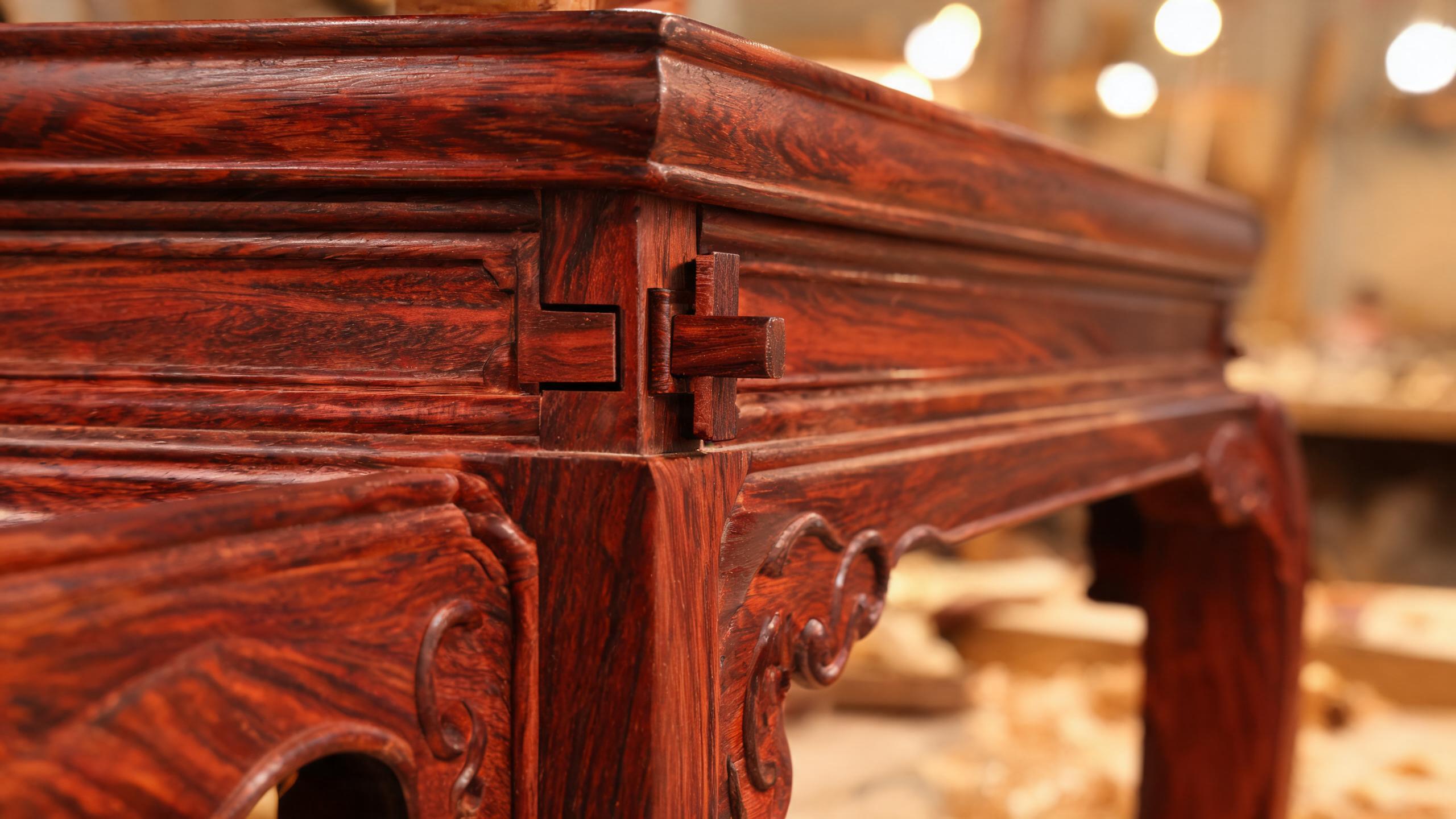
The way a rosewood furniture piece is assembled is as important as the wood itself. Traditional Chinese classical furniture is built using mortise-and-tenon joinery — interlocking joints cut into the wood that fit together without metal nails or screws. This is not just tradition for tradition's sake; it is a superior engineering method.
Mortise-and-tenon joints allow the wood to expand and contract naturally with changes in temperature and humidity. Metal fasteners, by contrast, do not flex with the wood. Over time, they can work loose, cause the wood to crack, or deform the frame. This is why genuine classical rosewood furniture is assembled without metal nails — to avoid cracking and deformation, especially when the furniture is shipped to climates very different from the factory's.
In Yunxiao's workshop, artisans use traditional mortise-and-tenon techniques with bamboo dowel pins in the primary frame — zero metal fasteners. The joints are cut by hand and fitted precisely, so the piece is stable without a single nail. For a B2B buyer, this joinery is a direct indicator of quality and longevity. A piece held together with screws and glue is not classical rosewood furniture in the traditional sense, no matter how it looks.
The skill required to cut a precise mortise-and-tenon joint by hand is considerable. It takes years of training for an artisan to develop the eye and the hand to fit joints that are strong, tight and invisible once assembled. This craftsmanship is one of the reasons genuine classical rosewood furniture is more expensive — and more durable — than mass-produced furniture assembled with fasteners.
The Drying Process: Why Moisture Content Matters
Wood is a living material that absorbs and releases moisture. If it is not dried correctly before it is made into furniture, it will warp, crack or split after it reaches your market. This is one of the most common causes of warranty claims on imported solid wood furniture — and it is entirely preventable with proper drying.
A serious rosewood furniture factory kiln-dries its timber to a controlled moisture content before machining. Yunxiao, for example, kiln-dries its timber to 8–12 percent moisture content with a 48-hour equalization period, and gives each product a 36-day constant-humidity drying cycle. This conditioning ensures the wood is stable enough to survive the journey to Europe, North America, Australia or Southeast Asia and to perform well in the buyer's local climate.
When you ask a supplier about materials, always ask about the drying process. A factory that cannot tell you its target moisture content or its drying cycle is not controlling one of the most important quality variables in solid wood furniture.
The moisture content of wood is expressed as a percentage of the wood's dry weight. Wood that is too wet will shrink and crack as it dries in your climate. Wood that is too dry can absorb moisture and swell. The goal is to condition the wood to a moisture content that is stable and appropriate for the climates where the furniture will be used. A factory that understands this — and can tell you its target range — is demonstrating real technical competence.
The Finish: Lacquer, Beeswax and Compliance
The finish on rosewood furniture is both a protective layer and a major compliance consideration. Traditional classical furniture is finished with raw lacquer and beeswax — natural, eco-friendly materials that protect the wood while letting its natural grain and colour show through.
A high-quality lacquer finish is applied in multiple thin coats, each cured and hand-rubbed. Yunxiao, for example, applies a six-coat raw lacquer finish, with each coat cured for 24 hours and hand-rubbed with pumice stone for a penetrating satin sheen. This is labour-intensive, which is why it costs more — but it produces a finish that is durable, beautiful and safe.
The eco-friendly nature of the finish is not just a marketing point. It is a compliance point. Finishes used in furniture exported to the European Union and the United States must meet chemical safety standards. Yunxiao states that its beeswax and lacquer finishing meets EU REACH and US CARB standards. For a B2B buyer, this means the finish will not create regulatory problems in your destination market, and it is safe for use in homes, hotels and commercial spaces.
The finish also affects the appearance and feel of the furniture. A well-applied lacquer finish deepens the colour of the rosewood, brings out the grain, and creates a smooth, satin surface that is pleasant to touch and easy to clean. A poor finish can look dull, feel rough, or peel and crack over time. The number of coats, the curing time and the hand-rubbing all contribute to the final quality.
Upholstery and Secondary Materials
For sofa sets and other upholstered pieces, the materials extend beyond the wood. The cushions, the fabric or leather, the foam, and the springs all form part of the finished product. When you ask what a rosewood sofa set is made of, you need to know what is inside the cushions as well as what is in the frame.
A reputable supplier will specify the upholstery materials, the density of the foam, the type of fabric or leather, and whether the cushions are removable and replaceable. These details affect comfort, durability, maintenance and cost. They also affect compliance, since upholstery materials may be subject to flammability and chemical regulations in your market.
For a B2B buyer, the practical question is whether the upholstery can be customized to your market's preferences and regulations. A factory that offers flexible OEM and ODM options can adjust fabric, colour, foam density and dimensions to suit your requirements — which is a significant advantage when you are sourcing for a specific project or market.
The quality of the upholstery matters as much as the quality of the wood. A beautiful rosewood frame with cheap, sagging cushions will disappoint your customers. When you evaluate a sofa set, ask about the foam density, the fabric grade and the construction of the cushions. These details determine how the piece feels and how long it lasts.
Hardware and Accessories
Traditional classical rosewood furniture is designed to be assembled without metal hardware in the primary frame. However, functional pieces such as cabinets, wardrobes and sideboards may include hinges, handles, locks and drawer slides. The quality of these fittings matters for the long-term function of the piece.
When sourcing, ask what hardware is used, whether it is solid brass or a cheaper substitute, and whether it is replaceable. High-quality hardware that matches the classical aesthetic adds to the value and longevity of the piece. Cheap hardware that corrodes or fails will undermine an otherwise excellent piece of furniture.
Drawer construction is another detail worth examining. Traditional furniture may use dovetail joints on drawers, which are strong and durable. Floating-panel construction on doors and panels allows the wood to move with seasonal changes without cracking. These details are signs of thoughtful, high-quality construction that will serve your customers well for decades.
The Carving: Hand-Carved vs. Machine-Carved
Classical rosewood furniture is famous for its intricate carving — dragons, clouds, lattice patterns, ruyi sceptres and other traditional motifs. The carving is not just decoration; it is a major part of the value and character of the piece. Understanding how the carving is done helps you judge quality.
Hand-carved furniture is created by skilled artisans using traditional chisels and tools. Each piece is unique, with the subtle variations that come from human hands. Hand carving is labour-intensive and time-consuming — a single carved panel can take many hours of work. This is reflected in the price.
Machine-carved furniture is produced using CNC routers and other automated equipment. It is faster and cheaper, and it can reproduce a design consistently. However, machine carving tends to be shallower and less refined than hand carving, and it lacks the depth and character of hand work.
For a B2B buyer, the choice between hand-carved and machine-carved depends on your market and your price point. Hand-carved pieces command a premium and appeal to buyers who value craftsmanship and authenticity. Machine-carved pieces offer a more accessible price. The key is to know which you are buying and to price it accordingly.
Quality Indicators Every B2B Buyer Should Verify
Now that you understand the materials, here is a practical checklist of quality indicators to verify with any rosewood furniture supplier. These are the questions that separate a genuine, well-made piece from an imitation or a poorly constructed one.
- Species documentation: Can the supplier name the exact species (for example, Dalbergia cochinchinensis) and provide documentation for it?
- Solid construction: Are the load-bearing components solid wood with no veneer, MDF or finger joints?
- Joinery: Is the frame assembled with mortise-and-tenon joints and no metal nails?
- Drying: What is the target moisture content and drying cycle?
- Finish: What finish is used, and does it meet EU REACH and US CARB standards?
- Compliance documents: Can the supplier provide FSC and CITES documentation for the timber?
- Packaging: Is the furniture packed to ISPM 15 heat-treated standards for export?
- Carving: Is the carving hand-carved or machine-carved, and what does that mean for the price?
- Upholstery: What are the foam density, fabric grade and cushion construction for upholstered pieces?
Each of these points is verifiable. A transparent supplier will answer them directly and provide the supporting documents. A supplier that cannot or will not answer them is a risk you do not need to take.
Compliance and Documentation: FSC, CITES and ISPM 15
For B2B buyers importing rosewood furniture, compliance is not optional. Rosewood species, including Siamese rosewood, are regulated under CITES. Depending on your destination country, you may also need to comply with the EU Timber Regulation (EUTR) or the US Lacey Act, which require you to demonstrate that the timber was legally harvested.
A reliable supplier prepares the full export documentation for you. Yunxiao, for example, states that its internal team prepares full export documents, FSC certificates and ISPM 15 heat-treated packaging, and that its shipments include FSC chain-of-custody documentation and CITES Appendix II export permits and re-export certificates. This is exactly the kind of documentation you need to clear customs and to demonstrate legal sourcing to your own customers and regulators.
When you ask "what is rosewood furniture made of", the answer should include not just the wood species but the paper trail that proves the wood is legal. A supplier that cannot provide CITES and FSC documentation for regulated rosewood is a serious compliance risk.
ISPM 15 is an international standard for heat-treating wood packaging material to prevent the spread of pests. Furniture that is shipped in ISPM 15-compliant packaging meets the phytosanitary requirements of most countries. This is another detail that affects whether your shipment clears customs smoothly.
Sourcing Considerations for B2B Buyers
Understanding the materials is the foundation, but sourcing well also means understanding the commercial terms. Here are the sourcing factors that matter alongside material quality.
- Minimum order and trial options: Can you order a trial single set before committing to a container? Yunxiao offers trial single sets and refundable samples, which lets you verify quality before a large investment.
- Lead time: Container orders typically take 45–60 working days after deposit. Plan your inventory and project timelines accordingly.
- Customization: Does the factory offer OEM and ODM custom sizes and patterns? For villas, resorts and whole-house projects, customization is often essential.
- Support: Does the supplier offer remote installation guidance and free layout drawings? These services reduce risk and cost on your side.
- Partial shipments: For long-term partners, can the factory ship partial orders? This helps manage cash flow and inventory.
A factory that offers trial orders, transparent lead times, customization and installation support is demonstrating confidence in its product and a genuine partnership approach — both of which matter when you are building a long-term supply relationship.
It is also worth considering the factory's location and history. Yunxiao is located in Xianyou County, Putian City, Fujian — the hometown of traditional hardwood craft. This region has a deep heritage of hardwood furniture making, which means access to skilled artisans and established supply chains. A factory with this kind of heritage is more likely to produce authentic, high-quality classical furniture.
Customization and OEM/ODM: Materials Tailored to Your Market
One of the advantages of sourcing from a factory like Yunxiao is the ability to customize. Because the factory controls the entire process — from timber selection and drying to joinery, carving and finishing — it can adjust sizes, patterns, finishes and upholstery to suit your market and your projects.
For a B2B buyer, this means you are not limited to a fixed catalog. You can specify the dimensions of a dining table to fit a particular room, choose the carving motifs that appeal to your customers, select the finish that meets your market's regulations, and adjust the upholstery to your local preferences. This flexibility is particularly valuable for hotel, resort and whole-house projects where every piece must fit a specific space and design brief.
When you discuss customization with a supplier, be specific about the materials you want. Specify the species, the joinery, the finish, the moisture content target and the compliance documents you require. A factory that can meet these specifications in writing is a partner you can build a business around.
OEM and ODM are two common models. Under OEM (original equipment manufacturing), the factory produces furniture to your specifications and branding. Under ODM (original design manufacturing), the factory contributes its own design expertise. Both models allow you to offer products that are tailored to your market without building your own factory.
Applications: Where Rosewood Furniture Is Used
Understanding what rosewood furniture is made of also helps you understand where it is used. Rosewood furniture is prized for its beauty, durability and prestige, which makes it a natural fit for a range of applications.
In residential settings, rosewood furniture is often the centrepiece of a living room, dining room or bedroom. A carved rosewood sofa set with tea tables, a dining set, or a complete bedroom suite brings warmth, elegance and a sense of heritage to a home. Buyers in Southeast Asia, Australia, Europe and North America increasingly seek these pieces for their distinctive character.
In hospitality, rosewood furniture is used in hotels, resorts and boutique properties where the design needs to make a statement. A grand carved sofa set in a hotel lobby, or a classical dining set in a resort restaurant, creates an atmosphere that ordinary furniture cannot. For these projects, the durability and prestige of rosewood are major advantages.
In commercial and office settings, rosewood furniture is used in executive offices, boardrooms and reception areas where a sense of quality and authority matters. The rich colour and fine craftsmanship convey a level of professionalism and permanence that is hard to achieve with other materials.
For whole-house projects, a factory that offers coordinated sofa, dining and bedroom sets can furnish an entire residence with a consistent style. This is a growing trend among buyers who want a cohesive, high-end look throughout a property.
Price Factors: Why Rosewood Furniture Costs What It Does
Understanding the materials also helps you understand the price. Rosewood furniture is not cheap, and there are good reasons for that. The timber itself is expensive and increasingly regulated. The craftsmanship is labour-intensive. The drying, finishing and compliance processes add cost. When you understand these factors, you can evaluate whether a price is fair.
The species of wood is the single biggest cost driver. Siamese rosewood is more expensive than ordinary hardwoods because it is slow-growing, scarce and regulated. The amount of solid wood in the piece also matters — a solid-wood piece uses far more timber than a veneered piece. The joinery, carving and finish all add labour cost.
Compliance also adds cost. FSC certification, CITES permits and ISPM 15 packaging all require documentation and processes that cost money. A supplier that provides these documents is building those costs into the price. A supplier that does not provide them may be cheaper — but you may pay for that saving later at customs or in your own compliance obligations.
For a B2B buyer, the lesson is to compare total cost, not just unit price. A slightly higher price from a supplier that provides full documentation, solid construction and proper drying may be far cheaper in the long run than a lower price from a supplier that cuts corners.
Common Mistakes Buyers Make When Sourcing Rosewood Furniture
Even experienced buyers can make costly mistakes when sourcing rosewood furniture. Here are the most common ones to avoid.
- Judging quality by photos alone: A photograph cannot show you whether the frame is solid wood or veneer, or whether the joinery is mortise-and-tenon or nailed. Always verify the construction details in writing.
- Ignoring compliance: Rosewood is regulated. Failing to secure CITES and FSC documentation can stop your shipment at customs and create legal exposure.
- Overlooking the drying process: Furniture that is not properly dried will crack and warp in your market. Ask about moisture content and drying cycles before you order.
- Choosing price over documentation: The cheapest quote is often the one with the least documentation and the lowest material quality. Factor compliance and durability into your total cost.
- Skipping a trial order: A trial single set or sample is a small investment that can save you from a costly container of substandard furniture.
- Assuming all rosewood is the same: Different species, different construction and different finishes produce very different products. Know exactly what you are buying.
Avoiding these mistakes comes down to one principle: verify the materials and the documentation before you commit, not after.
Frequently Asked Questions
What is rosewood furniture made of?
Genuine rosewood furniture is made from solid tropical hardwood in the Dalbergia genus, most commonly Siamese rosewood (Dalbergia cochinchinensis) for classical Chinese furniture. It is assembled with mortise-and-tenon joinery without metal nails, finished with raw lacquer and beeswax, and kiln-dried to a controlled moisture content.
Is all rosewood furniture solid wood?
No. Some cheaper furniture uses a thin rosewood veneer over a cheaper core, or finger-jointed wood. Genuine solid rosewood furniture has no veneer, no MDF and no finger joints in the load-bearing components. Always ask the supplier to confirm this in writing.
Why is rosewood furniture assembled without metal nails?
Traditional mortise-and-tenon joinery allows the wood to expand and contract naturally with changes in temperature and humidity. Metal fasteners do not flex with the wood and can cause cracking and deformation over time. This is why genuine classical rosewood furniture uses interlocking wooden joints.
What compliance documents do I need to import rosewood furniture?
Depending on your destination, you may need CITES permits, FSC chain-of-custody documentation, and evidence of compliance with the EU Timber Regulation or the US Lacey Act. A reliable supplier prepares these documents for you.
How can I tell if rosewood furniture is high quality?
Check the species documentation, confirm solid construction with no veneer or MDF, verify mortise-and-tenon joinery, ask about the drying process and moisture content, confirm the finish meets EU REACH and US CARB standards, and request FSC and CITES documentation.
Can I customize rosewood furniture for my market?
Yes. A factory with OEM and ODM capabilities can adjust sizes, patterns, finishes and upholstery to suit your market and projects. Specify your material and compliance requirements in writing when you discuss customization.
How long does it take to receive a container of rosewood furniture?
Container orders typically take 45–60 working days after deposit. This lead time includes drying, crafting, finishing and packaging. Plan your inventory and project timelines accordingly.
Can I order a single set before committing to a full container?
Many reputable factories, including Yunxiao, offer trial single sets and refundable samples. This lets you verify the quality and materials before making a larger investment.
Is rosewood furniture suitable for hotels and commercial spaces?
Yes. Rosewood furniture is prized for its durability, beauty and prestige, making it a popular choice for hotel lobbies, resort restaurants, executive offices and reception areas. Its solid construction and natural finishes are well suited to high-traffic commercial environments.
What is the difference between hand-carved and machine-carved rosewood furniture?
Hand-carved furniture is created by skilled artisans and is unique, deeper and more refined, but more expensive. Machine-carved furniture is produced with automated equipment, is more consistent and affordable, but tends to be shallower and less detailed. Know which you are buying and price it accordingly.
Conclusion: Know Your Materials, Protect Your Business
What is rosewood furniture made of? The answer is more than a list of materials. It is the foundation of every sourcing decision you make. Genuine rosewood furniture is made from solid, legally documented tropical hardwood, assembled with traditional mortise-and-tenon joinery, dried to a controlled moisture content, and finished with eco-friendly lacquer and beeswax that meet international safety standards.
When you understand these materials, you can ask the right questions, compare suppliers fairly, verify quality and compliance, and protect your business from the risks of imitations, poor construction and regulatory problems. You can also build a long-term partnership with a factory that is transparent about what goes into every piece.
Yunxiao Rosewood Furniture has been manufacturing and exporting classical solid redwood furniture since 2008, from a 12,000-square-metre factory in Xianyou County, Fujian — the hometown of traditional hardwood craft. Its artisans use traditional mortise-and-tenon techniques, kiln-dry timber to 8–12 percent moisture content, apply six-coat raw lacquer finishes, and prepare full FSC, CITES and ISPM 15 export documentation for buyers across Europe, North America, Australia and Southeast Asia.
If you are sourcing rosewood furniture for your import business, hotel, resort or residential project, take the time to understand the materials and verify the documentation. Ask the right questions, request a trial order, and build a relationship with a factory that is transparent about what goes into every piece. Your customers will thank you, and so will your bottom line.