
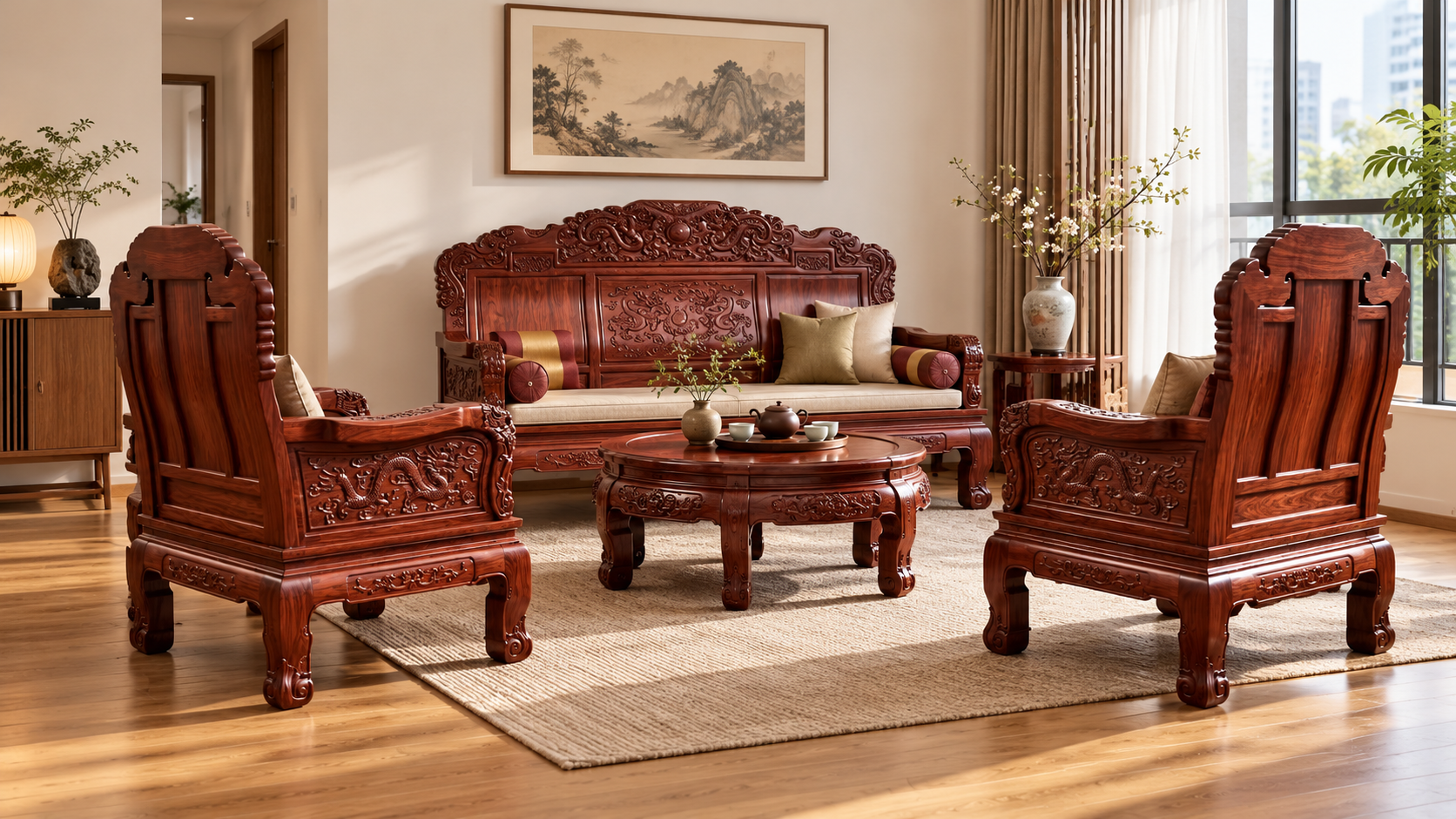
A B2B buyer's guide to compact classical rosewood furniture: a three-piece sofa set for 15 to 20 square metre living rooms, a four-seat tuck-under dining set, folding stools and round tea tables, with dimensions, joinery, freight math, OEM sizing and compliance details for importers.
Walk through any furniture fair in Milan, High Point or Dubai and you will hear the same question from importers, dealers and project buyers: how do we keep selling the classical solid-wood look when the rooms our customers live in are getting smaller? Apartments in European capitals, condominiums in Toronto and Sydney, serviced suites in Singapore and boutique hotel rooms in Bali all share the same constraint - limited floor area, tight circulation paths and end customers who refuse to give up either craftsmanship or comfort. For B2B buyers who specialise in classical Chinese furniture, this is not a niche problem. It is becoming the mainstream brief.
Classical rosewood furniture has historically been designed for grand spaces: nine-piece reception groupings, twelve-seat banquet tables, canopy beds with towering posts. Those configurations still sell, and they remain the backbone of villa and palace-hotel projects. But an increasing share of enquiries we receive at Yunxiao Rosewood Furniture now begins with a floor plan, a room dimension and a simple question: which pieces of rosewood furniture can we put into this space without crowding it?
This article answers that question the way a sourcing manager would want it answered: by looking at specific compact configurations - a three-piece rosewood sofa set, a four-seat square dining set with tuck-under stools, a rosewood folding stool and a round rosewood tea table - and by walking through the dimensions, joinery, packaging, freight and documentation details that decide whether a compact piece of solid rosewood furniture actually works for your market. Every figure quoted here comes from the production records of the corresponding Yunxiao product line, so you can carry these numbers straight into your own planning.
Why Compact Rosewood Furniture Is a Growing Import Category
The first driver is urban living. Across the markets Yunxiao serves - Europe, North America, Southeast Asia and Australia - the average size of new apartments keeps shrinking while the appetite for authentic, long-lasting materials keeps growing. A buyer furnishing a 55-square-metre city apartment does not want engineered-wood lookalikes; they want the same solid rosewood character their parents associated with a family estate, scaled to a living room that also has to hold a dining nook and a work corner. Dealers who recognised this early now dedicate an entire wall of their showroom to compact classical pieces, and their replenishment orders tell the story: smaller sets, ordered more frequently, in mixed configurations.
The second driver is the hospitality segment. Boutique hotels compete on atmosphere, not on room count. A 24-square-metre guest room with a carved rosewood armchair, a folding stool and a small tea table photographs better, reviews better and justifies a higher nightly rate than a room filled with anonymous laminated furniture. Hotel project buyers have learned that they can achieve the classical Chinese aesthetic with two or three accent pieces per room instead of a full suite, which keeps the per-room furniture budget realistic while preserving the premium feel. This is exactly where compact rosewood furniture for small spaces outperforms both full-size classical suites and mass-market imitations.
The third driver is logistics economics. Compact pieces pack into fewer crates, weigh less and open the door to LCL consolidated shipments for trial orders. A dealer who is unsure about a new classical line can test the market with a single three-piece sofa set or a handful of folding stools, receive the goods alongside other suppliers' cargo, and only commit to full containers once sell-through is proven. For first-time importers of Chinese rosewood furniture, this trial-friendly economics lowers the entry barrier dramatically - a point we will quantify later in the freight section.
The fourth driver is gifting and secondary spaces. Entryways, tea corners, reading nooks, balcony sit-outs and reception lobbies all need one or two statement pieces rather than full sets. A carved folding stool beside a round tea table creates a complete tea-ceremony vignette in under two square metres. Interior designers specify these vignettes constantly, and design-savvy retailers display them as ready-made room scenes. When a customer can see exactly how a compact grouping fits their own hallway, the sale closes itself.
What "Compact" Really Means for Solid Rosewood Furniture
Compactness in furniture is usually discussed as a single number - a footprint - but professional buyers need a more precise vocabulary. When we evaluate whether a piece of rosewood furniture genuinely suits a small space, we look at four separate measurements, and we recommend you request all four from any supplier before placing an order.
- Footprint: the floor area the piece occupies, length by depth. This determines whether the piece physically fits the room.
- Circulation clearance: the walkway that remains around the piece once it is placed. A living room needs at least 60 to 75 centimetres of clear passage; a dining chair zone needs roughly 75 to 90 centimetres behind the pulled-out seat.
- Sightline height: the backrest or tabletop height relative to the room's visual volume. High-backed carved pieces give grandeur but can overwhelm a low-ceilinged apartment; lower backs keep the room feeling open.
- Storage behaviour: whether the piece can disappear when not in use - stools that tuck under a table, folding stools that flatten against a wall, nesting pieces that share a footprint.
Full-size classical suites usually fail small rooms on circulation clearance and sightline height, not on raw footprint. A seven-piece rosewood sofa grouping can technically squeeze into a 15-square-metre room, but with 40 centimetres of walking space it becomes unusable. The compact configurations below were engineered in the opposite direction: dimensions were fixed first, around realistic room sizes and clearances, and the carving, joinery and finish were then built onto that geometry without compromise.
This is also why genuine compact rosewood furniture cannot simply be "shrunk" from an existing catalogue drawing. Proportions, joinery depths and carving fields all need to be re-engineered for smaller components - which is precisely the OEM/ODM work our design team handles, and a topic we return to later in this article.
The Living Room: A Three-Piece Rosewood Sofa Set Sized for 15 to 20 Square Metres
The living room is where the space problem bites hardest, and it is where our compact answer has been most refined. The Classical Siamese Rosewood Sofa 3-Piece Set with Carved Armrests was dimensioned specifically for living rooms of 15 to 20 square metres - the size range that covers most European apartments, North American condominium living rooms and boutique hotel lounges.
The set consists of one two-seat sofa measuring 165 centimetres in length, 62 centimetres in depth and 88 centimetres in backrest height; two single-seat armchairs, each 62 centimetres wide, 58 centimetres deep and 88 centimetres high; and one coffee table of 90 by 50 centimetres with a 45-centimetre height. Seat height across the seating pieces is 43 centimetres. In total, one set is three components and four pieces of furniture providing four seats - the coffee table is a companion piece, not a seat, a distinction worth clarifying with your own customers to prevent misunderstanding.
Arranged in the standard U-shape around the coffee table, the grouping occupies roughly 2.9 by 2.2 metres of floor. In a 15-square-metre living room of 3.5 by 4.3 metres, that leaves a circulation path of about 80 centimetres on the open side - comfortable, code-compliant and visually uncrowded. This is the arithmetic your retail staff should be able to repeat on the showroom floor, because it converts the vague promise of "compact" into a checkable number.
Crucially, none of the solid-wood specification was traded away to achieve the smaller footprint. Every frame component is cut from Siamese rosewood (Dalbergia cochinchinensis), density-sorted to a 0.90-1.00 g/cm3 band and kiln-conditioned to 8-12% moisture content. Seat rail connections use mortise-and-tenon joints cut to a 16 mm tenon depth, armrest-to-back-post junctions use 14 mm tenons, and every right-angle intersection is locked with a solid wood corner block and bamboo dowels - no metal fasteners anywhere in the primary frame. The armrest panels carry hand-carved ruyi sceptre motifs at roughly 18 carving hours per panel, and the whole set is finished with six hand-rubbed coats of raw lacquer, each cured for 24 hours and burnished with pumice stone to a satin sheen.
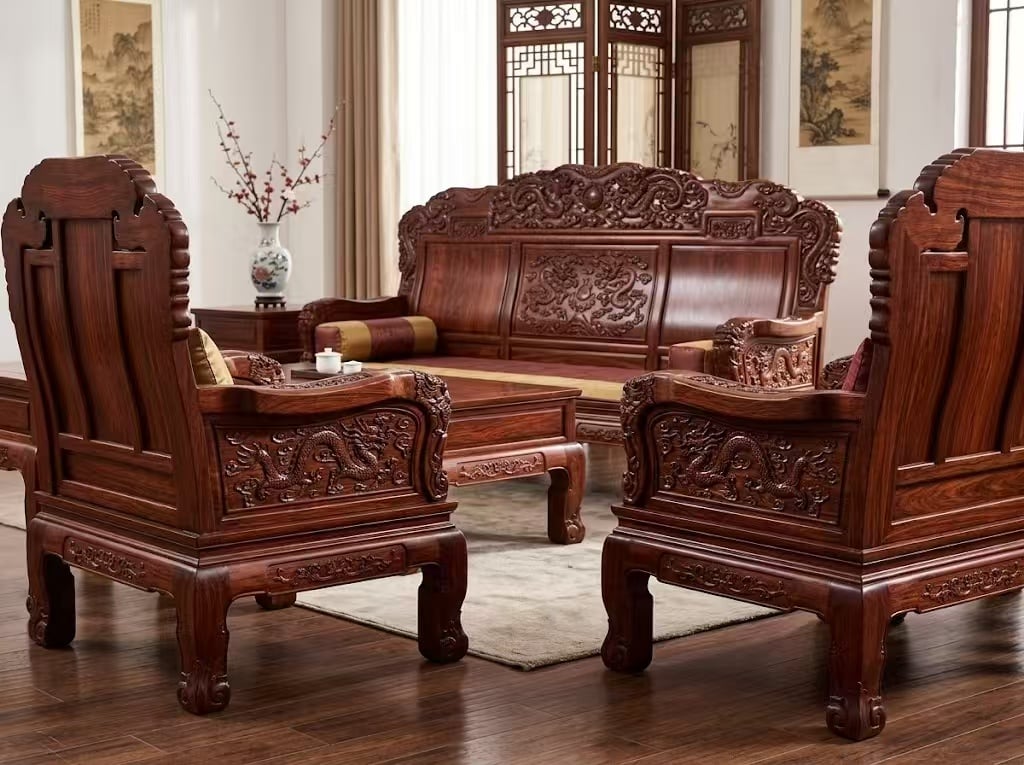
For importers, the practical takeaway is that this rosewood sofa set gives a compact apartment the same material story as a full-size suite: same species, same joinery discipline, same carving labour. Your sales pitch does not have to apologise for the size. It simply states the facts - a genuinely compact classical sofa set for small living rooms, built to the same standard as the grand configurations beside it in the catalogue.
The Dining Area: A Four-Seat Square Table with Tuck-Under Stools
Dining is the second space-critical zone, and it is where storage behaviour matters most. The Square Redwood Dining Table 4-Seat Compact Set with Carved Stools solves the problem with geometry: a square tabletop of 90 by 90 centimetres at a standard 75-centimetre height, paired with four stools rather than chairs. Each stool measures 35 by 35 centimetres with a 45-centimetre seat height, and the stools slide fully under the table when not in use. The entire four-person dining function therefore collapses into a 0.9-by-0.9-metre footprint - small enough for a kitchen dining nook under 10 square metres, a studio apartment or a breakfast corner in a boutique hotel suite.
The construction keeps the solid-wood promise. The top is edge-joined Siamese rosewood, kiln-dried to 8-12% moisture, with bamboo dowels along the join line; apron-to-leg connections use 14 mm tenon-depth mortise-and-tenon joints, and stool legs use 12 mm tenons. Each stool seat carries a hand-carved lotus medallion in shallow relief of 1.5 to 2.5 mm depth, taking approximately eight carving hours per seat. The glossy topcoat is a natural lacquer-based finish that complies with FDA 21 CFR 175.300 for repeated food contact - a certification detail your food-service and hospitality customers will ask about, and one you can state with confidence.
Quality controls on this line are specific and verifiable: each stool is load-tested at 100 kg for 24 hours, tabletop diagonals are compared to within 2 mm, and moisture readings are taken at three points per piece with re-conditioning triggered outside the 8-12% band. For a piece that will be pulled out, sat on and pushed back thousands of times in a hotel breakfast corner, that test discipline is what separates a durable asset from a warranty liability.
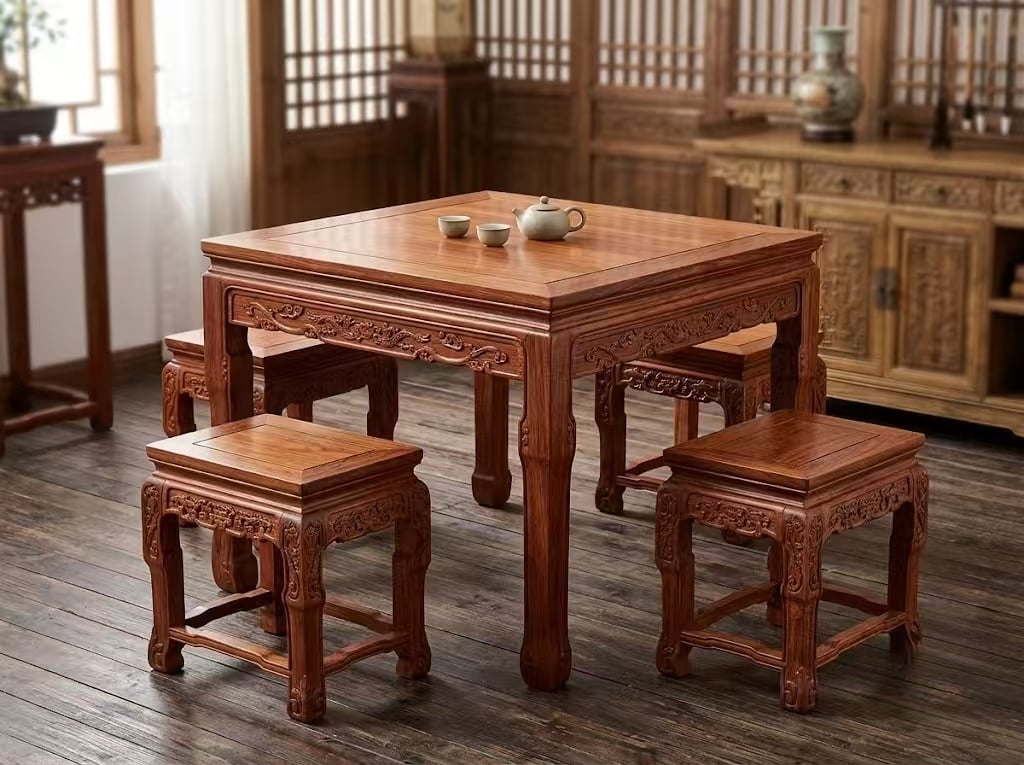
From a merchandising standpoint, the tuck-under behaviour is the demo that sells. In your showroom, pull one stool out, let the customer sit, then slide it back under the apron. The message lands instantly: full solid-rosewood dining for four, zero dedicated floor area when not in use. Few pieces in any furniture category demonstrate space-saving value so tangibly.
Flexible Accent Pieces: A Folding Stool and a Round Tea Table
Between the sofa and the dining table lies the category where compact rosewood furniture is most creative: flexible accent pieces. Two Yunxiao lines dominate this space.
The first is the Classical Siamese Rosewood Folding Stool with Carved Seat. It measures 35 by 35 centimetres with a 45-centimetre seat height, and it folds on a traditional mortise-and-tenon pivot - a 14 mm wooden joint reinforced with bamboo dowel pins, with no metal hinge to rust or loosen. The splayed outer legs and central straight legs follow the classical Chinese folding-stool silhouette, and each leg is carved from a single piece of solid rosewood with the splay angle following the grain direction. Only boards with a heartwood ratio exceeding 80% enter this line, kiln-conditioned over a four-week cycle with a 48-hour equalisation period. The carved seat panel takes roughly eight carving hours in shallow relief, and the six-coat hand-rubbed raw lacquer finish matches the rest of the catalogue.
Why does a folding mechanism matter for compact spaces? Because the stool can disappear. Flat against a wall, inside a storage bench, behind a console - the folding rosewood stool serves as extra seating when guests arrive and as a sculptural object the rest of the time. Tea rooms, entryways and boutique hotel lounges use it exactly this way, and it pairs with a tea table to form a complete tea-ceremony vignette in under two square metres. When ordering the stool and a tea table together, buyers should mention the combined order so the workshop can unify timber selection and colour matching across both pieces.
The second workhorse is the Classical Siamese Rosewood Round Tea Table with Carved Apron: a 90-centimetre-diameter, 40-centimetre-high table whose solid heartwood top is fitted as a floating panel inside the frame groove, allowing natural seasonal wood movement without cracking or binding. The apron carries an openwork cloud motif hand-carved at roughly fifteen hours per table, supported by four cabriole legs each shaped from a single piece of timber. Apron-to-leg connections use 16 mm tenon-depth mortise-and-tenon joints with bamboo dowel pins, and assembled tables are stress-tested at 60 kg distributed load for 24 hours.
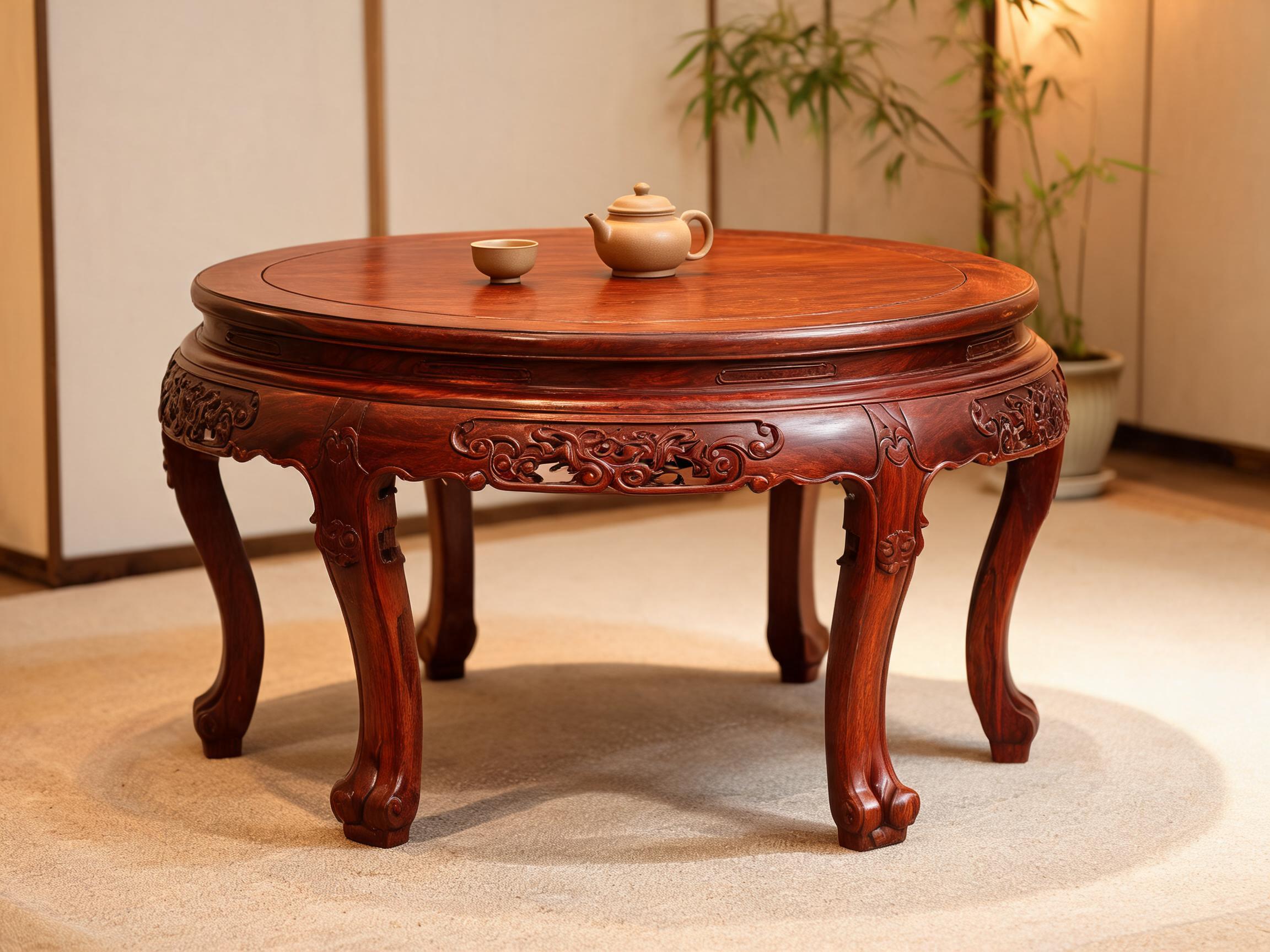
The round geometry is not merely decorative. A circle has no sharp corners to bump in a tight room, seats three to four people evenly for tea service, and reads as a focal point from every angle - which is why lobby designers favour it over rectangular coffee tables in compact hotel lounges. Combined with two folding stools, the table creates a complete, movable tea setting that a housekeeping team can reconfigure in minutes.
Small Footprint, Same Craft: Density, Moisture and Joinery
A recurring buyer concern about compact classical furniture is whether smaller components mean thinner material, weaker joints or machine-only carving. The honest answer is that it depends entirely on the factory's discipline. Here is how the discipline looks on the lines described above, and the questions you should ask any supplier of compact rosewood furniture.
Timber selection comes first. On the sofa, dining and accent lines, boards are sorted rather than merely accepted. The sofa set is grouped from boards within a 0.90-1.00 g/cm3 air-dry density band so the pieces respond consistently and match in colour across the set. The folding stool and tea table lines require a heartwood ratio above 80%, with boards exceeding 20% sapwood diverted to other products. Drying follows a fixed cycle - four weeks of kiln conditioning with gradual temperature ramping to reach 8-12% moisture content, followed by a 48-hour equalisation period - because a dense species like Dalbergia cochinchinensis punishes rushed drying with exactly the cracking complaints that compact apartments, with their heated, dry winters, are most likely to expose.
Joinery depth scales with component size, deliberately. Seat rails on the sofa use 16 mm tenon depth; armrest junctions use 14 mm; the dining set's apron-to-leg connections use 14 mm with 12 mm on stool legs; the tea table's apron connections use 16 mm. Bamboo dowel pins are driven through the tenons to prevent backing-out, and right-angle intersections on the sofa frame are reinforced with solid wood corner blocks. The primary frames contain no metal fasteners at all. When you audit a compact piece, run your hand along the underside rails and corner joints: a properly cut mortise-and-tenon shows a clean shoulder line and no fastener heads, and a 12 kg lateral pull test at the factory confirmed no visible movement on the sofa joints before packing.
Carving labour is preserved, not diluted. The ruyi armrest panels take about eighteen hours each; the lotus stool medallions about eight hours each; the tea table's openwork cloud apron about fifteen hours. Relief depths are verified with depth gauges at multiple points per panel, and carvings are inspected under magnification for tool slippage. The practical implication for your catalogue is important: a compact rosewood sofa set from a disciplined factory carries essentially the same carving-hours-per-piece story as its full-size sibling. You are selling reduced dimensions, not reduced craftsmanship - and that distinction is exactly what justifies the price positioning of authentic compact rosewood furniture for small spaces against mass-produced lookalikes.
Finish work completes the discipline. Six coats of raw lacquer, each cured for 24 hours and hand-rubbed with pumice stone, produce a penetrating satin surface rather than a plastic film. Inspection happens under 5000K lighting at close distance, with runs, sags or uncured spots reworked before packing. A compact piece that leaves the line with this finish will tolerate the dusting-and-wiping routines of both domestic households and hotel housekeeping teams, provided end users follow the same care basics that apply to any natural-lacquer surface: soft dry cloths, prompt spill wiping and coasters under hot items.
Commissioning OEM Sizing for Tight Rooms
Standard compact configurations cover most briefs, but real projects throw real exceptions: a 3.4-metre living room wall instead of 3.5, a lobby niche of 1.6 by 1.2 metres, a heritage building with a 30-centimetre step to negotiate. This is where OEM custom sizing earns its place, and where a factory's design process determines whether your custom order arrives right the first time.
Yunxiao's OEM/ODM cycle runs on a 15-day design approval clock that starts the day your drawings or reference images arrive. The deliverables in that window are a dimension drawing and a carving layout for your confirmation - two documents that deserve close reading, because they are where most expensive misunderstandings are prevented. The dimension drawing should state every external dimension, the seat or surface height, and the clearance your installation site requires; the carving layout shows which motifs appear on which panels and at what scale, so the carving density of a smaller component is agreed before a single chisel is lifted. Buyers reviewing these documents should check them against the actual site measurements - including doorways, stairwells and elevator depths on the delivery path - not only against the room itself.
Three custom-sizing requests come up so often they are worth pre-empting in your own product planning. First, sofa length adjustments: trimming a two-seat sofa from 165 to 150 centimetres is feasible, but the armrest width and seat depth need proportional review so the piece keeps its classical profile. Second, dining height variants: some Southeast Asian and Middle Eastern hospitality projects request lower seating heights for floor-level tea service, which changes stool leg geometry and should be specified explicitly. Third, finish and carving substitutions: swapping the ruyi motif for a buyer's own logo or a regional motif is supported, and for hotel projects the carving layout is the document that locks that decision. All three are routine within the OEM cycle - provided they are raised at the design-approval stage rather than after production starts.
Custom sizing also interacts with moisture and climate. A set commissioned for a dry-heated North American interior and one destined for humid coastal Southeast Asia may warrant slightly different moisture-conditioning targets within the 8-12% band. Mention your destination market when you request the design package; the workshop can factor it into the conditioning plan, and the wood drying certificate issued with the shipment will reflect the actual process.
Freight Economics: Crates, Container Math and LCL
Compact furniture is not only easier to sell into small rooms; it is cheaper to ship per unit of function. The packaging records of the four lines above make the point concretely, and these numbers are directly usable in your landed-cost models.
The three-piece sofa set ships fully assembled in two ISPM-15 heat-treated crates totalling 3.8 cubic metres at 320 kg gross. A 20-foot container with 22 cubic metres of usable capacity therefore takes five sets (19.0 cubic metres); six sets would require 22.8 cubic metres and exceed the limit, so five is the full-container quantity for this SKU. Below five sets, the same volume moves as LCL with freight billed per cubic metre. The dining set, by contrast, ships in a single crate of roughly 105 by 100 by 85 centimetres - about 0.89 cubic metres and 76 kg - which keeps LCL consolidation possible even for single-set trial orders, while a 20-foot container fits approximately twenty sets. The round tea table packs one per ISPM-15 crate at about 38 kg, with a 20-foot container accommodating roughly seventy tables. The folding stool, the smallest unit in the range, is crated individually and consolidates easily; volume pricing begins at twenty pieces.
Inside every crate the packing sequence follows export-furniture protocol: acid-free tissue paper, corrugated cardboard, EPS foam corner blocks and ISPM-15 heat-treated timber, with packaging validated by a one-metre drop test whose record is available on request. Fully assembled delivery matters for compact formats in particular: sofa sets and tea tables need no on-site assembly beyond unpacking and positioning, which removes a common failure point when hotel housekeeping or apartment residents receive the goods without technical staff on hand.
For first-time buyers, the trial economics deserve spelling out. A single folding stool or tea table can ride an LCL consolidation; a single three-piece sofa set is likewise shippable LCL, though at 3.8 cubic metres the freight-per-set economics improve markedly at five sets when the load switches to FCL. Payment terms follow the same logic: 30% T/T deposit with balance before shipment is standard, and letters of credit are accepted from five sets upward on the sofa line and ten sets upward on the dining line. Single-piece sample orders are supported across the range, and on the sofa line a sample armchair ordered ahead of a full-set order within 90 days earns a credit against that order, capped at half the order value - a structure that lets you test the goods physically before committing container-level capital.
Compliance Paperwork: FSC, CITES and Finish Declarations
Compact or full-size, rosewood furniture crosses borders under the same regulatory frame, and Dalbergia cochinchinensis is a CITES Appendix II listed species. Every shipment of the lines described here carries CITES export permits and FSC chain-of-custody documentation, together with a commercial invoice under HS code 9403.60 and a wood drying certificate. Certificate copies are available at the inquiry stage so your compliance team can verify documentation before contract signing - a step we recommend especially for first shipments into the EU, where timber-regulation checks at import are strictest.
On finishing compliance, transparency beats overclaiming. The workshop currently supplies a raw-material declaration and a supplier compliance statement for the lacquer and beeswax finishing materials, and the dining set's natural lacquer-based topcoat complies with FDA 21 CFR 175.300 for repeated food contact. Where a customer requires third-party test reports beyond these documents - REACH or CARB testing, for instance, or formaldehyde and benzene emission reports - testing can be arranged on request with costs quoted separately, and report numbers are confirmed at the inquiry stage. Buyers importing into the EU and North America should also confirm their country's CITES import-permit requirements before ordering; the export documentation set can be sampled in advance so your broker sees exactly what will accompany the goods.
Two practical habits will keep your compliance file clean. First, request the document set - CITES permits, FSC certificate, drying certificate, finish declarations - with the quotation, not after production, so any gap surfaces while it is still cheap to fix. Second, archive the certificate numbers against each order in your own system; when your end customer's auditor or a customs officer asks, the answer should take minutes, not days.
Merchandising Compact Rosewood Furniture to Your Customers
Wholesale success with compact classical furniture depends on how the category is presented at retail and project level. The lines above were engineered to support specific merchandising moves, and buyers who deploy them consistently report faster sell-through.
Merchandise by room scenario, not by SKU. A three-piece rosewood sofa set, a square dining set and a round tea table can fill three separate scenario corners of a showroom - living, dining, tea - each staged at true scale with measured clearances marked on the floor. When a customer sees the 80-centimetre walkway beside the sofa or the fully tucked stools under the dining table, the compact proposition stops being a claim and becomes an experience. Printed room-plan cards showing the footprint overlaid on typical 15, 20 and 30 square metre living rooms turn the same message into a takeaway.
Lead with the material story, close with the space story. Compact competitors in the market are usually smaller because they are cheaper - thin timber, metal brackets, veneer tops. Your differentiation is the reverse: smaller because it is smarter, with the same solid Siamese rosewood, the same mortise-and-tenon joinery, the same hand carving and the same raw-lacquer finish as the full-size suites. Train retail staff to answer the inevitable "why is it more expensive than the compact set next door?" with the density band, the tenon depths and the carving hours - concrete facts, not adjectives.
For hospitality and project channels, build vignette packages. A boutique hotel order rarely wants twenty identical sofas; it wants a coherent accent programme - one armchair, one folding stool and one tea table per room, repeated across rooms with consistent colour matching. Quoting these vignettes as bundles, with unified timber selection and colour matching requested at order time, simplifies the client's decision and smooths your own production planning. The remote installation guidance and free layout drawings available for project orders extend the same service logic from the factory to the site.
Finally, photograph at human scale. Compact furniture photographs badly next to full-size props; it photographs superbly with a person, a tea tray or a bookshelf for reference. Marketing assets that show the pieces actually being used in small rooms - the exact scenario your end customer lives in - consistently outperform white-background catalogue shots for this category.
A Pre-Order Checklist for Compact Rosewood Furniture Buyers
Before you issue a purchase order for any compact rosewood furniture line, run this checklist. It condenses the points above into the questions that protect your margin.
- Measurements: obtain the full footprint, height, seat height and the packed crate dimensions for every piece, and check them against your site plan including delivery paths.
- Clearances: confirm the remaining walkway in your scenario exceeds 60-75 cm for living areas and 75-90 cm behind dining seating.
- Material specification: ask which density band and heartwood ratio the line is sorted to, and confirm moisture conditioning is within 8-12% with a drying certificate issued per shipment.
- Joinery: request the tenon depths and confirm no metal fasteners in the primary frame; inspect corner joints on the sample piece.
- Carving: agree the motif and relief depth on a carving layout before production, especially for OEM pieces.
- Finish: confirm the finish system (six-coat hand-rubbed raw lacquer, or FDA 21 CFR 175.300-compliant lacquer on dining surfaces) and the care sheet supplied to end users.
- Logistics: calculate your container plan from the crate volumes - 3.8 CBM per sofa set, 0.89 CBM per dining set, roughly 38 kg per tea table crate - and confirm FCL break-points.
- Documentation: request CITES export permits, FSC chain-of-custody, HS 9403.60 invoice and finish declarations with the quotation, and confirm your country's CITES import-permit procedure.
- Commercial terms: confirm MOQ (one set or piece across these lines), payment structure, lead times (30-80 days depending on line and quantity) and the warranty: 24 months on joinery and frame under normal indoor use.
Frequently Asked Questions
What is the minimum order quantity for compact rosewood furniture?
Across the lines discussed here, MOQ is one set or one piece: one three-piece sofa set, one four-seat dining set, one folding stool, one round tea table. Volume pricing begins at five sets (sofa line), ten sets (dining line) or ten to twenty pieces (tables and stools). A 20-foot container takes five sofa sets, roughly twenty dining sets or about seventy tea tables, so your FCL break-point depends on the mix you order.
Can compact pieces be mixed in one container?
Yes, and mixed-container loading is the normal pattern for compact programmes. Because the dining set packs at 0.89 cubic metres per crate and tea tables at roughly 38 kg each, a single 20-foot container can combine, for example, dining sets, tea tables and a run of folding stools with precise cubic-metre arithmetic. Send your target mix and destination port, and the stowage plan is confirmed before deposit.
How long is the lead time?
Single-piece and single-set orders run 30 to 55 days from deposit confirmation depending on the line: 30-45 days for the folding stool, 35-50 days for the dining set and tea table, 40-55 days for the sofa set. Batch orders extend the cycle - 65-80 days for sofa sets of five or more, 60-75 days for dining sets of ten or more, 55-70 days for stool batches of twenty or more. Project deadlines should be raised at inquiry so the schedule can be confirmed against current capacity.
Do compact sets use the same wood as full-size suites?
Yes. All four lines use solid Siamese rosewood (Dalbergia cochinchinensis) with density sorting and 8-12% moisture conditioning. The compact dimensions come from re-engineered geometry, not from thinner stock, veneer or engineered cores, and the primary frames contain no metal fasteners.
Can the dimensions be customised to my room plan?
Yes. OEM and ODM customisation is supported with a 15-day design approval cycle covering a dimension drawing and a carving layout. Provide your site measurements including delivery-path constraints, and the factory will confirm feasibility, proportions and carving scale before production.
What warranty applies, and what voids it?
A 24-month structural warranty covers joinery and frame under normal indoor use, including joint separation and frame failure from manufacturing defects. It excludes damage from dragging, standing on the furniture, prolonged exposure to heat sources or direct sunlight, use outside recommended temperature and humidity ranges, and use in unheated or damp spaces. Claims are handled with photographs and the order number, and replacement components can be ordered for transit damage.
Is the folding stool reliable long-term?
The folding pivot is cut from wood itself - a 14 mm mortise-and-tenon joint reinforced with bamboo dowels - rather than bolted on, so there is no metal hinge to rust or loosen with humidity swings. Each stool's pivot is checked for smooth, binding-free movement before packing, and the frame carries the same 24-month structural warranty as the fixed furniture.
Can I order a sample before committing to a container?
Yes. A single armchair, stool or tea table can be ordered as a sample, and on the sofa line a sample armchair followed by a full-set order within 90 days earns a credit against that order, capped at 50% of the order value. LCL consolidation keeps sample freight manageable even for single pieces.
Working with Yunxiao on Compact Rosewood Furniture
Compact spaces are not a threat to the classical rosewood category; handled correctly, they are its fastest-growing doorway. A three-piece sofa set dimensioned for a 15-to-20-square-metre living room, a square dining set whose stools vanish under the apron, a folding stool that disappears against a wall and a round tea table that anchors a two-square-metre tea vignette - together they let your customers keep the species, the joinery and the carving they value, in the rooms they actually live and trade in.
Yunxiao Rosewood Furniture has manufactured classical redwood furniture in Xianyou County, Fujian - the hometown of traditional hardwood craft - since 2008, operating a 12,000-square-metre workshop with FSC chain-of-custody documentation and CITES export permit registration for Dalbergia cochinchinensis shipments. Container orders are supported with full export documentation, ISPM-15 packaging, partial shipments for long-term partners, remote installation guidance and free layout drawings for projects, with trial single sets and refundable samples available for first-time buyers across Europe, North America, Southeast Asia and Australia.
If you are planning a compact classical furniture programme - for a retail range, an apartment development or a boutique hotel group - send us your floor plans, target quantities and destination port. We will return a dimension proposal, a stowage plan and the applicable documentation set, so your first compact rosewood order arrives exactly as your showroom and your market need it to.