
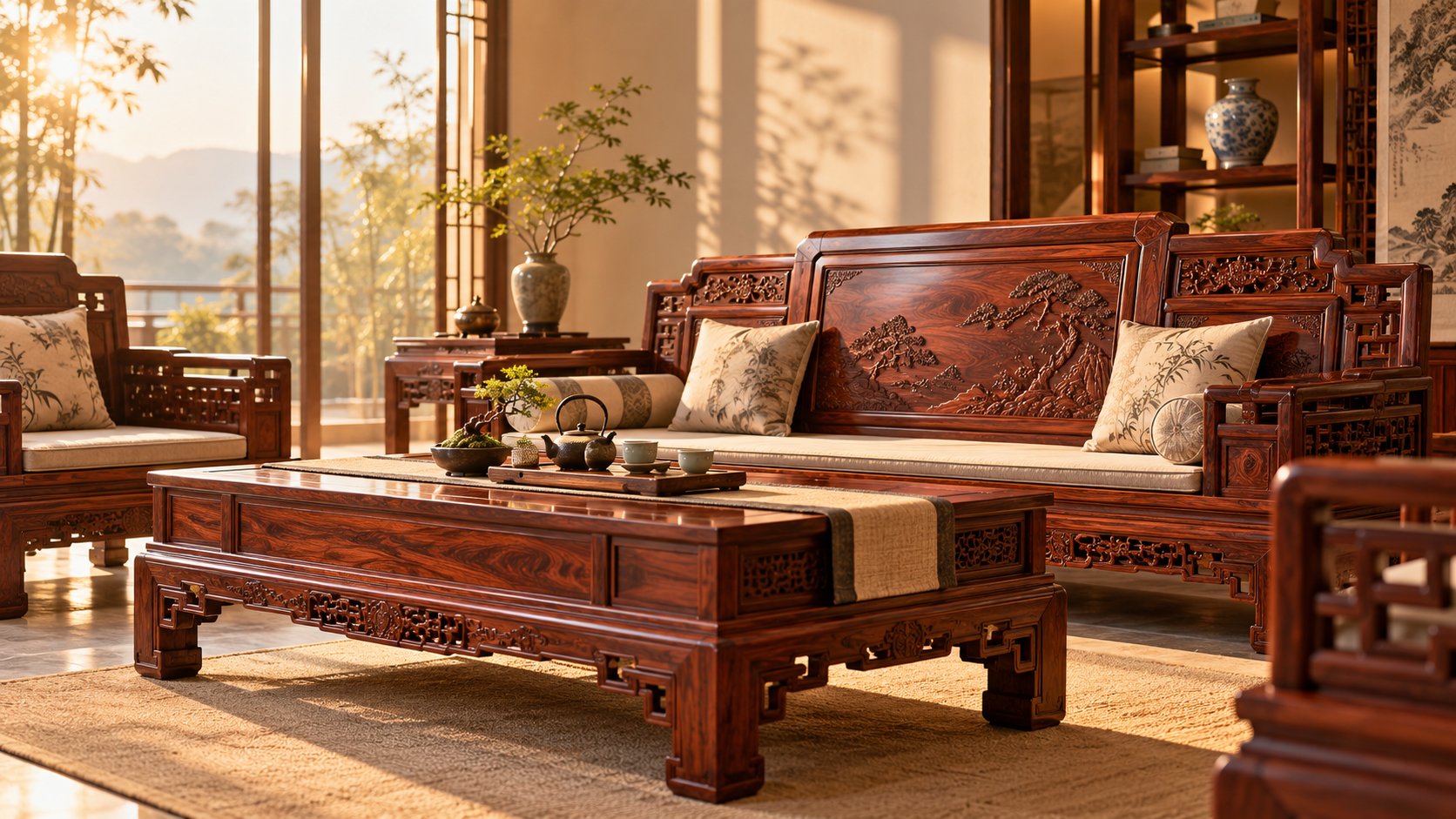
Praktikal na B2B evaluation kung sulit ba ang premium ng solid wood furniture sa 2026 — sumasaklaw sa total cost of ownership, drying, joinery, species hardness, compliance paperwork at ten-question supplier checklist para sa rosewood furniture importers.
Every importer, distributor and project contractor eventually faces the same purchasing decision: is solid wood furniture worth it in 2026, or should a buyer settle for veneer and engineered alternatives at a fraction of the quoted price? Search interest in this exact question has been climbing steadily since April, according to Google Ads historical metrics data for the keyword phrase is solid wood furniture worth it, and the broader category keyword solid wood furniture continues to anchor purchase evaluations across Southeast Asia, Australia and North America.
The honest answer is not a slogan. Solid wood furniture is worth it under specific, verifiable conditions: when the timber species and grade are documented, when drying and joinery are engineered for the destination climate, when compliance paperwork protects the importer, and when the total cost of ownership over the furniture's service life is calculated rather than just the invoice price. When those conditions are absent, the premium for solid wood cannot be justified, and a well-made veneered product may be the rational choice for a budget catalog line.
This guide walks through the decision the way a professional buyer should: the real cost difference at the point of purchase, what happens to that difference over ten years of commercial use, the technical facts that separate durable solid wood from disappointing solid wood, the compliance documents that protect your shipment, and a supplier evaluation checklist you can apply before committing to a container order.
Why This Question Matters More in 2026
Three forces make the solid wood versus engineered wood decision more consequential this year than it was five years ago.
First, raw material costs for premium hardwoods continue to climb. Our own recent market analysis (Why Is Solid Rosewood Furniture Becoming More Expensive for Global Buyers in 2026?) documents how legally harvested rosewood has become scarcer and more expensive, which raises the stakes of every solid wood purchase decision. A buyer who pays a genuine premium deserves a genuine product.
Second, enforcement of timber legality regimes has tightened. CITES Appendix II listing for Pterocarpus species, EU deforestation-linked requirements, US Lacey Act declarations and CARB formaldehyde standards all mean that the paperwork dimension of a furniture purchase is no longer optional. Solid wood imports attract more scrutiny precisely because they are solid wood, so buyers who choose this route must be prepared to verify it.
Third, hospitality and residential projects in our target markets are increasingly specifying classical and statement furniture as a differentiator. A hotel lobby or villa project that installs veneered imitations of classical rosewood furniture may save money on day one, but it competes against properties that invested in authentic pieces. The resale, repositioning and guest-perception value of genuine solid wood furniture is part of the investment calculus, and it is the part most often ignored in a first-pass price comparison.
What Buyers Actually Pay For: Purchase Price Versus Total Cost of Ownership
The sticker price gap between solid wood furniture and veneered or engineered furniture is real and sometimes dramatic. A veneered MDF dining table can land at 30 to 50 percent of the quoted price of a comparable solid rosewood table. Buyers who stop the analysis here systematically undervalue solid wood, because the purchase price is only the first line of a much longer cost ledger.
Cost Factor 1: Service Life
A well-built solid wood table or cabinet is inherently repairable. Surface scratches can be sanded and re-finished; a dented carved panel can be re-worked by a craftsman; a loose joint can be re-glued without destroying the piece. Engineered substrates do not offer this option, because once the veneer layer or the substrate itself is damaged, the panel is typically unsalvageable. In commercial environments such as hotels, restaurants and banquet halls, where furniture sees heavy daily use, this difference in repairability translates directly into replacement frequency. A veneered table top that delaminates in a humid banquet hall must be replaced wholesale; a solid wood top in the same environment can be re-sanded and returned to service.
This is not a theoretical distinction. Our article on commercial care for wood dining tables (How to Care for Wood Dining Tables in Hotels, Restaurants and Banquet Halls) describes the maintenance practices that keep solid wood surfaces in commercial service for years, practices that simply have no equivalent for a delaminating veneer.
Cost Factor 2: Climate Stability and Refurbishment Cycles
Solid wood moves with humidity. That is a physical fact, and any supplier who tells you otherwise is selling you something. The question is not whether the wood moves but whether the product is engineered to accommodate that movement without failing. This is where drying discipline and joinery design do their work, and it is why two pieces both labelled "solid wood furniture" can have completely different ten-year cost profiles.
A properly dried and joined solid rosewood piece shipped to coastal Southeast Asia or air-conditioned North America will stabilise after an acclimatisation period and then hold its geometry. A badly dried piece, by contrast, develops cracks, warped panels and split rails within the first season, and every one of those failures is a warranty claim, a replacement order or an unhappy project client. The cost of bad drying is not paid at the factory; it is paid in your market, at the worst possible time.
Cost Factor 3: Residual and Resale Value
Classical solid rosewood furniture holds a recognised secondary market in many of our target regions, particularly Southeast Asia, where well-maintained classical pieces are treated as appreciating heirlooms rather than depreciating furnishings. Veneered furniture has essentially no secondary market. When a hotel refurbishes after eight to twelve years, a solid wood suite can be refurbished and redeployed to lower-tier rooms, sold to staff housing, or resold; a veneered suite goes to landfill or discount disposal. Depending on project scale, this residual value can recover a meaningful fraction of the original premium.
A Worked Comparison Table
The table below compares the two purchase routes across the decision factors that matter to a B2B buyer. Figures for service life and refurbishment describe what documented construction and appropriate maintenance make possible; your own project conditions will determine actual outcomes.
| Decision Factor | Solid Wood (documented, properly dried and joined) | Veneer / Engineered |
|---|---|---|
| Initial purchase price | Higher; varies by species and carving content | Lower, often 30-50% of solid wood quote |
| Repairability | Sanding, re-finishing, re-gluing and panel re-work are possible | Delaminated or chipped panels generally not repairable |
| Commercial service life | Decades with maintenance; refurbishment cycles extend it further | Shorter in heavy-use environments; replacement on damage |
| Climate behaviour | Moves with humidity but engineered joints accommodate movement when drying and joinery are correct | Substrate swelling and veneer lifting in humidity swings |
| Secondary market | Recognised market for classical pieces, especially in Southeast Asia | Essentially none |
| Compliance paperwork | Species documentation, harvest legality and finishing compliance required (and available from a qualified factory) | Simpler species story, but formaldehyde and substrate documentation still needed |
| Brand and project positioning | Supports premium and classical positioning | Fits budget lines and fast-turn retail |
Read the table honestly: engineered furniture wins on price and simplicity, and for some product lines that is the right call. The case for solid wood rests on the rows below the first one, and those rows only favour solid wood when the factory has actually done the engineering work. That is what the next section is about.
The Technical Facts That Decide Whether Solid Wood Is Worth It
"Solid wood" is a material claim, not a quality claim. Two solid rosewood cabinets can differ more than a rosewood cabinet differs from a veneered cabinet, depending on how the timber was dried, how the joints were cut and how the finish was applied. A buyer evaluating whether solid wood furniture is worth the premium should verify four technical dimensions.
Dimension 1: Drying Discipline
Moisture content is the single most important hidden variable in furniture exporting. Timber that leaves the factory at the wrong moisture content will move after installation, and the consequences range from sticky drawers to cracked table tops and open joints. Different destination climates call for different target moisture ranges, which is why a serious factory conditions timber rather than merely drying it.
At Yunxiao, every piece of furniture goes through a 36-day constant-temperature, constant-humidity drying and conditioning process before finishing. The purpose of this extended cycle is not speed; it is uniformity. Rushing the drying process leaves moisture gradients between the surface and the core of a board, and those gradients are what drive warping and checking months later in your warehouse or your client's lobby. A documented, controlled drying process is one of the clearest technical signals separating a factory worth its premium from one that is not.
As a practical verification step, ask any prospective supplier to state the moisture content range of timber at packing, and to explain how the range is matched to your destination climate. For typical export destinations, timber conditioned to roughly 8-12 percent moisture content with an equalization period before packing is the documented practice, as we describe in our article on kiln drying (Why Does Kiln Drying Matter When Buying Rosewood Furniture from China?). A supplier who cannot answer this question is asking you to absorb the climate risk.
Dimension 2: Joinery Method
The classical Chinese answer to wood movement is mechanical: mortise-and-tenon joinery, in which a projecting tenon locks into a matching mortise, transferring load through the timber itself rather than through metal fasteners or glue alone. This joinery tradition is centuries old for a reason. It accommodates seasonal expansion and contraction without concentrating stress at a single point, and it does not rust, loosen at the glue line or split the surrounding wood the way screws can.
Yunxiao assembles every product without metal nails, using traditional mortise-and-tenon construction with wooden dowel pins in the primary frames. For the buyer, this matters in three concrete ways. First, joint integrity survives the humidity swings of tropical and temperate export climates better than nailed or stapled construction. Second, the furniture is genuinely re-serviceable: a joint can be re-fitted decades later rather than the piece being written off. Third, the absence of protruding fasteners matters for carved and polished surfaces, where a screw head or staple ruins both the aesthetics and the finish continuity.
When comparing quotes, ask exactly how the primary frame is joined. "Solid wood construction" that conceals particleboard cores, metal brackets or staple-reinforced joints is not the product the price suggests. Our buyers' guide to identifying real wood from veneer and engineered wood (How Do You Tell Real Wood from Veneer and Engineered Wood?) covers the inspection techniques in detail.
Dimension 3: Species Identity and Hardness
Not all wood sold as "rosewood" is the same species, and species identity drives both price and performance. Siamese rosewood (the trade name for the timber our classical sets are built around) is a dense tropical hardwood. Its hardness is not a marketing flourish: Janka hardness for this timber is approximately 2,430 lbf, a figure that describes the force required to embed a steel ball into the wood and that translates directly into dent and wear resistance under commercial use.
For a hotel lobby table, a banquet chair or a villa dining set, that hardness differential is what stands between a surface that stays presentable for years and one that picks up a permanent patina of dings in its first season. Buyers comparing quotes across species should ask each supplier to state the species (scientific and trade name), the Janka figure where the species has one, and the source region of the timber. A factory that works with legally certified Machilus Nanmu, aged red wood and Grade-A tropical hardwood, as we do, will have no difficulty documenting what is in the crate.
Dimension 4: Finishing and Interior Air Compliance
The finish is the interface between the wood and your market's regulators. Two regimes dominate our target markets. In the European Union, REACH restrictions govern the chemical content of consumer articles, including surface coatings. In the United States, CARB (the California Air Resources Board) Phase 2 standards limit formaldehyde emissions from composite wood products and set the de facto benchmark that many North American buyers apply across their catalogs.
Yunxiao's eco-friendly beeswax and lacquer finishing is specified to meet EU REACH and US CARB standards. For an importer, the practical significance is straightforward: finishing compliance failures are discovered at the border or, worse, after installation, and they are expensive precisely because the furniture itself is expensive. Confirming finishing standards before the purchase order, and confirming them against the actual product specification rather than a generic company claim, removes one of the largest hidden risks in furniture importing.
Where the Premium Actually Goes: Inside the Production Process
Buyers who compare a solid wood quote against an engineered quote are often comparing prices without knowing what the solid wood price is actually funding. This section breaks down the production inputs behind a classical rosewood set, using documented practices from our workshop, so the premium can be evaluated line by line rather than accepted as a lump.
Carving Hours and Artisan Labor
Hand carving is the most labor-intensive component of a classical set, and it is priced accordingly. As a documented example, the bamboo-motif chair backrests on our rectangular eight-seat dining set each require approximately sixteen carving hours per panel. Multiply that across a ten-piece set and the carving content alone represents weeks of skilled artisan time before the piece is ever assembled or finished. Machine carving exists and serves budget lines, but it cannot reproduce the depth variation, undercutting and edge refinement that distinguish hand-worked relief panels, and it is one of the clearest markers buyers can use to separate price tiers. Our article on identifying authentic hand-carved furniture from machine-carved imitations (How Can Buyers Identify Authentic Hand-Carved Redwood Furniture?) gives buyers the inspection points.
Timber Selection and Grain Orientation
Before any carving begins, boards are sorted by grain orientation and structural role. In our documented practice, timber is grain-orientation sorted, with boards that deviate more than four degrees from the length axis diverted to shorter components where their geometry still performs. This sorting discipline costs time and yields offcuts, but it is what allows long structural members to resist warping along their length. An engineered product does not face this constraint because its substrate is uniform by construction; a solid wood factory earns its premium partly by imposing this discipline on an inherently variable material.
Assembly Verification
After joinery, verification distinguishes a production process from an assembly line. Our dining chairs, for example, are individually load-tested with a 100-kilogram static weight held for 24 hours as an in-house QC procedure before packing. Verification at the piece level is what turns a specification into a repeatable outcome across a full container, and buyers should ask any prospective factory what is verified per piece versus per batch.
Compliance: The Paperwork That Protects Your Investment
A solid wood furniture purchase crosses more regulatory lines than most consumer goods, and the documentation burden scales with the timber's prestige. A buyer weighing whether solid wood furniture is worth it must include compliance risk in the calculation, because a shipment detained over missing documentation converts a good investment into a warehouse liability.
CITES and Species Documentation
Most rosewood species in commercial trade, including the Pterocarpus species central to classical furniture, are listed on CITES Appendix II, which means international trade requires export permits and, in many destination markets, import documentation. We prepare FSC chain-of-custody certification and CITES Appendix II export permits with every shipment, with certificate numbers confirmed at inquiry. For the buyer, the checklist is simple: confirm before ordering that the supplier can name the species, state its CITES status, and produce the export permit documentation that your customs broker will need.
The regulatory environment is tightening rather than loosening. Our article on how CITES regulations are reshaping the rosewood trade (How Will CITES Regulations Reshape the Global Rosewood Furniture Trade in 2026?) outlines what importers must prepare now, and the direction of travel is clear: markets are moving toward documented legality as the entry ticket, not the differentiator.
EU and US Market Entry Requirements
European buyers operate under the EU Timber Regulation framework, which requires demonstrated due diligence on the legality of timber in products placed on the EU market. North American buyers navigate the Lacey Act declaration requirements, which demand species-level declaration for covered products. Both regimes reward importers who work with factories that maintain documented chains of custody, and both penalise importers who discover documentation gaps after the goods have shipped. Our overview of EU and US compliance for redwood furniture (How Do EU Timber Regulation and US Lacey Act Affect Redwood Furniture Imports?) walks through both regimes.
Export Packaging and Physical Protection
Compliance does not end with paperwork. ISPM 15 heat-treated packaging is the phytosanitary standard for wood packaging material in international trade, and our export packing combines ISPM 15 compliant crating with moisture barriers and bracing engineered specifically for relief-carved furniture. Carved panels are the most valuable and most vulnerable component of a classical furniture shipment, and packaging that treats them like ordinary cargo is a false economy. Buyers comparing quotes should ask what the quoted price assumes about packing, because a container of damaged carvings erases the entire solid wood premium in one unloading.
Lead Time, MOQ and Order Structure: Planning the Investment
The practical dimensions of a solid wood purchase decision are lead time, minimum order structure and shipment flexibility, and these deserve the same analytical honesty as the technical dimensions.
Lead Time Reality
Container orders of classical rosewood furniture take 45 to 60 working days after deposit. That window is not padding; it reflects the sequential reality of the craft. Timber must be conditioned, components cut and carved, assembled, finished, cured and packed. Buyers planning hotel openings or project installations should reverse-schedule from the installation date and include shipping time and destination-climate acclimatisation in the plan. A factory promising solid rosewood furniture in three weeks is either quoting engineered product or skipping process steps that you will pay for later.
Our detailed guide to production lead times (How Long Does It Take to Manufacture and Deliver Custom Rosewood Furniture?) breaks down each stage and shows where the 45-60 day range comes from.
MOQ and First-Order Structure
The traditional objection to solid wood investment is that the minimum commitment is too large to test the market. This objection is solvable with order structure rather than price concessions. We supply trial single sets and refundable samples, which allows a first-time buyer to verify construction quality, finish and packing on a small commitment before scaling to a container. Partial shipments are available for long-term partners, which lets project buyers align delivery with installation phases instead of warehousing a full container.
For buyers structuring a first order, our article on testing a supplier before a full container (How Can First-Time Buyers Test a Rosewood Furniture Supplier Before a Full Container Order?) provides a practical sequence.
Customization as Investment Protection
Solid wood furniture carries another investment advantage that engineered product cannot match at any price: customization depth. Because the furniture is built from solid timber with traditional joinery, sizes, carving patterns and configurations can be specified for a project rather than accepted from a catalog. We provide OEM and ODM custom sizes and patterns for villas and resorts, plus free layout drawings for projects. For a designer or project contractor, this means the furniture fits the space rather than the space being arranged around the furniture, and for a distributor it means catalog differentiation that veneered import lines cannot replicate.
Planning Maintenance Costs Across the Ownership Cycle
Total cost of ownership is not only about what fails; it is about what must be routinely done to prevent failure, and what that routine costs in your market. A fair comparison between solid wood and engineered furniture should put realistic maintenance budgets on both sides of the ledger.
For solid wood furniture in commercial service, the maintenance cycle has three tiers. Daily and weekly care is cleaning with appropriate products and immediate attention to spills, which protects the finish rather than the wood beneath it. Annual or biannual care is a conditioning treatment appropriate to the finish system, which in our case is an eco-friendly beeswax and lacquer system; beeswax re-application is a straightforward property-maintenance task that local facility teams can be trained to perform, as our remote installation and care guidance covers. Cyclical major care, every several years depending on use intensity, is professional re-sanding and re-finishing of working surfaces, which resets the piece rather than replacing it.
For engineered furniture, the maintenance budget looks smaller on paper but carries replacement risk instead. The veneer surface cannot be sanded back; once wear penetrates the layer, the panel is finished. In a hotel or restaurant environment, that means the maintenance question is not how much polishing costs but how many years the surface survives before wholesale replacement. A buyer should price both scenarios across the intended holding period and include labor, downtime and disposal in each column.
One further cost consideration favors buyers in humid coastal markets: climate control. Solid wood furniture performs best in spaces with stable humidity, and most hospitality projects already operate HVAC systems that provide it. Where climate control is intermittent, such as seasonal villas, the drying and joinery engineering described earlier becomes even more important, and buyers should discuss their actual operating calendar with the supplier before ordering rather than after delivery.
Which Buyers Should Choose Solid Wood - and Which Should Not
Honesty requires stating the boundary of the argument. Solid wood furniture is not the right answer for every product line, and a buyer who recognises this makes better long-term supplier decisions.
Solid wood is usually worth it when:
- You are furnishing hospitality or residential projects where the furniture contributes to positioning and guest perception, such as hotels, resorts, villas, restaurants and banquet halls.
- Your retail or distribution catalog targets a premium or classical segment where material authenticity is part of the product story.
- You can verify drying, joinery, species and compliance documentation before ordering, converting the premium into a documented quality position.
- Your market has cultural or commercial appreciation for classical furniture, as is well established across Southeast Asia and increasingly in statement projects in Australia and North America.
- You plan to hold or redeploy the furniture across a refurbishment cycle rather than dispose of it at end of first use.
Solid wood may not be worth it when:
- Your line is a price-driven, high-turn retail assortment where the product story is style rather than material.
- You cannot verify the four technical dimensions above, and the supplier is unwilling to document them. In that case the quoted "solid wood" premium is unverified, and an engineered product at a transparent price may be the lower-risk purchase.
- Your project timeline cannot accommodate real production lead times, and the schedule pressure would force you to accept shortcuts.
The common thread in the second list is not that solid wood is overpriced; it is that unverifiable solid wood is overpriced. The premium is justified by facts, and where the facts cannot be produced, the premium is not justified.
A Supplier Evaluation Checklist for Solid Wood Furniture
Before committing to any solid wood furniture order, put the following questions to the supplier and require written answers. This checklist converts the analysis in this article into a procurement workflow.
- Moisture control: What is the moisture content of the timber at packing, and how is it matched to my destination climate? Look for a stated range (roughly 8-12 percent for typical export destinations) and an equalization step before packing.
- Drying process: How long is the drying and conditioning cycle, and is temperature and humidity controlled throughout? A documented extended cycle (ours is 36 days under constant temperature and humidity) is a strong signal.
- Joinery: How is the primary frame joined? Confirm mortise-and-tenon or equivalent mechanical joinery without metal fasteners in load-bearing members, and ask specifically about hidden substrates or filler panels.
- Species and hardness: What is the scientific and trade name of the timber, and what is its Janka hardness? For classical sets built on Siamese rosewood, expect a figure in the region of 2,430 lbf and a factory that can explain what that means for your application.
- Compliance documents: Can the supplier produce CITES export permits, FSC chain-of-custody documentation and destination-market compliance statements (EU REACH, US CARB) for the actual products ordered, not just for the company?
- Finishing: What finish system is applied, and what standards is it specified to meet? Confirm food-contact relevance separately where dining surfaces are involved; coating-material standards and finished-product claims are different statements.
- Packing: Does the quote include ISPM 15 heat-treated packaging, moisture barriers and bracing designed for carved components?
- Lead time and shipment structure: What is the production lead time after deposit, and can partial shipments align with your installation schedule?
- Sample policy: Can you order a trial set or refundable sample to verify the above answers physically before the container commitment?
- After-sales and installation support: Does the factory provide assembly documentation, remote installation guidance and response procedures for transit damage?
A supplier who answers all ten in writing has done most of the work of proving their quote is worth the premium. A supplier who answers none of them has answered your real question by omission.
Frequently Asked Questions
Is solid wood furniture really better than veneer?
It is different, not universally better. Solid wood offers repairability, longevity, refinishability and secondary-market value that veneer cannot match, which is why it dominates premium and commercial applications. Veneer offers lower cost and dimensional stability at a lower price point, which suits budget product lines. The comparison that matters is total cost of ownership over your actual service environment, not the invoice alone.
How long does solid wood furniture last in commercial use?
With documented construction (proper drying, mechanical joinery, compliant finishing) and the appropriate maintenance for the environment, solid wood furniture serves for decades in commercial settings, with refurbishment cycles extending that further. Actual outcomes depend on use intensity, climate control and maintenance discipline; our commercial care guide for hotels and restaurants covers the practices that protect the surface and structure.
Does solid wood furniture crack in overseas climates?
All wood moves with humidity; the engineering question is whether the product accommodates that movement. Controlled drying to a moisture content matched to the destination, equalization before packing, and mortise-and-tenon joinery are the three design responses that prevent the cracking failures buyers fear. Our article on why rosewood furniture cracks and how we prevent it (Why Does Rosewood Furniture Crack in Overseas Climates) explains the mechanism in detail.
What documents should I require when importing solid wood furniture?
At minimum: species identification, CITES export permit status for the species, FSC or equivalent chain-of-custody documentation, destination-market finishing compliance (EU REACH for the EU, CARB benchmarks for North America), and ISPM 15 compliant packing. Certificate numbers should be confirmed at inquiry, before the deposit, not after the goods ship.
Is the higher price of solid rosewood furniture justified?
The price reflects scarce legally harvested timber, intensive hand carving, extended drying cycles and skilled joinery, each of which is verifiable. It is justified when the buyer verifies those elements and the application values longevity and positioning; it is not justified when a supplier cannot document what the premium is buying.
What is a realistic first order for testing a solid wood supplier?
A trial single set or refundable sample is the standard low-risk entry, followed by a mixed or partial container once the sample verifies construction, finish and packing quality. This structure lets you convert the abstract question of this article into a physical verification before the full investment.
How can I verify that furniture is genuinely solid wood before shipment?
Combine documentation with physical inspection. On the documentation side, require species declarations and chain-of-custody papers. On the physical side, inspect for grain continuity across joints (solid wood shows continuous grain flowing through connected components), check edge banding (veneer shows a distinct band or seam on panel edges), examine unfinished areas such as drawer interiors and case backs, and weigh the piece against expectations for its species. Pre-shipment inspection, whether by your own team or a third-party inspector, is a standard step we support, and our inspection checklist article details what to look for.
Can I mix solid wood pieces and engineered pieces in one order or one project?
Yes, and for many buyers this is the rational portfolio answer. Statement and guest-facing pieces such as reception sofas, lobby tables and dining sets carry the positioning value that justifies solid wood, while back-of-house or high-turn budget lines can use engineered product without damaging the program. The practical requirement is that the material story be honest: label and price each line according to what it is, so that the premium pieces retain their credibility.
How long should solid wood furniture acclimatise after delivery?
Allow the pieces to rest in their installation environment before final assembly and use, especially where the destination climate differs significantly from the tropical factory climate. Our production practice includes a documented 48-hour equalization period for timber conditioned to 8 to 12 percent moisture content before packing, and a similar settling window on site lets the furniture adjust gradually to local humidity before it is loaded or put into service. Keep pieces out of direct airflow from air-conditioning vents during this window, and complete assembly with the joints dry and clean.
The Decision, Restated
Is solid wood furniture worth it in 2026? For buyers in hospitality, premium retail and project distribution, the answer is yes - with conditions that are entirely checkable. The premium buys documented timber, engineered climate stability, repairability, compliance protection and positioning value that engineered alternatives do not deliver. The four technical dimensions (drying, joinery, species, finishing), the compliance file (CITES, FSC, EU REACH, US CARB, ISPM 15) and the ten-question supplier checklist in this article convert that answer from opinion into a procurement standard you can apply to any quote, including ours.
If you are evaluating solid wood furniture for a hotel, villa, restaurant or distribution program and want the verification answers for a specific configuration, our team responds to inquiries with the documentation described in this article - species and moisture specifications, joinery details, permit availability and lead time commitments - so your investment decision can rest on facts rather than adjectives.
Ready to evaluate solid wood furniture for your next project or catalog?
Request a Quotation and Product Documentation