
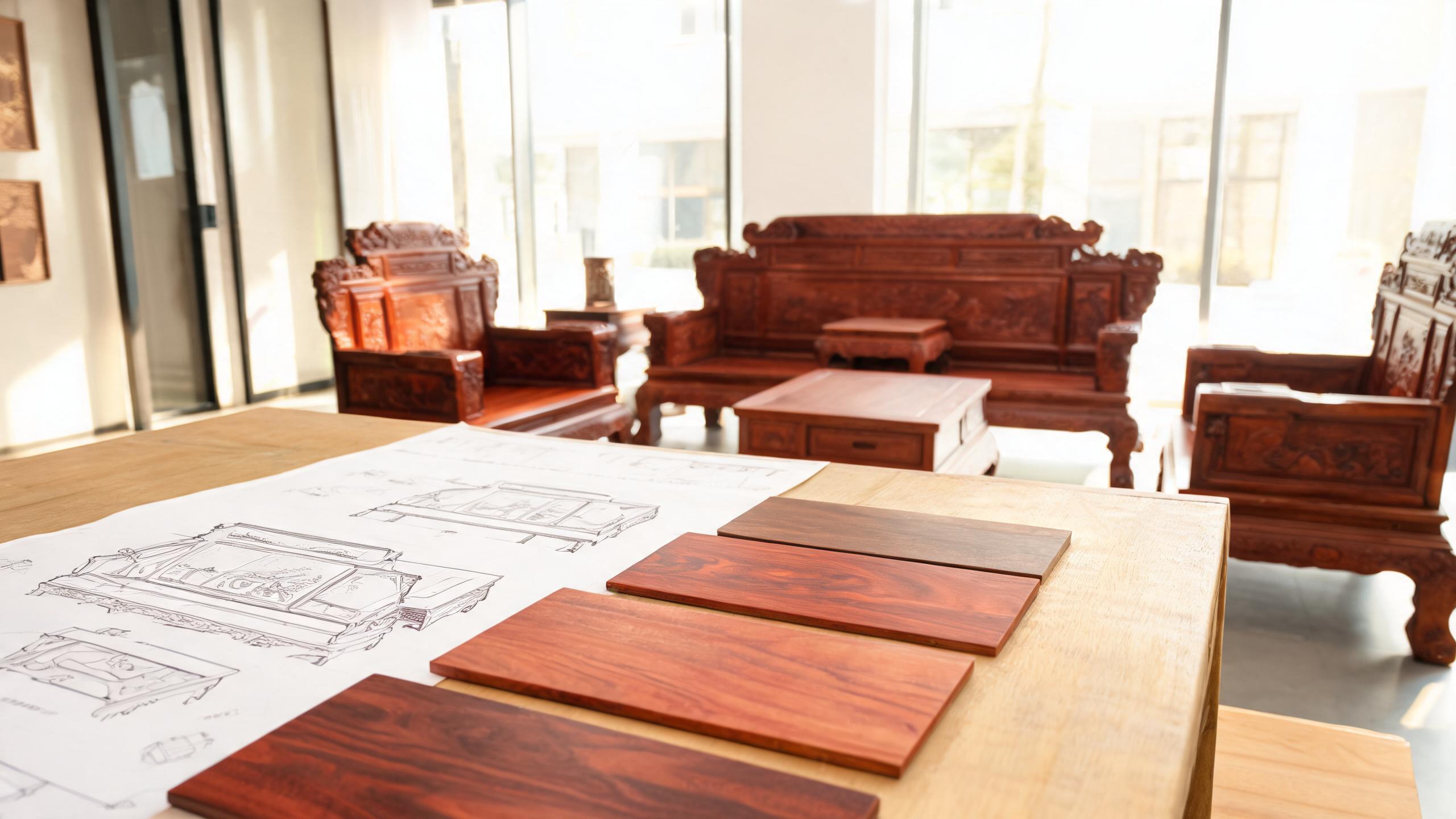
A definitional explainer for B2B importers and project buyers. Understand the difference between custom, bespoke, OEM and ODM furniture; how the custom process works with a rosewood factory; realistic timelines, communication, and what to prepare before you inquire.
BUYER GUIDE
If you are sourcing furniture for a hotel, a villa project, or a wholesale program, you have likely seen the terms "custom-made furniture," "bespoke furniture," "OEM," and "ODM" used interchangeably. They are not the same thing. The difference matters when you are committing a deposit, waiting 45 to 60 working days for a container, and trusting a factory on the other side of the world to deliver pieces that match your drawings.
This article is a definitional explainer. It answers the question "what is custom furniture" in practical, procurement terms. It explains how bespoke rosewood manufacturing actually works when you buy from a factory in China, what you can realistically expect at each stage, and what information you need to prepare before you send your first inquiry. It is written for B2B importers, wholesalers, and hotel or villa project buyers in Southeast Asia, Australia, and North America.
- Custom furniture means the piece is made to your dimensions, design, and finish. Bespoke is the same idea, usually with a higher degree of design involvement from the buyer.
- OEM means you supply the design and the factory manufactures it. ODM means the factory supplies the design and you select, modify, or brand it.
- A serious rosewood factory will ask for drawings, dimensions, material preferences, and quantity before quoting. The more precise your brief, the more accurate the price and timeline.
- Container orders from a factory like Yunxiao Rosewood Furniture typically take 45–60 working days after deposit. Trial single sets and refundable samples are available before you commit to volume.
- Compliance matters: ask about wood legality, finish standards, and packaging treatment before you order, not after.
What Is Custom Furniture? A Clear Definition for B2B Buyers
In everyday language, "custom furniture" simply means a piece that is not mass-produced to a standard catalog specification. It is made to fit a specific space, serve a specific function, or match a specific design language. For a consumer, that might mean a bookshelf built to fit an awkward alcove. For a B2B buyer, custom furniture usually means something more structured: a production run of tables, chairs, beds, wardrobes, or paneling made to your drawings, your dimensions, and your finish specifications, manufactured by a factory that can repeat the process consistently.
When people search "what is custom made furniture," they are often trying to separate it from two related terms: ready-made furniture and semi-custom furniture. The distinction is useful when you are evaluating suppliers.
| Type | Definition | Typical Buyer | Lead Time |
|---|---|---|---|
| Ready-made / Stock | Produced in standard sizes from existing molds or patterns. No changes allowed. | Retailers, online sellers | Short; ships from stock |
| Semi-custom | Standard frame or design with limited options: fabric, finish, or a few size variations. | Interior designers, smaller projects | Moderate |
| Custom / Bespoke | Made to buyer's dimensions, design, or material specification. Can be one piece or a full container. | Hotels, villas, wholesalers, importers | Longer; 45–60 working days for container orders is typical |
For importers and project buyers, custom furniture is not a luxury add-on. It is often the only way to make a design work. A hotel lobby has non-standard dimensions. A villa project requires a specific wood tone to match the architecture. A wholesaler needs a unique design that cannot be found on Alibaba. In all these cases, you are not buying a product; you are buying a manufacturing service.
Bespoke vs. Custom: Is There a Difference?
The words are often used as synonyms, and in most factory conversations they mean the same thing. If there is a nuance, it is in the degree of design ownership.
Custom usually means the buyer provides the specification: dimensions, material, finish, and perhaps a sketch. The factory's role is to engineer and build it. Bespoke often implies a higher level of personalization, sometimes including the factory helping to develop the design from a concept or a reference photo. In practice, a factory that offers both OEM and ODM services covers the full spectrum.
When a B2B buyer asks "what is custom made furniture," what they usually want to know is: can I send my drawings and get exactly what I specified? The answer depends on the factory's capabilities. A rosewood furniture factory with in-house design and production, like Yunxiao Rosewood Furniture, can handle both scenarios. You can send a complete technical drawing (OEM), or you can send a reference image and a rough dimension and let the factory propose a design (ODM).
The practical difference for you as a buyer is in the quotation process. OEM quotes are usually straightforward once the drawing is clear. ODM quotes involve more back-and-forth because the factory is investing design time before you commit. Some factories charge a design fee that is refundable against the first order; others include it in the sample cost. This is worth clarifying in your first inquiry.
OEM vs. ODM in Furniture: What the Terms Mean for Your Order
These two acronyms appear in almost every B2B furniture sourcing conversation. They describe who owns the design and how much input the factory has.
OEM (Original Equipment Manufacturer)
You, the buyer, provide the design. This can be a technical drawing, a CAD file, a detailed specification sheet, or a physical sample. The factory's job is to manufacture the piece to your exact specification, using the materials and finishes you select. The factory does not own the design; you do. This is the right choice when you have a specific design in mind, perhaps one developed by your own architect or designer, and you need a factory that can execute it reliably.
ODM (Original Design Manufacturer)
The factory provides the design. The factory has its own product development team and a catalog of existing designs. As a buyer, you can select a design from that catalog, request modifications to dimensions, materials, or finish, and put your brand on it. This is faster and often more cost-effective than OEM because the factory has already solved the engineering and tooling problems. It is a good option if you are a wholesaler looking to expand your product line quickly, or a project buyer who likes a factory's existing aesthetic but needs size adjustments.
| Factor | OEM (Your Design) | ODM (Factory Design) |
|---|---|---|
| Design ownership | Buyer | Factory (licensed to buyer) |
| Design cost | Higher; you pay for development | Lower; factory amortizes across buyers |
| Lead time to first sample | Longer; requires engineering review | Shorter; existing design |
| Uniqueness | High; exclusive to you | Medium; may be sold to others unless exclusive |
| Best for | Hotels, villas, branded collections | Wholesalers, importers, quick market entry |
Most serious factories, including Yunxiao Rosewood Furniture, offer both. The factory's website states it offers flexible OEM and ODM custom sizes and patterns for villas and resorts. For a B2B buyer, this flexibility is important because it means you can start with an ODM design to test the factory's quality, then move to OEM for your own exclusive pieces once trust is established.
How Much Does Custom Furniture Cost? A Realistic Look at Pricing Factors
This is the most common question after "what is custom furniture," and it is the hardest to answer without specifics. There is no per-piece price list for custom work because the cost depends on variables that change with every project. What we can do is break down the factors that drive the price, so you know what to ask about and what to expect.
Material Grade and Species
Rosewood is not a single material. It ranges from plantation-grown species to older, denser hardwoods. The factory's material choices — legally certified Machilus Nanmu, aged red wood, and Grade-A tropical hardwood — occupy different price points. Aged wood is more expensive than new wood because it has been seasoned for years, which reduces cracking and warping. The specific species, the thickness of the boards, and the grain pattern you select all affect cost.
Joinery and Construction Method
Mortise-and-tenon joinery, which is traditional in high-end Chinese furniture, is more labor-intensive than using screws, nails, or metal brackets. It is also stronger and more durable. If you require mortise-and-tenon throughout, expect a higher price than for a piece assembled with modern fasteners. The complexity of the joint, the number of joints per piece, and the skill required all factor into the labor cost.
Finish and Coating
The finish is a significant cost driver. Eco-friendly beeswax and lacquer finishes, which meet EU REACH and US CARB standards, are more expensive than low-grade solvent-based finishes. They also require more careful application and longer curing times. If you need a specific color match or a hand-rubbed finish, that adds labor hours.
Design Complexity and Detailing
A simple rectangular dining table is cheaper to build than a curved console with inlaid panels and carved details. Every curve, every carve, every intricate joint adds production time. When you request a quote, be specific about the level of detail. A sketch that looks simple on paper can be very complex to execute in solid wood.
Quantity and MOQ
Custom furniture does not always require a large minimum order. Many factories, including Yunxiao Rosewood Furniture, offer trial single sets. This allows you to order one piece to evaluate quality before committing to a container. However, the unit price for a single set is higher than for a container order because setup and design costs are spread over fewer pieces. For container quantities, the factory can offer better pricing because of economies of scale in material purchasing and production scheduling.
What to ask for pricing: When you request a quote, provide the piece type, quantity, dimensions (L×W×H), material preference, finish type, and a drawing or reference photo. The more complete your brief, the more accurate the quote. If you do not have a drawing, ask if the factory offers free layout drawings for projects — many do, and this is a good way to start the conversation.
Where to Get Custom Furniture Made: Choosing Between Local Craft and Overseas Factories
When you search "where to get custom furniture made," you will find two broad options: local workshops near your project site, and overseas factories, primarily in China and Southeast Asia. Each has its own economics.
Local Workshops
Local custom furniture makers offer the advantage of proximity. You can visit the workshop, see materials in person, and communicate face-to-face. This is ideal for a single high-end piece or a small project where the budget is less of a concern. The drawbacks are cost and capacity. Labor rates in Australia, North America, and Singapore are significantly higher than in China. A local workshop may not have the capacity to produce 50 identical hotel room desks in a consistent finish, nor the kiln and finishing infrastructure for large runs of solid rosewood.
Overseas Factories (China)
China, particularly the Fujian region around Xianyou County, has a deep history of rosewood furniture making. Factories there combine traditional joinery skills with modern production equipment. The cost advantage is substantial, but the buyer must manage the process remotely. This is where the factory's communication, sampling, and shipping processes become the deciding factor.
For B2B buyers, the decision is rarely either-or. A common strategy is to use a local designer for the concept and drawings, then source the manufacturing from an overseas factory with proven export experience. The local designer ensures the design fits the project context; the overseas factory delivers the cost-effective production.
How Bespoke Rosewood Manufacturing Works: The Step-by-Step Process
Understanding the process helps you ask better questions and set realistic expectations. Here is how a typical custom rosewood furniture order flows from inquiry to delivery, based on how factories like Yunxiao Rosewood Furniture operate.
Step 1: Inquiry and Brief
You send an inquiry with your requirements. This can be as simple as a message asking about the factory's capabilities, or as detailed as a full specification package. The factory reviews your brief and responds with initial questions. This is the most important step for you. The more information you provide, the fewer rounds of clarification are needed later.
Key items to include in your first inquiry:
- Product type (dining table, bed, wardrobe, paneling, etc.)
- Quantity (single set, 10 pieces, full container)
- Dimensions or a rough size range
- Material preference (rosewood, teak, specific hardwood)
- Finish preference (natural wax, lacquer, color tone)
- Target destination country (for compliance and shipping)
- Project type (hotel, villa, wholesale line)
Step 2: Design and Quotation
If you have drawings, the factory's engineering team reviews them for manufacturability. If you have only a concept, the factory may propose a design. Yunxiao Rosewood Furniture offers free layout drawings for projects, which means you can see how the piece will look and fit before committing. Once the design is agreed, the factory issues a quotation with a breakdown of costs and a proposed timeline.
Step 3: Sampling (Refundable or Trial Set)
Before mass production, most serious buyers request a sample. This is your opportunity to verify the quality of materials, the precision of the joinery, and the accuracy of the finish. Yunxiao Rosewood Furniture offers refundable samples. This means you pay for the sample upfront, and if you proceed with a container order, the sample cost is credited back to you. This is a standard practice that protects both parties.
For larger pieces or complete sets, a full sample may be impractical. In that case, the factory may produce a single representative piece, or a scaled-down mock-up of a specific detail, such as a corner joint or a section of paneling. Review the sample carefully against your specification. Check dimensions, wood color, and finish smoothness. This is your last chance to make changes before production begins.
Step 4: Deposit and Production Planning
Once the sample is approved, you pay a deposit and production begins. The factory schedules your order into its production line. For Yunxiao Rosewood Furniture, container orders take 45–60 working days after the deposit is received. This is a working-day estimate, not calendar days, and it does not include shipping time. Clarify whether the timeline is working days or calendar days when you receive your order confirmation.
During production, a good factory will provide updates. You should not expect daily photos, but you should expect milestone updates: materials selected, cutting started, assembly complete, finishing in progress, and final inspection. If the factory offers remote installation guidance, that is a sign they expect to ship products that require some on-site assembly, and they are prepared to support you.
Step 5: Quality Control and Inspection
Before packing, the factory performs an internal quality check. If you have hired a third-party inspection agency, this is when they would visit the factory. Even without a third party, you can request photos or a video call to review the finished pieces. Check for consistency across pieces in the same batch, especially for color and finish, which are the most common sources of discrepancy in wood furniture.
Step 6: Packaging and Export Documentation
For international shipping, packaging is not an afterthought. Solid wood furniture is heavy and can be damaged in transit. A reputable factory will use sturdy export packaging. Yunxiao Rosewood Furniture uses ISPM 15 heat-treated packaging, which is a requirement for wooden packaging materials in international trade. This treatment kills pests and ensures the packaging complies with import regulations in most countries.
Full export documents are prepared internally by the factory. This includes the commercial invoice, packing list, bill of lading, and any certificates of origin or material legality. Having the factory handle this internally simplifies your logistics. You should confirm in advance which documents they provide and whether they can issue the specific certificates your country requires.
Step 7: Shipping and Delivery
You arrange shipping through your own freight forwarder or ask the factory to recommend one. The factory will load the container and you track it to your port. For long-term partners, some factories offer partial shipments, which means you can receive a portion of your order earlier while the rest is still in production. This is useful for large projects where you need to start installation before the entire order is complete.
Materials and Compliance: What a B2B Buyer Must Verify
Custom furniture from overseas involves more than aesthetics. You are importing wood products across borders, and that triggers a set of compliance requirements. A responsible factory will be transparent about its materials and certifications. Here is what to look for and ask about.
Wood Legality and Certification
Rosewood and other tropical hardwoods are subject to international regulations like CITES (Convention on International Trade in Endangered Species). You must ensure that the wood used in your order is legally harvested and legally exported. A reputable factory will have FSC certificates (Forest Stewardship Council) for its wood sourcing. This is not just a marketing badge; it is a legal necessity for shipping to many countries. Ask to see the certificate and verify it covers the species you are ordering.
Finish and Coating Safety
The finish on your furniture matters for indoor air quality. Eco-friendly beeswax and lacquer finishes that meet EU REACH and US CARB standards are the benchmark for safe residential and commercial use. REACH is the EU regulation on chemicals; CARB is the California Air Resources Board regulation on formaldehyde emissions. If your project is in Australia, North America, or Europe, confirm that the factory's finishes comply with these standards. This is especially important for hotel rooms and villas where guests will be in close contact with the furniture.
Packaging Compliance
As mentioned, ISPM 15 is the international standard for heat-treating wooden packaging materials. If your shipment uses untreated wood in its pallets or crates, it can be held at customs or turned away. Confirm that the factory uses ISPM 15-compliant packaging. Since Yunxiao Rosewood Furniture prepares full export documents internally, they are experienced in this area.
| Compliance Area | What to Ask | Why It Matters |
|---|---|---|
| Wood legality | Can you provide FSC certificates or proof of legal harvest for the specific species? | Required for import clearance; protects against CITES violations. |
| Finish safety | Do your finishes meet EU REACH and US CARB standards? | Ensures indoor air quality; required for many commercial projects. |
| Packaging | Is your packaging ISPM 15 heat-treated? | Prevents customs delays and rejection of wooden packaging. |
| Export docs | What export documents do you provide internally? | Simplifies your logistics; ensures you have the paperwork for import. |
Timelines and Communication: Setting Realistic Expectations
One of the biggest sources of friction in overseas custom furniture sourcing is the mismatch between buyer expectations and factory realities. Here is what you should plan for.
Production Time
For a container order, 45–60 working days after deposit is a realistic benchmark. This is not a delay; it is the time required to select, dry, cut, join, assemble, finish, and inspect solid wood furniture. Rushing this process leads to quality issues. If you have a hard project deadline, work backward from your installation date and add a buffer for shipping and customs.
Communication Cadence
You will not get a phone call every day. A good factory communicates at milestones: when your order enters production, when materials are selected, when the first pieces are finished, and when the order is ready for inspection. You should also expect prompt responses to your questions, usually within 24 to 48 hours given time zone differences. Establish a preferred communication channel (WhatsApp, email, WeChat) and a schedule for updates at the start of the project.
Changes and Revisions
Changes after production starts are costly and slow the process down. If you need to modify a design, do it during the sampling phase. Once the deposit is paid and production begins, major changes may require a new quote and a delayed delivery. Minor changes, like a slight adjustment to a finish color, might be possible, but they should be communicated clearly and in writing.
Working with a Factory: What to Prepare Before You Inquire
To get the most useful response from a factory, prepare your brief in advance. A vague inquiry like "I want custom rosewood furniture, how much?" will get a vague answer. A specific brief gets a specific quote. Here is a checklist.
- Define the piece: Is it a dining table, a bed frame, a wardrobe, a TV console, or a full set of villa furniture? The more specific, the better.
- Provide dimensions: Give the exact L×W×H in centimeters or inches. If you are unsure, provide the space dimensions and let the factory suggest a proportion.
- Specify the wood: Do you want rosewood, or are you open to other hardwoods? If you have a preference for a specific tone (darker, redder, more grain), describe it.
- Choose the finish: Natural wax, lacquer, matte, or glossy? Do you have a color sample or a reference photo?
- State the quantity: Even a rough number helps. A single set is very different from a 40-foot container.
- Mention the destination: The country of import affects compliance requirements and shipping logistics.
- Share your project type: Hotel, villa, wholesale, or personal. This helps the factory understand your quality and timeline needs.
If you do not have a full technical drawing, do not let that stop you. A reference photo and a list of dimensions can be enough for the factory to propose a design, especially if they offer free layout drawings for projects. The key is to start the conversation with substance.
Why Choose a Rosewood Furniture Factory in Xianyou, Fujian?
Xianyou County in Putian, Fujian, is one of China's most important centers for rosewood furniture. The region has a long tradition of classical Chinese furniture making, and it has evolved into a hub for both traditional and contemporary designs. Factories there benefit from a deep pool of skilled craftsmen who understand mortise-and-tenon joinery and the behavior of dense hardwoods.
Yunxiao Rosewood Furniture Co., Ltd. is an example of this specialization. Founded in 2008, the company operates a 12,000 square meter factory in Xianyou. Its focus is on custom pieces for villas and resorts, which means it is accustomed to working with project buyers who need consistent quality across multiple pieces and who care about compliance. The factory offers trial single sets, so you do not need to commit to a container to test their work.
For a B2B buyer, this profile is attractive because it indicates a factory that has invested in the specific capabilities required for custom export work: design support, flexible order sizes, compliance documentation, and export packaging. When you compare factories, look for these signals rather than just low prices.
Risks and How to Mitigate Them
No sourcing process is without risk. Here are the common risks in custom furniture importing and how to manage them.
Design Miscommunication
What you imagine and what the factory builds can diverge. This is the most common issue. Mitigation: use drawings with dimensions, request a sample, and review photos at each production milestone. Do not rely on verbal descriptions.
Quality Inconsistency
In a batch of 50 chairs, one might have a slightly different wood tone. Wood is a natural material; some variation is inevitable. Mitigation: specify the acceptable range of color variation, and consider using a third-party inspection service before shipment.
Shipping Delays
Port congestion, customs holds, and weather can delay your shipment. Mitigation: build a buffer into your project schedule, and confirm the factory's packaging is ISPM 15 compliant to avoid holds.
Compliance Issues
If your shipment lacks the right documentation, it can be delayed or rejected. Mitigation: verify FSC certification and finish standards before ordering, and confirm the factory prepares all export documents internally.
FAQ: Quick Answers for B2B Buyers
What is custom furniture?
Custom furniture is any piece made to a buyer's specific dimensions, design, and finish, rather than produced to a standard catalog specification. It is a manufacturing service, not a stock product.
What is custom made furniture vs. ready-made?
Ready-made furniture is produced in standard sizes and designs, available from stock. Custom-made furniture is produced to order, based on the buyer's specification. Custom offers flexibility but requires a longer lead time.
How much does custom furniture cost?
There is no fixed price. The cost depends on material species and grade, joinery method, finish type, design complexity, and quantity. A factory can only provide an accurate quote after reviewing your specific brief.
What is the minimum order quantity for custom furniture?
It varies by factory. Some, like Yunxiao Rosewood Furniture, offer trial single sets for evaluation. Container orders are typical for full projects and offer better unit pricing.
How long does a custom furniture order take?
For a container order from a Chinese factory, 45–60 working days after deposit is a realistic production timeline. Shipping time is additional and depends on the destination.
What is OEM and ODM in furniture sourcing?
OEM means you provide the design and the factory manufactures it. ODM means the factory provides the design and you select or modify it. Most factories offer both.
Can I get a sample before placing a large order?
Yes. Reputable factories offer samples, often refundable against a larger order. This is the best way to verify quality before committing to volume.
Final Thoughts and Next Steps
Custom-made furniture is not a mystery. It is a structured process of specification, sampling, production, and shipping. The key to success as a B2B buyer is preparation: know what you want, communicate it clearly, and work with a factory that has the experience and transparency to deliver.
When you are ready to start, prepare a brief with your product type, dimensions, material preference, finish, and quantity. Send it to a factory with proven export experience in your target market. Ask about their sampling policy, production timeline, and compliance documentation. A factory like Yunxiao Rosewood Furniture, with its focus on villas and resorts, its trial set option, and its commitment to full export documentation, is the kind of partner that makes custom sourcing manageable.
Start with a conversation. The factory's team can guide you through the process, from initial layout drawings to final delivery. The question "what is custom furniture" is best answered by starting a project and seeing how the process works in practice.