
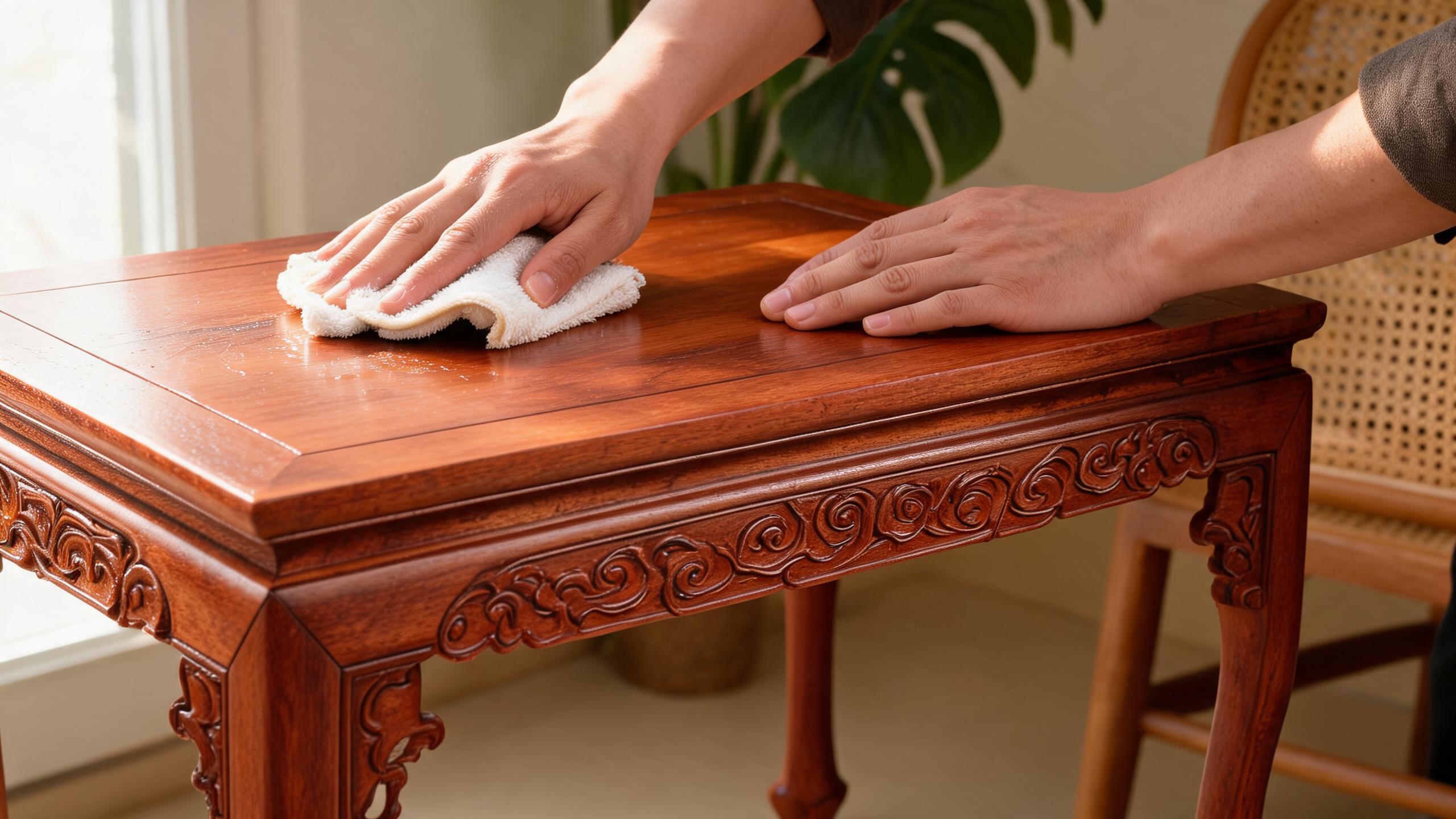
A practical, fact-based guide for B2B importers in Southeast Asia and Australia on protecting solid rosewood furniture against humidity damage. Covers wood behavior, finish selection, warehousing, container shipping, retail handling, and supplier evaluation — with actionable checklists and honest guidance on what to confirm with your supplier.
BUYER GUIDE · SOLID WOOD FURNITURE
If you import solid rosewood furniture into Singapore, Kuala Lumpur, Jakarta, Bangkok, or coastal Australia, you already know the problem: rosewood moves. It expands, contracts, checks, and sometimes splits when the air around it changes. In humid climates, the risk is not a matter of if but when — unless you plan for it from the moment the container door opens.
This guide is written for importers, distributors, and retail buyers who need practical, actionable steps to protect rosewood furniture care and reduce returns. We focus on the realities of the Southeast Asian and Australian markets: high relative humidity, monsoon seasons, and long shipping routes through equatorial waters.
- Rosewood is hygroscopic — it absorbs and releases moisture, causing dimensional change. Expect seasonal movement; plan for it.
- Finish choice matters more than most buyers realize. A good sealer slows moisture exchange; a poor one accelerates it.
- Container shipping is the highest-risk phase. Condensation, not the wood itself, is the usual culprit.
- Your supplier's drying process (MC%) is the single most important spec to verify before ordering.
- Retail and warehousing conditions in high-humidity markets need active control — passive measures alone are insufficient.
Why Rosewood Behaves Differently in Humid Climates
Rosewood (Dalbergia species) is a dense, oily hardwood. Its natural oils give it decay resistance and a rich color, but they do not make it waterproof. Like all solid wood, rosewood is hygroscopic: it constantly exchanges moisture with the surrounding air until it reaches equilibrium.
In practical terms, this means:
- When humidity rises, the wood absorbs moisture and swells. In confined joinery, this can cause panels to buckle or glue joints to fail.
- When humidity falls, the wood releases moisture and shrinks. This is when surface checks (small cracks) and end-grain splitting appear.
- Rapid changes are worse than steady high humidity. A piece that sits in an air-conditioned showroom at 55% RH, then moves to a humid warehouse at 85% RH, experiences more stress than one that stays at a constant 75%.
For Southeast Asian markets, the practical implication is clear: the risk window is not just the monsoon season. It is the transition between air-conditioned spaces and non-conditioned storage, and between the dry season and the wet season.
Moisture Content (MC%): The Spec You Must Verify
Before you place your next PO, ask your supplier one question: "What is the moisture content of the wood at the time of packing?" If they cannot give you a number, that is a red flag.
Wood that is properly kiln-dried to 8–10% MC and then sealed will behave predictably in most climates. Wood shipped at 14% MC or higher will release moisture as it moves into drier environments, causing shrinkage and checking. Conversely, wood dried to 6% MC and shipped into a humid market will absorb moisture and swell.
| Moisture Content at Packing | Behavior in High-Humidity Market (75–90% RH) | Risk Level |
|---|---|---|
| 6–8% | Absorbs moisture, swells slightly. Joinery may tighten. | Low–Moderate |
| 8–10% | Near equilibrium with typical indoor conditions. Minimal movement. | Low |
| 10–12% | Releases moisture in air-conditioned spaces; absorbs in humid storage. | Moderate |
| 12%+ | High risk of shrinkage, end-grain checking, and joint failure. | High |
If your supplier cannot provide a documented MC reading, ask for one. A reputable manufacturer of solid wood furniture will have a moisture meter on the production floor and should be able to state their target range. If they hesitate, treat it as a warning sign.
Finish Selection: The First Line of Defense
The finish on rosewood furniture is not just cosmetic. It is the primary barrier between the wood and the atmosphere. A well-applied finish slows moisture exchange dramatically; a poor one does almost nothing.
For humid climates, consider these options:
- Polyurethane / lacquer (film finishes): These create a continuous film that blocks moisture penetration. They are effective but can crack or peel if the wood underneath moves significantly. Best for furniture that will stay in one climate zone.
- Oil finishes (teak oil, tung oil): These penetrate the wood and do not form a film. They allow more moisture exchange, which can be beneficial in stable environments but risky in fluctuating humidity. They are easier to repair but require more maintenance.
- Wax finishes: Minimal protection. Suitable only for decorative pieces in climate-controlled spaces. Not recommended for high-humidity markets.
In practice, the best approach for humid climates is a multi-coat film finish (polyurethane or catalyzed lacquer) applied to all surfaces — including the underside and the back of panels, which many manufacturers skip.
Ask your supplier whether the finish is applied to all six sides of each component. Unfinished undersides and drawer interiors are common weak points where moisture enters first.
Container Shipping: The Highest-Risk Phase
The journey from factory to your warehouse is often where the most damage occurs. A container that sits on a ship deck in equatorial heat can reach internal temperatures of 50°C (122°F) during the day and drop to 25°C (77°F) at night. This temperature swing causes condensation — water droplets forming on the container ceiling and dripping onto the furniture below.
This is a well-known problem in the trade, and the solutions are equally well-established:
- Desiccant bags: Calcium chloride or silica gel desiccants absorb moisture inside the container. Use enough — a standard 20-foot container typically needs 10–20 kg of desiccant, depending on the route and season.
- Ventilation: Some containers have vents that can be opened or closed. For high-humidity routes, closed vents with desiccants are usually better than open vents, which let humid air in.
- Packaging: Furniture should be wrapped in breathable material (not plastic, which traps condensation) and protected with corrugated cardboard or foam at contact points.
- Loading: Leave air gaps between crates for airflow. Do not fill the container to the ceiling with no space for air movement.
If you are importing regularly, consider asking your supplier to use a hygrometer card inside the container. These cheap, color-changing cards show whether the container experienced high humidity during transit. They give you evidence for insurance claims if damage occurs.
Warehousing and Storage: Active Control Is Non-Negotiable
In Southeast Asia and coastal Australia, ambient humidity regularly exceeds 80% RH during the wet season. If you store rosewood furniture in an uncontrolled warehouse during this period, you are accepting damage as a cost of doing business.
The minimum standard for a furniture warehouse in a humid climate:
- Humidity control: A dehumidifier or air-conditioning system that maintains 50–60% RH. This is not optional.
- Temperature stability: Avoid large temperature swings. If the warehouse is not air-conditioned, at least keep it shaded and ventilated.
- Off the floor: Store furniture on pallets or racks, never directly on concrete. Concrete floors wick moisture and transfer it to the wood.
- Air circulation: Use fans to keep air moving. Stagnant air promotes mold growth on unfinished surfaces.
- No plastic wrapping: If furniture is wrapped in plastic for storage, condensation forms inside the wrap. Use breathable fabric covers instead.
For retail showrooms, the same principles apply. An air-conditioned showroom at 55% RH is fine, but be aware that furniture moved from a humid warehouse into the showroom will undergo a moisture shock. Allow a few days of acclimatization before display.
Handling and Installation: What to Tell Your Customers
End-user behavior affects your return rate. Most furniture damage in humid climates is not a manufacturing defect — it is a result of placement and care. Provide your retail customers with clear, simple instructions:
- Keep furniture away from direct air-conditioning airflow. The constant dry air causes the wood to dry out and check.
- Avoid direct sunlight. UV light fades the rich rosewood color over time and dries the surface.
- Use a humidifier in dry months, a dehumidifier in wet months. The goal is to keep indoor RH between 45% and 65%.
- Wipe spills immediately. Rosewood is oil-rich but not waterproof. Standing water can leave white marks on the finish.
- Use coasters and placemats. Heat and moisture from cups are a common cause of finish damage.
- Apply furniture wax or polish every 3–6 months. This maintains the finish and adds a layer of protection.
If you include these instructions as a printed card with each piece, you will reduce warranty claims significantly. Most customers do not know that solid wood moves — they assume any crack is a defect.
Seasonal Movement: What Is Normal, What Is Not
It helps to set expectations with your customers — and with yourself — about what constitutes acceptable movement in solid wood furniture.
| Condition | Normal or Defect? | Action |
|---|---|---|
| Small hairline checks on end grain | Normal in seasonal change | Monitor; apply wax. Usually closes when humidity rises. |
| Drawer slightly tight in wet season | Normal — wood swells | Do not force. Wait for dry season; or lightly sand the runner. |
| Panel gaps appearing in dry season | Normal — wood shrinks | Reassure customer; gaps close in wet season. |
| Large cracks (over 1–2 mm) within 3 months | Possible defect | Inspect. Check MC% at delivery and supplier drying records. |
| Glue joint failure or splitting | Defect | Claim under warranty. Check joinery quality and MC%. |
The key distinction is time. Wood that moves gradually with the seasons is behaving naturally. Wood that cracks severely within weeks of arrival was either not dried properly, not finished adequately, or exposed to extreme conditions in transit.
Supplier Evaluation Checklist
Before you commit to a new supplier of solid rosewood furniture, verify the following:
- Kiln drying capability: Does the factory own kilns, or do they buy pre-dried lumber? If they buy pre-dried, ask for the supplier's MC certificate.
- Target MC range: What MC% do they aim for at packing? The answer should be 8–10% for export to humid markets.
- Finish system: What type of finish? How many coats? Is it applied to all six sides? Ask for photos of the finishing line.
- Packaging for export: Do they use desiccants in containers? Do they wrap in breathable materials? Ask for a packing specification sheet.
- Warranty policy: What do they cover for humidity-related movement? A supplier who understands the issue will have a clear policy.
- Reference markets: Have they exported to Southeast Asia or Australia before? If yes, ask for references. If no, ask how they have adapted their process.
If a supplier cannot answer these questions with specifics, treat it as a risk. The cheapest quote is not cheap if it arrives cracked.
Frequently Asked Questions
Is solid rosewood suitable for tropical climates at all?
Yes, with proper drying, finishing, and care. Rosewood is naturally durable and has been used in tropical furniture for centuries. The failures you see in imported furniture are usually due to poor drying, inadequate finish, or mishandling in transit — not the wood itself.
Should I buy solid rosewood or veneered rosewood for humid markets?
Veneered panels are more dimensionally stable because the veneer is bonded to a stable substrate (like MDF or plywood). However, solid rosewood is preferred for heirloom-quality pieces. If you choose solid, the care requirements above apply. If you choose veneer, ensure the substrate is moisture-resistant grade.
How do I handle warranty claims for humidity damage?
First, determine if the damage is normal seasonal movement or a defect. Document with photos and, if possible, measure the MC% of the affected piece. If the MC% is above 12% months after arrival, the wood was likely shipped too wet. If the finish has failed, the application was likely inadequate. Present this evidence to your supplier — most reputable manufacturers will work with you on a resolution.
Can I re-finish rosewood furniture in my market to improve humidity resistance?
Yes. If you have stock that is under-finished, you can apply an additional coat of polyurethane or a hard wax oil in your own facility. This is a common practice among importers who buy unfinished or lightly oiled pieces. It adds cost but reduces future claims.
Final Recommendations for Importers
Rosewood furniture care in humid climates is not complicated, but it requires discipline. The three most important actions you can take as an importer:
- Specify and verify MC% at packing. This is your first line of defense. Put it in your PO.
- Invest in container protection. Desiccants and breathable packaging cost little compared to the cost of damaged goods.
- Control your warehouse environment. A dehumidifier is a capital expense, but it pays for itself in reduced claims and returns.
If you are evaluating suppliers for your next order of solid wood furniture, ask the questions in the checklist above. A supplier who can document their drying process, finish system, and export packaging is a supplier who understands the realities of your market.
If you need further guidance on specifications, finishes, or packaging requirements for your specific market, contact us — we can discuss your project and what to confirm with your manufacturing partner.