
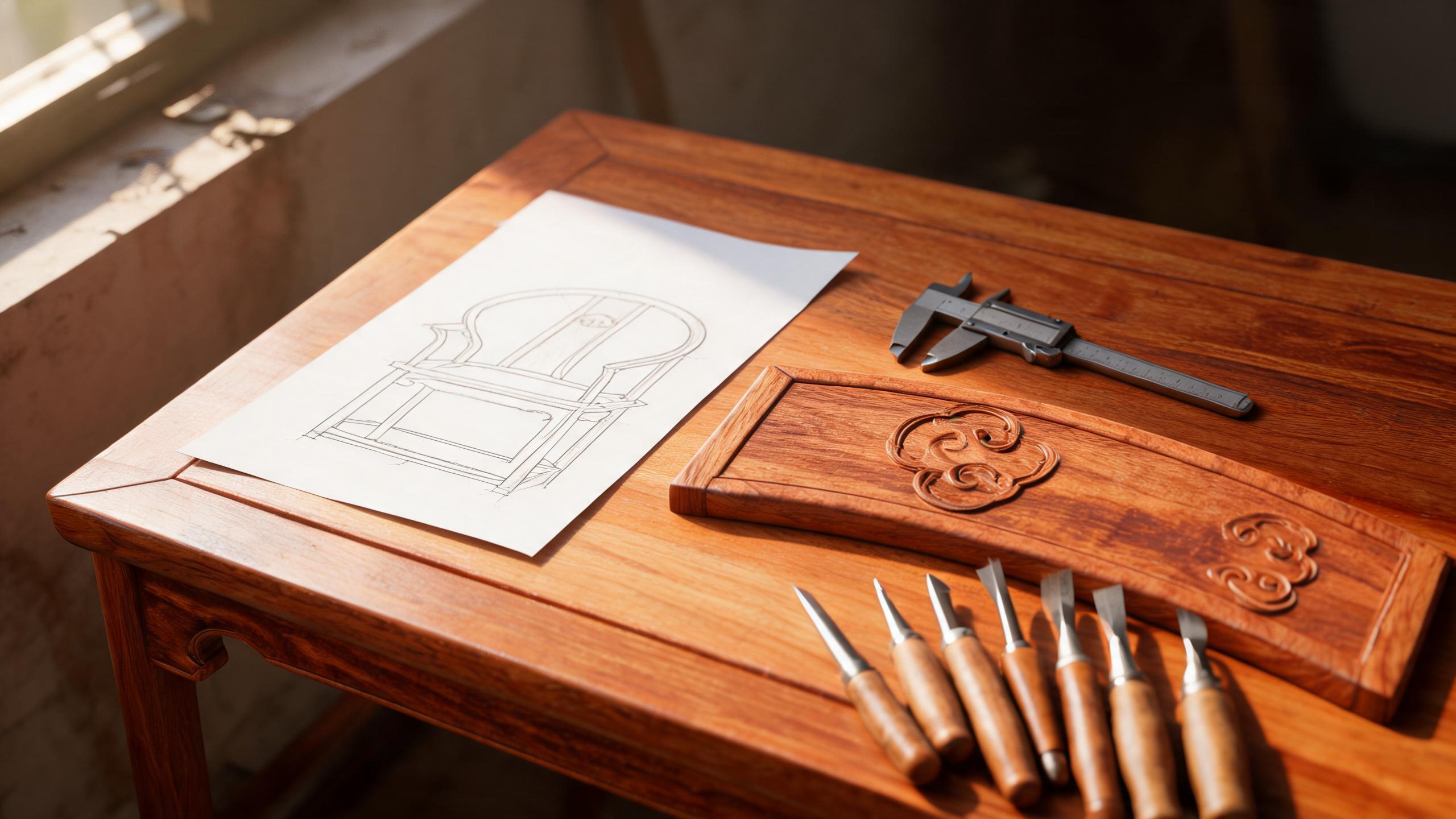
A practical, fact-first guide for B2B importers planning to source custom rosewood furniture from China. It covers the OEM vs. ODM decision, wood species selection, the step-by-step customization workflow from drawing to delivery, quality control checkpoints, cost drivers, and a supplier evaluation checklist.
BUYER GUIDE · OEM / ODM SOURCING
Why "Custom Rosewood Furniture from China" Is a Process, Not a Product Search
If you are searching for custom rosewood furniture, you are likely not looking for a single SKU. You are looking for a supplier who can turn a drawing, a photo, or even a rough idea into a finished, container-ready product that matches your market's quality expectations and your price structure.
This guide walks through the OEM/ODM customization workflow for rosewood furniture from China — from deciding which type of custom furniture you need, to specifying wood, approving samples, and managing production. It is written for importers, wholesalers, and e-commerce sellers who need a repeatable process, not a one-off quote.
- Decide between OEM (your design, factory executes) and ODM (factory design, you brand it) before sending inquiries — it changes the entire conversation.
- Rosewood is a broad category. Specify the exact species and grade (e.g., African rosewood vs. Brazilian rosewood) to avoid substitution disputes.
- Always require a pre-production sample and a third-party inspection report before shipment. Do not rely on photos alone.
- Clarify moisture content, joinery method, and finish type in writing. These three factors determine whether the furniture survives shipping and your local climate.
- Confirm the Incoterm, packaging standard, and delivery lead time before signing the contract.
Step 1: Define Your Customization Type — OEM vs. ODM
In the Chinese furniture export industry, the terms OEM and ODM are used precisely. Knowing the difference will help you communicate clearly with factories.
| Criteria | OEM (Original Equipment Manufacturer) | ODM (Original Design Manufacturer) |
|---|---|---|
| Design source | Buyer provides drawings, samples, or detailed specs | Factory provides existing designs; buyer selects and may request modifications |
| Best for | Buyers with a clear product vision, existing catalog, or brand standards | Buyers entering a new category quickly without in-house design resources |
| Tooling / mold costs | Usually buyer bears or shares development costs | Usually included in factory pricing or amortized over order volume |
| Exclusivity | Possible if volume justifies it; must be written into contract | Rare; same design may be sold to other markets |
| Lead time to first sample | Longer (4–8 weeks typical, depending on complexity) | Shorter (1–3 weeks, based on existing models) |
For rosewood furniture specifically, ODM is common because factories often have established lines of dining tables, coffee tables, and display cabinets. If you need a unique design for your brand, OEM is the route — but be prepared to invest in development time and sample costs.
Step 2: Specify the Wood — Rosewood Is Not One Species
The term "rosewood" covers multiple species with very different price points, grain patterns, and workability. A responsible supplier will ask you to clarify exactly which wood you mean. If they do not, that is a red flag.
Common types you will encounter in Chinese furniture factories:
- African rosewood (Pterocarpus erinaceus) — also called "pau rosa" or "senegal rosewood." Widely used in Chinese factories for affordable solid wood furniture. Has a reddish-brown color and medium density.
- Brazilian rosewood (Dalbergia nigra) — heavily restricted under CITES. Rarely available for commercial export. If a factory offers it cheaply, verify documentation carefully.
- Burmese rosewood (Dalbergia oliveri) — high density, dark streaks, used for high-end furniture. Also CITES-listed; export requires permits.
- Rosewood veneer over MDF or plywood — a common construction for case goods. Lower cost, stable panels, but not solid wood.
For most commercial importers, African rosewood or rosewood veneer over engineered wood offers the best balance of appearance, stability, and cost. Always confirm the scientific name and country of origin in your purchase contract.
Step 3: Prepare a Detailed Specification Sheet
Vague inquiries ("I want a nice rosewood table") produce vague quotes. A professional spec sheet does the opposite — it forces the factory to price precisely and reduces the chance of misunderstandings later.
Your specification sheet should include at minimum:
- Product type and dimensions — L × W × H in millimeters or inches, plus tolerance (e.g., ±3 mm).
- Wood species and grade — exact species, whether solid or veneer, and acceptable color variation.
- Moisture content — 8–12% is standard for export furniture to temperate climates.
- Joinery — mortise-and-tenon, dowel, screw, or a combination. For solid rosewood, mortise-and-tenon is preferred for durability.
- Finish — PU lacquer, NC lacquer, wax, or oil. Specify matte, satin, or gloss level.
- Packaging — export standard: 5-ply carton + foam + pallet, or custom packaging for your market.
- Target price range — be honest about your budget; it saves everyone time.
Step 4: The OEM/ODM Workflow — From Inquiry to Delivery
Here is the typical sequence you will follow with a professional Chinese furniture factory. Timelines vary, but the structure is consistent.
4.1 Inquiry and Quotation (1–2 weeks)
Send your spec sheet to 3–5 factories. Ask for a quote that includes: unit price (FOB or EXW), tooling or sample cost, MOQ, and production lead time. Compare like-for-like — a factory quoting FOB and another quoting EXW are not directly comparable.
4.2 Sample Development (2–6 weeks)
For OEM projects, the factory will create a pre-production sample. Some factories charge for this; the fee is usually deducted from the bulk order. Review the sample for:
- Wood color and grain match to your reference
- Joinery quality — no visible gaps, no wobble
- Finish uniformity — no drips, no rough spots
- Dimensions within tolerance
4.3 Contract and Deposit (1 week)
Typical terms: 30% deposit to start production, 70% balance before shipment (or against a copy of the Bill of Lading). Confirm the Incoterm — FOB and CIF are common, but EXW shifts more responsibility to you.
4.4 Bulk Production (3–8 weeks)
Production time depends on order size and complexity. A 40HQ container of dining tables might take 4–6 weeks. During this period, request production photos or a video call at key stages — after cutting, after finishing, and before packing.
4.5 Inspection and Shipping (1–2 weeks)
Use a third-party inspection service (e.g., SGS, BV, or a local agent) to check the finished goods before loading. Inspect for: correct wood species, dimensions, finish defects, and packaging integrity. Only after inspection passes should the balance payment be released.
Step 5: Quality Control — What to Check and Why
Rosewood furniture is an investment for your end customer. A single quality failure can cost you not just the shipment, but the customer relationship. Build these checks into your process.
| Checkpoint | What to Verify | Why It Matters |
|---|---|---|
| Wood species | Match to contract; check for mixed species in one batch | Substitution is the #1 dispute in rosewood imports |
| Moisture content | 8–12% using a moisture meter | Too high → cracking and warping in dry climates |
| Joinery | No loose joints, no visible glue squeeze-out | Affects structural lifespan of the piece |
| Finish | Even coating, no bubbles, no color mismatch between parts | Directly visible to your end customer |
| Packaging | Carton thickness, foam density, pallet strapping | Prevents transit damage; insurance claims are painful |
Step 6: Cost Drivers — Where Your Money Goes
Understanding what drives the price helps you negotiate intelligently and avoid surprise costs.
- Wood cost — the largest single component. African rosewood is significantly cheaper than Burmese or Brazilian. Veneer construction is cheaper than solid wood.
- Labor — hand-carved details, dovetail joinery, and multi-step finishing increase labor hours. Simple, clean-line designs are more cost-effective.
- Finish quality — a 9-step PU lacquer process costs more than a 3-step wax finish but looks and lasts better.
- Packaging — export-grade packaging adds 3–8% to the cost but is non-negotiable for sea freight.
- MOQ — factories price per unit based on batch size. A 50-piece order will have a higher unit cost than a 500-piece order. Ask for tiered pricing at 50, 100, 300, and 500 units.
Step 7: Evaluating a Supplier — Red Flags and Green Flags
Not every factory that says "we make custom rosewood furniture" can actually deliver. Use this checklist when evaluating suppliers.
Green flags:
- They ask detailed questions about wood species, dimensions, and finish before quoting.
- They provide a written spec sheet back to you for confirmation.
- They offer a pre-production sample and explain their sample fee policy.
- They can show you photos or videos of similar rosewood projects (not just generic furniture photos).
- They are transparent about production lead times and current capacity.
Red flags:
- They quote instantly without asking about specs.
- They claim "100% solid rosewood" at a price that seems too good to be true.
- They cannot explain which species of rosewood they use.
- They avoid third-party inspection.
- They demand 100% payment before production.
Frequently Asked Questions
What is the typical MOQ for custom rosewood furniture?
For OEM projects, MOQs often start around 50–100 pieces per design. ODM projects may have lower MOQs since the factory already has tooling. Confirm the MOQ in writing before sample development.
How long does the entire process take from inquiry to delivery?
For a standard OEM project: 1–2 weeks for quoting, 2–6 weeks for sampling, 4–8 weeks for production, and 2–4 weeks for sea freight to major ports (e.g., Los Angeles, Rotterdam). Plan for 3–4 months total for a first order.
Can I use my own branding on the furniture?
Yes. Most factories can apply a laser-engraved logo, a metal brand plate, or embossed marking on the furniture or packaging. Specify this in your spec sheet.
What about CITES restrictions on rosewood?
Some rosewood species are CITES-listed, meaning export requires permits. A reputable factory will advise you on which species are feasible for export and handle the paperwork. If you are unsure, ask the factory to state the species and confirm export compliance in the contract.
What if the production sample does not match my expectations?
Do not approve it. Request revisions until it matches your spec. A professional factory will iterate on the sample (usually with additional sample fees if the changes are significant). Approving a flawed sample and hoping for better bulk production is a common and costly mistake.
Next Steps: What to Prepare Before Contacting a Factory
To get the most useful quotes from Chinese furniture factories, prepare the following before you reach out:
- Clear product drawings or reference photos with dimensions.
- Specification of the exact rosewood species you want (or ask the factory to recommend one within your budget).
- Your target price range and order quantity.
- Your market's quality expectations (e.g., US retail vs. EU contract market).
- Your preferred Incoterm and any special packaging requirements.
With these in hand, you can move from "getting a quote" to "managing a production run" — which is where reliable margins are made in the custom furniture import business.
Need help developing your rosewood furniture spec sheet or evaluating a supplier? Contact us with your product drawings and target market, and we will walk you through the feasibility and costing.