
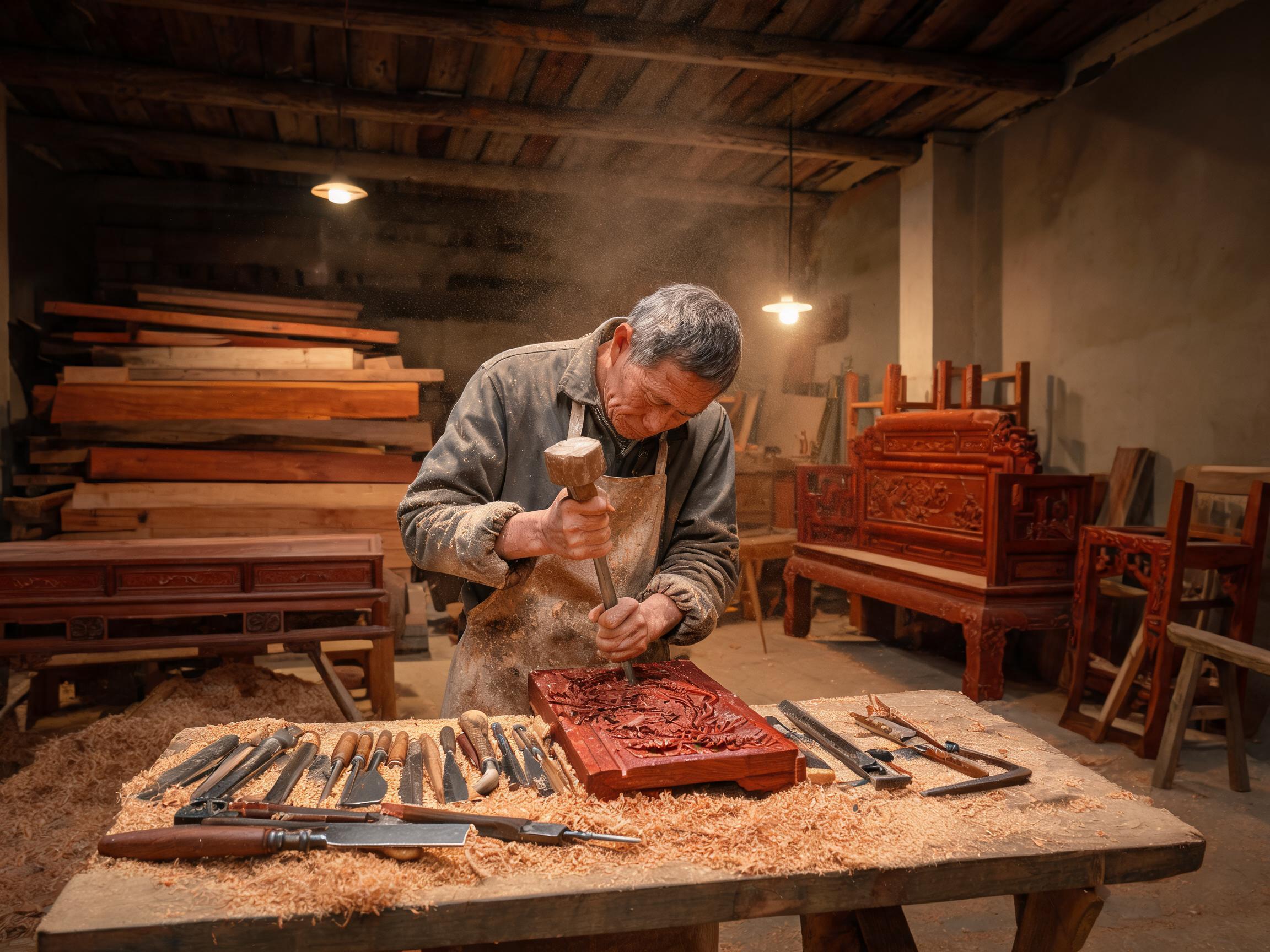
A practical sourcing guide for B2B importers covering rosewood dining table selection — from size and shape decisions to Ming-style designs, quality inspection points, and OEM customization workflows with Chinese manufacturers.
BUYER GUIDE · SOLID WOOD DINING FURNITURE
Why Rosewood Dining Tables Are a Stable Category for Importers
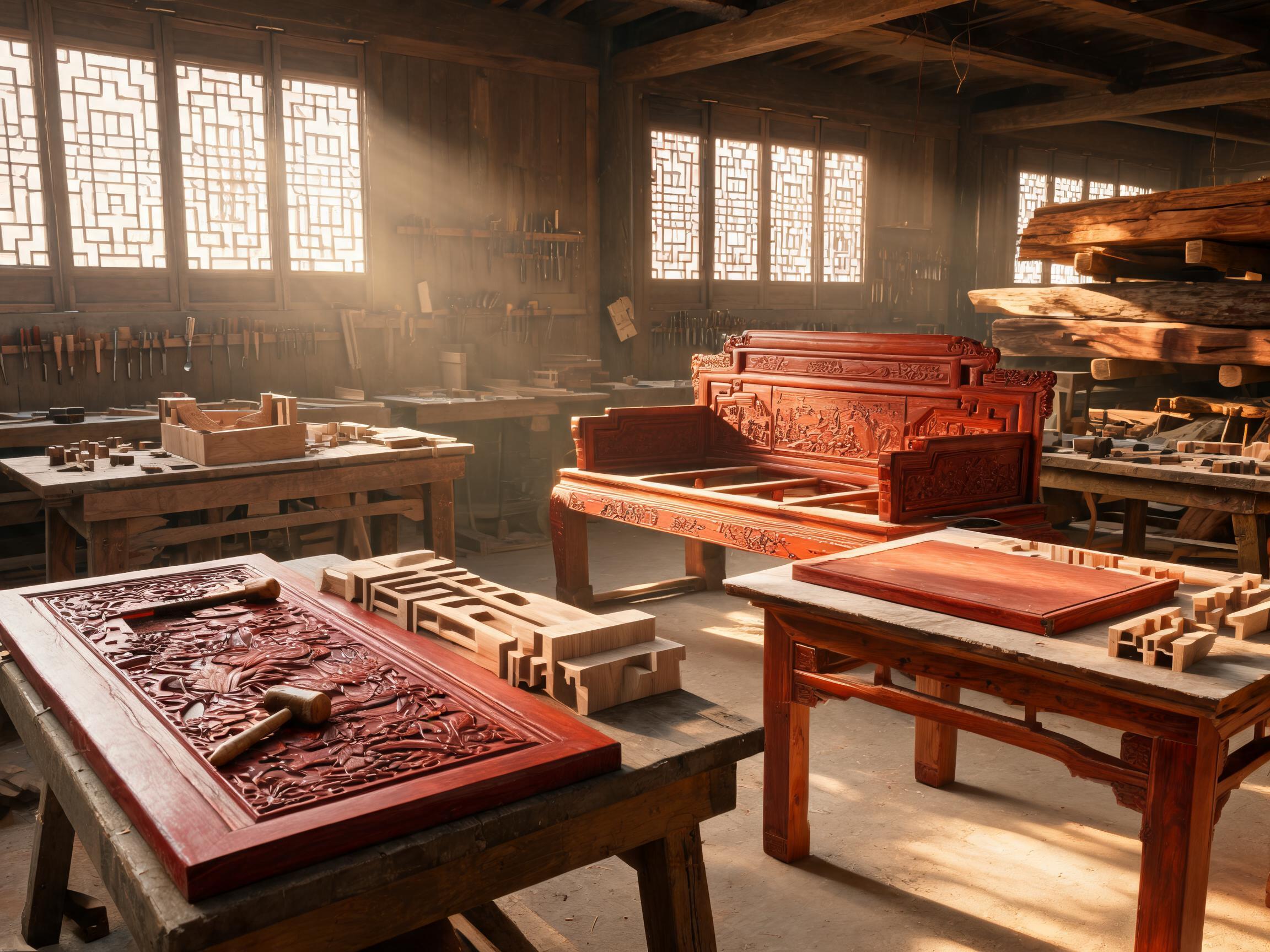
Rosewood dining tables occupy a specific segment in the global furniture market: they are not fast-moving consumer goods, but they carry higher unit value, longer product life cycles, and strong repeat-purchase potential in hospitality, high-end residential, and cultural/heritage projects. For B2B importers, the category offers better margin protection than mass-market rubberwood or MDF products — provided you source the right grade, the right construction, and the right factory.
This guide covers the four decisions that matter most when sourcing rosewood dining tables from China: size and seating logic, shape and spatial fit, style direction (with a focus on Ming-style rosewood dining tables), and OEM customization workflows. We also include a practical quality checklist and common pitfalls to avoid.
- Seating capacity, not table length alone, should drive your size specification — allow 60–75 cm of table edge per seated person.
- Ming-style rosewood dining tables command premium pricing but require strict joinery verification — mortise-and-tenon, not screws.
- OEM rosewood dining table programs work best when you specify wood grade, moisture content range, and finish type in writing before sampling.
- Always request a pre-production sample and a third-party inspection report before mass production.
Part 1: Sizes — Matching Table Dimensions to Seating Capacity
The most common sourcing mistake is specifying a table length without a clear seating target. A 180 cm rectangular table can seat six people comfortably, but only if the width and leg placement allow it. Here is the dimensional logic we recommend using when you brief a factory.
Rectangular Rosewood Dining Tables
| Table Size (L × W × H cm) | Seating Capacity | Typical Room Width Needed | Best Use Case |
|---|---|---|---|
| 140 × 80 × 75 | 4 persons | 2.8 m | Small apartments, tea rooms |
| 160 × 85 × 75 | 4–6 persons | 3.0 m | Compact dining rooms |
| 180 × 90 × 75 | 6 persons | 3.2 m | Standard family dining |
| 200 × 95 × 75 | 6–8 persons | 3.5 m | Larger family homes |
| 220 × 100 × 75 | 8 persons | 3.8 m | Villas, executive dining |
| 240 × 105 × 75 | 8–10 persons | 4.0 m | Hotel private dining rooms |
Note that 75 cm is the standard dining height for the Chinese and most Asian markets. For North American and European markets, 76 cm is more common. Confirm the target market height standard with your buyer before finalizing specifications.
Round Rosewood Dining Tables
Round tables are popular for Chinese-style dining because they support shared-plate service. The key metric is diameter, not length.
- 120 cm diameter — seats 4 people comfortably.
- 135–150 cm diameter — seats 6 people; this is the most common specification for family use.
- 160–180 cm diameter — seats 8–10 people; requires a room of at least 3.6 m × 3.6 m.
- 200 cm+ diameter — seats 12 or more; typically used in hotel VIP rooms or large banquet halls. These often require a lazy Susan (rotating center) — specify this early if needed.
Part 2: Shapes — Practical and Spatial Considerations
Shape affects not only aesthetics but also logistics and production cost. Here is how to evaluate each option.
Rectangular
The most space-efficient shape. It fits against walls, works in narrow rooms, and is the easiest to pack for export (rectangular cartons maximize container utilization). Rectangular rosewood dining tables are also the most common base for OEM customization because the structure is straightforward.
Round
Round tables are the traditional choice for Chinese and East Asian dining culture. They encourage group conversation and are safer in households with children (no sharp corners). However, they are less space-efficient and more expensive to crate for shipping due to their shape.
Oval
A compromise between rectangular and round. Oval tables seat more people than a rectangle of the same length and are popular in hospitality settings. Production cost is moderately higher because the curved edges require more skilled joinery work.
Square
Square rosewood dining tables (typically 80–100 cm per side) are common in tea rooms and small dining areas. They seat 4 people and can often be converted to a larger configuration with a removable leaf — a feature worth specifying if your buyers value flexibility.
Part 3: Styles — Why Ming-Style Rosewood Dining Tables Command a Premium
Within the rosewood dining table category, the Ming-style (明式) design is the most recognized and most valuable sub-segment. Ming-style furniture originated in the Ming Dynasty (1368–1644) and is characterized by clean lines, minimal ornamentation, and structural integrity achieved through precise joinery rather than nails or glue.
Key Features of Ming-Style Rosewood Dining Tables
- Mortise-and-tenon joinery (榫卯结构): The defining feature. No metal fasteners are used in the primary structure. This requires skilled craftsmen and significantly increases production time.
- Minimal carving: Unlike Qing-style furniture, which features heavy ornamentation, Ming-style relies on the beauty of the wood grain itself.
- Flowing, curved lines: Legs and aprons often feature subtle curves (e.g., the "horse hoof" leg design) that add elegance without decoration.
- High-quality hardwood: Ming-style furniture was traditionally made from precious hardwoods — rosewood, huanghuali, and ebony. Modern production often uses Burmese rosewood or other rosewood species.
For importers, Ming-style rosewood dining table sets typically sell at a 30–50% premium over contemporary designs of the same wood grade. The premium is justified by the labor intensity and the cultural cachet — but it also means your factory must genuinely master the joinery. We address how to verify this in Part 5.
Other Style Directions Worth Considering
| Style | Characteristics | Target Market | Production Complexity |
|---|---|---|---|
| Ming-style (classic) | Minimal, joinery-focused, no nails | Collectors, high-end residential, cultural projects | High — requires skilled joinery craftsmen |
| Contemporary minimalist | Clean lines, simpler joinery, often with metal or glass accents | Modern apartments, younger buyers | Medium |
| Qing-style (ornate) | Heavy carving, inlay work, dramatic silhouettes | Traditional interiors, hotels with classic themes | High — carving labor is expensive |
| Mixed (East-West fusion) | Rosewood top with metal legs, or rosewood frame with marble top | Design-forward hospitality and residential | Medium — requires multi-material supply chain |
Part 4: OEM Rosewood Dining Table Customization — What to Specify Before You Ask for a Quote
OEM rosewood dining table programs are common in this category because most importers do not design their own furniture from scratch — they adapt existing designs to their market's preferences. The quality of your OEM brief determines the quality of the samples you receive. Here is the minimum information a factory needs from you.
1. Wood Species and Grade
"Rosewood" is a broad term. Specify the exact species you want:
- Burmese rosewood (Pterocarpus macrocarpus) — the most common commercial grade, good color and grain, moderate cost.
- Siamese rosewood (Pterocarpus indicus) — lighter color, often used in contemporary designs.
- Indian rosewood (Dalbergia sissoo) — darker, heavier, higher density.
- Huanghuali (Dalbergia odorifera) — the most expensive and rare; usually only for high-end collectible pieces.
Also specify whether you accept solid wood, veneer over solid core, or engineered wood with rosewood veneer. These three options differ in cost by 40–60%.
2. Moisture Content Range
For export to different climates, specify the target moisture content (MC). Standard is 8–12% for most markets. For dry climates (Middle East, parts of the US), 6–9% is safer. A reliable factory will kiln-dry to your specified range and provide a moisture meter reading with each shipment.
3. Finish Type
- PU lacquer — durable, water-resistant, most common for commercial use.
- Natural oil/wax finish — shows wood grain better, but less protective; preferred for high-end residential.
- French polish (shellac) — traditional, glossy, but requires careful maintenance.
Specify the finish sheen level (matte, satin, gloss) and whether you need a food-safe finish for the table surface.
4. Construction and Joinery
State clearly whether you require full mortise-and-tenon construction (for Ming-style) or whether reinforced dowel-and-glue construction is acceptable (for contemporary designs). This is the single biggest factor affecting both cost and durability.
5. Packaging and Container Loading
Ask the factory for a container loading plan before you commit. A standard 40HQ container can hold approximately 25–35 rectangular rosewood dining tables (depending on size and whether chairs are nested). Confirm whether the factory uses foam-and-cardboard protection or wooden crates — the latter is more expensive but necessary for high-value pieces.
6. MOQ and Lead Time
MOQs for OEM rosewood dining table programs typically range from 20 to 50 pieces per design, depending on the factory. Lead times for a standard order are usually 30–45 days after sample approval. Ming-style pieces with complex joinery may take 60 days or more. Confirm these numbers with your supplier — they vary significantly by factory capacity.
Part 5: Quality Inspection Checklist — What to Check Before You Pay
We recommend a three-stage inspection process: pre-production, during-production, and pre-shipment. Here is what to verify at each stage.
Pre-Production
- Wood grade confirmation: request photos of the actual timber to be used, not stock photos.
- Moisture content reading for the batch.
- Sample approval: always require a physical sample, not just a photo. If a physical sample is impossible, request a video walkaround with a ruler for scale.
During Production
- Joinery quality: check that mortise-and-tenon joints are tight, with no gaps. A visible gap of more than 0.5 mm is a defect.
- Surface finish: check for even color, no bubbles, no runs in the lacquer.
- Leg stability: the table should not wobble on a flat surface. Test by applying pressure to each corner.
Pre-Shipment
- Check for cracks, warping, or insect damage — especially in the tabletop panels.
- Verify that the finish matches the approved sample.
- Confirm packaging quality: corners protected, table wrapped in breathable material (not plastic, which traps moisture).
- Request photos of the loaded container before the truck leaves the factory.
Part 6: Common Sourcing Pitfalls and How to Avoid Them
Pitfall 1: Assuming "rosewood" means one specific wood. It does not. Always specify the exact species and require it in writing on the contract. If the factory substitutes a cheaper species, you have no recourse without a written specification.
Pitfall 2: Skipping the moisture content requirement. Rosewood that is not properly kiln-dried will crack or warp after arrival in your market. This is the most common cause of customer complaints and returns. Make MC testing a contractual requirement.
Pitfall 3: Ordering Ming-style from a factory that only does contemporary furniture. The joinery skills are completely different. Ask for photos of completed Ming-style pieces and, if possible, references from other importers.
Pitfall 4: Not accounting for the "seating envelope." A table that seats 6 on paper may only seat 5 in practice if the legs are positioned in a way that blocks chairs. Always test with actual chairs during the sample stage.
Frequently Asked Questions
What is the difference between rosewood and redwood dining table sets?
In the furniture trade, "rosewood" refers to hardwood species in the Dalbergia and Pterocarpus genera. "Redwood" is a more general term that can refer to any wood with a reddish tone, including cheaper alternatives like rubberwood or African mahogany. When sourcing, always confirm the exact botanical species — the price difference between a true rosewood table and a red-toned hardwood table can be 3–5 times.
Can I order a Ming-style rosewood dining table with a custom size?
Yes. Most factories that produce Ming-style furniture can accommodate custom sizes, but note that changing dimensions affects the joinery layout. A 20 cm increase in length may require a completely different leg and apron design. Provide your custom dimensions during the quotation stage, not after production begins.
What is the typical MOQ for OEM rosewood dining table programs?
MOQs vary by factory, but 20–50 pieces per design is a common range. Some factories accept lower MOQs (10 pieces) at a higher unit price. For custom designs requiring new molds or templates, expect a one-time tooling fee.
How do I verify that a factory actually uses mortise-and-tenon joinery?
Ask for a video of the joinery being cut and assembled. A factory using genuine mortise-and-tenon will be happy to show it — it demonstrates their craftsmanship. Also request a sample piece and test its strength by applying lateral pressure. A glued-and-screwed joint will show visible movement or creaking; a mortise-and-tenon joint will not.
What is the typical lead time for a container of rosewood dining tables?
For standard designs, 30–45 days after sample approval is typical. For Ming-style pieces with complex joinery, allow 60–75 days. Confirm the lead time in writing and include a penalty clause for late delivery if your market timeline is tight.
Next Steps: Building Your Sourcing Brief
Before you contact suppliers, prepare a one-page sourcing brief that includes: target market and buyer profile, preferred wood species and grade, table dimensions and seating capacity, style direction (Ming-style or contemporary), finish type, MOQ, and target price range. This brief will save you weeks of back-and-forth and will signal to factories that you are a serious buyer.
If you are sourcing rosewood dining tables and need a factory that can handle both standard and custom OEM programs, contact us with your specifications — we will confirm feasibility, provide a quotation, and arrange a sample for your review. We work with established factories that specialize in solid wood dining furniture and can support Ming-style joinery work.