
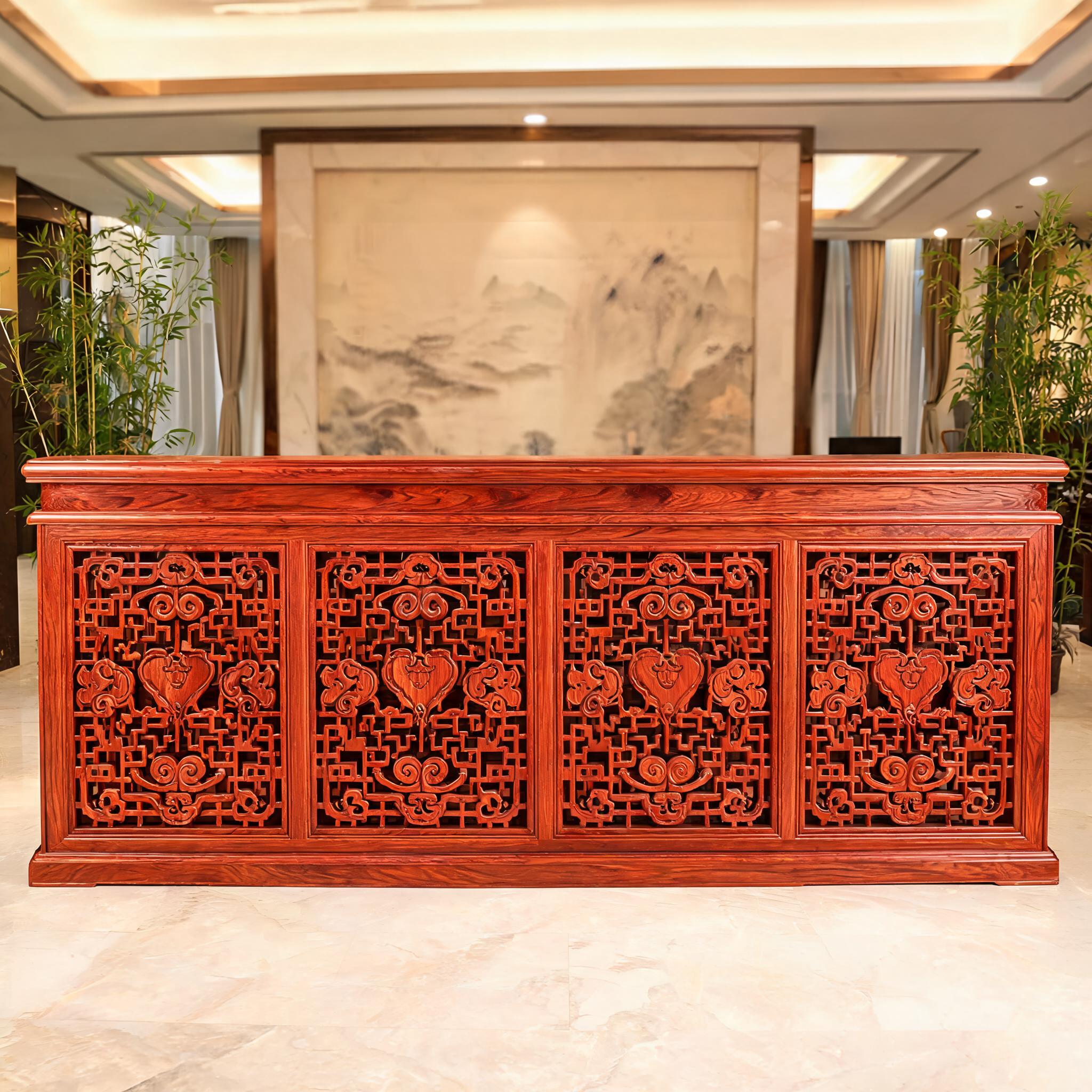
A practical B2B sourcing guide for hospitality buyers, interior designers, and procurement managers looking to import solid rosewood hotel front desks and lobby counters from China. Covers material grades, construction quality checks, customization workflows, logistics, and supplier evaluation criteria — written for real purchasing decisions, not generic sales talk.
BUYER GUIDE · HOSPITALITY PROCUREMENT
Rosewood Front Desk Sourcing: A Practical Guide to Importing Classical Chinese Solid Rosewood Hotel Reception Desks
The hotel front desk is the first physical point of contact a guest has with your property. It sets the tone for the entire stay. For boutique hotels, heritage properties, and luxury hospitality brands, a rosewood front desk in the classical Chinese style does more than function as a check-in counter — it anchors the lobby's visual identity.
But importing a solid rosewood reception desk from China is not like ordering a standard office counter. The material is dense, the craft is specialized, and the cost is significant. Getting it wrong means long delays, customs problems, or a piece that cracks within a year.
This guide is written for hospitality procurement managers, interior designers, and hotel developers who need to source rosewood hotel furniture from China with confidence. We cover the material grades you should specify, the construction details that separate good work from bad, the customization workflow, and the supplier evaluation criteria that matter.
- Specify the rosewood species and grade in writing — "rosewood" alone is not a legally or commercially sufficient term.
- Check the joinery, not just the surface. Solid wood construction and hidden frame quality determine whether a reception counter survives 10 years of daily use.
- Plan for a 60–90 day production window plus sea freight. Rush orders on solid rosewood pieces usually mean compromised drying or finishing.
- Ask for photos of the unfinished frame and the drying kiln logs. These two details tell you more than any finished product photo.
- Confirm the HS code and required phytosanitary documentation with your forwarder before the goods ship.
Why Rosewood for a Hotel Reception Desk?
Rosewood (primarily Dalbergia species) has been the preferred wood for Chinese classical furniture for centuries. Its density, deep reddish-brown color, natural oil content, and fine grain make it both durable and visually striking. Unlike many softwoods used in commercial furniture, a well-made solid rosewood piece does not need veneer or heavy finishing to look premium — the material itself carries the aesthetic.
For a hotel front desk, this translates into several practical advantages:
- Durability: High density means resistance to scratches, dents, and daily wear from luggage and guest traffic.
- Aging well: With proper care, rosewood develops a deeper patina over time. It does not look "worn out" — it looks established.
- Acoustic and tactile quality: The wood feels solid and sounds solid. This matters in a lobby where guests form first impressions.
- Design flexibility: Classical Chinese joinery allows for complex shapes — curved panels, carved details, recessed lighting coves — that are difficult or impossible with mass-produced modular counters.
However, these benefits only materialize if the material is genuine and the construction is sound. That is where most sourcing mistakes happen.
Step 1: Define the Rosewood Species and Grade
In international trade, "rosewood" is a loose term. It can refer to Brazilian rosewood (Dalbergia nigra), Indian rosewood (Dalbergia latifolia), Siamese rosewood (Dalbergia cochinchinensis), or various African species. Each has different density, color, price, and — critically — different CITES (Convention on International Trade in Endangered Species) status.
For Chinese classical furniture, the most commonly used and commercially available species is Dalbergia cochinchinensis (often called Siamese rosewood or "lao hongmu" in Chinese) and Dalbergia oliveri. These are protected under CITES Appendix II, which means international trade is legal but requires permits.
| Species | Common Trade Name | Density (g/cm³) | CITES Status | Typical Use |
|---|---|---|---|---|
| Dalbergia cochinchinensis | Siamese rosewood | 0.85–1.0 | Appendix II | High-end classical furniture, reception counters |
| Dalbergia oliveri | Burmese rosewood | 0.95–1.1 | Appendix II | Heavy structural pieces, carved panels |
| Dalbergia latifolia | Indian rosewood | 0.75–0.85 | Appendix II | Moderate-cost alternative, veneer core |
| Pterocarpus spp. | Padauk / narra | 0.65–0.80 | Not listed (check local) | Budget-conscious projects, non-CITES alternative |
What to do: In your inquiry, specify the exact species and ask the supplier to state it in the proforma invoice. Do not accept "rosewood" as a standalone description. If you have CITES permit requirements, clarify them with your customs broker before placing the order — the supplier can provide the export permit, but your import country's requirements may vary.
Step 2: Understand the Two Construction Methods
Not all "solid rosewood" reception desks are built the same way. There are two fundamentally different approaches, and the price difference reflects them.
Method A: Full Solid Wood Construction
Every visible panel, leg, and frame member is solid rosewood. This is the traditional method used in classical Chinese furniture. The piece is heavy (a 2.4-meter reception counter can weigh 400–600 kg), expensive, and extremely durable. Repairs are possible for decades because the material is homogeneous.
Method B: Solid Wood Frame + Rosewood Veneer
The structural frame is solid rosewood or another hardwood, but the large flat panels (tabletop, side panels) are made of engineered wood (plywood or MDF) with a rosewood veneer. This method is significantly cheaper and lighter, and it allows for larger seamless surfaces. However, it is not "solid rosewood furniture" — and if the veneer is thin or poorly applied, it can peel or bubble in humid climates.
| Factor | Full Solid Rosewood | Frame + Veneer |
|---|---|---|
| Unit weight (2.4m counter) | 400–600 kg | 150–250 kg |
| Cost index | 1.0 (baseline) | 0.4–0.6 |
| Durability | Very high | Moderate; depends on veneer quality |
| Repairability | High — can be sanded and refinished | Low — veneer cannot be sanded deeply |
| Best for | Heritage hotels, flagship properties, long-term investment | Boutique hotels, budget-constrained projects |
What to do: Decide which method fits your project budget and longevity requirements. State it explicitly in your RFQ. If you choose full solid wood, ask for a cross-section photo of a panel edge to verify there is no veneer line.
Step 3: The Quality Checks That Matter
When evaluating a rosewood reception desk supplier, do not rely on finished photos alone. Ask for specific evidence of construction quality.
3.1 Wood Drying (Kiln Process)
Rosewood has high natural oil content and can be prone to cracking if not dried properly. A reputable supplier will dry the wood to a moisture content of 8–12% (depending on your destination climate) using a controlled kiln process. Ask for the kiln drying records or at least the target moisture content. If the supplier cannot tell you the moisture content, treat that as a red flag.
3.2 Joinery Method
Traditional Chinese furniture uses mortise-and-tenon joints — no nails, no screws in the visible structure. This is not just aesthetic; it allows the wood to expand and contract with humidity changes without cracking. Modern commercial pieces may use metal brackets or glue for speed. For a high-end piece, insist on mortise-and-tenon for all structural connections.
3.3 Surface Finish
Rosewood should be finished with a hard wax, lacquer, or PU coating that protects the surface without obscuring the grain. Ask what finish is used and whether it is food-safe (relevant if the counter will have a coffee station or minibar area). For high-traffic hotel lobbies, a lacquer or PU finish is more practical than wax alone.
3.4 Hidden Areas
Check the underside of the counter, the back panels, and the inside of drawers. Poor-quality factories finish only the visible surfaces. A good factory will sand and finish all surfaces, including those the guest never sees. This is a reliable indicator of overall workmanship.
- Species name (scientific and trade name) on the proforma invoice
- CITES export permit (if applicable) — confirm before production
- Kiln drying records or target moisture content
- Photos of the unfinished frame (before panel assembly)
- Finish specification (type, brand, application method)
- Packaging specification for sea freight (see Step 5)
Step 4: Customization Workflow for Hospitality Projects
A chinese classical reception counter is rarely bought off-the-shelf. Most hospitality projects require customization to fit the lobby dimensions, brand aesthetic, and functional requirements (cable management, cash drawer integration, ADA height compliance, etc.).
Here is the typical workflow with a competent Chinese manufacturer:
- Initial RFQ: Send your lobby dimensions, design references (photos or sketches), and functional requirements. Include the number of check-in positions, whether you need a standing or seated height counter, and any integrated technology needs.
- Design Proposal: The supplier provides a CAD drawing or 3D rendering. Review the proportions carefully — a classical Chinese design can look heavy if scaled incorrectly for a modern lobby.
- Sample or Mock-up: For large projects, request a small sample panel (e.g., 30×30 cm) showing the wood grade, finish, and carving detail. This costs money but is worth it for a piece this expensive.
- Production: Solid rosewood pieces typically take 4–8 weeks for a single counter, longer for complex carvings or multiple units. Confirm the production schedule in writing.
- Inspection: Arrange for a pre-shipment inspection (third-party or video call) to check the finish, dimensions, and packaging.
- Shipping and Installation: Decide whether the counter ships fully assembled or in sections (knock-down). For large pieces, knock-down with on-site assembly by a local carpenter is often more practical.
Step 5: Logistics, Packaging, and Customs
Rosewood is heavy and valuable. Shipping it incorrectly is an expensive mistake.
Packaging
For sea freight, the counter must be wrapped in multiple layers: a moisture barrier (plastic film), foam padding, and a solid wooden crate. The crate should be made of fumigated timber (marked with the IPPC logo) to comply with ISPM 15 regulations. Ask the supplier to confirm this — a non-compliant crate will be rejected at the destination port.
Shipping Method
For a single large counter, a 20-foot container with other hotel furniture is the most cost-effective option. If you are shipping multiple pieces, a dedicated container makes sense. Air freight is rarely practical for solid rosewood due to weight and cost.
Customs and CITES
This is the area where most importers get delayed. Confirm the following with your customs broker before the goods ship:
- The correct HS code for your piece (furniture of wood — typically 9403.60)
- Whether your destination country requires a CITES import permit in addition to the export permit
- Any additional phytosanitary certificates required for solid wood
If your project timeline is tight, start the CITES paperwork early. It can take 4–8 weeks in some countries.
Step 6: Evaluating Suppliers — What to Ask Before You Commit
Not every Chinese furniture factory can produce a high-quality classical rosewood piece. The craft requires experienced carpenters, not just CNC machines. Use this checklist when shortlisting suppliers:
| Question | Why It Matters |
|---|---|
| How many years have you produced rosewood furniture specifically? | Rosewood behaves differently from other hardwoods. Experience matters. |
| Can you show photos of the unfinished frames of past rosewood projects? | Verifies that the "solid wood" claim is real and joinery is visible. |
| What is your target moisture content after kiln drying? | Indicates whether they understand climate-related cracking risks. |
| Do you provide a CITES export permit for rosewood? | If not, the shipment will be stopped at customs. |
| What is your MOQ for a custom reception desk? | Some factories require multiple units; others accept single-piece custom orders. |
| Can you provide a third-party inspection report before shipping? | Shows confidence in their quality control. |
| What is your standard packaging for sea freight? | Confirms ISPM 15 compliance and moisture protection. |
Budget Considerations
Pricing for a solid rosewood reception desk varies dramatically based on species, size, carving complexity, and construction method. As a rough reference:
- A 2.4-meter full solid rosewood counter with moderate carving: expect a significant investment, typically several times the cost of a comparable hardwood or veneer piece.
- A frame-and-veneer version of the same design: roughly 40–60% of the full solid price.
Get itemized quotes from at least three suppliers. Compare not just the unit price but also the packaging, delivery terms (FOB vs. CIF), and what is included (lighting, metal trim, drawers, cable grommets).
Frequently Asked Questions
Q1: Is rosewood legal to import?
Yes, for most Dalbergia species, provided the shipment has the required CITES export permit from the country of origin and, in some cases, an import permit from your country. Work with your customs broker to confirm the specific requirements for your destination.
Q2: How long does production take?
For a single custom solid rosewood counter, plan for 6–10 weeks from approved drawings to completion. Complex carving or multiple units will take longer. Add 3–5 weeks for sea freight to North America or Europe.
Q3: Can I get a sample before placing a full order?
Yes. Most serious manufacturers will produce a sample panel or a scaled mock-up for a fee, which is deducted from the order value. This is strongly recommended for large projects.
Q4: How do I maintain a rosewood front desk in a hotel environment?
Use coasters under drinks, wipe spills immediately, and avoid direct sunlight for extended periods. Depending on the finish, a periodic application of furniture wax or polish may be needed. Your supplier should provide care instructions specific to the finish used.
Q5: What if the piece arrives damaged?
This is why pre-shipment inspection and good packaging matter. Take photos of the crate upon arrival before opening. If there is damage, document it and file a claim with the freight forwarder immediately. A reputable supplier will also have insurance coverage for transit.
Final Recommendations
Importing a classical Chinese solid rosewood hotel reception desk is a significant investment, but it is one that pays off in guest experience and property value. The key is to treat it as a specialized procurement, not a standard furniture order.
Be precise about the species and construction method. Verify the supplier's claims with documentation and photos of the work-in-progress. Plan your logistics and CITES paperwork early. And when in doubt, ask the supplier for evidence — a good factory will be happy to provide it.
If you are evaluating a rosewood front desk for an upcoming hospitality project and need detailed specifications, MOQ information, or a custom quote, contact our team with your project dimensions and design references. We will respond with a practical assessment of feasibility and timeline.
Send us your lobby layout, design inspiration, and functional requirements. We will confirm material options, production timeline, and shipping details for your specific case. Request a project consultation →