
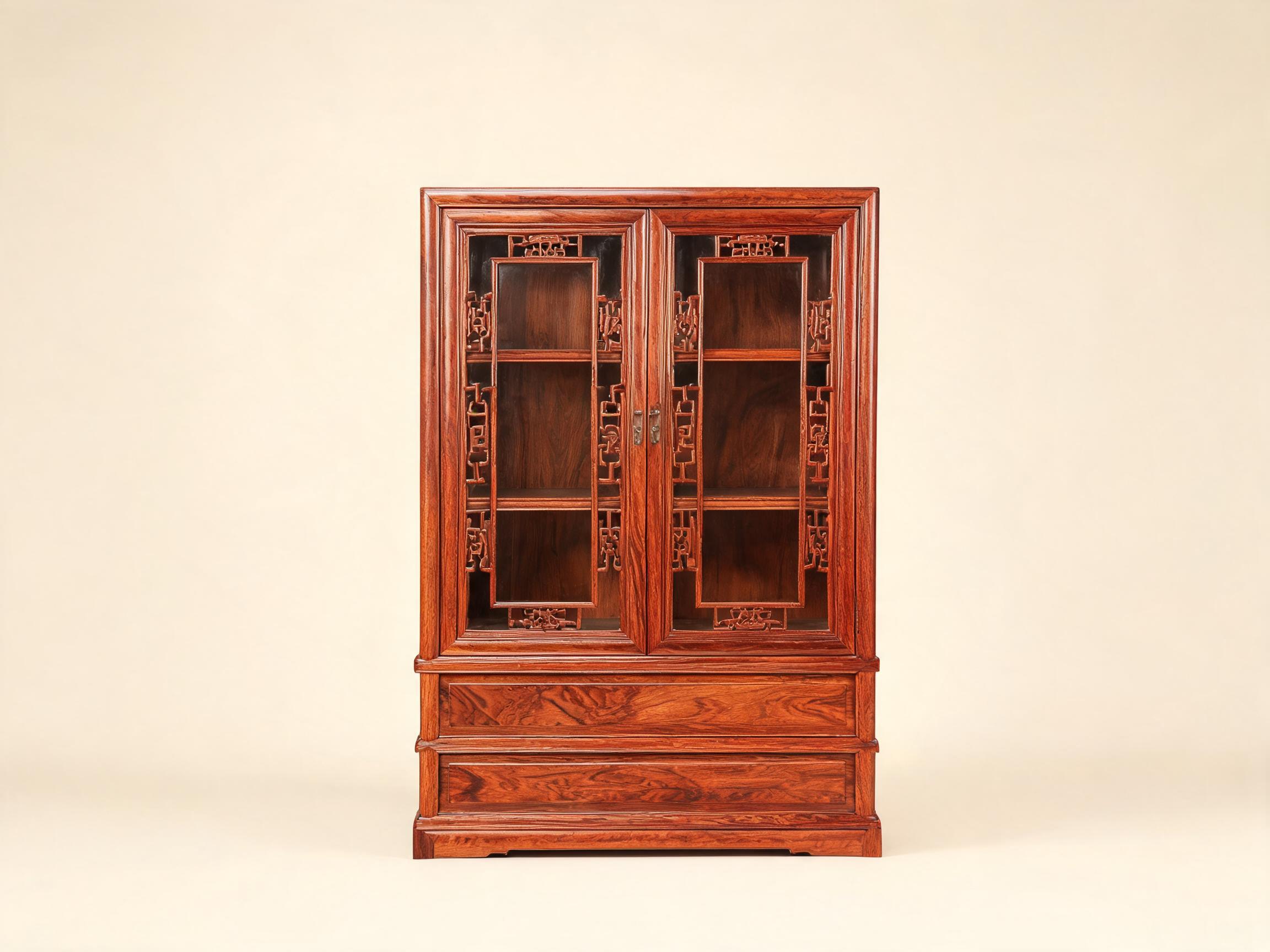
A practical B2B sourcing guide for importing rosewood glass display cabinets and carved Chinese display cabinets for hotels, showrooms, retail, and collectibles. Covers material selection, craftsmanship evaluation, quality checks, shipping considerations, and supplier assessment — written for procurement professionals, not consumers.
B2B SOURCING GUIDE
Rosewood Glass Display Cabinet Sourcing: A Buyer's Guide to Importing Classical Chinese Carved Cabinets
If you are sourcing display furniture for a hotel lobby, a high-end retail store, a museum gift shop, or a private collector's showroom, the rosewood glass display cabinet is a category that combines function with a strong visual statement. These pieces are not just storage units — they are often the focal point of a room. But importing them from China involves more than picking a nice photo from a catalog. You need to understand wood species, joinery quality, glass specifications, carving standards, and the logistics of moving large, heavy furniture across borders.
This guide is written for procurement professionals, interior designers, and retail buyers. It focuses on the practical decisions you will face when sourcing glass door cabinets and solid wood display cabinets from Chinese manufacturers. We will cover material identification, craftsmanship evaluation, quality control checkpoints, shipping considerations, and how to vet a supplier properly.
- Rosewood is a broad trade term — always specify the exact wood species and request a certificate of origin.
- Carving quality is the single biggest differentiator in price; inspect the depth, undercutting, and symmetry of the carvings.
- Glass-front cabinets require careful specification of glass type, thickness, and hinge hardware — these are common failure points.
- Never rely on photos alone. Request a pre-shipment inspection report or a live video walkaround of your actual unit.
- Plan for crating and freight costs that can equal 20–35% of the product value for large furniture items.
1. Understanding the Product Category
A rosewood display cabinet in the Chinese classical style typically features a solid wood frame, hand-carved decorative panels, and a glass-fronted door or doors. These cabinets are used to display porcelain, jade, antiques, books, or retail merchandise. The design language draws from Ming and Qing dynasty furniture traditions, with motifs like cloud patterns, dragon figures, floral scrolls, or geometric lattice work.
There are three main sub-types you will encounter when sourcing:
- Tall standing cabinets (立柜): Full-height units, often 180–210 cm tall, with one or two glass doors. Used in hotels, showrooms, and private residences.
- Low display cabinets (低柜): Waist-height units, around 90–110 cm tall, often used against walls in retail or gallery settings.
- Corner cabinets (角柜): Triangular or angled units designed to fit room corners. Popular in traditional interior design projects.
Within each type, you will find variations in wood quality, carving density, and glass configuration. A glass door cabinet can have a single large pane, multiple panes divided by mullions, or curved glass sections. Each configuration affects both the price and the manufacturing complexity.
2. The Wood Question: What "Rosewood" Actually Means
The term "rosewood" is used loosely in the furniture trade. In the Chinese market, it often refers to Huanghuali (Dalbergia odorifera), Zitan (Pterocarpus santalinus), or more commonly for commercial pieces, Hongmu (a group of rosewood species under the Chinese national standard GB/T 18107-2017). For export-grade commercial furniture, the most common materials are:
| Wood Type | Common Name | Typical Use in Cabinets | Relative Cost |
|---|---|---|---|
| Pterocarpus macrocarpus | Burmese rosewood / Maidu | Solid frames, carved panels | High |
| Dalbergia cochinchinensis | Siamese rosewood / Thai rosewood | High-end carvings, veneer | Very High |
| Dalbergia latifolia | Indian rosewood / Sonokeling | Solid frames, structural parts | Medium-High |
| Millettia laurentii | Wenge (often sold as "rosewood" in budget ranges) | Modern-style cabinets | Medium |
For B2B buyers, the critical point is this: always specify the botanical name, not just "rosewood." If a supplier quotes you a price for a "rosewood glass display cabinet," ask for the exact species and whether the piece is solid wood, veneer, or a combination. Many export cabinets use solid rosewood for the frame and rosewood veneer over medium-density fiberboard (MDF) for large flat panels. This is not necessarily a defect — it is a cost-saving measure that affects stability — but you need to know what you are paying for.
A common sourcing mistake is assuming "solid wood" means the entire piece is one solid block. In practice, even high-end cabinets use joined panels. The question is whether the visible surfaces are solid wood or veneer, and what core material is used beneath.
Also note the regulatory dimension. Many rosewood species are listed under CITES (Convention on International Trade in Endangered Species). You should confirm with your supplier that the wood is legally harvested and that the necessary export permits are available. This is not optional paperwork — customs in your destination country will require it.
3. Evaluating Carving Quality
The Chinese carved display cabinet is distinguished by its hand-carved ornamentation. Machine-carved pieces exist and are cheaper, but the highest-value items are hand-carved by skilled artisans. As a buyer, you need to be able to tell the difference.
Here is what to inspect:
- Depth of relief: High-quality carvings have deep undercutting — the background is cut away so the motif stands out clearly. Shallow, flat carvings indicate machine work or rushed handwork.
- Symmetry and flow: In traditional Chinese carving, patterns are symmetrical. Check that the left and right sides of a motif match. Look at the flow of lines — they should be continuous, not choppy.
- Backside finishing: A well-made cabinet is finished on the inside and back, not just the front. Poor suppliers often leave the back panels rough.
- Tool marks: Hand carving leaves subtle, irregular tool marks. Machine carving leaves uniform, repetitive patterns. If in doubt, ask for a close-up video of the carving surface.
Carving density is a major cost driver. A cabinet with carvings on the top rail, bottom rail, side stiles, and door frames will cost significantly more than one with carvings only on the top. Decide your budget and design intent before requesting quotes, and be specific about which areas must be carved.
4. Glass and Hardware Specifications
For a glass-front display cabinet, the glass is a functional component, not just a visual one. You need to specify:
- Glass type: Standard float glass, tempered glass, or laminated glass. Tempered is recommended for safety in public spaces like hotels and retail stores.
- Thickness: 4mm to 6mm is typical for cabinet doors. Thicker glass (8mm+) is used for large, frameless panels.
- Clarity: Low-iron glass (also called "extra clear" or "optiwhite") reduces the green tint visible in standard glass. This matters when displaying white porcelain or light-colored items.
- Hinges: Ask what brand of hinges is used. For heavy glass doors, soft-close hinges are recommended. Common quality brands in Chinese manufacturing include DTC and Blum (though Blum is often a premium upgrade).
- Lighting: Many display cabinets now come with LED strip lighting inside. Specify whether you want this included, and check the voltage compatibility for your market (110V vs 220V).
One practical tip: ask the supplier for a sample of the glass edge finish. Polished edges are standard, but the quality of the polishing varies. Rough edges are a sign of a low-cost production line.
5. Quality Control Checkpoints
Before you place a bulk order, you should establish a quality control (QC) process. Here are the checkpoints to include in your inspection protocol:
| Checkpoint | What to Verify | Common Defects |
|---|---|---|
| Wood moisture content | 8–12% for export furniture | High moisture leads to cracking and warping after shipment |
| Joinery fit | Mortise-and-tenon joints should be tight, no gaps | Nail-reinforced joints or visible filler |
| Carving consistency | Match against approved sample | Simplified carvings on production units vs. sample |
| Glass installation | No wobble, proper sealant, correct thickness | Thinner glass than specified, poor sealing |
| Finish / lacquer | Even coating, no runs, no bubbles | Uneven color, visible brush marks |
| Packaging | Foam corners, protective film, sturdy carton or crate | Insufficient padding causing transit damage |
If you are ordering a single container (typically 20–40 units depending on size), a pre-shipment inspection by a third-party agency like SGS or Bureau Veritas is a worthwhile investment. The cost is usually a few hundred US dollars per inspection, which is far less than the cost of receiving a container of defective goods.
6. Shipping and Logistics
Solid wood display cabinets are heavy and bulky. A single tall cabinet can weigh 80–150 kg depending on wood density and carving thickness. This affects both freight cost and handling requirements.
Key logistics considerations:
- Incoterms: For first-time buyers, FOB (Free On Board) from a major port like Shenzhen, Guangzhou, or Shanghai is common. This means the supplier handles export clearance and delivers to the port; you handle ocean freight, insurance, and destination clearance.
- Crating: Cabinets should be packed in wooden crates, not just cartons. The crate must have internal bracing to prevent movement. Ask for photos of the packing process.
- Fumigation: Wooden crates require ISPM-15 fumigation certification for most destinations. Confirm your supplier provides this.
- Lead time: Hand-carved pieces are not off-the-shelf. Production lead time for a 20-foot container of carved cabinets is typically 30–60 days, depending on the complexity. Factor this into your project timeline.
Also consider the destination country's import duties on wooden furniture. Rates vary significantly — for example, the US and EU have different tariff classifications for wooden furniture (HS code 9403.60). Your freight forwarder or customs broker can provide the exact rate for your shipment.
7. Supplier Evaluation Checklist
When comparing suppliers, go beyond the price quote. Use this checklist to evaluate each candidate:
- Factory vs. trading company: A factory can show you production photos and often offers better pricing. A trading company may offer more design variety but adds a margin. Ask directly which one you are dealing with.
- Export experience: Ask for the countries they have shipped to and the Incoterms they have used. A supplier who only sells domestically will have a steeper learning curve with export documentation.
- Sample policy: Reputable suppliers will make a sample for you, usually against a sample fee that is refundable upon bulk order. Avoid suppliers who refuse to make a sample.
- Customization capability: If you need custom dimensions, a different wood finish, or a modified carving pattern, confirm the supplier can do it and at what additional cost.
- Communication: Response time and clarity matter. A supplier who takes 3 days to answer a simple question will be painful to work with during production issues.
A good rule of thumb: if a supplier cannot provide a clear specification sheet with wood species, dimensions, glass thickness, and hardware brands in writing, treat that as a red flag. Professional suppliers document what they sell.
8. Budget Planning
Pricing for rosewood glass display cabinets varies widely based on wood species, carving density, and size. As a rough planning reference (note: prices change with material markets and should be confirmed with suppliers):
| Grade | Typical Features | Indicative FOB Price Range (USD) |
|---|---|---|
| Entry-level | Veneer over MDF, machine carving, standard float glass | $350 – $600 |
| Mid-range | Solid rosewood frame, mixed hand/machine carving, tempered glass | $700 – $1,500 |
| High-end | Full solid rosewood, hand-carved panels, low-iron glass, premium hardware | $1,800 – $4,000+ |
Add 20–35% for crating, ocean freight, and destination handling. Also budget for potential customs duties, which vary by country. For a hotel project requiring 30–50 units, this is a significant budget line — which is exactly why you need to get the specifications right before ordering.
9. Frequently Asked Questions
Q: Can I get a custom size for my project?
Yes, most factories accept custom dimensions. Expect a small surcharge (typically 5–10%) and a longer lead time for non-standard sizes, as the frame and carving patterns must be adjusted.
Q: What is the minimum order quantity (MOQ)?
This varies. Some factories accept 1–2 pieces as a trial order, but the unit price will be higher. For better pricing, plan for at least 10–20 units. Confirm the MOQ with each supplier before requesting a quote.
Q: How do I handle after-sales issues like cracked wood?
Wood is a natural material and can develop hairline cracks during transit due to climate changes. Reputable suppliers will provide a small repair kit (wood filler, touch-up stain) with the shipment. For major damage, document it with photos and file a claim with the shipping line. Your contract with the supplier should specify the warranty terms — typically 12 months for structural defects.
Q: Is it better to buy veneer or solid wood for commercial use?
For high-traffic commercial spaces, solid wood frames with veneer panels offer a good balance of stability and cost. Full solid wood is more expensive and can be more prone to movement in varying humidity, but it has higher perceived value for luxury settings.
Q: Can the supplier install the lighting for me?
Most suppliers can install LED lighting. Specify the voltage (110V or 220V), the color temperature (warm white 3000K is typical for display), and whether you want a remote control or a simple switch. Confirm the wiring is certified for your market's electrical standards.
10. Next Steps: From Quote to Order
If you are ready to move forward, here is a practical sequence of steps:
- Shortlist 3–5 suppliers based on the checklist above. Ask each for a specification sheet and a quote for your target quantity.
- Request a video walkaround of the factory and a close-up of the carving process. This is more informative than a photo.
- Order a sample of the specific model you intend to buy. Inspect it in person if possible, or hire a local agent to do so.
- Negotiate Incoterms and payment terms. Typical terms are 30% deposit, 70% balance against the Bill of Lading copy. Be cautious of suppliers demanding 100% payment before production.
- Schedule a pre-shipment inspection before the container is loaded.
- Arrange freight and confirm the fumigation and export documentation are in order.
Sourcing rosewood glass display cabinets is a niche but rewarding category. The products are visually striking, durable, and carry a cultural value that generic modern furniture does not. With the right specifications, a clear quality control plan, and a reliable supplier, you can deliver pieces that elevate any interior — and that your clients will remember.
If you have specific questions about a project, contact us with your dimensions, target quantity, and design references. We can help you assess feasibility and connect you with the right manufacturing partners.