
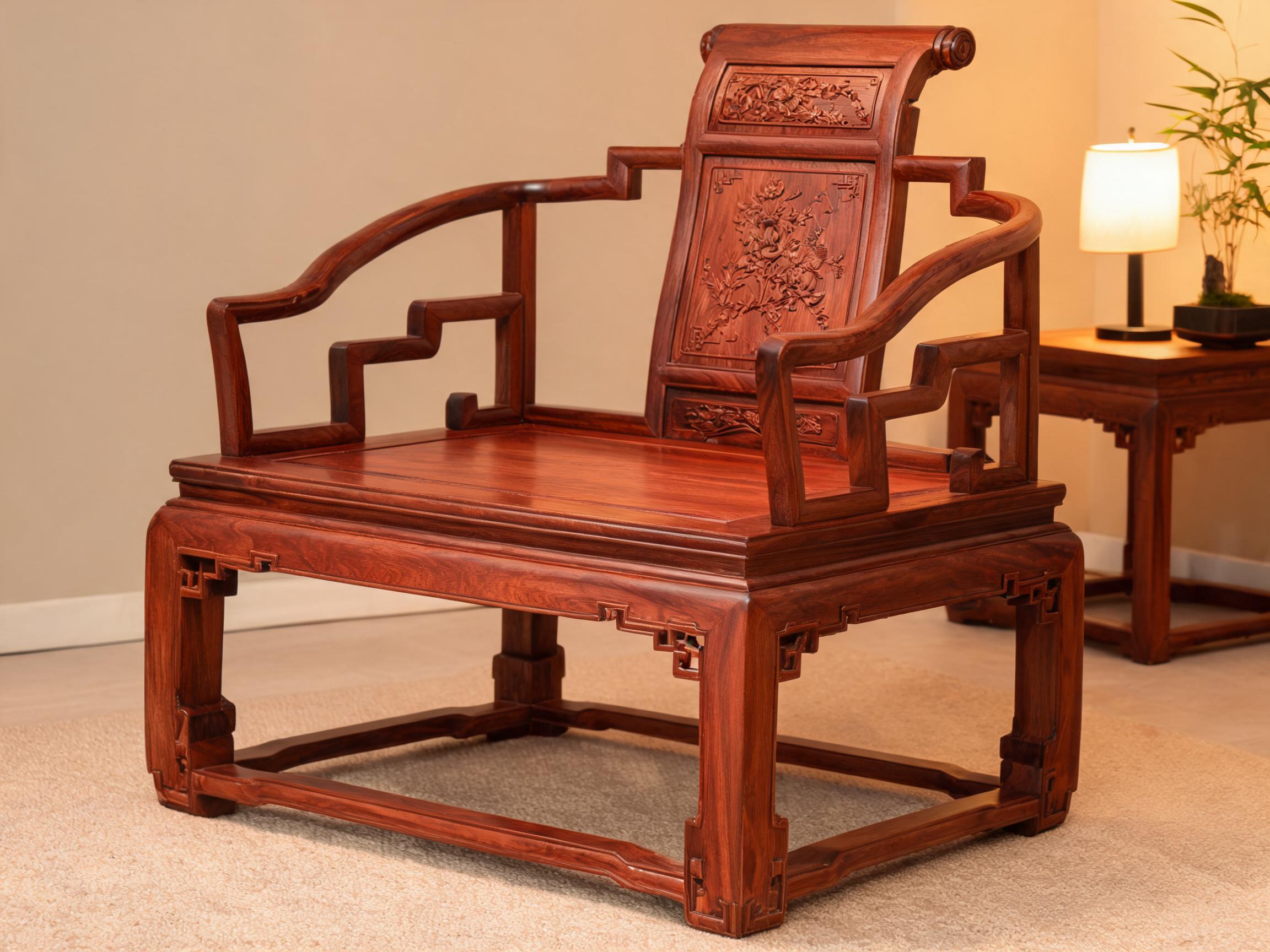
A practical B2B sourcing guide for importers, interior designers, and hospitality procurement teams looking to buy classical Chinese solid rosewood lounge chairs and carved armchairs. Covers wood species identification, joinery quality, carving craftsmanship, finish types, MOQ and lead time expectations, supplier evaluation criteria, and common pitfalls — written for buyers, not consumers.
BUYER GUIDE · HOSPITALITY & RESIDENTIAL FURNITURE
Rosewood Lounge Chair & Carved Armchair B2B Sourcing: What Importers Must Check Before Placing an Order
If you are sourcing rosewood lounge chairs or classical Chinese armchairs for a hotel lobby, a resort villa, or a high-end residential project, you already know the category is different from standard contract furniture. These pieces are not off-the-shelf items. They involve solid hardwood, hand carving, traditional joinery, and finish decisions that affect both cost and lead time.
This guide covers what to verify before you commit to a supplier: wood species and legality, construction quality, carving standards, finish options, packaging for long-distance shipping, and realistic MOQ and lead time expectations. It is written for procurement professionals, not end consumers.
- Confirm the exact wood species (e.g., rosewood vs. "rosewood-style" substitutes) and request CITES documentation before sampling.
- Inspect joinery — mortise-and-tenon construction is the standard for solid wood lounge chairs; glued-and-nailed frames are a red flag.
- Carving density and depth drive price more than any other factor. Agree on a carving standard in writing.
- For hospitality projects, request a finish sample on the actual wood species — not on a swatch card.
- Plan for 45–75 days production lead time for hand-carved pieces, plus 30–45 days sea freight.
1. Wood Species: Rosewood Is a Category, Not a Single Wood
The term "rosewood" covers multiple species with very different price points, grain patterns, and legal status. When a supplier quotes a solid wood lounge chair, the first question is: which rosewood?
Common species in the Chinese classical furniture trade include:
| Common Trade Name | Characteristics | Typical Use |
|---|---|---|
| Huanghuali (Dalbergia odorifera) | Fine grain, fragrant, very dense; high-end collector grade | Museum-grade reproductions, investment pieces |
| Hongmu / Rosewood (Dalbergia spp.) | Dark reddish-brown, medium to high density | Most commercial "rosewood lounge chair" orders |
| Pterocarpus (e.g., Padauk, Amboyna) | Lighter red/orange tones, less dense | Budget-conscious residential projects |
| Rubberwood / "Rosewood finish" | Not rosewood at all; stained to imitate color | Low-cost hospitality furniture — not solid rosewood |
Action for buyers: Ask the supplier to state the botanical name (genus and species) on the quotation and packing list. If the wood is a CITES-listed species, request the export permit number or confirm the supplier can provide one. Do not rely on the term "rosewood" alone — it is not a specification.
2. Construction: Mortise-and-Tenon vs. Glue and Screws
A genuine Ming style armchair or classical Chinese armchair is built with mortise-and-tenon joinery. This is not a stylistic preference — it is the structural reason these chairs survive for decades. The joint allows the wood to expand and contract with humidity changes without cracking.
For a hand carved lounge chair, check the following:
- Frame joints: Are the arms, legs, and back posts joined with visible mortise-and-tenon? Look at the side of the seat rail — you should see the end grain of a tenon, not a screw head.
- Back panel: Is the carved back panel set into a groove, or is it surface-mounted? A groove (floating panel) allows movement; surface mounting will crack.
- Seat: Is the seat frame solid wood, or is it plywood with a veneer? For a solid wood lounge chair, the seat frame should be solid timber.
- Weight: A genuine solid rosewood lounge chair is heavy. A 70×70×80 cm chair should weigh roughly 25–35 kg depending on wood density. If it feels light, question the material.
3. Carving Quality: What "Hand Carved" Actually Means
The term hand carved lounge chair covers a wide range. A chair with light incised line carving is not the same as one with deep, three-dimensional relief carving. The depth and density of carving directly affect labor hours and price.
Define the carving standard before sampling:
- Depth: Is the carving shallow (2–3 mm) or deep (8–15 mm relief)? Deep carving costs significantly more.
- Coverage: Which parts are carved? Back panel only, or back panel plus armrests and front apron?
- Style: Is it a specific historical style (Ming, Qing, or a modern interpretation)? A Ming style armchair is typically more restrained; Qing style is more ornate.
- Symmetry: On paired chairs, the carving should mirror. Check that the left and right armrests are identical.
For a curved armrest chair, the armrest curve is also a functional element. A well-made curved armrest is cut from a single piece of wood or joined with a clean, invisible seam. A poorly joined armrest will show a visible gap or a filled seam that will open with temperature changes.
4. Finish and Surface Treatment
Rosewood has natural oils and a high density. The finish matters for both appearance and durability in hospitality environments.
Common finish options:
| Finish Type | Appearance | Durability | Maintenance |
|---|---|---|---|
| Natural wax (traditional) | Matte, wood grain visible | Low to medium; needs periodic re-waxing | High — not ideal for heavy-use hotel lobbies |
| Lacquer (PU or NC) | Satin to high gloss | High; resistant to moisture and minor scratches | Low — wipe with a dry cloth |
| Oil finish (Tung or Danish) | Low sheen, natural feel | Medium; requires re-oiling | Medium |
| Polyurethane (commercial grade) | Glossy, plastic-like sheen | Very high; suitable for contract use | Very low |
Recommendation for hotels and resorts: Specify a matte or satin PU lacquer. It protects the wood from humidity, cleaning chemicals, and daily use while keeping the natural grain visible. Avoid high-gloss finishes on heavily carved pieces — the gloss will pool in the carving recesses and look uneven.
Ask the supplier for a finish sample on the actual wood you will use. Finish color varies by wood species and even by plank. A sample on a different wood is not a reliable reference.
5. MOQ, Lead Time, and Packaging
Hand-carved rosewood furniture is not a stocked commodity. Most suppliers build to order. Expect these ranges:
- MOQ: 2–5 pieces for a mixed order, or 10–20 pieces for a single design. Some suppliers accept a single container mixed with other furniture.
- Production lead time: 45–75 days for hand-carved pieces, depending on carving complexity and order size.
- Sample lead time: 20–35 days for a pre-production sample, plus shipping.
- Sea freight: 30–45 days to most major ports (US West Coast, EU, Middle East).
Packaging is a critical cost item. Carved rosewood chairs are heavy and have protruding parts (armrests, carved finials). Standard export packaging is a strong export carton with foam padding and a wooden crate for high-value pieces. Confirm the packaging specification in writing — a damaged carved armrest is expensive to repair and may not be repairable at all if the carving is broken.
6. Supplier Evaluation Checklist
Before placing an order, verify the following with any potential supplier:
- Wood species documentation: Can they state the botanical name and provide CITES documentation if required?
- Moisture content: What is the wood's moisture content at the time of production? (8–12% is typical for kiln-dried wood.)
- Joinery photos: Will they provide underside and joint photos during production?
- Pre-production sample: Is a sample available before mass production? At what cost?
- Production updates: Do they provide progress photos at each stage (rough carving, assembly, finish)?
- Repair policy: What happens if a piece arrives damaged? Who covers the repair or replacement cost?
7. Common Sourcing Mistakes
Three mistakes appear repeatedly in rosewood furniture sourcing:
Mistake 1: Assuming "rosewood" means one specific wood. As noted above, the term covers multiple species. Always confirm the botanical name.
Mistake 2: Buying on photos alone. A photo of a beautiful classical Chinese armchair does not tell you the joinery quality, the finish depth, or the actual wood density. Always request a pre-production sample or a video walkaround of the actual piece.
Mistake 3: Ignoring humidity conditions at the destination. Solid rosewood moves with humidity. In a dry climate (e.g., Middle East, Arizona), the wood will shrink slightly and may crack if the joinery is too tight. Discuss the destination climate with the supplier — experienced suppliers adjust joinery tolerance and finish for dry environments.
8. Application Guidance by Project Type
| Project Type | Recommended Configuration | Finish | Notes |
|---|---|---|---|
| Hotel lobby | Pair of carved lounge chairs + side table | Satin PU lacquer | High-traffic; choose durable finish, avoid very deep carving that is hard to clean |
| Resort villa | Ming style armchair + footstool | Natural wax or oil | Lower traffic; traditional finish acceptable |
| Residential project | Single statement piece or pair | Any; match interior | Confirm dimensions against doorways and elevators |
| Restaurant / private club | Matching sets of 4–6 | PU lacquer, matte | Spill resistance is key; specify lacquer, not wax |
FAQ: Quick Answers for Procurement Teams
Q: What is the difference between a Ming style armchair and a Qing style armchair?
Ming style is characterized by clean lines, minimal carving, and structural simplicity. Qing style is more ornate, with heavier carving and more decorative elements. For modern hospitality interiors, Ming style is more versatile.
Q: Can I order a custom size or a custom carving design?
Yes, most suppliers accept custom dimensions and custom carving patterns. Provide a technical drawing or a clear reference image. Custom carving adds 10–20 days to production time and increases cost depending on complexity.
Q: What is the typical lifespan of a solid rosewood lounge chair?
With proper joinery and reasonable care, 20–50 years or more. The wood is dense and stable. The finish will wear first — it can be re-lacquered or re-oiled.
Q: Do I need to worry about CITES for rosewood?
Yes, for certain Dalbergia species. Confirm the specific species and ask the supplier whether the export requires a CITES permit. A reputable supplier will tell you upfront. If they say "no problem" without checking, that is a red flag.
Q: Can I get a sample before mass production?
For orders of 10 pieces or more, most suppliers offer a pre-production sample. The sample cost is usually deducted from the order total. For smaller orders, request a video call showing the actual piece before shipment.
Next Steps
Sourcing rosewood lounge chairs and hand carved lounge chairs is a specialized procurement category. The key is to move from vague terms ("rosewood", "hand carved") to specific specifications: botanical name, joinery type, carving depth and coverage, finish system, and packaging standard.
When you are ready to evaluate a supplier, ask for the following in your first inquiry:
- Botanical name of the wood used
- Photos of the underside and joints of a finished chair
- Finish sample on the actual wood
- Production lead time and MOQ for your quantity
- Packaging specification and shipping weight per piece
If you are looking for a supplier that can provide these details and produce to a defined specification, contact us with your project requirements — we will respond with a technical quotation and production timeline.