
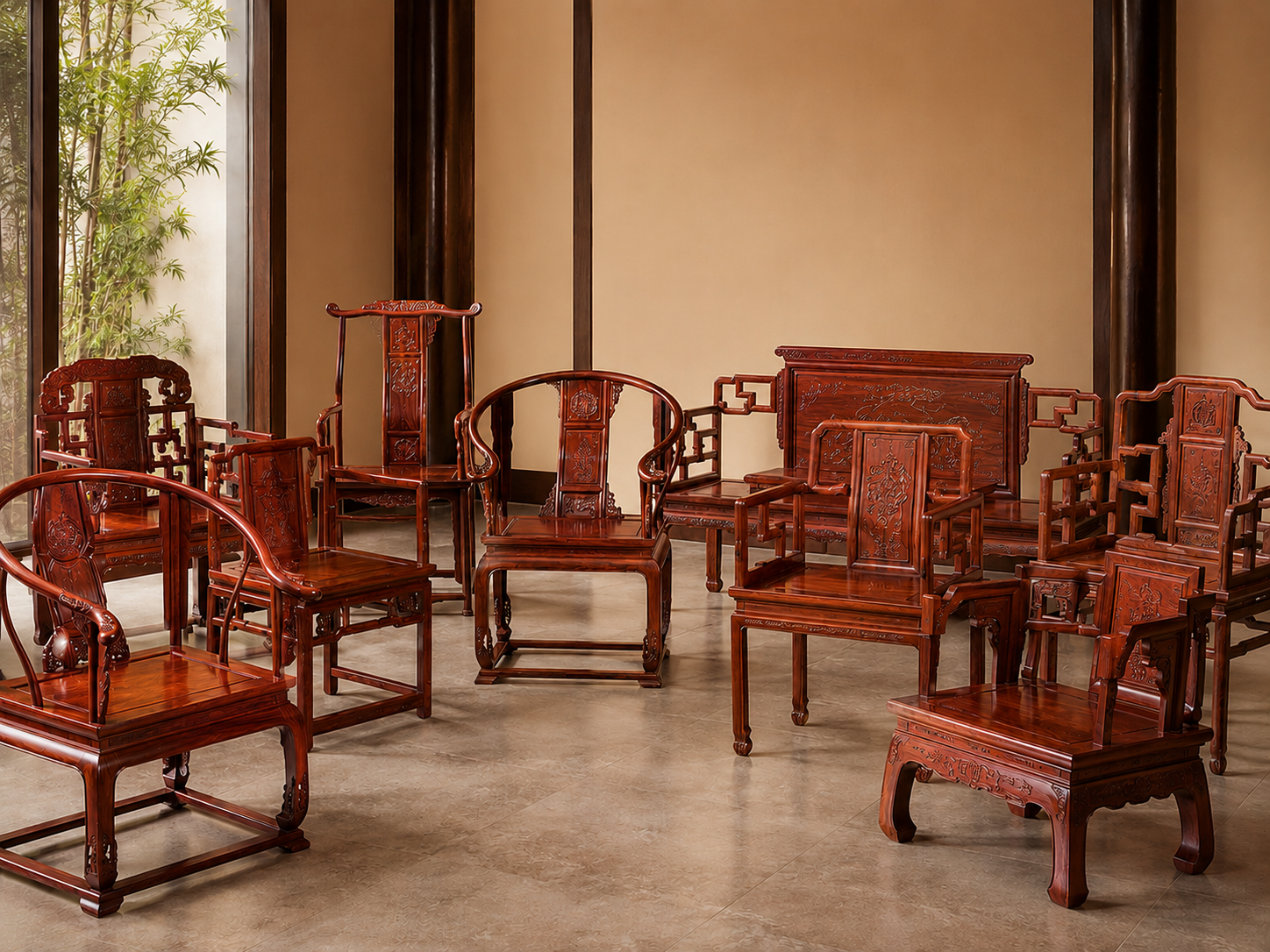
A practical procurement guide for importers and wholesalers sourcing a rosewood sofa set with a matching rosewood tea table. Learn how to verify solid rosewood construction, assess joinery and finish quality, coordinate pieces within a set, and evaluate supplier capabilities before placing a container order.
BUYER GUIDE · SOLID WOOD LIVING ROOM FURNITURE
Why a Coordinated Rosewood Set Is a Different Procurement Category
Buying a rosewood sofa set is not the same as buying individual chairs or a standalone cabinet. When a buyer orders a coordinated living room package—sofa, tea table, and often side chairs or a TV console—the commercial risk shifts. You are no longer evaluating one SKU. You are evaluating how well a supplier can match grain, color, and joinery across multiple pieces, deliver them as one consistent batch, and package them for ocean freight without damage.
This guide covers the specific checks a B2B importer should run before committing to a solid rosewood sofa and matching rosewood tea table package. It focuses on verifiable facts: wood species, construction method, finish system, packaging, and supplier documentation.
- Confirm whether "rosewood" means solid Dalbergia species or a commercial substitute—this changes price, legality, and durability.
- Check joinery and back-frame construction; a solid rosewood sofa's durability depends on the frame, not just the visible surface.
- Demand a set-level QC report: grain matching, color consistency, and moisture content across all pieces.
- Verify export documentation (CITES where applicable) before production, not after.
- Ask for a pre-production sample of the full set, not a single chair.
First, Define What "Rosewood" Means in Your Contract
The term "rosewood" is used loosely in the international furniture trade. For a procurement contract, you need the botanical species written into the specification sheet. Common commercial categories include:
| Commercial Name | Typical Species | Key Characteristics | Procurement Note |
|---|---|---|---|
| East Indian Rosewood | Dalbergia sissoo | Golden-brown to deep brown; medium density; good workability | Common in Chinese-made living room sets; verify origin documentation |
| Burmese / Siamese Rosewood | Dalbergia oliveri / cochinchinensis | High density; rich red-brown; premium grade | Strict CITES controls; require full export permits |
| Huanghuali (sometimes marketed as rosewood) | Dalbergia odorifera | Very high density; fragrant; used in high-end classical furniture | Rare and expensive; confirm if the quoted price is realistic |
| Commercial "Rosewood" (substitute) | Various non-Dalbergia hardwoods | Similar color but lower density and shorter lifespan | Not legally rosewood; clarify naming in the contract |
Action step: Ask your supplier for the botanical name and country of origin in writing. If the answer is vague ("it's rosewood, from Southeast Asia"), treat that as a red flag. A serious factory will specify the species and provide the corresponding export documentation.
Solid Rosewood Sofa: What to Inspect Beyond the Surface
A solid rosewood sofa is a significant investment. The visible frame—arms, front rail, top rail—is what you see in photos. But the structural integrity comes from parts you cannot see from the showroom angle: the back frame, the seat support system, and the joinery.
1. Frame Construction and Joinery
Ask specifically whether the back frame and seat rails are solid rosewood or a combination of solid wood and engineered wood. Some factories use solid rosewood for visible components and plywood for hidden structural parts to control cost. That is not necessarily a defect—but it must be disclosed in the spec sheet, and the price should reflect it.
For joinery, look for mortise-and-tenon or dowel-reinforced joints on load-bearing connections. Corner blocks screwed and glued into the frame add significant stability. Avoid accepting a sofa where the only connection between the arm and the front rail is a butt joint with glue.
2. Moisture Content and Climate Adaptation
Solid wood moves with humidity. A sofa built for a dry climate may crack when shipped to a humid coastal market, and vice versa. The standard acceptable moisture content for indoor furniture is typically 8–12%, depending on the destination region. Ask the factory for the kiln-dried moisture content reading on the batch, not just a general claim.
3. Finish System
Rosewood has natural oils that can affect how finishes adhere. A proper finish for a solid rosewood sofa is typically a multi-coat lacquer or polyurethane system, with a sealer coat first. Ask what finish is used and whether it is matte, satin, or gloss. Also confirm whether the finish is applied to all surfaces, including the underside of the sofa—an unfinished underside is a common cost-cutting measure that leads to moisture absorption and warping.
The Rosewood Tea Table: Matching, Function, and Proportion
The rosewood tea table is the visual anchor of the living room set. It sits low, it is touched constantly, and it carries the weight of daily use. For a coordinated set, the tea table must match the sofa in three ways:
- Wood color and grain direction: The table should be cut from the same log batch or at least the same species and color grade. Ask for photos of the actual table next to the sofa before production.
- Finish sheen: A sofa with a satin finish and a table with a high-gloss finish will look mismatched even if the wood is identical.
- Proportion: The table length should be roughly 50–60% of the sofa's seat length. A table that is too long or too short makes the whole set look off-balance.
Functionally, check the table's edge treatment. Rosewood is hard but can chip if the edges are sharp. A slight bevel or rounded edge reduces the risk of damage during shipping and daily use. Also verify the tabletop thickness—a solid rosewood top of less than 20mm may warp over time, especially on a wide span.
Coordinated Sets: The Grain-Matching and Color-Consistency Challenge
This is where a rosewood living room furniture set differs from buying individual pieces. When you order a set, you expect the pieces to look like they belong together. That requires the factory to do two things:
- Select wood from the same harvest batch—different batches can have noticeably different color tones.
- Match grain patterns—book-matched or slip-matched tops for the tea table, and consistent grain direction across the sofa's visible rails.
Put a grain-matching and color-consistency requirement into your purchase order. Specify that all pieces in the set must be within a defined color tolerance (e.g., no more than a 10% visual difference in tone). Require the factory to send a set-level photo or video before packing, not after.
Packaging and Ocean Freight: The Hidden Cost Center
A solid rosewood sofa set is heavy. A three-seat sofa in solid rosewood can weigh 80–120 kg depending on the design. The tea table adds another 30–50 kg. That weight drives both the packaging requirement and the freight cost.
Ask the supplier for the following packaging details:
- Inner protection: Is the furniture wrapped in foam sheets, corner protectors, and a plastic moisture barrier?
- Outer casing: Is it a wooden crate or a carton with a wooden frame? For heavy solid wood furniture, a full wooden crate or a reinforced carton with internal bracing is recommended.
- Container loading plan: How many sets fit in a 40HQ container? Ask for a loading diagram. This affects your landed cost per set more than the unit price.
Also confirm whether the factory treats the wood for insect infestation (heat treatment or fumigation) and whether they provide the official treatment certificate required for customs clearance in your country.
Supplier Evaluation Checklist for a Chinese Rosewood Sofa Set
When you shortlist factories for a Chinese rosewood sofa set, use this checklist during the first conversation:
| Check | What to Ask | Why It Matters |
|---|---|---|
| Species confirmation | "What botanical species is this? What is the country of origin?" | Determines legality, durability, and price fairness |
| Solid vs. veneer | "Which components are solid rosewood? Which are veneer or engineered wood?" | Prevents cost-cutting surprises; sets the right price expectation |
| Joinery method | "What joints are used on the sofa frame and table legs?" | Mortise-and-tenon or doweled joints last longer |
| Finish system | "What sealer and topcoat do you use? Is the underside finished?" | Affects moisture resistance and surface durability |
| Moisture content | "What is the kiln-dried MC% for this batch?" | Prevents cracking and warping in your destination climate |
| Set consistency | "Can you provide a set-level photo before packing?" | Verifies grain and color matching across all pieces |
| Export documents | "Do you provide CITES permits, phytosanitary certificates, and a commercial invoice?" | Required for customs clearance in most importing countries |
| Packaging spec | "What is the exact packaging? Can you share a loading plan?" | Determines freight cost and damage risk |
Cost Drivers You Should Price Into Your Margin
Several factors affect the FOB price of a rosewood sofa set. Understanding them helps you negotiate realistically:
- Wood grade: Premium-grade rosewood with uniform color and minimal defects commands a significant premium over commercial grade.
- Carving complexity: Hand-carved details add labor hours. A simple, clean-lined design will cost less than an ornate classical Chinese design.
- Finish quality: More coats mean more labor and drying time. A 5-coat finish costs more than a 2-coat finish, but it protects better.
- Set size: A 3+2+1 sofa configuration with a tea table will have a different per-piece cost than a single sofa with a table.
Ask the factory to break down the quote by piece, not just as a set price. This lets you compare apples to apples with other suppliers and adjust the set composition without renegotiating from scratch.
FAQ: Common Questions from Importers
Q: Is a solid rosewood sofa set worth the higher cost compared to mixed-material furniture?
It depends on your target market. Solid rosewood furniture has a long service life, can be refinished, and carries a premium perception in markets that value traditional craftsmanship. However, it is heavier, more expensive to ship, and requires more careful handling. If your buyers value longevity and authenticity, the higher price is justifiable.
Q: How do I verify that the wood is genuinely solid rosewood and not veneer?
Ask for a cross-section photo of the raw material before production. Check the weight—solid rosewood is dense and heavy. During the pre-production sample inspection, look at the underside and inside surfaces for visible wood grain that continues through the thickness. Veneer will show a distinct line where the thin layer meets the substrate.
Q: What is a realistic MOQ for a coordinated rosewood set?
MOQ varies by factory. Some workshops accept a single-set order for sample purposes, while production MOQs typically start at 10–20 sets for a coordinated package. Confirm the MOQ per SKU and per set configuration before you invest in sampling.
Q: Can I order a custom size for the tea table or sofa?
Most factories that produce solid rosewood furniture can accommodate custom dimensions, but it affects the price and lead time. Custom sizes require new cutting plans and may increase wood waste. Ask for the additional cost and extended delivery time before confirming.
Next Steps Before You Place an Order
Before you commit to a container of rosewood living room furniture, complete these steps:
- Request a full set sample—not a single chair—to verify grain matching and finish consistency.
- Ask for a written spec sheet listing the botanical species, moisture content, finish system, and joinery method.
- Confirm export documentation—CITES permits, phytosanitary certificate, and commercial invoice—before production begins.
- Review the packaging plan and loading diagram to calculate your true landed cost.
- Build a color-tolerance clause into your purchase order to protect against batch variation.
If a supplier cannot provide clear answers on these points, consider it a warning. A reliable factory will welcome these questions—they are the same questions their best long-term customers ask.
For a detailed quote, MOQ, or to discuss your target market's specific requirements, contact our sales team with your destination port and desired set configuration. We can provide the spec sheet, loading plan, and export documentation you need to make an informed decision.