
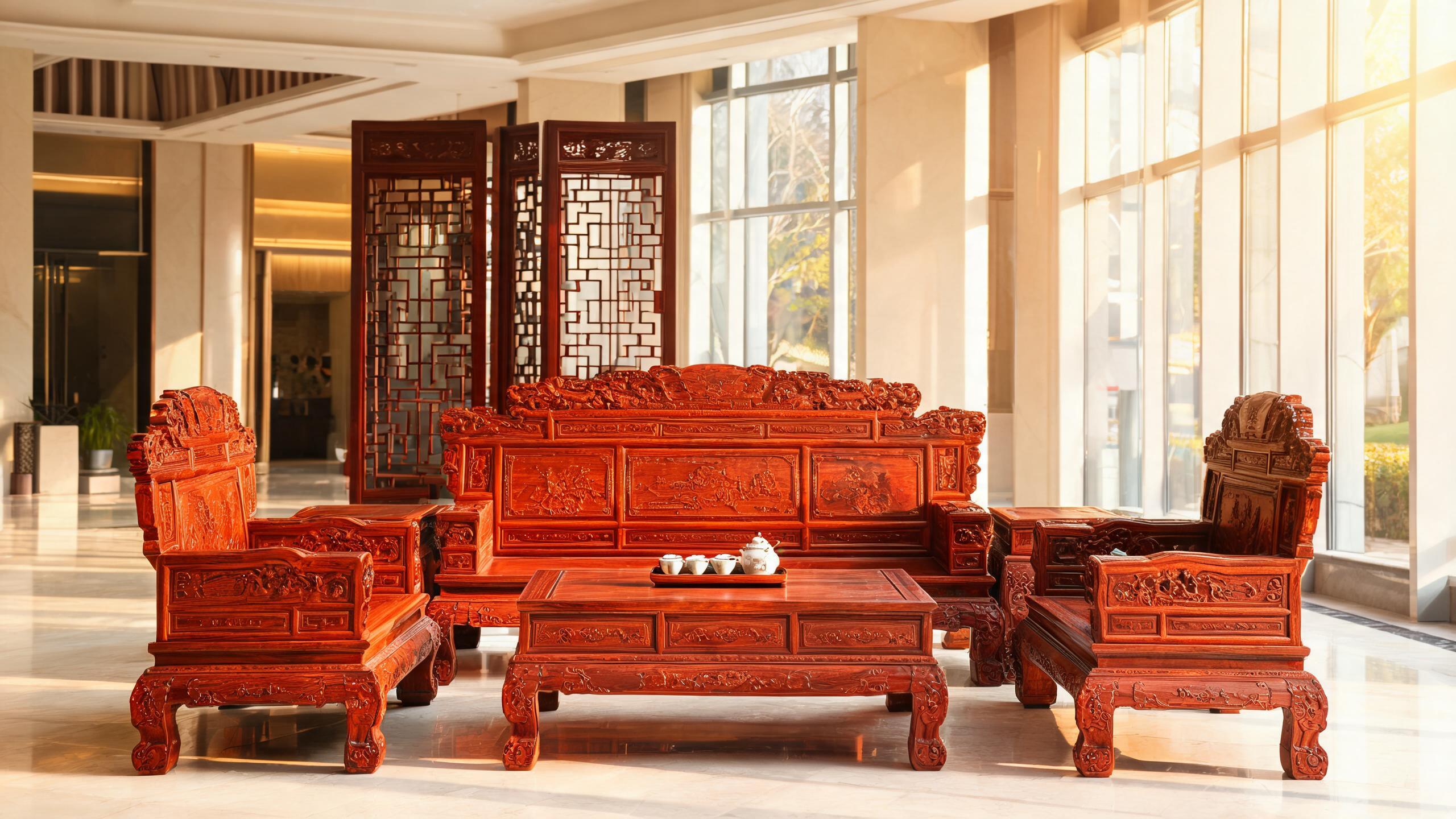
A visual identification guide for B2B importers: how to identify genuine rosewood furniture by natural heartwood and sapwood tones, grain patterns, and how lacquer, oil, and wax finishes shift the final colour. Includes a colour-based authenticity checklist and supplier verification advice.
BUYER GUIDE · VISUAL IDENTIFICATION FOR IMPORTERS
When you are sourcing rosewood furniture from overseas, the hardest part is often the simplest question: what does rosewood furniture look like? You cannot walk into the factory. You cannot run your hand across a tabletop or hold a sample board up to the light. What you have is a screen, a spec sheet, and a supplier who says the word “rosewood.”
That gap matters. Rosewood is not one single colour, and it is not one single grain. A freshly sanded piece looks different from a lacquered piece. The heartwood differs from the sapwood. A piece finished with beeswax looks warmer and softer than one finished with a high-gloss lacquer. If you do not know what to look for, you can easily mistake a substitute hardwood for the real material — or reject a perfectly good piece because it does not match a photo you saw online.
This guide is written for B2B importers, wholesalers, and project buyers in Southeast Asia, Australia, North America, and Europe who need to verify rosewood furniture before committing to a container. It explains the natural tones of rosewood heartwood and sapwood, the grain patterns that distinguish genuine material from imitations, how different finishes change the final colour, and how to use colour as one part of an authenticity check. It also covers the practical limits of visual identification — because colour alone is never enough.
- Genuine rosewood heartwood is not uniform: it ranges from deep reddish-brown to purplish-brown, often with darker streaks that follow the grain.
- The finish changes the colour more than most buyers expect. Lacquer deepens and reddens; oil warms; wax softens. Judge the wood, not just the surface.
- Sapwood — the pale outer layer — is a normal part of solid wood furniture, but high-end pieces are often made with sapwood removed or minimised.
- Colour is only one clue. Grain, weight, smell, and joinery all matter. A visual check should be paired with supplier documentation.
- Ask your supplier for unfinished or minimally finished samples before bulk orders, and confirm the exact species name, not just “rosewood.”
Why “Rosewood” Covers Many Different Looks
Before describing what rosewood furniture looks like, it is worth clarifying what the word “rosewood” actually refers to in the trade. Botanically, true rosewoods belong to the genus Dalbergia. The most famous example in classical Chinese furniture is Siamese rosewood (Dalbergia cochinchinensis), which is used in classical sets. But the term is also applied loosely in the market to other dense, dark reddish hardwoods that share a similar appearance.
This matters for your visual expectations. A piece labelled “rosewood” from one supplier may look noticeably different from a piece with the same label from another supplier, because the species may not be identical. Even within a single species, colour varies by the age of the tree, the region where it grew, and the part of the log used.
For this reason, the first step in any visual identification is to ask the supplier for the exact species name. “Rosewood” is a category, not a precise specification. When a supplier can name the species — for example, Dalbergia cochinchinensis — you have a much clearer reference point for what the colour and grain should look like.
The Natural Colour of Rosewood Heartwood
When buyers ask “what colour is rosewood furniture,” they are usually asking about the heartwood — the dark, mature inner wood that gives rosewood its value. The heartwood is where the rich colour lives.
Genuine rosewood heartwood is typically described as a deep reddish-brown to purplish-brown. The exact shade depends on the species and the age of the wood:
- Freshly cut or sanded: Often a lighter, more orange-brown or golden-brown tone with visible reddish undertones. The colour deepens as the wood oxidises when exposed to air.
- After oxidation: Over weeks and months, the surface darkens to a richer, deeper reddish-brown. This is a natural process, not a defect.
- Older, aged wood: Can develop a darker, almost mahogany-like brown with purplish or maroon hints. Antique pieces often look much darker than new ones.
One of the most distinctive features of rosewood is the presence of darker streaks — nearly black or deep purple-brown lines that follow the grain. These streaks are not paint or stain. They are natural colour variations in the wood itself, often caused by mineral deposits or the tree’s growth patterns. In high-quality pieces, these streaks add depth and visual interest. They are a sign of genuine rosewood, not a flaw.
It is important to note that rosewood is rarely a single flat colour. Even a well-matched tabletop will show subtle variations from board to board. This is normal for solid wood. If a piece looks perfectly uniform in colour, it is more likely to be veneer over a cheaper core, or a stained substitute, than solid rosewood.
Heartwood vs. Sapwood: The Pale Outer Layer
When you look at a piece of solid wood furniture, you are looking at two different zones of the tree. The heartwood is the dark, mature core. The sapwood is the pale, younger wood near the bark. In rosewood, the contrast between the two is often striking.
Rosewood sapwood is typically a pale yellow, cream, or light straw colour, clearly distinct from the dark reddish-brown heartwood. In many commercial pieces, sapwood is removed or kept to a minimum, because it is less durable and less visually desirable. However, some furniture — especially rustic or budget-oriented designs — includes sapwood as a deliberate design element.
For importers, the presence of sapwood is a quality signal:
- High-end classical furniture: Usually made from heartwood only, with sapwood carefully cut away. The colour is consistent and deep.
- Mid-range commercial furniture: May include small amounts of sapwood on less visible surfaces, such as the underside of a tabletop or the back of a cabinet.
- Rustic or natural-style furniture: May feature sapwood prominently for contrast. This is a design choice, not necessarily a defect.
When evaluating a piece, look at the edges and corners where sapwood would be most visible. If the colour is uniformly dark throughout, the maker has likely used heartwood only. If you see pale streaks or patches, those are sapwood. Decide whether that matches the quality level you are paying for.
Grain Patterns: How to Recognise Genuine Rosewood
Colour alone cannot identify rosewood. Many hardwoods share a similar reddish-brown tone. The grain pattern is a more reliable visual clue.
Rosewood grain is typically straight to slightly interlocked, with a medium to coarse texture. The most distinctive feature is the presence of dark streaks and contrasting grain lines. These streaks are often wavy or irregular, creating a dramatic, almost striped effect on the surface. In some pieces, the grain resembles a topographic map, with swirling lines and sudden shifts in colour.
Other grain characteristics to look for:
- Pore structure: Rosewood has open pores, which are visible to the naked eye as tiny pits or channels on the surface. These are not a defect; they are natural. A smooth, pore-less surface suggests a different wood or a heavy filler.
- Figure: Some rosewood pieces display a “waterfall” or “flame” figure, where the grain appears to ripple or shimmer. This is highly prized but not present in every piece.
- Interlocked grain: The grain direction can change abruptly, creating a ribbon-like effect. This makes the wood harder to work but adds to its visual richness.
Compare this to common substitutes. Many cheaper hardwoods have a more uniform, straight grain with less contrast. Stained woods may mimic the colour but lack the natural depth and irregularity of rosewood grain. If the grain looks too regular, or if the dark streaks appear to sit on the surface rather than within the wood, be suspicious.
How Finishes Change the Colour of Rosewood
This is where many buyers get confused. The same piece of rosewood can look like three different woods depending on the finish. When you ask “what colour is rosewood furniture,” the honest answer is: it depends on the finish.
Lacquer Finishes
Lacquer is the traditional finish for classical Chinese rosewood furniture. A high-quality lacquer finish is applied in multiple thin coats, often with hand-rubbing between coats. The result is a deep, glossy surface that intensifies the red and brown tones of the wood. Lacquer can make the colour look richer, darker, and more saturated than the raw wood.
In the classical furniture tradition, a six-coat raw lacquer process with hand-rubbing is used. This is a labour-intensive method that produces a smooth, durable, and deeply coloured surface. The lacquer does not just sit on top of the wood; it penetrates slightly and reacts with the wood’s natural oils, deepening the colour over time.
For importers, a lacquered piece will look more formal, more polished, and often darker than an oiled or waxed piece. The grain may be slightly less visible under a high-gloss lacquer, especially if the surface is heavily polished.
Oil Finishes
Oil finishes, such as tung oil or linseed oil, penetrate the wood and cure inside the pores. They do not build a thick surface film. The result is a natural, matte-to-satin sheen that lets the grain show clearly. Oil tends to warm the colour, bringing out the golden and orange undertones in the wood. It does not darken the wood as much as lacquer.
An oiled rosewood piece will look more casual and more “woody” than a lacquered piece. The grain will be more visible, and the surface will feel more textured. Over time, oiled wood may need to be re-oiled to maintain its appearance.
Wax Finishes
Wax finishes, such as beeswax, are the softest and most natural option. They provide a low-sheen, satin finish that softens the colour and gives the wood a warm, hand-rubbed glow. Wax does not penetrate as deeply as oil, and it does not build a film like lacquer. It sits partly on the surface, filling the pores and providing a gentle protective layer.
Beeswax finishes are often used on furniture that is meant to be touched and handled, because they feel smooth and warm. The colour under a wax finish is the closest to the raw, natural wood, but with a slightly deeper, richer tone due to the wax itself.
For eco-conscious buyers, beeswax and lacquer finishes that meet EU REACH and US CARB standards offer a compliant option. These finishes are free from harmful volatile organic compounds (VOCs) and are safe for indoor use in homes, hotels, and offices.
| Finish Type | Typical Sheen | Effect on Colour | Grain Visibility | Best For |
|---|---|---|---|---|
| Raw Lacquer (6 coats) | High gloss | Deepens and intensifies red-brown tones | Reduced; smoother, more polished look | Classical, formal, high-end sets |
| Oil (e.g., tung oil) | Matte to satin | Warms, brings out golden undertones | High; grain clearly visible | Contemporary, casual, natural look |
| Beeswax | Satin, soft glow | Softens and warms; closest to natural wood | High; wood feels textured | Eco-friendly, hand-touched pieces |
Aged Rosewood: How Colour Changes Over Time
Rosewood is not static. Its colour evolves over years and decades, which is one reason why antique pieces look so different from new ones.
When rosewood is freshly cut, the heartwood is often a lighter, more orange-brown tone. As the wood is exposed to air and light, it oxidises and darkens. This process can take months or years. A new piece of rosewood furniture may look noticeably lighter than the same design made five years ago.
Light also plays a role. Prolonged exposure to direct sunlight can lighten or fade the wood over time, while a piece kept in a dim room will darken more slowly. This is not a defect; it is the natural behaviour of the wood.
For importers, this means two things:
- Do not judge a new piece against an antique photo. A new piece will be lighter and brighter. It will darken with age.
- Ask about the age of the wood, not just the age of the furniture. A piece made from aged wood (wood that was cut and stored for years before being crafted) will have a darker, more mature colour from the start.
Colour Variations in Different Rosewood Species
As mentioned earlier, “rosewood” is a broad category. Different species have different characteristic colours. Knowing which species you are buying helps you set the right expectations.
Siamese Rosewood (Dalbergia cochinchinensis)
This is the classic rosewood used in high-end Chinese furniture. Its heartwood is typically a deep reddish-brown with dark purple-brown streaks. The colour is rich and dramatic, often with a high contrast between the lighter background and the darker streaks. It is one of the most visually striking rosewoods.
Other Dalbergia Species
Other true rosewoods, such as Brazilian rosewood (Dalbergia nigra) or Indian rosewood (Dalbergia latifolia), have their own colour profiles. Brazilian rosewood is often a more chocolate-brown with purple undertones, while Indian rosewood tends to be a more uniform golden-brown with darker streaks. These are less commonly used in Chinese-style furniture but may appear in other product lines.
Related Hardwoods
Many suppliers also use woods that are not true Dalbergia but are marketed as “rosewood” or “rosewood-style.” These include various tropical hardwoods with a similar reddish-brown colour. The appearance can be close, but the grain, weight, and durability may differ. Always confirm the exact species with the supplier.
For a B2B buyer, the safest approach is to request a species certificate or a wood identification report from the supplier. This is standard practice in the trade and should not be refused. If a supplier cannot name the exact species, that is a red flag.
How to Identify Rosewood Furniture by Colour: A Practical Checklist
When you are inspecting a piece — either in person at a trade show or in a video call with the supplier — use this colour-based checklist as a first pass. It will not give you a definitive answer, but it will tell you whether the piece is consistent with genuine rosewood.
- Look at the heartwood colour. Is it a deep reddish-brown to purplish-brown? Or is it a flat, uniform brown? Genuine rosewood has depth and variation.
- Check for dark streaks. Are there darker, almost black or purple-brown lines following the grain? These are a hallmark of rosewood.
- Examine the sapwood. Is there a pale, cream-coloured zone near the edges? A small amount is normal; a large amount suggests lower quality.
- Look at the grain contrast. Is the grain clearly visible, with alternating light and dark bands? Or does the surface look flat and monotone?
- Consider the finish. Is the piece lacquered, oiled, or waxed? Adjust your colour expectations accordingly. A lacquered piece will be darker and glossier.
- Ask for an unfinished sample. The best way to see the true colour is to look at a raw, sanded piece of the same wood. Ask the supplier to send a small sample board.
Remember: colour is a clue, not a proof. A stained birch or beech table can be made to look superficially like rosewood. The grain, the weight, and the smell are harder to fake.
What Rosewood Furniture Does NOT Look Like
It is often easier to identify rosewood by ruling out what it is not. Here are some common visual misconceptions:
- It is not a single flat colour. If a piece looks perfectly uniform, it is likely stained or veneered.
- It is not pale yellow or blonde. The heartwood is dark and rich. Pale wood is sapwood, not heartwood.
- It is not grey or washed out. Rosewood is warm and reddish. A grey tone suggests a different wood or a poor finish.
- It is not overly porous or rough. While rosewood has open pores, a quality finish fills and smooths the surface. A rough, unfinished-looking surface is a sign of poor craftsmanship.
- It is not lightweight. Rosewood is a dense, heavy hardwood. If a piece feels surprisingly light, it is not solid rosewood.
The Limits of Visual Identification
It would be convenient if you could identify rosewood by colour alone. You cannot. Here is why:
- Stains and dyes: A cheaper wood can be stained to mimic the colour of rosewood. The stain may be absorbed unevenly, but a skilled finisher can make it look convincing.
- Veneers: A thin layer of real rosewood veneer can be glued over a cheaper core. The surface looks like rosewood, but the piece is not solid rosewood.
- Photography: Photos and videos can distort colour. White balance, lighting, and screen settings all affect what you see. A piece that looks one colour in a photo may look different in person.
For these reasons, colour should be used as a screening tool, not a confirmation tool. If a piece does not look like rosewood, it probably is not. But if it does look like rosewood, you still need to verify the material through other means.
Beyond Colour: Weight, Smell, and Sound
When you are physically inspecting a piece, combine your colour assessment with these other sensory checks:
- Weight: Rosewood is dense and heavy. Pick up a chair or a small table. It should feel substantial for its size.
- Smell: Freshly sanded rosewood has a distinct, pleasant, slightly sweet aroma, often described as rosy or floral. This is where the name comes from. The smell fades with age and finish, but it is detectable on unfinished surfaces.
- Sound: When tapped, dense hardwoods produce a clear, ringing tone. A dull thud may indicate a hollow core or a softer wood.
These checks are not possible through a screen. If you are buying sight-unseen, ask the supplier for a video that shows the piece being handled, and request a small physical sample of the wood before committing to a large order.
How to Verify a Supplier’s Rosewood Claims
For B2B buyers, visual identification is only the first layer of due diligence. The more important layer is supplier verification. Here is a practical approach:
- Ask for the exact species name. Write it down and research it. Do not accept “rosewood” as an answer.
- Request documentation. A reputable supplier should be able to provide a certificate of origin, a species identification report, or a statement of legal compliance. For example, a factory that uses legally certified materials should be able to show the relevant permits.
- Ask about the finishing process. If the supplier claims an eco-friendly finish, ask for details. For instance, a six-coat raw lacquer process with hand-rubbing is a specific, verifiable claim. Similarly, finishes that meet EU REACH and US CARB standards are well-defined and testable.
- Ask about joinery. Genuine high-end rosewood furniture uses mortise-and-tenon joinery without metal nails. This is a hallmark of quality and is easy to verify by inspecting the joints.
- Request a sample. Before a bulk order, ask for a small, unfinished sample of the wood. This is the single best way to verify colour and grain in person.
A supplier that is transparent about its materials and processes is far more trustworthy than one that gives vague answers. If a supplier hesitates to provide species details or documentation, treat that as a warning sign.
Case Study: What to Expect from a Classical Rosewood Set
To put all of this into context, consider what a high-end classical rosewood furniture set from a reputable factory should look like. This is an illustrative example based on common industry practices, not a specific product claim.
A classical set — for example, a table with matching chairs — made from Siamese rosewood (Dalbergia cochinchinensis) would typically have:
- Deep reddish-brown heartwood with prominent dark purple-brown streaks.
- Minimal or no sapwood, visible as a uniform dark colour across all visible surfaces.
- A high-gloss lacquer finish (if classical style) that deepens the colour and gives a mirror-like sheen, or a satin wax finish (if a more natural style) that softens the colour and highlights the grain.
- Visible, open pores on the surface, filled and smoothed by the finishing process.
- Mortise-and-tenon joinery with no metal nails, visible at the joints.
- A heavy, solid feel — the piece should be difficult to lift alone.
If the piece you are inspecting is much lighter in colour, has a flat, uniform brown tone, or shows large areas of pale sapwood, it may not be the same quality of rosewood. Ask questions before you buy.
Practical Advice for Buying Rosewood Furniture Online
When you are buying from a supplier in another country, you are relying on photos, videos, and descriptions. Here is how to make that process more reliable:
- Ask for photos in natural light. Indoor lighting can make wood look warmer or cooler than it really is. Natural daylight shows the true colour.
- Ask for close-up photos of the grain. A close-up of the surface will show the grain pattern and pore structure, which are harder to fake than the overall colour.
- Ask for a video of the piece being turned. This shows the colour from multiple angles and helps you see how light reflects off the finish.
- Ask about the finish explicitly. Do not assume. Ask: “Is this piece lacquered, oiled, or waxed?” The answer will change your colour expectations.
- Ask about the wood source. Is the wood legally certified? Where was it harvested? A responsible supplier will have this information.
Remember that a small colour difference between a photo and the actual piece is normal. Wood is a natural material, and no two pieces are identical. What you are looking for is consistency with the species’ known characteristics, not a perfect match to a single photo.
Frequently Asked Questions
What colour is rosewood furniture?
Rosewood furniture is typically a deep reddish-brown to purplish-brown, often with darker streaks that follow the grain. The exact colour depends on the species, the age of the wood, and the finish. Lacquered pieces appear darker and glossier; oiled or waxed pieces appear warmer and more natural.
Is rosewood furniture always dark?
No. While the heartwood is dark, new pieces can be lighter and more orange-brown before they oxidise. The sapwood is pale yellow or cream. A piece with a natural, unfinished look may appear lighter than a high-gloss lacquered piece.
How can I tell if rosewood is real by looking at it?
Look for a rich, varied reddish-brown colour with darker streaks, a visible grain pattern with open pores, and a heavy, dense feel. Colour alone is not enough — combine the visual check with documentation from the supplier confirming the exact species.
Does the finish change the colour of rosewood?
Yes, significantly. Lacquer deepens and darkens the colour, oil warms it and brings out golden undertones, and wax softens it and gives a natural glow. The same wood can look different under different finishes.
What does a high-quality rosewood finish look like?
A high-quality finish is smooth, even, and durable. In classical furniture, a six-coat raw lacquer finish with hand-rubbing produces a deep, glossy, mirror-like surface. Eco-friendly finishes, such as beeswax or low-VOC lacquer meeting EU REACH and US CARB standards, are also a mark of quality.
Is sapwood a defect in rosewood furniture?
Not necessarily. Sapwood is the pale outer layer of the tree. In high-end pieces, it is usually removed for a uniform look. In rustic or budget pieces, it may be included as a design element. The presence of sapwood affects the colour consistency and, sometimes, the durability.
What if the rosewood furniture looks different from the photos?
Minor colour variations are normal due to lighting, screen settings, and the natural variability of wood. However, if the piece looks significantly different — for example, much lighter or with a different grain pattern — ask the supplier for clarification. It may be a different species or a different finish than you expected.
Conclusion: Colour Is Your First Clue, Not Your Final Answer
Knowing what rosewood furniture looks like is a core skill for any importer. The natural tones — deep reddish-brown heartwood with darker streaks and pale sapwood — are the first thing to look for. The grain pattern, with its open pores and contrasting lines, is the second. And the finish — lacquer, oil, or wax — determines the final colour you see on the surface.
But colour and grain are only the beginning. A responsible buyer will always confirm the exact species, request documentation, and ask for a physical sample before placing a large order. Visual identification helps you screen out obvious fakes and set your expectations. Supplier verification is what protects your investment.
When you are ready to source, work with a supplier that is transparent about its materials and processes. A factory that can name its wood species, describe its finishing process (such as a six-coat raw lacquer with hand-rubbing), and confirm compliance with international standards like EU REACH and US CARB is a more reliable partner than one that offers only vague assurances.
If you are evaluating a supplier and want to confirm what a genuine rosewood piece should look like, ask for unfinished samples and detailed production photos. Compare those against the characteristics described in this guide. And when in doubt, ask more questions. The right supplier will welcome them.
This guide is provided for informational purposes to help buyers make informed sourcing decisions. Specific product claims should always be confirmed directly with the supplier.