
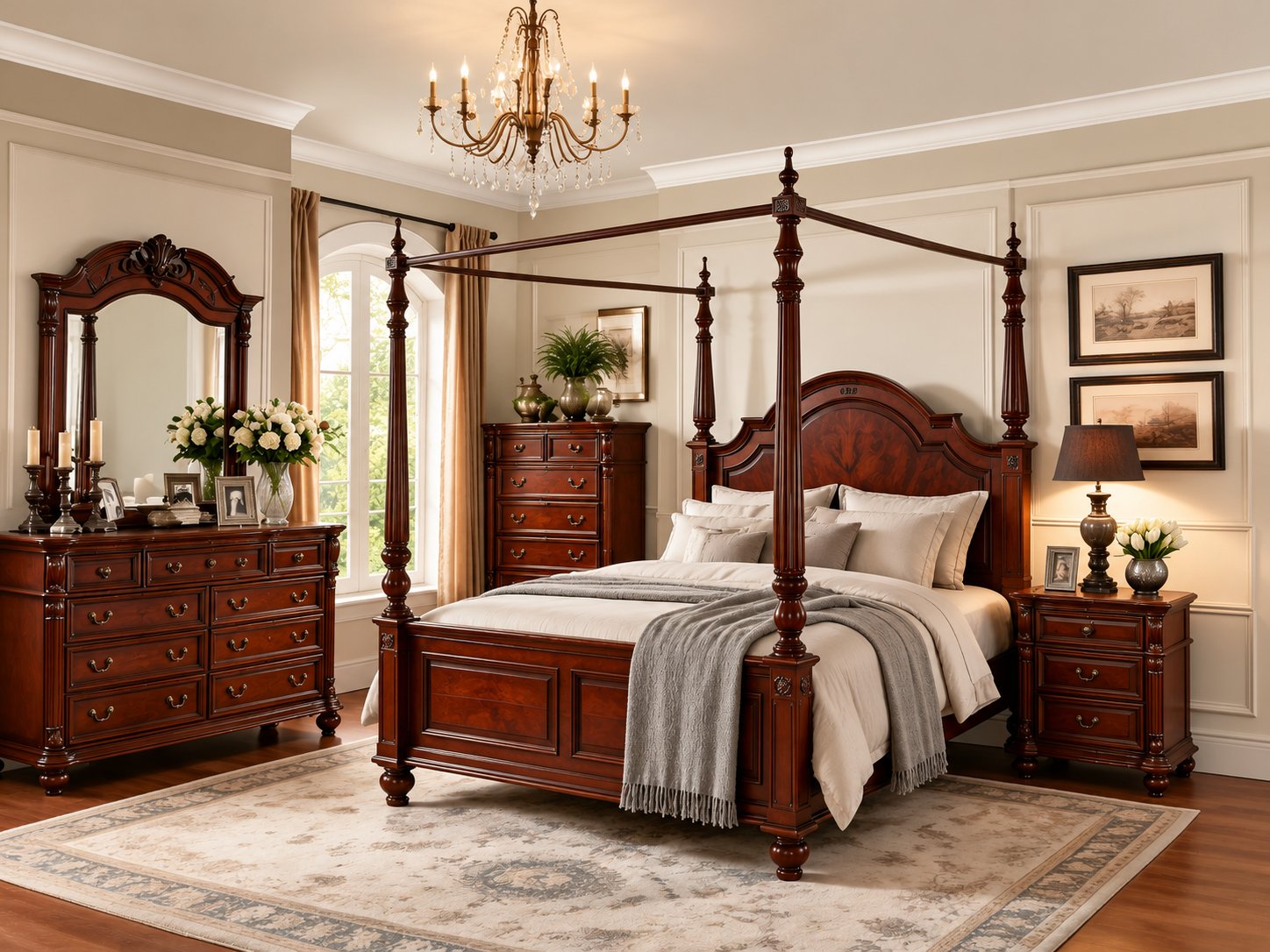
Panduan pembelian praktikal untuk rangka katil kayu rosewood pepejal: mengapa sambungan tanggam dan tenon dengan paku kayu mengatasi perkakasan logam, bagaimana kawalan kelembapan 8–12% dan panel terapung menghalang keretakan dalam iklim luar negara, apa yang perlu diperlukan oleh hotel, dan bagaimana pembungkusan eksport serta dokumentasi FSC dan CITES melepasi kastam.
When overseas importers, hotel project managers, and interior contractors start sourcing a rosewood bed frame from China, the same questions surface in almost every inquiry: Will the frame survive a heated North American winter or an air-conditioned summer in Southeast Asia? Why do so many hardwood beds loosen at the joints after one or two seasons? Is traditional joinery really better than metal hardware, or is that a myth the industry tells itself? And what kind of paperwork does a dense rosewood bed actually need to clear customs in the European Union, Australia, or the United States?
These are practical questions, and they deserve practical answers. A rosewood bed frame is a significant purchase — heavier, denser, and more expensive than most softwood or engineered-wood alternatives — so the decision criteria matter more, not less, than they do for a pine bed or an MDF platform frame. This article answers the question in the title from a manufacturer's working perspective: what a solid rosewood bed frame actually is, why mortise-and-tenon joinery with wooden dowels performs so well in bed frames specifically, how moisture control prevents the cracking buyers fear, what to check for hotels versus private homes, how export packaging and FSC/CITES documentation work, and where OEM customization fits into a procurement plan. Wherever a claim appears, it is tied to the documented specifications of two production bedroom programs: the Classical Four-Poster Redwood Bedroom Suite 5-Piece and the Classical Redwood Canopy Bed 3-Piece Bedroom Set, both built from Siamese rosewood (Dalbergia cochinchinensis) by Yunxiao Rosewood Furniture Co., Ltd. in Xianyou, Fujian.
What Counts as a Solid Rosewood Bed Frame?
The phrase "solid rosewood bed frame" gets used loosely in export marketing, so it is worth defining what a buyer should actually verify before believing it. A genuinely solid frame means the load-bearing components — corner posts, side rails, headboard stiles, footboard, and slat base — are cut from solid timber sections of the declared species, not from finger-jointed blocks, not from veneered engineered cores, and not from a different, cheaper wood with a rosewood-colored stain. In the two bedroom programs referenced here, the four corner posts of the bed are cut from single solid sections of Siamese rosewood. This is not a cosmetic detail: a single-section post preserves an unbroken load path from the canopy rail (or headboard) down to the floor, with no glued joint line in the column that carries the bed's weight.
Single-section construction also has a quality-control consequence that buyers can verify. Because solid posts cannot hide a joint, any post that arrives with a bend or twist is immediately visible. In the canopy bed program, the workshop applies a written tolerance: any post with a bend exceeding 1.5 mm over its length is diverted out of the bed program and used for shorter components instead. The same 1.5 mm tolerance is applied again at final inspection with a straightedge, so the manufacturing criterion and the inspection criterion are identical — a buyer auditing the factory sees one standard applied at both ends.
The species itself matters. Siamese rosewood (Dalbergia cochinchinensis) is a dense hardwood with an air-dry density of roughly 0.95 to 1.05 g/cm³ — dense enough that it resists denting and abrasion in daily bedroom use, and tight-grained enough to hold crisp carved detail, which is one reason it has been the wood of choice for classical Ming- and Qing-lineage furniture. The heartwood ranges from reddish-brown to deeper purplish tones with darker streaking. For buyers furnishing matched rooms, the relevant point is that all five pieces of the four-poster suite are cut from the same timber batch, so grain tone and color stay consistent across the bed, nightstands, wardrobe, and dresser — the suite reads as one room, not an assembly of separately sourced pieces.
A final verification note: density and species claims should be checked, not assumed. Buyers can ask a supplier for the timber batch records, confirm the botanical name in writing (Dalbergia cochinchinensis, not a vague "red wood"), and, for larger orders, arrange third-party inspection of material documentation on site — a service the factory explicitly supports. A supplier who documents the species is a supplier who has nothing to hide about it.
Mortise-and-Tenon Joinery: Why It Matters in a Bed Frame Specifically
Much is written about mortise-and-tenon joinery in classical furniture generally, but bed frames deserve their own explanation, because a bed is loaded differently from a cabinet or a chair. A bed frame carries dynamic, repeating loads: a person sits on the edge (concentrating weight on one rail), rolls over at night, and shifts position hundreds of times per year. Joints that rely purely on screws driven into end grain, or on metal angle brackets bolted through pre-drilled holes, work loose under this repeated loading — which is exactly the failure mode buyers report when an imported hardwood bed starts to creak and rack after its first season.
Mortise-and-tenon construction handles the problem differently. A tenon — a projecting tongue cut on the end of one member — fits into a matching mortise cut into the receiving member, creating a large, interlocking wood-to-wood contact area. In the bed programs described here, post-to-rail connections use mortise-and-tenon joints cut to a 20 mm tenon depth, secured with wooden dowels rather than metal fasteners in the primary frame. The wooden dowel matters for two reasons. First, metal screws driven into dense hardwood create localized stress points and, over years of humidity cycling, can enlarge their own holes as the surrounding wood expands and contracts. Second, wood-to-wood connections move with the wood: when the rail and post absorb or release moisture with the seasons, the joint materials expand and contract at the same rate, instead of fighting each other the way steel and wood do.
The canopy bed program adds a second, even more traditional technique at the top of the frame. The canopy rails connect to the posts with through-tenons that pass completely through the post top — 15 mm of the tenon emerges on the far side — and are then locked with wedges driven from above. This through-wedged tenon is a hallmark of classical Chinese bed construction. Mechanically, the wedge locks the joint in two directions at once, and gravity keeps it tight: the weight of the canopy frame presses the joint together rather than pulling it apart. There is no metal hardware in the primary frame to loosen, and a joint fitted this way can be re-wedged during service if ever needed, rather than requiring a replacement bracket or a stripped-thread repair.
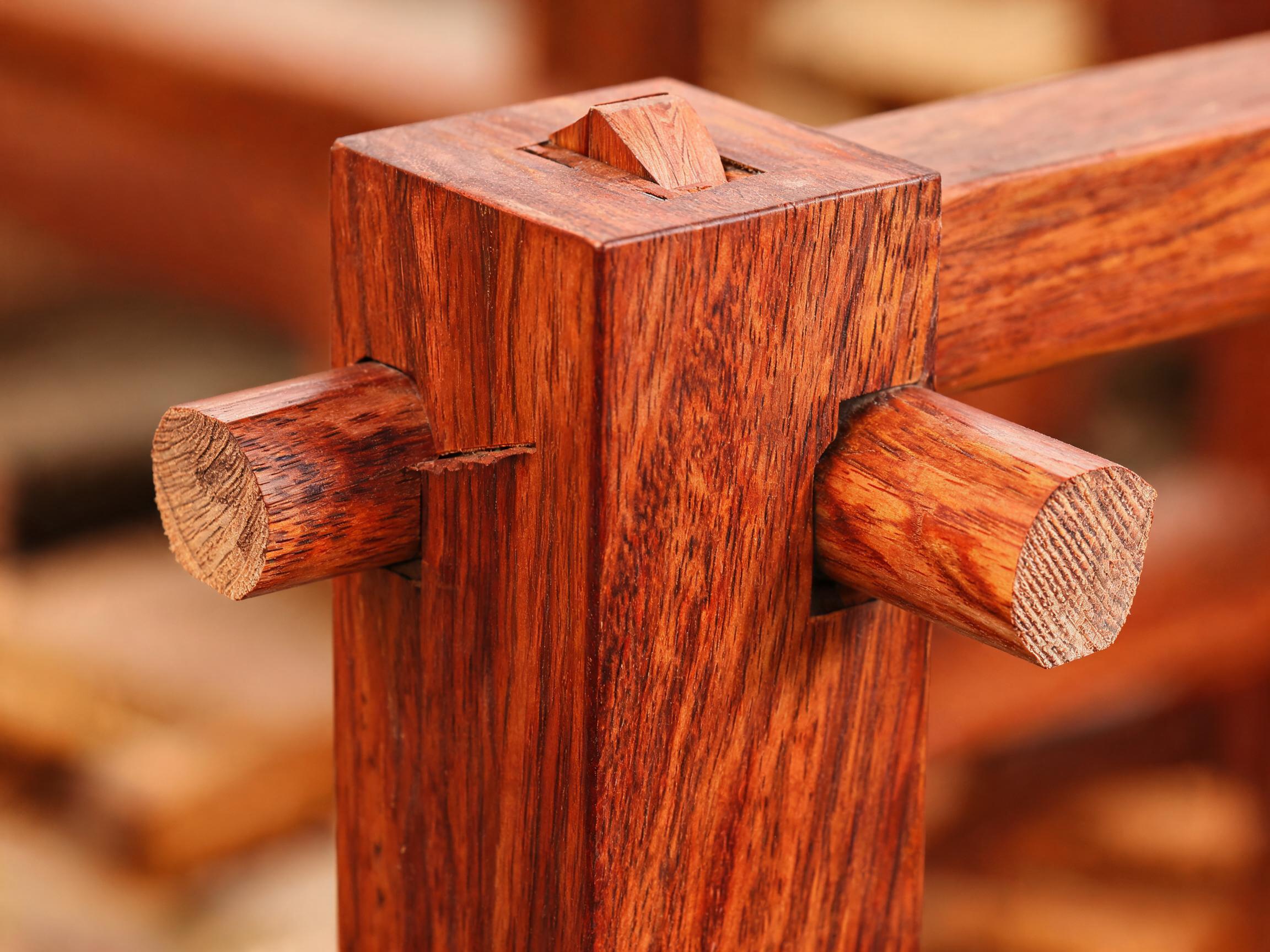
For a buyer, the practical takeaway is a short inspection checklist that works even before a container arrives: ask how the posts connect to the rails (the answer should name tenon depth — 20 mm in these programs); ask how the canopy or headboard locks to the posts (through-tenon and wedge, or metal brackets?); ask whether any metal hardware sits in the primary load path (in these frames, hardware is limited to separate, labeled fittings for assembly, not the frame itself); and ask what structural testing the assembled frame undergoes. On that last point, the canopy bed program documents an in-house standard: the assembled frame is loaded with 150 kg of distributed weight for 24 hours, and any joint showing separation is re-fitted before packing. The canopy frame is additionally tested by applying a 10 kg lateral force at each corner; movement exceeding 3 mm triggers wedge re-fitting. These are supplier-documented tests, not third-party certifications, so buyers who need certified test data for a hotel procurement file should raise it at inquiry — but the existence of a written, repeatable test standard at the factory is a meaningful signal in itself.
Controlling Wood Movement: Moisture Content and Climate
The second recurring question — will it crack? — is really a question about wood movement. All solid wood expands and contracts as it exchanges moisture with the surrounding air. A hardwood frame dried for a humid coastal factory and then shipped to a heated, dry North American interior will release moisture and shrink; the same frame sent to a humid Southeast Asian villa will gain moisture and swell. Cracking, splitting panels, and loosened joints are almost always the visible result of this movement, and almost always trace back to one of two causes: timber that was never dried to match its destination climate, or construction that gives the wood no room to move.
The first cause is addressed in drying. In the four-poster suite program, timber is dried for approximately 36 days under constant-humidity conditions, and finished timber moisture content is controlled at 8% to 12% before joinery. The canopy bed program specifies kiln drying to the same 8–12% band with a 48-hour equalization period, and — the detail serious buyers should notice — moisture is verified board by board before any joinery is cut, with three-point readings per piece at final inspection. Readings outside the band require re-conditioning, not a waiver. Eight to twelve percent is the widely used target range for interior furniture in heated and air-conditioned buildings, which is why it is the written standard here; buyers serving extreme climates (for example, high-altitude interiors with very low winter humidity) can and should flag the destination climate at inquiry so the conditioning plan can be discussed against it.
The second cause is addressed in construction. Even correctly dried wood will move a little with the seasons, so the frames give it room to do so: wardrobe doors and dresser side panels in the suite use floating-panel construction — a solid panel seated in a grooved frame — which allows the panel to expand and contract within the frame without splitting anything. The same principle explains why the slat base sits recessed into the side rails rather than glued into them, and why the finish choice matters: the traditional raw lacquer (qi) process used on both programs is a penetrating finish applied in multiple thin coats, each cured and hand-rubbed before the next — seven coats on the canopy bed — rather than a thick, brittle film that will check and crack when the wood beneath it moves.
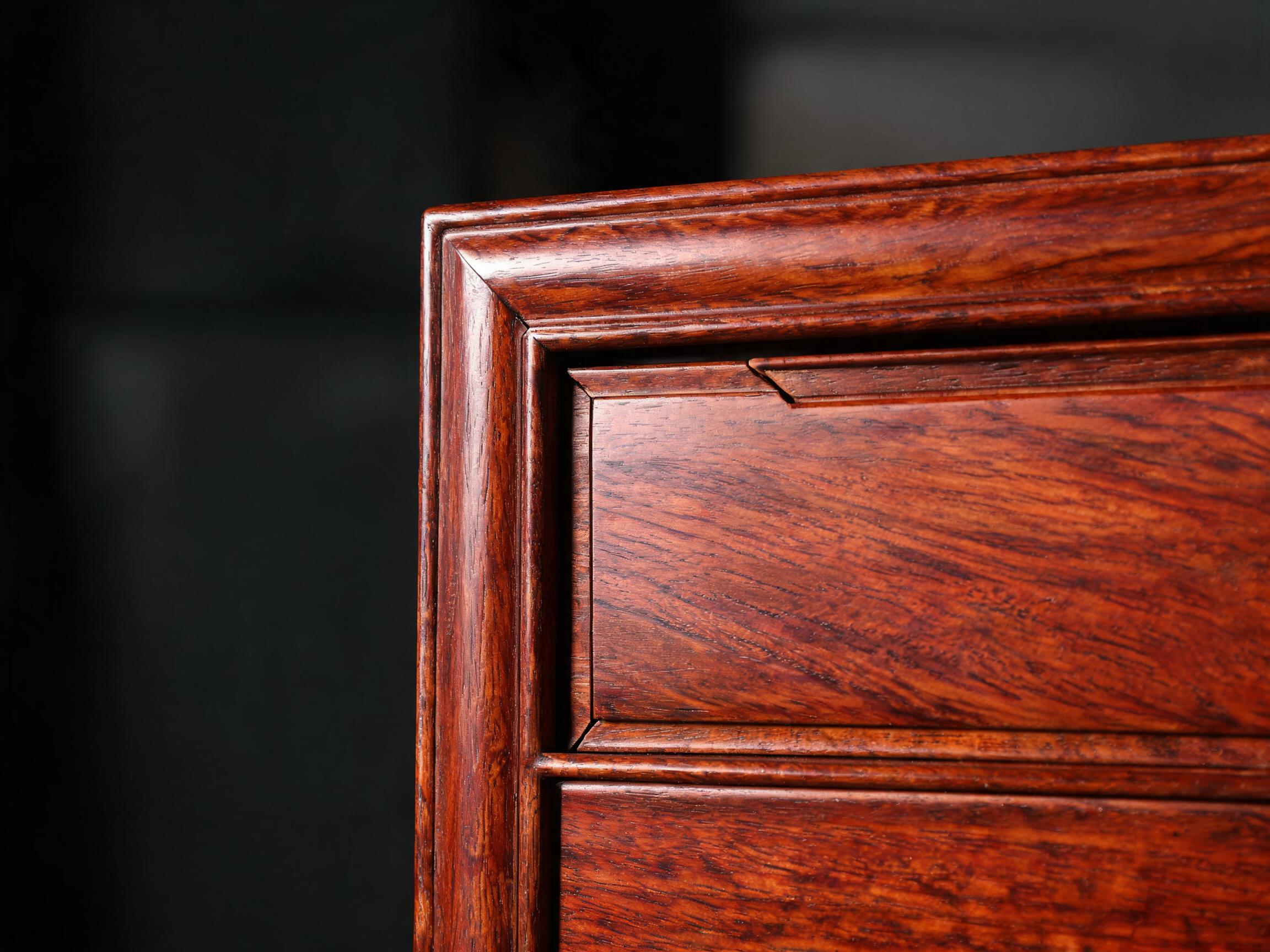
A word of honesty about what these measures do and do not promise: no solid-wood bed frame is immune to movement, and a supplier who claims a frame will "never crack in any climate" is telling you something about their marketing, not their timber. What documented moisture control, floating panels, and dowelled mortise-and-tenon construction actually deliver is a frame engineered to accommodate normal seasonal movement — and a warranty structure that recognizes the difference. The suite carries a 24-month warranty from receipt covering structural cracking, severe deformation, and loosened mortise-and-tenon joints from non-human causes, with response within 48 hours of a report and a proposed solution within 7 working days. Normal wood shrinkage, natural color variation, and grain differences are expressly not classified as defects — which is the correct line to draw, and a line buyers should expect any honest solid-wood supplier to draw.
Four-Poster and Canopy Frames: Two Structures, Different Rooms
Buyers searching for a rosewood bed frame will meet two classical structures more often than any others: the four-poster bed and the canopy bed. They look related, and they are — both stand on four single-section posts — but they solve different room problems, and the two production programs here map cleanly onto them.
The four-poster bed anchors the five-piece suite as its structural centerpiece. Its posts rise approximately 2.05 m, and the outer dimensions run approximately 2.10 m by 2.25 m in king, or 2.10 m by 1.85 m in queen, with roughly 150 mm of clearance under the side rail. This is the configuration for full-bedroom projects: the suite coordinates the bed with two nightstands, a two-door wardrobe, and a dresser with mirror, all from one timber batch. It suits master bedrooms in private residences and hotel rooms where the bed is meant to be the visual anchor of the room. Because the posts ship as single sections and cannot be broken down, buyers should measure doorway widths, corridor turns, and any stairwell landings on the delivery route before ordering — the factory states this explicitly, and experienced project buyers make it part of their site survey.
The canopy bed in the three-piece set takes the same solid-post logic and adds a full overhead frame — approximately 210 cm tall — connected by the through-wedged tenons described above. The set is deliberately compact: canopy bed plus two nightstands (each 50 × 40 × 55 cm), designed as a starting configuration for rooms from about 12 square meters upward, where a full five-piece suite would overwhelm the space or the budget. Boutique hotels and villa guest rooms are the natural fit. Buyers who later need a wardrobe and dresser can add matching pieces from the same catalogue rather than re-sourcing the room.
Choosing between them is mostly a function of three numbers a buyer already has: room area, ceiling height, and delivery route. The canopy needs ceiling clearance for its 210 cm frame (plus any pendant lighting above it); the four-poster needs roughly 2.05 m of clear height plus whatever mattress and bedding add. Both need the delivery-route check because solid posts do not come apart. Where the room is generous and the brief calls for a fully coordinated suite, the five-piece program fits; where the room is compact or the project is phased, the three-piece canopy set starts smaller without giving up the joinery or the documentation.
Sizing and Mattress Compatibility for Overseas Markets
Mattress compatibility is where well-made imported beds most often disappoint their owners, and it is entirely avoidable at the order stage. The bed frames in both programs are built to fit standard 180 cm × 200 cm (king) or 150 cm × 200 cm (queen) mattresses. Those are the dimensions common across Europe, Australia, and much of Asia. They are not the dimensions of a North American king, which runs 193 cm × 203 cm — a mattress that will overhang a 180 × 200 slat base on every side. The factory's own FAQ flags this directly and asks buyers to confirm the mattress standard at order, and any buyer serving the US or Canadian market should treat that confirmation as a required line item on the purchase order, not an assumption.
Beyond the mattress footprint, two further fit details are worth checking. First, the slat base in both frames is designed to support a standard innerspring or latex mattress without a box spring, with cross-slats spaced at approximately 90 mm centers — spacing tight enough to limit mattress sag over years of use. Buyers planning to pair the frame with a memory-foam mattress should confirm the foam manufacturer's support requirements, since some foam warranties specify maximum slat gaps more conservatively than 90 mm. Second, mattress-plus-frame height matters for hotels: the suite's side-rail clearance of roughly 150 mm is enough for underbed storage in a residence, but hotel housekeeping standards vary, so project teams should confirm whether their housekeeping spec requires a different clearance before the frame dimensions are locked.
For buyers who need a size that is not on the standard sheet, the answer is customization rather than compromise — OEM custom dimensions are supported in these programs with a 15-day design approval cycle, which is covered in a later section. The principle to hold on to is simple: a solid rosewood bed frame is a long-life purchase, and the mattress standard of the destination market is a fact the buyer controls, so it should be settled in writing before production, not discovered at installation.
What Hotels Should Require from a Rosewood Bed Frame
Hotels ask more of a bed frame than a private home does, and the difference is mostly about repetition and turnover. A residential bed is assembled once; a hotel bed is bumped by luggage carts, sat on by hundreds of guests per year, and sometimes disassembled and reassembled between rooms. Three requirements follow, and all three are verifiable in these two programs.
First, joint integrity under repeated load. The documented in-house tests — 150 kg distributed load for 24 hours on the assembled frame, and the 10 kg lateral-force test at each canopy corner with a 3 mm movement threshold — are exactly the kind of repeatable standard a hotel procurement file should ask to see, alongside the right to witness or third-party-verify them. Hotel buyers should also ask for the joint specification in writing (tenon depth, dowelling, through-wedged canopy joints) so the standard travels into the contract, not just into a brochure.
Second, batch consistency across rooms. A hotel corridor of twenty bedrooms needs twenty beds that read as one order: same tone, same grain direction character, same carving depth. Because the suite program cuts all five pieces of each suite from one timber batch, the tone-matching question becomes a batch-matching question across suites — and the factory explicitly supports batch-matched timber and carving for multi-suite projects, arranged by confirming room count at inquiry. Hand-carved elements bring a relevant caveat that the factory also states honestly: each post finial is turned and finished individually, so minor variation between finials is normal and expected in hand-worked furniture. Project buyers who need a near-uniform look across rooms should request batch-matched carving at order rather than discovering the nature of handwork after delivery.
Third, phased delivery against a project schedule. Hotel renovations rarely accept a single container date. The factory schedules project production in batches, and projects of twenty suites or more can be arranged as dedicated batch production with phased delivery scheduled against the project timeline — a logistics shape that fits fit-out sequencing. A standard 40-foot container loads approximately 6 to 10 complete suites, which gives project planners a concrete number for container-flow planning: a twenty-room project is roughly two to three containers, arriving on the project's schedule rather than the factory's.
Private buyers and villa owners should not skip this section, because the same three checks — documented joint tests, batch matching, and delivery scheduling — simply scale down. The difference is that a hotel procurement officer asks for them as a matter of process; a homeowner needs to remember to ask at all.
Built for Ocean Freight: Export Packaging Standards
A dense hardwood bed frame survives international shipping far better than a light frame does — mass dampens vibration — but only if the packaging takes the journey seriously. Both bedroom programs ship to documented export standards, and the specifics are worth knowing because they are the details a buyer can audit from photographs before the container is even sealed.
The five-piece suite program packs each piece in five-layer corrugated cartons with shock-absorbing foam, pearl-cotton corner protectors, and moisture-proof film. Large pieces receive additional wooden-frame reinforcement, and load-bearing components — the bed frame and bed posts — are reinforced as a priority. Hardware and assembly fittings are packed separately and labeled so nothing goes missing during installation. Before container loading, the supplier provides product packaging photos, loading photos, and a packing list for the buyer's confirmation, and commits in writing: if products are damaged or items go missing in transit because packaging did not meet the agreed standard, the supplier is responsible for replacement, re-shipment, or the corresponding loss.
The canopy bed program adds two details that experienced importers will recognize as meaningful. Its packaging uses ISPM-15 heat-treated timber for the crates — the international standard that prevents wooden packaging from being rejected or fumigated at destination borders — with EPS foam corner blocks throughout, and the packaging has passed a 1-metre drop test. The bed frame ships flat-packed (posts, rails, canopy frame, and slat base separated) in one crate, and the nightstands ship fully assembled in a second crate, which keeps the largest fragile surfaces protected while reducing assembly time on site to roughly 45–60 minutes for two adults, using the supplied wooden dowels and instruction sheet.
Flat-packing a solid-post bed also answers a question hotel engineers always ask: what does installation actually involve on site? For these frames, the answer is posts, rails, and slat base coming together with wooden dowels — no specialized tools, no on-site gluing, no metal-bracket alignment fights — and the nightstands arriving ready to place. Buyers should still stage the delivery route as noted earlier, because the single-section posts travel as single sections.
Documentation That Clears Customs: FSC and CITES
No section matters more for a first-time rosewood importer, and none is more often misunderstood. Dalbergia cochinchinensis is listed on CITES Appendix II, which governs international trade in the species — it is a trade-control listing, not a certification of quality, and a buyer who understands the distinction will have a smoother customs experience than one who treats the paperwork as a rubber stamp. Shipments in these programs include a CITES export permit issued by the Chinese CITES Management Authority with each consignment. One nuance trips up many importers and is worth stating plainly: where a destination or transit route requires a re-export certificate, that document is issued by the CITES Management Authority of the country of re-export — not by the original exporter — so importers should confirm their destination country's requirements with the relevant authority, and arrange any re-export certificate with their re-exporting party, before the shipment departs. Some EU member states additionally require phytosanitary or scientific-authority documentation, which is why the pre-departure check matters.
The second documentation stream is environmental. Timber in these programs is sourced under FSC chain-of-custody documentation, and the factory provides FSC transaction claims with each invoice so buyers can pass the claim through to their own customers. For buyers selling into the EU or North America, the FSC claim is what feeds green-building credit systems and corporate procurement policies that require responsible-sourcing evidence. The two streams travel together by design: FSC covers the responsible-forestry claim, CITES covers the legal trade and movement of the species, and neither substitutes for the other. Every shipment also includes a commercial invoice with HS code 9403.60 and a wood drying certificate, giving customs brokers the species, trade, and conditioning records in one document set.
The practical instruction for buyers is to raise documentation at the inquiry stage, not the customs stage: state the destination country, name any CITES import-permit requirement, and ask which certificates travel with the shipment. The factory's own inquiry guidance asks buyers to do exactly this, because the correct document set is assembled per destination. An importer who treats CITES as the supplier's problem alone is the importer who meets it first at the port.
OEM and ODM: When Customization Makes Sense
Standard configurations cover a surprising share of bedroom projects, but not all of them — and for the remainder, customization is a normal part of the business rather than a special favor. These two programs document what is on the menu. Custom dimensions are supported through OEM, with a 15-day design approval cycle from submission to approved drawings — a cycle length buyers can plan around, and one that makes customization realistic even inside a phased project schedule. Custom engraving and alternative carving motifs can be quoted on request; buyer logos can be applied for hotel or retail programs. Wood tone, by contrast, is bounded by nature: tone variation is limited to what the natural rosewood batch allows, and no staining is applied over the raw lacquer finish — a stance that protects the finish system described earlier, and one buyers should treat as a feature rather than a limitation, since stained rosewood is precisely what ages badly.
ODM development — where the buyer brings a concept or a market requirement and the factory develops the design — is likewise supported with the same 15-day approval cycle. The typical cases where it earns its keep: a hospitality group standardizing on a proprietary bed silhouette across properties; a retailer serving a market whose mattress standard differs from 180 × 200; a villa project matching new beds to an existing interior's carving language. In each case, the customization changes dimensions, carving, or finish application — not the structural logic, which remains solid single-section posts and dowelled mortise-and-tenon joinery regardless of the design brief.
Buyers considering customization should bring the same information they would for a standard order — bed size, quantity, destination port, documentation needs — plus drawings or reference images for the design element, and should treat the 15-day approval window as part of the production lead time (45 to 60 working days for a single set from deposit confirmation; 70 to 85 days for batch orders of three sets or more) rather than an addition to it.
A Practical Supplier Evaluation Checklist
Because this article has now touched every major decision dimension, it is worth compressing them into a checklist a buyer can carry into any rosewood bed frame negotiation — not as a formality, but as the actual questions that separate a documented program from a generic offer:
- Species and batch: Is the botanical name stated in writing (Dalbergia cochinchinensis)? Are all pieces cut from one timber batch, with grain matched at the workshop?
- Post construction: Are corner posts single solid sections? What bend tolerance triggers re-selection (here: 1.5 mm, applied at both selection and inspection)?
- Joinery: What tenon depth is specified on post-to-rail joints (here: 20 mm)? Are canopy or headboard joints through-wedged tenons? Is any metal hardware in the primary load path?
- Structural testing: What load and lateral-force tests does the assembled frame pass before packing (here: 150 kg/24 h distributed; 10 kg lateral per canopy corner with a 3 mm limit)? Can tests be witnessed or third-party verified?
- Moisture control: What is the moisture-content band (here: 8–12%), how is it verified per board, and is a wood drying certificate included?
- Panels and finish: Do door and side panels float in grooved frames? How many lacquer coats, and is each cured and rubbed (here: seven on the canopy bed)?
- Packaging: Is timber ISPM-15 heat-treated? What drop testing has packaging passed? Are packaging, loading photos, and a packing list provided before container sealing?
- Documentation: Does each shipment include the CITES export permit, FSC transaction claims, HS-coded invoice (9403.60), and drying certificate? Who arranges re-export certificates if the route requires one?
- Commercial terms: What is the MOQ (here: 1 set), payment structure (here: 30% deposit, 70% after buyer-confirmed inspection, L/C for 3+ sets), and lead time (45–60 working days single; 70–85 for 3+ sets)?
- Warranty and after-sales: What does the warranty cover and for how long (here: 24 months, structural coverage, 48-hour response)? How are transit-damage replacements handled?
A supplier who answers all ten from written documentation is a supplier whose rosewood bed frame will behave the way the brochure promises. A supplier who answers none of them in writing is answering a different question entirely.
How Production and Quality Control Support the Frame
Every construction claim above depends on who is doing the cutting, drying, and assembling — so a short factual profile of the production base belongs in a buying decision. Yunxiao Rosewood Furniture Co., Ltd. was founded in 2008 and operates from Xianyou, Putian, Fujian — a region with a long-standing classical-furniture industry — in a production facility of approximately 12,000 square meters covering the complete chain in-house: timber drying, woodworking, mortise-and-tenon assembly, hand carving, finishing, and export packing. In-house integration matters for a joinery-heavy product because the same hands control the timber's conditioning and the joints cut into it; a factory that outsources drying loses control of the variable that decides whether its joinery survives overseas.
Quality control runs through four documented checkpoints — timber inspection, carving inspection, structural assembly inspection, and surface finishing inspection — with a final quality inspection before shipment. Third-party inspection is supported: inspectors can review production records, drying records, and material documentation on site. For buyers building a first order with a new supplier, the sequencing that fits the payment structure is natural: finished-product photos, dimensions, and quality-inspection results are provided for the buyer's confirmation before the 70% balance is paid, and if inspection finds problems with specification, material, workmanship, or quantity, the supplier rectifies first and re-confirms before the balance is paid. Shipment follows within 3 working days of balance receipt. The structure puts the buyer's inspection between production and payment — which is exactly where a first-time importer wants it.
Buyers who want to see the process before committing can arrange workshop visits in Xianyou to inspect timber stock and production stages — a standing offer that itself functions as a confidence signal, since a factory confident in its drying rooms and joinery benches has nothing to hide from a visitor with a checklist.
Buyer FAQ
What mattress sizes do the rosewood bed frames fit?
Both programs fit standard 180 × 200 cm (king) or 150 × 200 cm (queen) mattresses. North American king (193 × 203 cm) differs — confirm the destination mattress standard at order; custom dimensions are available through OEM with a 15-day design approval cycle.
Does the bed require assembly on site?
The bed frames ship flat-packed — posts, rails, and slat base separated — and assemble with supplied wooden dowels in roughly 45–60 minutes with two adults. Nightstands ship fully assembled.
Is CITES documentation included with every shipment?
Yes — a CITES export permit issued by the Chinese CITES Management Authority travels with each shipment, alongside FSC transaction claims, an HS-coded invoice, and a wood drying certificate. Re-export certificates, where required, are arranged with the re-exporting country's authority before departure.
What does the warranty cover?
The 24-month warranty from receipt covers structural cracking, severe deformation, loosened mortise-and-tenon joints, and hardware damage from non-human causes, with response within 48 hours and a solution within 7 working days. Normal shrinkage, natural color variation, and grain differences are not defects.
How is the bed packed for ocean freight?
Five-layer corrugated cartons, shock-absorbing foam, pearl-cotton corner protectors, and moisture-proof film, with wooden-frame reinforcement on large pieces; the canopy program uses ISPM-15 heat-treated crates with EPS corner blocks, packaging that has passed a 1-metre drop test. Packaging, loading photos, and a packing list are provided before container loading.
What are the payment terms?
30% deposit after order confirmation; the 70% balance is paid after the buyer confirms finished-product photos, dimensions, and inspection results. L/C is accepted for orders of three sets or more. Shipment is arranged within 3 working days after the balance is received.
What is the minimum order quantity?
One set. Multi-suite hotel projects can arrange batch-matched timber and carving, and projects of twenty suites or more can run as dedicated batch production with phased delivery.
Can the carving, dimensions, or finish be customized?
Custom dimensions, engraving, alternative carving motifs, and buyer logos are supported through OEM/ODM with a 15-day design approval cycle. Wood tone follows the natural rosewood batch; no staining is applied over the raw lacquer finish.
What is the production lead time?
45 to 60 working days from deposit confirmation for a single set; batch orders of three or more sets run 70 to 85 days. Custom and large projects receive a dedicated production plan based on complexity and quantity.
How many sets fit in a container?
A standard 40-foot container loads approximately 6 to 10 complete five-piece suites. Single-set orders ship LCL; FCL applies from three sets.
Conclusion and Next Step
So — why is a solid rosewood bed frame with mortise-and-tenon joinery ideal for overseas homes and hotels? Because it is the one construction approach that addresses, in the wood itself, every failure mode an importer actually fears: single-section posts that carry load without a glue line; dowelled mortise-and-tenon joints and through-wedged canopy tenons that tighten rather than loosen under years of use; 8–12% moisture control and floating panels that let the frame breathe through climates it was never grown in; documented export packaging that treats a 45-day ocean voyage as an engineering problem; and a complete FSC and CITES document set that clears customs as cleanly as the frame clears inspection. Both the Classical Four-Poster Redwood Bedroom Suite 5-Piece and the Classical Redwood Canopy Bed 3-Piece Bedroom Set were built around that answer.
If you are evaluating rosewood bed frames for a residence, a villa project, or a hotel program, bring your questions to the factory directly: state the bed size (king or queen, or your market's mattress standard), the number of sets, the delivery destination with postal code or port, any batch-matching or customization requirements, and your destination country's CITES import-permit situation. A quotation built on those facts is the fastest route from this article to a bedroom that behaves, for years, the way a solid rosewood bed frame should.