
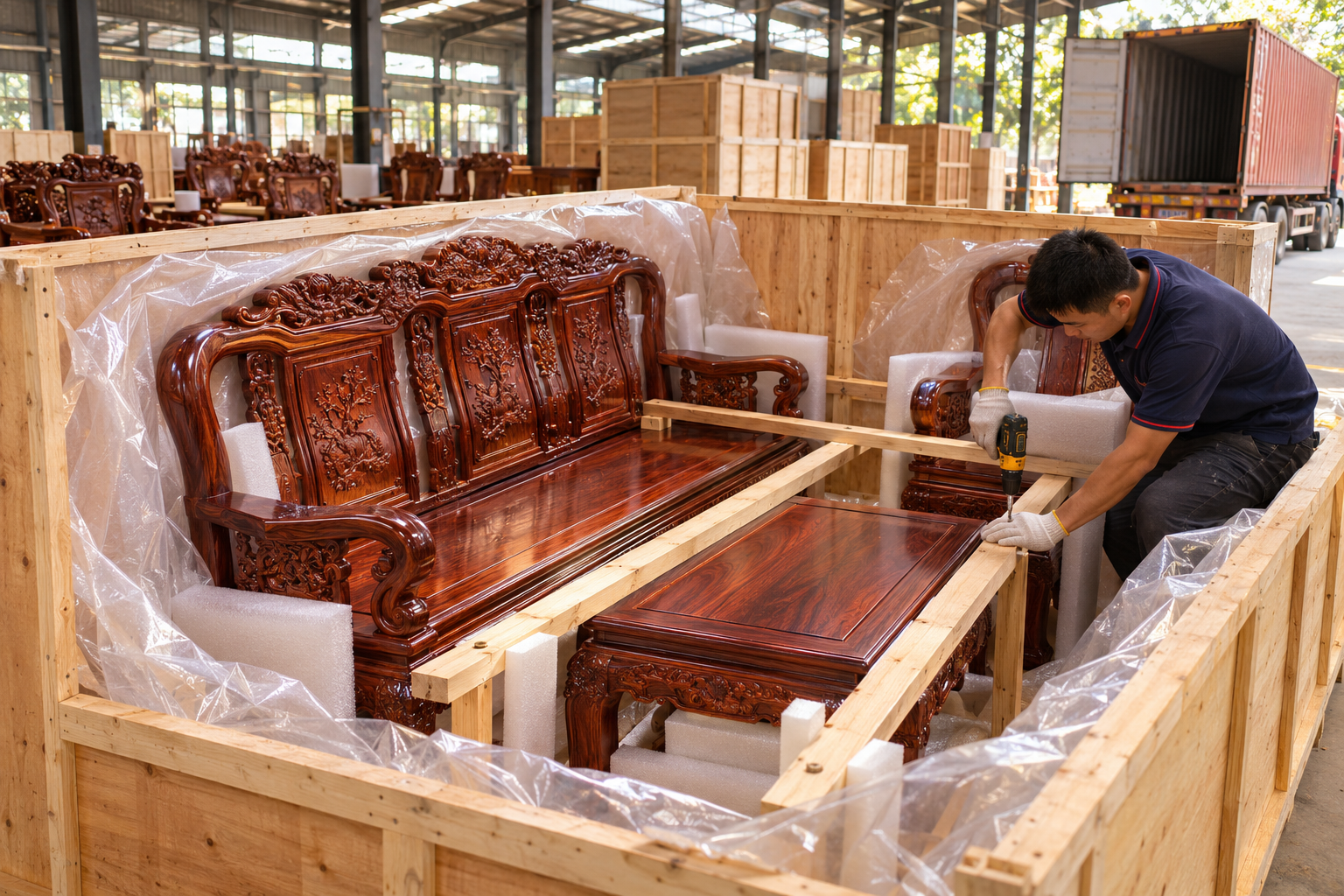
A B2B buyer's guide to whether rosewood furniture needs fumigation for export: what ISPM 15 regulates, heat treatment vs methyl bromide, reading the IPPC mark, and how Yunxiao prepares compliant export packaging.
The Short Answer: Fumigation Is Not Always Required, but ISPM 15 Packaging Usually Is
If you are importing classical rosewood furniture from China, the compliance question that causes the most confusion at the enquiry stage is also the one with the clearest answer once the terminology is untangled: the finished rosewood furniture itself is not the primary target of international phytosanitary rules — the wooden packaging around it is.
Under the International Plant Protection Convention (IPPC) standard known as ISPM 15 — formally, the "Regulation of Wood Packaging Material in International Trade" (FAO 2013, revised) — the regulated object is wood packaging material, abbreviated as WPM. That category covers solid wood used in crating, pallets, dunnage, and bracing timber, where the wood is more than 6 mm thick. It does not cover the finished article of furniture sitting inside the crate. A carved Siamese rosewood armchair, a mortise-and-tenon console table, or a seven-piece living room set is a manufactured, finished wood product, not packaging, and the standard does not require it to carry an IPPC mark or to undergo heat treatment in its own right.
What usually does apply to your shipment is the crate and pallet system. Because export crating for furniture is almost always built from solid sawn timber — and because the entire point of the standard is to stop wood-boring insects and pathogens from travelling across borders inside that timber — the solid wood packaging on a rosewood furniture container normally needs to comply with ISPM 15. In practice, that means the packaging wood has been either heat treated or fumigated with methyl bromide by an authorised treatment provider, debarked, and stamped with the IPPC mark before the furniture is loaded.
There is a second layer of requirements that buyers sometimes encounter, and it is important to state it carefully rather than overstate it: a destination country's national plant protection organisation (NPPO) — Australia's biosecurity authority is a commonly cited example — may impose commodity-level import conditions on finished wood products, or an importer may have its own internal biosecurity protocol that asks for pre-shipment treatment of the goods themselves. When that happens, treatment of the finished furniture can be requested or required. But this is destination-specific and shipment-specific; it is not a universal rule baked into ISPM 15.
So the practical answer, in order: check your solid wood packaging for ISPM 15 compliance as a baseline; check whether your destination NPPO or your own import protocol adds commodity-level conditions for finished furniture; and make sure both points are settled with your supplier and your customs broker before the container is stuffed. The rest of this article walks through each of those layers in detail, starting with what ISPM 15 actually is and why it exists.
Key distinction to remember: ISPM 15 regulates the wood packaging material (crates, pallets, dunnage, bracing) — not the finished rosewood furniture. Commodity-level treatment of the furniture itself only arises when a destination authority or your own import protocol requires it.
What Exactly Is ISPM 15 and Why Was It Created?
ISPM 15 is one of the International Standards for Phytosanitary Measures, a series of standards developed under the International Plant Protection Convention. The IPPC itself is a multilateral treaty hosted by the Food and Agriculture Organization of the United Nations (FAO), with the stated purpose of protecting cultivated and wild plants by preventing the introduction and spread of plant pests. Its work operates within the framework of the WTO Agreement on the Application of Sanitary and Phytosanitary Measures (the SPS Agreement), which allows member countries to set import restrictions to protect plant health, provided those measures are technically justified and not disguised trade barriers.
The problem the standard solves
For most of modern trade history, the international movement of goods travelled on, inside, and alongside raw solid wood: pallets, crates, skids, packing blocks, and bracing timber stuffed between cargo to stop it from shifting. That timber was rarely treated, rarely documented, and essentially invisible to customs authorities — a pallet looks like a logistics tool, not a potential pest carrier. Yet untreated solid wood can harbour wood-boring beetles in the larval stage, termites, nematodes such as the pinewood nematode, and fungal pathogens, all of which can survive a long ocean voyage inside the wood and emerge in a new country with no natural predators.
The phytosanitary consequences of that pathway are serious. Outbreaks of exotic wood-boring insects traced to imported wood packaging — the Asian longhorned beetle and the emerald ash borer being the most frequently discussed examples in the plant-health literature — have led to tree losses and costly eradication programmes in importing regions, particularly in North America and Europe. Because the risk came from packaging rather than from the commodities themselves, the IPPC developed a dedicated standard that would regulate the packaging pathway globally: ISPM 15, adopted in 2002 and revised in 2009 and 2013, which harmonised the way trading countries treat and certify wood packaging material. The current reference text is available from the IPPC: ISPM 15 (2013), Regulation of wood packaging material in international trade.
Before a single harmonised standard existed, importing countries each had their own requirements for wood packaging, which created inconsistency and disputes. The value of ISPM 15 is that once a piece of packaging wood is treated and marked in one participating country, it is recognised as compliant across the trading partners that have adopted the standard — which today includes essentially all major furniture-importing markets: the United States, Canada, the European Union, the United Kingdom, Australia, New Zealand, Japan, South Korea, and the major Southeast Asian economies.
What falls inside the scope
The standard applies to wood packaging material constructed from solid wood — that is, wood sawn from the log, with its original fibre structure intact — where any piece is thicker than 6 mm. In a furniture export context, the regulated items typically include:
- Crating timber: the frame boards, side panels, and lid boards of the wooden crate built around the furniture.
- Pallets: both the pallets carrying individual crates and any pallets used inside the container for stacking.
- Dunnage: loose timber placed in the container to fill gaps, protect corners, or separate pieces of furniture.
- Bracing and blocking: beams and wedges fixed inside the crate or container to stop heavy carved pieces from moving in transit.
Two conditions attach to the scope. First, the wood must be made from debarked timber — bark remaining on the wood is a recognised harbourage for pests, so the standard requires bark removal (allowing only limited, defined tolerances of bark residue, sometimes described in industry usage as "bark-free" conditions). Second, the wood must be processed by an approved measure — heat treatment or methyl bromide fumigation, discussed in the next section — applied by a treatment provider authorised under the national programme of the exporting country.
What is exempt
The standard explicitly exempts wood packaging made entirely from manufactured wood products — materials that were produced using glue, heat, and pressure, or a combination of them, in a process that destroys pests. The categories named in the standard include plywood, oriented strand board (OSB), particle board, and veneer that has been processed to a defined thickness. Fibreboard and similar engineered panels fall in the same exempt group. The logic is straightforward: no living pest survives industrial panel production, so there is nothing for the standard to regulate.
For furniture exporters, this exemption creates a real design choice. Some shippers build crates wholly or partly from plywood to sit outside the ISPM 15 net; others use solid timber crates because solid wood gives better holding strength for heavy, dense rosewood pieces and can be stamped as treated. Both routes can be compliant — what changes is the documentation burden. A solid timber crate needs a treatment record and an IPPC mark; a plywood crate needs to be genuinely all-plywood, with no untreated solid-wood dunnage sneaking in at loading time, because a single piece of untreated bracing timber in the container can put the whole consignment at risk of inspection failure at destination.
It is also worth noting what the standard deliberately does not cover. Finished furniture, wooden handicrafts, and other manufactured end products are outside the scope of ISPM 15 even when they are made from solid wood — the standard regulates packaging, not commodities. That distinction is developed in detail in the final section of this part of the article.
Heat Treatment or Methyl Bromide Fumigation: How Each Measure Works
ISPM 15 recognises exactly two approved treatment measures for solid wood packaging: heat treatment and methyl bromide fumigation. An exporter cannot invent a third method — chemical dipping, vacuum sealing, or painting the wood with preservative do not qualify — and a crate is either treated under one of the two approved measures by an authorised provider, or it is not compliant.
Heat treatment (HT): the measure used for furniture packaging
Heat treatment requires the wood to reach a minimum core temperature of 56 degrees Celsius, held for at least 30 continuous minutes, inside a closed chamber. The critical word is "core": the probe is measuring the temperature at the centre of the thickest piece of timber in the chamber, not the air temperature around it. Surface heat does not kill pests living inside the wood, which is why the standard specifies the internal reading. In practice, treatment providers run dedicated drying kilns or heat chambers instrumented with core probes and data loggers, and the resulting treatment record is what authorises them to stamp the wood with the HT mark.
For furniture exporters, heat treatment has two practical advantages that explain why it has become the default measure in the trade. The first is timing: treatment is applied to the raw packaging timber before the crate is built and before the furniture is packed, so the finished furniture never enters the treatment chamber. The rosewood carvings, the beeswax finish, and the lacquered surfaces are untouched by the process. The second is chemistry: heat treatment changes nothing in the wood except its temperature history, leaving no chemical residue on the crate timber — relevant when the crate sits in the same sealed container as furniture finished with lacquer and beeswax for weeks at a time.
There is an incidental benefit, too: the same kilns that bring timber to 56 degrees Celsius core temperature also reduce its moisture content, and drier packaging timber is less likely to transfer humidity to the goods it protects inside a container crossing humid sea lanes. That said, ISPM 15 heat treatment is not a furniture-drying process — the 56/30 schedule is a phytosanitary measure for packaging wood, and buyers evaluating the drying of the furniture itself should rely on the manufacturer's own drying programme. At our factory in Xianyou County, for example, rosewood is seasoned through a 36-day constant-humidity drying process before construction, which addresses the moisture question at the furniture level, separately from packaging compliance.
Methyl bromide fumigation (MB): how it works and where it stands
Methyl bromide fumigation is the second approved measure. The crate timber — or the packaged commodity with its packaging, in commodity-fumigation scenarios — is placed under gas-proof sheeting or inside a sealed fumigation chamber and exposed to methyl bromide gas at a dosage and duration specified in the standard, with temperature-dependent schedules and minimum concentration-time requirements documented and monitored during the fumigation period. The gas penetrates the wood and kills insects at all life stages.
Methyl bromide remains a valid ISPM 15 measure under the standard, but its use is narrowing. Methyl bromide is an ozone-depleting substance controlled under the Montreal Protocol on Substances that Deplete the Ozone Layer, and its non-quarantine uses have been progressively phased out over the past two decades; quarantine and pre-shipment (QPS) uses, which include ISPM 15 packaging treatment, remain exempt but are under long-term review by the Parties to the Protocol and by the IPPC's technical panel on phytosanitary treatments. In day-to-day furniture exporting, the observable consequence is that heat treatment has become the standard measure offered by most treatment providers for wood packaging, while methyl bromide is used mainly where a specific destination authority or a commodity-level requirement calls for fumigation of the goods themselves — a scenario we cover in the final section.
Side-by-side comparison
| Aspect | Heat treatment (HT) | Methyl bromide fumigation (MB) |
|---|---|---|
| Approved under ISPM 15 | Yes — primary measure for wood packaging | Yes — remains an approved measure |
| How applied | Timber heated in a chamber to a minimum 56 °C core temperature, held at least 30 minutes, with core-probe monitoring | Timber or packaged goods sealed under sheeting or in a chamber and exposed to methyl bromide gas at standard-specified dosage and duration |
| What it treats | Solid wood packaging material (crates, pallets, dunnage, bracing) before the crate is built | Wood packaging, and in commodity-fumigation scenarios goods plus packaging when a destination requires it |
| Effect on the furniture | None when applied to packaging timber before assembly and packing; furniture never enters the kiln | None for packaging-only treatment; if goods are fumigated, exposure conditions must be compatible with finishes — a point to confirm with the supplier before agreeing |
| Residue and environment | No chemical residue; consistent with buyers' environmental expectations | Ozone-depleting substance under the Montreal Protocol; QPS use remains exempt but faces long-term phase-down pressure |
| Common mark on the wood | IPPC mark with the "HT" code | IPPC mark with the "MB" code |
Practical note for buyers: when a supplier confirms "fumigated packaging," ask which measure was actually applied. If the crate timber carries the HT code, the treatment was heat treatment — which for furniture shipments is what you should expect — and the word "fumigation" in loose trade conversation should not be mistaken for a methyl bromide treatment of the goods themselves.
Reading the IPPC Mark on Your Export Crate
Once the packaging timber has been treated, the authorised treatment provider stamps each treated piece — or each assembled crate and pallet — with the IPPC mark. That stamp is the entire compliance mechanism of ISPM 15: importing countries rely on the mark, not on accompanying treatment paperwork for the packaging itself, to accept wood packaging at the border. Knowing what the mark must contain lets any buyer walk up to a crate and verify the basics in under a minute.
The components of a valid mark
- The IPPC logo: the stylised "wheat sheaf" symbol of the International Plant Protection Convention, positioned on the left of the stamp.
- Country code: the two-letter ISO country code of the treating country, followed by a hyphen. For treatment performed in China, this reads "CN."
- Producer/treatment provider number: the unique registration number assigned to the authorised wood packaging producer or treatment provider by the national plant protection organisation, formatted as a country-assigned identifier (for example, a number registered under the CN programme).
- Treatment code: "HT" for heat treatment or "MB" for methyl bromide fumigation. This is the single most informative character pair on the stamp — it tells you which approved measure was applied.
- Debarking indicator (where applied): under the current standard, treated wood must be debarked before marking, and some national programmes include a debarking (DB) indicator on the mark. Regardless of whether the code appears, bark-free condition is a requirement for compliant wood.
The mark must be legible, permanently applied — typically branded, stencilled, or stamped in a way that survives handling — and placed on a visible surface of the unit. Markings painted on with nothing behind them, partial stamps on only one board of a crate, or marks on timber that still carries bark are all legitimate reasons to ask questions before the container is sealed.
Why buyers should photograph the crates at loading
By the time a container reaches the destination port, the crates inside it are the importer's problem. If an inspection officer at arrival finds wood packaging without a mark, with an illegible mark, or with bark present, the consequences land on the consignment — not on the factory twelve thousand kilometres away. This is why we advise every B2B buyer to photograph the IPPC marks on the crates and pallets during loading supervision or to request loading photos from the supplier. Those photographs do two jobs: they document compliance for the importer's own file, and they give the customs broker instant evidence to draw on if the port authority questions the packaging at arrival.
The same photographs tie usefully into a broader inspection routine. If you are building a loading-day verification process for your orders, our pre-shipment inspection checklist for importers covers the crate, the mark, the goods, and the container condition in a single sequence you can hand to your inspection agent: how to inspect rosewood furniture before shipment — a B2B buyer's checklist.
What a missing or non-compliant mark can mean
The following describes the risk in bounded, general terms — the exact enforcement action depends on the destination country and the inspector's judgement. Where wood packaging fails inspection at arrival, typical outcomes include: the container being held pending re-treatment of the packaging at the importer's cost; the offending timber being removed and destroyed; the consignment being ordered re-exported; or, in stricter programmes, the whole shipment being refused entry. Each of those outcomes carries demurrage, storage, and re-handling charges that can dwarf the cost of doing the packaging correctly at origin. None of them, in a well-run supply chain, should ever be necessary — which is precisely why the mark deserves a photograph and a glance before the doors close.
One nuance worth knowing: the mark certifies the packaging wood, not the container's contents and not the container itself. If compliant, marked crates are loaded into a container together with loose, untreated dunnage picked up at the last minute, the dunnage is the non-compliant element and inspection authorities treat the packaging of the consignment as a whole. A disciplined loading process — every stick of timber inside the container either marked as treated or made of exempt engineered material — is what keeps the paperwork and the physical reality matched.
Is the Finished Rosewood Furniture Itself Regulated?
Having established what ISPM 15 does and does not cover, we can now answer the question in the title at the level it is usually asked: does the solid rosewood furniture inside the crate need its own fumigation or heat treatment?
The general rule: finished furniture is not wood packaging material
Finished furniture sits outside the definition of wood packaging material for a simple structural reason: WPM, by definition, is wood used to support, protect, or carry another article. The furniture is the article. The standard's scope language — solid wood used in crating, pallets, dunnage, bracing, and the like — is directed at the packaging pathway precisely because packaging timber is anonymous, reused, and untraceable, whereas a finished product is manufactured, identifiable, and declared as a commodity on its own customs classification.
The reasoning extends to the material itself. Rosewood furniture built in the classical tradition is not raw sawn timber in transit; it is a constructed product. At our factory, pieces are assembled with mortise-and-tenon joinery without metal nails, finished with eco-friendly beeswax and lacquer formulations specified to meet EU REACH and US CARB standards, and built from legally certified materials — Machilus Nanmu, aged red wood, and Grade-A tropical hardwood including Siamese rosewood (Dalbergia cochinchinensis) on the listed products. A finished, dried, finished-surface article of that description is a manufactured wood product in the commodity sense, and neither the IPPC mark nor packaging-level treatment attaches to it under ISPM 15.
Two adjacent regulatory regimes do touch finished rosewood furniture, and buyers encountering them sometimes conflate them with phytosanitary packaging rules. The first is species-level regulation under CITES: Siamese rosewood and other Dalbergia species are CITES-listed, so shipments of CITES-listed rosewood products travel with CITES export permits and FSC chain-of-custody documentation — a legal-wildlife-traceability requirement, entirely separate from pest risk. The second is chemical-compliance regulation for finishes and adhesives, which is where REACH and CARB obligations live. Neither of these replaces or duplicates ISPM 15; they run in parallel.
When commodity-level treatment can still be requested
Having said that the finished furniture is generally not regulated under ISPM 15, the honest and bounded qualification is this: a destination NPPO, or an importer's own biosecurity protocol, can still impose commodity-level conditions on finished wood products, and in those cases treatment of the goods themselves may be requested or required.
Australia is the example most often raised by buyers in project trade, because Australian biosecurity maintains entry conditions for wood commodities, including manufactured wooden articles, and goods may be directed for treatment on arrival if the authority assesses a biosecurity risk. Importers shipping to Australia commonly build a pre-shipment treatment step into their procurement protocol for solid wood furniture so that the goods arrive with a documented treatment history. The precise requirements for any given consignment — whether commodity treatment applies, which measure is acceptable, and how the treatment must be evidenced — are set out in the destination authority's import conditions for the specific product classification, and they change over time. We state this deliberately as a principle rather than as a country-by-country table: the authoritative source for your shipment is the import condition database of your destination NPPO, read together with advice from your customs broker.
There are also buyer-initiated reasons for commodity treatment that have nothing to do with regulation. Some importers — particularly those supplying hotel and villa projects — request pre-shipment fumigation of the goods themselves as part of their own quality and hygiene protocol, so that the furniture arrives with a documented treatment record for their project files or for downstream inspection by the project's consultants. When a buyer requests this, the practical points to settle in advance are: which measure is acceptable to the destination authority, whether the fumigation exposure conditions are compatible with the lacquer and beeswax finish on the furniture, which party bears the cost, and which certificate or declaration will be issued as evidence. All four are contract questions, answerable in the proforma stage — not assumptions to be discovered at the port.
How to resolve the open question for your market: ask your customs broker for the commodity-level import conditions on finished wooden furniture in your destination country, and ask your supplier to confirm in writing what packaging treatment will be applied and what documentation will accompany the shipment. Those two written confirmations close the compliance gap before production begins.
Why the packaging layer deserves most of your attention
If the finished furniture is generally outside the standard's scope and commodity treatment only arises for specific destinations or buyer protocols, then for the majority of rosewood furniture shipments the entire ISPM 15 question reduces to one operational task: making sure every piece of solid wood that touches the shipment — crate, pallet, dunnage, bracing — is treated, debarked, and marked. That task lives in the packaging workshop, not in the finishing shop, and it is best specified at the same time as the crate design itself, because treatment and packing are sequential steps on the same timber.
How the crate around a carved rosewood set is actually built — the moisture barriers, corner protection, and bracing that keep heavy dense hardwood pieces secure across a six-week ocean crossing — is a substantial subject of its own, and we treat it in a dedicated guide to how rosewood furniture is packaged for export shipping: export packaging for rosewood furniture, step by step. Reading it alongside this article gives you the full picture: the treatment standard covered here, and the physical protection system covered there, together define what arrives at your warehouse in the condition you ordered.
How Yunxiao Prepares ISPM 15-Compliant Export Packaging for Container Orders
Understanding the standard is one thing; applying it consistently to heavy, hand-carved rosewood furniture that will spend four to eight weeks on the ocean is another. At Yunxiao, export packaging is handled by our internal export team rather than outsourced to a third-party freight forwarder, which means the people who prepare the commercial documents are also the people who confirm that every crate, pallet and dunnage board leaving our 12,000 sqm factory in Xianyou County meets the ISPM 15 requirements described earlier in this article.
Our standard practice for container orders is to use heat-treated packaging marked with the IPPC logo and the HT code. Because the heat treatment is applied to the packaging wood — not to the finished furniture itself — the 36-day constant-humidity drying process that stabilizes the rosewood before carving is never interrupted or compromised. The treatment happens in the kiln on raw lumber destined for crating, and only after the wood has been debarked and dried is it fabricated into crates and bracing around the finished pieces. This sequencing matters: it means the furniture that has already been finished with eco-friendly beeswax and lacquer never passes through a heat-treatment chamber or a methyl bromide chamber at all.
What goes around the furniture
A rosewood console table or a seven-piece sofa set presents challenges that ordinary cargo does not. The pieces are dense — rosewood sinks in water — so the crates must be structurally robust enough to survive forklift handling at three or four points in the logistics chain. The surfaces are finished, polished or lacquered, so no crate component may press directly against carved or polished faces. And the joinery is mortise-and-tenon, assembled without metal nails, which means the furniture's strength comes from precisely fitted joints that must not be subjected to twisting loads during transit.
Our export crating therefore follows a layered approach, described in detail in our article on how rosewood furniture is packaged for export shipping: first a moisture barrier wrapping each piece to buffer humidity swings inside the container, then foam or soft padding at all contact points, then the heat-treated outer crate with internal bracing that immobilizes each piece. The bracing lumber is part of the same heat-treated, ISPM 15-marked wood supply as the crate walls — a point worth confirming with any supplier, because bracing and dunnage are exactly the categories of wood packaging material that inspectors examine most closely.
A useful question to ask any supplier: "Is the bracing wood inside the crate from the same heat-treated batch as the crate itself?" Non-compliance is discovered at destination far more often through bracing and dunnage than through the visible crate walls.
Documents that accompany the packaging compliance
Our export team prepares the full export document set, including the FSC certificates associated with our responsibly sourced material supply and, for shipments of CITES-listed rosewood products such as those made from Siamese rosewood (Dalbergia cochinchinensis), the CITES export permits required before the goods can lawfully leave China. FSC chain-of-custody documentation travels with shipments of the listed rosewood products as well. These paper trail requirements sit alongside — not instead of — the ISPM 15 packaging compliance: a container can be perfectly heat-treated and still be stopped at destination if the CITES paperwork for a regulated Dalbergia species is missing, and vice versa.
Production and delivery timing for container orders runs 45-60 working days after deposit. That window covers the drying, carving, assembly, finishing and finishing-cure stages described in our production articles, and it includes the packing stage in which the heat-treated crates are fabricated around the finished pieces. For long-term partners, partial shipments are available — for example, sending the first half of a villa project ahead of the second half rather than waiting for the full order to complete. Each partial shipment receives its own complete document set and its own compliant packaging; there is no "sharing" a fumigation or heat-treatment declaration between containers.
One practical note for project buyers: if your project schedule is tight, tell the export team at the proforma stage rather than after production begins. Coordinating the vessel booking with the completion of crating is easier when the crate fabrication and container loading are planned into the 45-60 working day window from the start, especially for carved sets that need particular loading sequences — a subject covered in our article on container loading planning for carved furniture.
What Buyers Should Verify Before the Container Leaves the Factory
Importers who treat packaging compliance as "the supplier's problem" sometimes discover at destination that a gap in the paperwork has become their problem, because the consignee is the party the customs authority deals with. The good news is that verification takes less than an hour if you do it at the right moment — which is before the container doors are closed, not after the bill of lading has been issued. Here is the checklist we recommend to buyers of our furniture, and which applies equally well when you buy from any Chinese manufacturer.
1. Ask for heat-treated packaging confirmation in writing
At the proforma invoice or sales contract stage, confirm in writing that all solid wood packaging material will be ISPM 15 compliant and heat treated, and that the crates will bear the IPPC mark with the HT code. This costs nothing to request at this stage and becomes awkward to fix afterward. If your destination is one of the markets where the NPPO has published specific biosecurity import conditions for furniture consignments, state that in the same message so the supplier's export team can check whether any commodity-level measures apply.
2. Request crate photographs showing the IPPC mark
Ask the supplier to photograph each crate's marked panel before loading, ideally with enough of the crate visible to identify which piece is inside. A legible, correctly formatted IPPC mark photographed before loading is your best evidence if a question arises at destination. Photographs taken after the container is sealed are of no use to you.
3. Check the packing declaration wording
Many destination administrations require a packing declaration stating what the packaging is made of — solid wood, plywood, no straw or bark, and so on. The wording should match the reality of the crate. If your crates are solid wood, the declaration must reference the heat treatment; if some internal cushioning components are plywood or other manufactured board, the declaration can note that these are exempt materials. A declaration that says "no solid wood used" on a solid-wood crate is not a paperwork trick — it is a discrepancy that inspectors notice.
4. Confirm whether your destination requires commodity-level treatment
This is the bounded, confirm-with-a-professional item. As explained in Part 1, the finished furniture itself is generally outside ISPM 15's scope, but a destination NPPO may impose additional conditions on specific commodities under its own biosecurity rules, and some buyers' own protocols require pre-shipment fumigation of the cargo regardless. Whether such conditions apply to your consignment depends on your country's current requirements and, sometimes, on the specific wood species declared. Confirm this with your customs broker or by checking your national plant protection organization's published import conditions before the goods ship — not on arrival.
5. Align the compliance steps with your incoterm
Who books the fumigation, who pays for the heat-treated crates, and who bears the risk if a crate is rejected at destination — these allocations follow from your incoterm. Under FOB, the buyer's side controls the main carriage and typically engages its own broker at destination, while the seller handles export clearance and delivery to the port; under CIF, the seller arranges carriage and insurance to the named port but the risk still transfers on loading. The practical differences matter for compliance coordination, and our article on FOB vs CIF incoterms when importing rosewood furniture walks through them in detail.
6. Inspect before the container closes
Compliance verification and quality verification happen at the same moment: during the pre-loading inspection. If you or your inspection agent are at the factory anyway to check the furniture, use the same visit to photograph the IPPC marks and review the crate construction. Our article on the pre-shipment inspection checklist for importers provides the full sequence and can be combined with the packaging checks above in a single factory visit.
Timing rule of thumb: all six verification steps can be completed between final production and container loading. None of them require extra production time — but all of them become expensive after the vessel sails.
Fumigation Certificates, Packing Declarations and Other Documents That Travel with Your Order
Documents are to a furniture shipment what joinery is to a chair: invisible when done well, catastrophic when missing. A rosewood furniture consignment from China typically travels with a set of documents, each serving a distinct function at a different checkpoint in the chain. Knowing what each document does helps you ask the right questions of your supplier and your broker.
| Document | What it does | Who relies on it |
|---|---|---|
| Commercial invoice | States the transaction value, goods description, incoterm and parties; the basis for customs valuation | Customs at destination, your bank if using L/C payment |
| Packing list | Itemizes crates, cartons and pieces per container; cross-referenced during inspection and unpacking | Your warehouse team, inspection agents, customs |
| Bill of lading (B/L) | Contract of carriage and document of title; controls who can take delivery of the container | Shipping line, destination port, your broker |
| Fumigation or heat-treatment certificate / declaration | Evidence that required treatment of the wood packaging (or cargo, if applicable) was performed | Destination NPPO / biosecurity authority, your broker |
| Packing declaration | Declares the composition of the packaging materials (solid wood types, no bark, no straw, plywood content) | Biosecurity authorities in markets that require the declaration |
| Certificate of origin | Certifies the goods' origin; can affect preferential duty rates under trade agreements | Customs at destination, your broker |
| CITES export permit (listed species only) | Legal authorization to export CITES-listed rosewood species; needed before your country's CITES import document can be issued | CITES management authorities in both exporting and importing countries |
| FSC chain-of-custody documentation | Supports claims about the responsible sourcing of the wood material | Buyers with sourcing compliance programs |
Two observations from practice. First, the treatment certificate and the packing declaration are the documents most often confused: a fumigation certificate speaks to a treatment that was performed, while a packing declaration speaks to what the packaging physically contains. Destination authorities may want both, and they must be consistent with each other and with the physical IPPC marks on the crates. Second, for CITES-listed rosewood, the export permit is a prerequisite, not an afterthought: the permit chain runs from the Chinese exporting authority to your country's importing authority, and a shipment of listed species without it can face seizure regardless of how well the crates are treated.
The duties and taxes applied at your border — which are separate from these compliance documents but calculated using them — are the subject of our article on import duties and tariffs for rosewood furniture. And if you are building your first import process end to end, our guide on importing rosewood furniture from China without risk places the document set in the wider context of payment terms, quality control and logistics planning.
Yunxiao's internal export team prepares the full document set for every shipment, including CITES export permits and FSC chain-of-custody documentation with shipments of CITES-listed rosewood products. Buyers should still review the drafts against their broker's requirements for their specific port — a ten-minute review at the factory catches mismatches that take weeks to correct through shipping-line amendments after the fact.
Frequently Asked Questions About Rosewood Furniture Export Treatment
Does solid rosewood furniture need fumigation?
Not as a general rule. ISPM 15 regulates wood packaging material, not finished furniture, and finished, processed wood products are outside the standard's scope. Commodity-level treatment of the furniture itself becomes relevant only when a destination NPPO's import conditions require it for specific consignments, or when the buyer's own risk protocol requests pre-shipment fumigation. Confirm your destination's current requirements with your customs broker before shipping.
Does ISPM 15 apply to the furniture or the packaging?
To the packaging. The standard covers solid wood (over 6 mm thickness) used in crating, pallets, dunnage and bracing. The crates, pallet boards and internal bracing around your furniture must be heat treated or methyl bromide fumigated, debarked, and marked with the IPPC mark. The carved rosewood chair inside the crate is not itself a "wood packaging material" subject to the mark.
Is methyl bromide still used?
It remains an approved measure under ISPM 15, but its use has been declining globally because of environmental concerns — methyl bromide is an ozone-depleting substance, and its use is being phased down internationally. Heat treatment has become the practical default for most exporters because it is cleaner, leaves no residue and integrates into normal kiln operations. If you have a preference for HT over MB packaging, say so at the order stage; it is a reasonable and common request.
What if my country requires commodity treatment of the furniture?
Then the treatment is arranged before export, performed by an appropriately authorized provider, and evidenced with a certificate that travels with the shipment. The supplier's export team should know your requirement at the proforma stage so the treatment can be scheduled into the packing sequence. Note that commodity treatment requirements are set by the destination administration and can change; the authoritative source is your country's NPPO or your broker, not the supplier's assumption.
Who pays for re-treatment if a crate is found non-compliant?
It depends on your incoterm and your contract. Under most terms, losses occurring after the risk transfer point are the buyer's to bear first, with recourse to the supplier governed by the sales contract — which is why the written packaging-compliance confirmation described earlier matters. The practical defense is prevention: request photographs of the IPPC marks before loading, and buy from suppliers whose own export team controls the crating rather than leaving it to a terminal handler. If re-treatment is ordered at destination, it will be at the importer's cost pending any contractual claim.
Can plywood pallets avoid ISPM 15?
Yes, in a narrow sense. Plywood, oriented strand board, particle board and other manufactured wood products created using glue, heat and pressure are exempt from ISPM 15 because the manufacturing process eliminates live pest risk. However, exemption is not always the best answer: plywood pallets and crates generally have lower load capacity than solid-wood structures of the same dimensions, which matters when the cargo is dense, heavy rosewood. Most rosewood shippers therefore use heat-treated solid wood packaging and manage compliance through the mark and documentation instead.
How long does heat treatment take?
The standard requires a minimum core temperature of 56 degrees C held for at least 30 minutes. In practice, a kiln cycle takes longer than that — the wood must be brought up to temperature throughout its cross-section, held, and cooled — and the cycle length depends on lumber thickness and kiln loading. What matters for your order planning is that heat treatment applies to the packaging lumber, so it does not extend the production schedule for the furniture itself; the treated wood supply is prepared in parallel with production within the normal export timeline.
Does treatment affect the lacquer or beeswax finish?
Not when the process is sequenced correctly. Heat treatment and methyl bromide fumigation under ISPM 15 target the packaging wood before it is assembled around the furniture, so the finished pieces never enter the treatment chamber. This is why the treatment and the finishing are independent steps: the furniture is finished with eco-friendly beeswax and lacquer inside the workshop, and the packaging wood is treated separately in the kiln. Buyers who are asked to accept whole-container cargo fumigation arranged at port — a rare request driven by specific destination requirements — should discuss the finishing materials with the supplier first to confirm compatibility.
Planning Your Next Container: Practical Takeaways for Importers
Everything in this article reduces to three habits, none of which require expertise beyond what you now have.
- Confirm packaging compliance at the proforma stage. Write ISPM 15 heat-treated packaging with IPPC-marked crates into the contract, alongside any commodity-treatment requirements your broker has identified for your destination. Compliance agreed in writing before production is a schedule item; compliance discovered after loading is a dispute.
- Verify the marks at loading. Whether through your own visit or your inspection agent, photograph each crate's IPPC mark before the container doors close, and check that the treatment certificate and packing declaration match what is physically in the container. This is the single half-hour with the highest return on the whole shipment.
- Keep the documents with the shipment and the story consistent. The invoice, packing list, bill of lading, treatment certificate, packing declaration, certificate of origin — and, for CITES-listed rosewood, the export permit and FSC documentation — should tell one coherent story about one consignment. Inconsistencies between documents are what trigger inspections, and inspections are where delays and costs multiply.
If you are planning a container of carved sets, the physical side of this — moisture barriers, bracing, loading sequence for heavy carved pieces — is covered in our article on container loading planning for carved furniture, which pairs naturally with the compliance steps in this piece.
When you are ready to plan a specific order, tell the Yunxiao export team your destination country and the product mix you have in mind — for example, a Ming-style Siamese rosewood living room sofa 7-piece set, which ships as a full export-ready set with CITES export permits and FSC chain-of-custody documentation on the listed rosewood. We will confirm the packaging and treatment approach for your port, prepare the document set to match your broker's requirements, and fold the packing stage into the 45-60 working day production window so compliance costs you nothing in time. For project buyers, we can also provide free layout drawings for the rooms involved, remote installation guidance on arrival, and partial shipments spread across your project phases for long-term partners. The correct answer to "does rosewood furniture need fumigation?" is ultimately destination-specific — so let's answer it for your destination before your container is built, not after it sails.