
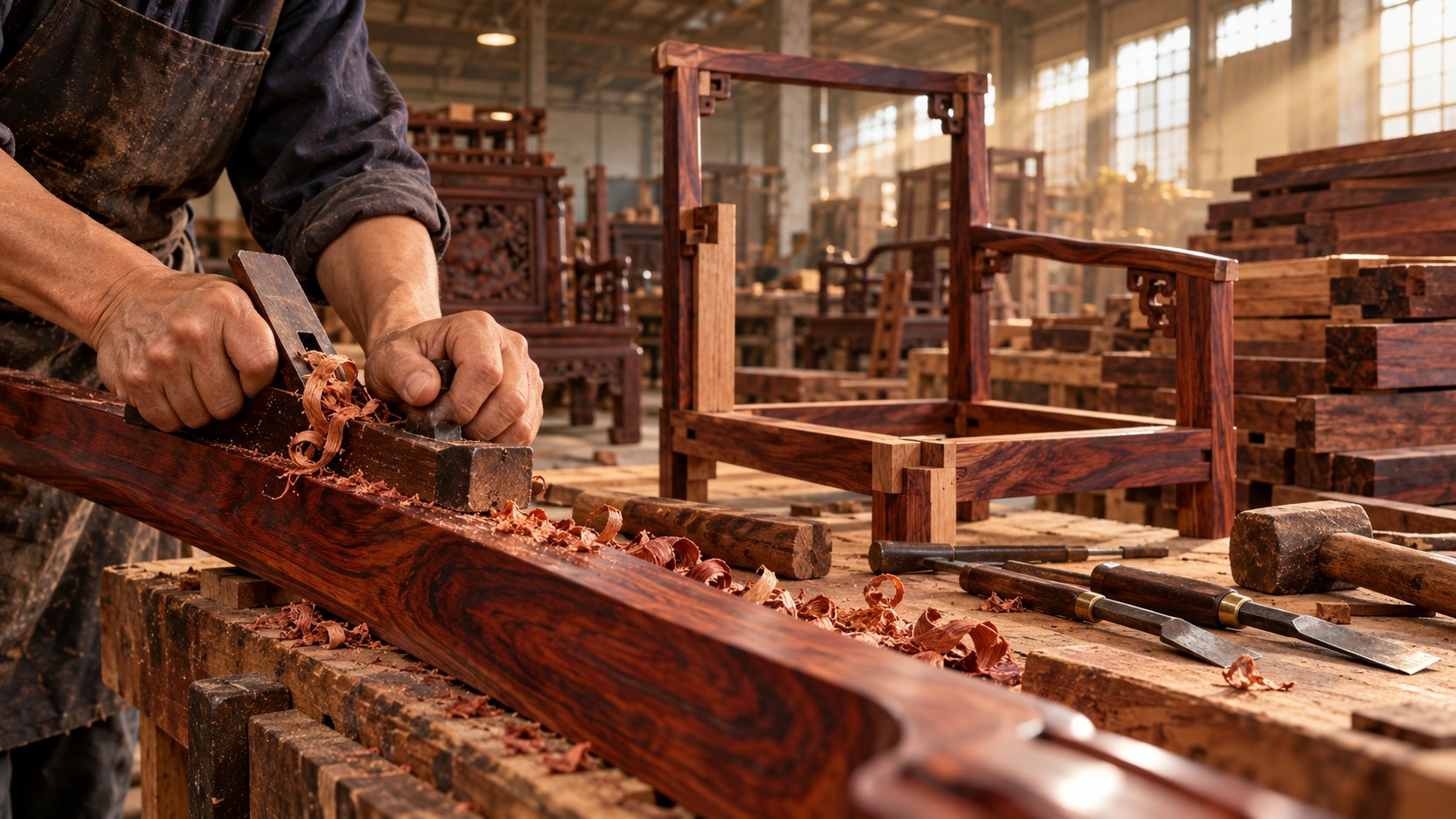
A practical verification guide for B2B buyers: seven checkable signals — business license scope, live video factory walkthroughs, equipment and work-in-progress evidence, showroom and sample room access, export documentation, MOQ and quote consistency, and technical depth — that reveal whether a supplier is a genuine rosewood furniture manufacturer or a middleman, before any deposit is paid.
You have compared catalogs, shortlisted three suppliers, and received three quotations for what looks like the same carved rosewood sofa set. The prices differ by eighteen percent. At this point, the most important question is not which catalog is prettier. The question is: who will actually make your order? If the answer is a genuine rosewood furniture manufacturer, you can walk the production line, fix tolerances at the bench, and hold one company accountable from timber to container. If the answer is a trading company presenting itself as a factory, your money now passes through an extra layer whose margin, quality control and delivery schedule you cannot see.
Neither situation is automatically bad — some trading companies are honest and add real value in communication or consolidation. The problem is not knowing which one you are talking to. A buyer who mistakes a middleman for a rosewood furniture factory China buyers often recommend usually discovers it at the worst possible moment: when a carving detail is wrong, when a delay stretches from weeks into months, or when a warranty claim gets forwarded to a factory you have never contacted. This article is about preventing that discovery. It does not repeat the step-by-step audit checklist we covered in How Do You Audit a Rosewood Furniture Factory Before Your First Container Order?, and it is not a factory tour walkthrough like Can You Visit a Rosewood Furniture Factory Before Ordering?. Instead, it lists the concrete, checkable signals that tell you whether the company on the other side of the chat window is a manufacturer at all — and how to read them before you wire a deposit.
Why Manufacturer Identity Shapes Every Term of Your Order
B2B furniture manufacturer verification matters because the identity of your counterparty silently rewrites every commercial term you negotiate. Consider what changes when an intermediary sits between you and the production floor.
- Price structure. A factory quotes based on timber cost, carving hours, finishing coats and workshop capacity. An intermediary quotes based on a factory price plus a margin. You can still get a fair deal through an intermediary, but you cannot verify the margin, and when raw timber prices move, the two quotations move differently.
- Quality control access. A manufacturer can show you work-in-progress on demand: the joinery of your bed frame being dry-fitted, the third coat of lacquer curing, the container being loaded. An intermediary can only forward photos, and you cannot tell whether the photos were taken in the workshop that is actually making your order.
- Technical problem-solving. When a solid wood panel cracks during kiln drying or a carved apron has a grain tear, a factory fixes the process at the bench the same week. An intermediary relays messages, and every relay loses technical precision.
- Accountability. If the shipment arrives damaged, a manufacturer repairs or remakes under one contract. A middleman may blame the factory, and the factory — which has no contract with you — has no obligation to you at all.
- Customization depth. OEM and ODM changes — resizing a dining table from eight seats to twelve, changing a carved motif, matching a specific wood tone — require drawing changes at the workshop. If the person you negotiate with cannot open the CAD file, your customization request is traveling through a chain of hope.
None of this means intermediaries should be banned from your sourcing. It means the decision to work with one should be a decision. B2B furniture manufacturer verification is the set of checks that turns an unknown counterparty into a known one — before the deposit, not after the complaint.
What Is Furniture Manufacturing — and Why It Is More Than Assembly
A useful starting point, especially for first-time importers, is to be precise about what is furniture manufacturing and what it is not. The term covers the full conversion of raw timber into finished, export-ready furniture: species selection and timber grading, sawing and milling, kiln drying to a target moisture content, dimensioning, joinery, carving, sanding, finishing, hardware fitting, assembly, inspection, and export packing. A furniture factory is a company that controls a meaningful share of this chain inside its own workshops, under its own management, with its own workers.
For classical rosewood furniture specifically, the chain has stages that a pure trading operation cannot replicate in a rented office:
- Timber control. Solid rosewood furniture depends on selecting boards with compatible grain and color before they are cut. A factory keeps timber stock and grades it; the decision is made by people who will be accountable for the finished grain matching.
- Drying. Dense tropical hardwoods must be dried slowly and evenly — at our facility, every component goes through 36 days of constant-humidity drying before joining — or the furniture will crack and deform in the dry winters of North America or Europe. Drying capacity is physical infrastructure: kilns, humidity control, floor space. It cannot be subcontracted away with an email.
- Joinery. Classical Chinese furniture is assembled with mortise-and-tenon joinery and wooden dowels rather than metal fasteners, because metal and wood expand at different rates and a nailed frame works loose in overseas climates. Cutting accurate mortises at scale requires skilled joiners and dedicated bench capacity.
- Carving. Hand carving — dragon, cloud, lattice and ruyi motifs cut in relief — is measured in hours per component, not minutes. A factory that genuinely carves has carvers on staff you can meet on a video call, with work in progress on their benches.
- Finishing. Multi-coat raw lacquer and beeswax finishing, each coat cured and hand-rubbed, is a process with curing schedules. Meeting EU REACH and US CARB expectations for the coatings used is a purchasing and QC discipline managed inside the factory.
When you understand this chain, identifying a manufacturer becomes mechanical rather than intuitive: you are looking for evidence that the company performs these stages itself. A company that performs none of them can still sell you furniture. But it is not a rosewood furniture manufacturer, and your verification should label it accordingly.
Factory vs Trading Company: Who Actually Answers for Your Container
The distinction is not about paperwork alone — it is about who stands next to your order physically. Use this comparison to decide which counterparty profile you are actually dealing with:
| Dimension | Manufacturer (factory) | Trading company / middleman |
|---|---|---|
| Production evidence | Can show live video of your order in progress, on request, with workshop context | Provides stock photos or forwarded clips of unknown workshops |
| Technical answers | Specifies timber species, joinery method, drying schedule, finishing coats | Answers with adjectives; forwards technical questions and waits |
| Customization | Discusses drawings, tolerances and prototype directly with engineering staff | Relays requests; customization speed depends on another company's queue |
| Factory visit | Invites you to its own address; signage, sample room and workshops match | Schedules visits at a "cooperating factory"; may avoid hosting at its registered office |
| Price movement | Explains quotes from timber, labor and finishing inputs | Explains quotes from "market conditions" |
| After-sales | Handles claims under one contract, with parts and carvers in-house | Forwards claims; response time is the sum of two companies' delays |
A more complete treatment of this distinction — including when a trade company is the right choice — appears in Where to Buy Solid Wood Furniture from China: A B2B Buyer's Guide to Factories, Trade Companies and Verified Sourcing. The rest of this article assumes you want to identify the manufacturer directly, and focuses on the signals that make that identification possible from your desk.
Seven Verifiable Signals of a Genuine Rosewood Furniture Manufacturer
How to identify a furniture manufacturer is not a matter of intuition or of trusting a website banner that says "Factory Direct." It is a matter of requesting evidence that only a factory can produce quickly, consistently and without embarrassment. The seven signals below are ordered roughly by how early you can check them in a conversation.
Signal 1: Business License Scope and Registered Address
Chinese companies hold a business license whose scope of operations and registered address are public records. Ask the supplier for the company's registered full name exactly as it appears on the license, and take three steps:
- Read the business scope. A manufacturer's scope typically includes manufacturing (production) activities for furniture, alongside sales and import-export rights. A pure trade intermediary's scope lists wholesale and trading but no manufacturing category. Scope wording alone does not prove production — some licensed factories outsource — but scope without any manufacturing category is a strong negative signal for a company claiming to run its own workshops.
- Match the registered name to the quotation and bank account. The company name on the proforma invoice, the beneficiary name on the bank account, and the name on the license should match. When you are asked to pay "a related trading company" while the factory name sits on the catalog, you are being introduced to the middleman layer whether or not it was disclosed.
- Check the registered address against the claimed factory location. If the registered address is an office suite in a metropolitan CBD and the claimed factory is an industrial park in a furniture-making county, ask directly which entity owns the production facility and how the two are related. In Fujian's hardwood craft belt — Xianyou County in Putian, where our 12,000㎡ facility has operated since 2008 — the cluster of genuine factories is dense enough that an office-only registration in a distant province is worth questioning.
None of these checks requires a site visit. All of them take less than an hour. Together they eliminate the most common disguise: a trading company borrowing the credibility of the word "factory."
Signal 2: Factory Address, Production Videos and Live Video Walkthroughs
The single most efficient verification tool available to an overseas buyer is the live video factory walkthrough. A genuine rosewood furniture factory in China has nothing to hide from it; an intermediary must prepare for it.
The difference shows in how each responds to the request. A manufacturer will typically say yes immediately and propose a time during working hours, because the workshops are running whether or not you call. An intermediary will propose delays, suggest a "recorded video instead," or arrange a call with a cooperative factory — sometimes without saying so. Recorded video is still useful evidence if it is specific: ask for an unedited clip that shows the exterior of the building, the signboard with the company name, and a continuous walk through at least two production stages on the same day. Generic stock footage of "a furniture factory" proves nothing; the value is in the continuity between the signboard, the building and the process.
During a live call, ask the host to perform small, unrehearsed actions: point the camera at a label or work order on a bench, walk from one stage to the next without a cut, introduce a carver and ask what motif they are cutting. These actions are trivial for people who work in the building daily and disproportionately hard to fake. Our own article on conducting a virtual factory audit covers the audit framework in detail; the identity-verification version of the same call is simpler — you are only confirming that the company showing you the workshops is the company that will invoice you.
Signal 3: Equipment, Workshops and Work-in-Progress Evidence
A solid wood furniture factory at production scale has physical signatures that are expensive and slow to fake. On your video call or visit, look for the specific infrastructure of classical rosewood manufacturing rather than generic workshop imagery:
- Drying kilns and timber storage. Stacks of thick hardwood planks, stickered for airflow, and kiln chambers are the least failable evidence of real production. No timber stock means no control over the input of your furniture.
- Joinery and carving benches in use. Look for partially assembled mortise-and-tenon frames with exposed joints, and carvers' benches with gouges, mallets and works in relief. A showroom is display; benches with work in progress are production.
- Finishing area. Separate finishing rooms with curing racks, and components at different coat stages, indicate the multi-coat lacquer schedule a factory actually runs.
- Export packing zone. Crates, ISPM 15 heat-treated stamping on packing timber, moisture barriers and bracing materials confirm the last stage of an export-oriented operation.
Work-in-progress evidence tied to your order is stronger still. Once your project is past sampling, a manufacturer can show your components — the specific bed posts, the specific dining top — mid-process. Ask for this at defined milestones. A supplier who can never show your own order in progress, only "similar orders," has not earned the benefit of the doubt.
Signal 4: Showroom and Sample Room Access
A manufacturer's showroom is attached to its production site, because the showroom exists to let buyers touch the output of the workshops next door. When you evaluate a supplier's showroom claim, check the geography: is the showroom at the same address as the factory, or across the city? During a visit or a live video tour, the connection between showroom and workshop should be observable — the same compound, the same staff, the same building continuity.
The sample room answers a different question: not "can they make one beautiful piece" but "can they make a consistent catalog." A working B2B sample room holds dozens of sets spanning sofa, dining and bedroom categories, in the factory's own finishes, with tags or labels tying pieces to real product codes. From a sample room you can check cross-set consistency of color and grain selection — the discipline described in our article on keeping wood color and grain consistent across a full container order. An intermediary can rent a showroom and stock it with borrowed pieces; what it cannot produce is a coherent, self-made catalog with controlled finishes across every category. For buyers who cannot travel, the practical alternative is the trial order and refundable sample approach described in How Can First-Time Buyers Test a Rosewood Furniture Supplier Before a Full Container Order?
Signal 5: Export Records and Documentation Capability
Furniture direct from manufacturer to importer crosses customs, and the paperwork trail is evidence of who actually ships. Ask a candidate supplier which documents they prepare in-house for a typical order:
- Commercial invoice, packing list and bill of lading — issued in whose name?
- For rosewood species covered by CITES, the export permit issued by the Chinese CITES management authority — a real, named document that a factory shipping genuinely protected species must obtain for each shipment.
- FSC chain-of-custody documentation where the buyer's market or project requires certified timber.
- ISPM 15 heat-treatment marking on export crates.
A manufacturer that exports regularly produces these documents as routine and can tell you which authority issues each one, what the lead time for a CITES permit adds to the schedule, and which documents carry which company name. An intermediary often does not know the answers without asking someone else — and the hesitation itself is data. Documentation capability is also the honest boundary of this signal: some factories export through an affiliated export agent, which is common practice. The check is not "no agent ever" but "the company can explain its own export arrangement precisely." Vagueness about how goods leave the country is the red flag, not the existence of an arrangement.
Signal 6: MOQ Structure and Quote Consistency
The way a supplier quotes minimum order quantities and prices reveals the shape of the business behind the spreadsheet. Manufacturers and intermediaries quote differently, and the differences are detectable:
- MOQ logic. A factory's MOQ follows its production economics — how many sets fill a drying cycle, a finishing batch, a container. Our own MOQ structure, discussed in What Is the Minimum Order Quantity for Rosewood Furniture and Can You Mix a Container?, allows mixed-container loading precisely because a factory controls scheduling and can plan mixed production. An intermediary's MOQ often just mirrors whatever the underlying factory requires, plus padding — and the padding is invisible to you.
- Quote decomposition. Ask two suppliers the same question: what drives the difference between your 6-seat and your 12-seat dining set quotation? A manufacturer answers in inputs: more timber volume, more carving hours, additional chairs, crate size. An intermediary answers in discounts and quantities. Inputs can be reasoned with; margins can only be bargained with.
- Consistency over time. Re-request a quotation after two weeks of conversation. A factory's number moves only when an input moves — timber, freight, exchange rate. A middleman's number moves with negotiation pressure, because there is no costed bill of materials underneath it.
- Uniform SKU handling. Genuine manufacturers hold stable specifications for their catalog items — the same carved cloud apron tea table is quoted with the same dimensions and finishing schedule every time. If the "same" product's specifications change between quotations, the seller is re-sourcing each time rather than producing to a fixed standard.
Signal 7: Technical Depth of the Answers You Receive
The fastest identity test costs nothing: ask technical questions and grade the answers on specificity. You do not need to be a wood scientist; you only need to notice whether answers contain verifiable specifics or adjectives.
- Ask what species the quoted sofa set uses. A factory answers with the botanical trade name — for example, Siamese rosewood (Dalbergia cochinchinensis) — and can state what part uses solid material and how panels are constructed to handle seasonal movement. An intermediary answers "high-quality rosewood."
- Ask how the furniture is joined. A factory describes mortise-and-tenon construction, where dowels are used, and why the frame avoids metal fasteners for overseas climates. An intermediary says "strong joints."
- Ask about drying and finishing. A factory states a drying schedule — ours is 36 days of constant-humidity drying per batch — and the finishing system, coat count and compliance targets such as EU REACH and US CARB for coatings. An intermediary promises "well-dried, eco-friendly."
- Ask for one customization example with constraints. A factory recalls a real project: what changed, what it cost in time, what the limits were. An intermediary recalls nothing specific.
Grade all four answers together. One vague answer may be a language gap — cross-border trade involves many non-native communicators, and a competent engineer may answer awkwardly in English. Four consistently vague answers from a sales team that is fluent about prices and delivery dates are a pattern: fluent where it costs nothing, vague where it requires the factory floor.
How to Buy Furniture Direct from a Manufacturer: A Practical Verification Sequence
Buyers searching how to buy furniture direct from manufacturer or where to buy furniture directly from the manufacturer usually want a sequence, not a philosophy. Here is the order we recommend, designed so that each step can eliminate a supplier cheaply before the next, more expensive step begins:
- Screen the license. Request the registered company name, business scope and address. Eliminate suppliers whose scope has no manufacturing category and who cannot explain their production arrangement. (Signal 1)
- Run the identity video call. Twenty minutes during working hours: signboard, two production stages in one continuous walk, one unrehearsed question to a workshop worker. Eliminate suppliers who dodge, delay beyond a reasonable week, or stage a borrowed facility without disclosure. (Signal 2)
- Probe technical depth. Send the four questions from Signal 7 in writing. Grade for specificity. Keep the specific ones. (Signals 3, 7)
- Test the quotation logic. Request a decomposition of one quote and a re-quote two weeks later. Compare MOQ explanations. (Signal 6)
- Check export documentation. Ask which documents the supplier issues and in whose name, including CITES and FSC where applicable. (Signal 5)
- Sample before scaling. Order a single trial set or refundable sample. Evaluate timber, joinery, finish and packing with your own hands. (Signals 3, 4)
- Then commit container volume — ideally after the fuller audit framework in our first-container audit guide, which covers QC stages, inspection points and claim terms in depth.
The sequence is deliberately front-loaded. The first two steps cost hours and eliminate most misrepresentation; the later steps cost money and should only be spent on suppliers who survived the earlier ones. Buyers sometimes invert this — order samples from five suppliers first — and end up paying for five freight shipments to learn what two video calls would have revealed.
Red Flags That Suggest a Middleman Rather Than a Solid Wood Furniture Factory
Verification is easier in the negative direction. These behaviors, observed individually, warrant questions; observed together, they should end the conversation:
- The bank account never matches the catalog brand. The website shows "XX Furniture Factory"; the invoice comes from a trading company you have never heard of; the explanation changes between email threads.
- Video calls are always "next week," never during working hours. Or the call always takes place from a showroom or office, never from the workshops, "because of dust/noise/signal."
- Photos are beautiful but anonymous. Every production image could be from any factory; none carries the company's own signage, own work orders or own people.
- Technical questions return as new questions. You ask about drying; the reply asks you what drying standard you require. The relay pattern — your question forwarded, someone else's answer paraphrased — becomes visible in reply latency and in answers that never commit to a number.
- Customization is always "no problem." No drawing discussion, no tolerance conversation, no prototype timeline. Real customization has limits, and a factory can state them from experience.
- Prices undercut every factory quotation by a wide margin. A price below the plausible input cost of solid rosewood — timber alone, before carving hours and finishing — means either misrepresentation of material or a sale that will be renegotiated after the deposit. Either way, the negotiation you thought you finished has not started.
- The sample is superb; the contract entity is different. Samples are easy to source from anywhere. The binding question remains who signs the contract and receives the deposit.
One caveat keeps this list honest: these flags indicate misrepresentation, not the mere existence of an intermediary. A trading company that says plainly "we do not manufacture; we work with three factories, here is how QC works" is behaving transparently, and transparent intermediaries are a legitimate sourcing channel. The verification exercise exists to find the truth, and the truth can be either answer — what it cannot be is a costume.
What Is the Best Furniture Manufacturer for a Long-Term B2B Partnership?
Verification tells you that a company is a factory. It does not yet tell you that it is the right factory. When buyers ask what is the best furniture manufacturer for repeat container programs, the honest answer is that "best" is a fit question, and fit has checkable components:
- Category depth over category breadth. A factory that has made classical rosewood sets for years — sofa sets with tea tables, 6–12 seat dining sets, complete bedroom suites — will have solved the recurring problems of the category: grain matching across a set, panel movement, carving consistency. Depth shows in the sample room and in how naturally technical questions get answers.
- Compliance infrastructure. If your market is the EU or North America, coatings compliance (REACH, CARB), timber legality documentation (FSC chain of custody, CITES permits for controlled species) and ISPM 15 packing are not optional extras; they are infrastructure the factory either has or lacks. Ask which compliance items the factory handles routinely.
- Export-facing service systems. Long-term partnerships are built on operational details: who prepares documents, how milestone photos are delivered, whether layout drawings are provided for project buyers, whether remote installation guidance is available when your local team unloads. These services are confirmable by asking to see an example — a redacted drawing, a document pack from a previous (anonymized) shipment.
- Production scheduling transparency. Ask how a repeat order is slotted: what happens between deposit and completion, and what the current realistic lead time is — for container orders of classical sets, 45–60 working days after deposit is a workable reference frame for this category, with partial shipments possible for long-term partners. A factory can explain its queue; an intermediary can only repeat a promise.
- Communication that survives problems. The best predictor of how a partnership handles a defect claim is how the pre-order conversation handles an inconvenient question. Ask one deliberately difficult question — "what happens if I find a crack on arrival?" — and weigh the specificity of the answer.
Notice that none of these components requires the factory to be large or to hold every certificate that exists. They require the factory to be legible: able to show and explain its own operation. Illegibility is expensive for buyers; legibility is the practical meaning of trustworthiness in cross-border sourcing.
How Quotes and Custom Furniture Costs Reveal Who You Are Talking To
Cost questions deserve their own caution. Buyers frequently ask how much does custom furniture cost, and the honest answer for classical rosewood is: it depends on timber volume, carving hours, finishing system and packing — which is precisely why quotation behavior is such a strong identity signal. A manufacturer can walk you from inputs to price: how many cubic meters of timber a 12-seat banqueting set consumes, why a deeply carved apron adds bench hours, what the finishing schedule costs per piece, and how crate dimensions move freight. An intermediary can only walk you from price to discount. We keep the full pricing breakdown in How Much Does Solid Wood Furniture Cost? A B2B Buyer's Guide to Rosewood Furniture Pricing; for the purposes of verification, hold one rule: whoever can explain the cost drivers without hesitation is close to the production; whoever can only adjust the total is not. The same rule applies to payment-term discussions, which we treat separately in What Payment Terms Should You Negotiate When Ordering Rosewood Furniture from China? — a factory that controls production can offer staged terms tied to production milestones, because it knows when each stage actually finishes.
How Yunxiao Rosewood Furniture Verifies Itself to B2B Buyers
We invite the same verification we recommend. As a working reference point for what a manufacturer's answers should look like, here is our own file, drawn from our company profile and export practice:
- Who we are. Yunxiao Rosewood Furniture Co., Ltd was founded in 2008. Our 12,000㎡ factory is in Xianyou County, Putian City, Fujian — a county known nationally for traditional hardwood craftsmanship. We manufacture and export full sets of classical solid redwood furniture — carved sofa sets with tea tables, 6–12 seat dining sets and complete bedroom suites — to wholesalers, hotels and designers in Europe, North America, Australia and Southeast Asia.
- Materials. We work in legally certified Machilus Nanmu, aged red wood and Grade-A tropical hardwood, including Siamese rosewood for our classical sets. Solid material, floating-panel construction for seasonal movement, and grain selection for color consistency across sets are standard practice, not options.
- Process evidence. Every component is dried for 36 days under constant humidity before joining. Frames are assembled with mortise-and-tenon joinery and bamboo dowel pins — no metal fasteners in the primary structure — to keep furniture stable in overseas climates. Finishing uses eco-friendly beeswax and lacquer systems meeting EU REACH and US CARB standards, applied in multiple cured coats and hand-rubbed. Our workshop walkthrough article documents the production sequence from timber to finished piece.
- Documentation. Our internal team prepares full export documents, FSC certificates and ISPM 15 heat-treated packaging; shipments of controlled rosewood species carry CITES export permits issued by the Chinese CITES management authority.
- Commercial terms. Container orders take 45–60 working days after deposit, with partial shipments available for long-term partners. We support trial single sets and refundable samples, provide free layout drawings for villa and resort projects, offer remote installation guidance after delivery, and handle OEM & ODM custom sizes and patterns directly with our own workshop and design staff.
Run any of the seven signals against this file: the business scope, the live video walkthrough of the workshops in Xianyou, the sample room at the factory address, the document names, the MOQ logic and the cost decomposition of any quotation — all of it is checkable, and checking it is welcome. A manufacturer that has operated since 2008 does not need buyers to take its word for anything.
Frequently Asked Questions
How can I verify a rosewood furniture manufacturer without visiting China?
Combine the remote checks: business license scope and address, a live video walkthrough during working hours with unrehearsed actions, written technical questions graded for specificity, a quote decomposition test, and a document checklist (CITES, FSC, ISPM 15 as applicable). A refundable sample or trial single set completes the file. None of these requires travel, and together they are stronger evidence than a rushed one-hour factory visit.
Is buying through a trading company always a mistake?
No. It is a mistake only when the relationship is misrepresented. A transparent intermediary who discloses the role, explains the QC arrangement and shares the margin structure can be a reasonable channel — particularly for buyers consolidating mixed products. The verification exercise exists so that you choose the channel knowingly, not so that you banish one of them.
What is the single strongest identity signal?
The live, unrehearsed video walkthrough during production hours, requested on short notice. It is cheap to grant for a real factory and expensive to fake, because it demands the building, the people, the equipment and the work in progress simultaneously, with continuity between them.
Do genuine manufacturers ever refuse a factory visit?
Rarely, and when they do, the reason is usually practical — a specific production stage with confidentiality or safety constraints, or a season of peak capacity. The distinction to watch is refusal of everything: no visit, no live video, no alternative evidence. A factory has at least one channel it can open; a disguise has none.
How do MOQ and lead time signals work together?
They corroborate each other. A manufacturer's MOQ follows production economics, and its lead time follows the same economics: drying batches, carving capacity, finishing schedules. When MOQ is oddly low but lead time is suspiciously round, or when neither changes with the product mix, the numbers are probably borrowed from somewhere else.
What documents should a rosewood furniture exporter provide for a first order?
At minimum: commercial invoice, packing list, bill of lading, and ISPM 15-marked export packing. Where the species and destination require them: CITES export permits for controlled rosewood species and FSC chain-of-custody documents where certified timber is specified. A manufacturer can state which of these it issues itself and which an export agent issues — and that distinction should be disclosed before the deposit, not after.
The Bottom Line Before Your First Order
Verifying a genuine rosewood furniture manufacturer is not a matter of finding the most persuasive salesperson. It is a matter of requesting the specific evidence that only a factory can produce: a license scope with manufacturing in it, a video walkthrough that starts at the signboard, benches with your kind of work in progress, a sample room at the factory address, documents with real authority names, quotations that decompose into timber and hours, and technical answers that commit to numbers. Seven signals, most of them checkable within a week and all of them checkable before money moves.
The buyers who skip this step rarely lose money to fraud outright; more often they lose it slowly — to a margin they never saw, to a delay no one owned, to a customization that died in a relay chain. The buyers who run the verification gain something quieter and more valuable: a production floor they can talk to directly, and a counterparty whose answers stay consistent from the first quotation to the last container. That consistency is what a long-term sourcing relationship is made of.
If you are evaluating suppliers now, put our file to the test: request the live workshop video, ask the technical questions, decompose a quotation, and review the document list. Contact Yunxiao Rosewood Furniture through the inquiry form on this page or the contact page, and we will schedule your video walkthrough of the Xianyou factory — during working hours, with your questions welcome.