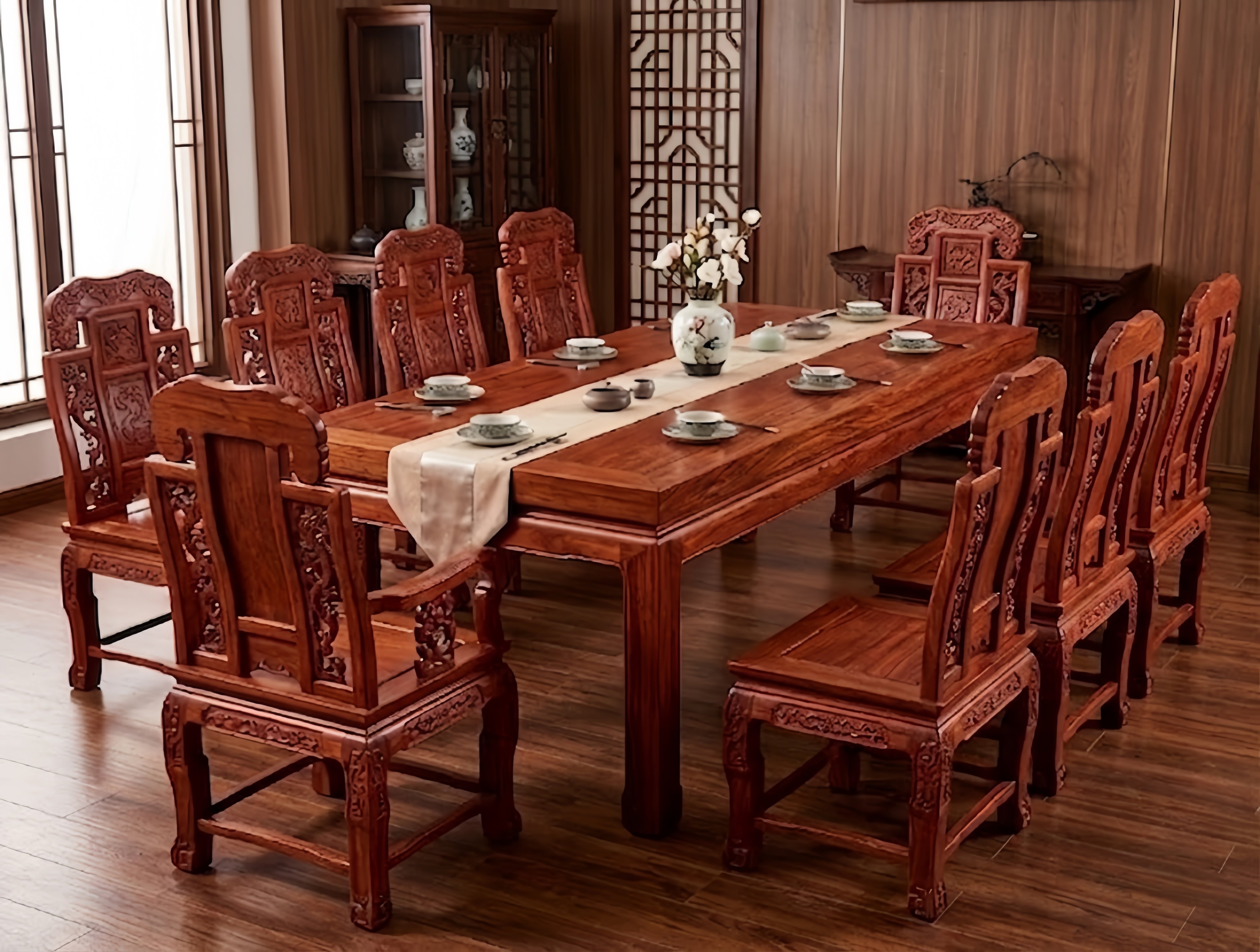
The Evolution of Classical Furniture Design: From Ming Dynasty to Modern Export
Classical furniture represents a convergence of material science, structural engineering, and cultural artistry that has endured for over six centuries. The classical Chinese furniture tradition, originating in the Ming dynasty (1368-1644), established design principles that remain relevant for today's B2B buyers sourcing furniture for North American, Australian, and Southeast Asian markets. Yunxiao Rosewood Furniture Co., Ltd, founded in 2008 in Xianyou County, Fujian Province, continues this tradition from a 12,000-square-meter factory producing 16 catalog products in solid Siamese rosewood.
For furniture wholesalers, interior designers, and hospitality procurement teams, understanding what distinguishes authentic classical furniture from imitations and mass-produced replicas is essential for making informed purchasing decisions. This guide examines the design evolution, structural markers, material characteristics, and procurement considerations that define classical rosewood furniture in the global B2B market.
Identifying Authentic Classical Carving Techniques
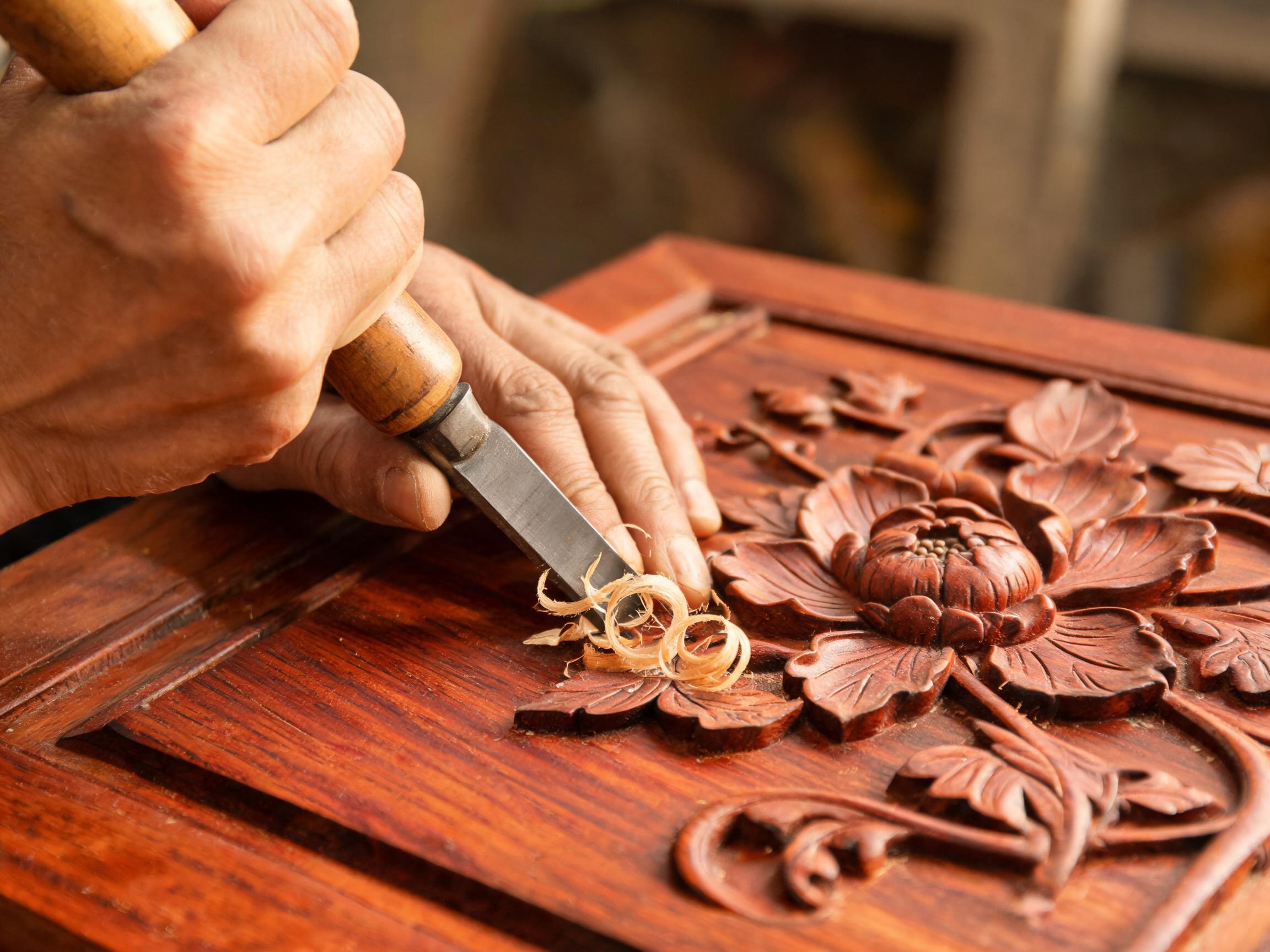
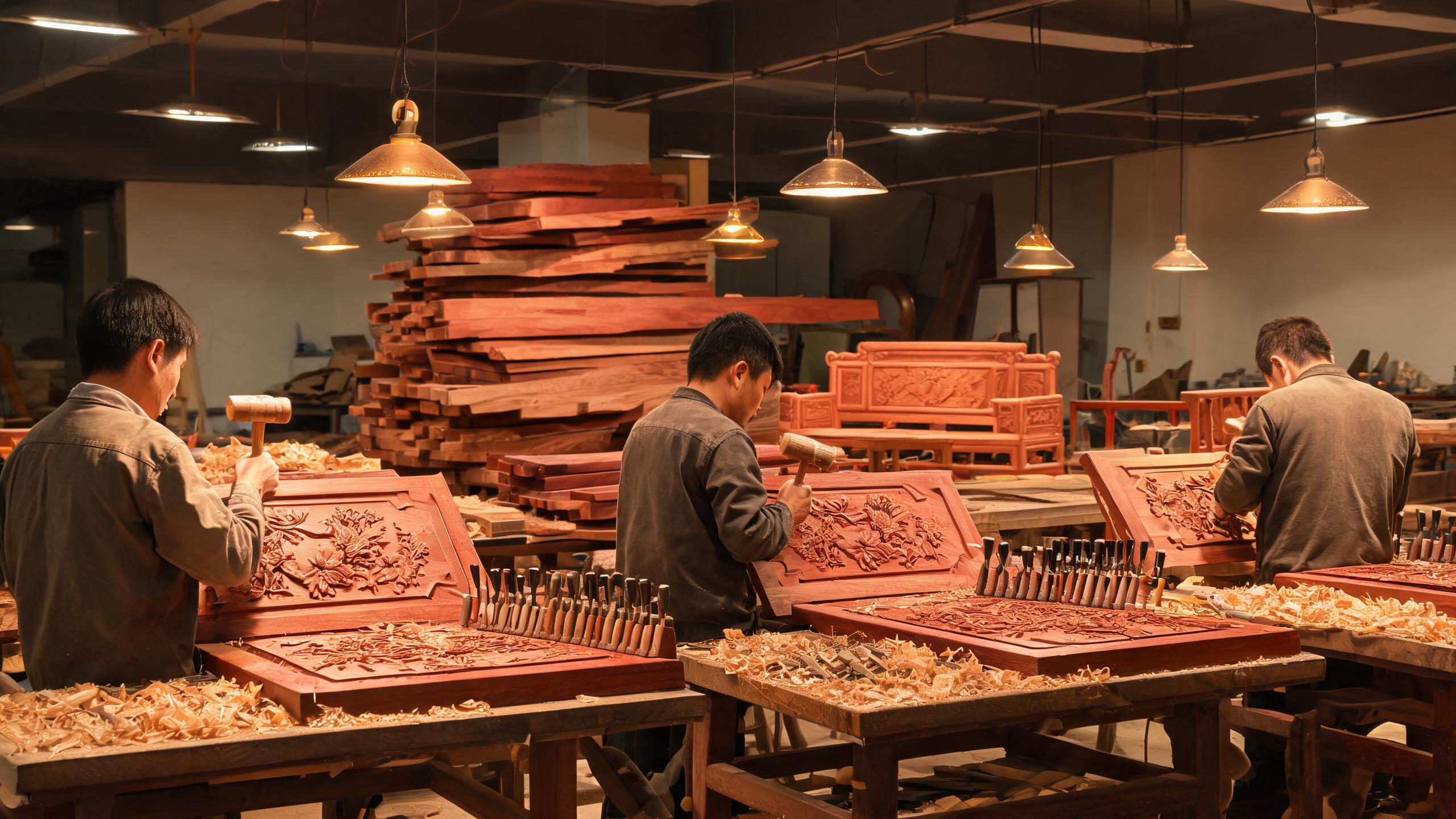
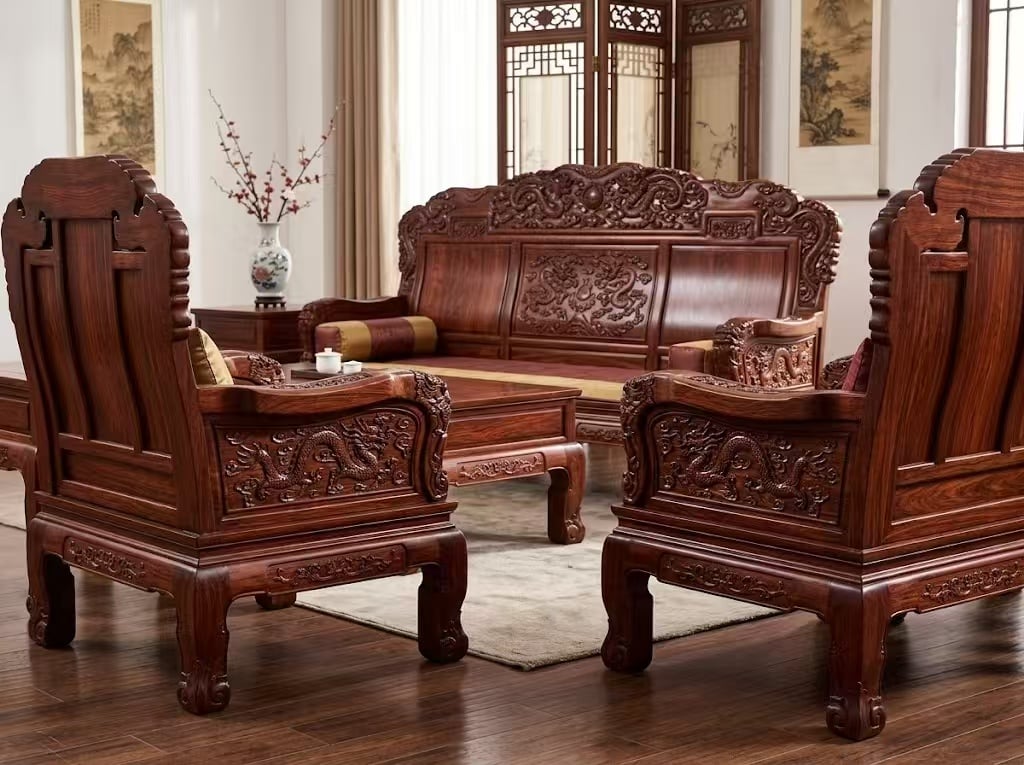
The carving on classical furniture is its most visible distinguishing feature. Authentic classical carving follows techniques developed in Xianyou, Fujian, a region with over 500 years of hardwood furniture craft tradition. Master artisans use traditional hand tools-chisels, gouges, and wooden mallets-to create three-step relief carving that machine carving cannot replicate.
Three-step relief carving involves three depth levels: low relief (background removal establishing motif silhouette), medium relief (secondary elements creating dimensional layering), and high relief (foreground elements carved to full three-dimensional depth). A single backrest panel with this technique requires 30 to 40 hours of hand work. Machine-carved imitations typically show uniform depth, mechanical tool marks, and lack the subtle variation that distinguishes hand work.
Buyers can verify authentic hand carving by examining:
- Tool marks: hand-carved surfaces show subtle irregularities from chisel strokes; machine carving produces uniform, repetitive patterns.
- Relief depth variation: authentic three-step relief has distinct depth transitions between background, midground, and foreground; machine carving tends toward flat or uniformly deep relief.
- Interior corner detail: hand chisels can reach into acute angles and undercuts that machine bits cannot access; these areas reveal whether carving was done by hand.
- Wood grain response: hand carvers adjust their technique to the grain direction of each piece, preventing tear-out; machine carving ignores grain direction, producing rough patches.
Yunxiao provides close-up carving photos during production and welcomes in-person inspection at the Xianyou facility. Carving samples on wood panels can be mailed for buyer approval before production begins.
Classical Furniture in Contemporary Hospitality and Residential Spaces
Classical rosewood furniture is no longer confined to traditional Chinese interiors. Contemporary designers and hospitality groups across North America, Australia, and Southeast Asia are integrating classical pieces into diverse interior styles, creating cultural focal points that differentiate their spaces from generic furnishings.
| Application | Recommended Style | Design Integration |
|---|---|---|
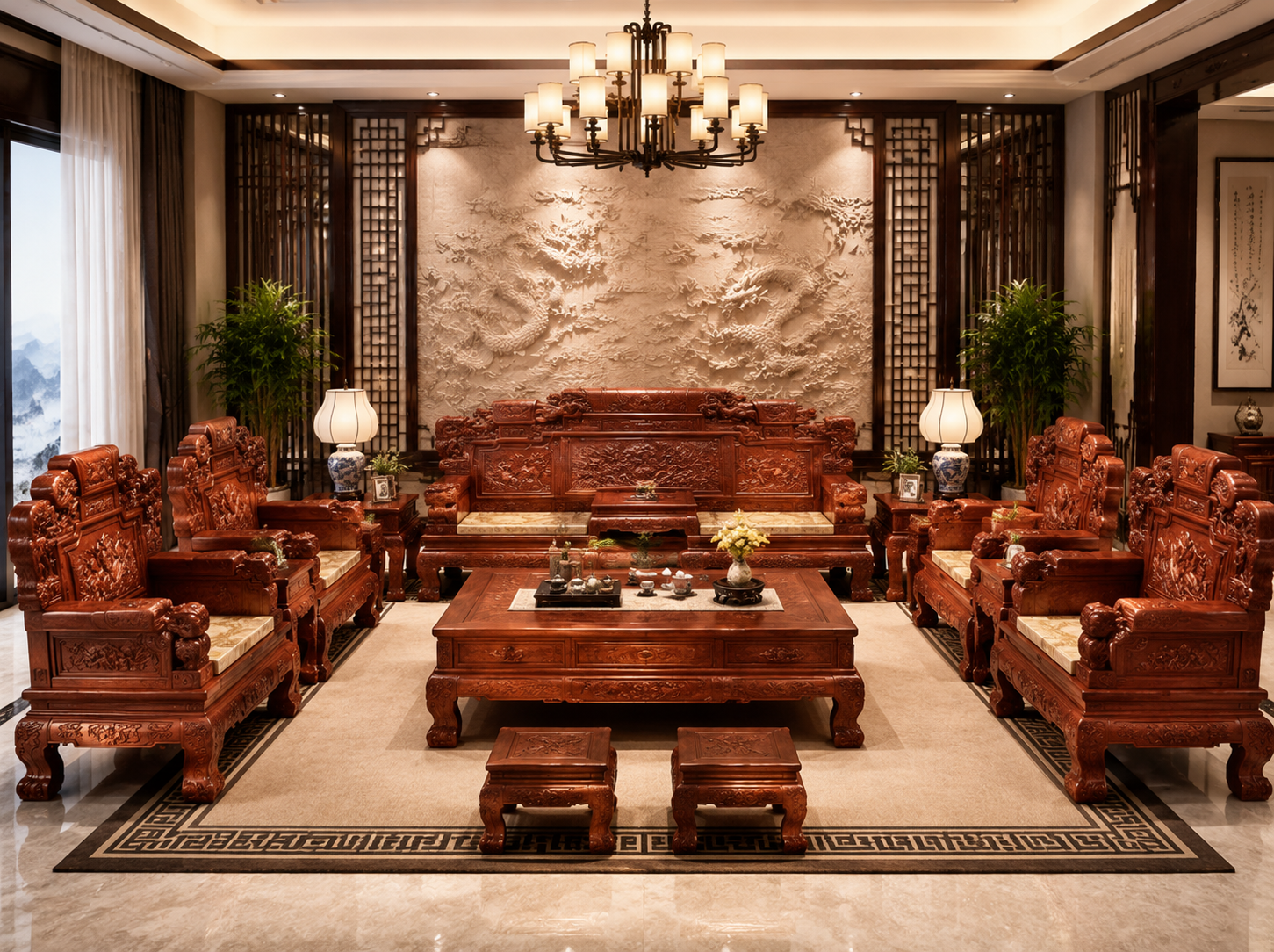
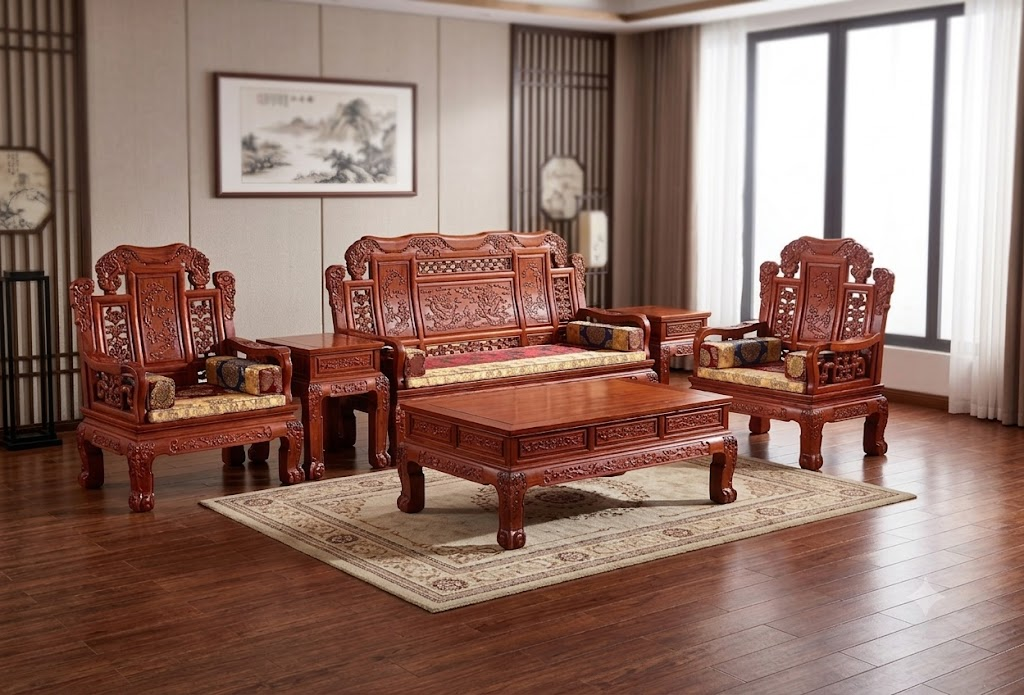
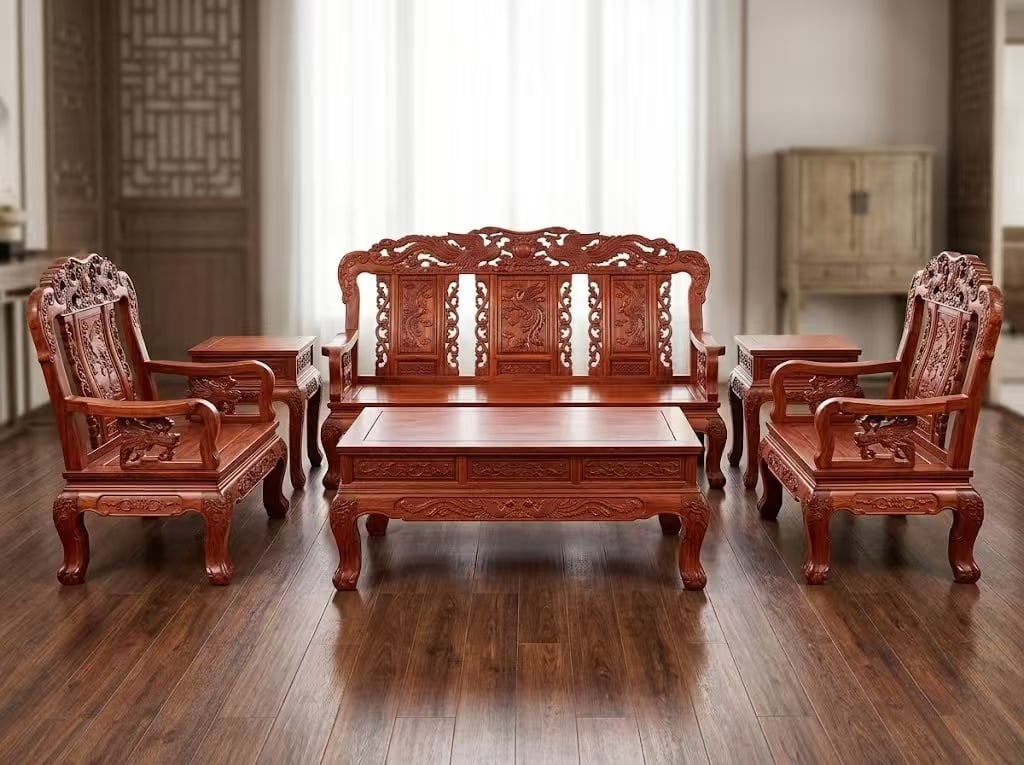
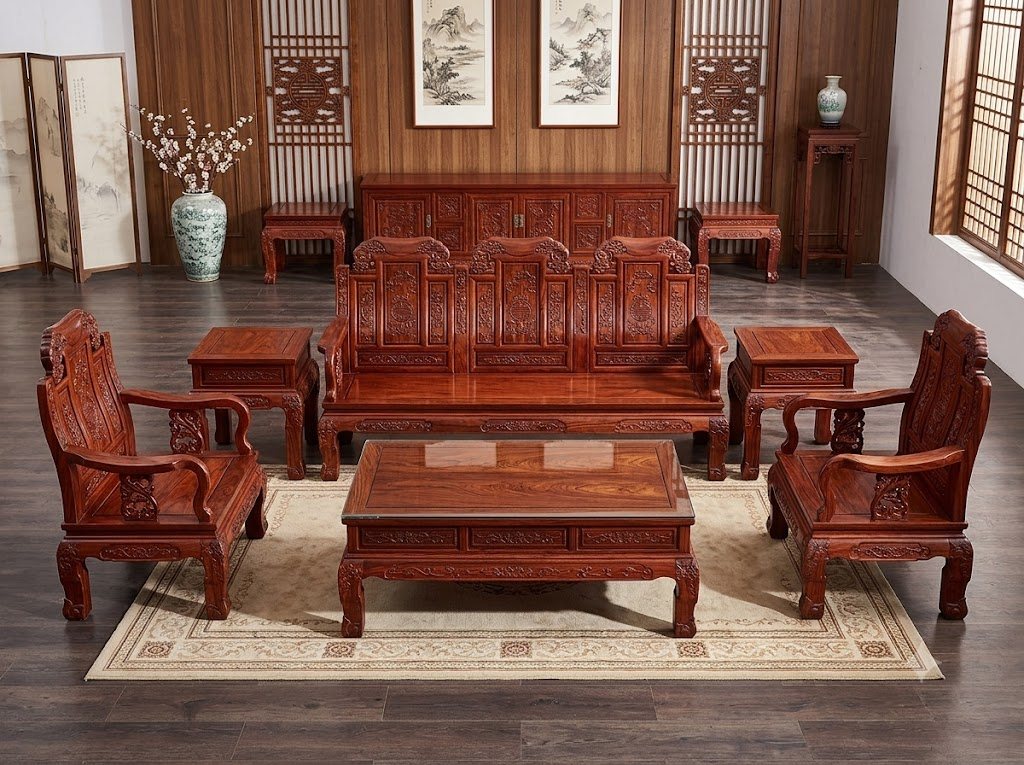
| Boutique hotel lobby | Qing-style carved sofa set (5-6 piece) | Statement piece against minimalist backdrop; carving as visual anchor |
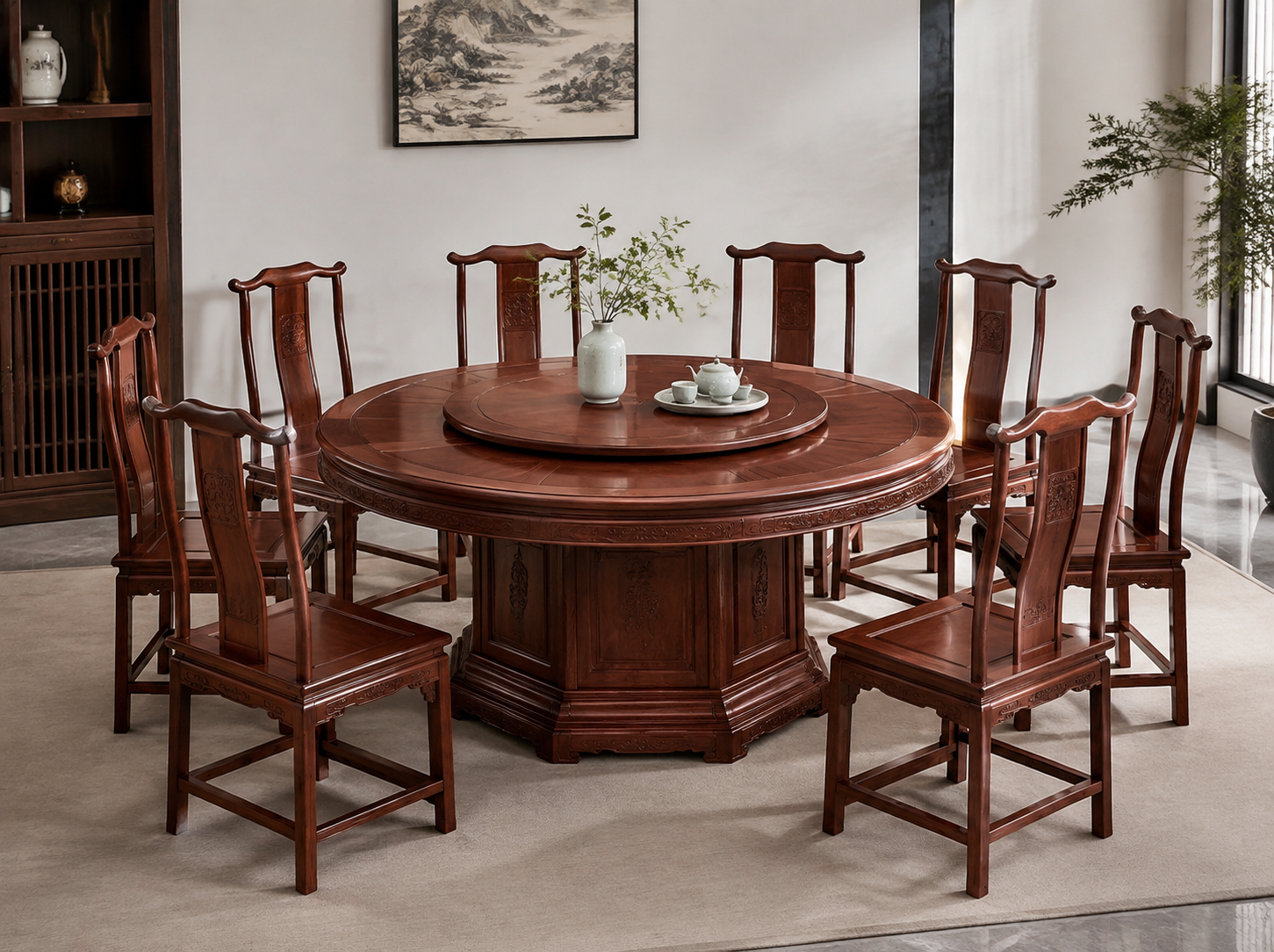
| Fine dining restaurant | Ming-style round dining set (8-seat) | Clean lines complement modern plating; FDA-compliant food surface |
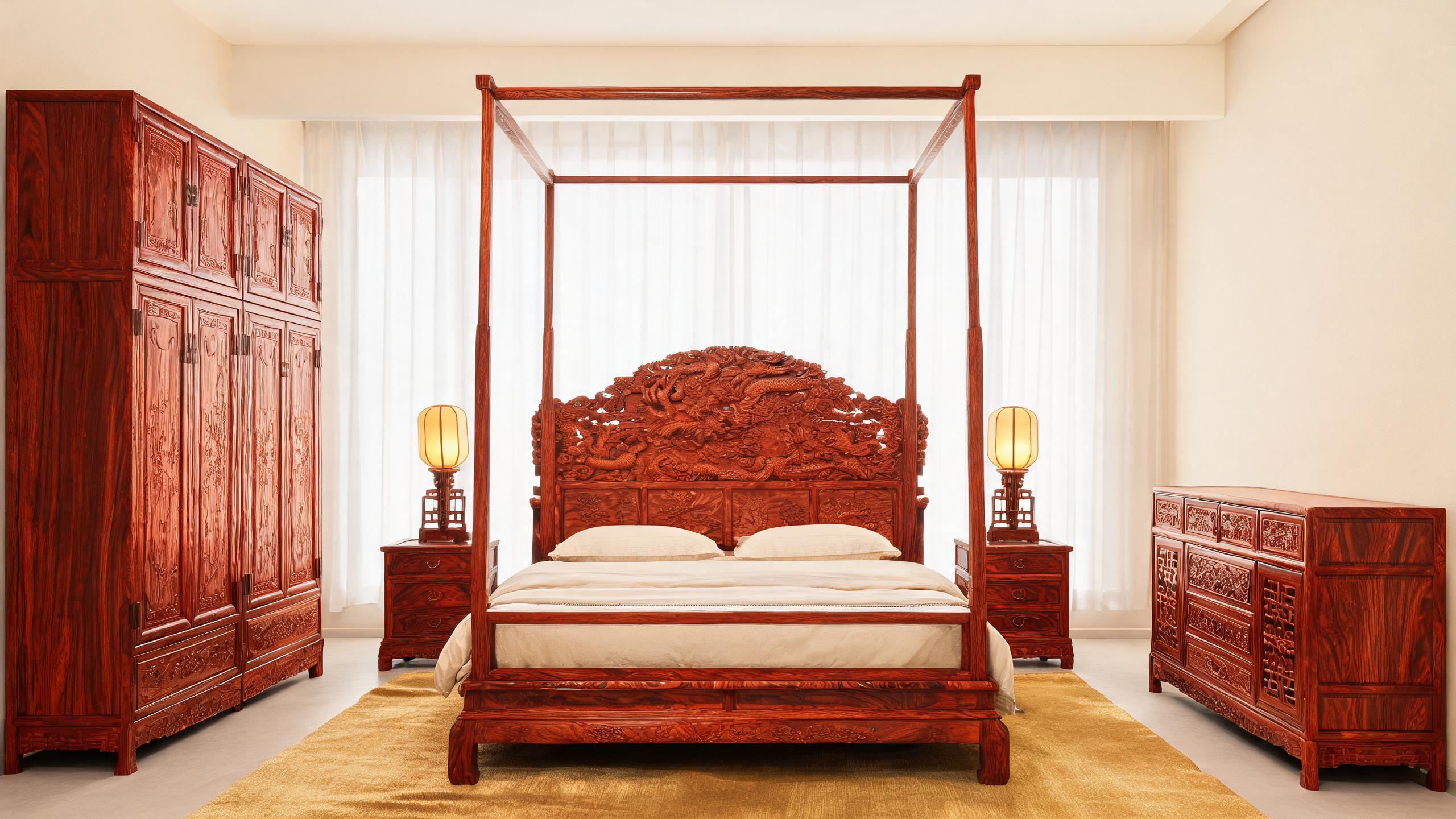
| Resort guest suite | Ming-style bedroom suite (3-5 piece) | Calming aesthetic; climate-stable construction for tropical AC |
| Cultural center | Imperial Dragon 10-seat sofa set | Full imperial scale; dragon motif as cultural narrative |
| Luxury residence | Four-poster bedroom suite 5-piece + reception sofa | Coordinated whole-house program; Ming and Qing mix |
Designers often combine Ming and Qing styles within the same project-Ming for spaces requiring calm and clarity (dining rooms, bedrooms), Qing for spaces demanding visual impact (lobbies, reception halls). The key to successful integration is allowing the furniture's carving and material quality to serve as the primary decorative element, with surrounding architecture and soft furnishings kept restrained.
Wood Grain, Color, and Aging in Classical Rosewood
One of the most distinctive characteristics of classical Siamese rosewood furniture is how its appearance evolves over time. Unlike synthetic finishes that remain static or degrade, raw lacquer-finished rosewood develops a deeper, richer patina as the wood ages and the lacquer oxidizes.
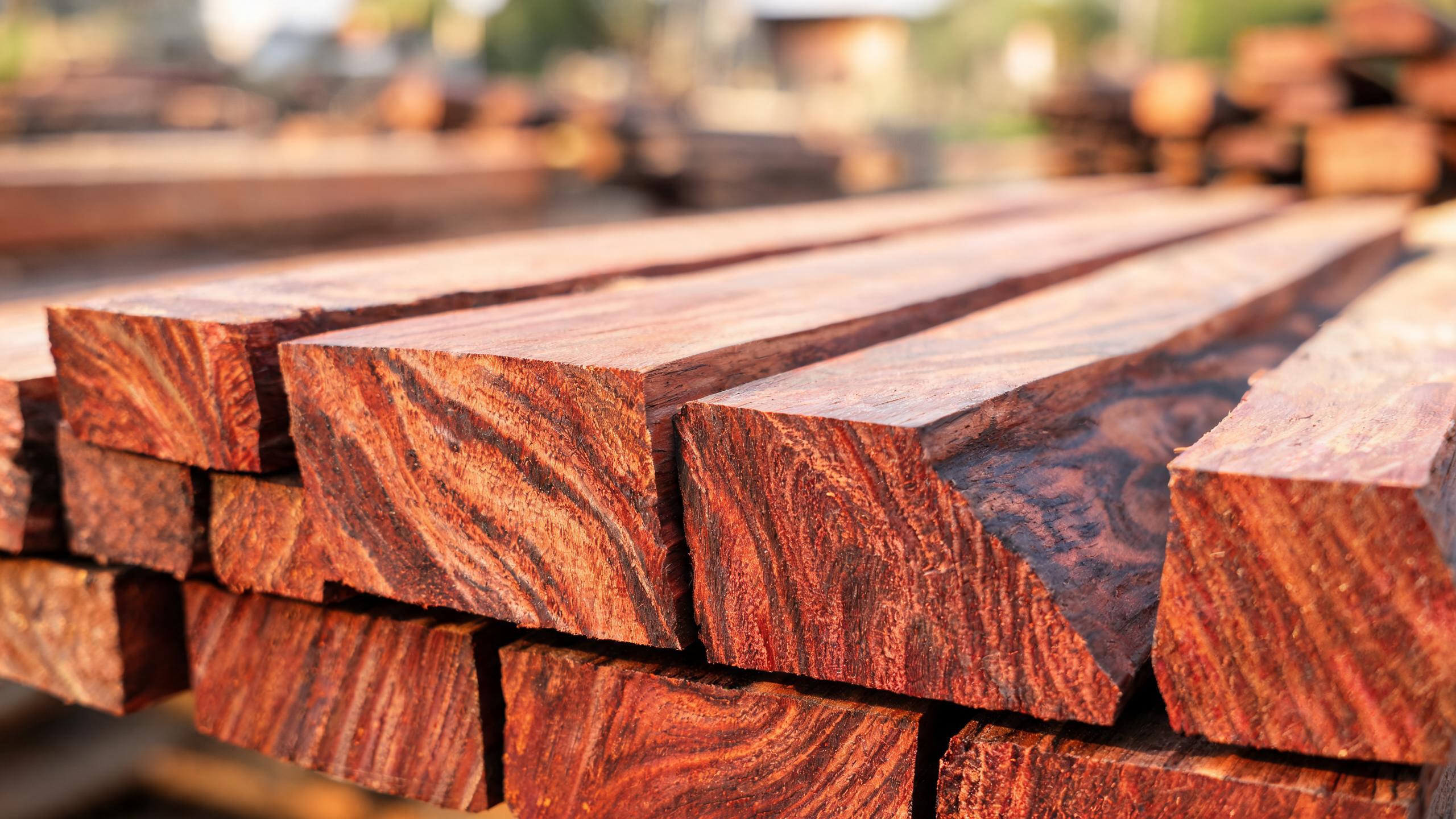
Freshly finished Siamese rosewood displays a deep reddish-brown heartwood color with interlocked, wavy grain patterns that create a chatoyant (light-shifting) surface. Over the first two to three years after delivery, the wood gradually darkens as the raw lacquer continues to polymerize and the wood's natural oils migrate toward the surface. This aging process is not a defect-it is the hallmark of authentic classical furniture that distinguishes it from pieces with synthetic finishes that look the same on day one and day one thousand.
Yunxiao selects heartwood with an 80 percent or higher heartwood ratio for carving clarity. Sapwood, which is pale yellow and lacks the density and color depth of heartwood, is excluded from visible surfaces. This selection standard ensures that every visible surface on the finished furniture will develop the rich patina that classical furniture buyers expect.
The 8 to 9 coat hand-rubbed raw lacquer finish contributes to this aging process. Unlike polyurethane or nitrocellulose finishes that create a plastic-like barrier, raw lacquer is breathable-it allows moisture vapor transmission while protecting the surface. This breathability means the wood continues to interact with its environment, deepening in color and developing character without the finish blistering or peeling.
Structural Markers of Authentic Classical Joinery
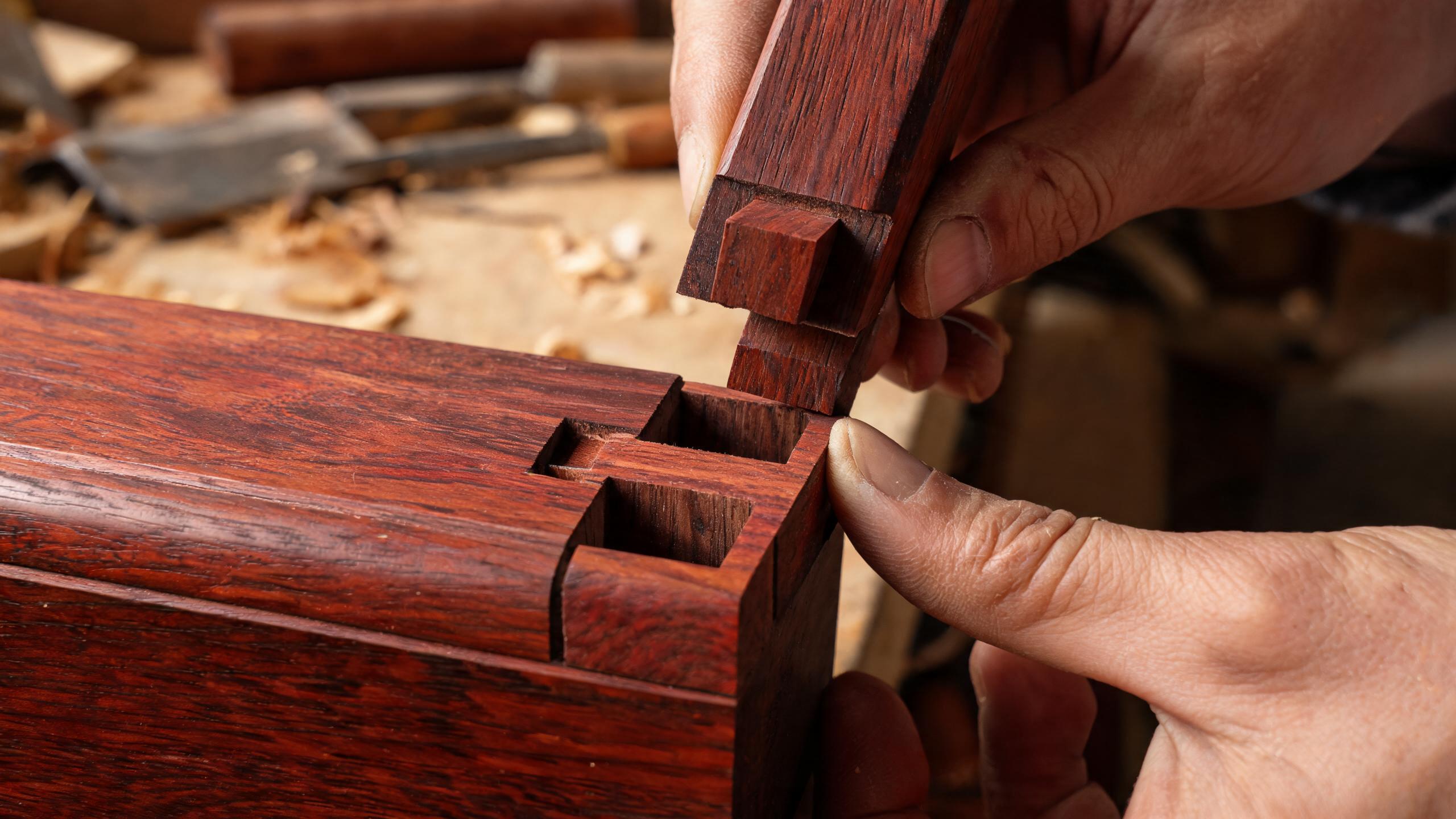
The joinery used in classical Chinese furniture is both a structural system and a design feature. In authentic classical furniture, joints are visible and celebrated, not hidden behind brackets or plugs. Buyers evaluating classical furniture should examine the following structural markers:
Through-tenon with wedge: the primary leg-to-apron joint. The tenon passes completely through the apron and is split at the tip; a bamboo wedge is driven into the split, expanding the tenon inside the mortise. This joint is visible from above as a thin line where the wedge meets the apron surface. It cannot pull apart under tension and actually tightens with load.
Floating-panel construction: visible on tabletops, wardrobe doors, and bed panels. The panel sits in a grooved frame, held by wooden buttons that allow lateral movement. A small gap between the panel edge and the groove wall is normal and intentional-it accommodates seasonal wood expansion. Buyers should be suspicious of panels that fit tightly with no gap, as this indicates the piece may crack when the wood expands.
Dovetail drawer joints: visible when drawers are pulled out. The trapezoidal dovetail shape resists pull-out forces and is a hallmark of quality drawer construction. Machine-cut dovetails show uniform spacing and angle; hand-cut dovetails have subtle variation that indicates craft work.
Bamboo dowel pins: used to secure mortise-and-tenon joints. Bamboo is chosen because it has similar moisture expansion characteristics to rosewood, preventing the differential movement that causes joint failure. Metal pins or screws in primary structural joints indicate non-traditional construction.
Caring for and Maintaining Classical Rosewood Furniture
Classical rosewood furniture is built to last generations, but proper care ensures it reaches its full lifespan. For B2B buyers supplying furniture to hotels, restaurants, or residential clients, providing maintenance guidance adds value and reduces after-sales issues.
Humidity management: Siamese rosewood performs best in environments with 40 to 70 percent relative humidity. In extremely dry climates (below 30 percent), use humidifiers to prevent excessive moisture loss. In extremely humid climates, air conditioning dehumidification is sufficient. The 36-day kiln drying and floating-panel construction accommodate normal humidity fluctuations, but extreme conditions require environmental management.
Lacquer maintenance: the raw lacquer finish requires no polishing or waxing for the first five years. After that, a light application of natural beeswax can be applied annually to nourish the surface. Avoid silicone-based polishes, which create a buildup that prevents the lacquer from breathing and can cause cloudiness.
Carving care: dust carved surfaces regularly with a soft brush. Avoid spraying cleaning agents directly onto carving, as liquid can accumulate in relief depressions and cause localized finish damage. For stubborn dust, use a slightly damp cloth followed by immediate drying.
Structural inspection: for commercial installations (hotels, restaurants), inspect joints annually. Mortise-and-tenon joints that are properly maintained will remain tight indefinitely. If a joint shows movement, it can be re-wedged by a qualified furniture repair technician.
Classical Furniture as Investment: Value Retention and Heirloom Quality
Unlike mass-produced furniture that depreciates from the moment of purchase, authentic classical rosewood furniture has inherent material value that tends to appreciate over time. Several factors contribute to this value retention:
Siamese rosewood (Dalbergia cochinchinensis) is a CITES Appendix II listed species, meaning its trade is regulated and supply is finite. As accessible stands of this tropical hardwood become scarcer, the material value of existing furniture increases. This regulatory framework creates a floor under the value of rosewood furniture that does not exist for furniture made from non-regulated species.
The hand-craft labor invested in each piece-representing 30 to 40 carving hours per backrest panel, 36 days of kiln drying, and 20 to 30 days of lacquer finishing-cannot be replicated at lower cost. As labor costs in China's craft regions rise, replacement value for equivalent quality furniture increases.
For B2B buyers, this value retention characteristic is a selling point when marketing classical furniture to end customers. Furniture that will appreciate-or at minimum retain its value-commands higher retail prices and generates customer satisfaction that drives repeat business and referrals.
Quality Control Standards for Classical Furniture Export
Yunxiao's quality control for classical furniture covers the full production chain. Timber verification: 36-day kiln drying records with moisture content readings below 14 percent, heartwood ratio verification. Carving inspection: design accuracy against approved drawings, relief depth consistency, surface finish quality. Assembly verification: joinery tightness, dimensional accuracy, structural integrity. Finish assessment: lacquer coverage, color consistency compared to approved sample, surface sheen under controlled lighting. Third-party pre-shipment inspection welcomed.
Packaging and Logistics for Classical Furniture Export
Classical furniture with hand-carved surfaces requires specialized export packaging. Protocol: acid-free tissue paper on all carved surfaces, custom-cut EPE foam brackets, VCI anti-corrosion film with desiccant packs, ISPM-15 heat-treated wooden crates with internal bracing. English labeling with contents and HS code 9403.60. Container loading supervised at Xianyou warehouse. 40-foot container: 6 to 10 sets. FOB Xiamen default with routes to Los Angeles, Sydney, Singapore, Rotterdam. Partial shipments for long-term partners. Lead time: 45-60 working days standard, 60-75 for custom OEM/ODM.
Export Documentation for Classical Rosewood Furniture
CITES Appendix II export permit (shipment-specific, 5-10 working days processing), FSC chain-of-custody certificate, ISPM-15 heat treatment certificate, EU REACH and US CARB compliance declarations, FDA 21 CFR 175.300 for dining surfaces, commercial invoice with HS code 9403.60, packing list. All in English. Buyers should engage customs brokers experienced with CITES Appendix II timber.
Frequently Asked Questions
How can I tell if classical furniture is hand-carved or machine-carved?
Hand-carved surfaces show subtle tool mark variations, distinct three-step relief depth transitions, accessible interior corner detail, and grain-direction-aware carving. Machine carving produces uniform depth, repetitive patterns, and rough patches in grain-against areas. Yunxiao provides close-up carving photos and can mail carving samples on wood panels.
Will the rosewood color change over time?
Yes. Siamese rosewood with raw lacquer finish deepens in color over the first two to three years as the lacquer polymerizes and wood oils migrate. This patina development is the hallmark of authentic classical furniture and distinguishes it from synthetic-finished pieces that remain static.
What is the difference between Ming and Qing classical style?
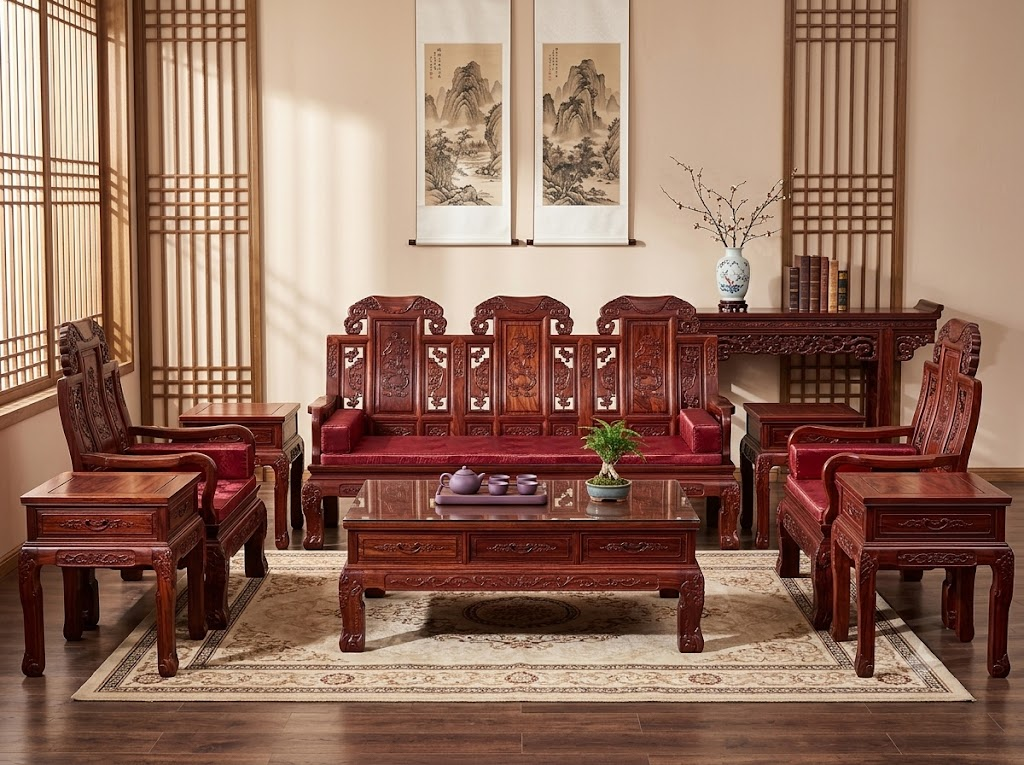
Ming style features clean lines, minimalist proportions, and geometric lattice carving-suitable for contemporary interiors. Qing style is bolder with elaborate relief carving of dragons, phoenixes, and floral scenes-suitable for grand lobbies and reception halls. Many buyers combine both styles within the same project.
How do I maintain classical rosewood furniture?
Maintain 40-70 percent relative humidity. No polishing for the first five years. After that, annual natural beeswax application. Dust carved surfaces with soft brush. Avoid silicone-based polishes. Inspect joints annually in commercial installations. The 36-day kiln drying and floating-panel construction accommodate normal humidity fluctuations.
Is classical rosewood furniture a good investment?
Siamese rosewood is CITES Appendix II listed with finite supply, creating material value that tends to appreciate. Hand-craft labor (30-40 carving hours per panel, 36-day kiln drying, 20-30 day lacquer finishing) cannot be replicated at lower cost. Value retention is a selling point for B2B buyers marketing to end customers.
What structural features should I look for in authentic classical furniture?
Through-tenon with wedge joints (visible from above, tighten with load), floating-panel construction (intentional gap for wood movement), hand-cut dovetail drawer joints (subtle variation), and bamboo dowel pins (similar moisture expansion to rosewood). Metal screws or brackets in primary joints indicate non-traditional construction.
Can classical furniture work in modern interior designs?
Yes. Designers integrate classical rosewood pieces into contemporary spaces by using Ming-style furniture for clean, minimalist environments and Qing-style as statement pieces. The key is allowing the furniture's carving and material quality to serve as the primary decorative element with restrained surroundings.
What documents come with classical furniture shipments?
CITES Appendix II export permit, FSC chain-of-custody, ISPM-15 heat treatment certificate, EU REACH and US CARB compliance, FDA 21 CFR 175.300 for dining surfaces, commercial invoice with HS code 9403.60, packing list. All in English. Use a customs broker experienced with CITES timber.
Can I order custom classical designs with exclusive carving?
Yes. OEM and ODM customization includes exclusive carving patterns, custom dimensions, and finish colors. Design proposals with 3D mockups within 15 working days. Carving samples on wood panels mailed for approval. Exclusivity agreements available for container-quantity orders.
What are the payment and trade terms for classical furniture orders?
30 percent T/T deposit, balance before shipment. L/C available above USD 30,000. Trial single sets and refundable samples available. FOB Xiamen default with direct routes to Los Angeles, Sydney, Singapore, Rotterdam. CIF and DAP available on request.