
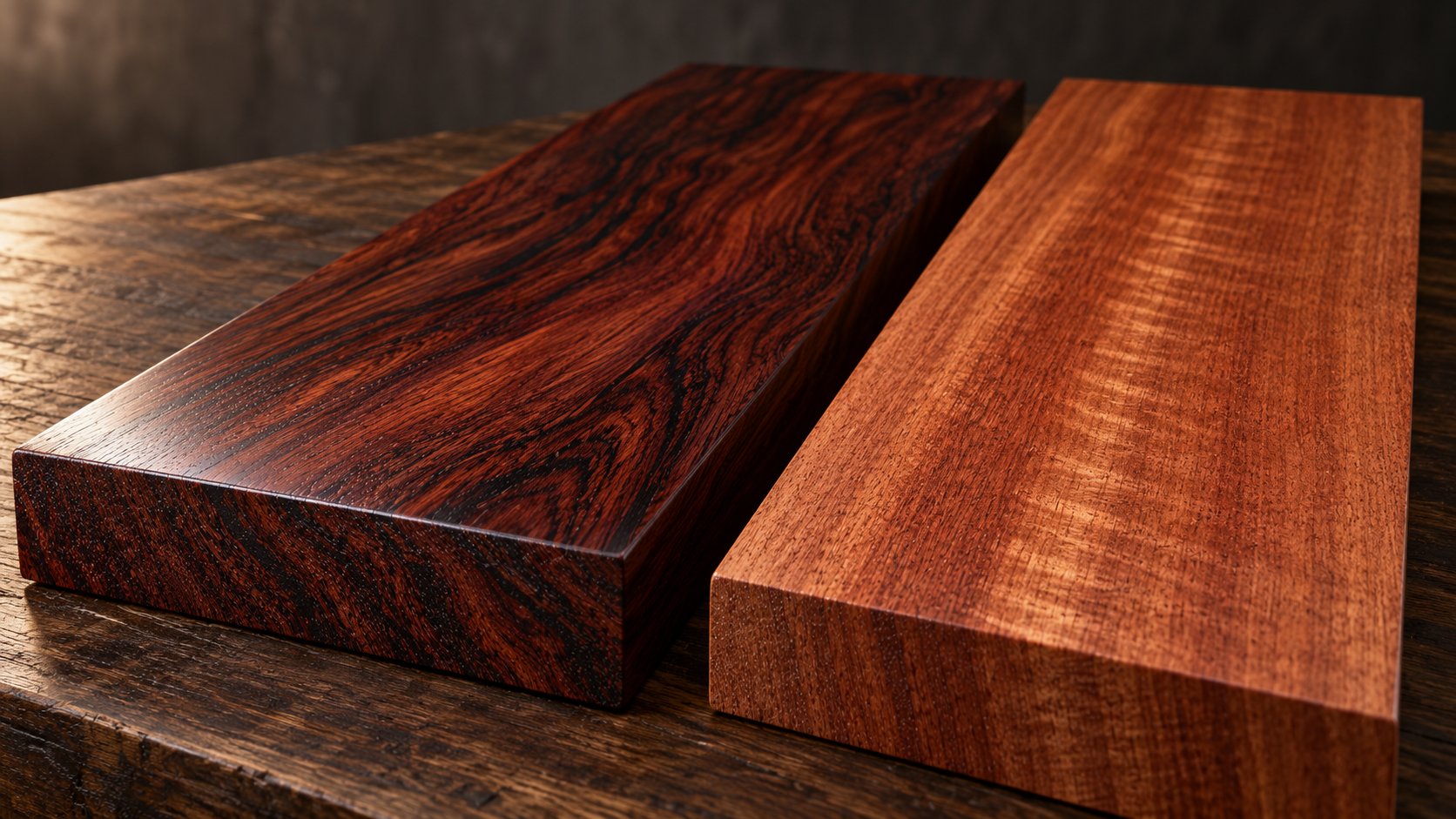
Perbandingan B2B 2026 secara langsung antara perabot rosewood dan mahogany: kepadatan, prestasi iklim, ukiran dan sambungan kayu, pematuhan CITES, struktur kos dan kayu mana yang sesuai untuk barisan produk mana.
Every month, importers type some version of the same question into a search bar: is rosewood better than mahogany furniture? The question usually arrives after a quoting session has gone wrong in a specific way. One supplier has priced a classical rosewood sofa set at three times the cost of a mahogany-look living room line from another vendor. A hotel fit-out schedule lists “mahogany” in one room package and “rosewood” in another, with no botanical names attached. A distributor in Sydney or Dubai or Dallas is trying to decide which material to anchor a 2026 catalog around — and the honest answer is that neither wood is “better” in the abstract. Each is better at a different commercial job.
This guide answers the question the way a procurement decision actually needs it answered. Instead of re-defining each timber — you can find full species guides elsewhere on this site — we compare rosewood and mahogany head to head on the seven factors that decide container-scale furniture orders in 2026: botany and supply security, density and construction behavior, climate performance in Southeast Asian, Australian and North American conditions, carving and finishing outcomes, regulatory burden, cost structure, and product-line fit. The goal is not to crown a winner. It is to give you a framework you can defend to your own customers, your finance department and your customs broker.
One disclosure up front, because E-E-A-T starts with honesty: we manufacture classical furniture in Siamese rosewood (Dalbergia cochinchinensis), not mahogany. That position gives us daily, hands-on evidence about rosewood’s behavior in production and in export markets — and it means we have no incentive to oversell mahogany. Where mahogany genuinely wins, we say so. The comparison below reflects how we actually walk sourcing teams through this decision when they ask us to quote both directions.
First, What Are We Actually Comparing? What Is Rosewood Furniture in the 2026 Market
Before the comparison is useful, both words need precise meanings. Buyers searching “what is rosewood furniture” usually discover that the name covers more than one reality — and the same is true of mahogany, in a different way.
True rosewoods belong to the genus Dalbergia, a large group of tropical legume-family hardwoods. The species that matters most for classical Chinese furniture — and for this comparison — is Siamese rosewood (Dalbergia cochinchinensis), one of the timbers listed under China’s hongmu national standard (GB/T 18107). It is the wood of Ming- and Qing-style sofa sets, tea tables, canopy beds and display cabinets: dense, deep reddish-brown, oily to the touch, and dramatic in grain. In the Chinese classical tradition it is the benchmark premium material, which is why chinese redwood furniture as a search category maps overwhelmingly onto rosewood and its close relatives rather than onto any Western cabinetwood.
Mahogany, by contrast, is the common name for Swietenia species — genuine mahogany from the Americas — plus, by long trade convention, African mahogany (Khaya). It is the cabinetwood of the Western polished tradition: moderately hard, dimensionally very stable, friendly to tools and finish systems, and historically the wood of Chippendale-era and colonial-style furniture. In trade documents, “mahogany” covers a wider and looser set of timbers than “rosewood” does — a point that matters when we get to specification discipline later in this article.
So the real comparison is not rosewood versus a single thing called mahogany. It is a dense, regulated, collectible-classical timber versus a family of stable, workable, polish-tradition cabinetwoods. Keeping that asymmetry in view prevents most of the confusion that follows when buyers compare quotes.
Botany, Supply Security and Where Each Wood Actually Comes From
The two timbers are not botanical relatives — they are not even in the same plant family. Rosewoods are legumes (Fabaceae); mahoganies are in the Meliaceae family. That biological distance drives everything downstream: growth rate, density, oil content, color, and the regulatory regimes attached to each.
Supply is the first divergence a 2026 buyer must price in. Virtually the entire Dalbergia genus has been listed on CITES Appendix II since 2017, and Siamese rosewood’s natural stands in mainland Southeast Asia have been heavily harvested for decades. Legal, documented supply exists — working factories in the classical furniture tradition maintain export permits, re-export certificates and chain-of-custody documentation as routine — but the material is genuinely scarce, slow-growing, and priced accordingly. Scarcity has a commercial upside for importers: rosewood furniture holds material value over time, and tight supply has historically supported rather than eroded the price of existing stock.
Mahogany supply is broader but also regulated. Big-leaf mahogany (Swietenia macrophylla) has been CITES Appendix II since 2003; much of today’s volume is plantation-grown across the tropical Pacific, Latin America and Asia, and a large share of what trades as “mahogany” in Europe and North America is actually African Khaya. Plantation mahogany is faster-growing, somewhat lighter and more variable than old-growth material, but well-managed plantations produce sound, stable furniture timber. The practical supply difference is this: mahogany is easier to source in volume at moderate price points; rosewood is harder to source at all without documentation discipline — and that scarcity is precisely what underwrites its premium position.
For a buyer building a multi-year program, the supply question is not “which wood exists” — both exist — but “which supply model fits my risk tolerance.” Rosewood rewards importers who plan ahead, book production with documented factories, and treat material certification as part of the product. Mahogany rewards buyers who need flexibility and volume at controlled cost.
Density, Hardness and Weight: The Numbers That Decide Furniture Behavior
The single biggest physical difference between the two timbers is mass. Siamese rosewood runs roughly 1,000 to 1,200 kilograms per cubic meter at 12 percent moisture content. Genuine mahogany sits near 500 to 650 kg/m³, with African mahogany similar or slightly lighter. On the Janka hardness scale, mahogany lands around 800 to 900 pounds-force; Siamese rosewood scores far higher. A dining chair in rosewood feels planted and cool in the hand; the same form in mahogany feels noticeably lighter.
Those numbers translate into furniture behavior in specific, checkable ways. Density is why rosewood resists dents and surface wear in high-traffic settings — hotel lobbies, dining rooms, executive offices — and why carved relief stays crisp for decades. It is also why rosewood furniture ships heavy: a container of classical rosewood sofa sets approaches weight limits long before volume limits, which affects freight cost per set. Mahogany’s moderate density is not a defect; it makes large case pieces easier to move, kinder to hardware and floor systems, and cheaper to freight — real advantages for bedroom programs and for retail environments where furniture is repositioned often.
For buyers asking “is solid wood good for furniture” at this tier, the honest answer is that both are true solid hardwoods — no veneer, no MDF, no finger-jointed cores in either case when specified correctly — and both outperform engineered substitutes on service life. The difference is what the solidity is engineered to do. Rosewood’s solidity is armor: scratch resistance, wear life, patina. Mahogany’s solidity is reliability: dimensional steadiness, workability, finish depth at a working weight. Table these two profiles against your customer’s usage pattern rather than choosing on principle.
| Attribute (typical values) | Siamese rosewood (Dalbergia cochinchinensis) | Genuine / African mahogany (Swietenia / Khaya) |
|---|---|---|
| Density at 12% MC | ≈ 1,000–1,200 kg/m³ | ≈ 450–650 kg/m³ |
| Janka hardness | Far above mahogany (very high) | ≈ 800–900 lbf |
| Surface feel | Oily, waxy, self-lubricating | Smooth, finish-dependent |
| Color development | Deepens to rich dark red-brown with age and light | Deepens evenly to classic reddish brown |
| CITES status | Appendix II (genus-wide since 2017) | Appendix II (S. macrophylla since 2003) |
| Market role in 2026 | Premium classical & collectible segment | Polished contract & volume classical segment |
Figures are class guides, not batch guarantees. Timber varies tree to tree; a responsible supplier confirms density-relevant details like moisture content and grading against the actual production batch, and reputable factories state those targets in writing rather than leaving them to implication.
Climate Performance: Which Wood Survives Which Market
For importers serving Southeast Asia, Australia and North America — the three most common destination profiles for classical solid-wood furniture — climate behavior is where abstract comparisons become concrete claims you must stand behind with your own customers.
Southeast Asia combines high humidity with stable temperatures. The enemy here is not movement in well-seasoned wood; it is moisture-driven finish failure and insect pressure in under-dried or soft material. Dense, oily rosewood handles humidity well: its natural oils resist moisture uptake, and its density gives insects little purchase. The critical variable is not species but drying discipline — timber must be kiln-dried to a controlled moisture content and conditioned before machining, or even rosewood will move. Mahogany-family timber also performs respectably in humid climates — its dimensional stability is the reason it conquered the boat and door trades — but its lower density means dents and edge wear accumulate faster in high-traffic commercial interiors.
Australia is the harder test: strong UV, dry interior heating in southern winters, and big seasonal humidity swings. Solid wood moves in those conditions regardless of species; the question is how the construction absorbs the movement. This is where joinery philosophy separates the two woods. Dense, oily rosewood is less friendly to glue-dependent construction, but it is superb in traditional joinery that does not rely on glue — classical Chinese mortise-and-tenon frames, floating panels, dovetailed drawers. The traditional system anticipates movement structurally. Mahogany glues and screws more forgivingly and stays flat, so movement in a mahogany piece is typically absorbed by the material’s own low shrinkage coefficients. Both systems work; they work differently, and you should ask any supplier which system their production actually uses.
North America splits into two profiles. In the humid Southeast and Gulf states, the Southeast Asia logic applies. In the dry interior and heated northern homes, the risk is over-dry wood: boards that were conditioned too wet for the destination will shrink, open joints, or crack. A factory that dries timber to a stated target — and states it, for example, kiln-drying to an 8–12 percent moisture content band with an equalization period before machining — is managing this risk deliberately. Buyers should treat a supplier’s drying protocol as a first-order selection criterion, ahead of species choice, because it predicts overseas performance more reliably than any material table.
The honest summary: rosewood’s density and oil content give it an edge in humid, high-wear environments; mahogany’s stability and low weight give it an edge where furniture is moved frequently and budgets are volume-driven. In dry climates both depend overwhelmingly on drying discipline and joinery design — which are supplier variables, not species variables.
Carving, Joinery and Construction: What Each Wood Makes Possible
If your catalog lives in the classical segment, the material decision is inseparable from the carving and joinery it can carry. This is where the two timbers genuinely diverge in character rather than just degree.
Mahogany carves crisply and cleanly. It was the eighteenth century’s carving wood of choice for a reason: it takes fine moulding detail with minimal tear-out, works in every grain direction, and is kind to cutting tools. For European polished-classical programs — acanthus scrollwork, fluted pilasters, carved crests in the Chippendale manner — mahogany-family timber is the natural medium, and it is faster to work, which shows up in price.
Siamese rosewood carves beautifully but slowly. Its density and interlocked grain demand sharper tools, slower feeds and frequent tool maintenance; deep openwork carving in rosewood is expert work measured in days per panel, not hours. What the wood returns is a carving that reads differently: the fine, dense grain recedes behind the relief, the cut edges hold a glass-like crispness, and after lacquer finishing the contrast between carved and flat surfaces is sharper than lighter hardwoods can achieve. On a rosewood armchair with a hand-carved ruyi backrest, the motif reads as part of the material rather than as applied decoration — that integration is the aesthetic argument for rosewood in classical lines.
Joinery behavior follows the same split. Rosewood’s oiliness complicates glue-dependent assembly — solvent preparation is standard practice where glued joints are unavoidable — but its strength in interlocking wooden joinery is superb, which is why classical Chinese cabinetmaking built its entire tradition on mortise-and-tenon construction with minimal or zero metal fasteners. Mahogany glues reliably, holds screws near edges without splitting, and forgives less-perfect joinery. Buyers should treat this as a specification issue, not a brand issue: when you quote rosewood furniture, confirm the joinery system in writing (mortise-and-tenon frames, dovetailed drawers, floating panels); when you quote mahogany, the same written confirmation protects you against glued-and-stapled shortcuts that the wood’s easy workability makes possible.
There is also a maintenance-afterlife dimension that shows up years after the sale. Dense rosewood surfaces can be re-polished and re-lacquered across decades of service, and the wood beneath remains sound — one reason classical rosewood furniture trades in a genuine secondary and collector market. Mahogany refinishes well too, and its lighter weight makes refurbishment logistics easier, but it does not carry the same material-value narrative your reseller customers can use in their own marketing.
Finishing and Surface Behavior: Lacquer Depth Versus Finish Flexibility
The finish system each wood rewards is different, and it affects both the look you can sell and the compliance paperwork behind it.
Rosewood is rich in natural oils and aromatic compounds. Those oils give finished rosewood its waxy, self-lubricating feel and its depth under hand-rubbed finishes — but they complicate adhesion for film finishes, so classical production uses multi-coat raw lacquer systems applied in thin layers, each cured and hand-rubbed, building depth without fighting the wood’s chemistry. The result is the deep satin sheen buyers associate with premium chinese redwood furniture. For a hand-carved rosewood tea table, the finish is what turns dense timber into a surface that photographs as luxurious in a showroom and wears honestly in a living room.
Mahogany is comparatively finish-agnostic. Its drier, more even pore structure takes lacquer, shellac, oil and polish systems without chemistry fights, which is why the European polished tradition built on it and why contract manufacturers like it for large consistent runs. If your program needs a specific film-build look, a color-matched production across hundreds of pieces, or rapid finish cycles for volume timelines, mahogany-family timber is the easier medium.
Compliance attaches to the finish as much as to the wood. Furniture for the EU and US must satisfy chemical-safety regimes — REACH in Europe, CARB-related formaldehyde and emissions rules in California and beyond — and classical finishes built on natural lacquer and beeswax generally travel well through those regimes when the factory documents them. Whichever timber you choose, ask for the finish specification in writing: coating type, number of coats, curing method, and the standards the finished product is documented against. That single paragraph of paper prevents more border and retail surprises than any other finish-related question.
Regulatory Burden in 2026: CITES, Due Diligence and the Paper Trail
Both timbers sit inside CITES Appendix II, so neither is “banned” — both trade legally with documentation. The practical burden differs, and 2026 enforcement makes the difference matter more than it did five years ago.
For rosewood, the genus-wide Appendix II listing means every commercial shipment needs permits naming the species, plus your destination market’s import-side paperwork. For buyers subject to the EU Timber Regulation and the US Lacey Act, due-diligence obligations attach to the whole chain: species identification, harvest legality, and documented origin. None of this is optional overhead — it is the condition of the material’s premium status. The factories that operate in this trade routinely prepare CITES export permits, re-export certificates and FSC chain-of-custody documentation where claimed, and heat-treated ISPM 15 packaging as standard. When you evaluate a rosewood supplier, the paperwork question is not “can you provide documents” but “are documents a routine line item in every shipment, or an exception you arrange on request.” The first answer is the professional one.
For mahogany, the paperwork surface is narrower in daily practice: genuine big-leaf Swietenia requires CITES Appendix II permits, but African Khaya — the volume species behind most Western “mahogany” furniture — is not CITES-listed, and plantation supply chains are generally straightforward to document. If low compliance friction is a genuine constraint for your market or your team’s capacity, mahogany lines are operationally lighter.
But reframe the burden before deciding it is only a cost. For a growing segment of hospitality and residential buyers, documented CITES and FSC paperwork is a selling asset: it is what allows a distributor to tell an end-customer that the material is legal, traceable and ethically sourced. Rosewood’s heavier documentation regime is inseparable from its scarcity story — and scarcity, honestly told, is the story that supports premium retail pricing.
Cost Structure: What You Are Actually Paying For in Each Quote
Price differences between rosewood and mahogany furniture are large, and they are driven by different cost stacks. Understanding the stack is what lets you judge whether a quote is fair rather than merely low.
In a rosewood quote, the raw material dominates. Siamese rosewood timber is scarce, regulated and slow-growing; legally documented logs command a steep premium over unregulated substitutes — which is precisely why documentation matters. Labor follows: the wood’s density means slower machining, slower hand carving, longer finishing cycles. Drying and conditioning add cost before machining even starts. Compliance documentation adds administrative cost to every shipment. What the buyer receives for that stack is a product whose material alone carries resale value, whose wear life spans decades, and whose story supports top-shelf retail positioning.
In a mahogany quote, material cost is moderate — plantation and Khaya supply keeps timber affordable — and labor is lower because the wood works quickly. Finishing and hardware costs are comparable or lower. What mahogany buys is margin structure: a classical-looking product at a working price point, with stable supply and light compliance friction, that supports volume retail and mid-premium contract programs.
Neither stack is “better.” They serve different shelves. A two-tier program — rosewood for the heritage and statement lines, mahogany-family timber for the polished volume lines — is not a compromise; it is how the furniture market has structured itself for two centuries, and it lets a single supplier relationship serve both price points without diluting either.
One pricing warning applies to both woods: compare quotes on specification, not on name. A “rosewood” quote built on veneered panels and machine carving is not the same product as a solid-timber, hand-carved one, and the gap between them is routinely 40 to 60 percent of unit cost. The specification checklist later in this article exists to keep that comparison honest.
Lead Times, MOQ and Container Economics
Beyond unit price, the two materials differ in operational rhythm, and that rhythm affects your inventory planning as much as your margin.
Rosewood production is scheduling-intensive. Drying and conditioning cycles, slow machining, expert hand carving and multi-coat lacquer work mean realistic container lead times typically run in the 45–60 working day range after deposit for classical programs, longer for highly carved custom work. Minimums are usually flexible — many classical factories accept single-set trial orders precisely because they expect buyers to verify quality before committing to volume — but re-orders of scarce, high-grade timber benefit from forward booking. The operational posture rosewood rewards is planning: seasonal pre-orders, documented specifications, and a factory relationship that can reserve production capacity.
Mahogany production is rhythmically easier: faster machining, standard finish cycles, and broader timber availability make shorter lead times and larger volume runs realistic. For buyers filling mixed containers — combining bedroom, dining and occasional lines — mahogany’s lighter weight also improves freight economics per unit, since a container of mahogany furniture hits volume limits before weight limits.
Container loading itself deserves a word for classical carved furniture in either material: pieces with deep carving and projected elements need engineered packing — corner protection, floating-panel relaxation, ISPM 15 heat-treated crating — and loading plans that avoid point-loading carved aprons. Ask any prospective supplier how they pack and load carved sets; the answer is a fast tell on their export maturity.
The Decision Framework: Which Wood for Which Product Line in 2026
Bring the factors together and the comparison resolves into a decision framework rather than a verdict. Walk each line of your program through these questions.
Choose rosewood when the material is the value proposition. If your customers buy permanence, heritage and material story — classical Chinese furniture collections, luxury hotel lobby statements, collector-grade bedroom suites, the hongmu tradition — rosewood’s density, patina, carving depth and documented scarcity are exactly what justifies premium retail. In markets where chinese redwood furniture carries brand weight — Southeast Asia above all, plus Chinese-speaking communities in Australia and North America — rosewood is not one option among several; it is the category definition. A carved-lattice display cabinet or a full carved sofa set demonstrates the difference in person in a way no comparison table can.
Choose mahogany-family timber when the program is polished, priced and movable. European and American classical lines built on the polished tradition, volume bedroom and dining programs, contract furniture where weight limits and repositioning matter, and price points where rosewood cannot reach margin — mahogany-family timber is the disciplined choice, and its stability and finish flexibility make it easy to manufacture consistently at scale.
Run both, separated by product line. The strongest import programs in this segment assign timbers by line rather than debating a single material identity: rosewood carries the heritage and statement tier, mahogany carries the polished volume tier, and the catalog covers a retail span neither wood could serve alone. The one non-negotiable rule: never let the two names share a quotation line without botanical names and written specifications. That discipline is the subject of the next section.
Specification Discipline: Writing the Order So the Container Matches the Sample
Whichever timber wins your program, the specification paragraphs below are what convert this comparison into enforceable purchase orders. They are the working checklist we recommend to every sourcing team, and they apply identically to rosewood and mahogany lines.
- Species first, trade name second. Write the botanical name and put the trade name in parentheses: Dalbergia cochinchinensis (Siamese rosewood) or Khaya ivorensis (African mahogany). A quote that says only “rosewood” or “mahogany” is buying a word, not a wood.
- Solid-wood declaration by component. State which components are solid timber — frames, legs, rails, carved elements — and whether any panels may be veneered, naming the substrate if so. Classical solid-wood programs should read “solid throughout, no veneer, no MDF, no finger joints” in load-bearing components.
- Moisture content bound to packing, not to promise. A stated kiln-dry target with an equalization period, measured at packing, with meter verification permitted at inspection. This single line prevents most “furniture cracked in my climate” disputes for either species.
- Joinery system named. Mortise-and-tenon frames, dovetailed drawers, floating panels — written as requirements, not descriptions. For rosewood, confirm the glue strategy given the wood’s oiliness; for mahogany, confirm it anyway, because easy-working wood makes shortcuts easy.
- Carving method stated. Hand-carved versus machine-carved is a price and value distinction large enough to dispute over. Name the method and the depth expectations per element class.
- Finish system and standards. Coating type, coat count, curing and rubbing method, and the chemical-safety standards the finished product is documented against for your destination market.
- Documentation as a condition of shipment. CITES permits where applicable, FSC chain-of-custody where claimed, legal-origin documents always, ISPM 15 packaging, and a pre-shipment inspection clause that includes the right to species verification.
A quote that accepts this block can be produced accurately by any serious factory in Asia. A quote that resists it is telling you something before you have paid anyone anything.
How the Comparison Looks From Inside a Rosewood Workshop
Because this article ends with a decision you need to make, it is fair to show you the vantage point it is written from. We manufacture classical furniture in Siamese rosewood from a workshop in Xianyou County, Fujian — a region with generations of hardwood craft specialization — producing sofa, dining and bedroom sets in the Ming and Qing traditions. Production runs on the disciplines described above: timber kiln-dried to a controlled moisture content with equalization before machining, primary frames assembled in traditional mortise-and-tenon joinery with zero metal fasteners, hand carving executed by trained artisans, and multi-coat raw lacquer finishes hand-rubbed to a satin depth. Export documentation — CITES permits, FSC chain-of-custody where claimed, ISPM 15 heat-treated packaging — is prepared as a routine part of every shipment, and OEM/ODM customization from dimension changes to full design development is supported alongside remote installation guidance for buyers’ local teams.
We are transparent about what that means for this comparison: rosewood is the material we know best and the one we have bet the workshop on. It is also, in our honest judgment, the right anchor for importers whose customers buy the material as much as the furniture. For programs where mahogany’s profile fits better, the framework above will serve you — and we would rather you specify the right timber for the right line than win an order with the wrong material. That judgment is what a two-century-old trade teaches: the wood is a business decision, and business decisions deserve evidence rather than loyalty.
If you are weighing the two timbers for a 2026 program, the fastest next step is concrete: send us your product lines and target markets, and we will walk through which lines justify rosewood’s premium and which do not — including sample and trial options for verifying quality before any container commitment. Buyers comparing programs can also review how a rosewood wardrobe with carved panel doors or a complete sofa, dining and bedroom program is specified and documented in practice.
Frequently Asked Questions: Rosewood vs Mahogany Furniture for Importers
Is rosewood better than mahogany furniture in terms of durability?
For surface wear and dent resistance, yes — rosewood’s density (roughly double mahogany’s) makes it markedly more resistant to scratches, dents and edge wear in high-traffic use, and it can be re-polished across decades. For dimensional stability in changing humidity, mahogany-family timber is excellent and arguably easier to manage in dry climates. Overall service life depends more on drying discipline and joinery quality than on species alone.
Why is rosewood furniture more expensive than mahogany furniture?
Three stacked reasons: raw material scarcity (CITES-listed, slow-growing, legally documented supply commands a premium), labor intensity (dense wood machines and carves slowly, and classical finish cycles are long), and compliance cost (permits and chain-of-custody documentation on every shipment). In exchange the buyer gets a product whose material itself retains value and supports premium retail positioning.
Is mahogany a good alternative to rosewood for classical furniture?
For the Western polished-classical tradition — Chippendale and colonial-style programs — mahogany-family timber is the historically authentic medium and a very good one: stable, carveable, finish-friendly. For classical Chinese furniture in the hongmu tradition, rosewood is the authentic material, and substitutes change both the look and the story. The right question is which tradition your catalog serves.
Do both rosewood and mahogany require CITES permits?
Yes for the core species: the Dalbergia genus (rosewoods) has been Appendix II since 2017, and big-leaf mahogany (Swietenia macrophylla) since 2003. African mahogany (Khaya) is not CITES-listed, which makes mahogany lines administratively lighter. In practice, documented rosewood supply from established factories handles the paperwork as routine, and the documentation doubles as a marketing asset.
Which wood is better for humid climates like Southeast Asia?
Dense, oily rosewood handles humidity and high-traffic wear exceptionally well, provided the timber was properly kiln-dried and conditioned. Mahogany-family timber is also humidity-stable — its stability made it a boatbuilding wood — but its lower density accumulates wear faster in commercial settings. In both cases, the supplier’s drying protocol predicts performance better than the species name.
Which wood is better for dry, heated interiors in North America?
Both depend primarily on conditioning and joinery design. Wood dried to a stated moisture-content target with equalization, built with floating panels and joinery that allows movement, performs in dry interiors regardless of species. Ask for the drying specification in writing; it matters more for dry-climate outcomes than the rosewood-versus-mahogany choice itself.
Can I mix rosewood and mahogany lines in one order or container?
Suppliers can quote and pack mixed programs, and a two-tier material strategy across product lines is commercially sound. Just never let the two species share a quotation line without botanical names — mixed-name lines are where substitution disputes begin. Specify each line’s species, construction and finish separately, and inspect against each specification.
What should I check before paying a deposit for either timber?
Confirm the written specification block: botanical species, solid-wood declaration, moisture-content target at packing, joinery system, carving method, finish system and standards, documentation requirements, and pre-shipment inspection rights including species verification. Approve physical color and figure samples rather than photos, and use trial single sets where offered before committing to container volumes.
Where can I buy real rosewood furniture with documentation for B2B import?
Buyers searching “where to buy real wood furniture” at container scale should shortlist factories that publish species names, drying protocols, joinery systems and documentation practices — then verify with samples and written specifications. Classical rosewood furniture manufacturers in Fujian’s craft region, our own workshop among them, ship documented programs across Southeast Asia, Australia, Europe and North America, with trial orders available before container commitment.
Conclusion: Neither Wood Wins — Your Product Line Decides
Is rosewood better than mahogany furniture? Rosewood is better when the material itself is the product: when your customers buy density, patina, carving depth, heritage and documented scarcity, and when your margins support premium retail. Mahogany-family timber is better when the program is polished, priced for volume, and built on the Western classical tradition: stable, workable, finish-flexible and administratively light. The 2026 import programs that perform best are not loyal to either answer — they assign each timber to the lines where its physics, its paperwork and its story do the most commercial work.
Whatever you decide, decide it on specification: botanical names, moisture targets, joinery systems, carving methods, finish standards and documentation duties, all in writing, verified on samples before containers. That discipline turns a two-century naming confusion into a clean order — and it is the difference between furniture that matches the catalog and a container of expensive explanations.
Tell us your product lines, target markets and price points — our team will review which lines justify rosewood’s premium, prepare species and compliance documentation, and quote sample and trial options before any container commitment.