
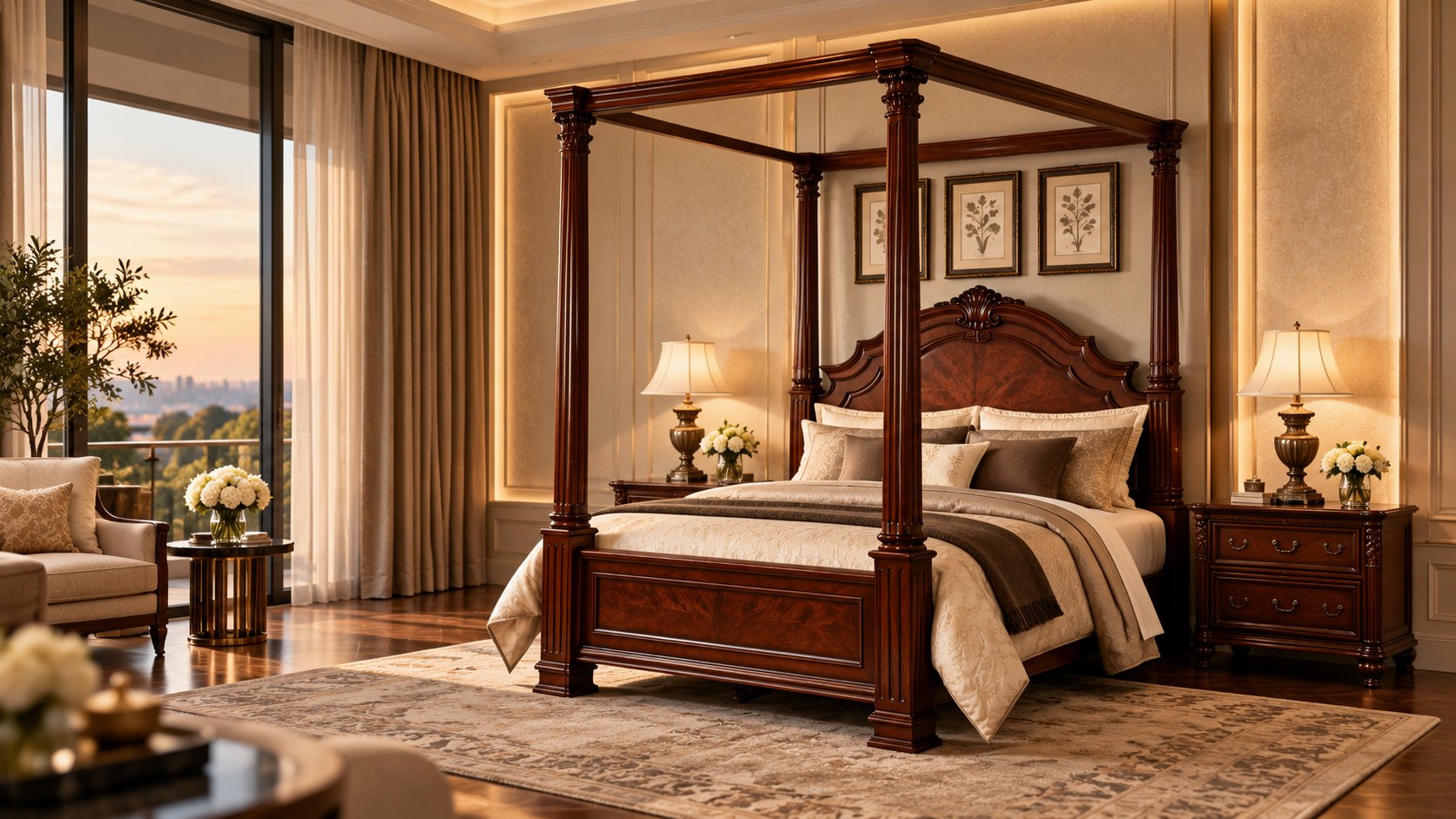
Panduan B2B tentang mengapa katil kanopi Cina menjadi karya tandatangan untuk suite hotel mewah dan vila — bahan rosewood, sambungan berpasak tembus, ujian struktur yang disahkan, dan panduan pemerolehan untuk Asia Tenggara/Australi…
A canopy bed changes the way a bedroom feels before anyone touches anything in it. The four posts lift a frame into the upper volume of the room, the eye travels upward, and the sleeping space acquires an architecture of its own. In recent seasons, procurement teams for luxury hotels, resort developers, and villa project managers across Southeast Asia, Australia, and North America have been asking for this exact silhouette more often — and increasingly they ask for it in Chinese classical form, in solid rosewood, with joinery that will survive a decade of commercial housekeeping.
That shift raises a fair question for anyone planning a hospitality or high-end residential project: why is a Chinese canopy bed becoming a signature piece for luxury hotel suites and villas? The short answer is that it solves several problems at once. It gives a room an unmistakable focal point without relying on art or upholstery budgets. It signals cultural depth that modern minimalist beds cannot fake. And when it is built properly — in dense Siamese rosewood with traditional mortise-and-tenon construction — it brings a level of structural honesty that buyers can verify before the container ships.
This article examines the Chinese canopy bed from a B2B sourcing perspective: what it is, how it is built, which material and craft details actually matter in a hotel or villa application, how it fits the three bedroom suites in the Yunxiao range, and what procurement teams in Southeast Asia, Australia, and North America should check before placing an order. Every specification cited here comes from the current Yunxiao product documentation, so you can carry this page straight into a tender comparison.
What Exactly Is a Chinese Canopy Bed?
A Chinese canopy bed — often described in trade contexts as a rosewood canopy bed or a four poster bed with canopy frame — is a bed whose four corner posts carry a rectangular top frame, creating a partially or fully enclosed sleeping volume. Unlike the light, draped iron canopy beds common in European catalogues, the classical Chinese version is architectural. The posts are structural columns. The top frame is a real frame, joined to the posts with wood-on-wood connections rather than bolted hardware. Historically, the enclosure served practical purposes: hanging bed curtains for warmth and privacy in unheated rooms, and defining status in the hierarchy of a household.
In the classical furniture vocabulary of the Ming and Qing dynasties, this form is known as the jiazichuang — literally a bed framed like a miniature building. That building metaphor is worth keeping in mind during procurement, because it describes how the bed should be engineered. A good Chinese canopy bed is not a panel bed with posts glued on top; it is a small timber structure, with a load path that runs from the canopy rail down through solid posts to the floor. When you inspect a sample or a specification sheet, the first question to ask is whether that load path is continuous, or whether it is interrupted by finger joints, veneer, or metal brackets hidden inside the posts.
The difference matters more in commercial use than in domestic use. A hotel housekeeping team moves a bed every day. Luggage collides with posts. Curtain rings slide along canopy rails. A canopy bed built as a miniature building tolerates this; a canopy bed built as decoration does not. That single engineering distinction is why serious buyers now specify joinery details, not just dimensions, when sourcing a classical redwood canopy bed for hotel suites and villas.
Why the Form Suits Luxury Hospitality and Villa Projects
Luxury hospitality design has spent the last decade working through a particular problem: how to make rooms feel generous, rooted, and memorable in markets where almost every five-star property uses the same international furniture programme. In Singapore, Bali, Chiang Mai, Hangzhou, Kyoto, and increasingly in Australian wine-country lodges and North American resort retreats, the answer many designers have converged on is a room with a strong East Asian or classical centre — and the canopy bed is the most direct way to build one.
A focal point that carries the whole room
From a design economy standpoint, a canopy bed does the work of several other elements. The posts and top frame create vertical interest in rooms with high ceilings, which are standard in villa master bedrooms and premium hotel suites. The silhouette reads clearly from the doorway, in photographs, and through glass walls to terraces — which matters in an era where most guests first meet a property through its online gallery. A suite built around a carved rosewood canopy bed photographs as a complete, authored space; the same room with a plain upholstered platform bed photographs as generic inventory.
Cultural depth that supports rate positioning
For resort and boutique hotel operators, the bed is also a storytelling asset. A Chinese canopy bed in hand-carved rosewood lets marketing describe the room in terms of heritage and craft rather than thread counts. Guests remember the object. This is especially valuable in Southeast Asian resort markets and in Chinese diaspora destination markets such as Malaysia and Singapore, where the form carries genuine cultural recognition, and in Western villa markets, where it reads as deliberate, exotic calm rather than period costume.
Practical advantages in daily commercial use
There are practical reasons too. The posts and top frame accept sheers, blackout drapes, mosquito netting, or nothing at all — one chassis, several seasonal looks, no re-purchase. In tropical resort settings, a canopy configured for netting solves an insect problem without chemical sprays or fixed screening. In villas in North America and Australia, the same frame supports seasonal drapery changes that refresh the room without touching the bed itself. A well-built canopy bed is, in commercial terms, the most reconfigurable bed category on the market.
Anatomy of a Well-Built Chinese Canopy Bed
Because the form is architectural, buyers should evaluate it the way they would evaluate a timber structure. The current Yunxiao canopy bed specification breaks down into six verifiable elements, and each one carries a concrete inspection point you can write into a purchase agreement.
Single-section corner posts
The four corner posts of the Yunxiao Classical Redwood Canopy Bed 3-Piece Bedroom Set are cut from single solid sections of Siamese rosewood — not finger-jointed and not veneered. This preserves the load path from canopy rail to floor without a glued joint anywhere in the column. At the factory, any post with a bend exceeding 1.5 mm over its length is diverted to shorter components, and the same 1.5 mm straightedge tolerance is applied again at final inspection, so the manufacturing criterion and the outgoing inspection criterion are identical. For buyers, the check is simple: request confirmation that posts are single-section, and that the straightness tolerance is written into the inspection report.
Through-tenon canopy connection
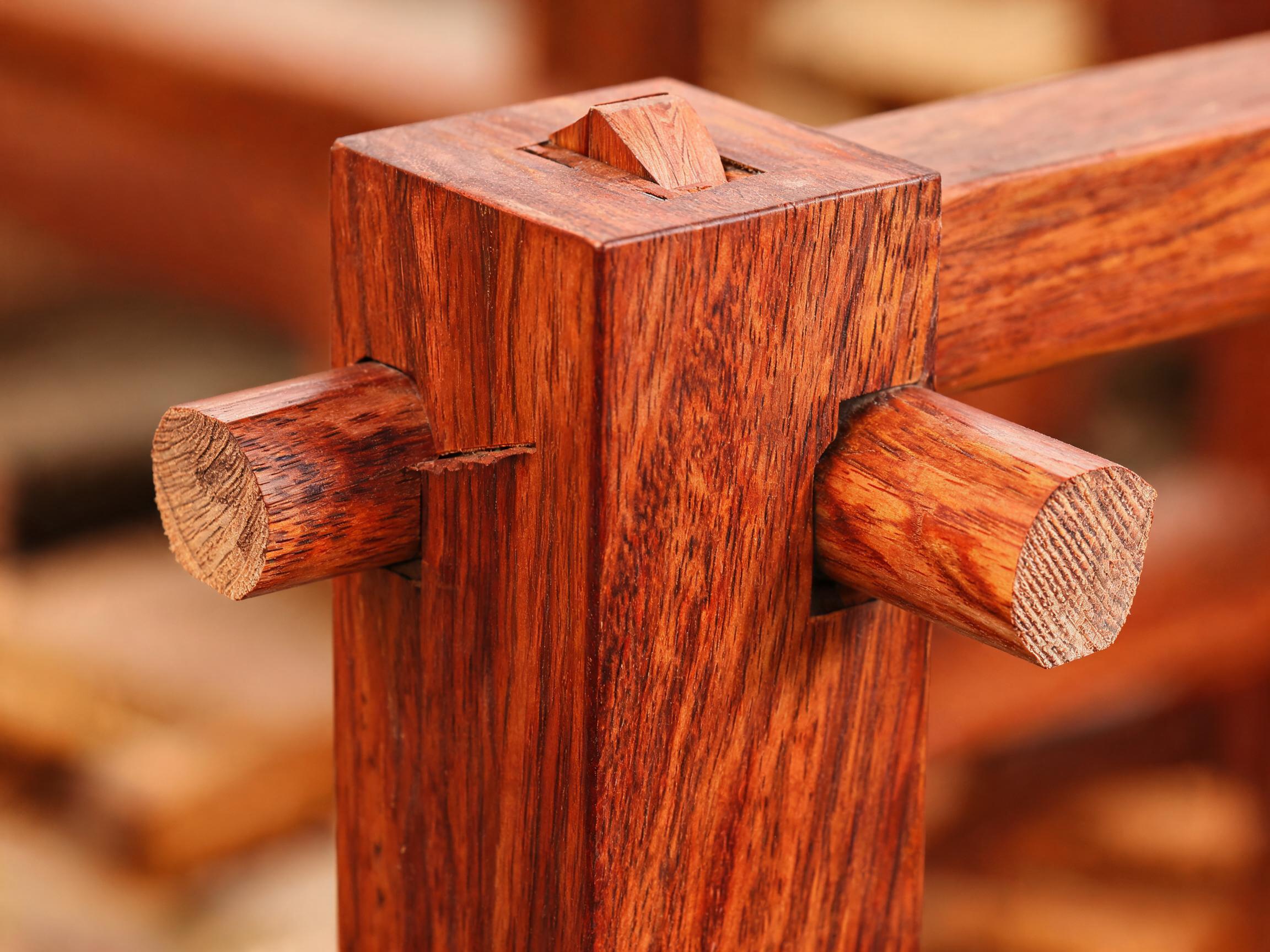
The canopy frame connects to the post tops with through-tenons that pass completely through the post — 15 mm of protrusion — and are locked with wedges driven from above. This is a traditional Chinese construction method, and it has a practical consequence: the connection tightens under load instead of relying on the shear strength of a bolt. There is no metal hardware in the primary frame. The wedge is also serviceable; a frame that develops movement after years of transport or use can be re-wedged on site rather than replaced.
Mortise-and-tenon rail connections with wooden dowels
Posts connect to the side and end rails with mortise-and-tenon joints cut to a 20 mm tenon depth and secured with wooden dowels. Again the point is structural honesty: the joint is a timber connection, sized for the loads a bed frame actually sees, and inspectable at the dry-fit stage. The factory dry-fits every bed frame before glue application to verify alignment, which is a stage buyers can request photographs of for any batch.
Recessed slat base at 90 mm centres
The slat base sits recessed into the side rails and supports a standard innerspring or latex mattress without a box spring. Cross-slats are spaced at approximately 90 mm centres, a density chosen to limit mattress sag over years of hotel use. This is one of those unglamorous details that separates a bed specified for a five-year refresh cycle from one specified for ten.
Verified structural testing
The assembled frame is tested to in-house standards before packing: a 150 kg distributed load applied for 24 hours, with any joint showing separation re-fitted; and a 10 kg lateral force test at each canopy corner, with movement exceeding 3 mm triggering wedge re-fitting. These are not abstract numbers. They simulate exactly the abuse a hotel housekeeping team and a container journey will deliver, and they give buyers a pass/fail criterion to reference in pre-shipment inspection.
Kiln conditioning to 8–12% moisture content
Timber is kiln-dried to 8–12 percent moisture content with a 48-hour equalisation period, and moisture is verified board by board before joinery. Final quality inspection takes three-point readings per piece, and any reading outside the 8–12 percent window sends the piece back for re-conditioning. The reason this matters to buyers in Southeast Asia, coastal Australia, and humid North American summer markets is dimensional stability: a canopy bed is a tall, wide structure, and the frame that arrives at 9% moisture is the frame that stays square in a 70% relative humidity suite.
Siamese Rosewood: The Material Behind the Category
Most serious Chinese canopy beds for the export market are built in Siamese rosewood (Dalbergia cochinchinensis), a dense hardwood with the deep reddish-brown colour and fine, interlocked grain associated with classical Chinese furniture. Published reference values for the species place its Janka hardness at approximately 1,000–1,300 lbf, which puts it comfortably in the range that resists dents and scratches in daily bedroom use — a relevant figure for hotel buyers comparing species, and one reason rosewood has outlasted softer woods in institutional settings for centuries.
Density brings its own procurement considerations, and honest documentation is part of the product. Every Yunxiao shipment includes FSC chain-of-custody documentation and CITES export permits covering the Appendix II listing that applies to Dalbergia rosewoods. For buyers in Australia, the EU, the UK, the United States, and Canada, CITES paperwork is not optional — customs authorities in all of these markets ask for it on rosewood imports, and a supplier who cannot produce clean permits per shipment is a supplier who will eventually strand your container. The practical guidance: confirm at quotation that CITES export permits are issued per shipment, and confirm your own import-permit requirement for your country before the deposit.
Surface treatment is the other half of the material story. The Yunxiao canopy bed carries a seven-coat hand-rubbed raw lacquer finish. Each coat is cured for 24 hours and hand-rubbed with pumice stone before the next goes on, producing the low-sheen, depth-rich surface that distinguishes genuine raw lacquer from sprayed polyurethane. Raw lacquer also behaves well in service: it tolerates normal indoor temperatures, and the care requirement is simply to avoid placing items hotter than roughly 60–70 degrees C directly on the surface. There are no added urea-formaldehyde adhesives in the primary frame joinery, and formaldehyde and benzene emission testing per GB 18584 is underway, with report numbers provided with quotations at inquiry — a point worth requesting explicitly in your RFQ.
Carving and Ornament: Where Hand Skill Shows
The ornament on a classical Chinese canopy bed is not decorative padding; it is the visible record of hand skill, and it is one of the fastest ways to separate genuine workshop production from machine-relief imports. On the Yunxiao canopy bed, the post tops carry hand-carved cloud-relief ball finials — a Ming-era motif whose spiralling clouds traditionally signalled good fortune — and the carving continues along the canopy rail in classical line work.

Buyers evaluating carving quality have three quick checks. First, depth: genuine hand relief has deep undercuts that machine relief cannot reach. Second, consistency across pieces: in a hotel order of forty beds, the finials should match in proportion because they are carved to a pattern, yet each will carry slight tool variations that signal hand work. Third, the finish relationship: raw lacquer over carving settles into the recesses and catches light differently across the relief, whereas spray lacquer fills and flattens it. Yunxiao supports custom carving programmes for project buyers, including buyer logos on post finials, under the OEM/ODM arrangements described later in this article.
Three Ways to Configure the Bedroom Around a Canopy Bed
A canopy bed rarely ships alone into a hotel or villa project, so the practical question becomes which surrounding configuration the project needs. The Yunxiao bedroom range offers three documented paths, all built in the same Siamese rosewood, with the same finishing standard and the same documentation pack.
Path one: the compact three-piece canopy set
The Classical Redwood Canopy Bed 3-Piece Bedroom Set pairs the canopy bed frame (king 180 x 200 cm or queen 150 x 200 cm, selectable at order) with two matching nightstands of 50 x 40 x 55 cm. It is designed as the starting configuration for rooms from roughly 12 square metres upward — think resort superior rooms, villa guest rooms, serviced apartments, and boutique properties where the canopy is the hero and the floor plan is tight. Buyers who need a wardrobe and dresser can add those pieces separately from the catalogue.
Path two: the five-piece four-poster suite
The Classical Four-Poster Redwood Bedroom Suite 5-Piece extends the same language to a full suite: the four-poster bed, two nightstands, a wardrobe, and a dresser with mirror, in hand-carved Ming style joinery with raw lacquer finishing and the same FSC and CITES documentation. This is the natural specification for villa master bedrooms and hotel suites of 20 square metres and above, where the buyer wants the room dressed from a single supplier so timber, carving depth, and lacquer tone match across every piece.
Path three: the six-piece wardrobe suite with panel bed
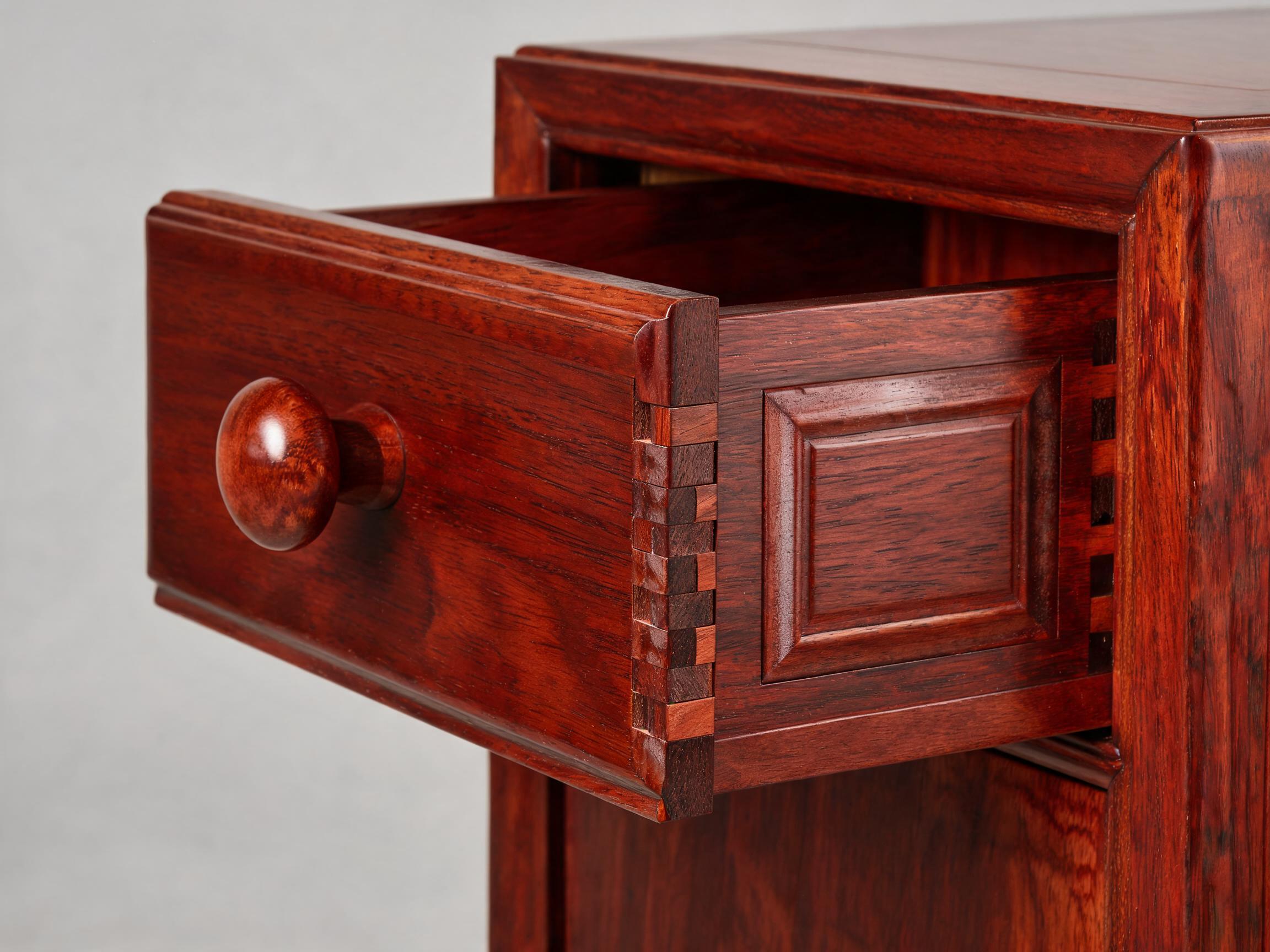
Where the project prefers a lower, contemporary-classical silhouette — or where ceiling heights make a 210 cm canopy impractical — the Classical Redwood Bedroom Wardrobe Suite 6-Piece Set covers the room with a king/queen panel bed, two nightstands, a two-door wardrobe with floating-panel doors, a dresser, and a mirror. Drawers are hand-cut dovetail construction throughout, the finish is the same seven-coat raw lacquer, and the commercial terms are documented at MOQ 1 suite with a 50–65 day lead time. Project buyers often mix configurations: canopy sets for the signature suites, six-piece suites for standard rooms, which keeps the material and finish story consistent across the property.
Specification summary — Classical Redwood Canopy Bed 3-Piece Bedroom Set: king 180 x 200 cm or queen 150 x 200 cm; canopy height approximately 210 cm; nightstands 50 x 40 x 55 cm; solid Siamese rosewood throughout; mortise-and-tenon joinery with wooden dowels and through-wedged canopy connection; 7-coat hand-rubbed raw lacquer; 8–12% moisture content; FSC chain-of-custody and CITES Appendix II documentation; bed flat-packed, nightstands fully assembled; MOQ 1 set; single set lead time 45–60 days, batch orders of 3+ sets 70–85 days; 24-month structural warranty.
Designing the Suite Around the Bed: Colour, Light, and Drapery
A canopy bed this deep in colour rewards a disciplined palette. Interior teams specifying the Classical Redwood Canopy Bed 3-Piece Bedroom Set consistently get the strongest results with three moves. First, keep wall and ceiling tones in the warm neutral family — cream, oatmeal, soft greige — so the reddish-brown rosewood reads as the room's anchor rather than competing with it. Second, light the bed from two directions: a warm bedside lamp on each nightstand to lift the carving in the evening, and a soft ceiling wash that keeps the 210 cm canopy from reading as a dark mass in photographs. Third, dress the canopy sparingly. Sheer white or ivory panels hung between the posts photograph beautifully and keep the frame visible; full blackout drapes suit villas in bright coastal markets and can be drawn back by day so the bed's silhouette returns.
Bedding choices follow the same logic. Crisp white linens with one warm accent — a terracotta throw, a mustard cushion — pick up the lacquer's depth, while patterned designer bedding tends to fight the carved detail. In resort applications, operators often standardise on white base linens across room types and let the canopy drapery carry the seasonal colour story, which simplifies housekeeping procurement while keeping each room type visually distinct.
Mattress and Bedding Compatibility
The slat base matters to more than structure; it determines what the housekeeping team can specify above it. The recessed slat platform supports a standard innerspring or latex mattress directly, without a box spring, and the approximately 90 mm slat centres give continuous support across both king 180 x 200 cm and queen 150 x 200 cm platforms. For hotel buyers this usually means the property's existing mattress programme fits without modification — a quiet cost saving in a refit, where replacing beds but retaining mattresses is the normal sequencing. The 55 cm nightstand height sits comfortably alongside a standard mattress-plus-base height, keeping lamps and water carafes within reach of a seated guest.
Two practical notes for project specifiers. Confirm the mattress thickness your brand standard requires before finalising bed size, since canopy proportions are most balanced with a mattress in the conventional hotel range rather than an ultra-plush topper stack. And remember that the bed ships flat-packed with the slat base separated, so mattress placement happens after on-site assembly — one more reason the delivery-route measurements described earlier belong in the RFQ.
How a Canopy Bed Compares With a Panel Bed in the Same Range
Project buyers often ask whether the canopy is worth the additional ceiling height and freight volume compared with the panel bed in the six-piece suite. The honest comparison runs along three axes. Visually, the canopy bed is the stronger signature: it claims the vertical volume of the room and reads as an event, which is why it belongs in the suites and villa masters where photography and first impressions do the commercial work. The panel bed, with its lower, cleaner headboard wall, suits standard rooms, service apartments, and markets where a calmer silhouette is the brand. Structurally, both share the same wood-on-wood joinery philosophy and the same seven-coat raw lacquer standard; the canopy simply adds the through-wedged top frame as a second structural system. Commercially, the canopy bed costs more in freight volume because of the posts and canopy frame, which is why the mixing strategy described earlier — canopies in signature rooms, panel-bed suites in standard rooms — delivers the best balance of impact and container efficiency. Both configurations document identically: FSC chain-of-custody, CITES export permits, ISPM-15 packaging, and the 24-month structural warranty travel with either choice.
Batch Consistency for Multi-Room Installations
A forty-bed hotel order is a different manufacturing proposition from a single villa set, and the workshop plans it that way. When room count is confirmed at inquiry, timber for the batch is matched so that grain colour and figure run consistently across all the beds installed in the same wing or floor — a detail guests never articulate but always notice. Carving is executed to the same pattern across the batch, so the cloud-relief finials on room 214 match room 215 in proportion while retaining the slight tool variations that identify genuine hand work. The kiln schedule is planned so that every piece in the batch passes through the same 8–12% moisture conditioning and the same 48-hour equalisation, and the structural tests — the 150 kg / 24-hour load and the 10 kg lateral force check — are applied to frames across the batch rather than to a token sample alone. For the buyer, the practical instruction is simple: state the room count and the room grouping at inquiry, and the batch-matching plan comes back with the quotation.
What Happens at Final Inspection Before Your Container Closes
Understanding what the factory checks before packing helps buyers write pre-shipment inspection into their own contracts. At outgoing quality inspection, each canopy bed frame passes five documented checks. Post straightness is verified with a straightedge against the same 1.5 mm tolerance used at the post-selection stage. Joint integrity is confirmed by loading the assembled frame with 150 kg of distributed weight for 24 hours; any joint showing separation is re-fitted before the bed advances. Canopy frame stability is tested by applying 10 kg of lateral force at each corner, with movement exceeding 3 mm triggering wedge re-fitting. A three-point moisture audit takes readings per piece, and any reading outside the 8–12 percent window sends the piece back to re-conditioning. Finally, the surface is inspected under 5000K LED lighting, and any lacquer defect is reworked before packing. Bed frames advance to packing only after all five checks, and buyers commissioning third-party pre-shipment inspection can hand inspectors this exact five-point list as the acceptance basis.
Reading the Bed as a Hotel Asset: Durability, Serviceability, Turnaround
For a procurement team, a canopy bed in a hotel suite is capital equipment. Three questions decide whether it performs like one: what breaks, what can be fixed on site, and how fast a damaged component returns to service.
What breaks, and where the design already answers it. The two historical failure points of imported canopy beds are post joints and canopy connections. The single-section post design removes the glued joint that fails under racking loads; the through-wedged tenon removes the bolt that loosens under vibration. The 150 kg / 24-hour distributed load test and the 10 kg lateral force test at each canopy corner simulate the actual abuse pattern, and every bed passes both before packing.
What can be fixed on site. The bed ships flat-packed — posts, rails, canopy frame, and slat base separated — in one crate, with nightstands fully assembled in a second crate. Flat-packing is not only a freight decision; it is a serviceability decision. Wedges can be re-driven, and replacement components can be ordered for transit damage under the 24-month structural warranty, which covers joinery and frame under normal indoor use. Because the connection system is traditional joinery rather than proprietary hardware, any competent local carpenter can execute a wedge re-fit without special tools.
How fast the programme turns around. A single set ships in 45–60 days from deposit confirmation; batch orders of three sets or more run 70–85 days, which covers batch-matched timber and carving for multi-room installations. Ocean freight is standard, with FOB Xiamen as the default term and CIF or DDP available on request; LCL handles single-set orders and FCL begins at three sets. Payment terms are 30 percent T/T deposit with balance before shipment, with L/C accepted on orders of three sets or more. Buyers planning a phased hotel refit can sequence deposits against room-block schedules rather than committing the whole property at once.
Climate, Installation, and Site Planning: What Buyers in Each Region Should Check
The same bed lands in three very different environments, and the pre-order checks differ slightly by region.
Southeast Asia: humidity and insects
In tropical Southeast Asian resorts, the governing variable is humidity swing. The 8–12% kiln target and three-point moisture audit are the specifications doing the work here; they are what keep a 210 cm canopy frame from loosening across a monsoon season. The canopy's netting capability converts a perennial insect problem into a drapery line-item. Installation teams should confirm air-conditioning schedules before final wedge tightening, since timber takes a few weeks to equilibrate to a continuously conditioned interior — a normal settling period in solid wood construction, not a defect.
Australia: compliance paperwork and dry interiors
Australian importers' first questions are documentary: CITES import requirements on Dalbergia rosewoods, ISPM-15 heat-treated packaging (standard on every Yunxiao crate, with EPS foam corner blocks throughout), and the FSC chain-of-custody paper trail that supports sustainability claims in guest-facing marketing. Australian interiors trend dry, especially in heated southern villas; the raw lacquer finish is stable in conditioned interiors, and maintaining indoor relative humidity in the moderate band is ordinary good practice for any solid-wood furniture programme.
North America: ceiling heights, delivery routes, and documentation
North American villa projects usually have the ceiling volume for a 210 cm canopy, but delivery is the planning item: posts ship as single sections and cannot be broken down for tight stairwells, so measure doorway widths and stairwell turns on the delivery route before ordering. The documentation pack — CITES export permits, FSC certificate, commercial invoice with HS code 9403.60, and a wood drying certificate — arrives with every shipment and covers both customs and insurance requirements. Buyers serving the hospitality channel should also confirm local fire-regulation treatment of any drapery hung from the canopy, which is a site-level responsibility rather than a furniture specification.
A B2B Sourcing Checklist for Chinese Canopy Beds
Before comparing quotations, put these ten checks in your RFQ. Each one maps to a verifiable specification in the Yunxiao documentation, which is what makes the comparison meaningful rather than rhetorical.
- Post construction: confirm corner posts are single solid sections, not finger-jointed or veneered, with the 1.5 mm straightness tolerance stated in writing.
- Canopy connection: confirm through-tenons passing fully through the post top, wedged from above, with no metal hardware in the primary frame.
- Rail joinery: confirm 20 mm mortise-and-tenon depth with wooden dowels, and dry-fit before glue.
- Structural testing: request the 150 kg / 24-hour load result and the 10 kg lateral-force result for your batch, with the 3 mm movement limit stated.
- Moisture control: specify 8–12% kiln moisture with per-board verification and three-point audit readings per piece.
- Finish specification: confirm seven coats of hand-rubbed raw lacquer, cured 24 hours per coat.
- Species documentation: confirm Siamese rosewood (Dalbergia cochinchinensis) with FSC chain-of-custody and CITES export permits per shipment.
- Packaging: confirm ISPM-15 heat-treated crates with EPS foam corner protection and the 1-metre drop-test result.
- Commercial terms: confirm MOQ, lead time by order size, shipping terms, and the 24-month structural warranty in the proforma.
- Site data: provide ceiling heights, doorway widths, and stairwell turns with the RFQ so packaging and delivery are planned, not discovered.
Buyers who work through this list usually find that the price gap between quotations reflects exactly these ten lines — which is the point. A canopy bed is a ten-year asset; the quotation that documents its structure is the one that prices the same asset you think you are buying.
OEM and ODM: Adapting the Platform to Your Project
Hotel and villa programmes rarely accept catalogue dimensions without adjustment, and the Yunxiao workshop treats customisation as routine rather than exception. Custom dimensions, carving programmes on post finials, and buyer logos are supported, with OEM and ODM arrangements running on a 15-day design approval cycle — the interval from drawing submission to approved shop drawing. For resort groups standardising across properties, this means the canopy bed platform can be scaled to each market's room module while keeping one specification, one documentation pack, and one finish standard group-wide. A single nightstand can also be ordered as a sample piece, and if a full set order follows within 90 days, part of the sample cost is credited against it — the lowest-risk way to evaluate the carving depth, lacquer tone, and joinery quality in person before committing a room block.
Frequently Asked Questions from Project Buyers
What is the minimum order for a hotel or villa project? MOQ is 1 three-piece set. For hotel projects requiring multiple sets, batch-matched timber and carving can be arranged by confirming room count at inquiry, so the beds across your property share one visual standard.
Which bed sizes are available on the canopy bed? King 180 x 200 cm or queen 150 x 200 cm, selectable at order. Custom dimensions are supported under OEM arrangements with the 15-day design approval cycle.
How is the bed packed for ocean freight? Two ISPM-15 heat-treated crates: one flat-packed bed frame (posts, rails, canopy frame, and slat base separated) and one with the fully assembled nightstands. EPS foam corner protection throughout, and the packaging has passed a 1-metre drop test.
What documents ship with the order? Every shipment includes CITES export permits, the FSC certificate, a commercial invoice with HS code 9403.60, and a wood drying certificate.
What are the lead times? 45 to 60 days from deposit confirmation for a single set; 70 to 85 days for batch orders of three sets or more, which includes batch-matching timber and carving.
What warranty applies? A 24-month structural warranty covers joinery and frame under normal indoor use, and replacement components can be ordered for transit damage.
Can the canopy take drapery and netting? Yes — the canopy frame is designed for sheers, blackout drapes, or mosquito netting, which is one of the form's practical advantages in resort applications.
How should the lacquer surface be maintained? Raw lacquer tolerates normal indoor temperatures; simply avoid placing items hotter than roughly 60–70 degrees C directly on the surface. Dry-dusting and a lightly damp cloth are all routine care requires.
Which shipping terms are available? Ocean freight is standard. FOB Xiamen is the default term; CIF and DDP are available on request. LCL applies to single-set orders and FCL begins at three sets.
What customisation can be quoted? Custom bed dimensions, carving programmes on post finials, and buyer logos are supported. OEM and ODM arrangements run on a 15-day design approval cycle.
Can we inspect the workshop before ordering? Workshop tours in Xianyou can be arranged for buyers who want to inspect timber stock and production stages in person. The company also engages international buyers through Canton Fair and Shanghai International Furniture Fair channels.
How do we start a quotation? Send the bed size, the number of sets, the destination port, and any custom requirements. If your country requires a CITES import permit, mention it so the documentation pack is prepared correctly with the first shipment.
Conclusion: A Signature Piece You Can Specify With Confidence
The Chinese canopy bed has earned its place in luxury hotel suites and villas for reasons that go beyond fashion: it gives a room an architectural focal point, it carries cultural depth that supports premium positioning, and — when it is built the classical way, in single-section rosewood posts with through-wedged canopy joinery — it delivers verified structural performance that a procurement team can test, document, and warranty. Whether your project needs the compact three-piece canopy set, the full five-piece four-poster suite, or the six-piece wardrobe suite with a lower silhouette, the specification and the paperwork arrive together, which is what makes this category genuinely sourceable rather than merely beautiful.
Request a Project Quotation
Tell us the bed size (king or queen), the number of sets, your destination port, and any custom carving or dimension requirements. Mention your country's CITES import-permit needs so the documentation pack is prepared with the shipment.