
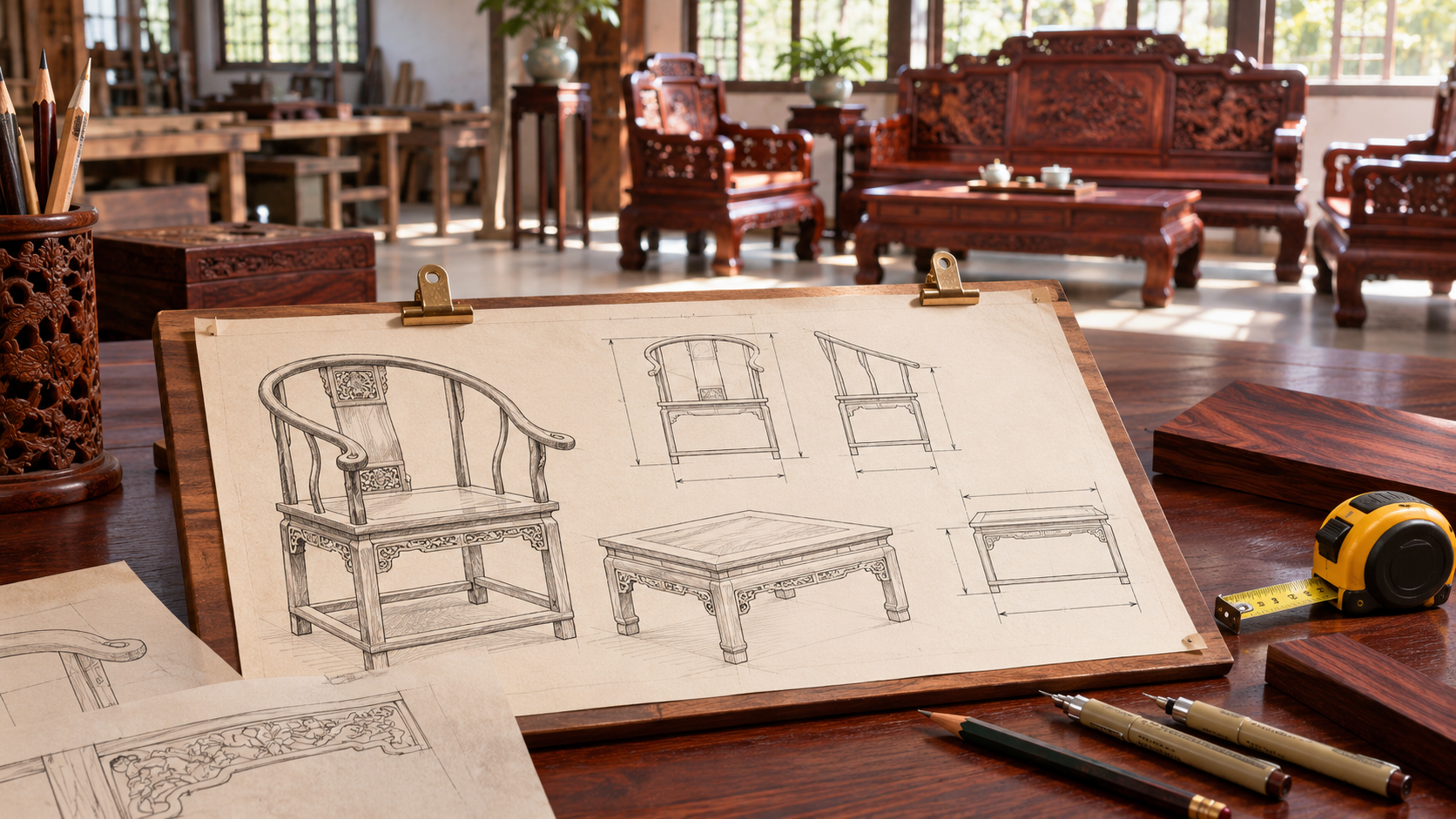
A practical six-step guide for overseas B2B buyers on communicating custom design requirements to a rosewood furniture factory in China: requirements documents, drawings, specification sheets, feasibility checks, sample approval and revision control.
Why Communication Decides the Outcome of a Custom Rosewood Furniture Order
When a wholesaler, hotel buyer or interior designer orders custom rosewood furniture from a factory in China, the single largest variable in the outcome is not the price and not even the factory's skill. It is the quality of the communication between buyer and maker. Classical Chinese furniture is built by hand, piece by piece, from mortise-and-tenon joinery that must be cut to precise proportions, from hardwood that must be dried and conditioned to a specific moisture content, and from carving patterns that take hours of skilled chisel work per table. Once production begins, there is no efficient way to reverse a carving that has already been cut two or three millimeters deep into rosewood, and no way to stretch a tenon that was sized for a different rail thickness. Everything downstream of the first cut inherits the accuracy of the instructions that came before it.
This is why requirements that stay verbal are so dangerous in this trade. A buyer who says "I want a nine-piece carved sofa set, Ming style, but a bit larger" has communicated almost nothing that a production team can act on. How much larger, in which dimensions, measured where? Which of the classical motifs should appear on the backrests, and at what relief depth? What seat height does the destination market expect? A factory that receives this kind of brief must guess, and both parties then carry the risk of the guess. If the guess is wrong, the correction may surface only when the container arrives in Europe or Australia - at which point the furniture cannot be economically reworked, because solid rosewood components are dimensionally locked by their joinery.
The stakes scale with the order. A single trial set that misses the mark is a recoverable cost. A full container of dining sets built to an ambiguous specification, or a villa project with forty pieces that do not fit the rooms, is not. Yet the underlying problem is nearly always the same: the buyer knew what they wanted in their own mind, but never translated that mental picture into drawings, numbers and written specifications that a factory on another continent could read without interpretation. The distance involved in sourcing custom furniture from China makes this translation step more important, not less, because there are no convenient site visits to patch over gaps in the brief.
The good news is that the communication problem has a well-understood solution, and it does not require the buyer to be a furniture engineer. It requires a short written requirements document, a set of drawings and references chosen for what each one can resolve, and a specification sheet that converts preferences into verifiable requirements. Factories on their side have matching tools - sample development processes, layout drawings, order tracking systems - that are designed to work with exactly these inputs. This article walks through the full sequence: what custom design actually covers in classical rosewood furniture, how to write down what you need, how to prepare drawings a factory can use, how to build a specification sheet, and then how the sample, production and shipment stages confirm what was agreed. The aim is that by the end, you can hand a rosewood furniture factory a package of documents that can be quoted accurately, sampled faithfully and produced without costly misunderstanding.
It is worth stating plainly what good communication protects. It protects your budget, because a factory quoting from a clear specification can price real work rather than adding contingency margins against unknowns. It protects your schedule, because questions raised during quoting are free, while questions raised during production cost days. And it protects the craft value of what you are buying, because classical Chinese furniture has a documented vocabulary of proportions, motifs and joinery conventions that a competent factory knows deeply - and your written brief is what allows that knowledge to be applied to your project rather than substituted by assumptions about it.
What "Custom Design" Actually Covers in Classical Rosewood Furniture
Before writing anything down, a buyer needs to understand which elements of a classical rosewood piece a factory can realistically flex and which are constrained by the craft itself. Custom does not mean infinitely variable. It means specific dimensions, patterns and configurations chosen from within a system that has its own logic. Knowing where the flexibility lies - and where it does not - is the difference between a brief a factory can execute and one that generates weeks of back-and-forth.
Dimensions and scale. This is the most flexible dimension of custom work, and the one most buyers care about first. Overall lengths, widths and heights of sofas, dining tables, beds, wardrobes and display cabinets can be adjusted to fit specific rooms, ceiling heights and market preferences. A villa in North America may want a dining table that seats ten rather than the standard six; a resort in Southeast Asia may need a lower, wider sofa platform suited to local lounging habits. Reputable factories offering OEM and ODM manufacturing routinely adjust sizes, and Yunxiao, for example, documents flexible OEM and ODM custom sizes and patterns specifically for villas and resorts. What a buyer should understand, though, is that size changes ripple. A longer table changes the spacing of its aprons and legs, which changes the proportion of the carved panels between them. An experienced factory will manage these ripples for you, but only if your drawing tells them the target dimensions and the room context they must serve.
Carving patterns and motifs. Classical Chinese furniture carries a rich repertoire of hand-chiseled motifs - dragons, clouds, lattice work, floral panels, auspicious characters - and the choice of motif, its density and its placement is genuinely customizable. This is where ODM input matters: a factory that carves by hand, as Yunxiao does with experienced artisans producing everything from dragon panels to open lattice, can adapt existing motifs to your panels or combine elements you request. The craft constraint to respect is depth and density. Hand relief carving is cut at depths on the order of two to three millimeters, and a documented example from one tea table involved roughly twelve hours of carving for a single table. Dense carving therefore adds real production time and cost, and extremely shallow or non-traditional relief may not read well in hardwood. Specify the motif and its prominence, and let the factory tell you what depth and density the design supports.
Joinery and structure. Here the flexibility narrows sharply, and a good buyer treats that as a feature rather than a limitation. Classical rosewood furniture is assembled with mortise-and-tenon joints, often reinforced with bamboo dowel pins, and in quality production the primary frame contains no metal fasteners. This construction exists for a reason: metal and wood expand and contract at different rates, and screwed or bolted hardwood frames crack and deform when furniture built in one climate is shipped to another. The proportions of a mortise and tenon are governed by the thickness of the members being joined, so a buyer cannot simply ask for a "thinner frame" without the factory recalculating the entire joint system. The right way to communicate on structure is to state the outcome you need - for example, that the furniture must withstand dry winter heating in Europe without joint failure - and let the factory confirm that its mortise-and-tenon system, doweling and drying regime are designed for exactly that.
Timber choice. Solid rosewood production is not a matter of picking any red-colored hardwood. Species differ in density, grain, color after finishing, and legal status. Yunxiao's product line, for instance, uses Siamese rosewood (Dalbergia cochinchinensis) along with legally certified Machilus Nanmu, aged red wood and Grade-A tropical hardwood, and because Dalbergia species sit on CITES Appendix II, species selection is inseparable from export documentation. A buyer should specify the species or material grade they expect in writing, and confirm it appears identically in the quotation, the sample and the sales contract. This is one of the areas where verbal agreement is weakest, because "rosewood" is used loosely in the market to cover several very different timbers at very different price points. For a fuller checklist of what to verify before committing, see the companion article on what to check before ordering custom furniture from a Chinese rosewood factory.
Finish. Finishing in classical rosewood work is a process, not a coat of paint. Traditional finishing uses raw lacquer and beeswax applied in multiple hand-rubbed coats; Yunxiao's lines use six-coat or nine-coat hand-rubbed raw lacquer, with each coat cured for twenty-four hours and rubbed down with pumice stone before the next. The finish affects color depth, sheen, feel and durability, and it is also where regulatory compliance lives - a factory finishing for export should meet standards such as EU REACH and US CARB. Buyers can usually choose among finish levels and sheen outcomes, but they should specify the target in the specification sheet and confirm it on the approved sample, because the same wood under different finishing regimes looks noticeably different in photographs.
Upholstery and hardware. Many classical Chinese pieces - armchairs, sofa sets, bed heads - incorporate cushions, fabric or leather, and fittings such as brass pull plates on sideboards and wardrobes. These elements are highly customizable and are often where a buyer's local market taste shows: fabric fire-retardancy expectations, cushion firmness, hardware color and style. They are also easy to omit from a drawing, because drawings naturally focus on the wooden body. Make upholstery and hardware explicit line items in your brief, with materials and any local compliance needs stated, so they are quoted and sampled rather than improvised.
What remains constrained. Beyond joinery proportions, two processes sit mostly outside buyer control, and understanding why prevents frustration. The first is drying. Solid hardwood must be audited to a moisture content in the region of eight to fourteen percent and conditioned to the destination climate before shipment; Yunxiao applies a thirty-six-day constant-humidity drying process to every product. This is not a step a buyer can shorten by negotiation - it is what keeps custom furniture from cracking in a heated European apartment or a humid Australian coastal home. The second is the sequence of hand operations: carving hours, lacquer curing days and joinery fitting cannot be compressed the way machine processes can, which is why realistic lead times for container orders at established factories run in the range of forty-five to sixty working days after deposit. Communicating your needs within these craft realities, rather than against them, is itself a form of good communication.
Step 1: Write Down What You Actually Need
The first concrete act of good communication is not a drawing and not a phone call. It is a short written requirements document, produced on the buyer's side, before any contact with a factory. Its purpose is narrow and important: to force you to convert intentions into statements, and to give the factory a single reference text against which its quotation and its questions can be checked. Most serious misunderstandings in custom furniture from China trace back to a requirement that existed only in conversation, so the document exists to make that impossible.
Start with the room or project context, because context drives more decisions than any single dimension. A dining set destined for a private villa has different requirements from one destined for a hotel restaurant: usage intensity, expected lifespan, cleaning regimes, coordination with interior finishes. State what the furniture is for, who will use it, and where it will end up - including the destination country and its climate. Climate is not a courtesy note; it determines the moisture conditioning the factory must target before shipment, and a factory like Yunxiao that conditions timber to the destination climate can only do so if it knows the destination. "For a residential project in southern Germany" carries more engineering information than three pages of dimensions.
Next, quantify. List the items you need and the quantity of each: nine-piece carved sofa set with tea table, one; six-seat dining set, four; double wardrobe with carved doors, six. Quantities shape everything downstream - whether the order fills a container, whether trial single sets make sense before full production, and how the factory schedules carving and drying capacity. A buyer ordering a full container of mixed items should also note which items are critical to ship first, because factories that support partial shipments for long-term partners can plan production order around your priorities, but only if the priorities are stated at the start rather than requested mid-production.
Then state your target market and any compliance expectations attached to it. If the furniture will be sold in the European Union, note that finishing should meet EU REACH requirements; if in the United States, note CARB. If your business requires documented legal sourcing, note that FSC chain-of-custody documentation and CITES export permits for applicable species should accompany the shipment. You do not need to be a compliance expert to write these lines - you need only tell the factory which market the goods are for, so that its export documentation team prepares the right papers. Yunxiao, for example, maintains an internal team for full export documents and includes FSC and CITES Appendix II permits per shipment on applicable product lines, but it is the buyer's written statement of destination and requirements that triggers the correct preparation.
Finally, and this is the discipline that makes the whole document useful, separate what matters from what is nice to have. Not every preference carries equal weight, and a factory that knows your hierarchy can make sensible trade-offs without stopping production to ask. Write it in two tiers. In the "must have" tier: species, the dimensions that must fit a specific room, the load-bearing and durability expectations, compliance documents, the delivery date the project depends on. In the "nice to have" tier: a preferred motif variant, a particular sheen level, an alternative fabric color. When the factory later reports that the denser carving would push production beyond your date, your tiering gives both sides a common basis for the decision - and it demonstrates to the factory that it is dealing with a buyer who knows the difference between a requirement and a preference, which changes the quality of the conversation in your favor.
Keep the document short. One to two pages is enough. A sprawling document with undefined terms is harder to act on than a tight one, and anything you cannot state precisely - the exact curve of a chair back, the exact tone of the finish - belongs in the drawings and the sample stage, which is where the next steps take over. The requirements document tells the factory what to achieve; the drawings tell it what the achievement looks like.
Step 2: Prepare Drawings and Reference Materials
Drawings are the language of production, and the practical question for a buyer is not whether to provide them but which kinds, given that most buyers are not draftsmen. The useful insight is that different input types resolve different kinds of uncertainty, and a good brief combines several of them deliberately. You do not need every input to be perfect; you need each input to do its specific job.
Reference photographs and sketches resolve questions of style and overall look. A photograph of a Ming-style armchair you want approximated, a picture of a carved panel whose dragon motif you like, a rough sketch of how you want a display cabinet configured - these tell the factory what family of design you are in. Their limitation is dimensional: a photo carries no reliable scale. A factory that quotes from a photograph alone is estimating proportions by eye, so treat photos as the starting reference, never as the sole source.
Dimensioned views - even simple ones - resolve questions of size and fit. This is the minimum technical input that every custom brief needs: for each item, the key dimensions written clearly - overall length, width, height, seat height, internal clearances where they matter, such as the distance between table legs if chairs must tuck under, or the interior width of a wardrobe against your room wall. A dimensioned hand sketch with straight lines and arrows is genuinely usable. What the factory needs is a number attached to each critical edge, not artistic quality. If you cannot draw, write the dimensions in a table beside a simple labeled rectangle; production teams read numbers, not beauty.
CAD or technical drawings resolve questions that photos and sketches cannot: exact proportions, section profiles, the relationship of a carved panel to its frame, hardware positions. Many interior designers and architects already produce these for their projects, and if you have them, send them - a factory accustomed to OEM and ODM manufacturing can read standard technical drawings directly. What matters most in technical drawings for classical furniture is the dimensioned orthographic views (front, side, plan) rather than perspective renders, which look impressive but hide true scale. If your drawing set includes both, make clear which view carries the authoritative dimensions.
Physical samples resolve what no image can: color, grain, finish sheen and the tactile quality of the timber. This is why the sample stage exists in professional custom work, and why sample arrangements matter when comparing factories - Yunxiao offers refundable samples, which reflects a standard structure: you approve a physical sample, and the sample becomes the reference object that production must match. If you have a piece of timber, a finish block or even a fabric swatch for upholstery, photograph it, describe it, and be prepared to send or match it at the sample stage. Every attribute confirmed on a physical sample is an attribute that cannot be disputed later.
When factories read drawings for sizes, they extract the controlling dimensions first - the ones that cascade into joinery and panel sizing - and then check the drawing for internal consistency. A drawing with conflicting dimensions, or one where the total width does not equal the sum of its parts, generates clarification questions that cost days. You can preempt most of this by having someone on your side check the arithmetic of your own drawing before sending it: does the sofa length plus the side tables actually fit the wall you measured? Do six chairs of the stated width actually fit around the stated table? Five minutes of checking on your side saves a week of correspondence on the factory's.
One further input deserves its own note: the room. For hotel, resort and villa projects, a simple dimensioned floor plan - room sizes, doorway widths, ceiling heights, the position of windows and fixed elements - transforms the conversation. Doorway and corridor widths in particular are forgotten constantly and matter enormously, because a wardrobe or bed head that fits the room but not the elevator or the staircase becomes a problem at installation. Use the factory's own capacity here as part of your preparation rather than after it: some suppliers, including Yunxiao, provide free layout drawings for projects, which means the factory can convert your dimensions and floor plan into a proposal showing how the full furniture configuration sits in your space. The effective way to use this offer is to send your floor plan and requirements document together and ask for the layout drawing early, then review it carefully - it is your last cheap opportunity to catch a spacing error, a clearance problem or an item count mistake before any wood is cut. Buyers working on hotel and villa projects can see how this sequence connects end to end in the article on how a rosewood furniture factory supports hotel and villa projects from layout drawings to container delivery.
A final practical habit at this stage: version and date every file. "Sofa drawing v3 - March" prevents the classic failure in which the factory produces to version two because it was the last attachment it downloaded. In an exchange that may run over weeks and multiple email threads, version control on your side is the cheapest insurance in the entire process.
Step 3: Turn Preferences into a Specification Sheet
Drawings show what the furniture looks like; the specification sheet states what it must be, in lines that can be verified. The move from drawings to a spec sheet is where communication becomes contractual, because each line of a good specification sheet is checkable - on the sample, during production or at pre-shipment inspection. The format is simple, and the discipline lies in completing every row rather than in the template itself.
Structure the sheet as a table with four columns: the item or attribute, the requirement stated as a measurable or verifiable condition, why it matters for this order, and how it will be verified. The "why" column is not decoration - it tells the factory's engineers the intent behind the requirement, so that when a conflict arises (as it genuinely can between, say, carving density and lead time), they propose a solution that preserves your intent. The "verify" column prevents the most common specification failure: a requirement written in language no one can later test. Below is an example of how such a sheet looks for a classical rosewood order. It is an illustration of the method, not a product promise - your own rows and values will come from your requirements document and your drawings.
| Item | Requirement (example wording) | Why it matters | How to verify |
|---|---|---|---|
| Timber species | Siamese rosewood (Dalbergia cochinchinensis) for all visible frame and panel parts; same species on sample and production | "Rosewood" covers several timbers at different prices and densities; the species determines value, color and CITES handling | Species named identically in quotation, contract and sample approval; CITES Appendix II export permit for the shipment |
| Dimensions | Per dimensioned drawing v3, dated; tolerances agreed in writing (for example, overall dimensions within a stated small range) | Furniture must fit the room, the doorway and the neighboring pieces as planned | Measurements checked on the approved sample and on finished pieces before packing |
| Carving motif | Cloud-and-dragon relief on backrest panels, hand-chiseled, density per drawing; target relief depth per factory recommendation (typically a few millimeters) | Carving hours drive cost and lead time; the motif defines the piece's character | Carved sample physically approved; production checked against the sample |
| Joinery | Mortise-and-tenon construction with bamboo dowel pins; no metal fasteners in the primary frame | Metal and wood move differently with climate; fastener-free frames resist cracking and deformation abroad | Construction confirmed in writing; sample joint inspected |
| Moisture treatment | Timber audited to 8-14% moisture content and conditioned to the destination climate before shipment | Undried hardwood cracks when moved between climates; this is the main defense against transit-seasoning damage | Drying process stated in the contract; destination climate named in the requirements document |
| Finish | Hand-rubbed raw lacquer, six-coat or nine-coat as selected, with beeswax; finishes meeting EU REACH and US CARB standards | The finish defines appearance and durability and carries the regulatory burden in your market | Finish approved on the physical sample; coating compliance confirmed for the destination market |
| Upholstery and hardware | Cushion fabric, color and firmness specified; brass hardware style and finish specified per drawing | These carry local market taste and local expectations such as fabric performance; easily forgotten in wooden-body drawings | Material swatches approved at sample stage |
| Packaging | ISPM-15 heat-treated export crates, with corner and surface protection inside | Rosewood surfaces and carved edges are vulnerable in a long ocean transit; crates must meet phytosanitary rules | Packing method stated in the quotation; photos at pre-shipment inspection |
| Documents | Full export documents per shipment; FSC chain-of-custody and CITES permits on applicable product lines | Missing paperwork delays clearance at destination regardless of how good the furniture is | Document set confirmed before balance payment; originals checked on receipt |
Two practices make the sheet work in practice. First, attach it to every document it governs: the quotation request, the sample order and the sales contract should all reference the same specification sheet and version number, so that "as per the spec" always means the same text. Second, treat the sheet as a living checklist during the sample stage. When the sample arrives, walk through the specification row by row against the physical piece - species, dimensions, carving, joinery, finish - and note any discrepancy in writing before approving. A discrepancy caught against the spec sheet is a correction; the same discrepancy caught after the container lands is a dispute. For a detailed view of what happens between an approved specification and a finished prototype, see the article on how a rosewood furniture factory develops samples and prototypes for custom B2B orders.
Completed well, the specification sheet changes the character of your relationship with the factory. Quotations become itemized against real requirements rather than estimated against guesses. Clarifying questions become rare and specific. And when production proceeds, both sides are measuring progress against the same written standard - which is, in the end, what communication was for. The next stages of the process, from sample approval through production tracking to shipment, are covered in the second half of this article.
Step 4: Confirm Feasibility with the Factory Before You Commit
Once your specification sheet is complete, the next step in communicating custom design requirements is a technical confirmation round with the factory before any deposit is paid. This stage exists to answer one question: can the piece you have described actually be built the way you described it, from the material you named, to the standard you expect? Closing these questions in writing protects both sides. The buyer avoids paying for a design that has to be reworked, and the factory avoids producing a piece that will be rejected at inspection because an assumption was never checked.
The first technical question is timber availability and substitution. Rosewood furniture is made from specific species, and at Yunxiao the documented material range includes legally certified Machilus Nanmu, aged red wood, Grade-A tropical hardwood and Siamese rosewood (Dalbergia cochinchinensis). If your drawings specify a species the factory does not stock, the correct outcome is not silence but a written substitution proposal: the factory names the alternative, explains the difference in grain, color and density, and the buyer accepts or rejects it in writing. Never let a species change happen implicitly between quotation and production. For B2B orders, especially custom furniture from China destined for regulated markets, species substitution can also affect the compliance documents attached to the shipment, so a substitution agreed in writing should trigger a re-check of the paperwork as well as the product.
The second question is moisture content and climate conditioning. A general principle in solid hardwood work: timber that is dried to a moisture content appropriate for the factory's climate will move when it reaches a very different one. Cold, dry winters in North America or Europe pull moisture out of wood and can cause cracking; humid coastal climates in Southeast Asia do the opposite. This is why the factory's own process matters and why it belongs in your written exchange. Yunxiao's documented process is specific: timber is audited to 8-14% moisture content, every product goes through 36 days of constant-humidity drying, and pieces are conditioned to the destination climate before shipment. A buyer should confirm in writing that destination conditioning applies to their order, because it is one of the few variables that meaningfully changes how a solid rosewood piece behaves after arrival.
The third question concerns carving depth and motif reproduction. Hand-carved classical Chinese furniture is produced by artisans chiseling motifs such as dragons, clouds and lattice by hand, and hand work has a range rather than an identical output. Yunxiao documents an example on one tea table of approximately 12 carving hours per table with relief cut at 2-3 mm depth. When you submit a motif, ask what the factory can hold consistent across a set: the depth, the line sharpness, the general composition. Hand carving means small variation between pieces is part of the craft; what you should define in writing is the tolerance you consider acceptable, so that natural variation is not mistaken for a defect later. If your reference image is a machine-carved or CNC-rendered pattern, say so, and ask how hand carving will interpret it.
The fourth question is joinery, and this is where feasibility conversations often change the design. Classical construction relies on mortise-and-tenon joinery with bamboo dowel pins and no metal fasteners in the primary frame. The proportions of those joints depend on the proportions of the piece. If a buyer enlarges a carved sofa set beyond its standard dimensions, the tenon thickness, rail widths and panel sizes may need to be recalculated, or the frame may lose the strength and resistance to cracking and deformation that the joinery system is designed to provide overseas. Expect the factory to propose such changes, and treat a counter-proposal as engineering input rather than resistance. The right response is to ask why the change is needed, confirm the structural reasoning, and then approve the revised drawing formally. A factory that explains its joinery adjustments is doing the feasibility work this step is for.
The fifth question is finishing and compliance documents. Finishing is not only an aesthetic choice; it interacts with the regulations of your market. Yunxiao's documented finishing is an eco-friendly beeswax and lacquer system meeting EU REACH and US CARB standards, applied as six-coat or nine-coat hand-rubbed raw lacquer with each coat cured 24 hours and rubbed with pumice stone. When you specify finish, confirm which system applies to your product line, the number of coats, and the sheen you expect, and confirm in writing that the required documentation - which for Yunxiao includes FSC chain-of-custody and CITES Appendix II export permits per shipment on applicable product lines - will accompany your order. If a buyer's specification implies a finish outside the factory's standard systems, that too must be surfaced now, not after finishing has begun.
A practical way to run this step is a short written feasibility checklist sent with your drawings, covering species, moisture conditioning, carving tolerances, joinery changes for resized pieces, and finish compliance. The factory's answers, once returned, become part of the order record. If you have not yet vetted the factory itself, the checks described in what to check before ordering custom furniture from a Chinese rosewood factory pair naturally with this feasibility round.
Step 5: Agree on Samples and Approval Standards
A sample answers questions that drawings cannot. A drawing shows geometry; a sample shows how a finish reads under light, how a carving edge catches shadow, how a color sits on the actual timber, and how a joint closes. But a sample also has limits, and stating those limits plainly is part of good communication. A sample proves material, finish treatment, carving quality and construction method at a point in time. It does not prove that a full production run of a different size will behave identically, and it does not transfer automatically to pieces with substantially changed dimensions, because grain selection and finishing outcomes vary with each board and each piece. Understanding what a sample does and does not prove keeps the approval conversation honest on both sides.
For B2B buyers, the scale of sampling is a real concern: a complete carved sofa set is a large commitment to make twice. This is why structured sampling offers matter in the buying decision. Yunxiao's documented offers include refundable samples and trial single sets. A trial single set lets a buyer evaluate one complete piece - a chair, a tea table, a bedside cabinet - under the full production process rather than a reduced mock-up, and a refundable sample arrangement means the sample cost can be credited against the container order when the buyer proceeds. Both terms should be confirmed in writing before sampling begins, along with who pays freight and how long the sample stage takes.
The most common sampling failure is not a bad sample; it is an undefined approval standard. If nobody has written down what "approved" means, the buyer judges the sample against a private mental image and the factory judges it against its standard practice, and the two rarely match. Before the sample is made, agree in writing on the criteria you will use to approve it:
- Dimensions. State the tolerances (for example, within a small fixed margin on overall width, depth, height and seat height) and specify the units.
- Color and tone. Ideally against a physical color reference you both hold, not a screen rendering, because screens shift color substantially.
- Finish sheen. Matte, semi-matte or gloss, and whether the beeswax or the lacquer system defines the surface.
- Carving quality. Depth (the documented 2-3 mm relief on comparable work is a useful reference), edge sharpness, motif fidelity to the approved drawing.
- Joints. Tight closure of mortise-and-tenon joints, clean bamboo dowel pinning, no gaps visible at normal viewing distance.
- Overall condition. Surface smoothness, absence of cracks or checks, consistency of tone across visible faces.
Photographs and videos are valuable during production but are not a substitute for a physical sample at the approval stage. Photos compress color range, flatten sheen and hide surface texture; a carving that looks crisp in a well-lit close-up may read differently across a whole chair face. The sensible division of labor is: physical sample for first approval of material, color, finish and carving; photos and video for confirming that production pieces match the approved sample, for reviewing details that would be expensive to ship, and for progress checks on a running order. Say which medium governs which decision before either is used, so a photo approval is never later re-litigated against a physical piece.
Finally, record the outcome of the sample stage itself: which sample was approved, on what date, against which revision of the drawings. That approved sample becomes the reference object for the entire order, and every later dispute is settled by pointing at it. The mechanics of how a factory builds and refines prototypes for this stage are described in more detail in how a rosewood furniture factory develops samples and prototypes for custom B2B orders.
Step 6: Manage Revisions and Version Control
Custom projects rarely survive to production without a revision. A dimension changes after the hotel's floor plan is finalized, a client asks for a different carving motif, a market test suggests a darker finish. Revisions are normal; uncontrolled revisions are what damage custom projects. The discipline in this step is simple and almost entirely procedural.
Number every drawing revision. The first set of drawings is Rev. A; the first change produces Rev. B; and so on. Every file carries the revision letter, the date, and a one-line description of what changed. When the factory confirms a revision, it confirms against that number - "Rev. B confirmed, price and drawings updated accordingly" - and the previous version is retired from active use. A surprising number of disputes in custom furniture from China trace back to two parties working from different revisions of the same drawing, each certain they are right because both documents look similar at a glance.
Confirm every change in writing, in the main project channel. If a size change is discussed in a phone call or a video walkthrough, the follow-up message should restate it - "confirming: sofa length changes from X to Y centimeters, Rev. B drawing attached" - and the factory's written acknowledgment closes it. Verbal agreement is memory; writing is record. When production is running, memory is not sufficient to stop a cutting list from being built to the wrong number.
Avoid mixed-channel instructions. B2B projects accumulate channels: email, a messaging app, video calls, sometimes a colleague forwarding a screenshot. When instructions arrive through three channels, two things go wrong - messages are missed, and messages are duplicated with slight differences. Agree at the start on one primary channel for instructions and confirmations, and use other channels only for logistics or scheduling, with anything binding copied into the primary channel. Assign one name on the buyer's side and one on the factory's side as the points of decision, so conflicting instructions from different people on the same team do not reach the workshop.
Understand what a revision does to cost and schedule. The documented production window for container orders is 45-60 working days after deposit, and that window assumes the approved drawings stay stable. A change requested before cutting begins may cost little; the same change after timber has been cut, carved or finished can require rework from an early stage, because in classical construction the carved panels and joinery members are dimensioned to each other. Hand carving in particular cannot be "edited" - a changed motif means new carving hours. The practical rule: batch your revisions, finalize them at the approval stage, and after production starts treat further changes as exceptional decisions with an explicit cost and schedule consequence to be confirmed before work proceeds. How the order is then monitored from workshop to container is covered in how to track a custom rosewood furniture order from production to shipment.
How a Rosewood Furniture Factory Turns Your Requirements into Production
Knowing the production chain helps a buyer communicate, because each stage answers a different kind of question, and knowing where your input matters most tells you when to raise it. The sequence below reflects the general process of classical solid rosewood manufacturing, grounded in the documented stages of Yunxiao's production.
Drawings and confirmation. Production begins with the approved drawing set - Rev. B, C or beyond - plus the specification sheet and the approved sample reference. This stage answers the questions of geometry and intent: sizes, proportions, motifs, finish specification. Buyer input here is everything; after this point, changes become rework.
Timber selection. The factory selects material from its certified range - Machilus Nanmu, aged red wood, Grade-A tropical hardwood or Siamese rosewood - matching grain and color across the pieces of a set. This stage answers questions of material identity and appearance: which species, how grain is matched across a sofa set, what tone variation is natural. A buyer's written species and appearance expectations, agreed in Step 4, govern this stage.
Drying and climate conditioning. Timber is audited to 8-14% moisture content and each product undergoes 36 days of constant-humidity drying, with conditioning to the destination climate before shipment. This stage answers the durability questions: how the piece will behave in a dry European winter or a humid Southeast Asian monsoon season. The buyer's only task here was to state the destination climate clearly - and to be suspicious of any process that skips this stage.
Cutting and joinery. Members are cut and classical mortise-and-tenon joints are formed, later pinned with bamboo dowels, with no metal fasteners in the primary frame. This stage answers the structural questions: whether a resized piece holds its strength, which is exactly why the factory may have counter-proposed proportion changes back in the feasibility step. The joinery decisions are already locked in the approved drawings.
Hand carving. Artisans chisel the motifs - dragons, clouds, lattice and related traditional patterns - by hand, at relief depths comparable to the documented 2-3 mm and with carving times on the order of the 12 hours documented for a single tea table. This stage answers the aesthetic questions, and it is where the written carving tolerance from Step 5 earns its keep: hand work varies slightly between pieces, and the written standard defines what variation is within craft norms.
Assembly. Components are assembled into complete pieces - carved sofa sets with tea tables, dining sets for 6 to 12, bedroom suites, display cabinets - with joints closed and pinned. Progress photos and video are most useful here for a buyer verifying that production matches the approved sample.
Finishing. The beeswax and lacquer system is applied as six or nine hand-rubbed coats of raw lacquer, each cured for 24 hours and rubbed with pumice stone. This stage answers the surface questions: sheen, depth of color, smoothness. Because each coat needs its cure time, finishing consumes a fixed block of the schedule - one more reason late finish changes are expensive.
Crating and export documentation. Finished pieces are packed in ISPM-15 heat-treated export crates, and the shipment is accompanied by full export documents prepared by the factory's internal team, including FSC chain-of-custody and CITES Appendix II export permits on applicable product lines. This stage answers the compliance and logistics questions that were agreed on paper months earlier - which is why those papers needed to be right in Step 4, not improvised at the port.
Common Communication Mistakes and How to Avoid Them
Most failed custom orders do not fail on craftsmanship; they fail on communication. The table below collects the mistakes that appear most reliably in cross-border custom furniture projects, what each one causes, and the practice that prevents it.
| Mistake | What it causes | What to do instead |
|---|---|---|
| Verbal-only changes during production | The workshop builds to the last written drawing; the change is "discovered" at final inspection, when rework is most expensive. | Confirm every change in writing against a numbered revision, with the factory's acknowledgment, before work continues. |
| Missing or mixed units (inches vs. millimeters, metric-only drawings vs. imperial habits) | A sofa arrives inches off from expectation; in joinery-driven construction, small unit errors compound across connected pieces. | Declare one unit system for the whole project and repeat it on every drawing and every dimension in the specification sheet. |
| Unreadable or ambiguous reference photos - dark, angled screenshots with no caption | The carver interprets the motif freely; the buyer expected a different pattern, depth or density of carving. | Send high-resolution, well-lit references, name the motif and the elements you care about, and have the factory return its interpretation as a drawing for approval. |
| Skipping written approval criteria before sampling | Sample approval becomes a matter of taste argued after the fact, and "approved" gets re-litigated against the production run. | Define dimensions, color, sheen, carving depth and joint standards in writing before the sample is made, and record which sample was approved. |
| Late changes after production has started | Rework of cut timber, new carving hours, and slipping of the 45-60 working day production window after deposit. | Batch and finalize revisions at the drawing and sample stage; treat post-start changes as exceptional, with confirmed cost and schedule impact. |
| Assuming the factory's climate equals your market's climate | Timber dried for a humid production region can check or swell in a heated European interior or an air-conditioned villa, even with good joinery. | State the destination climate in the specification and confirm in writing the 36-day constant-humidity drying and destination conditioning apply to your order. |
None of these mistakes requires unusual negligence to occur; each is the default behavior of a busy project. The fix in every row is the same in kind: move the decision from memory into a document that both parties have confirmed.
Frequently Asked Questions
What units and drawing formats work best when sending requirements to a factory in China?
Declare one unit system for the entire project - millimeters are the convention in Chinese furniture manufacturing - and apply it consistently across drawings, specification sheets and email confirmations. For formats, standard vector files (such as CAD exports and PDF drawings) with clear dimension lines work well; reference images can be high-resolution photos, but every image should carry a caption saying what it shows and which elements are binding versus inspirational.
How detailed do my drawings need to be?
Every dimension that matters to you must appear on the drawing; anything left off will be decided by the factory from its standard practice. As a minimum: overall dimensions of every piece, seat and table heights, clearances, the motifs and their placement, and the finish specification. If you cannot produce technical drawings yourself, a dimensioned sketch plus a written specification sheet is workable, provided the factory returns its own drafted drawings for your approval - which is effectively what the factory's layout drawings do for project orders.
Can I make small customization changes, or is custom work only for full redesigns?
Customization covers a range. Documented OEM and ODM offers at Yunxiao include custom sizes and patterns - adjusting the dimensions of a dining set to fit a room, or adapting carving motifs - alongside fully bespoke development. Small changes are generally feasible when they are specified clearly and confirmed before production; what matters is not the size of the change but whether it is captured in a revised drawing and acknowledged in writing like any other requirement.
Where does sampling fit in the overall timeline?
Sampling sits between drawing approval and mass production, so its duration adds to the total project time before the 45-60 working day container production window even begins. A trial single set or a refundable sample needs to be built, finished, shipped and evaluated - each step taking real time - which is why buyers planning fixed opening dates for hotels or villas should build the sample stage into the schedule from the start rather than compressing it at the end. Note also that finishing alone consumes a fixed sequence of coats and 24-hour cures, so sampling cannot be accelerated indefinitely.
What documents come with an export shipment?
Yunxiao's internal team prepares the full export document set per shipment. On applicable product lines this includes FSC chain-of-custody documentation and CITES Appendix II export permits, alongside standard export paperwork. Crating uses ISPM-15 heat-treated export crates. Buyers should confirm at the quotation stage which documents apply to their specific species and destination market, since the document set follows the timber specification agreed in the drawings.
Start Your Custom Design Conversation
Communicating custom design requirements to a rosewood furniture factory in China comes down to a short chain of written steps: a specification sheet, a feasibility round, defined sample approval criteria, and controlled revisions - each one turning a preference into a document the workshop can build from. If you have drawings, a room layout, or even a set of reference images and dimensions, send them to Yunxiao Rosewood Furniture. We will return a quotation, free layout drawings for your project, and arrange samples under our refundable sample policy, with OEM and ODM custom sizes and patterns for villas, resorts and trade clients. The clearer your requirements arrive, the more of that first conversation we can spend on the details that make classical solid rosewood furniture worth specifying.