
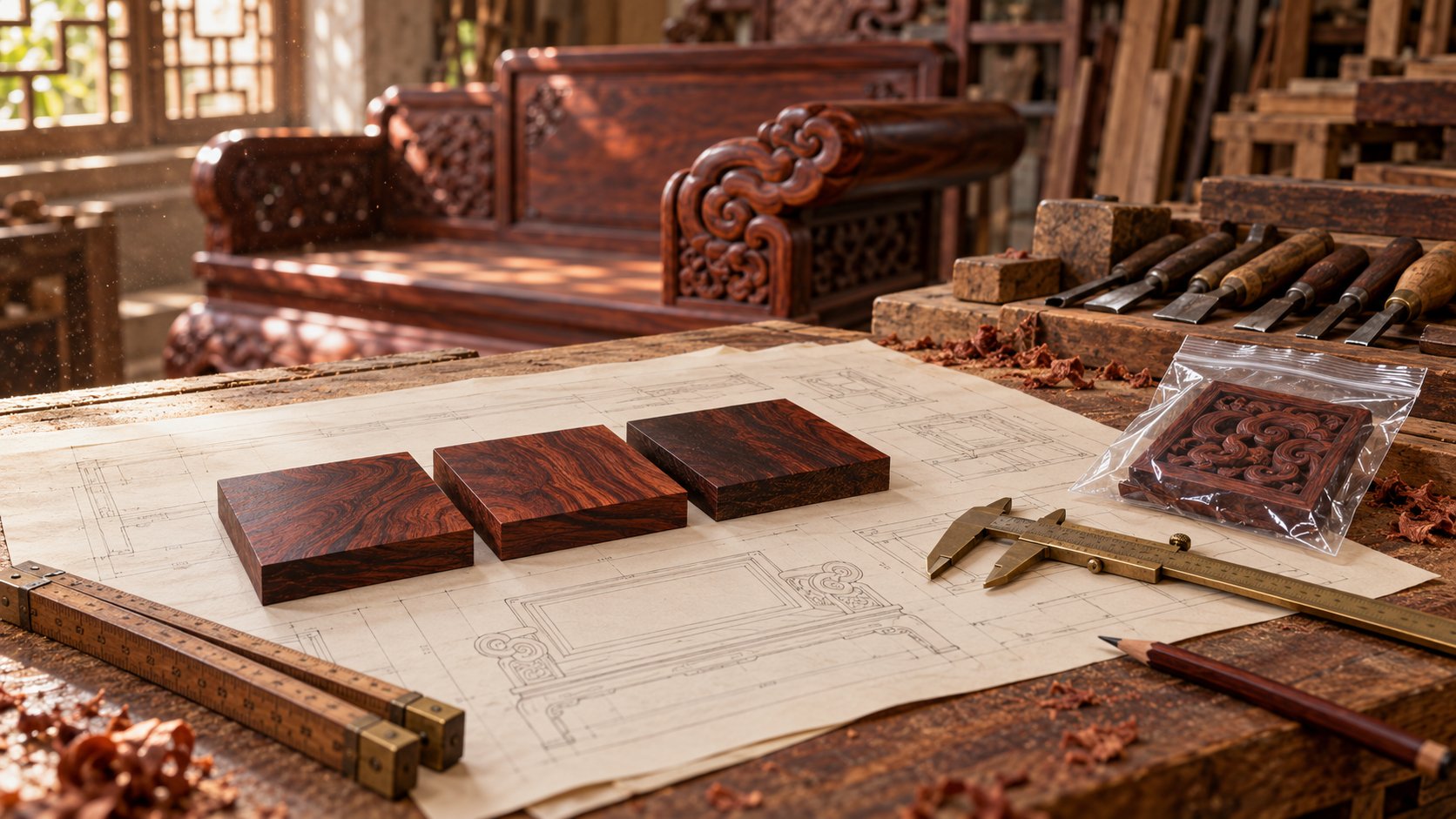
A buyer-side checklist for custom furniture orders placed with a Chinese rosewood factory: approved shop drawings, botanical species and grade, sealed samples, MOQ and container mix, lead-time milestones, export documents and inspection clauses.
Product Insight · Custom and OEM Orders
The short answer: before you wire a deposit to a Chinese rosewood factory for custom furniture, six things should already exist on paper — a dimensioned shop drawing you have approved, the botanical species and grade of every visible timber, a sealed sample you have signed, a minimum order quantity stated per model rather than per container, a lead time tied to named milestones, and an export document set matched to your destination country. If any one of those six is still a verbal promise in a chat thread, the order is not ready for a deposit, no matter how good the showroom photographs look.
This article walks through those six items in the order they usually break. It is written for importers, wholesale distributors, hospitality procurement teams and interior design studios who are placing a first or second custom order with a hardwood factory in China and want to know what to demand before money moves. Where our own workshop practice is relevant, we describe it plainly, including the parts that depend on the individual order.
The reason to be this pedantic is simple. A stock order can be judged by a catalogue photo and a price. A custom rosewood order cannot. The piece you receive is the result of about a dozen handoffs — drawing, timber selection, drying, joinery, carving, finishing, packing, documentation — and each handoff is a place where your intent can quietly drift. Buyers who lose money on custom furniture rarely lose it because the factory cannot build; they lose it because nobody wrote down what “correct” meant until the container was already on the water.
Why do custom furniture orders fail before production even begins?
In our experience of export orders from Xianyou County, the failures that hurt buyers most are decided in the weeks before a single board is cut. They fall into six recognisable patterns.
- Specification drift. The buyer approved a design intent — a Pinterest image, a hotel mood board, a sketch with three dimensions — and the factory interpreted it. Nobody produced a dimensioned drawing with tolerances, so both sides were honest and both sides were wrong.
- Species substitution by ambiguity. The purchase order says “rosewood” or “red wood”. Those are trade words, not species. A factory that receives an ambiguous species name will build with whatever it considers a fair commercial match, and the buyer discovers the gap at the customs declaration or at the first claim.
- Sample-to-production gaps. The sample was beautiful and the container was not, because the approved sample was a one-off carved by a senior artisan rather than a fair production reference, or because nobody sealed it and the colour drifted between batches.
- MOQ surprises. The buyer plans a 20-model assortment for a boutique hotel and learns at quotation stage that each model carries its own minimum, turning a tidy plan into three containers.
- Lead-time arithmetic. “60 days” is quoted, then measured from a different starting point than the buyer assumed, and lands after the hotel opening instead of before it.
- Documents at the port. Timber legality paperwork, plant-health certificates or permits for a CITES-listed species are requested after the container is booked, when there is no longer any schedule slack to absorb a delay.
Each of these is cheap to prevent and expensive to fix. That asymmetry is the practical argument for treating pre-order verification as the real work of sourcing custom furniture, and the production phase as execution.
What should a shop drawing package contain before you approve it?
A drawing that is good enough to negotiate price is not necessarily good enough to manufacture. The test is whether a joiner who has never spoken to you could build the piece correctly from the sheet alone. In our workshop, the drawing package that goes to the production floor is expected to answer the following questions without a phone call.
Dimensions, scale and tolerance
Every custom piece needs overall dimensions plus the dimensions that actually govern comfort and fit: seat height, seat depth, arm height, table apron clearance, drawer internal depth, shelf spacing, and the footprint of the piece as packed. Units should be stated explicitly, because a millimetre and a inch are only one keystroke apart in a spreadsheet. Ask for the dimension unit and the tolerance band to be printed in the drawing title block rather than negotiated per part; then check that the tolerance makes sense for the joints involved. A face-frame joint and a carved backrest panel do not tolerate the same deviation, and a drawing that applies one blanket figure to both is a drawing that has not been thought through.
Two dimensions are missed so often that they deserve their own line. The first is the door-to-room path: a 2.4 m sideboard that cannot pass a service lift is a 2.4 m problem. The second is the destination interior. Our rectangular eight-seat dining table is 180 cm long and is sized for dining rooms of roughly 20 to 30 square metres; put that same table in a 14 square metre room with a sideboard and the buyer will measure it as “too big” even though the drawing was accurate. Give the factory the room dimensions and the circulation you need, not only the furniture dimensions.
Material callouts, component by component
A custom drawing should name the material for each component, not once for the whole piece. Visible frame, visible panels, structural rails, secondary internal parts, drawer bottoms, back panels and any inlay are separate lines. This is where honest factories differentiate themselves: it is easy to specify solid rosewood on the parts a buyer will photograph and something lighter on the parts they will never see. If the drawing does not separate them, you cannot tell which happened.
Ask for the joinery to be drawn, not described: where the mortise sits, how the tenon is pinned, which joints are glued and which are mechanically fixed, and whether any metal fasteners enter the primary frame. This matters for export because a frame that relies on screws in a humid workshop can loosen in a dry, heated interior. Our own frames are assembled with mortise-and-tenon joints and concealed bamboo dowels, without metal fasteners in the primary frame, and that is the kind of statement that belongs in a drawing note so that it survives staff changes on both sides.
Finish and colour reference
“Natural” or “medium brown” is not a finish specification. The drawing or its attached finish sheet should state the sheen level, the number of coats, the type of finish and the colour reference — and the colour reference should be physical, not a screen. Screens disagree; two phones in the same room disagree. A finish sample board prepared on the actual timber lot is the only reference that both parties can be held to, and it should travel with the sealed sample discussed below.
Hardware, inlays and packing marks
Custom orders in this category often include stone inlay tops, glass, brass fittings or soft-close hardware. Each of these needs its own line with the model or specification and who supplies it. Packing marks belong on the drawing too: which face must not be compressed, which corner needs foam, whether the piece ships assembled or knocked down, and how the carton is labelled for multi-room hotel deliveries where a crate has to arrive at a specific floor without being opened.
Revision control and an approval signature
The single most useful field on any drawing is the revision letter. A drawing that changes without a revision log turns every later conversation into a memory contest. Ask for revision letter, date, a one-line change description, and a signature block for the buyer, so that the approved version is identifiable months later when a replacement part is needed. When we quote a change, the revised drawing is what carries it, not the email that requested it.
| Drawing element | What a complete version shows | What to send back |
|---|---|---|
| Dimensions | Overall plus seat, apron, drawer and footprint figures, with unit and tolerance in the title block | Any sheet where tolerance is described as “standard” |
| Material callouts | A material named for every component, including secondary and hidden parts | One blanket “solid rosewood” note for the whole piece |
| Joinery | Joint positions drawn, pin method stated, metal fasteners explicitly allowed or excluded | Joinery left to the workshop’s discretion |
| Finish | Coat count, sheen, finish type and a physical colour board tied to the timber lot | Colour approved from a photograph |
| Packing | Crate type, protection points, assembled or knocked down, labelling for room-level delivery | “Export packing” as an unexplained promise |
| Revision | Revision letter, date, change note, buyer signature block | Undated files named “final” and “final2” |
How do you pin down wood species and grade in writing?
Species is the line item where a custom order carries the most value and the most ambiguity. “Rosewood” is a commercial category, not a species, and the same English word has been applied to timbers from several genera and continents. If the purchase order does not name the species, the factory cannot be held to one.
Write the botanical name next to the trade name for every visible component. In our own specification sheets the working materials are Siamese rosewood (Dalbergia cochinchinensis), Machilus Nanmu, aged red wood and Grade-A tropical hardwood, and the species is stated per product rather than as a category label. Two habits make this enforceable. First, add a no-substitution clause: if the named species cannot be supplied within the agreed window, the factory must notify you and wait for written approval rather than deliver a “similar” timber. Second, ask for a species declaration per shipment that matches the line items, because that is the document your customs broker and your compliance team will actually read.
Grade needs the same treatment. “Grade A” means nothing until it is defined, so define it in the terms a factory can measure: acceptable defect limits, colour and grain matching rules, moisture content, and what happens to a board that fails. Our production standard conditions timber to 8 to 12 percent moisture content through a 36-day constant-humidity drying cycle, with a 48-hour equalisation period before machining, and boards whose grain runs more than four degrees off the length axis are diverted to shorter components instead of being used in a long rail. Those are auditable statements: a buyer can ask for moisture readings at loading, and can ask how grain is sorted, and will get a concrete answer or a revealing silence.
Colour matching deserves its own sentence in the order. Solid timber is not a painted surface; two boards from the same species can differ visibly in tone. Across a ten-seat sofa set or a full bedroom suite, the eye reads mismatched panels as a quality fault even when each piece individually passes. If the order covers multiple pieces that will stand in one room, state that visible surfaces should come from a consistent timber selection and ask how the factory plans that selection across the batch. Our answer, for container orders, is to sort and match grain and colour across the run before assembly rather than after finishing — which is also why changing quantities late in the process costs more than it looks.
Finally, decide what your evidence standard is and say so before the order. A moisture meter reading at loading, a photograph of the board stack with the lot number, a retained offcut from the actual batch: all are cheap. A laboratory species test is not cheap but is the only method that settles an argument about identity after arrival. Buyers who import a new species for the first time often retain one offcut per model precisely so that a later dispute has physical evidence behind it.
What does a sealed sample actually prove — and what does it not?
A sealed sample, sometimes called a golden sample or master sample, is the physical object that both parties sign and keep. It converts a hundred adjectives into one artefact. But it is worth being precise about what it settles, because buyers often treat a sample as a guarantee of the whole order and are then surprised.
A properly handled sample proves four things at the moment it is approved: the colour and sheen of the finish on that timber lot, the depth and crispness of the carving on that motif, the feel of the joinery and the tightness of the joints, and the dimensional accuracy of one piece against its drawing. What it does not prove is that every piece in a container will match it exactly. Timber is a natural material, and a factory that promises a perfect match across forty pieces is either misunderstanding the material or managing your expectations badly. What a sealed sample should do is define the acceptable range — and that range has to be written down next to the sample, because a sample without a stated tolerance becomes an absolute standard the moment a dispute starts.
The mechanics matter more than buyers expect. Insist on three things. First, the sample is sealed and signed by both parties, with a date, the drawing revision it was built to, the species and the finish reference written on the label. Second, colour is approved in consistent light, ideally daylight or a defined colour temperature, never on a phone screen in a car park. Third, the sample is photographed against a scale and a colour reference so that the record survives even if the physical piece is later damaged in transit.
Custom orders also need a decision on which sample is representative. For a carved bedroom suite, a full-size sample of every piece is expensive and slow; a carved panel sample plus an approved corner joint plus a finished colour board is often enough to freeze the specification, provided everyone agrees in writing that those three elements define the standard for the rest. Our own practice is to offer trial single sets and refundable samples for buyers evaluating a new line, precisely because a buyer who has handled one finished piece makes a better decision than a buyer who has only seen renders. That is also the point at which the sample becomes a milestone: nothing should go into volume production until the sample is signed, because the sample is the cheapest possible place to discover that the carving motif reads differently at production scale, or that the finish is glossier than the showroom piece.
Carving deserves a footnote here. Hand-carving time is not uniform across motifs, and a design that looks like a small change can add days per panel. One of our dining chair lines carries hand-carved bamboo motif backrests at roughly sixteen carving hours per panel. If your custom order changes the motif, ask what the carving time becomes, and let that number feed the lead time rather than discovering it during production. More on the sample and prototype process itself is set out in our article on how a rosewood furniture factory develops samples and prototypes for custom B2B orders.
How should MOQ and container mix be written into the order?
Minimum order quantity is the clause most likely to be misunderstood because three different minimums get used in the same conversation: a minimum per model, a minimum per order, and a minimum per container. They are not interchangeable, and a quotation that does not say which one it means will cause a fight later.
Ask for the MOQ table per model, then ask the question that actually determines your plan: can different models ship in one container? In our case, container orders can mix products across sofa, dining and bedroom categories, and long-term partners can arrange partial shipments to phase a project rollout. That flexibility is what makes a hotel or multi-unit residential project workable, because a project rarely needs a full container of one model. Confirm two numbers before you commit: the packed volume per model, and the maximum mixed configuration the factory will accept without a surcharge. Packed volume is the number that decides whether your assortment fits 40HQ or needs a second box, and it is not the same as the product dimensions on the drawing.
Two further points belong in this clause. First, state whether the MOQ is measured before or after the sample order, because a refundable sample set is normally additional to the production minimum. Second, if the project may expand, write down how repeat orders are treated: a second container at the same specification should not require re-approval of drawings and samples, and the factory should be able to say how long it retains the approved sample and the drawing revisions. If the answer is “we will find it when you order”, the price of your repeat order carries avoidable rework. The mechanics of mixing configurations are covered in more detail in our guide to the minimum order quantity for rosewood furniture and mixing a container.
How do you tie lead time to milestones you can enforce?
A lead time is only useful if it has a starting point and a definition. “60 days” quoted without either is a number that will be reinterpreted at least once. Our container orders are scheduled at 45 to 60 working days after deposit confirmation, which is a working-day figure, not a calendar-day figure, and it begins after the deposit is confirmed rather than after the purchase order is signed.
That distinction is where project schedules break. If your order needs a new motif, the clock that matters does not start until the sample is approved, and approval can take as long as your own review does. A practical schedule therefore lists the milestones and who owns each one, so that a delay has an address.
| Milestone | Owner | What it gates |
|---|---|---|
| Drawing revision approved | Buyer | Quotation can be fixed; timber list can be raised |
| Sealed sample signed | Buyer and factory | Volume production release; finish and carving standard frozen |
| Deposit confirmed | Buyer | Production slot; the 45–60 working day clock starts |
| Timber released and conditioned | Factory | Frame assembly; moisture content confirmed before machining |
| Frame assembly and carving complete | Factory | Finishing schedule; the point to request in-process photographs |
| Finishing and curing complete | Factory | Pre-shipment inspection window |
| Inspection passed | Buyer or third party | Packing; any rework gets absorbed before the container is booked |
| Documents issued | Factory and forwarder | Customs clearance at destination |
Two calendar realities sit outside that table. The first is the Chinese New Year shutdown, which compresses production and inland transport for several weeks and pushes bookings forward. If your delivery window lands in the first quarter, work backwards from the shutdown rather than from your own installation date; we have written separately about when to order rosewood furniture from China before Chinese New Year 2027. The second is ocean freight variability: transit time and port congestion are not factory-controlled, so keep the factory lead time and the shipping time as two separate numbers in your plan instead of blending them into one vague promise.
A schedule with milestones also gives you a fair basis for escalation. If a step slips, you can see which step and whose input it needs, and whether the fix is a phone call or a change to the packing plan. The commercial side of that conversation, including how repeat container orders are scheduled, is discussed in our article on how long custom rosewood furniture takes to manufacture and deliver.
Which export documents must be confirmed before you pay a deposit?
Documentation is the part of a custom order that buyers most often leave to the end, and it is the part that can stop a container at the border. Two document families are involved: those that establish the legality and traceability of the timber, and those that move the goods and settle the payment.
On legality, the relevant question is which species you are importing and what your destination requires. For a CITES Appendix II species such as Dalbergia cochinchinensis, export permits are issued per shipment, so the permit cannot meaningfully be promised a year in advance; what can be confirmed at quotation stage is whether the factory routinely issues them for that species and what documentation the permit will reference. FSC chain-of-custody documentation is a separate track and answers a different question: it traces material through the supply chain rather than authorising trade in a listed species. Our standard export set includes FSC chain-of-custody documentation and CITES Appendix II export permits where the species requires them, with certificate numbers confirmed at inquiry rather than asserted in a brochure. Buyers with a compliance team should ask for the certificate type and scope, not just the word “FSC”.
On movement and payment, the set is less exotic but more frequently incomplete: commercial invoice, packing list with carton-level detail, certificate of origin, bill of lading or telex release, and the plant-health or fumigation documentation that accompanies ISPM-15 heat-treated packing. For the destination side of the arithmetic — duty rates, tariff classification and what the importing country asks of a wood furniture shipment — see our article on import duties and tariffs on rosewood furniture from China in 2026, and for the chain-of-custody mechanics our note on FSC-certified timber compliance when importing from China.
| Document | Issued by | What to verify before the deposit |
|---|---|---|
| Species declaration | Factory | Botanical names match the purchase order line by line |
| CITES export permit (if listed) | National CITES authority | Factory confirms it issues permits for this species; lead time before shipment is realistic |
| FSC chain-of-custody documentation | Certification body | Certificate scope covers the product type and the production site |
| Commercial invoice and packing list | Factory | Model-by-model quantities and carton counts reconcile with the PO |
| Certificate of origin | Chamber of commerce or authority | Form matches the preferential rate you are claiming, if any |
| ISPM-15 / phytosanitary paperwork | Treatment provider and plant-health authority | Packing is heat-treated and marked; destination accepts the treatment |
| Bill of lading | Carrier | Consignee, notify party and release mechanism match your payment terms |
One practical rule: put the document list in the purchase order as an annex with a named responsible party for each line, and make the balance payment conditional on the set being complete in draft. A document chase that starts two weeks before the vessel sails is a booking deadline problem; the same chase that starts at deposit is a checklist.
Which commercial terms and inspection clauses protect the order?
With the specification and documents settled, the remaining pre-deposit work is commercial: who controls freight, when money moves, and what counts as acceptance. None of these are exotic, but each is worth writing in the purchase order rather than leaving to the invoice.
Incoterms. FOB and CIF are the two most common starting points for furniture containers, and the difference is not only price. FOB means you or your forwarder control the booking, which usually gives you better visibility of the sailing date and the container condition; CIF is simpler for a first order but puts the forwarder choice with the seller. Whichever you choose, name the loading port, the container type and the free time, and confirm who arranges the inland haul from the factory. A custom order with carved, fragile pieces benefits from an agreed loading deadline, because packing a container properly takes hours, not minutes, and a rushed load is where corner damage happens.
Payment. For a first custom order, the usual structure is a deposit with the balance against a copy of the bill of lading, or a letter of credit if your bank requires one. Three clauses are worth adding: the deposit percentage and the exact trigger; what happens to the deposit if the sample is never approved; and whether the balance can be split so that a second inspection or a second shipment is possible. If your order is a phased hotel rollout, a payment schedule that matches the shipment plan protects both sides better than a single balance payment at the end.
Inspection criteria. “We inspect before shipping” is not a criterion. Write down what will be checked and against what reference. A workable clause names the drawing revision and the sealed sample as the standard, then lists the checks: dimensions against drawing, moisture content reading at loading, joint tightness and the presence or absence of metal fasteners in the primary frame, finish uniformity with the sample, carving depth and motif match, hardware operation, and stability of chairs and tables under load. Our own in-house procedure includes load-testing every chair with 100 kg of static weight for 24 hours, which is exactly the kind of specific, testable line that makes an inspection clause real rather than ceremonial. If you plan to use a third-party inspection company, state that access will be granted before packing, and put an agreed inspection window in the schedule so that the visit does not become a delay.
Acceptance, rework and spares. Decide in advance what happens if a piece fails inspection. The options are rework before shipment, replacement in a later shipment, or a price adjustment, and each has a different schedule consequence. A clause that says failures will be “resolved amicably” resolves nothing. Ask also about touch-up materials and small spare parts for carved edges and hardware, because a hotel maintenance team will need them long before it needs a new sofa. The pre-shipment inspection sequence itself is set out in our checklist article on inspecting rosewood furniture before shipment.
How should the order confirmation dossier be assembled?
Every item discussed so far is a document, and documents only protect you if they live in one place and share one revision. The most useful habit we see among experienced buyers is a single order confirmation dossier per purchase order, assembled before the deposit and updated rather than replaced.
The dossier has a fixed order, and the order is the point. First the purchase order itself, with quantities per model, unit prices, Incoterms and the payment schedule. Second the approved drawings, by revision letter. Third the sealed sample record, with photographs, the date, and the written acceptance range for colour and grain. Fourth the material specification, naming species and grade per component, with the no-substitution clause. Fifth the packing specification, including crate type and labelling. Sixth the document annex listing every certificate and who provides it. Seventh the inspection plan, naming the criteria and who attends. Eighth the milestone schedule with owners. When a question arrives three months later — a replacement part, a second container, a colour query — the answer is in one of those eight places or it does not exist.
One rule makes the dossier work: no verbal changes. If the buyer wants a wider seat, the change goes into a drawing revision, the revision gets a price and a schedule impact, and both parties sign. If the factory needs to substitute a species or a hardware model, it proposes the change in writing before building. In our own workflow, this is not bureaucracy for its own sake; a custom rosewood piece passes through carving, assembly and finishing teams who only ever see the drawing and the sample, so the paperwork is the instruction set.
What are the most common pre-order mistakes buyers make?
These are the eight we see most often, in rough order of how much they cost to fix after the fact.
- Approving a photograph instead of a sample. Screen colour, lighting and compression hide exactly the properties you are trying to judge: sheen, grain figure and carving crispness. Fix it by requiring a physical sample for any finish or motif you have not bought before.
- Leaving the species as a trade word. “Rosewood” in the purchase order is an invitation to interpretation. Fix it with botanical names per component and a no-substitution clause.
- Treating a catalogue model as a custom model. If you change dimensions and carving on a stock design, it is a custom order and needs its own drawing. Fix it by asking whether the drawing you are approving is the production drawing or a catalogue sheet.
- Assuming MOQ applies to the container. Per-model minimums can quietly triple your order. Fix it by requesting the MOQ table and the packed volume per model in the same email.
- Ignoring packed dimensions. A piece that fits the room may not fit the lift, the door or the crate. Fix it by adding installed and packed dimensions to the drawing, and confirming the unloading method at destination.
- Starting the lead-time clock in the wrong place. A schedule measured from the purchase order rather than from deposit and sample approval is usually a month optimistic. Fix it by writing the milestones and their owners into the order.
- Leaving export documents to the forwarder. Permits and certificates that involve an authority take time to issue. Fix it by listing documents at deposit and confirming which ones depend on a government office rather than the factory office.
- Assuming a custom order can be scaled up later without cost. A repeat order at the same approved revision should be straightforward; a repeat order that reopens the design is a new project. Fix it by agreeing how long drawings and samples are retained and what a repeat order includes.
None of these fixes require expertise in Chinese furniture manufacturing. They require the discipline to convert intent into a document before money moves, which is a skill buyers already have from other categories.
Frequently asked questions about ordering custom furniture from a Chinese rosewood factory
- How long does a custom rosewood order take from deposit to shipment?
- Our container orders are scheduled at 45 to 60 working days after deposit confirmation. Sampling and sample approval happen before that clock starts, so a first custom order with a new motif should plan the sample stage separately and keep a buffer for your own review time.
- Can I order a sample before committing to a container?
- Yes. We offer trial single sets and refundable samples for buyers evaluating a new product line. The sample is the cheapest place to check finish, carving and joinery, and it becomes the sealed reference once you approve it.
- Can different models share one container?
- Yes. Container orders can mix products across sofa, dining and bedroom categories, and partial shipments are available for long-term partners phasing a project. Ask for the packed volume per model so the mix can be planned against the container type rather than guessed.
- What wood species can be specified?
- Our standard working materials are Siamese rosewood (Dalbergia cochinchinensis), Machilus Nanmu, aged red wood and Grade-A tropical hardwood, stated per product. If your destination market requires a particular species or a particular legality document, state it in the RFQ so it can be confirmed before quotation rather than after.
- Do you supply export documents and timber legality paperwork?
- Our internal export team prepares the export documentation set, FSC chain-of-custody documentation and ISPM-15 heat-treated packing, and issues CITES Appendix II export permits where the species requires them. Certificate numbers are confirmed at inquiry, and permits for listed species are issued per shipment.
- Can the factory work from a hotel design package?
- We support OEM and ODM custom sizes and patterns, and provide layout drawings and remote installation guidance for project buyers. Send the room schedule, the drawing set and the finish reference, and the reply should tell you which parts of the design can be built as drawn and which need a decision.
- What should I check first if I have never imported furniture before?
- Start with the three items that cannot be fixed later: species and grade in writing, a sealed sample, and the document set your destination requires. Dimensions and finish can be revised on a drawing revision; an unclear species or a missing permit cannot be repaired once the goods are on the water.
Next step: turn your project into a specification the factory can build
If you are planning a custom order for a hotel, villa, residential development or retail assortment, the fastest way to a reliable quotation is to send the four things a factory actually needs: the room or layout schedule with key dimensions, the design reference for each piece, the finish and species you intend to specify, and your target delivery window including the installation date. With those in hand, the reply can be a dimensioned drawing rather than a price list.
Our catalogue gives you a starting point for the conversation. The Ming-style Siamese rosewood seven-piece living room set shows how a carved backrest motif carries across a matched group; the rectangular eight-seat dining set with bamboo-carved chairs is a useful reference for seat spacing and table proportions in a 20 to 30 square metre room; and the classical four-poster bedroom suite illustrates the drawing detail a bed frame needs before carving is specified. Any of them can be resized, re-carved or re-finished as a custom order, provided the changes go into the drawing revision.
Send your drawing set, species preference, quantity plan and destination port, and we will come back with the questions that still need answering before a deposit makes sense. That conversation is the cheapest part of the project, and it is the one that decides whether the container matches the plan.