
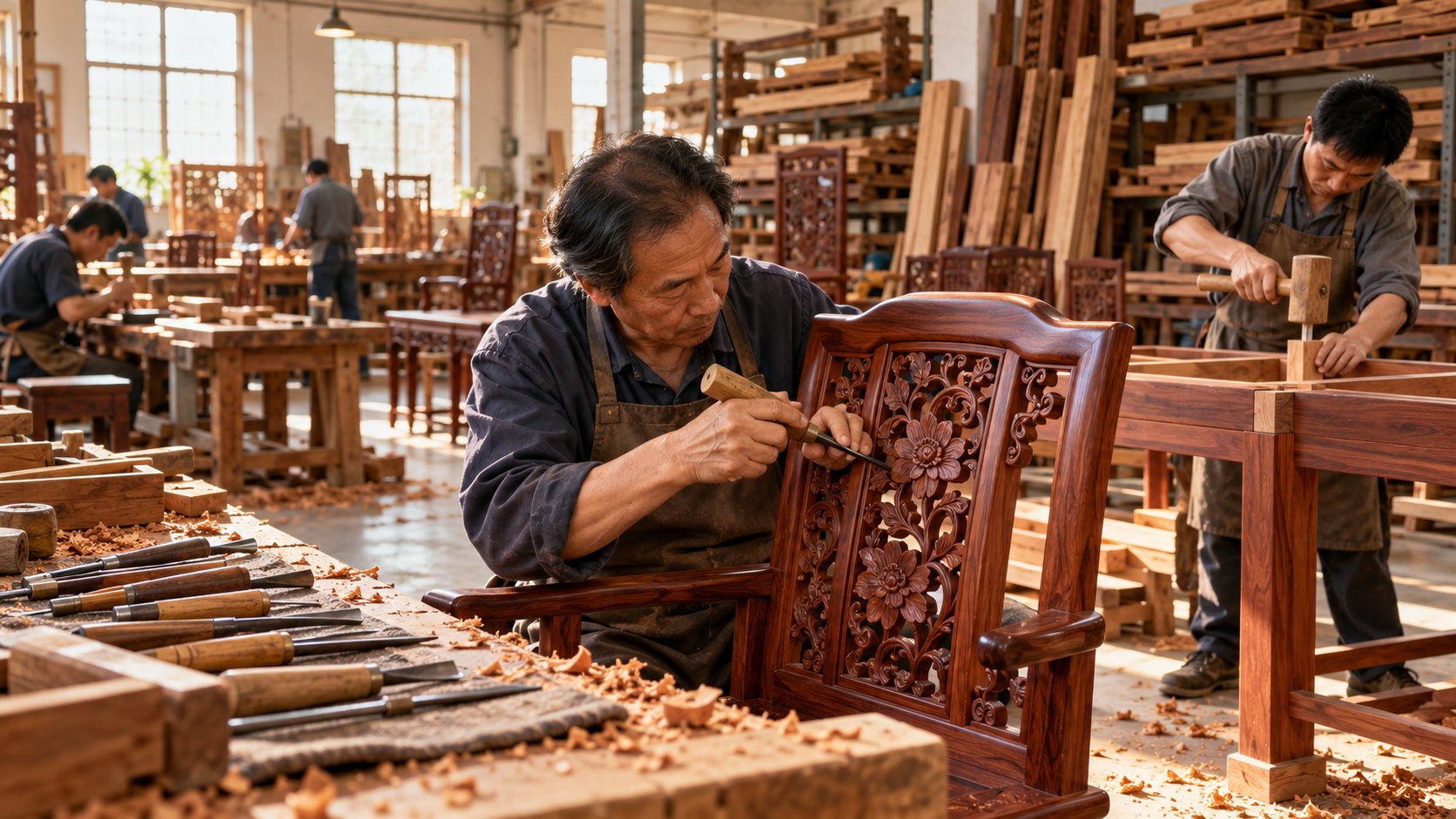
A step-by-step walkthrough of how Yunxiao Rosewood Furniture's Xianyou factory turns timber into export-ready classical furniture — 36-day constant-humidity drying, mortise-and-tenon joinery without metal fasteners, hand carving, raw-lacquer and beeswax finishing, AQL quality control, ISPM-15 packing, and FSC/CITES compliance documentation, with a 12-question buyer verification checklist and FAQ.
When a wholesaler in Sydney, a hotel project contractor in Dubai, or a furniture importer in Rotterdam searches for a rosewood furniture factory, the question behind the search is rarely about machinery or floor space. The real question is: what exactly happens between the day I place an order and the day a container arrives at my warehouse — and can I trust every step in between? That gap between a signed purchase order and an export-ready shipment is where most sourcing risk lives. A sofa set that looks perfect in a showroom photo can still arrive with hairline cracks, loose joints, mismatched grain, or missing CITES paperwork if the factory behind it does not run a disciplined production and export process.
This article walks through that process at Yunxiao Rosewood Furniture Co., Ltd, a classical redwood furniture manufacturer founded in 2008, operating a 12,000-square-meter factory in Xianyou County, Putian City, Fujian — a region widely known as the hometown of traditional hardwood craftsmanship in China. Instead of a marketing brochure, what follows is a step-by-step account of how raw timber becomes classical furniture that is genuinely ready for export to Southeast Asia, Australia, Europe, and North America: how timber is selected and dried, how mortise-and-tenon joinery is executed without metal fasteners, how hand carving and lacquer finishing are carried out, how quality is checked before packing, and how OEM and ODM sampling, ISPM-15 crating, container loading, and compliance documentation fit into the same pipeline. Buyers who understand this sequence can audit any rosewood furniture factory more confidently — including ours — and know precisely which questions to ask before committing to a container order.
What "Export-Ready" Actually Means for a Rosewood Furniture Factory
In domestic Chinese trade, "ready" usually means the piece is finished and looks good. In export trade for classical redwood furniture, the bar is much higher. A piece that is beautiful in a workshop in Fujian can fail on arrival in Phoenix, Perth, or Frankfurt if any one of the following conditions is not engineered into it from the start:
- Moisture content matched to the destination climate. Solid hardwood expands and contracts with humidity. Timber dried for a humid coastal climate will shrink and crack in a heated, dry interior; timber dried too aggressively can crack in transit or loosen joints. Export-ready furniture starts with timber audited to a defined moisture range — at our factory, solid wood is dried and audited to 8–14% moisture content and conditioned toward the destination climate before shipment.
- Joinery that tolerates climate movement. A classical Chinese rosewood piece is traditionally assembled with mortise-and-tenon joints and no metal fasteners. That is not nostalgia; it is engineering. Wood moves seasonally, metal does not, and rigid nailed frames crack around every nail over time. A proper mortise-and-tenon frame with bamboo dowels and solid wood corner blocks flexes as a structure instead of fighting itself.
- Finish that complies with destination regulations. Finishes and adhesives for furniture entering the European Union and the United States must meet EU REACH and US CARB expectations, and emission-sensitive buyers increasingly ask for test evidence. Export-ready means the finish system is chosen with these rules in mind and test reports against GB 18584 requirements can be provided with the quotation.
- Legally documented timber. Rosewood-class timber moves under strict international controls. An export-ready order carries FSC chain-of-custody documentation and, per shipment, CITES Appendix II export permits for the species that require them — without which a container can be held, fined, or refused at the destination port.
- Packaging and loading engineered for carved furniture. Relief-carved panels, chair backs, and table aprons are the most valuable — and most fragile — surfaces of a classical set. Heat-treated ISPM-15 crates, moisture barriers, custom bracing, and a container loading plan are not add-ons; they are part of manufacturing for export.
Each of these five conditions maps to a specific stage of production. The rest of this article follows that sequence in order, because that is the same sequence we recommend buyers use when auditing any rosewood furniture factory — ask about the stages in the order the wood actually experiences them, and inconsistencies in a supplier's answers will surface quickly.
Step 1: Timber Selection and the 36-Day Constant-Humidity Drying Routine
Every classical redwood furniture project begins long before a chisel touches the wood, with the selection of timber. Our factory works with legally certified Machilus Nanmu, aged red wood, and Grade-A tropical hardwood, sourcing material that carries legal documentation from the outset. For a B2B buyer, the significance of this stage is straightforward: no amount of skilled joinery can rescue a sofa set built from poorly selected or inadequately dried timber. The defects that destroy export shipments — seasonal cracking, warping, joint failure — are almost always determined at the timber stage.
Selection starts with species and grade. Siamese rosewood and comparable hardwoods are chosen for density, color depth, and grain figure appropriate to the piece being built: tighter, more uniform grain for Ming-style lines that celebrate the wood itself; richer figure for Qing-style carved pieces where the surface will carry dragon, phoenix, or lattice motifs. Density is not left to eye alone — timber for our sofa sets is sorted to a density range of 0.90–1.00 g/cm³ so that every component in one order responds to moisture and load in a consistent way. When a full container of furniture is made from timber of wildly different density, the pieces age at different rates; when density is sorted, a set stays coherent.
Then comes the stage that matters more than any other for overseas buyers: drying. Freshly sawn hardwood can carry a moisture content far above what a finished piece should hold. Our factory runs a 36-day constant-humidity drying routine on every product, followed by timber auditing to a 8–14% moisture content window, and conditioning toward the destination climate before shipment. The 36-day figure is not a marketing number — it reflects how long it takes to bring dense tropical hardwood down to a stable moisture level gradually. Rushing this stage with aggressive heat produces case-hardened boards that look fine at the factory and crack months later in a buyer's showroom.
Why does this matter so much for export orders specifically? Because the furniture is not staying in Fujian. A dining set shipped to North America will live in winter-heated interiors where relative humidity can drop dramatically; a set shipped to Singapore or Brisbane faces the opposite problem of sustained humidity. A rosewood furniture factory that dries everything to a single generic number is gambling with the buyer's inventory. Conditioning toward the destination climate, and recording the moisture audit per batch, is what turns "dried wood" into export-ready wood. We expand on the mechanics of this in our separate article, Why Does Kiln Drying Matter When Buying Rosewood Furniture from China?, which covers the drying science in more depth.
For buyers, the practical checkpoints at this stage are simple and worth writing into any purchase contract: ask for the drying method and duration, ask for the moisture content range the factory audits to, and ask whether timber is conditioned differently for different destination climates. A factory that answers these three questions with specific numbers — as we do: 36 days, 8–14%, destination conditioning — has nothing to hide. A factory that answers vaguely is asking you to absorb the risk of its shortcuts.
Step 2: Cutting, Milling, and Preparing Components with Zero Metal Fasteners
Once timber passes the moisture audit, production moves to cutting and milling — and this is where a classical rosewood furniture factory separates itself from a general furniture plant. Classical Chinese furniture is not built from flat panels and screws; it is built from a three-dimensional network of shaped components — legs, aprons, rails, stretchers, spandrels, and backrest panels — each cut with a specific role in the finished frame.
Our production floor begins each order by breaking down the approved drawings into a component list. For a six-seat oval dining table set with Ming-style chairs, that list runs to well over a hundred individual pieces: eight chair legs, eight seat frames, eight crest rails, dozens of aprons and stretchers, plus the table's own pedestal and top frame. Each component is cut from boards matched for grain direction and color tone, then milled to precise dimensions. Grain orientation matters enormously in solid hardwood — a chair leg cut with the grain running the wrong way will snap at the shoulder under load, no matter how thick it is. Experienced craftsmen assign each board to the component it suits best before any cutting happens, which is slower than random allocation but eliminates an entire class of structural failures.
Two details of this stage deserve a buyer's attention. First, all furniture is assembled without metal nails, a principle we apply across the entire product range to avoid cracking and deformation as the wood moves through seasonal cycles in overseas climates. Metal does not move with wood; every nail is a rigid point of conflict inside a living material. Second, components destined for the same visible surface are book-matched or tone-matched at this stage rather than later. Ensuring consistent wood color and grain matching across a full container order is a production discipline that starts in milling, not in final assembly — we describe that discipline in detail in our article on color and grain consistency across container orders.
Step 3: Mortise-and-Tenon Joinery — the Structural Heart of Classical Redwood Furniture
Mortise-and-tenon joinery is the defining craft of classical Chinese furniture, and for a B2B buyer it is also the most practical structural feature to verify. In this system, a projecting tongue (the tenon) cut at the end of one component fits into a matching cavity (the mortise) cut into another, locking the frame together mechanically. Our sets use multiple joint families drawn from the classical repertoire — through-tenons, hidden shoulder tenons, dovetail joints on drawers, and corner joints reinforced with solid wood corner blocks and bamboo dowels.
Why does this matter commercially? Because joint quality is the single best predictor of how furniture survives an ocean shipment and years of use. Consider what actually happens to a container of furniture in transit: it is lifted, tilted, vibrated for weeks, and moved through climates at both ends. A glued-and-screwed frame absorbs those shocks at its most rigid points. A properly cut mortise-and-tenon frame distributes them through interlocking geometry, and the bamboo dowels that pin our primary frames add shear strength without introducing metal that will corrode or loosen in humid conditions. Our workshop assembles each frame and tests its rigidity before finishing — a chair back that flexes at the joint line goes back, not forward.
There is a practical verification step for buyers here. When you audit a factory — in person or virtually, as our guide to conducting a virtual factory audit explains — ask to see a partially assembled frame with the joints exposed. A factory confident in its joinery will show you dry-fit frames; a factory relying on glue and fasteners will steer you toward finished photos. The difference in those two responses tells you more than any certificate.
Step 4: Hand Carving — Where Craftsmanship Becomes Visible Value
For carved classical sets, the next stage is the one your customers will actually see: hand carving. Our carving workshop carries forward regional methods passed down through generations of Xianyou artisans, and master carvers hand-chisel dragon, cloud, phoenix, and lattice motifs into solid rosewood using traditional tools. The depth of skill involved is easy to underestimate. A single ruyi-sceptre motif on an armrest panel of our three-piece Siamese rosewood sofa set takes approximately 18 carving hours per panel — before sanding, before finishing, before assembly.
Hand carving also has a structural dimension that photographs cannot show. A carved panel cut too deeply weakens the board; carved too shallowly, the motif looks stamped rather than sculpted. Our carvers work to depth standards matched to each component's thickness and function, and the design of each motif is adapted to the grain of the specific piece of wood in front of them — which is precisely what distinguishes hand carving from machine-carved imitation work. For buyers building an import catalog, this difference is a selling point worth verifying: our guide on identifying authentic hand carving gives your inspection team concrete checkpoints.
The carving stage is also where our training pipeline matters. We describe how we develop and retain master carvers in our article on training master carvers for global B2B buyers, because consistency across a 40-piece container order depends on more than one talented individual — it depends on a workshop that can reproduce the same quality standard across every piece, on every order, year after year.
Step 5: Scraping, Sanding, and Surface Preparation Before Any Finish Is Applied
Between carving and finishing lies a stage that many buyers never hear about but every experienced inspector checks: scraping and sanding. Classical furniture finishing begins with hand-scraping the flat surfaces with blades to remove machine marks and level the grain — a technique that produces a surface which takes stain and lacquer far more evenly than sanded wood alone. The surfaces are then progressively smoothed, and the whole piece is inspected under raking light to catch tear-out, dents, and uneven edges while they are still cheap to fix.
This stage is where the quality ceiling of a rosewood furniture factory is set. Lacquer and wax are honest materials: they reveal preparation rather than hide it. A nine-coat finish applied over poorly prepared wood will telegraph every defect within months, as the finish wears unevenly where the surface beneath it was uneven. For buyers evaluating samples, run a fingertip along the underside of a table apron or the inside of a chair rail — places that rarely get final attention. The standard of finish there tells you the standard everywhere.
Step 6: Raw Lacquer and Beeswax Finishing — Nine Coats, Built for Export Regulations
Finishing is where classical craftsmanship meets export compliance, and it deserves careful explanation because finish claims are among the easiest for a supplier to exaggerate and among the easiest for a buyer to verify. Our finishing system uses hand-rubbed raw lacquer applied in multiple coats — nine coats on our Qing-style carved sofa set, six coats on our compact three-piece set — with a breathable penetrating formula that hardens with the wood rather than sealing it in a plastic film. A final beeswax treatment completes the surface. This system matters for three reasons.
First, durability in real climates. A penetrating lacquer finish moves with seasonal humidity changes instead of cracking over them, which is why it suits solid rosewood exported to both the dry winters of North America and the humidity of Southeast Asia. Second, serviceability: scratched or worn areas on a raw-lacquer surface can be spot-repaired and re-blended by a technician, which matters to hotel operators and rental-furniture businesses whose pieces take daily wear. Third — and for many buyers decisive — compliance. Eco-friendly beeswax and lacquer finishing at our factory is selected to meet EU REACH and US CARB standards, and raw lacquer and solid wood construction materials are tested for formaldehyde and benzene emissions against GB 18584 requirements, with current test reports provided with the quotation for verification before ordering. For a hotel project in the EU or a retail chain in the US, that documentation is not a formality; it is what allows the goods to clear compliance review on arrival.
Step 7: Quality Control — Timber Inspection, Structure Testing, and AQL Sampling Before Packing
Quality control in a rosewood furniture factory is not a single final check; it is a sequence of gates that mirrors the production stages above. At our factory the QC gates include, at minimum: incoming timber inspection against the documented moisture and density standards; in-process joint-fit checks during assembly; finish inspection under raking light; and a pre-packing audit on every export order.
The pre-packing audit is where the AQL sampling discipline that B2B buyers know from third-party inspections comes into play. For large container orders, our internal team performs AQL-based sampling across the shipment — checking joint tightness, finish consistency, carving integrity, hardware-free assembly confirmation, dimensions against the order sheet, and packing condition — so that problems are caught inside the factory rather than at your warehouse. Buyers who commission their own third-party inspection will find our production team familiar with the process; we also publish a dedicated pre-shipment checklist in our article on how to inspect rosewood furniture before shipment, which your QC staff can use directly.
Structure testing is equally concrete. Our export crates are passed through an in-house 1-metre six-face drop test before the packing method is approved for shipment — because the strongest furniture in the world still needs packaging that survives port handling. For the furniture itself, assembled frames are checked for racking resistance and joint tightness; chair and table frames are flexed under load by hand to reveal any joint that will loosen in transit. These are honest, repeatable checks — and they are the same checks we invite buyers or their appointed inspectors to witness during pre-shipment visits.
Why does a factory volunteer this level of internal QC detail? Because in B2B furniture export, the cost asymmetry is brutal. A defect caught at the packing stage costs a re-work day; the same defect caught in Rotterdam costs a return shipment, a claim, and a damaged retail season. Any rosewood furniture factory that cannot describe its QC gates in this level of specificity is asking buyers to fund that asymmetry.
Step 8: OEM and ODM Customization — How Custom Orders Move Through the Same Pipeline
A large share of our production is custom work: villa and resort projects needing specific sizes, hotel chains requiring brand-matched finishes, distributors developing private-label classical lines. The critical point for buyers is that custom orders run through the same timber, joinery, carving, finishing, and QC pipeline as standard sets — customization changes the drawings, not the disciplines.
The custom journey starts with a design brief: dimensions, seat counts, carving motifs, finish tone, and target market. For a villa project this might mean a 12-seat banqueting set scaled to a specific dining hall; for a hotel lobby, a reception sofa set with auspicious phoenix carving matched to the interior palette; for a wholesale catalog, a Ming-style line adapted to apartment-sized footprints. Our design team translates the brief into technical drawings for confirmation, then the sampling stage begins.
Sampling deserves special attention because it is where most sourcing disputes originate. Our process provides refundable samples for qualified B2B buyers: a sample set is built on the production line — not on a separate "sample bench" with better workers — so what you approve is what a container will replicate. Sample evaluation should follow a fixed checklist: measure every dimension against the drawing, inspect the deepest carving recesses, check joint lines with a feeler gauge if possible, verify finish tone under both daylight and warm interior light, and assemble/disassemble any knock-down elements. Only when the sample is signed off does bulk production begin, and even then the approved sample remains the binding reference for the AQL audit at packing.
OEM and ODM differ in where the design originates: OEM production executes the buyer's own designs and brand requirements, while ODM development starts from our existing classical repertoire — Ming-style sofa sets, dragon-carved reception sets, canopy bedroom suites — and adapts sizes, motifs, and finishes to the buyer's market. Both routes end at the same place: a full container of furniture that matches an approved sample. Buyers weighing the two models can read our comparison in what makes a factory reliable for OEM and ODM whole-house custom orders.
Step 9: Export Packing, ISPM-15 Crating, and Container Loading for Carved Furniture
Packing carved classical furniture is a discipline of its own, and it is the stage where many otherwise-good suppliers fail. Relief-carved panels protrude from frames; chair backs, table aprons, and bed crowns cannot simply be wrapped and stacked like flat-pack goods. Our export packing protocol uses ISPM-15 heat-treated crates — mandatory for wood packaging entering the EU, US, Australia, and most other destinations — combined with moisture barriers, custom bracing for carved surfaces, and piece-by-piece crating for fragile components.
The crates themselves are validated, not assumed: the in-house 1-metre six-face drop test mentioned earlier is applied to the packing method before shipment approval. Inside the container, loading follows a planned map — heavy pieces low and forward, crates braced against shifting, carved panels never loaded face-to-face without protection. We cover the full loading methodology in our article on container loading for carved sets, and the packing materials standards in how rosewood furniture should be packaged for export shipping.
A practical packing benchmark for buyers: ask any prospective supplier what happens to a carved sofa armrest during loading — whether it is capped, crated individually, or simply wrapped. The answer reveals how much of the "factory" is actually a packing shed. For destination-specific considerations — including how European and North American climates affect delivery — see our guide to shipping classical redwood furniture sets to Europe and North America.
Step 10: Compliance Documentation — FSC, CITES, and Timber Legality for Smooth Customs Clearance
No order is export-ready until its paperwork is as complete as its joinery. Solid rosewood-class timber sits under international plant-protection controls, and the documentation package is what converts a beautiful container into one that clears customs without detention. For every export shipment, our internal trade team prepares the full document set, which includes:
- FSC chain-of-custody certificates connecting the timber in your order to responsibly managed forests, which EU and North American retail channels increasingly require for shelf access.
- CITES Appendix II export permits for the species that require them, issued per shipment — the document that keeps a rosewood container moving through ports instead of sitting in a bonded warehouse.
- ISPM-15 packing declarations confirming heat-treated wood packaging.
- Emission test reports for the finish system against GB 18584 requirements, provided with the quotation for pre-order verification.
- Commercial invoice, packing list, and bill of lading prepared to the destination port's requirements.
Buyers importing into the EU and US should also understand the downstream regulatory frame: the EU Timber Regulation and the US Lacey Act place due-diligence obligations on importers, not just exporters. Our article on how EUTR and the Lacey Act affect redwood furniture imports explains the practical implications, and our piece on FSC-certified timber compliance covers the certification chain. For the international timber trade context more broadly — including how CITES listing changes affect planning — read how CITES regulations are reshaping the rosewood trade.
What This Process Means for Your Lead Times and Order Planning
Every stage above takes real time, and a credible rosewood furniture factory will quote lead times that reflect the sequence rather than a wish. Container orders at our factory take 45–60 working days after deposit, and the anatomy of that window matters to your planning: timber preparation and drying for the batch, component cutting and joinery, carving (the longest single stage for carved sets, at roughly 18+ hours per major carved panel), the multi-coat lacquer schedule with drying time between coats, QC and AQL sampling, and packing with crate drop-testing. Partial shipments are available for long-term partners whose project schedules need staged delivery.
The lead-time implication for buyers is counterintuitive but important: a factory quoting 20 days for a carved classical container order is almost certainly skipping the drying discipline or compressing the lacquer schedule — and both shortcuts surface as claims months later. We break down the full lead-time structure in our B2B guide to production lead times, and the capacity planning behind repeat container orders in how the factory manages capacity and delivery reliability.
Factory Strength and Compliance: What 17 Years of Export Manufacturing Adds to the Process
Process discipline explains how a single order becomes export-ready; factory infrastructure explains how a factory does it repeatedly, across dozens of containers a year, without drift. Three elements of our operation are worth knowing when you compare rosewood furniture factories.
Location and craft ecosystem. Our 12,000㎡ factory sits in Xianyou County, Putian City, Fujian — the recognized hometown of traditional hardwood craft in China. That location is not decorative: it determines access to experienced carving artisans, a deep local supply chain for tooling and timber services, and a workforce where classical joinery and carving skills pass between generations. A factory's address in this industry is a genuine proxy for craft depth.
Scale matched to B2B export. The factory produces complete classical sets — carved sofa sets with tea tables, 6–12-seat dining sets, full bedroom suites, wardrobes, display cabinets, and tea tables — with the component depth that whole-house and hospitality projects demand. Flexible OEM and ODM customization covers sizes, seat counts, carving patterns, and finish tones for villas and resorts. For first-time buyers, we support trial single sets and refundable samples precisely so that a first container is never a leap of faith; our article on testing a supplier before a full container order outlines a low-risk first-order path.
Export service embedded in the factory. Our internal team prepares full export documents, FSC certificates, and ISPM-15 heat-treated packaging in-house rather than outsourcing trade compliance to a third party. Remote installation guidance, free layout drawings for projects, and partial shipment arrangements are part of the standard service frame for long-term partners. The commercial structures we work under — direct supply, distributor partnerships, and project sourcing — are described in our guide to becoming a rosewood furniture distributor and partnering with a Chinese factory.
A Buyer's Verification Checklist: 12 Questions to Ask Any Rosewood Furniture Factory
The process walkthrough above converts into a practical audit tool. Before placing a container order with any rosewood furniture factory — ours or a competitor's — put these twelve questions in writing:
- What drying method and duration do you use, and what moisture content range do you audit to before finishing? (Ours: 36-day constant-humidity drying, 8–14% moisture, conditioned to destination climate.)
- Is timber density sorted within an order? (Ours: 0.90–1.00 g/cm³ for sofa sets.)
- Are primary frames free of metal fasteners? What reinforces the joints? (Ours: mortise-and-tenon with solid wood corner blocks and bamboo dowels.)
- How many carving hours go into a major carved panel, and who executes the carving — employees or subcontractors?
- How many coats of finish, what finish system, and can you provide current emission test reports for the quoted batch? (Ours: multi-coat hand-rubbed raw lacquer plus beeswax, GB 18584 test reports with quotation.)
- What are your QC gates between stages, and can I appoint a third-party inspector for pre-shipment AQL sampling?
- Is the packing method drop-test validated, and to what standard? (Ours: in-house 1-metre six-face drop test, ISPM-15 crates.)
- Which compliance documents ship with the goods — FSC, CITES permits, packing declarations? (Ours: FSC chain-of-custody and per-shipment CITES Appendix II permits.)
- What is your quoted lead time for a full container of carved sets, and what does the window include? (Ours: 45–60 working days after deposit.)
- Can the first order be a trial single set, and are samples refundable? (Ours: yes, for qualified B2B buyers.)
- Do you provide installation guidance and project layout drawings? (Ours: remote installation guidance and free layout drawings.)
- Can I visit or virtually audit the workshop and see dry-fit frames and the drying facilities?
A factory that answers all twelve with specifics — numbers, document names, test methods — has demonstrable process control. One that answers in generalities is transferring process risk to you. Even if you never order from us, use this list; it is the fastest way to separate a genuine rosewood furniture factory from a trading office with good photos.
A worked example: tracing one dining set through the full sequence
To make the pipeline concrete, consider how one real order type moves through all ten stages: an Oval Redwood Dining Table 6-Seat Set with Ming Style Chairs bound for a distributor in Australia. Timber for the batch is selected from legally documented stock and sorted by density; the boards enter the 36-day constant-humidity drying routine and are audited to the 8–14% moisture window, then conditioned toward the drier end of the range for Australian interiors. Component cutting assigns each board by grain direction — table pedestal members, chair legs, crest rails, and aprons each take the boards suited to their load paths. The frame goes together with mortise-and-tenon joints pinned with bamboo dowels, no metal fasteners anywhere in the primary structure. Ming-style chairs carry restrained carving on the backrests and aprons, executed by hand and adapted to each piece's grain; the surfaces are scraped and smoothed before the first of several hand-rubbed raw lacquer coats goes on, each given its drying interval, with a beeswax treatment completing the finish. QC gates follow: joint-fit checks in assembly, finish inspection under raking light, and AQL sampling across the completed sets at packing, with dimensions checked against the order sheet. The sets are crated in ISPM-15 heat-treated packaging from a drop-test-validated method, loaded to a container map that keeps carved surfaces protected, and dispatched with FSC chain-of-custody documents, per-shipment CITES permits for the species concerned, and the finish emission test reports already supplied with the quotation. From deposit to vessel, the schedule runs within the 45–60 working-day window, with documents reaching the buyer's customs broker ahead of arrival. Nothing in that account is exotic — it is simply the standard sequence, executed in order, with records kept at each gate. That is what "export-ready" means in practice, and it is the standard any buyer should hold every prospective supplier to before signing a container contract.
Frequently Asked Questions
How do I verify a rosewood furniture factory is actually a factory, not a trader?
Ask for a live video walkthrough of the drying kilns, carving workshop, and packing area during working hours — not a promotional video. A real factory will show dry-fit frames, timber stock, and in-process carving without hesitation. Our article on virtual factory audits walks through the full process.
What moisture content should rosewood furniture be dried to for export?
It depends on the destination climate, which is why a single fixed number is a red flag. Solid wood for our export sets is audited to 8–14% moisture content and conditioned toward the destination climate before shipment — drier targets for heated North American and European interiors, moderated targets for Southeast Asian humidity.
Why is furniture assembled without metal nails?
Wood expands and contracts with seasonal humidity; metal does not. Rigid metal fasteners create stress points that work loose and split surrounding wood over years. Mortise-and-tenon joinery with bamboo dowels and solid wood corner blocks lets the frame move as a structure, which is why classical pieces survive overseas climates.
Can I order a custom size or a custom carving pattern?
Yes. Flexible OEM and ODM customization covers sizes, seat counts, carving motifs, and finish tones for villas, resorts, hotels, and wholesale catalogs. Custom orders are confirmed through technical drawings and a production-line sample before bulk manufacturing begins.
What documents do I need to import rosewood furniture from China?
At minimum: commercial invoice, packing list, bill of lading, ISPM-15 packing declaration, and — for rosewood-class species — CITES export permits, plus FSC chain-of-custody documentation where your channel requires it. Our team prepares the full set in-house for every shipment.
How long does a full container order take?
Container orders take 45–60 working days after deposit, reflecting the full sequence: timber drying, joinery, carving, multi-coat finishing, QC, and validated packing. Partial shipments are available for long-term partners.
Work With a Factory That Shows Its Process
The distance between a signed purchase order and an export-ready container of classical rosewood furniture is filled with hundreds of decisions — which boards go to which components, how deep a chisel cuts, how long lacquer cures, which crate gets braced where. A buyer cannot supervise every one of those decisions from another continent, but a buyer can choose a rosewood furniture factory whose process is specific enough to verify. That is the entire point of walking through the sequence above.
If you are planning a container order — a hotel project, a villa development, a wholesale classical line, or a first trial set — send us your requirements: destination port, target quantities, preferred styles, and any project drawings. Our export team will confirm the appropriate configuration, provide the drying, finish, and compliance documentation described above with the quotation, and arrange samples or a virtual workshop tour so you can see the process before committing. Requests for factory videos, audit visits, and the sample process are welcome — contact our export team through the inquiry form on this site to start the conversation.