
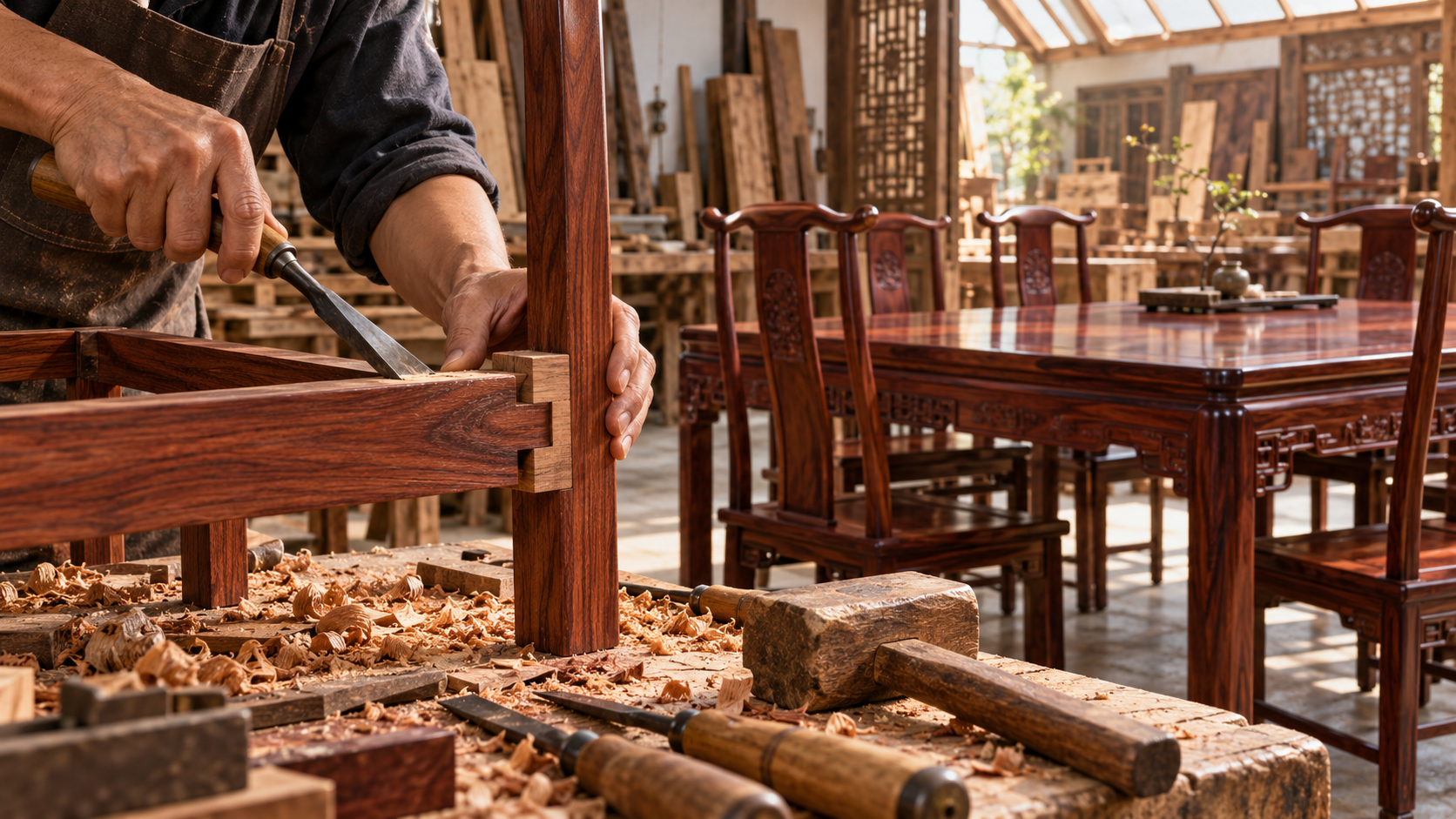
A rosewood furniture factory explains the full manufacturing process behind restaurant-grade furniture for commercial buyers, from timber grading and 36-day drying to mortise and tenon joinery, commercial finishes, batch QC and bulk container delivery.
A busy restaurant is one of the hardest environments any piece of furniture will ever face. Chairs are dragged across tile floors a hundred times a night, table tops are wiped with industrial cleaners between covers, and banqueting staff stack and restack seating after every event. Residential furniture rarely survives six months of that treatment. Yet hospitality operators still want the warmth, weight and character of real hardwood, and that is exactly where experienced restaurant furniture manufacturers earn their reputation. Making commercial grade furniture from dense rosewood is not simply a matter of building a domestic chair and calling it heavy duty. It requires deliberate engineering decisions at every stage of production, from the way a log is graded to the way a finished table is crated for export.
Yunxiao Rosewood Furniture has manufactured classical solid hardwood furniture sets in Xianyou County, Fujian, since 2008, supplying full dining, sofa and bedroom collections to wholesalers, hotels, designers and restaurant groups across Europe, North America, Southeast Asia and Australia. Over those years the workshop has learned, order by order, which details decide whether solid wood dining furniture holds up in commercial service: moisture content, joinery reinforcement, finish selection, batch consistency and disciplined export logistics. Those lessons are baked into the production routine described in this article.
In the sections below, we take you through a rosewood furniture factory step by step, from timber selection and the 36-day drying program through mortise and tenon joinery, hardware upgrades, wear-resistant finishing, batch quality control, sample approval and bulk container delivery. If you are a chain operator, banqueting manager, interior designer or procurement lead evaluating restaurant furniture manufacturers for an upcoming project, this is the process you should expect a serious factory to follow, and the questions you should ask before signing a purchase order.
Why Commercial Buyers Need Furniture Built to a Different Standard
The first thing to understand is that commercial service changes the physics of the problem. A chair in a private dining room might be sat on ten times a day and moved once a month. The same chair in a hotel banquet hall may be occupied for sixteen hours a day, slid across the floor between events, stacked six high on a trolley and cleaned with a neutral detergent every night. Over a five-year service life, that is tens of thousands of load cycles, thousands of lateral impacts and constant exposure to moisture, heat and cleaning chemicals.
Under that kind of duty cycle, the weak points of ordinary furniture show quickly. A joint that relies on glue alone can creep and eventually fail as humidity swings through the seasons. A top coat formulated for a living room will haze and wear through at armrest height within months. A chair frame built with thin members to reduce cost will develop wobble once the joints begin to micro-move under repeated racking loads. None of these failures are visible on the showroom floor, which is why comparing furniture on photographs alone is such an unreliable way to buy for a restaurant project.
Professional restaurant furniture manufacturers therefore design backwards from the duty cycle. They start by asking how many covers a day the dining room serves, whether the furniture will be stacked or fixed, how often it will be deep cleaned, what the ambient humidity range is in the destination market, and what the replacement expectation is. The answers change the specifications: thicker seat rails, deeper tenons, more aggressive moisture conditioning, harder finish systems and stricter batch matching. A rosewood furniture factory that also serves the residential market runs its commercial orders on a different internal standard, and a serious buyer should be able to see that difference in writing, not just in marketing language.
There is also a contract dimension. When a restaurant group or hotel operator buys hundreds of chairs and dozens of tables, the purchase is usually tied to an opening date, and delays carry revenue consequences. That makes production reliability, documentation and packing quality part of the product itself. A chair that arrives flawless six weeks late is still a failed delivery. This is why the later sections of this article devote as much attention to scheduling, inspection and container loading as to woodworking, because for commercial buyers the two are inseparable.
What Restaurant-Grade Really Means for Solid Wood Dining Furniture
The phrase commercial grade furniture gets used loosely across the industry, so it helps to define what it should mean for solid hardwood restaurant seating and tables. At minimum, it covers four measurable areas: structural duty rating, environmental conditioning, surface durability and batch uniformity. Each area can be specified, tested and verified, which is exactly what separates a genuine rosewood furniture factory serving hospitality clients from a general workshop that simply ships heavy chairs.
Structural duty means the frame is engineered for loads and movements beyond domestic use. In our production, every dining chair undergoes an individual static load test of 100 kilograms held for 24 hours as an in-house quality control procedure before it is approved for packing. That single test screens out the most common commercial failure mode, which is gradual joint deformation under sustained seating load. It also forces discipline upstream: a chair that passes the 24-hour test reliably is a chair whose geometry, joinery depth and wood selection were correct from the start.
Environmental conditioning means the wood itself is prepared for the climate it will serve, not just the climate of the factory. Solid wood moves with humidity, and a restaurant that runs air conditioning all day and opens doors to a humid street at night creates a moisture gradient across a thick tabletop every single day. Conditioning timber to a stable 8 to 12 percent moisture content, then holding it through a 48-hour equalization period before machining, is how a factory pre-compensates for that daily movement. We will detail the 36-day drying program behind those numbers in the next section.
Surface durability means the finish is chosen for cleaning agents, abrasion and food contact, not just for looks. A restaurant tabletop is a work surface: hot plates, water rings, bleach-based cleaners and steel trolleys all conspire against it. The finishing stage therefore specifies coating materials with food-contact documentation, applies multiple coats with proper cure time, and treats high-touch areas such as armrests and chair backs differently from vertical carved panels. Finally, batch uniformity means that chair number 240 in the order matches chair number 1 in color, grain direction and finish gloss, because in a dining room the eye reads the whole room as one composition. Consistency across a container load is a manufacturing capability, and we treat it as a formal quality control stage rather than a matter of luck.
| Specification Area | Typical Residential Build | Restaurant-Grade Build at Yunxiao |
|---|---|---|
| Load testing | Sample-based or none | Every chair: 100 kg static load held 24 hours |
| Moisture content | Regional average, sometimes unspecified | 8 to 12 percent, 48-hour equalization before machining |
| Joinery | Glue-dominant, screws common | Mortise and tenon with bamboo dowel pins in the primary frame |
| Finish intent | Appearance first | Food-contact documented coating material, wear-zone reinforcement |
| Batch control | Piece-by-piece variation accepted | Color and grain matching across the full container order |
| Export packing | Carton only | ISPM 15 heat-treated crating, moisture barriers, bracing for carved parts |
Step One: Selecting and Grading Timber for Commercial Loads
Every commercial-grade piece begins long before the first cut, at the timber yard. Rosewood-class hardwoods are dense, oily and figure-rich, which is precisely why they carve beautifully and resist wear, but the raw boards that arrive at a rosewood furniture factory are far from uniform. Growth stress, grain deviation, knots and hidden cracks concentrate in specific boards, and a board that would be acceptable for a decorative wall panel may be entirely wrong for a chair leg that must survive ten years of restaurant service.
Our grading process starts with visual and mechanical sorting of every board. Technicians check grain orientation against the length axis of the intended component, and boards that deviate more than four degrees from that axis are diverted to shorter parts where the mechanical penalty is lower. This single rule does more for commercial durability than almost any other, because grain run-out is the classic hidden cause of leg and rail failure: a tenon cut across a sloping grain line holds in the showroom and shears in year three. Sorting also separates boards by color and figure, which feeds directly into the batch consistency program described later, and flags any material with active insect damage, ring shake or excessive tension that could move after machining.
For commercial orders, we work with legally certified and documented materials, including Machilus Nanmu, aged red wood and Grade-A tropical hardwood, with FSC chain-of-custody and CITES Appendix II documentation available for shipments to markets that require it. Compliance is not a side issue for restaurant buyers: hotel and restaurant groups increasingly carry ESG and sourcing commitments in their own procurement policies, and a supplier who cannot produce clean paperwork becomes the buyer's problem at customs. Working with FSC-certified rosewood and properly permitted material is part of the base specification for our export orders, not an upgrade.
Grading also decides which components get which material. The densest, straightest stock is reserved for legs, seat rails and load-bearing frames. Boards with striking but less directional figure are allocated to carved backrests and aprons, where the visual payoff is highest and the mechanical load is lower. This allocation logic, learned over years of production, is one of the quiet advantages of working with established restaurant furniture manufacturers rather than trading companies that buy finished parts from whoever is available that month.
Step Two: The 36-Day Drying and Moisture Conditioning Standard
If timber selection decides how strong a chair can be, drying decides how long it stays that way. Freshly sawn hardwood carries far more water than a finished restaurant can tolerate, and rushing this stage is the single most common cause of cracks, open joints and warped tops in imported solid wood furniture. Our standard program gives every component a 36-day constant humidity drying cycle, followed by conditioning to a stable 8 to 12 percent moisture content and a 48-hour equalization period before any machining begins.
Why so long? Because wood does not dry evenly. The shell of a thick rail loses moisture first while the core remains wet, and if you machine or assemble during that gradient, the piece will continue to equalize after it leaves the factory, distorting joints that were cut to perfect tolerances. A controlled 36-day cycle with managed humidity lets the interior catch up with the exterior, so the board arrives at equilibrium as a whole. The 48-hour equalization before machining adds a final safeguard: boards rest in the ambient workshop condition where they will actually be cut, so the moisture reading the machinist relies on reflects reality rather than the kiln.
Destination climate matters here as well. A restaurant in coastal Southeast Asia, a mountain resort in Australia and a climate-controlled hotel group in North America all impose different equilibrium moisture conditions on the same chair. As experienced exporters we factor the destination into conditioning targets for commercial orders, which is one of the practical questions a buyer should put to any factory under consideration: not just whether they dry their wood, but to what reading, held for how long, and adjusted for which market. Vague answers at this stage predict vague quality later.
Drying discipline also protects the carved detail that defines classical hardwood furniture. Relief-carved panels have thin sections and thick sections within the same piece of wood, and uneven moisture makes the thin sections move against the thick ones, telegraphing cracks through the carving itself. By the time our carving artisans begin work, the material has already been stabilized, so the 16 or more hours of hand carving that a single bamboo-motif chair backrest may receive are invested in wood that will hold its form. Buyers comparing solid wood dining furniture quotes should treat documented drying time as a genuine cost item: it consumes factory space and working capital, and a price that seems too good usually means this stage was shortened.
Step Three: Mortise and Tenon Joinery, Reinforced for Commercial Service
The structural heart of classical Chinese furniture is mortise and tenon joinery, a family of interlocking joints that connect members without nails, developed and refined over centuries precisely because hardwood punishes shortcuts. In a well-cut mortise and tenon, load transfers through long-grain-to-long-grain contact, which is dramatically stronger and more stable than screws biting into end grain. As the wood expands and contracts through the seasons, the joint flexes slightly and reseats, instead of working loose the way a metal fastener in a moving hole eventually does.
Our primary frames are assembled with traditional mortise and tenon construction and bamboo dowel pins, with no metal fasteners in the primary frame. This is not nostalgia; it is a deliberate engineering choice for commercial grade furniture. Metal screws create rigid points in a frame that is otherwise designed to micro-move with humidity, and the stress concentrates exactly where the screw meets the grain. Bamboo dowels, by contrast, are dense, hard and dimensionally compatible with hardwood, pinning the joint while allowing the assembly to breathe as a unit. For a deeper look at the tradition behind this system, see our article on mortise and tenon joinery, the soul of classical furniture.
Commercial service, however, pushes traditional joinery harder than a scholar's study ever did, so the factory makes specific adaptations for restaurant orders. Tenon length and thickness are increased on seat rails and backrest posts, because the racking loads of a dragged chair concentrate there. Shoulder geometry is cut to close gaps under load rather than merely at the bench. Glue is used as a complement, not a substitute, applied to matched surfaces with full coverage control. And the frame geometry itself is checked under load: a chair must pass the 100-kilogram, 24-hour static load test not just once at prototype but across production, because a design that passes marginally will fail randomly across a batch of two hundred.
This is also the stage where artisan capacity matters commercially. Hand-cut joinery at scale requires a bench workforce that can hold tolerances across hundreds of repetitions, not just produce one flawless showpiece. Carving hours tell a similar story: a single carved chair backrest panel in our bamboo-motif dining set represents roughly 16 hours of hand carving, and reproducing that panel consistently across a restaurant order is a workforce-planning exercise as much as a craft one. Buyers evaluating restaurant furniture manufacturers should ask to see both a single hero piece and mid-production photos of the same item in quantity, because consistency is the harder of the two achievements.
Step Four: Where Modern Hardware Belongs in a Commercial Grade Frame
Traditional construction and commercial practicality are not enemies, and knowing where to depart from tradition is a mark of a mature rosewood furniture factory. While the primary frame of every chair and table stays pure mortise and tenon, selected secondary components in commercial orders are engineered with modern hardware to solve problems that nails-and-glue-only thinking cannot.
Consider the practical realities of restaurant operations. Banqueting staff need tables that can be disassembled or folded for storage between events. Maintenance teams prefer a glide or leveler they can replace on site rather than sending a chair to a workshop. Table tops on extension or flip-top mechanisms need repeated-cycle hardware rated for thousands of operations, not a one-time install. In these zones, specifying replaceable, standards-based hardware actually extends service life, because the wear concentrates in a serviceable part instead of the frame itself.
The principle we follow is simple: hardware is allowed where it serves maintenance, adjustment or transport, and it is kept out of the structural joints that define the furniture's stability. Reinforcement blocks at high-stress corners, threaded inserts for table bases that will be assembled and disassembled by hotel staff, felt or polymer glides specified for the expected floor type, and discreet stretcher components where stacking requires them are all legitimate commercial adaptations. What we avoid is the opposite trade, the all-screw frame marketed as reinforced, which trades long-term joint integrity for short-term assembly speed and typically fails exactly where the screws terminate.
Buyers can apply this principle directly during factory audits or sample reviews. Ask which components are designed to be serviced in the field, request the hardware specification for anything that moves or detaches, and ask how the hardware choice interacts with the joinery. A capable factory will answer specifically, component by component. A factory that answers with marketing adjectives has likely never had its furniture come back from a restaurant, and that inexperience will surface in year two of service. For buyers extending this thinking to other commercial sectors such as senior living, the same logic applies across healthcare furniture manufacturers, where serviceability and hygiene drive similar engineering decisions.
Step Five: Surfaces Engineered for Service: Finishes and Wear Treatment
Once the frame is proven, the surface becomes the frontline. Restaurant tabletops and armrests are cleaned dozens of times daily with detergents, exposed to hot plates and spilled liquids, and abraded by dishware and trolleys. A finish selected for showroom gloss will fail fast in that environment, so commercial finishing starts from a different question: not how the wood looks on day one, but how it looks after two years of service and one refinishing cycle.
Material compliance comes first. For tabletops and other food-adjacent surfaces, our glossy lacquer coating material is specified to meet FDA 21 CFR 175.300 food-contact requirements, a documentation standard that applies to the coating material itself. Across the wider export range, our beeswax and lacquer finishing systems are selected to meet EU REACH and US CARB standards, which govern the chemical composition of finishes and composite components in the European and North American markets. For restaurant buyers sourcing from Asia, insisting on this paperwork is not bureaucratic caution; it is how you keep the health-inspection conversation boring, which is exactly where you want it.
Application discipline matters as much as material choice. Film-forming lacquer is applied in multiple coats with controlled drying between layers, so the final film has the thickness to resist ring-marking and micro-scratching rather than a single cosmetic pass. High-touch zones, chair arms, seat edges, the top edge of table aprons where hands and trays drag, receive the same engineering attention as the visible top surfaces. Carved areas are finished differently from flat panels, because relief geometry traps polish and cleaner if the same process is applied blindly. Every finishing stage is followed by inspection under directional light, the fastest way to reveal orange-peel texture, dust inclusion or thin film before it becomes a warranty photo.
Maintenance reality is part of the specification too. Commercial finishes should be repairable: a restaurant cannot ship a scratched tabletop across an ocean. Our finishing systems are selected so that on-site touch-up and local refinishing are practical, and we provide care guidance matched to the finish system rather than generic advice. For a detailed commercial-care protocol, see our guide on how to care for wood dining tables in hotels, restaurants and banquet halls. Buyers comparing restaurant furniture manufacturers should ask for the finish system by name and chemistry, the number of coats, the cure schedule and the recommended on-site maintenance products, because these details, more than the color swatch, determine what the table looks like in year three.
Step Six: Batch Consistency and Quality Control Across Container Orders
Consistency is where manufacturing systems separate from workshops. A restaurant or banquet order is not one beautiful chair; it is two hundred matching chairs, thirty tables, and sideboards that must sit in the same room as both. Color, grain figure, carving depth, gloss level and dimension must all read as a single family across the entire order, and that outcome has to be engineered into the production sequence rather than hoped for at final inspection.
Our batch consistency control starts at timber allocation. Boards sorted by color and figure at grading are reserved as matched sets for each order, so the same tonal family flows through the whole production run rather than being assembled retrospectively. During machining, critical dimensions are checked against control samples, and assembly stations work from the same master reference piece for geometry. Finishing draws from batch-mixed lacquer so that gloss and tone do not drift between the first and last week of production, a subtle failure mode that shows up as visible table-to-table variation in a finished dining room.
Formal quality control runs through the order, and our production follows an ISO 9001-aligned quality management system with documented checkpoints from material intake through packing. Every dining chair passes the 100-kilogram static load test held for 24 hours. Carved panels are compared against approved reference samples for depth and motif fidelity. Before packing, a final inspection verifies finish condition, hardware function, dimensional tolerance and completeness of assembly hardware. For buyers who want to examine this system in depth, our article on how we ensure quality control for B2B buyers walks through the checkpoints in detail.
Third-party verification adds the outer layer. Restaurant buyers are welcome to commission independent pre-shipment inspection, and a confident factory treats that as routine rather than adversarial. What matters is that the factory's internal records can answer the inspector's questions: which chair was load-tested, when, by whom, with what result. Traceability of that kind is what turns a container of furniture from a leap of faith into a managed deliverable, and it is a question worth asking every candidate supplier before the deposit, not after.
Step Seven: Samples, Prototypes and Order Tracking for Chain Projects
For chain restaurants, hotel groups and design-led projects, the buying process is sequential by nature: concept, sample, approval, production, delivery. A factory structured for commercial work builds its service around that sequence instead of around a single transaction. At our workshop, the sequence begins with layout drawings, which we provide free for projects, translating the dining room plan into a furniture schedule of table sizes, seating counts and service clearances before any money changes hands.
Samples come next, and we make them refundable against the production order, because a sample exists to de-risk the decision, not to tax it. A serious sample program covers the decisions that photographs cannot: how the finish reads under warm dining light, how the chair feels after twenty minutes of sitting, how the carved backrest catches the eye from across the room, how the weight and balance feel to service staff who will move it nightly. Buyers should test samples under their real conditions, including their actual cleaning products, and should inspect the sample's joinery and finish quality with the expectation that production will match it.
Once production starts, order tracking becomes the buyer's window into the factory. Our process provides milestone visibility from material preparation through carving, assembly, finishing, curing and packing, so a chain project manager can coordinate delivery with fit-out schedules instead of chasing shipping updates. This is particularly valuable for phased restaurant rollouts, where multiple locations open months apart and each phase must match the last. The same tracking discipline supports repeat orders: a chain that reorders matching chairs a year later needs the factory to reproduce the original specification, and that requires the record-keeping to still exist. Our article on how we manage production capacity and delivery reliability across repeat container orders explains this system in depth.
Buyers should also confirm how design changes are handled mid-project. Real projects evolve: a banquet manager sees the sample and wants a different arm profile; the designer adjusts the table size after the floor plan is redrawn. A capable rosewood furniture factory prices and schedules these changes transparently, documents the revised specification, and updates the reference sample, so that the approved sample and the shipped product remain the same object. Factories that resist documentation usually do so because their records cannot support it, and that resistance is a useful signal during supplier evaluation.
Step Eight: Export Packing and Bulk Delivery for Restaurant and Banquet Projects
The last stage of manufacturing happens after the finish cures: getting intact furniture across an ocean and into a loading dock. Export damage is preventable, but only through systems, and our packing protocols were engineered specifically for relief-carved hardwood furniture, the most damage-prone category in the trade. Every export order ships in ISPM 15 heat-treated crating, the international standard for wood packaging material, with moisture barriers and internal bracing calculated for the specific piece: carved backrests get cushioned restraint, table tops are protected on both faces, and legs are blocked against shifting.
Container loading is a planning discipline of its own. Mixed orders, chairs nested in counted layers, tables crated flat, sideboards floor-loaded, are arranged so that weight distributes correctly and unload order matches the destination's handling sequence. Documentation travels with the shipment: commercial invoice, packing list, FSC chain-of-custody documents and CITES Appendix II permits where the destination market requires them, so customs clearance proceeds on paper as smoothly as the furniture moves in the container.
Timing commitments are part of the deliverable. Standard container orders complete in 45 to 60 working days after deposit, and partial shipments are available for long-term partners, which matters enormously for phased rollouts where the first location cannot wait for the last one's furniture. Commercial buyers should also plan the receiving end: our support includes remote installation guidance, and furniture that arrives site-ready, with assembly hardware bagged and labeled per table, turns the install from a two-day problem into a one-shift task. Free layout drawings tie the whole delivery back to the original plan, so what arrives matches what the dining room was designed around.
Site dimensions deserve one more note here. Restaurant success often hinges on choosing the right table formats for the room, from compact four-tops to twelve-seat banqueting tables, and the factory's standard platform of dining sets, from a 4-seat compact square to a 12-seat carved banqueting set, maps directly onto those needs. Our guide on choosing rosewood dining table set sizes for hotels, villas and restaurants covers the sizing logic, including clearance distances that banquet planners should verify before finalizing a floor plan.
How to Evaluate Restaurant Furniture Manufacturers Before You Order
With the full process in view, the evaluation question becomes concrete. Two suppliers can show identical photographs; only their systems differ, and systems can be probed with questions. The checklist below condenses this article into the inquiries we recommend before any restaurant, hotel or banqueting order, whether you place it with us or elsewhere.
- Moisture program: What moisture content do you condition to, for how long, and is it adjusted for the destination climate? Expect a specific number, a duration, and an equalization step.
- Joinery specification: What joins the primary frame, and where is hardware used? Look for mortise and tenon construction in load paths and a rational, serviceable policy for hardware elsewhere.
- Load testing: Is seating load-tested per unit or per sample, at what load, for how long? Per-unit testing with records is the commercial answer.
- Finish documentation: What coating system, with what food-contact or chemical-compliance documentation, and how many coats with what cure schedule?
- Batch control: How do you match color, grain and gloss across the full order? Ask to see the mechanism, not just the promise.
- Quality system: Is there a documented quality management system with checkpoints, and will you accept independent pre-shipment inspection?
- Compliance paperwork: Can you provide FSC chain-of-custody and CITES documentation for this shipment, and ISPM 15 packing for the container?
- Project process: Are layout drawings, refundable samples, milestone tracking and partial shipment available for phased rollouts?
- Service life support: What maintenance guidance, touch-up support and replacement-part policy comes with the order?
Notice that none of these questions ask about price directly. Price matters, of course, but in commercial furniture the unit cost is only meaningful relative to the specification behind it. A chair that fails in eighteen months was not cheaper; it was simply paid for twice, with an operational disruption in between. Buyers who anchor the conversation on the process questions above find that the price conversation becomes more honest on both sides, because both parties are now pricing the same object. A broader buyer's framework for evaluating suppliers against restaurant and banquet requirements is available in our article on choosing rosewood furniture for a restaurant or banquet hall project.
Compliance Paperwork: FSC-Certified Rosewood, CITES, REACH and CARB
Documentation deserves its own section because for many restaurant groups it has moved from afterthought to gating requirement. Corporate procurement policies increasingly reference responsible sourcing, and hospitality brands face public scrutiny of their supply chains in a way that private buyers do not. The paperwork that protects a buyer in this environment is specific, and knowing what to ask for is part of professional purchasing.
FSC-certified rosewood refers to material sourced under the Forest Stewardship Council's chain-of-custody standard, which traces certified material from forest through processing to the shipped product. For a buyer, FSC chain-of-custody documentation on the shipment converts a sustainability claim in your procurement file into an auditable record. We provide FSC chain-of-custody documentation with export orders, with certificate numbers confirmed at inquiry so the buyer can verify status directly.
CITES, the Convention on International Trade in Endangered Species, governs cross-border movement of listed timber species, and rosewood-class species fall under its appendices. Shipments that require it travel with CITES Appendix II export permits, prepared as part of our standard export documentation by our in-house team. REACH, the European Union's chemical regulation, and CARB, the California Air Resources Board's formaldehyde standards, govern the finishes and composite materials in furniture sold into those markets; our beeswax and lacquer finishing and material specifications are selected to meet both. ISPM 15 heat treatment of export crating completes the set, ensuring the wood packaging itself clears phytosanitary inspection.
The practical advice for buyers is to request these documents at quotation stage, not at shipping stage. Documented material takes longer to source and carries real cost, so a quote that includes FSC and CITES documentation is priced differently from one that does not, and discovering the gap after deposit is expensive. Established restaurant furniture manufacturers will have these answers immediately, because they ship documented material routinely. Hesitation here, like hesitation on the moisture program, is a signal about what happens inside the factory when nobody is watching.
Frequently Asked Questions
How long does a bulk restaurant order of rosewood furniture take to produce?
Standard container orders complete in 45 to 60 working days after deposit, covering material preparation, the drying program, carving, assembly, finishing with full cure, inspection and export packing. Partial shipments are available for long-term partners and phased projects. Buyers should also budget time at the front for layout drawings and sample approval, and at the back for ocean transit and customs, so the realistic door-to-door planning window is wider than the production window alone.
Is mortise and tenon joinery really stronger than screws for restaurant chairs?
For the primary frame, yes, and the reason is mechanical rather than traditional. Screws bear on end grain, the weakest orientation of wood, and create rigid points that concentrate stress as the frame micro-moves with humidity cycles. A cut mortise and tenon transfers load through long-grain contact and pins with bamboo dowels, allowing the assembly to move as a unit. Hardware remains appropriate for serviceable, non-structural components, which is exactly how we apply it.
What maintenance does solid wood dining furniture need in a restaurant?
Daily care with pH-neutral cleaners and soft cloths, immediate wipe-down of spills, periodic inspection of glides and hardware, and scheduled touch-up of high-wear zones. The finish system should be specified for repairability so that local refinishing is possible on site. Our commercial care guide linked above provides a protocol matched to the finish system rather than generic advice.
Can rosewood furniture be customized for a specific restaurant brand?
Yes. We offer flexible OEM and ODM customization of sizes, patterns and configurations for villas, resorts and restaurant projects, supported by free layout drawings and refundable samples. Brand-specific carving motifs, table dimensions, seating counts and finish tones are all negotiable within the engineering limits of the material, and approved specifications are documented so repeat orders match.
What documentation should I request with a commercial order?
At minimum: FSC chain-of-custody documentation, CITES Appendix II export permits where the species and destination require them, finish compliance documentation such as FDA 21 CFR 175.300 coating material specification for food-adjacent surfaces plus REACH and CARB conformity for EU and US markets, ISPM 15 packing certification, and the commercial invoice and packing list. Request all of it at quotation so pricing reflects the true specification.
Conclusion: From Factory Floor to Dining Room Floor
Restaurant-grade furniture is not a label; it is a chain of decisions that begins at timber grading and does not end until the crate is opened in your dining room. The 36-day drying cycle that prevents year-two cracks, the mortise and tenon frames pinned with bamboo dowels that outlast screw joints, the documented finish chemistry that keeps health inspections uneventful, the per-chair load testing that catches the one weak frame before it reaches your floor, the batch matching that makes two hundred chairs read as one room, and the packing and paperwork that deliver all of it intact and legal: each link is ordinary on its own. Together they are the difference between furniture that photographs well and furniture that survives a decade of service.
Since 2008, our 12,000-square-meter factory in Xianyou County, Fujian, the heartland of traditional hardwood craft, has refined this chain across full sets of classical solid wood dining furniture, carved sofa collections and complete bedroom suites for wholesale, hospitality and design clients on four continents. Whether your project is a single flagship restaurant, a resort banqueting program or a multi-site chain rollout, the evaluation checklist in this article is yours to use, and the questions are designed to be asked of any supplier, including us.
If you are planning a commercial dining project and want to see the process firsthand, request a layout drawing and a refundable sample, review the documentation list with our export team, and judge the factory by the same standard this article describes. Serious restaurant furniture manufacturers welcome that conversation, because the buyers who ask detailed questions are, in our experience, the buyers whose projects succeed.