
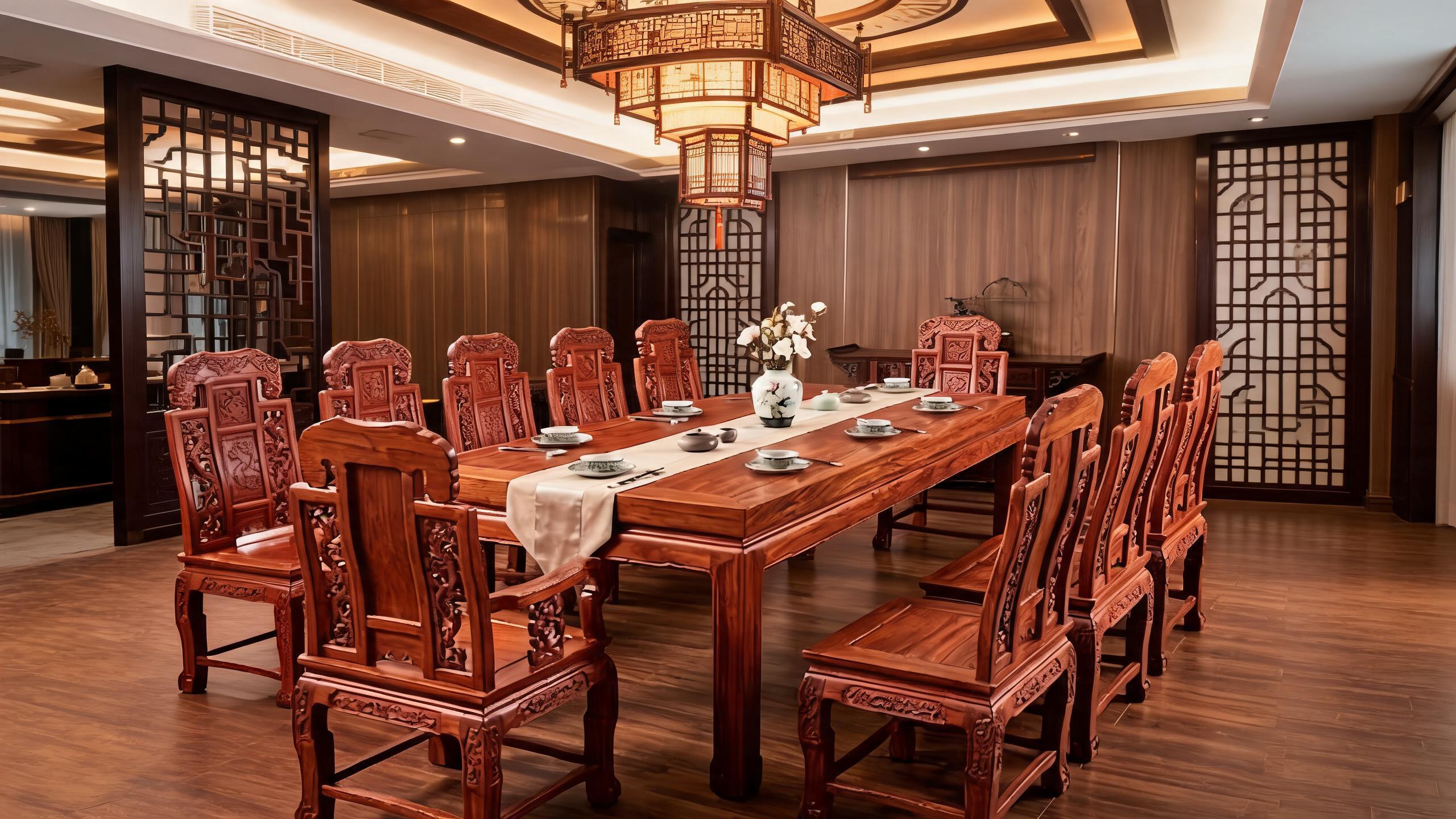
A practical B2B guide comparing 4 to 12 seat rosewood dining table sets for hotels, villas and restaurants, with verified dimensions, space-planning rules, materials, compliance documentation and OEM sizing options.
Introduction: Why Dining Table Set Size Is a Commercial Decision, Not a Detail
When a hotel group, a villa developer, or a restaurant operator sources a rosewood dining table set from China, the question that decides the success of the entire project is rarely "which table looks best." It is "which size fits the room, the service model, and the guest experience we are selling." A dining set that is 40 centimeters too wide turns a comfortable service aisle into a squeeze; a table that seats too few forces covers to be turned away at peak hours; a banqueting table that cannot be approached from both sides slows down staff and disappoints guests. After more than fifteen years of manufacturing classical solid rosewood furniture for wholesalers, hotels, and designers across Europe, North America, Australia, and Southeast Asia, we have learned that size selection is where projects are won or lost long before the first container ships.
This guide answers the question in the title directly: which rosewood dining table set size should you choose for hotels, villas, and restaurants? We will walk through the real seat capacities available, the room dimensions each configuration demands, the differences between round, oval, square, and rectangular tops, and the operational realities of banquet service, private dining, and residential projects. Every recommendation is grounded in the actual dining sets we manufacture today, with verified dimensions, materials, and compliance documentation, so you can map each option directly onto your own floor plans and procurement briefs.
What Is a Rosewood Dining Table Set in the B2B Context?
In international trade, a rosewood dining table set is not a single table. It is a coordinated package: one solid hardwood dining table plus a matched set of chairs, finished in the same lacquer system, carved in the same motif family, and packed for ocean freight as a unit. For hospitality and residential project buyers, the set approach matters commercially because it guarantees visual consistency across a dining room, simplifies reordering, and reduces the coordination cost of sourcing tables and chairs from different factories.
Our dining sets are built from solid Siamese rosewood, a dense tropical hardwood prized for its deep reddish-brown tone, straight grain, and dimensional stability after proper conditioning. Every set is assembled with traditional mortise-and-tenon joinery reinforced with bamboo dowel pins rather than metal screws in the primary structure. This is not nostalgia; it is engineering. Metal fasteners in dense hardwood create stress points that crack as wood expands and contracts across climates, while well-cut mortise-and-tenon joints flex with the timber. For buyers shipping to the dry winters of North America or the humid monsoon seasons of Southeast Asia, this joinery choice is the difference between furniture that survives ten years and furniture that fails in two.
The Current Dining Set Range at a Glance
Our catalog currently covers six dining configurations, spanning four to twelve seats:
- Square Redwood Dining Table 4-Seat Compact Set with Carved Stools — a compact square table with four lotus-medallion carved stools, designed for small private dining rooms, tea areas, and suites where floor area is at a premium.
- Oval Redwood Dining Table 6-Seat Set with Ming Style Chairs — a six-seat oval top with open-slat Ming-style chairs, the most space-efficient configuration for mid-size dining rooms.
- Ming Style Round Redwood Dining Table 8-Seat Set — a 150 cm diameter round table with eight Ming-style chairs, the classic choice for private dining rooms and family-style service.
- Rectangular Redwood Dining Table 8-Seat Set with Bamboo Carved Chairs — a rectangular top with bamboo-motif carved chairs, suited to restaurants that want a linear, formal arrangement.
- Rectangular Redwood Dining Table 10-Seat Set with Carved Chairs — a 220 cm × 100 cm top with ten hand-carved chairs, each backrest carrying an auspicious cloud motif that takes approximately twenty carving hours per chair.
- Square Redwood Dining Table 12-Seat Banqueting Set with Carved Chairs — a square dual-pedestal banqueting table with twelve longevity-character carved chairs, built for hotel banquet rooms and large private dining halls.
Each of these configurations solves a different commercial problem. The rest of this guide maps them to real project scenarios.
How Many Seats Do You Actually Need? Matching Capacity to Venue Type
Hotels: Banquet Rooms, Private Dining, and Executive Suites
Hotel procurement usually splits into three distinct dining environments, and each points to a different set size.
Banquet and event rooms need maximum covers per square meter with formal presence. The 12-seat square banqueting set is engineered exactly for this: its dual-pedestal base eliminates the leg interference of a four-leg table, so guests seated at the corners and midpoints all have clear legroom, and service staff can approach from every side. A square banqueting table also reads as a deliberate statement in a hotel's Chinese restaurant or private event hall, which is why it appears repeatedly in five-star property specifications across Southeast Asia and Australia.
Private dining rooms (PDRs) in hotel Chinese restaurants typically host groups of eight to twelve for business dinners and family celebrations. The Ming Style Round Redwood Dining Table 8-Seat Set is the workhorse here. A 150 cm diameter round top serves eight diners comfortably with a lazy-susan-compatible center, and round tables carry strong cultural resonance for Chinese banquet service — every guest faces every other guest, which is precisely the social dynamic private dining rooms are sold on. For PDRs that must flex to larger parties, the 12-seat banqueting set covers the overflow.
Executive suites and hotel residences call for smaller footprints. The 4-seat compact set with carved stools fits a suite dining alcove or a presidential suite's private tea area, where the carved lotus medallions read as craft detail rather than banquet furniture.
Villas and Luxury Residential Projects
Villa buyers — whether end clients, interior designers, or developers fitting out show homes — tend to overestimate the table size their dining room can carry. The most common specification error we see is ordering a 10-seat rectangular set for a dining room that measures 5 × 5 meters. The rule of thumb we give every project partner: allow at least 90 centimeters of clearance from the table edge to the nearest wall or fixed furniture on every side where a chair will be pulled out, and 120 centimeters on the primary service side. A 220 cm × 100 cm ten-seat table therefore needs a room of roughly 4.4 × 3.4 meters at absolute minimum, and 5 × 4 meters to feel generous.
For most villa dining rooms in the 4 × 4 to 5 × 5 meter range, the 8-seat configurations — round or rectangular — are the sweet spot. They seat a large family plus guests, leave genuine circulation space, and their carved chair backrests remain visible as craft features rather than being crammed against walls. The 6-seat oval set suits open-plan living-dining spaces where the dining zone shares floor area with circulation paths; the oval shape softens traffic flow around the table in a way a rectangular top cannot.
Restaurants: Covers, Turnover, and Aisle Width
Restaurant operators think in covers per service and table turnover. Here the arithmetic is unforgiving. A 10-seat rectangular set occupies roughly 3.6 × 2.6 meters of floor once chair pull-out and service aisles are counted; at a typical upscale Chinese restaurant's average check, that table must turn enough covers per service to justify the footprint. Fine-dining venues with long dwell times favor the 8-seat and 10-seat rectangular sets because larger parties spend more per table and the carved backrests contribute to the atmosphere guests are paying for. Fast-casual and tea-house formats, where dwell time is short, get better economics from the 4-seat and 6-seat configurations, which pack more parties into the same floor area.
One operational note from restaurant clients in Australia and North America: rectangular tops make it far easier to combine tables for large walk-in groups. Two 8-seat rectangular sets can be pushed together into a sixteen-cover banquet on a busy evening; round tables cannot. If your service model includes unpredictable large parties, rectangular wins on flexibility alone.
Round, Oval, Square, or Rectangular: Choosing the Top Shape
Shape is not an aesthetic footnote; it determines seating geometry, service efficiency, and the room's social dynamics.
Round tops (the 8-seat Ming Style set) equalize distance between diners, work naturally with rotating serving trays in Chinese banquet service, and have no head-of-table hierarchy — ideal for family-style dining and celebratory meals. Their cost is floor efficiency: a round table's circumscribed square is mostly wasted corner space, so round tables need slightly larger rooms per cover than rectangular ones.
Oval tops (the 6-seat set) split the difference. They preserve the conversational flow of a round table while occupying a more compact footprint, and their curved ends keep corner guests out of the service path. They are the most forgiving shape for irregular rooms.
Square tops (the 4-seat compact and 12-seat banqueting sets) read as formal and architectural. The 12-seat square banqueting table's dual-pedestal base is the critical engineering feature: with twelve diners, a conventional four-leg frame would put legs exactly where corner guests sit. The dual-pedestal design also distributes the load of a large solid-wood top, preventing the slight seasonal sag that single-pedestal tables can develop.
Rectangular tops (the 8-seat and 10-seat sets) maximize seats per square meter, align naturally with rectangular rooms, and allow table combining. The 220 cm × 100 cm ten-seat top is sized so that each diner has roughly 60 centimeters of table width — the international hospitality standard for formal place settings — without guests at the corners colliding with legs.
The Space Planning Math: Dimensions You Can Put in a Floor Plan
Project buyers need numbers, not adjectives. Here are the working dimensions for each configuration, based on our manufacturing specifications and standard hospitality clearance rules:
- 4-seat compact square set: table approximately 90 × 90 cm; with chair pull-out, plan a 2.4 × 2.4 meter zone. Single-crate packaging makes it the most economical set to ship LCL for sample orders and small projects.
- 6-seat oval set: table approximately 180 × 100 cm; plan a 3.6 × 2.8 meter zone. The open-slat Ming chairs visually lighten the arrangement in open-plan spaces.
- 8-seat round set: 150 cm diameter top; plan a 3.6 × 3.6 meter zone. Add 30 cm more clearance if a serving trolley will circulate.
- 8-seat rectangular set: table approximately 200 × 100 cm; plan a 3.8 × 2.8 meter zone.
- 10-seat rectangular set: 220 × 100 × 78 cm top with 45 cm seat height and 98 cm chair backrest height; plan a 4.2 × 3.0 meter zone minimum.
- 12-seat square banqueting set: table approximately 240 × 240 cm with dual-pedestal base; plan a 5.4 × 5.4 meter zone. This is a statement piece that anchors a room — do not specify it for anything smaller.
Chair seat height across the range is standardized at 45 centimeters, which pairs correctly with the 78-centimeter table height and leaves the standard 28–30 centimeters of thigh clearance specified in commercial hospitality guidelines. When mixing sets across a property — banquet hall on the ground floor, PDRs on the mezzanine — this standardization means chairs remain interchangeable in service, a small detail that housekeeping and F&B teams will thank you for.
Material and Construction: Why Siamese Rosewood and Mortise-and-Tenon Joinery Matter for Export
Size decisions only pay off if the furniture survives its destination climate. This is where material specification becomes part of the size conversation, because a table that cracks in year two is the most expensive table you can buy, whatever its dimensions.
All our dining sets use solid Siamese rosewood conditioned to 8–12 percent moisture content before assembly. That conditioning window is calibrated deliberately: timber dried below 8 percent will swell in humid Southeast Asian monsoon conditions; timber above 12 percent will shrink and open joints in the heated, dry interiors of North American and Northern European winters. The 36-day constant-humidity drying cycle we run before machining is what allows the same table to perform in both climates.
The joinery is the second half of the stability equation. Every apron, leg, and backrest in the dining sets is joined with mortise-and-tenon joints reinforced with bamboo dowel pins — no metal screws in the primary structure. Dense rosewood and steel expand at different rates with temperature and humidity; over years, screwed joints in solid hardwood work loose and split the surrounding timber. Traditional joinery distributes stress across the joint face instead. The 12-seat banqueting set goes further, using through-wedged mortise-and-tenon joints on the pedestal assembly, where the wedges mechanically lock the joint against the racking loads a twelve-diner table experiences daily.
Each chair in the carved sets represents approximately twenty hours of hand carving. The cloud motifs on the 10-seat set's backrests, the bamboo motifs on the 8-seat rectangular set, the longevity characters on the 12-seat banqueting chairs, and the lotus medallions on the 4-seat stools are cut by hand with traditional tools — a depth of relief that machine carving cannot replicate and that photographs poorly but reads unmistakably in person. For showroom-based wholesalers, this is a selling point worth demonstrating live.
Food-Safe Finishes: FDA 21 CFR 175.300 Compliance
Dining furniture touches food. Every dining set in the range is finished in a glossy lacquer system that meets FDA 21 CFR 175.300, the US food-contact regulation for resinous and polymeric coatings. For buyers in North America this is a procurement checkbox that eliminates an entire category of customs and liability risk; for buyers in Europe, the Middle East, and Australia it is equally useful evidence of finish quality when presenting to hotel F&B directors and restaurant consultants.
The finish also serves the timber. A food-contact-compliant coating sealed over properly conditioned rosewood slows the moisture exchange between the wood and the dining room environment, further protecting joints from seasonal movement, and it withstands the hot-pot service, teaware, and alcohol wipes of commercial dining. The beeswax-and-lacquer finishing tradition behind this system also meets EU REACH and US CARB standards, so the same sets clear compliance review on both sides of the Pacific.
Documentation: FSC, CITES, and What Importers Must Collect
Every dining set shipment includes FSC chain-of-custody documentation and CITES Appendix II export permits. Buyers importing rosewood furniture should treat these documents as part of the product specification, not paperwork afterthoughts:
- FSC chain-of-custody certificates substantiate responsible forestry claims in your marketing and satisfy the due-diligence expectations of the EU Timber Regulation and the US Lacey Act.
- CITES Appendix II permits are required for the international trade of the rosewood species in our range; shipments without them face seizure at destination ports.
- ISPM-15 heat-treated export crates with EPS foam protection are standard on every set, engineered specifically for relief-carved furniture: custom bracing protects the carved backrests and aprons, and moisture barriers guard against container condensation on long ocean routes.
Our internal export team prepares the full document set per shipment, and partial shipments are available for long-term partners phasing large hotel or villa projects.
Customization: OEM and ODM Sizing for Specific Projects
The six catalog configurations answer most project briefs, but real rooms are not always catalog-shaped. Through our OEM and ODM program we routinely adjust:
- Top dimensions — extending a rectangular top from 220 cm to 260 cm for a villa's twelve-cover family dining room, or reducing a banqueting square to fit a heritage building's bay window alcove.
- Seat counts — adding chairs to an existing table specification, or producing a 14-seat extension of the banqueting platform for hotel private halls.
- Carving motifs — adapting the cloud, bamboo, lotus, or longevity motif families to a property's design language, or developing project-exclusive patterns under ODM terms.
- Finishing tone — shifting the lacquer tone lighter or darker to match an interior designer's palette while retaining food-contact compliance.
Custom sizes and patterns are quoted against drawings, and we provide free layout drawings for projects so designers can verify clearances before committing. Container orders take 45–60 working days after deposit; trial single sets and refundable samples are available for first-time buyers who want to verify carving quality and finish in person before committing to a full container.
Container Planning: How Many Sets Fit a Shipment
Size selection has a logistics dimension. A 40-foot high-cube container holds approximately:
- Four to five 10-seat rectangular sets, crated with carved-chair protection;
- Five to six 8-seat sets (round or rectangular);
- Eight to ten 6-seat oval sets;
- Twelve or more 4-seat compact sets, which ship two crates stacked thanks to their single-crate packaging.
Mixed loads — for example, one 12-seat banqueting set for the hotel's main hall plus four 8-seat sets for PDRs — are planned by our export team against crate dimensions, and ISPM-15 crating is engineered per load so that carved components never bear stacking weight. Buyers planning multi-property rollouts should sequence shipments by installation date; partial shipments under a framework order are standard practice for our long-term partners.
Budget Logic: What Drives Price Across the Size Range
Within the same material and finish system, price scales with three factors: timber volume, carving hours, and chair count. The 4-seat compact set is the entry point not because it is simplified — its lotus stools carry full hand carving — but because its timber volume and chair count are the smallest. The 12-seat banqueting set sits at the top of the range because it combines the largest timber section (the dual-pedestal base requires thick, dense stock), twelve fully carved chairs, and through-wedged joinery. The 10-seat rectangular set's twenty carving hours per chair place it above the 8-seat sets despite similar table volume.
For procurement planning, the useful comparison is price per cover rather than price per set. On that basis the 8-seat and 10-seat rectangular configurations are typically the most efficient for restaurants, while the 12-seat banqueting set's premium is justified in banquet rooms by its covers-per-event yield and its role as the room's centerpiece. Request a quotation against your specific configuration mix; volume pricing applies to container orders and framework agreements.
A Buyer's Checklist Before You Specify a Rosewood Dining Table Set
- Measure the room, then subtract. Apply the 90/120 cm clearance rule and confirm the remaining envelope against the dimensions in this guide.
- Decide the service model first. Banquet flexibility, PDR intimacy, and restaurant turnover each point to different shapes and sizes.
- Confirm the destination climate. Insist on documented moisture conditioning (8–12 percent) and mortise-and-tenon construction for cross-climate stability.
- Verify food-contact compliance. Ask for the FDA 21 CFR 175.300 finish specification in writing.
- Collect the document set. FSC chain-of-custody, CITES Appendix II permits, and ISPM-15 crating confirmation should be line items in the purchase contract.
- Order a sample or trial set first. Refundable samples and trial single sets let you verify carving depth and finish before a container commitment.
- Plan the container. Share your installation schedule so partial shipments can be sequenced.
Regional Considerations: Southeast Asia, Australia, and North America
The same rosewood dining table set performs differently across the three markets we serve most, and buyers should factor regional conditions into both size and specification decisions.
Southeast Asia: Humidity, Monsoon, and Banquet Culture
Southeast Asian buyers — hotel groups in Singapore, Malaysia, Thailand, and Indonesia, plus villa developers in Bali and Phuket — operate in consistently high humidity, often above 80 percent relative humidity during monsoon months. Timber conditioned to the upper end of our 8–12 percent moisture window performs best here, and the ventilated construction of mortise-and-tenon joinery handles the seasonal swelling without the joint stress that glued assemblies suffer. Culturally, round tables dominate: Chinese banquet tradition runs deep across the region's hospitality sector, and the 8-seat round Ming Style set is our single most reordered configuration among Southeast Asian hotel groups. Air-conditioned interiors moderate the humidity swing, but loading docks, storage rooms, and unconditioned back-of-house areas still see the full monsoon range, so acclimatization on arrival — letting crated furniture rest in the installation space for several days before unwrapping — is a step our installation guidance covers in detail.
Australia: Dry Interiors, Compliance Culture, and Design Integration
Australian projects present the opposite challenge: heated interiors through southern winters push indoor relative humidity down to 30–40 percent, the driest conditions our furniture encounters. Timber at the lower end of the conditioning window, sealed with our food-contact lacquer system, holds joints closed through these cycles. Australian buyers also operate in one of the world's most documentation-conscious import environments; biosecurity screening of timber packaging is strict, and ISPM-15 heat-treated crating is not optional but a hard border requirement. Design-wise, Australian luxury residential and boutique hotel projects increasingly pair classical Chinese carved furniture with contemporary interiors, which is why the 6-seat oval set and the 8-seat rectangular set with bamboo carving — lighter visual profiles within our range — are frequently specified by Melbourne and Sydney interior designers for open-plan spaces where a heavy banquet table would overwhelm the room.
North America: Dry Winters, Large Rooms, and FDA Expectations
North American buyers — restaurant groups, hotel management companies, and distributors serving the Chinese restaurant sector — combine the driest winter interiors of any market with some of the largest dining rooms. Commercial dining spaces in the United States and Canada routinely exceed the floor areas of their Asian counterparts, so the 10-seat and 12-seat configurations find their most natural home here. The FDA 21 CFR 175.300 food-contact finish is effectively a procurement prerequisite for restaurant chains and hotel F&B groups, and our compliance documentation is reviewed by corporate procurement teams before any purchase order is issued. Winter delivery also matters: furniture arriving in January into a heated building at 20 percent relative humidity needs the full acclimatization period before installation, and our remote installation guidance walks project teams through the process.
Chair Ergonomics: The Overlooked Half of a Dining Set
Buyers obsess over table dimensions and forget that guests spend the entire meal in the chairs. Three ergonomic parameters decide whether a carved rosewood dining chair is comfortable for a two-hour banquet or merely beautiful for a photograph.
Seat height. Our chairs are standardized at 45 centimeters seat height against a 78-centimeter table, producing the 33-centimeter differential that ergonomists recommend for dining posture — high enough that diners' forearms rest naturally on the table edge, low enough that feet stay flat on the floor for the majority of adult heights. This pairing matches the dimensions used across international hospitality furniture standards, which is why our sets integrate cleanly into rooms furnished with other commercial-grade pieces.
Backrest height and rake. The carved backrests in our range stand 98 centimeters from the floor. That height supports the mid-back — the region of the spine that fatigues during long meals — while the traditional slight rake built into the chair frame leans the torso back just enough to relax the lumbar muscles without encouraging the slouched posture that makes diners look uncomfortable in a fine-dining room. Hand-carved openwork backrests add a further ergonomic benefit that solid panels lack: airflow. In the humid dining rooms of Southeast Asia, a carved openwork backrest stays noticeably cooler against the back than an upholstered or solid-panel chair.
Seat width and armrest clearance. Our side chairs provide approximately 48 centimeters of seat width, and the armchair that heads the 10-seat rectangular set is proportioned so that its armrests clear the table apron — a detail that matters because an armchair whose arms cannot slide under the table edge forces the host to sit farther back and break the table's sight lines. When you plan place settings, allocate 60 centimeters of table edge per side chair and 70 centimeters for the armchair position.
Comparing the Six Configurations Side by Side
The table below condenses the guide into a single reference you can attach to a procurement brief. Dimensions are manufacturing specifications; zone sizes apply the 90/120 cm clearance rule from the space-planning section.
- 4-Seat Compact Square Set (YX-DT-04S): square top approx. 90 × 90 cm; four lotus-medallion carved stools; plan a 2.4 × 2.4 m zone; best for suites, tea areas, and compact private dining; ships single-crate, LCL-friendly.
- 6-Seat Oval Set (YX-DT-06O): oval top approx. 180 × 100 cm; six Ming-style open-slat chairs; plan a 3.6 × 2.8 m zone; best for open-plan villas and mid-size restaurant rooms.
- 8-Seat Round Ming Style Set: round top 150 cm diameter; eight Ming-style chairs; plan a 3.6 × 3.6 m zone; best for hotel private dining rooms and family-style banquet service.
- 8-Seat Rectangular Set with Bamboo Carved Chairs: rectangular top approx. 200 × 100 cm; eight bamboo-motif carved chairs; plan a 3.8 × 2.8 m zone; best for formal restaurant rows and combinable layouts.
- 10-Seat Rectangular Set (YX-DT-10R): top 220 × 100 × 78 cm; ten cloud-motif carved chairs, approx. 20 carving hours each; plan a 4.2 × 3.0 m zone; best for fine-dining rooms and large villa dining rooms.
- 12-Seat Square Banqueting Set (YX-DT-12S): square top approx. 240 × 240 cm on a dual-pedestal base; twelve longevity-character carved chairs with through-wedged joinery; plan a 5.4 × 5.4 m zone; best for hotel banquet halls and grand private dining.
Every configuration shares the same specification spine: solid Siamese rosewood, 8–12 percent moisture conditioning, mortise-and-tenon joinery with bamboo dowel pins, FDA 21 CFR 175.300 food-contact lacquer, and FSC plus CITES documentation per shipment. That shared spine is what allows a property to mix configurations across floors and functions while maintaining one consistent quality and compliance story.
Two Project Scenarios: How the Sizing Logic Plays Out
Scenario 1: A 120-Key Resort in Southeast Asia
A resort group fitting out a new property in Indonesia came to us with three dining environments: a 60-cover Chinese restaurant, four private dining rooms, and a presidential villa. For the main restaurant we specified a mixed floor of 8-seat rectangular sets — combinable for large tour groups, separable for regular service — plus a row of 6-seat oval sets along the windows where floor plates narrow. The four PDRs each received the 8-seat round Ming Style set, matching the banquet culture of the resort's target guests, with one PDR upgraded to the 12-seat banqueting set for multi-family celebrations and corporate events. The presidential villa took the 10-seat rectangular set in its formal dining room and a 4-seat compact set in the tea pavilion. One container carried the full order, sequenced so the restaurant furniture arrived first for the soft-opening phase and the villa pieces followed with the fit-out second wave. The mixed-configuration approach let the resort match furniture to revenue per square meter in each environment rather than defaulting to a single set size everywhere.
Scenario 2: A Villa Development in Australia
A developer building twelve luxury villas in Queensland specified furniture for show homes and sales packages. The dining rooms measured 4.8 × 4.2 meters — generous by apartment standards but too tight for the 10-seat rectangular set the developer initially wanted. Applying the clearance rule showed the 10-seat set would leave under 80 centimeters on the service side, so we recommended the 8-seat rectangular set with bamboo carved chairs, which left a comfortable 110-centimeter service aisle and kept the carved backrests visible as a selling feature rather than pressed against walls. The developer ordered one trial set first, verified the finish and carving in the show home, and then placed a phased container order across the build schedule — a textbook use of the trial-set pathway for first-time buyers.
Care and Maintenance: Protecting the Investment After Installation
A correctly sized and correctly built dining set still needs sensible care to reach its multi-decade service life. The guidance we ship with every export order covers the essentials.
Climate control. Maintain indoor relative humidity between 40 and 60 percent where the building's HVAC allows. The furniture tolerates excursions outside this band — that is what the moisture conditioning and traditional joinery are for — but chronic extremes at either end shorten the life of any solid-wood product. Avoid positioning tables directly against heating outlets or under air-conditioning vents that blow dry air across one end of the top.
Daily cleaning. Wipe the lacquered surface with a soft, slightly damp cloth and dry immediately. The FDA-compliant finish is engineered for commercial dining service — hot teaware, alcohol wipes, and food acids — but abrasive pads and solvent cleaners will dull the gloss over time. For banquet operations, tablecloths and runners also protect the center of the top from serving-ware contact during high-turnover services.
Joint and hardware checks. Traditional joinery needs no tightening — there are no metal fasteners to work loose in the primary structure — but an annual visual inspection of the pedestal assemblies on the 12-seat banqueting set and the leg-to-apron joints across the range catches any transport damage or floor-impact issues before they propagate. Our remote installation guidance includes a simple inspection checklist for housekeeping teams.
Refinishing. After years of commercial service, the gloss layer can be renewed on site by a competent local refinisher using compatible food-contact coatings; the dense rosewood substrate takes refinishing exceptionally well, which is a genuine lifecycle advantage over veneered commercial furniture that must be replaced once its surface wears through.
How to Order: From Floor Plan to Container
The ordering pathway we recommend to first-time project buyers runs in five steps. First, send us your floor plan or room dimensions with the intended service model; we return free layout drawings showing which configurations fit with correct clearances. Second, confirm the configuration mix and request a quotation — volume pricing applies to container orders and framework agreements. Third, order a trial single set or refundable sample if this is your first order, so your team can verify carving depth, joinery, and finish in person. Fourth, on confirmation, production runs 45–60 working days after deposit, with our export team preparing FSC, CITES, and ISPM-15 documentation and engineering the crating per load. Fifth, receive remote installation guidance for your project team, and sequence partial shipments if the installation schedule spans multiple phases. Long-term partners typically move to framework orders with scheduled partial shipments after their first container, which smooths both cash flow and warehouse pressure on the destination side.
Frequently Asked Questions
How many people can sit at a 220 cm rosewood dining table?
A 220 × 100 cm rectangular top seats ten diners at the international hospitality standard of roughly 60 cm of table width per person — five per side. This is the configuration of our Rectangular Redwood Dining Table 10-Seat Set with Carved Chairs.
What size room do I need for a 12-seat banqueting table?
Plan a zone of at least 5.4 × 5.4 meters: the square top itself measures approximately 240 × 240 cm, and each of the twelve carved chairs needs 90 cm of pull-out clearance plus service aisles. The dual-pedestal base eliminates corner leg interference, but the room must still allow staff to serve from all four sides.
Is a round or rectangular table better for a hotel private dining room?
For Chinese banquet service, round is the conventional choice — the 150 cm Ming Style 8-seat round table puts every guest in conversation and supports rotating service. For venues that must combine tables for unpredictable large parties, rectangular sets offer flexibility that round tops cannot.
Will rosewood dining furniture crack in dry or humid climates?
Not if the timber is properly conditioned and the joinery is traditional. Our sets are dried to 8–12 percent moisture content over a 36-day constant-humidity cycle and assembled with mortise-and-tenon joints and bamboo dowel pins — no metal screws in the primary structure — specifically to prevent the cracking and joint failure that plague screwed, under-dried hardwood furniture in export climates.
What documentation comes with an export order?
Every shipment includes FSC chain-of-custody certificates, CITES Appendix II export permits, and ISPM-15 heat-treated crating documentation, prepared by our internal export team.
Can we order custom sizes or carving patterns?
Yes. Through our OEM and ODM program we adjust top dimensions, seat counts, carving motifs, and finish tones against drawings, with free layout drawings provided for project verification. Container orders take 45–60 working days after deposit.
Can we test quality before ordering a full container?
Yes. We offer trial single sets and refundable samples so first-time buyers can inspect carving depth, joinery, and finish in person, plus remote installation guidance for project teams.
Conclusion: Match the Set to the Room, the Service, and the Climate
Choosing a rosewood dining table set size for hotels, villas, and restaurants comes down to three honest questions: how many covers must the table serve, how much clearance does the room genuinely offer, and what service model will operate around it. The 4-seat compact set answers small private spaces; the 6-seat oval set answers open-plan efficiency; the 8-seat round and rectangular sets answer the widest range of private dining and family-service rooms; the 10-seat rectangular set answers formal restaurants and large villa dining rooms; and the 12-seat square banqueting set answers hotel banquet halls that need a centerpiece engineered for twelve covers and daily service loads.
Whichever configuration your project calls for, the specification behind it — solid Siamese rosewood conditioned to 8–12 percent moisture content, mortise-and-tenon joinery with bamboo dowel pins, FDA-compliant food-contact lacquer, FSC and CITES documentation, and ISPM-15 export crating — is what turns a correctly sized table into a decade-long asset rather than a two-year liability. Explore the full dining range on our product pages, request layout drawings for your floor plan, and contact our export team for a configuration-specific quotation.