
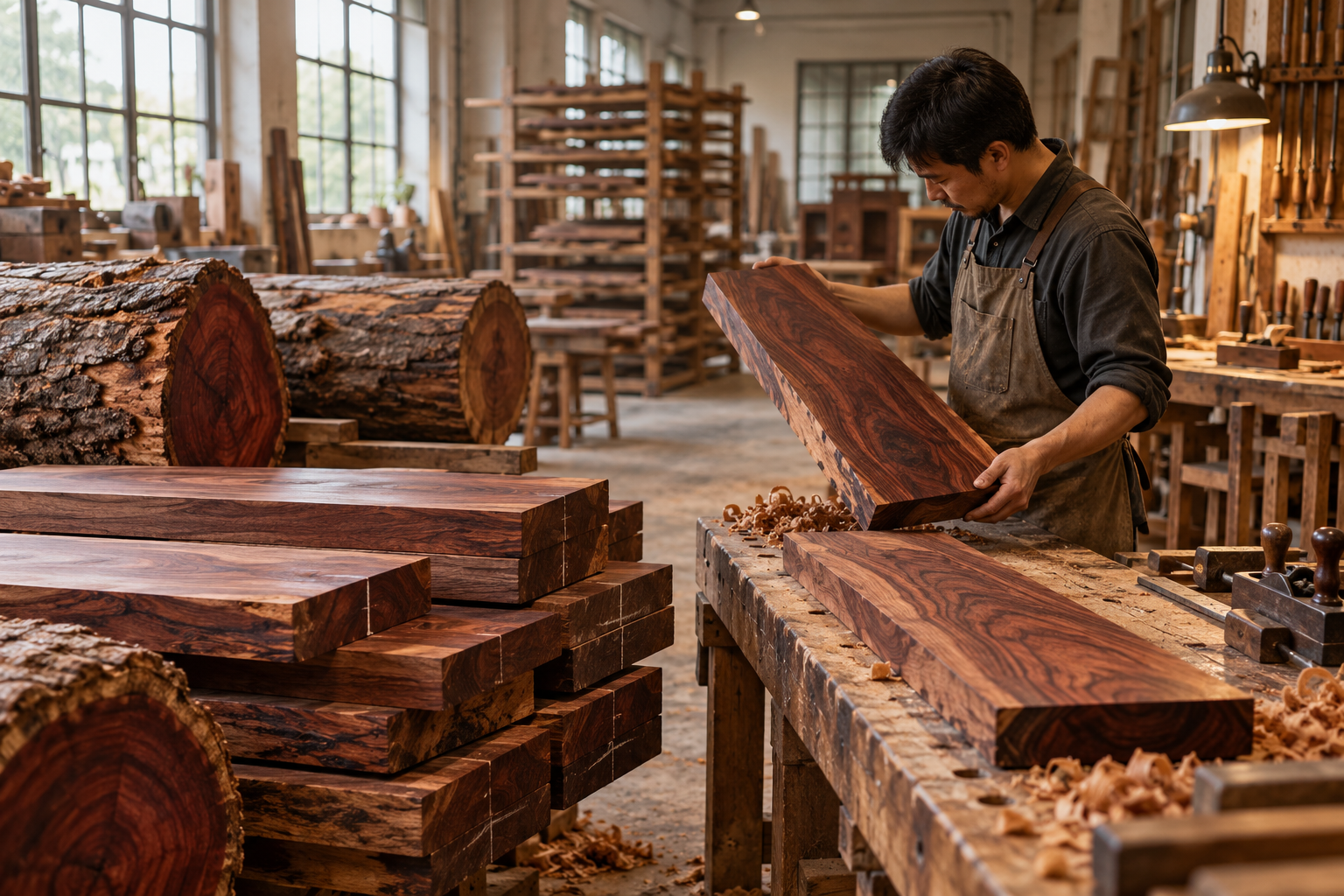
How does a rosewood furniture factory select timber before production starts? An inside look at species selection, grading, 36-day kiln drying, batch matching and FSC/CITES documentation for B2B importers sourcing classical Chinese furniture.
What Happens Before a Single Cut Is Made?
When overseas buyers evaluate a rosewood furniture factory, the conversation usually starts with catalogs, carving styles and container prices. Those things matter, but the decision that quietly shapes everything else — the color consistency of a twelve-seat dining set, the stability of a canopy bed through a heated North American winter, the paperwork that clears customs smoothly in Hamburg or Sydney — is made weeks earlier, at the timber yard, before a single board is cut. Timber selection is where an export order succeeds or fails long before anyone lifts a chisel.
This article walks through how a professional rosewood furniture factory actually selects timber for export production: which species enter the yard and why, how boards are graded and matched into batches, what happens during the kiln-drying cycle, how timber choices shape joinery and construction, and which compliance documents must travel with the wood. If you are sourcing classical Chinese furniture for wholesale, hospitality or design projects, understanding this process will help you ask sharper questions, compare quotations on a like-for-like basis, and avoid the most expensive mistakes in solid hardwood furniture manufacturing.
At Yunxiao Rosewood Furniture Co., Ltd., the working methods below are not theoretical. The company was founded in 2008 and operates a 12,000-square-meter factory in Xianyou County, Putian City, Fujian Province — a region widely regarded as the hometown of traditional hardwood craft in China. Because the factory covers the complete production chain in-house, from timber drying through woodworking, mortise-and-tenon assembly, hand carving, finishing and export packing, the people who choose the boards are the same people accountable for the finished container. That accountability is exactly what disciplined timber selection is meant to protect.
Why Timber Selection Decides the Fate of an Export Order
Solid hardwood is a natural material, and no two boards are identical. Every plank differs in density, color, grain direction, figure and moisture behavior. In furniture made for the domestic Chinese market, some of that variation is tolerated, and in classical pieces it is often celebrated as part of the wood's character. Export is less forgiving. Classical furniture sets travel for weeks through ocean freight, cross multiple climate zones, and arrive into environments the wood has never experienced — then must satisfy commercial buyers who inspect shipments with moisture meters, tape measures and purchase specifications in hand.
In practice, timber problems surface in three ways. First, appearance: pieces within one set show visible color or grain mismatch, so a bedroom suite reads as assembled from leftovers rather than designed as one room. Second, movement: under-dried or poorly selected timber cracks, warps or opens its joints after arrival, especially in heated or air-conditioned interiors. Third, compliance: timber without proper legal documentation can delay a shipment at the border no matter how beautiful the furniture is. All three failure modes trace back to decisions made at timber selection, and all three are expensive to fix after the fact.
There is also a straightforward commercial logic. In classical solid hardwood furniture manufacturing, the raw material represents a substantial share of the total production cost, and the gap between mixed-grade stock and properly selected Grade-A material is significant. A quotation built on carefully selected, kiln-dried hardwood will rarely be the cheapest number on the table. Over the life of the order, however — counting avoided rework, avoided on-site repairs against a project margin, and avoided replacement shipments — it is usually the cheapest. Buyers who understand this rarely choose a supplier on price per set alone.
The asymmetry of risk deserves emphasis. A material problem discovered at the grading bench costs a factory one board. The same problem discovered at the destination port, or after installation in a finished hotel room, costs an ocean freight cycle, a replacement production run, and in project settings a delay penalty that can dwarf the value of the furniture itself. A cracked carved panel cannot be meaningfully repaired on site; it has to be remade and reshipped. This is why experienced importers treat the material specification as part of the commercial negotiation, with the same seriousness as price and lead time, rather than as an afterthought buried in a catalog description.
Which Woods Go Into Export-Grade Rosewood Furniture?
In the international hardwood trade, "rosewood furniture" is an umbrella term that covers several related species and a few traditional substitutes. A professional rosewood furniture factory does not use one wood for everything; it matches the species to the role each component plays in the finished piece. Understanding that mapping is the first step in evaluating any quotation.
Siamese Rosewood: the Structural and Carving Backbone
The premium classical sets produced at Yunxiao are built around Siamese rosewood, known botanically as Dalbergia cochinchinensis. It is a genuinely dense hardwood, with an air-dry density of roughly 0.95 to 1.05 g/cm³ and a Janka hardness of approximately 2,430 lbf (10,790 N) according to The Wood Database reference data for the species. The heartwood ranges from reddish-brown to a deeper purplish tone with darker streaking, and the tight, interlocked grain holds carved detail cleanly. That combination of density, color and carving quality is precisely why this species has been the material of choice for classical Ming and Qing lineage furniture for generations.
Density, however, is both an asset and a responsibility. A dense species moves less than a soft one and takes crisp detail from the carver's chisel, but it also punishes careless drying with surface checks and internal stress. This is why species selection and drying discipline must be discussed together: the best Siamese rosewood timber in the yard can still be ruined in the kiln, and the best kiln schedule cannot rescue timber that was badly selected in the first place.
Nanmu, Aged Red Wood and Supporting Timbers
Not every component in a classical set needs the hardest wood available. Alongside Siamese rosewood, Yunxiao works with legally certified Machilus nanmu, aged red wood and Grade-A tropical hardwood. Nanmu is valued in traditional Chinese woodworking for its fine, even texture, gentle golden sheen and dimensional stability, which makes it well suited to drawer boxes, concealed panels and interior components where smooth finish quality matters more than maximum hardness. Aged red wood and selected tropical hardwoods fill supporting roles where their specific color and stability characteristics serve the design.
Experienced factories make these allocations deliberately rather than by accident. A wardrobe carcass, a display cabinet back panel and a carved sofa armrest have different jobs, and the timber for each is chosen accordingly. For the buyer, the practical rule is simple: ask which species is used in which component, and ask for it in writing on the order confirmation. Vague answers at this stage are one of the most reliable early warning signs in supplier evaluation.
How Species Choices Map to Product Lines
In a typical whole-house or hospitality order, the allocation looks like this: carved sofa sets, tea tables and beds carry the visible, structural load and are built from batch-matched Siamese rosewood; wardrobes and dressers combine solid rosewood frames with floating-panel construction to tolerate seasonal wood movement; drawer interiors and concealed components may use nanmu or other certified supporting timbers where their stability and finish qualities perform best. If you want a deeper material-level orientation before comparing suppliers, the site's guide to what rosewood furniture is actually made of covers the species, the joinery and the OEM customization process in detail.
Where Does a Rosewood Furniture Factory Source Its Timber?
Timber selection begins before the factory sees a single board. Sourcing policy determines what is even possible at the grading bench. Because Dalbergia rosewood species are listed on CITES Appendix II, international trade in the timber requires export documentation issued by the official management authority of the exporting country, and responsible manufacturers work exclusively within legally harvested, fully documented supply chains. Yunxiao's material list — legally certified Machilus nanmu, aged red wood, Grade-A tropical hardwood and Siamese rosewood — reflects that policy, and the factory supplies a CITES export permit issued by the Chinese CITES Management Authority with each shipment of listed species.
Documentation is paired with responsible-forestry certification. Siamese rosewood timber used in production is sourced under FSC chain-of-custody documentation, and FSC transaction claims are provided with each invoice so that importers can pass the claim through their own supply chain — a requirement that is increasingly written into corporate procurement policies and green-building standards in Europe and North America. For buyers, the practical consequence is that responsible sourcing is no longer a marketing statement; it is a set of verifiable documents that arrive with the goods.
There is also a structural difference between factories that dry their own timber and those that buy ready-dried boards from traders. Operating an in-house drying program — as Yunxiao does, with a 36-day constant-humidity cycle — means tying up working capital in green and drying timber for weeks, but it gives the factory control over when boards are cut, how they are stacked, what moisture target they are dried to, and which batches are reserved for which orders. A factory that owns its drying can promise a moisture content specification; a factory that buys dried boards can only pass along whatever its trader promises. When you compare rosewood furniture suppliers, that distinction is worth more than any brochure adjective.
How Is Timber Graded Before It Enters the Workshop?
Grading is not a single event but a series of decisions. Timber is assessed when it enters the yard, again after rough cutting when the boards reveal their interior condition, and once more when components are allocated to specific orders. At each stage, graders are sorting every board into the role it can honestly perform.
The defects and characteristics a grader evaluates are consistent across serious hardwood furniture manufacturing:
- Surface checks and end splits — small cracks that appear during drying; they indicate drying stress and can propagate into visible failures on wide panels.
- Knots — dense points of branch wood that disrupt grain and create localized weakness and color contrast; acceptable in rustic furniture, not in classical carved work.
- Sapwood — the paler outer wood, softer and less durable than heartwood; premium classical furniture is cut from heartwood, so sapwood bands are marked for removal or restricted to hidden areas.
- Warp, twist and cup — deformation that signals either poor stacking or unstable timber; boards that moved before machining will keep moving after assembly.
- Insect damage and staining — pinholes and discoloration that compromise both structure and finish quality.
- Grain direction — structural parts such as legs, posts and rails need straight, correctly oriented grain along the load path; carved panels reward tight, even figure.
- Color and figure — boards are sorted by tone so that complete sets can be assembled from visually consistent stock.
Alongside visual inspection, density and moisture are checked with instruments rather than eyeballed: moisture meter readings are taken at multiple points and depths, and boards are weighed and sounded as a cross-check. For Dalbergia cochinchinensis, a finished moisture content of 8% to 12% is the working target, verified before timber is released to production.
The grading output is an allocation, not a discard pile. The cleanest, best-colored boards are reserved for visible carved surfaces — sofa armrests, table aprons, bed posts. Structurally critical components are cut from straight-grained, defect-free stock even where the color is less dramatic. Hidden components are allocated sound but less decorative timber. This is standard practice in a disciplined factory, and it is worth asking any prospective supplier how their allocation works. Buyers who want a buyer-side counterpart to this process will find a practical walkthrough in the guide to verifying the quality grade of rosewood before placing a bulk order.
| Timber condition | What it signals | Typical allocation at selection |
|---|---|---|
| Clean, straight-grained heartwood, correct moisture | Premium structural and visible stock | Posts, rails, load-bearing frames and visible carved surfaces |
| Minor color variation within the batch tone range | Normal natural variation | Visible panels, positioned so variation reads as intentional |
| Small, sealed surface checks away from joints | Drying stress already arrested | Concealed or low-stress components only |
| Sapwood bands, knots, active splits, insect damage | Unfit for export-grade classical work | Marked out and removed before machining |
Carved classical work adds one more layer of selectivity. Hand carving amplifies every irregularity in the wood: a chisel skating across interlocked grain can tear out where the figure swirls, and any knot beneath a carving breaks the pattern the artisan is working to. For that reason, boards with tight, even figure and uniform tone are channeled toward carved aprons, crest rails and sofa panels, while plainer machine-finished surfaces tolerate a wider range of natural variation. Buyers comparing carved and uncarved lines from the same factory will notice that the carved pieces carry a steeper material requirement — one more reason their pricing differs beyond the additional labor.
What Happens During the 36-Day Drying Cycle?
Moisture control is the part of timber selection that buyers cannot see but feel most clearly a year after delivery. Wood is hygroscopic: it exchanges moisture with the surrounding air until it reaches equilibrium with the ambient climate. Timber dried for a humid coastal environment will shrink and crack in the dry, heated air of a North American winter; timber dried too aggressively can case-harden and develop internal stress that releases as warp after machining. This is why drying is treated as a continuation of selection rather than a separate step.
At Yunxiao, timber is dried for approximately 36 days under constant-humidity conditions, and finished timber moisture content is controlled at 8% to 12% before release to production. That range is a deliberate engineering choice: it is low enough to suit the heated interiors and air-conditioned buildings of overseas markets in North America, Europe and Australia, while remaining achievable without driving excessive stress into dense species like Siamese rosewood. A separate article on why kiln drying matters when buying rosewood furniture from China examines the moisture physics in more depth.
Constant-humidity kiln drying also does something air drying cannot: it allows the schedule to be controlled and documented. Drying records are kept by batch, and the factory supports third-party inspection, which means an independent inspector can review production and drying records on site before shipment. For a first-time buyer, that traceability is often the single most reassuring piece of evidence available: it converts a promise about moisture content into a record you can audit.
One caution belongs in every honest discussion of drying: kiln drying cannot repair bad selection. Boards that entered the kiln with deep checks, excessive sapwood or latent insect damage come out with the same defects, only drier. Drying discipline and grading discipline reinforce each other; neither substitutes for the other.
It is also worth remembering that equalization does not stop at the factory door. Even correctly dried timber continues to adjust for some weeks after installation as it settles into its new environment. Professional guidance to end customers usually includes simple accommodations: unpack and rest furniture in the installation room before final placement, keep pieces away from direct heat sources and prolonged strong sunlight, and expect minor drawer and door adjustments during the first seasonal cycle. These are the normal behaviors of genuine solid wood, and a factory that explains them honestly is more credible than one that promises the impossible.
How Timber Selection Shapes Joinery and Construction
The joinery in classical Chinese furniture is often described as decorative heritage, but it is better understood as an engineering response to how solid wood moves. Mortise-and-tenon frames, dovetailed drawer boxes and floating panels all exist because generations of craftsmen learned what happens when rigid metal fasteners meet moving timber. Mortise-and-tenon joinery connects the historical technique to its modern export relevance.
Timber selection determines what that joinery can achieve. The four-poster bed in Yunxiao's classical bedroom suite, for example, uses corner posts cut from single solid timber sections rather than finger-jointed or veneered stock. That construction preserves a continuous load path from canopy rail to floor, but it is only possible when the yard can supply long, clear, straight-grained sections of sufficient dimension — which is precisely what the grading stage exists to find and reserve. Similarly, floating panels housed in grooved frames let solid wood expand and contract with seasonal humidity without splitting the frame; they require panels and frames cut from stable, correctly dried stock to work as intended.
Grain orientation is another quiet decision with loud consequences. Rails are cut so that tenons run with the grain; wide table tops are laid up from boards whose grain and color are balanced across the surface; curved members are sawn to follow the intended line without cutting through short grain. None of this is visible in a product photograph, yet all of it determines whether a set stays tight through its first overseas heating season. Yunxiao assembles its furniture with mortise-and-tenon joints secured by wooden dowels and no metal fasteners in the primary frame — a traditional approach that also avoids the corrosion and stress-concentration problems fasteners introduce in dense hardwoods.
How Batch Selection Serves Hotel and Whole-House Projects
For a single sofa set, color matching is a manageable craft problem. For a villa with eleven rooms of furniture, a boutique hotel with forty suites, or a whole-house export order combining living, dining and bedroom collections, batch selection becomes a project-management discipline of its own. The core principle is to cut entire projects from the same timber batch, so that grain tone and color remain consistent not just within a set but across the whole installation.
This is how the factory approaches coordinated sets: every component in a five-piece bedroom suite, for instance, is cut from the same batch of Siamese rosewood so the room reads as a single design decision. For larger hospitality and residential projects, production can be scheduled in dedicated batches with phased delivery — projects of twenty suites or more can be arranged as dedicated batch production, scheduled against the project timeline. Carving can also be batch-matched across rooms when a near-uniform look is required; because decorative elements are executed by hand, minor variation between pieces is normal and expected, and batch planning is how a project keeps that variation intentional rather than random.
Buyers should raise batch matching explicitly at quotation stage. It affects which timber is reserved, how production is sequenced, and how long the order takes. A factory that answers with a concrete plan — which batch, which drying records, which delivery phases — is demonstrating exactly the production control that separates a manufacturer from an assembly operation.
How Timber Planning Supports Repeat and Growing Orders
The first container proves a supplier; the repeat order tests it. Because color and grain vary from log to log, a re-ordered bedroom suite will never be pixel-identical to the first delivery unless the factory planned for continuity. Factories that manage their own timber program handle this by keeping batch records that link each shipment to its drying and production documentation, and by maintaining drying inventory ahead of confirmed demand — the working-capital commitment mentioned earlier is precisely what makes a reliable reorder possible within a normal lead time.
Yunxiao's published production framework reflects that planning: standard orders run about 45 to 60 working days from deposit, custom and large projects receive a dedicated production plan, projects of twenty suites or more can be scheduled as dedicated batch production with phased delivery, and partial shipments are available for long-term partners. For an importer building a catalog year over year, that combination — documented batches, in-house drying, phased delivery — is what turns "the same supplier" into "the same material," which is what their own retail or project customers ultimately notice.
Buyers can protect continuity on their side with three habits. Reference the original batch and production photos when re-ordering, so the factory can match tone within an agreed tolerance. Agree on that tolerance in advance — for example, a described color range rather than an absolute match, since solid wood will never behave like laminate. And plan reorder lead times with the same discipline as first orders, including drying and documentation time. Factories can absorb a great deal of variation when buyers communicate; they cannot absorb silence.
Which Documents Travel With the Timber?
In 2026, compliance documentation is part of the material itself. For European and North American importers, three document streams matter, and all of them attach to the timber long before the furniture is crated.
- CITES export permits. Dalbergia cochinchinensis is listed on CITES Appendix II. Each shipment of listed species includes a CITES export permit issued by the Chinese CITES Management Authority. Where a shipment routes through an intermediary country, a re-export certificate is issued by the management authority of the re-exporting country, so importers should confirm their destination's requirements with the relevant authority and arrange any re-export documentation with their re-exporting party before departure.
- FSC chain-of-custody claims. Timber is sourced under FSC chain-of-custody documentation, and FSC transaction claims are provided with each invoice so the claim can be passed downstream. Buyers serving green-building projects or corporate procurement policies that require certified material can rely on the documentation set arriving with the shipment.
- Finish and packaging compliance. The beeswax and lacquer finishing system is formulated to meet EU REACH and US CARB standards, addressing the chemical compliance of the surface itself, and export crates are built to ISPM 15 heat-treated standards so the packaging clears plant-inspection controls.
The practical takeaway for B2B buyers is that due diligence under frameworks such as the EU Timber Regulation and the US Lacey Act becomes dramatically simpler when the exporter's documentation is complete and consistent. A detailed treatment of these obligations is available in the guide to how EU and US timber regulations affect redwood furniture imports. When comparing suppliers, ask for sample document sets early — a factory that produces them without hesitation has clearly shipped into regulated markets before.
A Worked Example: Reading a Timber Specification Line by Line
Material claims are easiest to evaluate when each clause is treated as a separate, checkable promise. Consider a specification line a buyer might reasonably receive for a carved sofa set: "Solid Siamese rosewood (Dalbergia cochinchinensis), kiln-dried to 8–12% moisture content, FSC chain-of-custody documented, CITES Appendix II export permit included." Read as a whole, it sounds like marketing. Read clause by clause, it becomes a verification checklist.
"Solid Siamese rosewood" makes two claims at once: the species, and that components are solid rather than veneered or finger-jointed. The species claim should carry the botanical name on the order confirmation — a factory confident in its material has no reason to resist this. The "solid" claim can be checked at inspection by examining joints, edges and panel construction for veneer lines or glued laminations.
"Kiln-dried to 8–12% moisture content" is a measurable promise. At pre-shipment inspection, moisture meter readings taken at several points on several pieces should fall inside that range, and the factory's drying records — which third-party inspectors can review on site — should show the batch history behind the numbers.
"FSC chain-of-custody documented" means transaction claims should appear on the invoices themselves, not merely in a brochure, so the claim can legally pass to the buyer's own customers. "CITES Appendix II export permit included" means the original permit, issued by the Chinese CITES Management Authority, travels with the shipment documents. A buyer who unpacks a quotation into clauses like these can compare two suppliers objectively, and can tell very quickly which clauses a weaker supplier would rather not put in writing.
How Timber Choices Affect Price, Lead Time and Quotations
Timber selection is invisible in a quotation but decisive inside it. Grade-A batch-matched Siamese rosewood costs more than mixed-grade stock; an in-house 36-day drying cycle ties up material for weeks before production even begins; CITES and FSC documentation adds administrative work that less scrupulous suppliers simply skip. None of these costs can be eliminated without moving them somewhere else — usually onto the buyer, after the container has sailed.
Lead time reflects the same reality. Standard production runs about 45 to 60 working days after deposit confirmation for a standard order, and custom or large projects receive a dedicated production plan based on complexity and quantity. Partial shipments are available for long-term partners, which matters for project buyers phasing deliveries against construction schedules. Buyers planning seasonal launches or hotel openings should work backward from the installation date and include the drying and documentation stages in the plan, not just the machining and carving.
The good news is that verifying material claims does not require trusting anyone's word. Yunxiao's minimum order starts at a single set, samples are refundable, and payment terms are structured as a 30% deposit with the 70% balance due only after the buyer confirms finished-product photos, dimensions and inspection results. Third-party inspection is supported, with inspectors able to review production and drying records on site. For a first-time buyer, a trial order is the lowest-risk way to confirm that the material specification discussed in emails is the material that actually arrives — before committing a full container.
Matching Timber Programs to Destination Climates
Where the furniture is going should influence how its timber is selected, dried and finished. The target markets for Chinese classical furniture each present a distinct moisture profile, and a factory that exports seriously will ask about the destination.
- Southeast Asia — consistently high humidity means timber that is too dry will re-absorb moisture and swell; ventilation, finishing and realistic moisture targets matter as much as species density.
- Australia — a mix of humid coastal and dry inland conditions, plus strong UV exposure near glazing, calls for balanced moisture targets and finishes with good light stability.
- North America — dry, heated winter interiors are the classic cracking scenario for imported hardwood furniture; the low end of the 8% to 12% moisture range exists precisely for this climate.
- Europe — comparable to North America in winter heating behavior, with meaningful regional variation between, say, Nordic interiors and Mediterranean coastal homes.
When requesting a quotation, tell the factory the destination city and the installation environment — a hotel with full HVAC behaves differently from a private villa with open windows. A serious rosewood furniture factory will adjust moisture targets, finishing recommendations and even panel construction choices accordingly, and will say so explicitly rather than treating every order identically.
What Should B2B Buyers Ask Before Committing to an Order?
Armed with the process above, a buyer can evaluate any rosewood furniture factory with a short, pointed list of questions. None of them is hostile; serious manufacturers answer them daily, and the answers are exactly what separates a reliable long-term partner from a risky one.
- Which species is used in which component, and can that allocation be written into the order confirmation?
- What moisture content is the timber dried to, how is it measured, and can drying records be reviewed by third-party inspection?
- Is the timber FSC chain-of-custody documented, and will FSC transaction claims appear on invoices?
- What CITES documentation is included with the shipment, and who arranges any re-export certificate the route requires?
- How are batches matched across sets and rooms for the project, and can production photos of the actual timber batch be provided?
- What finishing system is applied, and what are the compliance claims behind it for the destination market?
- What warranty covers structural movement, and what is the response process if material or workmanship problems are found at inspection?
Yunxiao's published terms answer each of these directly: a 24-month warranty from receipt covering structural cracking, severe deformation, loosened joints and hardware damage from non-human causes, with response within 48 hours of a reported problem and a proposed solution within 7 working days; third-party inspection welcome; documentation sets included with each shipment. Buyers conducting broader supplier due diligence can extend this checklist with the audit frameworks described in the guides to auditing a rosewood furniture factory before a first container order and verifying a genuine manufacturer.
Frequently Asked Questions
Is all rosewood furniture made from the same wood?
No. "Rosewood" is a trade umbrella covering multiple species, most importantly the Dalbergia genus, and classical Chinese furniture may also incorporate nanmu, aged red wood and other certified hardwoods in supporting roles. Two quotations that both say "rosewood" can describe materially different products, which is why the component-by-component species allocation should be part of any order confirmation.
What is the difference between "rosewood" and "redwood" in this trade?
In Chinese furniture exports the two English terms are often used interchangeably, because both translate the same family of classical hardwood categories; a site may sell "redwood dining sets" and "rosewood bedroom sets" that share species and construction. This is why buyers should anchor on botanical names and component-level specifications rather than trade labels. When a quotation names Dalbergia cochinchinensis explicitly, the ambiguity between rosewood and redwood disappears.
Why does Siamese rosewood command a premium over other hardwoods?
Three reasons converge. Its density — an air-dry 0.95 to 1.05 g/cm³ and roughly 2,430 lbf Janka hardness per The Wood Database reference data — gives excellent structural performance and takes carved detail cleanly. Its color and figure suit classical Ming and Qing lineage designs. And its CITES Appendix II status means legal, documented supply carries real administrative cost. The premium buys performance and compliance, not just a name.
How can I verify the timber in my order matches the specification?
Combine three checks: production and batch photos of the actual timber allocated to your order before shipment; a pre-shipment inspection — factory quality inspection is standard and third-party inspection is supported, with access to production and drying records; and documentation verification, including the CITES export permit and FSC transaction claims that accompany the shipment. Moisture readings taken at inspection should fall within the 8% to 12% target range.
Does kiln drying completely prevent cracking in overseas climates?
It dramatically reduces the risk but no honest supplier can promise zero movement in solid wood. Properly dried timber at the right moisture target, combined with movement-tolerant construction such as floating panels and mortise-and-tenon joinery, and a sensible installation environment away from direct heat and sudden humidity swings, together give the outcome buyers actually need: furniture that stays structurally sound and visually coordinated for years. Minor shrinkage and natural color variation are characteristics of genuine solid wood, not defects.
Can I mix species in one order to manage cost?
Yes, and it is common practice when done transparently. Using certified nanmu for drawer boxes and concealed components, for example, is a legitimate engineering allocation rather than a downgrade, provided it is disclosed and priced honestly. What undermines trust is undisclosed substitution on visible or structural components. Ask for the material allocation in writing and the question disappears.
What documentation do I need to import Siamese rosewood furniture into the EU or US?
Each shipment includes a CITES export permit issued by the Chinese CITES Management Authority and FSC transaction claims on the invoices, which together support your due diligence under the EU Timber Regulation or the US Lacey Act. Whether additional documentation — such as a re-export certificate for certain routings, or destination-specific phytosanitary paperwork — is required depends on your destination and route, so confirm requirements with your customs broker and the relevant authority before the shipment departs.
The Bottom Line for Importers
Timber selection is the least visible stage of classical furniture manufacturing and the one that most reliably predicts how an order performs. Species allocation, defect grading, batch matching, moisture control and documentation are five decisions that no product photograph can make for you — and five areas where a professional rosewood furniture factory should have clear, verifiable answers ready.
Yunxiao Rosewood Furniture Co., Ltd. has been manufacturing and exporting full sets of classical solid hardwood furniture — carved sofa sets with tea tables, six-to-twelve-seat dining collections and complete bedroom suites — from Xianyou, Fujian since 2008, for wholesalers, hotels and designers across Europe, North America, Australia and Southeast Asia. Trial single sets, refundable samples, free layout drawings for projects and remote installation guidance are available, and the team can quote against your destination climate, project quantity and delivery schedule. To start, browse the Ming style Siamese rosewood living room collection or send an inquiry describing your project — the more specific you are about destination and timeline, the more precise the timber program behind your quotation will be.