
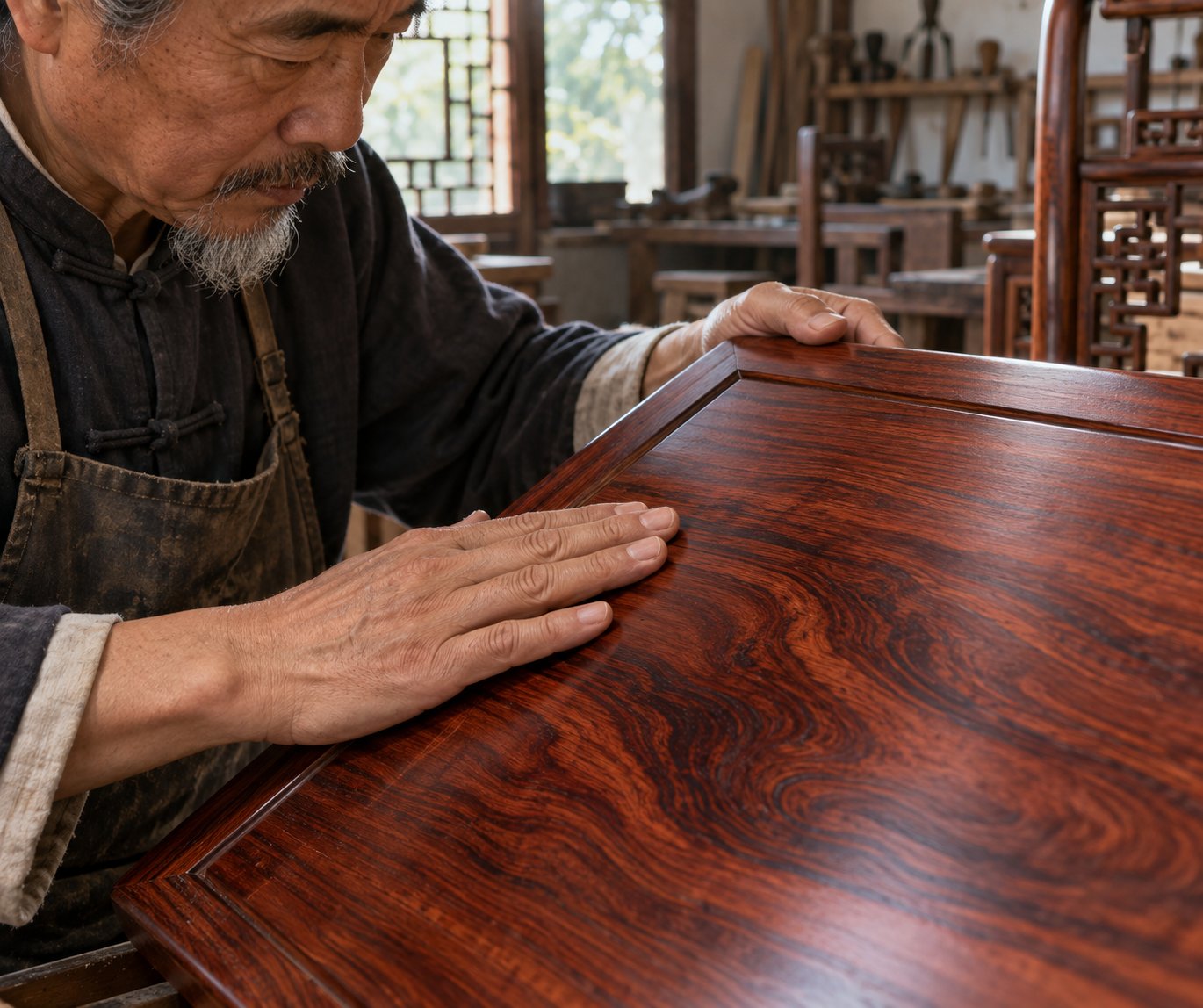
A practical B2B guide to verifying rosewood quality grades before a bulk furniture order: species identity, grain, moisture, joinery, finish, legal documents, and factory audit.
Why Rosewood Quality Grade Decides Whether Your Bulk Order Sells
When an importer wires a deposit for a full container of classical rosewood furniture, the single biggest variable in that transaction is not the freight rate and not the exchange rate. It is whether the wood inside the crates is actually the species and grade the quotation promised. A dining set made from dense, well-dried Dalbergia cochinchinensis and a dining set made from a lighter look-alike hardwood can look almost identical in a factory photo, yet behave completely differently after eighteen months in a heated European showroom or an air-conditioned hotel lobby in Southeast Asia. One stays tight and stable; the other develops hairline cracks at the panel edges, loose joints, and a finish that dulls unevenly. By the time your customers notice, the goods are already on your floor, and the cost of the difference comes out of your margin.
This guide walks through the practical verification steps a B2B buyer can use to check rosewood quality grade before committing to a bulk furniture order. It is written from the perspective of a manufacturer that has produced classical redwood furniture sets in Xianyou County, Fujian since 2008 and ships them to wholesalers, hotels, and designers across Europe, North America, Australia, and Southeast Asia. The checks below are the same ones we invite buyers to run on our own production, because a supplier confident in its grading has nothing to hide from an inspection.
Before we begin, it helps to be clear about the stakes. A full container of classical carved furniture is a large, slow-moving investment. The furniture is heavy, the freight is expensive, and the lead time is measured in months rather than weeks. If the grade is wrong, you cannot simply return the container and reorder; the cost of rework, storage, and lost sales lands entirely on you. That is why the verification steps in this guide are worth doing before you sign, not after the goods arrive. Every minute spent checking grade at the quotation stage saves days of dispute resolution later.
What "Quality Grade" Actually Means for Rosewood Furniture
The phrase "quality grade" gets used loosely in furniture marketing, so it is worth defining precisely before you can verify it. For classical rosewood furniture, grade is the combined result of four separate factors, and a shipment can fail on any one of them even when the others are perfect.
First, species identity. True rosewood in the classical Chinese furniture trade refers to hardwoods in the Dalbergia genus and a small circle of related dense tropical species. Siamese rosewood (Dalbergia cochinchinensis) is the benchmark timber for high-end classical sets in Fujian workshops. Substitutes exist at every price point, and some are legitimate value choices when they are honestly declared, but a shipment sold as Siamese rosewood and delivered as something else is a grade failure regardless of how nice the substitute looks.
Second, within-species selection. Even genuine Dalbergia cochinchinensis is graded by the proportion of heartwood, the density of the grain, the presence of mineral streaks or voids, and the straightness and match of grain across a set. A Grade-A selection uses dense, dark heartwood with tight, even grain and no soft sapwood in load-bearing members. Lower selections mix in paler sapwood, wider grain, and more character defects. Neither is "fake," but they are not the same product and should not share a price.
Third, preparation. The same log can produce excellent furniture or cracked furniture depending on how the timber was dried and rested before cutting. Moisture content that suits a workshop in humid Fujian will not suit a dry North American winter or a monsoon-then-air-conditioning cycle in Southeast Asia. Preparation quality is invisible in photos and catastrophic to skip.
Fourth, construction and finishing. Mortise-and-tenon joinery cut to tight tolerance, floating panels that allow seasonal wood movement, and a properly cured lacquer or wax finish are what convert good timber into furniture that survives export. A buyer verifying grade must check all four layers, because a supplier weak on any one of them will usually talk loudest about the one they are strong on.
It is also worth understanding that grade is not a single global standard. Different markets and different product tiers use different grading language, and a factory may apply its own internal grades. The practical approach is not to argue about labels but to agree on measurable properties: the botanical species, the proportion of heartwood, the target moisture content, the joinery method, and the finish specification. Write those into the order, and the grade question answers itself.
Step One: Confirm the Species in Writing, Then in the Wood
Species verification starts with paperwork and ends with your own eyes and hands. Ask the supplier to state the botanical name of the timber, not just a trade name. "Red wood," "rose wood," and "bubinga-style hardwood" are marketing labels; Dalbergia cochinchinensis, Dalbergia latifolia, or Pterocarpus species are checkable identities. A factory that works with legally certified timber will have this information on its material declarations already, because the same botanical names appear on the CITES and Lacey Act documentation that accompanies legal export.
Once the species is stated in writing, verify it physically. Dense rosewoods share a few properties that are difficult to fake across a whole furniture set. The wood is heavy for its size; a side chair in solid Dalbergia cochinchinensis has a substantial, dense heft that lighter plantation hardwoods do not replicate. The grain is typically interlocked, producing a ribbon or ripple figure under raking light rather than the flat, uniform stripe of lower-density species. Freshly cut or sanded areas carry the characteristic faint rose-like scent of the genus, strongest on unfinished tenons or inside drawers. The color deepens with age and light exposure rather than fading to gray the way many substitute woods do.
On our own production line, every Siamese rosewood component is cut from legally certified Dalbergia cochinchinensis, and the species declaration follows the shipment. For buyers who want independent confirmation, a small offcut from a hidden area can be sent to a wood identification laboratory; the cost is trivial against a container order, and a supplier who resists the request is telling you something. Reference data such as The Wood Database lists Dalbergia cochinchinensis at approximately 2,430 lbf on the Janka hardness scale, which places it far above the common furniture hardwoods a substitute seller might reach for.
One practical tip: ask for the species declaration on the commercial invoice and the packing list, not just in an email. When the species is written into the shipping documents, it becomes part of the legal record of the transaction, and it is far harder for a supplier to quietly substitute timber later. The botanical name should also appear on the CITES permit, so you can cross-check the three documents against each other with very little effort.
Step Two: Read the Grain Like an Inspector
Grain reading is the fastest skill a buyer can develop for remote quality checks, because it works on photographs as well as in person. Ask for close-up photos of the same component taken from two angles under strong side lighting, and look for the following.
On a Grade-A selection, the grain lines are tight and closely spaced, the figure is consistent from one chair to the next in a set, and there are no pale sapwood bands crossing visible faces. Where panels meet rails, a careful factory matches grain direction and color so the joint reads as one piece of wood. On carved surfaces, the grain should flow through the carving rather than around it; carving across weak or punky grain produces chipped edges that appear within months.
Warning signs in the grain include wide, open pores that catch finish unevenly, mineral streaks or black lines running through load-bearing members, sapwood patches on visible faces, and grain that changes direction abruptly mid-panel, which signals finger-jointed or pieced construction where solid wood was claimed. None of these make furniture unusable, but each one marks a lower grade than the one you may be paying for.
Color consistency across a set is a separate check. Solid rosewood varies naturally from log to log, so a factory that plans a ten-seat dining set will reserve timber from matched boards for the same order. Ask how the factory handles color and grain matching across a full container; the answer separates workshops that plan material from workshops that cut whatever is on the rack. We addressed this question in detail in our article on keeping wood color and grain consistent across a full container order, and the short version is that matching is a planning decision made at timber selection, not a finishing trick applied afterward.
When you are reviewing grain photographs, ask for shots of the same piece under both direct and raking light. Direct light shows color and figure; raking light reveals surface quality, carving edges, and whether the finish has been built up or merely sprayed on. A single glossy photo can flatter almost any piece of wood, but a pair of honest photos under different lighting tells a much more complete story.
Step Three: Verify Moisture Content and Drying Discipline
Moisture is where the most expensive surprises hide. Wood is hygroscopic: it exchanges moisture with the air until it reaches equilibrium with its environment. Timber dried for a humid coastal workshop will shrink and crack when it lands in the dry, heated air of a North American winter or a desert-climate hotel in Australia. Timber dried too aggressively for those markets, meanwhile, will swell and bind joints in tropical humidity. The target is not a single number but a controlled process that ends in the right range for the destination.
Ask three questions. What is the drying method and duration? What moisture content do you target for shipments to my market? And how do you rest the wood after drying, before machining? A disciplined answer sounds like this: kiln drying in a controlled chamber, followed by an extended conditioning period at constant humidity, then a rest period so the wood stabilizes before cutting. Our own process runs each component through 36 days of constant-humidity drying and conditioning, because classical furniture with thick carved members and wide floating panels needs slow, even moisture migration, not a fast surface dry that leaves the core wet.
Verification is easy and cheap. A pin-type moisture meter costs very little and reads through a finish on hidden surfaces such as drawer bottoms, cabinet backs, or the underside of a seat rail. Readings in the low-to-mid single digits suit most North American and European interiors; tropical destinations run somewhat higher. What matters more than any single reading is consistency: several components of the same shipment should read within a narrow band of each other. Wide variation means the drying batch was mixed or rushed, and the pieces will move at different rates in your customer's living room.
Also inspect how the design accommodates the moisture movement that will happen anyway. Floating panels in wardrobe doors and dresser tops, expansion gaps at panel edges, and frame-and-panel construction are all signs that the factory designs for movement rather than pretending it will not occur. Our four-poster bedroom suite, for example, uses floating-panel construction on the wardrobe and dresser specifically so seasonal movement happens inside the frame instead of splitting the panel.
It is worth asking about the drying schedule in some detail, because the answer reveals a lot about the factory's discipline. A fast, high-temperature kiln dry can bring the surface moisture down quickly while leaving the core wet, and that imbalance shows up later as warping and cracking. A slow, staged schedule with a conditioning phase produces timber that is stable through the core. When a supplier can describe its drying schedule in concrete terms, including the conditioning and rest periods, it is a strong signal that moisture is treated as a process rather than an afterthought.
Step Four: Inspect Joinery, Because It Carries the Structure
Classical Chinese furniture earns its longevity from joinery, and joinery quality is the clearest signal of a workshop's real capability. The traditional standard is mortise-and-tenon construction with wooden dowels, assembled without metal fasteners in the primary frame. Metal screws and nails are faster and cheaper, but they create rigid points that fight the wood's natural movement and become the starting points for cracks around the fastener.
To verify joinery on a sample or during a factory visit, open a drawer and look at the joints joining the front to the sides: dovetails cut in solid wood indicate care; butt joints with visible staples or nails indicate the opposite. Look underneath a seat rail or inside a table apron for the shoulder lines of mortise-and-tenon joints. Ask what proportion of the frame is joined without metal. On our production, the primary frames of every set are assembled with mortise-and-tenon joinery and bamboo dowel pins, with zero metal fasteners in the load-bearing structure, which is also why the furniture tolerates overseas climates better than nailed equivalents.
Fit tolerance is the second half of the check. A well-cut joint closes with hand pressure and a mallet tap, shows a hairline glue line, and needs no filler. Gaps filled with colored putty, joints that rock, or tenons that show daylight around their shoulders all indicate rushed work. If you cannot visit the factory, request a short video of a joint being assembled and disassembled, or order a single trial set before the container. A factory confident in its joinery will welcome both requests; we supply trial single sets and refundable samples precisely because we would rather prove the joint than describe it.
Joinery also tells you about the factory's attitude toward the wood itself. A workshop that cuts tight mortise-and-tenon joints is handling the timber with care at every stage, from selection through drying to assembly. A workshop that relies on nails and glue to hold a frame together is usually compensating for wood that was not dried or selected well enough to hold a proper joint. In that sense, joinery is not just a construction detail; it is a window into the whole production philosophy, and it is worth looking at closely.
Step Five: Evaluate the Finish Beyond the Photo Shine
Finish quality determines how the furniture looks after two years, not two days. Classical rosewood furniture is traditionally finished with raw lacquer applied in multiple coats, each one cured and hand-rubbed, sometimes followed by a beeswax top layer. The number of coats and the curing discipline between them are the difference between a finish that penetrates and hardens with the wood and a finish that sits on top as a plastic film waiting to be scratched.
Ask how many coats are applied, how long each coat cures, and whether the finish meets the chemical compliance standards of your market. European Union buyers should expect REACH-compatible finishing; United States buyers should expect CARB-compatible materials. These are not decorative credentials; they are the standards your customs broker and your retail customers' regulators will care about. Our finishing process applies six coats of raw lacquer, each cured for 24 hours and hand-rubbed with pumice stone to a penetrating satin sheen, using eco-friendly materials formulated to meet EU REACH and US CARB requirements.
Physically, a quality hand-rubbed finish feels warm rather than glassy, shows the grain through the sheen rather than burying it, and has even color in recesses as well as on flat faces. Run a fingertip along the inside of a carved apron: overspray and film-forming finishes collect in corners; hand-rubbed penetrating finishes stay consistent. Check the undersides and drawer interiors too. A factory that finishes hidden surfaces with the same discipline as visible ones applies the same standard everywhere, and that consistency is what you are really buying.
Finish is also where a buyer can most easily be misled by photography. A high-gloss finish photographs beautifully but can be a thin film that scratches and dulls quickly, while a matte hand-rubbed finish photographs more modestly but wears far better. Ask for a video of the finish under moving light, or better, handle a sample. The way a finish feels and reflects light in person is the honest test, and it is worth the small cost of a sample to learn it.
Step Six: Verify the Legal Chain, Not Just the Product
For rosewood specifically, legality is inseparable from quality, because the most valuable species in this trade are also the most regulated. Dalbergia species are listed under CITES, which means international shipments require export permits issued by the exporting country's CITES Management Authority. The United States enforces the Lacey Act declaration requirements on furniture imports, and the European Union Timber Regulation requires documented due diligence on the timber's origin. A shipment that arrives without a clean paper chain can be held, fined, or refused regardless of how beautiful the furniture is.
Your verification checklist here is concrete. Confirm the supplier can issue a CITES export permit for the species in your order, issued by the Chinese CITES Management Authority, and that the permit will accompany the shipment. Confirm FSC chain-of-custody documentation is available if your customers or your market require certified sourcing. Confirm the packing complies with ISPM 15 heat-treatment standards for solid wood packaging, which prevents a phytosanitary hold at destination. And confirm who prepares the export documents: a factory with an internal documentation team produces consistent paperwork; a factory that improvises paperwork per shipment is a recurring risk.
We prepare full export documentation, FSC certificates, and ISPM 15 heat-treated packing in-house for every container, and each Siamese rosewood shipment carries its CITES export permit. For buyers new to this territory, our article on how EU Timber Regulation and the US Lacey Act affect redwood furniture imports walks through the document chain in detail.
The legal chain is also a quality signal in its own right. A factory that maintains clean, current documentation for every shipment has to run a disciplined operation, because the paperwork cannot be faked consistently across many orders. When a supplier can produce the full document set for a recent shipment on request, it demonstrates that compliance is built into the operation rather than improvised. When the paperwork is vague, delayed, or inconsistent, treat it as a warning that the rest of the operation may be equally loose.
Step Seven: Audit the Factory Behind the Quotation
Wood grade is ultimately a production capability, so the last verification step is the factory itself. A quotation is a promise; a workshop is the evidence. If travel is not practical, a structured virtual audit covers most of the ground: a live video walk through the timber yard, the drying chambers, the carving benches, the assembly floor, and the packing area, with your questions answered in real time. What you are looking for is process, not polish. Stacked, stickered timber resting in an organized yard; drying chambers with records; carvers working at benches rather than a single showcase carver; a packing line with custom crating, moisture barriers, and bracing for carved components.
Ask about capacity and lead time in the same breath, because unrealistic promises on either signal a trading company reselling another factory's output. Container orders of classical carved furniture take real time: our standard is 45 to 60 working days after deposit, which reflects carving hours, drying discipline, and finishing cure time that cannot be compressed without cutting corners. A supplier quoting half that for a full container of hand-carved sets is either pre-selling capacity it does not control or planning to skip steps you will pay for later.
Finally, ask how the factory handles the questions this article raises. Does it offer pre-shipment inspection with photo and video evidence? Does it welcome third-party inspection? Does it provide free layout drawings for project buyers and remote installation guidance after delivery? These service behaviors correlate strongly with production discipline, because a factory that plans to stand behind its grading builds the inspection and support habits in advance.
A virtual audit is not a substitute for a physical visit, but it is a powerful filter. A factory that can walk you through its timber yard and drying chambers on a live call, answer questions about species and moisture on the spot, and show you work in progress is demonstrating the transparency that grade verification depends on. A factory that deflects, offers only polished showroom footage, or cannot schedule a live walkthrough is telling you that its production would not survive close inspection.
How to Spot Common Rosewood Substitutes
Because rosewood is valuable and regulated, the market has a long history of substitutes, and a buyer who can recognize the most common ones is far less likely to be surprised. The first group is other Dalbergia species that are not Siamese rosewood. These can be excellent furniture woods in their own right, and they are not necessarily a problem if they are honestly declared, but they are not what a buyer paying for Dalbergia cochinchinensis should receive.
The second group is related dense hardwoods that are marketed under rosewood-adjacent names. Some of these are legitimate value choices with their own character; the issue is only when they are sold as rosewood without disclosure. The third group is the more serious problem: veneered or engineered construction where a thin rosewood veneer is laid over a cheaper core. A buyer inspecting a drawer side or a seat rail can often spot this by looking at the end grain, where a veneer shows a thin surface layer over a different core, and by checking the weight, which is lower than solid rosewood of the same size.
The most reliable defense against substitution is the combination of checks already described: the botanical name in writing, the CITES and Lacey Act documentation, physical inspection of grain, weight, and scent, and a trial order before the container. No single check is foolproof, but a supplier who has to pass all of them consistently will find it far easier to simply deliver what it promised. Substitution is a business decision on the supplier's side, and it is a decision that becomes much less attractive when the buyer is clearly checking.
How to Verify Rosewood Across Sofa, Dining, and Bedroom Sets
The verification principles in this guide apply to every product category, but each type of set has its own points of attention, and it helps to know where to look. On a carved sofa set, the highest-risk areas are the carved aprons and armrests, where the grain must flow through the carving, and the seat rails, which carry the load. Check that the carving is cut into solid wood rather than applied as a separate glued-on panel, and that the frame joints under the upholstery or cushions are mortise-and-tenon rather than nailed.
On a dining set, the tabletop is the largest single surface and the most likely place for a grade difference to show. Ask how the top is constructed: a solid top from matched boards is the premium option, while a veneered or edge-glued top is a different product. Check the leg-to-apron joints, which carry the weight of the table and its load, and confirm the chairs use the same grade of timber as the table rather than a lower selection hidden by the smaller size of the parts.
On a bedroom suite, the wardrobe and dresser are where floating-panel construction matters most, because the large flat panels are the most exposed to seasonal movement. Check that the panels float in their frames rather than being glued rigid, and inspect the drawer construction, which is a reliable indicator of overall care. A bedroom suite also has the most hidden surfaces, so it is the category where finishing hidden areas consistently is most important, and where a buyer can learn the most by opening every drawer and looking inside.
Across all three categories, the same rule holds: verify the species, the moisture, the joinery, the finish, and the documents on the actual production, not on a catalog sample. A factory that grades its sofa, dining, and bedroom sets to the same standard is a factory you can plan a season around.
How to Budget and Negotiate for Grade-A Rosewood
Grade-A rosewood furniture costs more than lower grades, and a buyer who understands why is better positioned to negotiate a fair price rather than simply the lowest one. The premium pays for three things: the selection of dense heartwood, the drying and conditioning time, and the joinery and finishing labor. Each of these is a real cost that a factory cannot cut without changing the product, so a price that is dramatically below the market for the claimed grade is a warning, not a bargain.
When you negotiate, anchor the conversation in the measurable properties rather than the label. Agree on the botanical species, the proportion of heartwood, the target moisture content, the joinery method, and the finish specification, and let the price follow from those. A supplier who is willing to put those properties in writing is negotiating in good faith; a supplier who resists specifying them is usually protecting the flexibility to deliver less than promised.
It is also worth negotiating the verification terms into the order. A pre-shipment inspection with photo and video evidence, a third-party inspection option, and a trial order before the container are all reasonable requests that protect both sides. A factory that agrees to these terms is confident in its grading; a factory that resists them is asking you to trust it on faith, and faith is not a shipping document.
How to Compare Rosewood with Other Solid Hardwoods
Part of verifying rosewood quality is understanding how it compares with the other solid hardwoods a buyer might consider, because the comparison clarifies what you are paying for. Rosewood, and especially Siamese rosewood, is prized for its density, its rich color and figure, and its stability when properly dried. Its Janka hardness, around 2,430 lbf for Dalbergia cochinchinensis, places it well above many common furniture hardwoods, which means it resists dents and wear in high-traffic hospitality settings.
Against lighter hardwoods, rosewood offers greater durability and a more distinctive appearance, but it also costs more and carries heavier regulatory requirements. Against other dense tropical hardwoods, the differences are more about appearance and workability than raw performance. The right choice depends on the project: a luxury hotel lobby that needs furniture to last decades and make a statement may justify rosewood, while a high-volume retail line may favor a lower-cost hardwood with honest disclosure.
The key point for a buyer is that the comparison should be made on facts, not on marketing. Ask for the Janka hardness, the density, the moisture behavior, and the regulatory status of any wood you are considering, and compare those numbers across options. A supplier that can give you these figures for its rosewood and for the alternatives is giving you the information you need to make a sound decision; a supplier that only offers adjectives is not.
Red Flags That Should Stop a Bulk Order
Across the checks above, a handful of responses should pause any negotiation. A supplier who cannot state the botanical name of its timber, or who changes the story between the quotation and the proforma invoice. A refusal to allow third-party inspection or to provide moisture readings, justified with assurances that "photos are enough." A price dramatically below the market for the claimed species and grade, which in this trade almost always means a substituted species, a thinner material section, or skipped drying time. Lead times that ignore the physical reality of carving and curing. And paperwork offered "after shipment" rather than before deposit, which inverts the only order in which documents can actually protect you.
None of these flags mean the supplier is dishonest; some are signs of inexperience. But a bulk order of regulated hardwood furniture is the wrong place to educate a supplier at your expense. The verification steps in this guide exist precisely so that problems surface while they are still cheap to fix.
It is also worth noting that a single red flag is rarely fatal on its own, but several together should be decisive. One vague answer might be a language or communication issue; a pattern of vague answers, resistance to inspection, and prices that seem too good is a pattern you should not ignore. Trust your process, and let the checks do the work of separating a confident factory from a hopeful one.
A Practical Pre-Order Verification Checklist
Condensed for daily use, here is the sequence we recommend to every buyer before a bulk rosewood furniture order. Confirm the botanical species in writing and match it to the CITES and Lacey Act documentation your market requires. Request close-up grain and color photographs of actual production, not catalog renders, from two angles under side light. Ask for the drying method, duration, target moisture content for your destination market, and the conditioning period after drying. Specify joinery expectations: mortise-and-tenon primary frames, no metal fasteners in load-bearing members, and evidence on a sample or video. Define the finish: coat count, cure time per coat, hand-rubbing, and REACH or CARB compatibility as applicable. Verify the document chain: CITES export permit, FSC chain of custody where required, ISPM 15 packing, and in-house export documentation. Audit the factory live or virtually, including the timber yard and drying chambers. Order a trial set or refundable sample before the container. Agree on pre-shipment inspection with photographic evidence, and keep a moisture meter in your inspection kit. Each step takes minutes; skipping any of them can cost a season.
How We Prove Grade on Every Yunxiao Order
Because this guide describes the standard we hold ourselves to, it is fair to close with what verification looks like on our side. Yunxiao Rosewood Furniture was founded in 2008 and operates a 12,000-square-meter factory in Xianyou County, Putian City, Fujian, a region with generations of classical hardwood craft. We produce full sets of classical solid redwood furniture, from carved sofa sets with tea tables to six-to-twelve-seat dining sets and complete bedroom suites, using legally certified Machilus Nanmu, aged red wood, and Grade-A tropical hardwood including Siamese rosewood. Every primary frame is assembled with mortise-and-tenon joinery and wooden dowels, without metal nails, after 36 days of constant-humidity drying. Finishing uses eco-friendly beeswax and raw lacquer meeting EU REACH and US CARB standards. Shipments carry FSC chain-of-custody documentation, CITES export permits for the species involved, and ISPM 15 heat-treated packing, prepared by our internal export team. Container orders run 45 to 60 working days after deposit, with partial shipments available for long-term partners, and we support new buyers with trial single sets, refundable samples, remote installation guidance, and free layout drawings for villa and resort projects.
If you are evaluating suppliers for an upcoming season, put our production through the same checklist you would apply to anyone else. Ask us for grain photographs from current orders, moisture readings from a shipment bound for your market, a video of a joint being cut and assembled, or a live walk through the drying chambers. The furniture that survives export is the furniture that was verified before it was built, and we would rather be verified than promised.
Frequently Asked Questions
What is the difference between Grade-A rosewood and lower grades? Grade-A refers to dense heartwood with tight, even grain and no sapwood on visible or load-bearing faces, selected and color-matched across a set. Lower grades mix sapwood, wider grain, and more character defects. Both can be genuine Dalbergia; they differ in selection, not species, and should differ in price.
How can I verify the wood species without visiting the factory? Require the botanical name in writing, cross-check it against the CITES export documentation that must accompany legal shipments, inspect grain, weight, and scent on samples or production photos, and if needed send a small hidden-area offcut to a wood identification laboratory.
What moisture content should rosewood furniture have on arrival? It depends on the destination climate, but the more important signal is consistency across the shipment and a documented drying and conditioning process. Ask for the factory's target range for your market and verify with a pin meter on hidden surfaces.
Why do reputable factories avoid metal nails in classical furniture? Metal fasteners create rigid points that resist the wood's natural seasonal movement, concentrating stress and initiating cracks. Mortise-and-tenon joinery with wooden dowels moves with the wood, which is why classical frames built this way stay tight in overseas climates.
Which documents must accompany a legal rosewood furniture shipment? At minimum a CITES export permit for the species, commercial and packing documentation, ISPM 15-compliant heat-treated packing marks, and where applicable FSC chain-of-custody certificates plus Lacey Act declarations for the US or due diligence records for the EU.
Is a trial order really necessary before a full container? Yes. A trial single set or refundable sample lets you verify species, moisture, joinery, and finish with your own hands at minimal cost, and it establishes the quality baseline you will inspect the container against.
Can I trust a supplier who only shows catalog photos? No. Catalog renders and polished photos cannot show grain, moisture, joinery, or finish honestly. Ask for production photos of actual current orders, a live virtual walkthrough, and a sample before committing to a bulk order.
How long should a full container of hand-carved rosewood furniture take? Realistic lead times for classical carved furniture are measured in working days, not weeks of shortcuts. A disciplined factory needs time for carving, drying, and finishing cure; a quote that is dramatically faster than the market usually means steps are being skipped.
Ready to put a supplier's rosewood grading to the test? Explore our Imperial Dragon carved redwood sofa set, our Ming style round dining table set, and the classical four-poster bedroom suite, or start with a three-piece Siamese rosewood sofa set as your trial order, and request the grain photos, moisture readings, and documentation for any set before you commit to a container.