
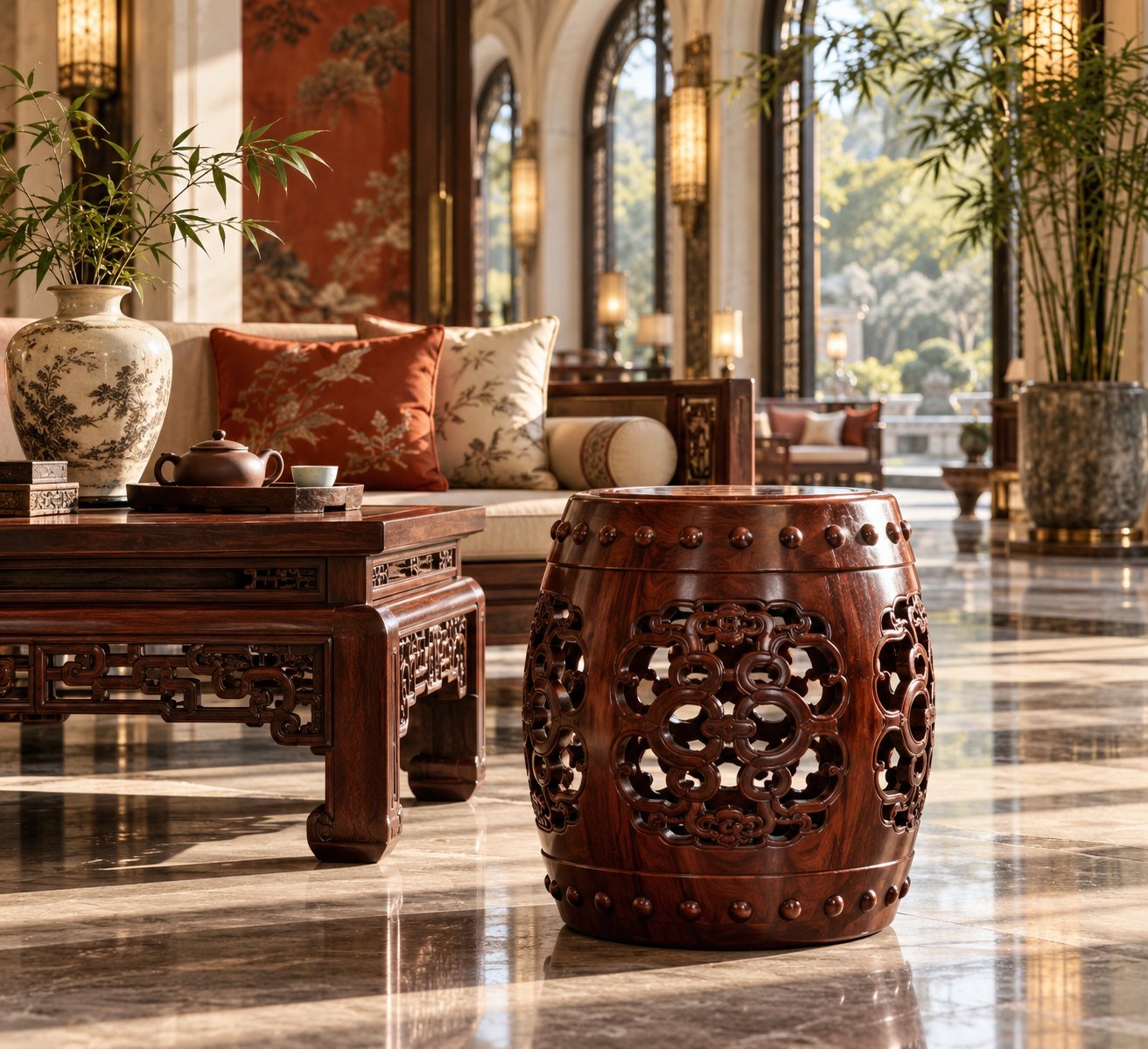
A B2B buyer's guide to Chinese garden stools: what the drum stool is, why luxury hotels and villas specify them, the materials and craftsmanship behind authentic rosewood pieces, and how to source wholesale with verified compliance and lead times.
Walk through any well-specified boutique hotel in Lisbon, a villa project in California, or a resort lobby in Queensland, and you will notice a quiet shift in the accent furniture being specified. Alongside the consoles and lounge seating, procurement teams are increasingly adding a piece that would have been unfamiliar to most Western specifiers a decade ago: the chinese garden stool. Drum-shaped, richly carved, and finished in a deep satin sheen, these pieces have moved from museum gift shops into genuine luxury hotel furniture programs — not as curiosities, but as versatile accent seating and side tables that hold their own against any contemporary design language.
Part of the appeal is practical. A garden stool is compact, strikingly sculptural, and works in places where conventional seating or tables cannot: beside a bathtub, flanking a console, clustered around a tea table, or as a standalone sculptural object in a courtyard. For importers and wholesalers, it is also a piece with a story — one rooted in Chinese classical furniture tradition stretching back centuries — which makes it far easier to merchandise than a generic accent table. And for designers working on villa and hospitality projects, it offers something rare: an accent piece that is simultaneously furniture and art object, without the fragility that usually implies.
This guide is written for B2B buyers — furniture importers, hotel procurement managers, interior designers, and wholesalers — who are evaluating chinese garden stools for their catalog or next project. We will cover what the piece actually is and where it comes from, how it is used in hotel and villa settings, what separates well-made rosewood furniture from poorly dried imitations, which classical styles suit which markets, and what to verify before you place an order — including moisture content, joinery, documentation, and realistic lead times. Where useful, we will point to how our own factory approaches these questions, so you can benchmark any supplier against concrete, checkable practices rather than marketing language.
What Exactly Is a Chinese Garden Stool?
A chinese garden stool — called a drum stool in English because of its barrel-like form, and known in the Chinese classical furniture tradition as a zuodun or xiudun — is a compact, usually drum-shaped seat with a flat top, a slightly waisted or lattice-carved body, and decorative bands at the top and bottom rims. Despite the name, it was never exclusively a garden piece. These stools served as seating in interiors, on verandas, and in courtyards alike; the English name likely stuck because export-era examples were so often photographed in garden settings.
From Dynasty Courts to Modern Lobbies
As general industry knowledge, drum-form stools appear in Chinese material culture well before the Ming dynasty, with early examples depicted in paintings and surviving in ceramics and wood. But the form reached its artistic maturity during the Ming (1368–1644) and Qing (1644–1912) dynasties, when China's classical hardwood furniture tradition — working in dense tropical hardwoods with refined joinery and minimal ornament — was at its peak. Ming-era stools tend toward restrained, elegant lines with subtle carving; Qing examples grew more elaborate, with denser relief carving, pierced medallions, and richer surface decoration. Collectors and designers today still distinguish between the two, and for good reason: a Ming-style stool reads quiet and architectural, while a Qing-style piece reads ornate and expressive. Both approaches have a place in modern specifications, and the choice between them says a great deal about the mood a designer wants a space to carry.
What makes this heritage relevant to a B2B buyer is not romance for its own sake. It is that the form survived because it works: a drum stool is inherently stable, its low center of gravity suits both seating and side-table use, and its compact footprint means it can be shipped and placed efficiently. Few accent pieces in the luxury hotel furniture category carry that combination of proven ergonomics and centuries of design refinement. When a guest asks about the carved stool in the lobby, the front desk has an answer with real depth to it — and that is merchandising value you cannot buy from a catalog of anonymous modern accents.
Anatomy of a Traditional Drum Stool
Understanding the anatomy of the form helps you read quality at a glance — and spot shortcuts just as quickly. A traditional drum stool consists of several defining elements:
- The drum body: a rounded or slightly convex barrel form, sometimes with a pierced or lattice-carved waist with openwork panels (the kaiguang "windows" popular in Qing-style pieces).
- Top and bottom bands: raised decorative rims that frame the body, often echoing the stretchers of classical Chinese tables and chairs.
- Nail-stud or boss motifs: round appliqués that recall the metal studs of drums, rendered here in carved wood — a purely decorative survival of the form's origin.
- The seat: flat or gently dished, often the panel where the finest carving is concentrated.
It is worth distinguishing the garden stool from two neighbors in the classical furniture family. First, it is not a nightstand-style accent table: it is lower, rounder, and designed around a seating silhouette, even when used as a side table. Second, it is not a folding stool — a separate and equally venerable form in Chinese classical furniture, exemplified by the cross-legged jiaowu tradition. A folding stool pivots and collapses on a central axis; a garden stool is a fixed, solid construction. Buyers comparing pieces should note that these are structurally different products with different joinery logic, and a supplier should be able to explain exactly how each is assembled.
Traditionally, the finest examples were made in dense tropical hardwoods — the same material family that defines high-end rosewood furniture today — with precious examples in huanghuali and zitan reserved for scholarly and courtly settings. More common pieces used regional hardwoods and elm. In contemporary export production, solid Siamese rosewood (Dalbergia cochinchinensis) is one of the most dependable choices: dense enough to hold crisp carved detail, warm reddish-brown in color, and well suited to traditional beeswax and lacquer finishing. Solid-wood construction matters here in a way it does not with case goods — a stool is carved and shaped all over, so veneered or finger-jointed constructions reveal themselves quickly, especially on curved surfaces.
With the form and its history established, the practical question follows: where do these pieces actually earn their place in a hotel, resort, or villa specification?
Why Are Chinese Garden Stools a Must-Have for Luxury Hotels and Villas?
Walk through a well-designed resort courtyard in Suzhou, a boutique hotel lobby in Singapore, or a villa terrace in Southern California, and you will notice a recurring element: the Chinese garden stool. Cylindrical, carved, and compact, this piece of Chinese classical furniture has quietly become one of the most versatile accents in high-end hospitality and residential projects. For importers and procurement managers evaluating rosewood furniture for their catalogs or FF&E schedules, the garden stool deserves closer attention — not as a novelty, but as a workhorse piece that earns its footprint many times over.
General industry knowledge explains part of the appeal. The drum stool — known in Chinese as xiudun or zuodun — has been a fixture of Ming and Qing dynasty interiors for centuries, valued precisely because it is light, portable, and architecturally neutral. It complements almost any seating arrangement without competing with it. That historical versatility translates directly into modern commercial value, especially in properties where spaces must serve multiple functions throughout the day.
Flexible Seating That Moves With the Guest Experience
One of the most practical arguments for specifying chinese garden stools in hospitality projects is operational flexibility. Banquet and event teams constantly reconfigure lounges, terraces, and function spaces, and heavy upholstered furniture simply cannot keep up. A well-made hardwood stool, by contrast, can be carried by one member of staff and positioned in seconds — extra seating at a private dinner, a perch beside a pool cabana, a quick solution when an unexpected party of guests arrives at the tea pavilion.
Weight matters here, and so does durability. In classical Chinese cabinetmaking, the drum stool's frame relies on mortise-and-tenon joinery rather than metal fasteners, which is also how we at Yunxiao build our classical rosewood pieces — assembled without nails to avoid the cracking and deformation that metal fixings can introduce as timber moves with the seasons. A stool built this way can be lifted, shifted, and knocked about by housekeeping teams for years without loosening at the joints, something buyers should verify directly by asking any supplier about joinery construction and requesting joint-fit inspection documentation before committing to an order.
For garden stool wholesale buyers, this portability also reduces handling costs. Stools stack and pack efficiently in containers, and their compact 35 x 35 cm-class footprint means a single mixed container can carry a meaningful quantity alongside larger statement pieces — a point we address in more detail in our guide to MOQ and mixed containers.
More Than a Seat: Side Table, Plant Stand and Styling Anchor
Designers rarely specify the chinese garden stool as seating alone. In practice, it is one of the most adaptable accent pieces available:
- As a compact side table, placed beside an antique chinese tea table or a modern sofa to hold a cup, a book, or a ceramic vase.
- As a nightstand alternative in villas and resort suites where a full bedside table would overwhelm a smaller room.
- As a plant stand, elevating orchids, bonsai, or statement greenery at exactly the right height against a garden wall.
- As a vanity or dressing stool in spa suites and bathrooms, where a low, wipeable hardwood surface outperforms upholstered seating in humid conditions.
This multi-role character is what convinces procurement managers to include the category in their luxury hotel furniture specifications. One SKU type serves four or five styling functions across the property, which simplifies both the FF&E list and long-term replacement planning. It also means a stool pairs naturally with the larger pieces in a collection — set one beside a carved lounge chair from our Siamese rosewood lounge chair range and you have a complete conversation corner; place another next to a round carved-apron tea table and the pairing reads as a deliberate tea-service vignette rather than assembled odds and ends.
A Design Accent That Reads as Intentional, Not Trend-Driven
Hotel and villa buyers are rightly wary of trend-led accent furniture: pieces that photograph well at launch and look dated within two seasons. The garden stool sits at the opposite end of the spectrum. Its form has barely changed in five centuries, which means it does not "date" — it simply reads as considered. Interior designers treat well-executed rosewood stool pieces almost as collectible accents: carved seat panels, clean drum silhouettes, and the deep, warm grain of genuine hardwood give them an heirloom quality that resin or ceramic imitations cannot replicate.
This is also where rosewood furniture design shows its hand, literally. A hand-carved relief panel — the kind of work that takes a skilled carver several hours per piece, cut with small chisels in shallow, precise relief — carries a texture and depth that machine-molded alternatives fake poorly. Guests may not articulate why a piece looks expensive, but they notice. For properties competing on perceived quality, that difference is the entire point. Buyers evaluating suppliers should ask to see carving work up close, ideally at trade fairs such as the Canton Fair or Shanghai International Furniture Fair, where finish quality and joinery tolerances can be inspected first-hand.
There is a longevity argument as well. Rosewood, particularly dense species such as Siamese rosewood (Dalbergia cochinchinensis), withstands daily commercial use far better than softwood or composite alternatives, and a properly dried and finished piece holds its surface through years of cleaning cycles. Our own production reflects this: full sets undergo a 36-day constant-humidity drying cycle before joinery begins, precisely because moisture control is what determines whether classical furniture survives export climates. The risks of getting this wrong — and how a factory should prevent it — are covered in our article on why rosewood cracks overseas and how to prevent it.
Bridging Indoor Comfort and Outdoor Living
Finally, the garden stool excels in the transitional zones that define contemporary resort design: covered courtyards, poolside pavilions, spa terraces, and loggias. These semi-outdoor spaces demand furniture that tolerates humidity swings and frequent cleaning while still looking refined. A beeswax and raw-lacquer finished hardwood stool — finished to meet EU REACH and US CARB expectations, and built from properly kiln-conditioned timber — is far better suited to these environments than an upholstered accent chair, and far more elegant than generic plastic or cast-stone seating.
In villa projects, the stool works as the connective tissue between interior and exterior: moved onto a covered terrace in the morning, back beside the bed at night. In resort settings, clusters of stools around a pavilion create flexible social seating that photograph beautifully and reconfigure instantly. For a full picture of how these accents sit within a broader specification — including how a factory supports such projects from layout drawings to container delivery — see our guide to factory support for hotel and villa projects.
For importers, the takeaway is straightforward: few pieces in the classical category offer this combination of portability, multi-function use, design durability, and guest-facing appeal. Whether sourced as a standard product or developed through an OEM/ODM program with custom carving patterns and sizes, the chinese garden stool is a small SKU with an outsized role in any luxury hotel furniture or villa program. And for buyers who want to see the craft standard up close before committing to a custom run, our Siamese rosewood folding stool with carved seat demonstrates the same joinery, carving, and finishing discipline applied to a compact seating piece — with single-piece trial orders available.
What Materials and Craftsmanship Go Into an Authentic Chinese Garden Stool?
When importers evaluate chinese garden stools for their catalogs, the questions that separate a sellable product from a return-risk are always the same: what wood is it actually made from, how is the frame joined, how much handwork is in the carving, and what protects the surface during an ocean crossing and a decade of use? These are not aesthetic questions — they are spec-sheet questions, and buyers who ask them early avoid most of the disputes that plague the rosewood furniture trade. Below, we walk through each stage as it is practiced at our Xianyou County factory, using the classical Siamese rosewood stool line as the reference point.
Timber Selection: Why Species and Heartwood Ratio Matter
The stool line is made from solid Siamese rosewood (Dalbergia cochinchinensis) throughout — no veneer, no MDF, and no finger joints in load-bearing parts. Published reference data places the Janka hardness of this species at roughly 1,000–1,300 lbf, which is one reason it has long been favored for chinese classical furniture that must hold up under daily commercial use in hotels, showrooms and private residences. Hardness alone, however, is not the whole story.
What matters just as much is the proportion of heartwood to sapwood in every piece of timber. Sapwood is softer, lighter in color and far more vulnerable to insect damage and moisture movement. For this stool line, our quality process includes heartwood ratio verification, with a threshold of more than 80% heartwood before a piece is approved for production. Any importer sourcing garden stool wholesale should ask prospective suppliers how they verify heartwood content — and whether that check is documented or simply a verbal assurance. A supplier who can describe the check point-by-point is generally one who actually performs it.
Moisture content is the other silent variable. Timber that leaves a southern China factory at a humidity level suited to Fujian will move — sometimes badly — once it reaches a heated European showroom or a dry North American interior. Our stool timber is kiln-conditioned to 8–12% moisture over a four-week cycle with a 48-hour equalization period, and full sets go through a 36-day constant-humidity drying process. A three-point moisture audit is performed on finished pieces at the 8–12% range. We cover the science behind this in more detail in our article on why rosewood furniture cracks in overseas climates and what prevents it; for procurement teams, the practical takeaway is that a wood drying certificate should be a standard document in any shipment file, and ours is included.
Mortise-and-Tenon Joinery: Strength Without Metal
The defining feature of classical Chinese cabinetmaking — and the reason antique pieces from the Ming and Qing periods still stand today — is joinery that relies on geometry rather than fasteners. As general industry knowledge, well-made traditional chinese garden stools follow the same principle: the frame is interlocked, not nailed. Metal nails work against hardwood rather than with it, creating stress points that widen as the timber expands and contracts across seasons and climates.
On our folding stool, the pivot is a 14 mm mortise-and-tenon joint reinforced with bamboo dowel pins, and the primary frame contains zero metal fasteners. Bamboo dowels are used in the stool frames specifically because wood-on-wood connections move together with changes in humidity, while a steel pin embedded in rosewood does not. This is the same joinery philosophy we apply across the wider collection, from the round tea table with carved apron to the lounge chair with carved backrest.
Buyers can verify joint quality without a lab. Our quality checks include a dedicated joint-fit inspection and a folding-pivot check, and a simple on-site test — flexing the frame gently and listening for creaks, inspecting visible joints for gaps — reveals more about craftsmanship than any brochure. If you want a fuller picture of how the whole system works, our in-depth article on what rosewood furniture is made of, inside Yunxiao's Siamese rosewood mortise-and-tenon craft and OEM customization, covers material selection, joinery and custom options in detail.
Hand Carving: The Detail Buyers Can Verify
Carving is where machine production and handwork diverge most visibly, and it is also where the price gap between a genuine classical stool and a lookalike becomes obvious. The decorative seat panel on our stool takes approximately 8 carving hours per stool, executed in shallow relief of 1.5–2.5 mm depth using chisels between 3 and 8 mm.
Why specify relief depth in a millimeter range? Because consistency is measurable. Our quality control includes a relief-depth gauge check at three points on each panel, so a buyer receiving a batch of twenty stools should find the same carving depth on every seat. When evaluating chinese garden stools from any supplier, ask how carving depth and pattern consistency are inspected. A supplier with a gauge and a checklist is a different kind of partner from one who describes carving only in adjectives. For importers building a rosewood furniture design program around authentic Ming or Qing styling, this measurability is what allows a catalogue to promise "hand-carved" and stand behind it.
Lacquer and Finishing: Protection You Can Spec
The final stage determines how the stool survives its first humid summer and its first dry winter. Our stools receive six coats of raw lacquer, with each coat cured for 24 hours and hand-rubbed with pumice stone to build a satin sheen layer by layer. This is not a shortcut process — skipping cure time or coats is one of the most common ways lower-cost production cuts corners, and the result typically shows within a year as dulling, checking or uneven wear.
Finishing also has a compliance dimension. Our eco-friendly beeswax and lacquer finishing is stated to meet EU REACH and US CARB standards — an important point for importers who need to answer their own customers' chemical-safety questions. Buyers inspecting samples should look for an even film across carved recesses (hand-rubbing shows itself in how the sheen follows the relief, not just the flat surfaces), and can request sample sets through our refundable sample program before committing to a batch.
Every element described here — the >80% heartwood threshold, the 14 mm bamboo-doweled mortise-and-tenon, the 8–12% moisture audit, the six-coat finish — is verifiable through our quality documentation and visible in the product itself. The classical Siamese rosewood folding stool with carved seat is the closest example on our website, with garden stool variations available through our OEM/ODM custom program, including custom sizes, carving patterns and finishes for villa and resort projects. Serious buyers are welcome to inspect any of these processes during a factory visit or at our Canton Fair and Shanghai International Furniture Fair stands.
Which Garden Stool Styles Should You Add to Your Catalog?
Chinese garden stools are one of the most flexible categories an importer can carry. They work indoors as extra seating, as side tables beside a lounge chair, or outdoors in covered courtyards and terraces — a versatility that few other pieces of Chinese classical furniture can match. But "garden stool" is not a single style. Before you commit to a catalog line, it is worth understanding how the main stylistic and formal differences affect what your buyers — whether hotel procurement managers or high-end retailers — will actually order.
Ming-Style Simplicity vs Qing-Style Ornament
As general design history, the distinction between Ming and Qing aesthetics shapes almost every piece of rosewood furniture design you will encounter. Ming-style pieces favour clean, continuous lines, gently curved members, and a near-total absence of surface decoration; the beauty lies in proportion and the grain of the wood itself. Qing-style work, by contrast, embraces denser carving, richer relief work, and a more layered silhouette.
For a Chinese garden stool, this choice is not academic. A Ming-style stool with a plain seat panel reads as understated and contemporary-adjacent, which suits minimalist villa interiors and boutique properties that want a quiet Chinese accent. A Qing-influenced stool with carved decoration becomes a statement object — the kind of piece guests notice and photograph. Most wholesalers find it practical to offer both registers, and many hotels do the same across different areas of a property.
If you are weighing which direction fits your import catalog, our guide to Ming or Qing style for import catalogs covers the decision in more depth, including how each style photographs for marketing and how they pair with existing stock.
Drum Stools, Square Stools and Folding Forms
Form matters as much as ornament. The classic drum stool — round, slightly waisted, often with raised bosses — is what most people picture when they think of Chinese garden stools. In hospitality settings, round forms soften a seating group and arrange flexibly around tables. Square stools, by contrast, sit flush against walls and sideboards and read as more architectural; they also stack visually into symmetrical compositions, which designers in hotel lobbies tend to appreciate.
Folding forms deserve special mention. The traditional Chinese folding stool — splayed outer legs with central straight supports, pivoting on a mortise-and-tenon joint rather than metal hardware — is one of the oldest silhouettes in the canon. For buyers, the practical advantage is storage and deployment: folding stools can be moved between event spaces, suites, and terraces without a handling crew. Yunxiao's own folding stool, in solid Siamese rosewood with a hand-carved seat panel, is a good reference for what this form looks like executed in hardwood; see the Classical Siamese Rosewood Folding Stool with Carved Seat for the current benchmark.
Note that drum-stool and square-stool garden forms are handled through the factory's OEM/ODM custom program rather than as listed SKUs — the same approach that applies across the rosewood furniture range. Custom sizes, carving patterns, and finishes are confirmed through a 15-day design approval cycle, with free layout drawings for villa and resort projects.
Carving Motifs and What They Signal to Guests
Motif selection is where a Chinese garden stool stops being generic and starts telling a story. A few of the most durable choices:
Lattice and openwork patterns suggest refinement and craftsmanship; on a stool seat they demonstrate the carver's skill immediately, and on shallow relief they add texture without collecting dust. Cloud-scroll aprons and ruyi-head motifs carry auspicious meaning — good fortune, wish-granting — and are among the most recognisable decorative elements in Chinese classical furniture, which makes them easy for non-Chinese guests to read as "authentic." Dragon and phoenix carving reads as the most formal and imperial register; it suits grand lobby compositions but can overwhelm a quiet suite. Drum-nail bosses, the round metalwork-inspired studs on traditional drum stools, signal the form's drum-inspired origins and add a tactile, sculptural quality.
In a luxury hotel furniture context, these signals matter because guests form impressions in seconds. A stool carved with ruyi clouds near an entrance reads as welcoming; lattice work beside a reading chair reads as scholarly restraint. The depth of carving matters too — Yunxiao's folding stool uses shallow relief of roughly 1.5–2.5 mm, cut with 3–8 mm chisels over about eight hours per seat, deep enough to hold shadow and detail but shallow enough to remain durable under commercial use.
Finally, think of stools as part of a collection, not isolated SKUs. A carved stool beside a rosewood lounge chair, a round tea table with a carved apron, or a sideboard in the same style builds a coherent narrative — the approach we discuss in our B2B guide to rosewood sideboards for luxury hotels and villas. A consistent motif language across seating, tables, and storage is what turns individual pieces of Chinese furniture for sale into a designable, hotel-ready collection — and it is usually what tips a one-off trial order into a full container.
How Do Chinese Garden Stools Perform in Demanding Hospitality Environments?
Hotel procurement managers and designers specify chinese garden stools for lobbies, courtyards, terraces and tea rooms because they are compact, sculptural and versatile — but hospitality is one of the harshest environments any piece of wooden furniture will ever face. Stools are moved daily, knocked by luggage carts, wiped down by housekeeping crews and placed next to radiators, air-conditioning outlets or open windows. If you are sourcing chinese classical furniture for a hotel or villa project, the real question is not how a garden stool looks on arrival, but how it holds up after eighteen months of this treatment. The answer, in our experience, comes down to three things: drying, joinery and finishing.
Climate Stability Starts With Drying, Not Coating
The most common failure mode we see in imported rosewood furniture is not structural — it is cracking and deformation caused by moisture movement. Solid rosewood is hygroscopic. A stool dried to a tropical humidity level and then placed in a heated European hotel lobby will slowly lose moisture, shrink unevenly across the grain, and split along panel edges or at stress points. The reverse happens in humid Southeast Asian climates, where timber that was not properly conditioned will swell and distort.
This is why a serious manufacturer treats drying as a core production stage rather than an afterthought. At our Xianyou factory, full furniture sets go through a 36-day constant-humidity drying process before any cutting begins. Stool timber follows a dedicated kiln-conditioning cycle: four weeks to bring moisture down to a stable 8–12%, followed by a 48-hour equalization period so that the core and surface of the timber reach equilibrium before machining. That equalization step matters more than most buyers realize — timber that leaves the kiln with a dry surface and a wet core will continue moving after assembly, and no finish can stop it.
Joinery is the second half of the equation. Traditional Ming and Qing cabinetmakers understood this problem centuries ago, which is why chinese classical furniture is built on mortise-and-tenon construction with no metal fasteners. Metal nails restrict the natural expansion and contraction of wood, concentrating stress at the nail line until the timber cracks around them. Our stools use classic mortise-and-tenon joinery throughout — the folding stool in our collection, for example, uses a 14 mm tenon at the pivot, reinforced with bamboo dowel pins — precisely so the joints can flex slightly with seasonal movement instead of resisting it. You can read a fuller explanation in our article on why rosewood furniture cracks in overseas climates and how we prevent it.
Finishes That Survive Commercial Cleaning Routines
A hospitality-grade finish has two jobs: protect the wood and tolerate frequent handling and cleaning. Our stools receive six coats of raw lacquer, each cured for a full 24 hours and hand-rubbed with pumice stone between coats. The result is a low-satin sheen that penetrates and seals the surface rather than sitting as a brittle film — the traditional approach behind durable rosewood furniture design, and one that wears gracefully instead of peeling. Housekeeping staff can maintain it with a soft, slightly damp cloth and a pH-neutral cleaner; abrasive pads, ammonia-based sprays and steam cleaners should be avoided. An annual application of a quality beeswax polish will keep the surface fed, which is standard guidance we provide with export orders. For a deeper look at the process, see our article on why traditional lacquer finishing matters for export markets.
What Buyers Should Put in Their Durability Spec
When a garden stool wholesale order goes out to tender, vague language like "high quality rosewood" gives the factory nothing to be held accountable for. We encourage buyers — whether specifying luxury hotel furniture or building a retail catalog — to write measurable criteria into the RFQ:
- Moisture content target: specify 8–12% for stool timber, verified by a documented three-point moisture audit, with the wood drying certificate supplied with shipment documents.
- Joinery standard: mortise-and-tenon throughout the primary frame, no metal fasteners in load-bearing parts, dowel reinforcement specified.
- Finish system: number of lacquer coats and curing time per coat, stated explicitly — six coats at 24-hour cure is our benchmark for the stool line.
- Material verification: heartwood ratio (we verify above 80% heartwood on this line), species documentation, and FSC chain-of-custody and CITES support prepared by the factory's internal team.
- Structural warranty: a written commitment, not a verbal one. Our stool line carries a 24-month structural warranty on joinery and frame.
Buyers who write specifications at this level tend to receive far more consistent quotations, and factories take the enquiry more seriously. If you want to see how these standards translate into a finished piece, our Classical Siamese Rosewood Folding Stool with Carved Seat is the closest published reference on our site — and for garden stool designs tailored to a specific project, our OEM/ODM program can develop them to your drawings. Related reading on pairing stools with larger pieces, such as an antique chinese tea table in a lobby seating group, is covered in our guide to tea tables for villa and hotel lobby projects.
How Should B2B Buyers Source Chinese Garden Stools from a Chinese Factory?
Sourcing chinese garden stools for wholesale distribution or project specification is a different exercise from buying a single piece for a showroom. The stakes are higher: container-level capital, compliance exposure, and your reputation with hotel procurement teams or retail customers all rest on the factory you choose. This section walks through the practical steps we recommend to any importer evaluating a rosewood furniture partner, drawing on how we operate at our own facility in Xianyou County, Fujian — and on what we would want a serious buyer to check regardless of whom they source from.
Vetting a Manufacturer Before You Commit
The first rule of chinese classical furniture sourcing is simple: verify claims with documents and physical evidence, not marketing copy. Any credible rosewood furniture manufacturer should be willing to open its workshop. If you cannot travel, ask for a live video walkthrough of the drying kilns, the carving benches and the finishing room. A factory that resists this request is telling you something.
When buyers visit us in Xianyou — a region long known as a hometown of traditional hardwood craft — we show the same things we would want to see as a buyer ourselves: timber conditioning records, the 36-day constant-humidity drying cycle applied to full sets, and joint-fit checks on actual production pieces rather than staged samples. Ask specifically how a factory controls moisture content. Rosewood furniture that cracks in a heated European apartment or an air-conditioned Southeast Asian lobby usually failed at the drying stage, long before it was packed. We have covered the mechanics of this in detail in our guide on why rosewood cracks overseas and how we prevent it.
Second, test with a small order before you scale. Our stool line carries an MOQ of one piece precisely so importers can evaluate craft quality — the mortise-and-tenon pivot, the bamboo dowel reinforcement, the six-coat raw lacquer — without committing capital. Samples are refundable against subsequent bulk orders. A factory confident in its joinery should offer exactly this kind of trial path.
Third, check where the factory stands on design capability. If you plan to specify chinese garden stools for villas, resorts or boutique hotels, ask about the custom workflow: how long does design approval take, and will the factory produce layout drawings for your project? Our OEM/ODM program runs a 15-day design approval cycle with free layout drawings, which matters enormously when a hotel project has a fixed opening date.
MOQ, Lead Times and Mixed-Container Strategies
Garden stool wholesale economics live or die on container planning. Because stools are compact relative to cabinets or beds, they are ideal fillers in mixed containers — but only if the factory's MOQ structure allows it. Our stool line starts at one piece, with volume pricing applying from twenty pieces upward, which lets wholesalers blend stools alongside larger items such as an antique chinese tea table in solid Siamese rosewood or a lounge chair line without meeting separate minimums for each SKU.
Lead times deserve equal scrutiny. A single stool sample takes 30–45 days; batch orders of twenty or more run 55–70 days. Full container orders ship 45–60 working days after deposit. For long-term partners we can arrange partial shipments, which is often the difference between keeping a hotel project on schedule and paying for storage. We break down the mechanics of this in our article on MOQ and mixed-container strategies.
Payment structure is another signal of how a factory works. Our standard terms are a 30% T/T deposit with the balance before shipment, and L/C available for orders of ten pieces or more. Whichever supplier you choose, make sure payment milestones are tied to verifiable stages — drying completion, assembly, finishing — rather than calendar dates alone.
Compliance Paperwork: FSC, CITES, REACH and CARB
This is where many shipments stall, and where a buyer's due diligence pays for itself. Siamese rosewood (Dalbergia cochinchinensis) is a controlled species, so CITES export permits are non-negotiable for destinations that require them. Confirm before ordering that the factory's internal team prepares the full documentation package: FSC chain-of-custody documentation, CITES export permit support, the wood drying certificate, and the correct HS classification — 9403.60 in our case. Certificate copies should be available at the inquiry stage, before any deposit changes hands.
Finishing compliance matters just as much for European and North American buyers. Our beeswax and lacquer finishing is specified to meet EU REACH and US CARB standards. Ask any prospective supplier to state which standards their finishes meet and to support the claim with documentation. Our overview of traditional lacquer finishing for export markets explains why this affects both compliance and long-term finish durability.
A broader framework for evaluating suppliers across all these dimensions — materials, drying, paperwork, project logistics — appears in our 2026 guide on sourcing classical rosewood furniture for luxury hotel and villa projects.
Packing, Shipping and After-Sales Support
Transit damage is the silent killer of garden stool wholesale margins. Hand-carved panels and hand-rubbed lacquer surfaces will not survive casual packing. Our crates are ISPM-15 heat-treated wood, fitted with EPS foam corner blocks, acid-free tissue and corrugated cardboard. Ask any supplier to describe their packing spec in this level of detail — vagueness here usually means corner-cutting.
After-sales terms reveal how a factory views the relationship. We back joinery and frames with a 24-month structural warranty and provide remote installation guidance, which matters when a hotel's local crew assembles pieces on site. Trial sets, refundable samples and fair presence — we meet international buyers at the Canton Fair and the Shanghai International Furniture Fair — all give you low-risk ways to start the relationship.
Finally, if your pipeline includes villa or hospitality work, choose a factory that functions as a project partner, not just an order-taker: one that supplies layout drawings, coordinates mixed containers and supports phased delivery. Our article on factory support for hotel and villa projects covers that process end to end. Vet along these lines, and a chinese garden stool program becomes a reliable, repeatable line in your rosewood furniture design catalog rather than a one-off gamble.
Frequently Asked Questions About Sourcing Chinese Garden Stools
Can I order a single Chinese garden stool as a sample before committing to a full container?
Yes. Yunxiao's MOQ is one piece, and the team offers refundable samples plus trial single sets, so buyers can evaluate joinery, weight and finish quality before placing a wholesale order. For the company's closest catalog piece — the classical Siamese rosewood folding stool with carved seat — a single-piece lead time runs 30–45 days. Garden stools themselves are produced through the OEM/ODM custom program rather than as a standard listed SKU, so sample requests are handled as custom quotations. Note that garden stool wholesale buyers confirming larger programs can also ask about L/C terms, which apply to orders of 10 or more pieces.
Can garden stools be customized to match my hotel's existing Chinese classical furniture?
Yes. Custom sizes, carving patterns and finishes are available through the OEM/ODM program, which was developed for villas and resorts. The design approval cycle is 15 days, and the factory provides free layout drawings for projects — useful when you are matching a stool's seat height, silhouette or relief carving to existing pieces such as a lounge chair or an antique Chinese tea table in the same lobby. For guidance on how a factory supports a full hotel fit-out, see Yunxiao's article on factory support for hotel and villa projects.
What documentation do I need to import rosewood garden stools into the EU or US?
Three documents matter most for rosewood furniture: FSC chain-of-custody documentation, a CITES export permit for the regulated species, and a wood drying certificate. Yunxiao's internal team prepares all three, and certificate copies are available at the inquiry stage — a good early test of any supplier's compliance claims. On finishing, the factory states that its eco-friendly beeswax and lacquer finishing meets EU REACH and US CARB standards. Crates are ISPM-15 heat-treated, which customs authorities in both regions expect for solid-wood packaging.
How do I keep the lacquer finish looking new in a high-traffic lobby?
Start by understanding what you are protecting. Each stool receives six coats of raw lacquer, every coat cured for 24 hours and hand-rubbed with pumice stone to a satin sheen — a slow, layered build that resists wear better than a quick spray finish. For maintenance, dry dusting and a lightly damp cloth are generally sufficient; avoid abrasive cleaners that cut through the lacquer layers. Hospitality buyers can read more in Yunxiao's article on traditional lacquer finishing for export markets.
What is a realistic lead time for a wholesale garden stool order?
Container orders ship 45–60 working days after deposit, and partial shipments are available for long-term partners — practical when a resort phase-in schedule doesn't align with a single delivery. For batch orders of 20 or more of the comparable folding stool, the quoted window is 55–70 days, reflecting the hand-carving and curing stages. Buyers weighing smaller quantities or mixed containers can consult the article on MOQ and mixed containers.
The Bottom Line for Importers and Hospitality Buyers
Chinese garden stools earn their place in any luxury hotel furniture program because they solve several problems at once: compact seating that stacks visually into a room, an unmistakable Chinese classical furniture silhouette that anchors a villa courtyard or lobby corner, and solid rosewood construction that withstands commercial use when the timber is properly dried. As general industry knowledge, the drum-stool form has survived centuries precisely because it is simple, strong and versatile — qualities that matter as much to a procurement manager as to a collector. Paired with a carved round tea table, a pair of stools completes a seating-and-tea-table vignette that photographs and functions beautifully, as in the classical Siamese rosewood round tea table with carved apron.
If you are building a catalog or specifying rosewood furniture design for a project, send your specifications and destination port to the Yunxiao team. They will confirm documentation requirements for your market, provide free layout drawings for the space, and support installation remotely — a straightforward way to put a supplier's process to the test before your first container.