
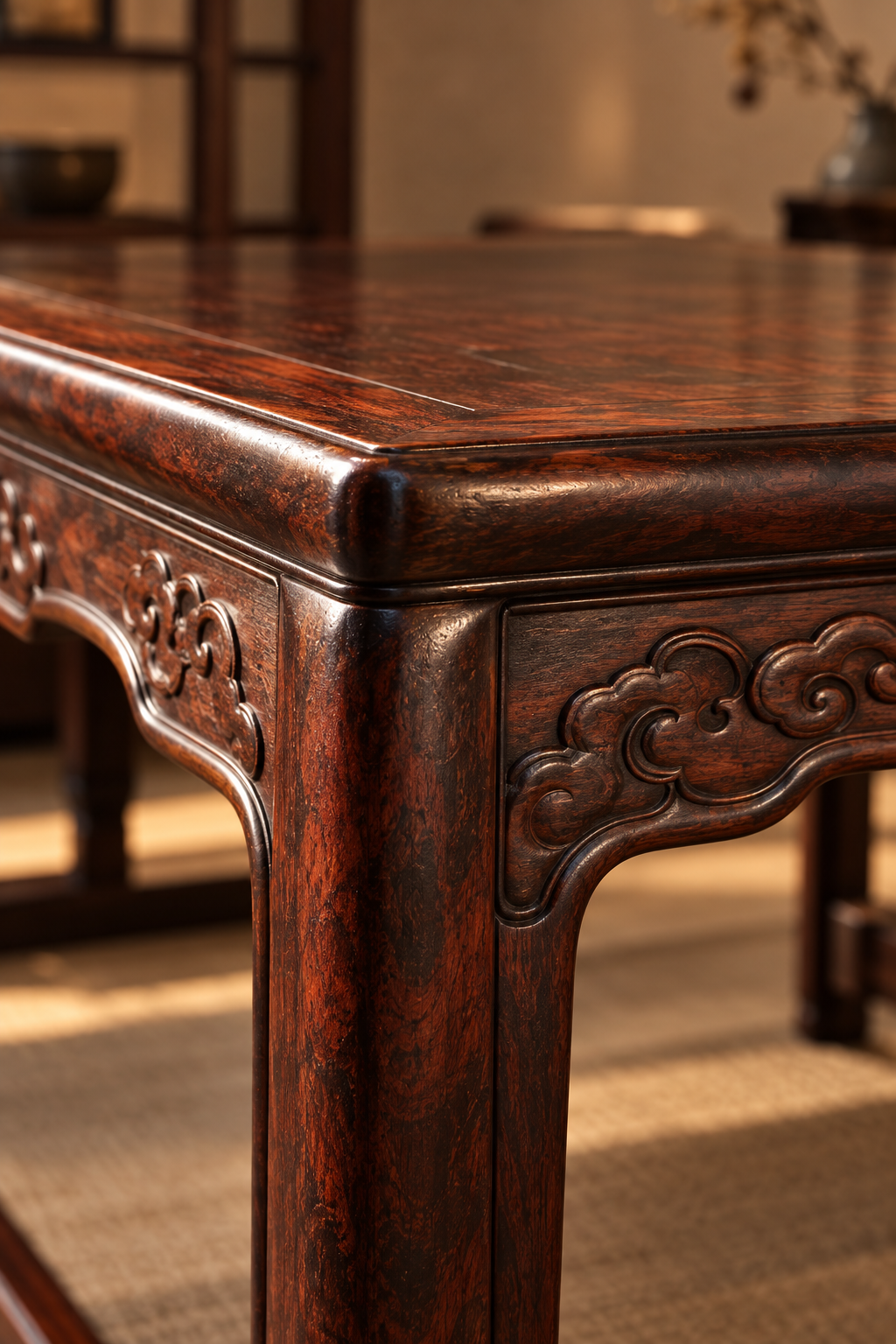
An E-E-A-T guide for B2B importers: the science of rosewood patina, finish systems, a patina-vs-defect diagnostic table, care guidance and pre-order specifications.
A wholesale buyer in Rotterdam once sent us two photos of the same carved tea table: one taken the day the container was unloaded, and one taken eight months later after the table had spent a season on a bright showroom floor. The second photo showed a deeper, warmer, noticeably darker surface. The buyer's first question was not about beauty — it was about liability. Has the finish failed? Is this a quality claim? Will my customers think the furniture is deteriorating?
This scenario plays out in showrooms, hotels and villas on every continent where classical rosewood furniture is sold. Color change in solid rosewood furniture is one of the most misunderstood phenomena in the hardwood trade, and it sits right at the boundary between a natural material characteristic and a perceived defect. For importers, distributors and project buyers, understanding what actually happens to rosewood over time — and why — protects margins, prevents unnecessary claims, and can even become a selling point.
In this guide, we explain the science behind rosewood furniture color change, how different finishes influence it, how to distinguish healthy patina from genuine quality problems, and what B2B buyers should specify before placing a container order. Everything about our own workshop practices below comes from processes we run daily in our Xianyou factory, so you can verify each claim directly with us before ordering.
What Is Patina? Color Change Versus Damage
Patina is the gradual change in a wood surface's color, depth and sheen that results from natural aging — oxidation, light exposure, handling and the slow curing of finishes. In classical Chinese furniture culture, patina is prized: auction houses and collectors pay premiums for pieces whose surfaces have mellowed over decades, because an honest patina is impossible to fake convincingly and signals genuine age and use.
For a B2B buyer, the critical distinction is this:
- Patina is a slow, uniform, progressive deepening or warming of color. The surface remains smooth, the finish stays intact, and the change enhances rather than degrades appearance. It affects the whole piece consistently — tabletop, apron, legs and carvings all shift together.
- Damage is localized and often accompanied by physical symptoms: whitish water rings, sticky or tacky patches, fine cracking (checking), peeling or flaking finish, dark stains around joints, or uneven blotches where one area changed dramatically while its neighbors did not.
A uniform darkening of a raw-lacquer tea table over its first year is patina. A white ring under a hotel guest's water glass is damage. The first is the wood behaving exactly as dense, oil-rich hardwoods behave; the second is a maintenance or usage issue. Confusing the two costs importers money in both directions — accepting claims they should decline, or missing real defects they should have caught at inspection.
The Science: Why Rosewood Furniture Darkens and Deepens Over Time
Three natural mechanisms drive color change in rosewood and other dense tropical hardwoods. None of them indicates a manufacturing fault; all three are chemistry.
1. Oxidation of Wood Extractives
Rosewood species such as Siamese rosewood (Dalbergia cochinchinensis) are exceptionally rich in natural extractives — oils, resins and phenolic compounds that give the timber its fragrance, its natural water resistance and much of its color. From the moment freshly machined wood meets air, oxygen reacts with these compounds. The reaction is slow at room temperature but never stops: extractives polymerize and darken, much the way a cut apple browns, only across months and years instead of minutes. This is why a freshly sanded patch inside a drawer can look noticeably lighter than the surrounding surface for months — the exposed wood is still catching up with the oxidation the rest of the piece completed years earlier.
2. Light Exposure and Photodegradation
Ultraviolet and visible light break down lignin and rearrange surface chemistry in wood. Different species respond differently: some pale, some yellow, and rosewood — with its high extractive content — generally deepens and warms toward a richer red-brown under continued light exposure. A display cabinet positioned near a south-facing window will darken fastest on its most exposed faces. This is also why dealers of vintage Scandinavian rosewood furniture treat original surface color as part of a piece's provenance: light history is permanently written into the wood.
3. Finishing Chemistry and Surface Cure
Traditional finishes continue evolving long after the furniture leaves the workshop. Raw lacquer and wax finishes cure and harden over months; the lacquer film itself amber-gently with age, adding warmth to the surface tone. Oil-rich woods also continue to slowly feed their own natural oils toward the surface, enriching the sheen. In other words, part of the color change you see in year one is the finish reaching its final cured state — a process we deliberately extend and control through multi-coat application.
These three mechanisms overlap. Oxidation happens everywhere; light acts fastest on exposed surfaces; finishing chemistry changes the pace and hue of both. The combined result is the mellowing curve described in the next section.
How Climate, Season and Placement Affect the Speed of Patina
Patina does not advance at the same speed everywhere. The same model can mellow at noticeably different rates in two locations, and buyers who understand the variables can both set expectations and advise end customers.
- Light intensity and duration. Showrooms with large glazed facades, hotel lobbies with atrium daylight and retail floors lit by strong spotlights all accelerate surface change relative to interior rooms with curtained windows or corridors with indirect light. Display lighting aimed directly at hero pieces is the single fastest driver most dealers encounter.
- Temperature. Chemical reactions proceed faster in warmth. A piece in a warm, conservatory-like space will evolve faster than an identical piece in a cool, climate-controlled office — one more reason two pieces of the same model rarely look identical after a year apart.
- Humidity swings. Humidity does not change hue directly, but wide swings stress the surface microscopically and, in poorly dried wood, open checks that scatter light unevenly. Stable humidity keeps the patina curve smooth. This is a core reason our production runs 36-day constant-humidity drying before finishing.
- Airflow and dust. Surfaces in open, dusty environments develop a fine film that dulls sheen; regular soft dusting keeps the developing surface clean so the deepening tone shows through as intended.
- Use and handling. Armrests, seat edges and tabletop centers that are touched and wiped daily develop their satin depth faster than rarely-touched lower panels. Gentle use genuinely improves the surface — another argument for selling solid hardwood over veneer.
For project buyers, the practical translation is simple: pieces destined for glass-fronted, high-traffic spaces should be expected to reach their mature tone first, and mixed-use projects should avoid judging color uniformity by comparing a lobby table against a guestroom piece in its first year.
What Freshly Shipped Furniture Looks Like: Setting the Baseline
Because expectations are anchored at delivery, it helps to describe what a correctly finished piece looks like on day one. When our export cartons are opened, a classical set finished in our six-coat system presents a consistent, even tone across every visible surface — top, apron, legs and carvings — with a smooth satin sheen rather than a mirror gloss. There should be no gloss differential between a carved panel and its neighboring flat panel, no sticky residue, and no sharp color steps between boards.
Buyers receiving their first order should photograph each model line under the same lighting the showroom will use, at the same time of day, and archive the images. This is the baseline every later comparison will be made against. It is also worth noting what day-one furniture should not look like: if a new delivery shows dull patches, milky zones or a tacky feel under the wrapping, that is a finishing or curing issue to raise with the factory immediately, not a patina question to be answered over time. A clean baseline is what makes the entire year-one narrative credible to your own customers.
How Different Finishes Influence Color Change
Not all rosewood furniture changes color at the same rate or in the same way. The finish system is the single biggest variable a buyer can actually control.
| Finish System | Typical Color Behavior | B2B Implications |
|---|---|---|
| Six-coat raw lacquer, hand-rubbed | Slow, gentle deepening; develops warm satin sheen; most resistant to blotching | Most predictable aging; best for hotel and villa projects with long display periods |
| Beeswax over lacquer | Adds initial warmth; wax layer enriches with buffing; slightly faster perceived deepening | Popular for classical interiors; easy for end users to refresh |
| Thin oil finishes | Fastest and most visible darkening; most light-sensitive | Requires the most end-user maintenance; specify care instructions clearly |
| Thick synthetic topcoats | Wood color change largely hidden under the film; film itself may yellow | Hides the timber's natural evolution; rarely used in authentic classical work |
Our workshop finishes classical sets with a six-coat raw lacquer system, each coat cured for a full 24 hours and hand-rubbed with pumice stone before the next, with beeswax as the final polish. This is slower and costlier than spraying a single heavy topcoat, but it produces the penetrating satin sheen that ages gracefully — and it is why our pieces' color evolution stays gradual and uniform instead of blotchy. You can see the system described on individual products such as our Classical Siamese Rosewood Tea Table with Carved Cloud Apron.
Color Behavior Across Rosewood Species and Common Lookalikes
Buyers sourcing across several suppliers will meet several timbers sold under the redwood and rosewood umbrella, and each behaves differently as it ages. Knowing the differences protects you from comparing apples to oranges when evaluating claims.
- Siamese rosewood (Dalbergia cochinchinensis). The principal timber in our classical sets. Dense, oily, deep red-brown when freshly finished; mellows toward a warmer, more uniform tone with age. Its high natural oil content is exactly what makes patina develop so attractively under lacquer and wax.
- Machilus nanmu. A lighter, golden-toned timber we use alongside aged red wood and Grade-A tropical hardwood. Nanmu ages with a gentle golden deepening rather than the strong red-brown shift of true rosewood, which makes it popular for pieces where a brighter classical tone is preferred.
- Aged red wood. Already partially mellowed before machining, so its first-year color movement is smaller; buyers who want minimal early change often prefer aged material for this reason.
- Other hardwoods and stained lookalikes. Lower-density timbers stained to imitate rosewood often fade, blotch or wear through at edges within a couple of years because the color is in a surface layer, not the wood itself. A useful field test for your receiving team: sand a hidden spot — true rosewood shows consistent color through the thickness, while stained material reveals pale wood beneath.
Our material sourcing and species standards are described in more depth in our guide to what rosewood furniture is made of. When comparing quotations between factories, always ask which species and grade is quoted — an aging comparison is only meaningful between like timbers and like finishes.
A Realistic Timeline: What Color Change to Expect, and When
Buyers often ask for a schedule. Wood is a natural material, so exact timing varies with species batch, climate and light conditions — but the pattern is consistent enough to plan around.
- First 4–8 weeks after delivery: Minimal visible change. This is when the piece is acclimatizing to its new environment — a separate process governed by moisture content, discussed below.
- Months 2–12: The most noticeable period. Surfaces exposed to daylight and regular handling deepen visibly; showroom floors will see faster change than dim hotel corridors. A honey-toned surface can move one to two shades warmer.
- Years 2–5: The rate slows noticeably. The surface approaches its mature tone; change becomes subtle and mostly involves sheen quality — the satin depth that comes from years of gentle buffing and use.
- Year 5 and beyond: True patina territory. Changes are slow and increasingly valued. With sound finishing, there is no endpoint where the wood suddenly stops or degrades.
Two practical notes for importers: first, keep a reference photo from delivery day on file for every model line; second, expect slightly different rates between a bright Miami showroom and a basement stockroom — the same model stored in cartons will change far less than display samples. Neither situation is a defect, but explaining the difference to your own customers preemptively prevents most color-related complaints.
Patina or Problem? A Buyer's Diagnostic Table
Use this comparison when evaluating a customer's claim or a pre-shipment sample:
| Observation | Normal Patina | Likely Problem |
|---|---|---|
| Color pattern | Uniform, whole-piece deepening | Blotches, rings, or one face changing while others stay static |
| Surface texture | Smooth, unchanged | Tacky, rough, flaking or sticky patches |
| Rate of change | Gradual over months | Sudden change within days or weeks |
| Sheen | Deepening satin glow | Dull, cloudy, or milky zones |
| Accompanying signs | None | Hairline cracks, loose joints, water marks, warping |
| Smell | Faint natural wood scent | Mildew, sour or chemical odor |
Cracking deserves special mention because it is the defect most often confused with color change. Surface checking is driven by moisture movement, not light or oxygen, and it demands a different response. We cover the mechanics in our article on why rosewood furniture cracks in overseas climates and how we prevent it.
Moisture Control: The Foundation of Color Stability
Color change and moisture change are different processes, but they interact. Wood that is still losing moisture after delivery can develop checks and micro-gaps that catch light unevenly and make color change look patchy. Wood that reaches its destination properly dried simply darkens evenly.
That is why our production protocol puts every component through 36 days of constant-humidity kiln drying before joinery begins. Drying to a stable moisture content appropriate for overseas interiors means the piece arrives dimensionally settled, so the only evolution your customers will observe is the natural, uniform patina described above. The relationship between drying schedules, climate adaptation and long-term stability is explained in detail in our guide to why kiln drying matters when buying rosewood furniture from China.
For buyers serving dry inland climates or heated winter interiors, we recommend mentioning a simple acclimatization step to end customers: let furniture rest in its final room, out of direct sun and away from heat sources, for one to two weeks before heavy use. This protects joints and keeps the patina curve smooth.
Inside Our Finishing Process: How Yunxiao Supports Predictable Color
Because patina is inevitable, our job as a manufacturer is not to prevent color change — it is to make it predictable, uniform and graceful. Four workshop practices do most of that work:
- Timber selection and matching. We select legally certified Siamese rosewood, aged red wood and Grade-A tropical hardwood, and match boards by grain and base tone within each set, so the starting point of every piece in a container is already consistent. Our material standards are described in our overview of what rosewood furniture is made of.
- 36-day constant-humidity drying. As above, this stabilizes the wood before finishing so lacquer adheres to a settled substrate.
- Six-coat raw lacquer, 24-hour cures, pumice hand-rubbing. Each layer cures a full day before the next is applied; hand-rubbing between coats compacts the film into the penetrating satin sheen that ages evenly. There are no shortcuts that produce the same result.
- Final beeswax polish. The wax layer is the user-serviceable surface: it enriches with ordinary buffing and gives end customers a simple way to maintain sheen without touching the lacquer underneath.
- Compliance as a baseline. Our lacquer and wax systems are eco-friendly formulations selected to meet EU REACH and US CARB expectations, and every export order ships with ISPM 15 heat-treated packaging and full export documentation, with FSC certificates available.
Why does the traditional lacquer route matter commercially, not just aesthetically? Because a finish that cures slowly and completely produces a surface whose future behavior is known. Buyers who want the full reasoning can read our piece on why traditional lacquer finishing matters when sourcing rosewood furniture for export markets.
What B2B Buyers Should Specify Before Ordering
Color change becomes a commercial risk only when expectations are unwritten. Four specifications remove almost all of it:
- Request a finish and color standard with the sample. Our samples are refundable against subsequent container orders — treat the sample as the contractual color reference for the finish system, base tone and sheen level.
- Agree that patina is expected. Put one line in your resale or project documentation acknowledging that solid rosewood naturally deepens in tone with light and age. This single sentence defuses the majority of end-customer color queries.
- Define the lighting context for projects. Hotel lobbies with tall windows, basement showrooms and brightly lit retail floors will display the same model at slightly different paces. For multi-zone projects, stagger furniture placement or specify window treatment accordingly.
- Confirm batch consistency expectations. For repeat orders, tell us which production batch you are matching. Boards from different logging periods can vary in base tone; knowing your reference batch lets us select timber accordingly.
Buyers planning their first order will find the broader process — samples, trial sets, lead times and documentation — in our first-order guide on how to test a rosewood furniture supplier before a full container order.
Keeping Color Consistent Across a Container Order
A 40-foot container of classical furniture might hold 60 to 120 pieces across several models. Uniform patina starts with uniform inputs, so here is how we keep a mixed-container order consistent:
- Batch-level timber allocation. Components for one order are cut from timber allocated in the same purchase period wherever possible, minimizing base-tone drift between the dining set and the bedroom set that will ship together.
- Same-batch finishing. Lacquer batches are mixed and applied within the same production window per order, so film tone and sheen start identical across models.
- Carton-stage light protection. Export cartons and crating keep pieces dark until arrival, which means the entire order begins its patina curve together at the destination — showroom and stock pieces will drift apart in pace, as noted above, but they start level.
- Pre-shipment photo records. We photograph finished surfaces before packing. When a customer calls twelve months later asking whether the wood has changed, both sides compare against an agreed baseline instead of memory.
Documentation That Supports You When Color Questions Arise
When a color question does reach you from a retail customer or a hotel operator, the fastest resolution is documentation that was assembled before the furniture ever shipped. We recommend importers keep a simple file per model line, and we provide the factory-side half of it with every order:
- Approved sample reference. The physical sample (or the sealed photo record of it) defines the starting tone, finish build and sheen level for the order.
- Pre-shipment surface photos. Our QC team photographs representative finished surfaces before crating, so the departure condition is on record from our side as well as yours.
- Finish specification. A short written description of the finishing system — six-coat raw lacquer, 24-hour cures, pumice hand-rubbing, beeswax polish — that your team can quote verbatim in customer-facing explanations.
- Care instructions. The do-and-avoid table later in this article, formatted for hand-off to end customers, prevents the maintenance mistakes that create most genuine surface problems.
- Compliance paperwork. Export documents, ISPM 15 treatment evidence for the packaging and, where applicable, FSC certificates — so that any inspection or claim conversation starts from verified facts rather than recollection.
With these five items on file, most color conversations end in one email: the change is uniform, the surface is intact, the reference photo confirms it, and the finish specification explains why. Importers who adopt this habit report that color queries stop escalating into claims at all.
Briefing Your Sales Team: The Five Sentences That Resolve Color Queries
Not every showroom has a wood technologist on staff, so it pays to compress everything above into language a sales associate can use at the counter. We suggest five sentences, in this order:
- "Solid rosewood is naturally rich in oils, and it deepens in tone as it ages — the same way fine leather darkens."
- "The change is gradual and even across the whole piece, and it is a sign of genuine hardwood, not a fault."
- "Our furniture is finished with six hand-rubbed coats of natural lacquer, so the surface ages smoothly instead of blotching."
- "Keep it out of prolonged direct sun and wipe spills promptly — the monthly wax buff is all the maintenance it needs."
- "If you ever see rings, sticky patches or cracks, that is different — tell us and we will handle it under the warranty."
The first four sentences turn a worried question into a confident purchase rationale; the fifth draws the honest boundary that keeps the first four credible. Teams that rehearse this script report fewer escalations and, notably, more upsells of care kits and display-position advice — the conversation becomes a service moment rather than a dispute.
Caring for Rosewood Furniture: Preserving the Patina Your Customers Will Love
End-user care determines whether color evolution looks luxurious or neglected. The rules are simple, and we recommend sharing them with every order:
| Do | Avoid |
|---|---|
| Dust with a soft, dry cloth, following the grain | Silicone-based polishes and abrasive cleaners |
| Buff wax-finished surfaces monthly with a clean cloth | Placing hot vessels directly on tabletops |
| Use coasters, mats and felt pads under objects | Positioning furniture in prolonged direct sunlight |
| Wipe spills immediately with a barely damp cloth, then dry | Steam cleaners and soaking-wet cloths |
| Keep indoor humidity moderate and stable where possible | Placing furniture against heating radiators or AC vents |
| Rotate decorative objects occasionally to avoid shadow lines | Leaving plastic or rubber mats on finished surfaces long-term |
A full maintenance routine, including seasonal waxing guidance, appears in our long-form guide on how to care for and maintain solid rosewood furniture, and our team has also published a dedicated article on what to use to clean rosewood furniture without damaging the lacquer finish. Both are written for exactly this hand-off: importer to dealer to end customer.
Patina as a Selling Point: Marketing Rosewood's Evolution to Your Customers
Once your team can explain color change confidently, it stops being a support topic and becomes a story that sells. Retailers of classical furniture consistently report that the aging narrative — a surface that grows more beautiful the longer it is used and enjoyed — resonates strongly with customers comparing solid hardwood against veneered alternatives that look identical on day one and cannot improve with time.
Practical marketing angles our partners use:
- Before-and-after storytelling. Photograph showroom samples at delivery and again after a season; the deepening of tone is visible, honest and requires no retouching.
- The heirloom frame. Position patina as the furniture equivalent of fine leather or cast iron: it records use, rewards care and cannot be manufactured artificially.
- Contrast with disposable finishes. Veneer and laminates fade and peel; solid rosewood with a raw-lacquer finish deepens. That contrast is a durable differentiator for premium retail.
- Project referencing. For hotel and villa clients, note that public-area pieces develop their mature tone during the first operating year — arriving, conveniently, as the property finds its rhythm.
- Sample-in-the-window display. Some retailers keep one piece in strong daylight as a deliberate demonstration; customers comparing it with a carton-fresh piece in the stockroom can see the evolution with their own eyes, which is more persuasive than any brochure.
A Worked Example: Handling a Customer's Color Query Step by Step
Consider a common situation: a distributor's retail customer writes in after ten months to say their new rosewood armchair has "changed color and must be faulty." Here is the sequence we recommend, which resolves the vast majority of such cases without a claim:
- Ask for two photos — a full view and a close-up of the most-changed area — plus a note on where the chair stands relative to windows and lamps.
- Compare against the delivery reference. If the change is an even deepening across the whole piece, and the close-up shows a smooth, intact surface, the pattern matches normal patina.
- Check the pace. Ten months is squarely inside the fastest-change window described in the timeline above; deepening at this stage is expected, especially near daylight.
- Explain, don't argue. Send a short, warm explanation: solid rosewood is oil-rich and deepens with light and time; the even, gradual change is the timber maturing, and the surface will keep developing its satin depth with ordinary care.
- Offer a care refresher. Include the do-and-avoid table and the monthly wax-buffing tip. A customer who learns one useful thing rarely stays worried about the same thing twice.
- Escalate only on real symptoms. If the photos instead show rings, blotches, flaking or cracks — or the change is sudden and localized — treat it as a potential finish or usage issue, document it, and involve us with the pre-shipment reference photos. That is the pathway the documentation file above exists to support.
The pattern generalizes: distinguish uniform and gradual from localized and sudden, and nearly every color conversation resolves itself.
Key Takeaways for Importers and Distributors
- Rosewood furniture darkens and deepens over time through oxidation, light response and finish curing — natural chemistry, not a defect.
- Healthy patina is uniform, gradual and smooth; damage is localized, sudden and textured. Teach the distinction to every customer-facing team member.
- The finish system is the controllable variable: six-coat raw lacquer with beeswax gives the most predictable, graceful aging.
- Demand pre-shipment photo records, finish specifications and care sheets as part of every order — paper prevents disputes.
- Frame patina as a premium: a surface that improves with age is a story veneered furniture can never tell.
Frequently Asked Questions
Does rosewood furniture really darken in the first year, or is that a finish defect?
It really darkens, and it is not a defect. Dense, oil-rich hardwoods like Siamese rosewood contain natural extractives that oxidize and deepen in tone, and the curing lacquer film gently ambers as well. Uniform deepening over the first year — smooth surface, intact finish, whole-piece consistency — is the wood behaving exactly as this species should.
How much color change should I warn my customers about?
Tell them the truth simply: expect a gradual, even deepening over the first year or two, faster on surfaces exposed to daylight, then a slowing curve toward a stable mature tone. Frame it as evolution, not deterioration, and keep the delivery-day photo as a reference.
Can color change be stopped completely?
No natural finish stops oxidation and light response entirely; thick synthetic topcoats can mask it but change the character of classical furniture and can themselves yellow. The realistic goal — and our production goal — is a slow, uniform, graceful change, not a frozen surface.
Why do two pieces of the same model look slightly different after a year?
Placement history. The piece that sat near a window or under display lighting darkened faster than the one in a dim corner or in cartons. Base tone and finish are identical at shipment; the divergence comes from light and use afterward. Rotating display positions periodically keeps a set looking harmonious.
Will the carvings change color differently from flat surfaces?
Not if the finishing system is applied correctly. Our carvings receive the same six-coat lacquer build and hand-rubbing as flat panels, with brushing adapted to the relief work, so carved and flat areas darken together. A visible tone difference between a carving and its surrounding panel is a finishing shortcut, not patina.
Is the darkening stronger on wax-finished or lacquer-finished pieces?
Perceived change is usually quicker and slightly warmer on wax-forward surfaces because the wax layer itself enriches with buffing, while a well-built lacquer system modulates and slows the shift. Neither is better in absolute terms; lacquer gives the most predictable curve, wax the most user-refreshable surface. Choose by project type and end-customer maintenance appetite.
Does humidity alone change the color of rosewood furniture?
Humidity by itself does not shift hue; it governs dimensional movement instead. What humidity does influence is whether color change looks even: stable indoor humidity keeps the surface and joints settled so the deepening tone develops uniformly, while wide swings — especially on poorly dried wood — can open fine checks that scatter light and make the surface look uneven. That is why drying quality, discussed earlier, matters as much to appearance as it does to structure.
What if one piece in my order changes faster than the others?
Check placement first: the fast-changing piece is usually the one near a window or under strong retail lighting. If the difference appears without any light-exposure explanation, and especially if the surface texture or sheen is also off, send us photographs against the pre-shipment reference and we will assess it as a potential finish issue.
Do you offer samples so I can observe the color behavior before committing to a container?
Yes. We supply refundable samples and trial single sets, and every order can be accompanied by our standard export documentation, ISPM 15 packaging and, where applicable, FSC certificates. Most wholesale buyers start with a sample or a trial set, observe the finish through their own selling season, and then scale to full containers.
Conclusion: Plan for Patina, and It Works for You
Rosewood furniture changing color over time is not a flaw to be argued away — it is the visible chemistry of one of the world's most beautiful hardwoods doing what it has always done. For B2B buyers, the competitive advantage goes to those who understand the mechanisms, specify finishes that age predictably, and set expectations correctly with their own customers before the container is even packed.
Our workshop in Xianyou, Fujian has been producing classical redwood furniture sets for wholesalers, hotels and designers across Europe, North America, Australia and Southeast Asia since 2008 — with mortise-and-tenon joinery throughout, 36-day constant-humidity drying, six-coat hand-rubbed raw lacquer finishing, and full OEM/ODM customization for villas and resorts. Container orders take 45–60 working days after deposit, with partial shipments available for long-term partners.
If you are evaluating rosewood furniture suppliers, or if you would like samples that let you observe our finishing quality through your own selling season, contact our export team today for a quotation, a finish specification sheet and a color reference for your target models. We are glad to walk your purchasing team through patina expectations, project lighting and batch consistency before your first order — and to support you with layout drawings and remote installation guidance for the projects that follow.