
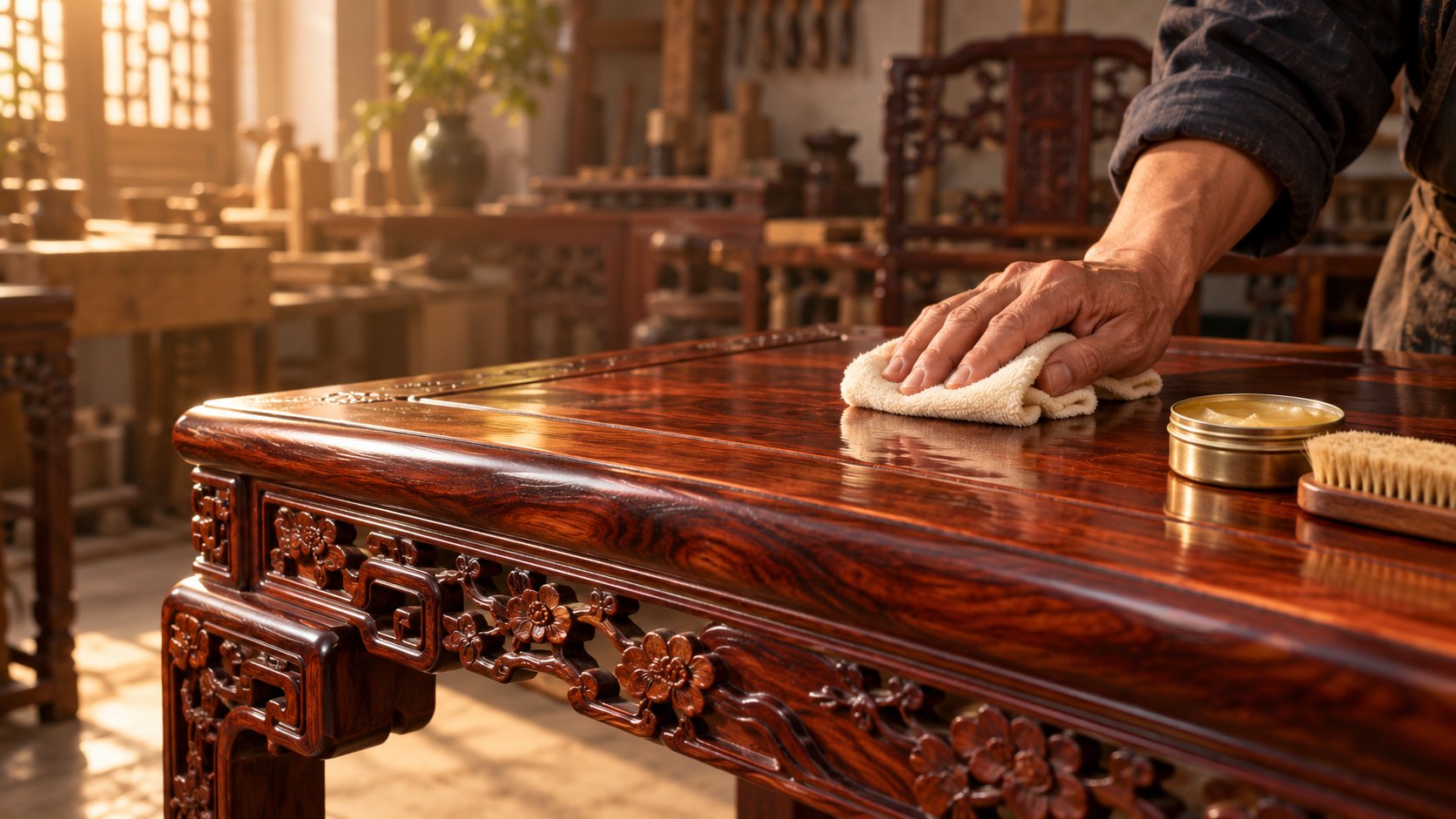
A factory-side guide to cleaning classical rosewood furniture: the safe toolkit for hand-rubbed lacquer finishes, banned products, step-by-step routines, re-waxing cycles, hotel and showroom cleaning SOPs, and climate adjustments for export markets.
Product News · Care & Maintenance Guide
Every week, buyers and hotel housekeeping managers ask us a version of the same question: what should you use to clean rosewood furniture without damaging the lacquer finish? It is a fair question, and an expensive one to answer wrongly. Classical rosewood furniture is finished with layers of hand-rubbed raw lacquer and natural beeswax — a surface that is durable, repairable and beautiful, but also chemically sensitive. The wrong spray bottle, applied twice a week by an untrained cleaner, can dull a satin sheen that took craftsmen days of hand-rubbing to build. The right routine, by contrast, costs almost nothing and keeps the furniture looking showroom-new for decades.
This guide is written from the factory floor, not from a generic housekeeping manual. We have manufactured and exported classical solid rosewood furniture from Xianyou County, Fujian — the recognized hometown of traditional hardwood craft — since 2008, and our finishing lines combine multiple coats of hand-rubbed raw lacquer with an eco-friendly beeswax finish that meets EU REACH and US CARB standards. In the sections below we explain exactly what to use to clean wood furniture finished this way, what to keep far away from it, how often to re-wax, and how hotels, villas and showrooms should structure a cleaning routine that protects the investment their guests came to admire.
Why the Lacquer Finish Decides How You Clean Rosewood Furniture
Before discussing any cleaning product, you need to understand what the surface actually is. On classical Chinese rosewood furniture, the finish is not a plastic film sprayed on at the end of the line. It is a traditional finishing system with its own logic, and every cleaning rule in this article follows from that logic.
Our standard export lines receive six successive coats of raw lacquer, a natural sap harvested from the lacquer tree that has been used on Chinese furniture and food vessels for thousands of years. Each coat cures for approximately 24 hours under controlled humidity before the surface is hand-rubbed with pumice stone, which drives the lacquer into the dense pore structure of the rosewood rather than leaving it sitting on top. Court-style carved sets — such as our Imperial Dragon sofa program, where a single carved armrest represents roughly 40 carving hours — carry an extended nine-coat hand-rubbed raw lacquer schedule. Over the lacquer, select lines receive an eco-friendly beeswax top layer that adds warmth to the touch and can be renewed by the end user.
Two structural facts matter for cleaning. First, the finish is penetrating, not film-forming: it bonds with the wood fiber, so it does not chip or peel the way synthetic polyurethane does — but strong solvents can still discolor or soften it, and abrasives can cut it below the surface. Second, the furniture underneath is assembled with mortise-and-tenon joinery and bamboo dowel pins, with no metal fasteners in the primary frame, and every piece of timber is conditioned through a 36-day constant-humidity drying cycle to a stable 8–14% moisture range before cutting. That construction means the surface is continuous and gently contoured — joints, shoulders and carved recesses are exactly where dust, wax residue and cleaning moisture collect, and also where careless scrubbing does the most visible damage.
The practical conclusion: when buyers ask what is a good wood furniture cleaner for classical rosewood, the honest answer is that the best cleaner is usually the gentlest one — water, a soft cloth, a drop of pH-neutral soap — and the discipline to keep everything else away from the surface. The furniture was engineered to be easy to maintain. The maintenance routine just has to respect the finish.
What Should You Use to Clean Wood Furniture Finished with Raw Lacquer?
Here is the complete safe toolkit. It is deliberately short, and every item is inexpensive — which is exactly why a disciplined routine is so much better than a cupboard full of promising sprays.
| Tool or material | What it does | How to use it |
|---|---|---|
| Soft, lint-free cotton or microfiber cloths (several) | Dry dusting and final buffing | Keep separate cloths for dusting, damp wiping and buffing. Wash them without fabric softener, which leaves a residue that clouds the sheen. |
| Clean, soft-bristled brush (a dry paintbrush works well) | Lifting dust out of carved recesses, lattice and joints | Use gentle strokes in the direction of the carving. Never scrub, and never use a brush that has touched any chemical product. |
| Distilled or filtered water | Damp wiping | Tap water leaves mineral spots in hard-water regions. The cloth should be wrung out until it is damp, not wet — no water should pool on the surface. |
| Mild pH-neutral soap | Removing grease, fingerprints and sticky residue | One drop in a bowl of water on the cloth, never poured on the wood. Follow with a second wipe of clean damp cloth, then dry immediately. |
| Natural beeswax furniture polish | Nourishing the finish and renewing the sheen | Thin coat, applied with the grain, buffed well. This is the only "polish" a lacquered rosewood surface needs. |
| Cotton gloves or a second dry cloth | Drying and buffing without fingerprints | Dry immediately after any damp wipe. Speed matters more than product choice. |
Notice what is not on this list: no furniture sprays, no multi-surface cleaners, no oils. If a cleaning product advertises itself loudly, it almost certainly does not belong on raw lacquer. To clean rosewood furniture safely, remember the sequence that covers 95% of situations: dry dust, damp wipe where needed, dry immediately, wax occasionally.
For carved pieces — the phoenix-and-peony backrests, cloud aprons and lattice panels on our tea tables and sofa sets — the soft brush is the most important tool in the kit. Dust settles into carved recesses and, if it is never lifted out, it absorbs ambient moisture and gradually dulls the lacquer in exactly the areas that show the craftsmanship most. Two minutes with a soft brush per week protects hours of carving.
What Is a Good Wood Furniture Cleaner for Rosewood Surfaces?
This is the question that generates the most confusion, because the retail shelf is full of products labelled "wood cleaner" or "furniture polish" that are formulated for modern varnished or oiled furniture — and several of them will visibly damage a raw lacquer finish. So let us answer it directly: what is a good wood furniture cleaner when the surface is hand-rubbed raw lacquer over dense, oily rosewood?
The shortlist is short. A solution of mild pH-neutral soap in water is the best general-purpose cleaner, because it removes fingerprints, food residue and grease without attacking the lacquer or leaving film. Distilled water alone handles routine damp wiping. For surfaces that have lost some depth of sheen through months of dry dusting, the appropriate product is not a cleaner at all — it is a thin application of quality natural beeswax, buffed along the grain, which re-nourishes both the lacquer and the wax layer above it. That is the entire approved list.
A useful test for any product you are considering: read the ingredient label. If it contains silicone, ammonia, alcohol, bleach, petroleum solvents or abrasive agents, set it aside — the sections below explain why each of these is disqualified. If the label is vague or the product promises to "restore," "revive" or "feed" the wood in one spray, treat that as a warning rather than a recommendation. A lacquered rosewood surface does not need feeding; it needs gentle cleaning and occasional wax.
Buyers sourcing for hospitality projects should also standardize this answer across their operation. When we work with hotel and villa buyers, we recommend assembling a dedicated furniture cleaning kit — soft cloths, a soft brush, a small bottle of pH-neutral soap, distilled water in a spray bottle, and a tin of natural beeswax — kept physically separate from the kitchen and bathroom chemical cupboard, and labelled clearly. The most common cause of finish damage we hear about from the field is not a bad product chosen deliberately; it is a housekeeper under time pressure reaching for the nearest spray bottle.
Procurement teams furnishing hotels, villas or showrooms can take this one step further and specify the consumables themselves. Order the cleaning programme as part of the fit-out: cases of pH-neutral soap clearly labelled for wood, sealed tins of pure natural beeswax, stacks of lint-free cotton and microfiber cloths washed without fabric softener, and one soft brush per housekeeping zone. Keep multi-surface dispensers out of rooms that contain wood furniture, and print the banned-product list on the inside lid of the cleaning kit. When the right products are the easiest products to reach, the wrong ones rarely get picked up.
What Should You Never Use to Clean Rosewood Furniture?
Now the list that protects your investment. Each of the following product categories causes predictable, and often permanent, damage to a hand-rubbed lacquer finish. Share this table with every cleaning team that touches classical wood furniture.
| Banned product | Why it damages the finish | What the damage looks like |
|---|---|---|
| Silicone-based furniture polishes and many "lemon oil" sprays | Silicone builds a plastic-like film on top of the lacquer that blocks the wood's natural moisture exchange and cannot be removed without stripping | Progressive dulling and cloudiness; future refinishing becomes difficult because new lacquer will not bond over silicone |
| Ammonia-based glass and multi-surface cleaners | Ammonia is aggressive against lacquer chemistry and clouds or softens the cured surface | Permanent cloudy patches and a blotchy sheen where the spray landed |
| Alcohol, hand sanitizer and alcohol-based disinfectant sprays | Alcohol is a solvent for lacquer; pooled contact dissolves the surface locally | Sharp-edged dull spots or stripped areas, often where sanitizer was sprayed or a spilled drink sat |
| Bleach and chlorine-based sanitisers | Attacks the lacquer film and can lighten the wood pigment beneath | White or pale streaks that cannot be wiped back |
| Abrasive creams, scouring powders and scrubbing pads | Physically cut through the hand-rubbed sheen, which is only fractions of a millimetre thick at the surface | Scratched swirl marks and a permanently flat patch |
| Steam cleaners | Heat plus forced moisture drives water into the finish edges and carved recesses and can lift the lacquer | Whitened edges, lifting finish around joints |
| Vinegar and acidic DIY solutions | Acid etches the lacquer surface over repeated contact | Gradual loss of depth in the sheen, etched patches on tabletops |
| Paper towels and rough rags for wiping | Wood-pulp fibers are mildly abrasive and leave fine scratches on a polished surface | Fine haze visible under raking light |
One clarification buyers sometimes raise: alcohol damage is about contact time and concentration, not a single wipe. A coaster under a whisky glass matters more than one accidental touch of sanitizer on a cloth — but a hotel that sanitizes tabletops nightly with an alcohol spray will see finish failure within a season. Where disinfection is required by operations, wipe with the soap-and-water method and reserve chemical disinfectants for non-wood surfaces.
And one positive reframe: the ban list is not a limitation on the furniture, it is a promise about its finish. Raw lacquer and beeswax contain no synthetic plasticizers or high-VOC solvents — which is precisely why the same finishing system meets EU REACH and US CARB requirements. A surface gentle enough to be compliant in the strictest markets deserves a cleaning routine equally free of aggressive chemistry.
Step by Step: How to Clean Rosewood Furniture Safely
The routine below works for every category — sofa sets, dining tables, bedroom suites, tea tables, wardrobes and display cabinets. The whole cycle takes minutes, and the order matters: remove dry soil before introducing any moisture, and always finish dry.
Step 1 — Dry dust, weekly or more often in busy rooms
Wipe all flat surfaces with a soft, lint-free cloth, following the grain. On carved pieces, use the soft-bristled brush to lift dust out of recesses, carved aprons, lattice panels and the shoulders of mortise-and-tenon joints before it absorbs humidity. Do not press hard; the carving is meant to be admired, not scrubbed.
Step 2 — Damp wipe only where needed
For fingerprints, grease or sticky residue, wring a soft cloth out in a solution of one drop of mild pH-neutral soap per bowl of distilled water until it is damp, not wet. Wipe the affected area, then go over it again with a second cloth wrung out in clean water. If you can see moisture sitting on the surface, the cloth is too wet — wring it again.
Step 3 — Dry immediately with a soft cloth
Standing water is the enemy of every wood finish, and it is the easiest risk to eliminate. Buff the surface dry in the direction of the grain right after any damp wipe. On dining tables, wipe spills — wine, tea, soup, citrus — as they happen rather than at the end of service; acid and alcohol do their damage in minutes.
Step 4 — Refresh the wax on schedule, not on impulse
Between wax cycles, cleaning is purely the dry-and-damp routine above. When the surface starts to look dry or the sheen loses depth (typically every six to twelve months in a home; more often in commercial rooms, as below), apply a thin coat of natural beeswax with a soft cloth, work it with the grain, let it sit for the time the product recommends, then buff with a clean dry cloth until the satin sheen returns. Thin coats buffed well always beat thick coats; over-waxing leaves a cloudy build-up that attracts dust.
Step 5 — Protect the surface between cleanings
Cleaning and prevention are one system. Coasters under glasses, trivets under hot dishes, placemats under tableware, felt pads under decorative objects, and a rule that nothing hot or wet sits directly on the lacquer — these habits prevent the marks that no cleaning routine can remove. On dining sets, the lacquer tolerates short contact with warm dishes in the 60–70°C range, but a pot straight from the stove belongs on a trivet, every time.
Followed in that order, the routine answers the practical version of our title question: what should you use to clean rosewood furniture? Soft cloths, a soft brush, water, a drop of pH-neutral soap, and natural beeswax on a schedule — nothing else.
How to Clean Different Types of Rosewood Furniture
The toolkit never changes, but the wear patterns do. A sofa set, a dining table, a wardrobe and a display cabinet put the same finish under very different kinds of stress, so a good routine weights its attention differently across the categories in your order.
Sofa and reception sets suffer most from skin contact. Natural oils from hands and heads transfer to carved armrests and backrests every day, and over months they hold dust and slightly dull the sheen exactly where guests touch. Dust the carved surfaces weekly with the soft brush, and give armrests and chair rails a damp-wipe clean monthly — always finishing dry. If the set carries upholstered cushions, follow the cushion maker's care instructions separately and keep the wood frame out of the upholstery cleaning process, since fabric shampoos are not lacquer-safe.
Dining tables face food chemistry: wine, tea, vinegar-based sauces, citrus and hot serving dishes. Speed of response matters more than any product — wipe spills as they happen, keep placemats and coasters as part of the standard table setting rather than an optional courtesy, and give rotating trays and their central joints a separate wipe, because crumbs and moisture collect under the moving plate.
Tea tables in living rooms and hotel lobbies combine daily cup contact with decorative styling. Lift teaware rather than sliding it, watch for condensation under cold pitchers, and on models with an inlaid stone top, clean the stone insert with the same pH-neutral method — natural stone sealers tolerate mild soap well but not the aggressive sprays banned for the wood.
Wardrobes, sideboards and display cabinets add interiors and glass to the routine. Wipe drawer runners and interior shelves occasionally with a dry cloth to remove dust that transfers back onto stored items; clean glass doors with a standard glass product sprayed onto the cloth, never onto the door, so the liquid cannot run down into the carved frame. If drawers stick slightly in humid months, note it in the maintenance log rather than forcing them — seasonal swelling usually resolves as the air dries.
How Often Should You Wax Rosewood Furniture?
Waxing frequency is the most misunderstood part of wood furniture maintenance, and both extremes cause problems: too little wax lets the surface look dry and tired; too much wax builds a cloudy film that traps dust and dulls the carving detail. The right interval depends on how hard the surface works.
- Residential furniture: once or twice a year is right for most homes. Dust regularly, clean spills promptly, and re-wax when the sheen looks flat rather than by the calendar alone.
- Hotel lobbies, restaurants and showrooms: every three to six months, because daily wiping with damp cloths gradually thins the wax layer. High-touch surfaces — dining tabletops, sofa armrests, tea tables in guest interaction areas — sit at the short end of that range.
- Reception and display pieces handled by many guests daily: inspect monthly; a thin re-wax on a schedule is cheaper than refinishing a dull reception desk.
The application method matters as much as the frequency. Apply wax thinly with a soft cloth, with the grain, over a clean dry surface — never over dust or on a damp day. Work it into the flat surfaces and, with a soft cloth wrapped around a finger, along carved shoulders where the sheen breaks down first. Let it haze, then buff thoroughly; the buffing is what produces the deep satin glow, and leftover unbuffed wax is what turns cloudy. Use a product that is pure natural beeswax or formulated for lacquered hardwood — never a wax that contains silicone, for the reasons in the banned list above.
A practical marker for buyers: furniture finished with multiple hand-rubbed coats of raw lacquer, as ours is, holds wax well and responds visibly to a thin re-wax — the sheen deepens rather than needing to be built up. If a piece needs heavy wax to look decent, that is a signal to inspect the finish itself, not to keep adding product.
Before each scheduled wax, run a thirty-second sheen check: view the surface at a low raking angle from a window or lamp. An even satin glow with visible grain depth means the routine is working; chalky flatness on high-touch areas means the wax cycle should move up in the calendar, while sticky or cloudy patches mean product build-up that needs buffing out before any new wax is applied. The check takes less time than the waxing itself and prevents both under-care and over-care.
Cleaning SOPs for Hotels, Villas and Showrooms
A private owner can improvise; a hotel or showroom cannot. With dozens of pieces and rotating staff, care has to run on a written routine with named responsibility — because the most expensive damage in commercial settings comes from well-intentioned staff using the wrong product, not from guests. Here is the SOP structure we recommend to hospitality and project buyers, calibrated for classical rosewood furniture with a lacquer-and-beeswax finish.
| Cadence | Task | Notes |
|---|---|---|
| Daily (after service / closing) | Dry dust flat surfaces; wipe tabletops with damp-then-dry cloth after each service; confirm coasters and placemats are in place; log any spill, mark or damage with a photo | Assign to a named shift role, not "anyone available" |
| Weekly | Soft-brush dusting of carved recesses, lattice and joint shoulders; inspect high-touch pieces (armrests, chair arms, table edges) for sheen loss or sticky film; check the furniture cleaning kit is stocked | The weekly carve-dusting is the task most often skipped and most visible when skipped |
| Monthly | Full damp-wipe clean with pH-neutral soap on all wood surfaces; inspect for white rings, dull patches or wax build-up; review the damage log | Refresher training for new housekeeping staff each month: damp not wet, soap not spray, dry immediately |
| Quarterly (commercial) | Thin beeswax re-application on high-traffic pieces; rotate displayed furniture where sunlight reaches some pieces more than others, so any colour deepening develops evenly | Residential projects can run this seasonally instead |
| Annually | Full wax cycle across all pieces; joint and finish inspection; touch-up plan for any worn area | Raw lacquer is repairable — minor wear areas can be re-coated and bonded without stripping, which keeps annual costs low |
Three disciplines make this SOP work in practice. First, the dedicated kit: the only products a cleaner should be able to reach for wood furniture are the ones in the labelled kit — never the kitchen cupboard. Second, the damage log: a photo and date for every mark turns warranty conversations from argument into evidence, and shows whether a problem is isolated or systematic. Third, the ten-minute induction: every new member of the housekeeping team learns three rules before touching the furniture — damp cloth not wet, soap not spray, dry immediately — and learns the banned-product list by name.
Showroom operators should add one more habit: since display furniture is handled constantly by visitors, plan the wax cycle around sales seasons, and keep a discreet maintenance card on or under each display piece recording its last wax date. Buyers notice a well-maintained finish — and in a showroom, the surface is demonstrating the product.
A Ten-Minute Induction for New Cleaning Staff
Every routine above depends on the person holding the cloth, so make the induction formal and short enough to actually happen. Ten minutes at hiring, repeated whenever a new team member joins the housekeeping or showroom crew, covers everything a cleaner needs to know about classical wood furniture.
- Rule one: dust dry first, moisture only where needed, dry immediately after — in that order.
- Rule two: the only products for wood are in the labelled furniture kit — soap, water and beeswax. Nothing from the kitchen, bathroom or general-purpose cupboard ever touches the furniture.
- Rule three: nothing hot, wet or alcohol-based sits on the surface; coasters and trivets are part of the setup, not an afterthought.
- Rule four: carved areas get the soft brush, never scrubbing, never a wet cloth deep in the recesses.
- Rule five: any mark, chip or dull patch gets logged with a photo and the date — before anyone attempts to clean it away.
Close the induction by having the new cleaner clean one piece under supervision and name the banned products from memory. It costs ten minutes once per employee, and it is the single highest-return maintenance investment a hotel, villa or showroom operation can make — most of the expensive damage in the field traces back to a well-meaning person who was never told what not to use.
How Destination Climates Change Your Cleaning Routine
The same furniture, shipped to four continents, needs slightly different maintenance rhythms. Not because the finish changes — the lacquer-and-beeswax system is the same — but because climate changes how fast surfaces soil, how quickly wax thins, and what the cleaning team should watch for. (A related but separate topic — how wood movement itself behaves in dry versus humid climates — is covered in our dedicated climate-care article and is not repeated here.)
- Tropical Southeast Asia: constant humidity means dust settles into carved recesses faster and can hold moisture against the surface. Dust more frequently, dry every damp wipe thoroughly, and watch for any mildew film in deep carving during monsoon months — lift it with the soft brush and a slightly damper cloth, never with bleach. Wax cycles hold at three to six months; air-conditioned interiors actually make surfaces drier than the climate outside.
- Heated North American and European interiors in winter: indoor heating pulls moisture from the air, and the wax layer on a hard-working surface thins faster than in temperate seasons. Shorten the wax interval for pieces near heat sources, and keep the damp-wipe routine gentle — a surface that looks chalky in February usually wants wax, not more cleaning.
- Australian coastal versus inland regions: coastal salt air leaves a faint film that weekly damp wiping handles easily; dry inland interiors behave like the heated-winter case above. Either way, the tools do not change — only the cadence.
- Hard-water regions anywhere: switch to distilled water for damp wiping. The mineral spots tap water leaves are one of the few "cleaning damages" caused by doing almost everything else right.
The pattern across all climates: the toolkit never changes, and only the frequency dials move. That is a deliberate advantage of a penetrating lacquer finish over surface films, which respond to climate stress by cracking and delaminating — a maintenance burden this finish simply does not create.
What Cleaning and Care Terms Belong in an OEM/ODM Contract?
For B2B buyers, the cleaning routine is not only an operations topic — it belongs briefly in the paperwork. When we support OEM and ODM programs for villa, hotel and private-label clients, we keep the care-related clauses deliberately lean, because a contract that over-specifies maintenance creates disputes instead of preventing them.
Three items are worth writing down. First, the finish specification: the finishing method, coat count, wax system and the standards the materials meet (EU REACH and US CARB for our lines) — so both parties share one definition of "the surface." Second, the care documentation: the buyer receives a written care sheet in the shipment, and passes it to the end client or housekeeping team at handover; most avoidable finish damage happens downstream of a handover where nobody was told what not to spray. Third, the warranty boundary: structural issues are covered under our 24-month structural warranty, while damage from incorrect cleaning products or methods is not — which is exactly why the banned-product list above is worth circulating to every team that touches the furniture. Buyers planning private-label or custom programs can request the care sheet branded to their own market.
Frequently Asked Questions
Keep the Finish, Keep the Value
What should you use to clean rosewood furniture without damaging the lacquer finish? The complete answer fits in one drawer: soft cloths, a soft brush, distilled water, a drop of pH-neutral soap, and natural beeswax applied thinly on a schedule. What protects the answer is discipline — keeping silicone polishes, ammonia, alcohol, bleach, abrasives and steam away from a surface that was finished by hand, coat by coat, precisely so it would not need aggressive chemistry to stay beautiful.
That is also the quiet commercial point for importers and hospitality buyers. Furniture finished with multiple hand-rubbed coats of raw lacquer and beeswax, built on timber conditioned through a 36-day constant-humidity drying cycle and joined with mortise-and-tenon construction and bamboo dowel pins, is designed so that a simple routine is enough. The maintenance story is part of the product story you can pass to your own customers — and if you are specifying furniture for a hotel, villa or showroom program, ask us for the written care sheet, the finish specification and the compliance documentation to include in your handover pack.
To discuss finishes, care documentation and OEM/ODM programs for your market, or to request details on pieces such as our Classical Siamese Rosewood Tea Table with Carved Cloud Apron, the Ming Style Siamese Rosewood Living Room Sofa 7-Piece Set, the Classical Siamese Rosewood Display Cabinet with Carved Lattice Doors or the Classical Siamese Rosewood Square Tea Table with Inlaid Stone Top, contact Yunxiao Rosewood Furniture for specifications and a quotation.