
A practical B2B guide to EU REACH and US CARB/TSCA Title VI compliance for classical rosewood furniture: how eco-friendly beeswax and lacquer finishing, solid-wood joinery and documented timber sourcing build a compliance file importers can verify before ordering.
When a European wholesaler or a North American hotel group sources classical rosewood furniture from China, the questions that decide the order are rarely about price alone. Increasingly they are about chemistry. Buyers ask: does rosewood furniture meet EU REACH and US CARB standards? What is actually in the finish that families, hotel guests and staff will touch every day? And can a Chinese factory prove it with documents rather than promises?
These questions deserve serious answers, because chemical compliance has become a routine gate in the furniture trade. In the European Union, REACH Regulation (EC) No 1907/2006 governs chemicals used in articles placed on the market, including coatings, adhesives and surface treatments. In the United States, California's Airborne Toxic Control Measure for composite wood (17 CCR 93120) and the federal TSCA Title VI rule (40 CFR Part 770) set formaldehyde emission limits for composite wood panels and for finished goods made with them. Retailers, importers and project buyers increasingly pass these requirements down the supply chain, and a furniture factory that cannot answer them clearly will lose orders to one that can.
This article is written for importers, distributors, hospitality procurement teams and design firms evaluating a classical rosewood furniture supplier. It explains what EU REACH and US CARB actually cover, where solid rosewood furniture stands compared with composite-panel furniture, how a specialist factory builds compliance into the manufacturing process rather than bolting it on at the end, and exactly which documents you should request before signing a purchase order. The factory perspective here comes from Yunxiao Rosewood Furniture, a manufacturer founded in 2008 in Xianyou County, Putian City, Fujian — a region known as the hometown of traditional hardwood craft — operating a 12,000-square-meter workshop that exports complete sofa, dining and bedroom sets to Europe, North America, Southeast Asia and Australia.
Why Chemical Compliance Has Become a Buying Criterion for Wooden Furniture
Classical rosewood furniture occupies a particular position in the international furniture trade. It is sold as a premium, long-life product: buyers expect decades of service, hand carving, and a finish that ages gracefully rather than peels. That same expectation raises the bar on chemistry. A carved sofa set that stays with a family for thirty years will be touched, leaned against, cleaned and re-polished thousands of times. A hotel suite installed in a resort must satisfy inspection regimes that increasingly use EU and US chemical rules as their reference point, even outside those jurisdictions.
Regulators have responded to real health concerns. Formaldehyde emissions from certain bonded wood products, and hazardous substances in coatings and adhesives, have been studied for decades. In response, the EU built REACH as a broad registration, evaluation and authorisation framework with a candidate list of Substances of Very High Concern, while California adopted the composite wood ATCM and the US federal government followed with TSCA Title VI. None of these rules was written specifically for classical Chinese furniture, but all of them apply to furniture sold into those markets, and importers carry legal responsibilities under them.
For a B2B buyer the practical consequence is simple: your customers and regulators will eventually ask what is in the product. If your supplier cannot describe the finish, the adhesives and the panel materials with documented evidence, you inherit the risk. If the supplier can, chemical compliance turns from a threat into a selling point that helps your catalogue stand out in a crowded market.
There is also a commercial logic beyond regulation. Hotels, resorts and villa developers increasingly specify low-emission, low-odor materials for indoor environments where guests sleep and dine. Wholesalers report that questions about finishes and certification now appear in first-round RFQs rather than at the final contract stage. In other words, chemical compliance has moved upstream in the buying journey, and the suppliers who document their process early are the ones who stay on the shortlist.
What EU REACH Means for Buyers of Rosewood Furniture
REACH — the Registration, Evaluation, Authorisation and Restriction of Chemicals regulation — applies to substances, mixtures and articles. Finished furniture entering the EU is an article, and articles carry two main duties that matter to furniture buyers: restrictions on certain hazardous substances, and information duties linked to the candidate list of Substances of Very High Concern (SVHCs). If an article contains an SVHC above 0.1 percent by weight, suppliers in the supply chain must communicate that information to their customers, and in some cases notify the European Chemicals Agency.
For furniture, the chemistry of greatest interest sits in three places. First, the surface finish: lacquers, varnishes, stains and waxes can contain solvents, plasticizers, biocides or colorants, and some older formulations included substances that have since been added to the SVHC candidate list. Second, adhesives and bonding agents: even a solid-wood chair may use glue in dowels, veneered details, or laminated components, and adhesive chemistry is a classic compliance question. Third, auxiliary materials: cushions, webbing, padding and packaging can each introduce their own chemical questions.
What does this mean in practice when you evaluate a rosewood furniture supplier? Ask these questions and expect concrete, non-defensive answers:
- What finish system is applied to the furniture, and what is it based on? A factory that finishes pieces with natural beeswax and traditional lacquer can describe its coating chemistry in a few sentences; a factory that cannot name its own finishing materials is a warning sign.
- Does the factory screen purchased coatings and adhesives against the current SVHC candidate list, and can it state the position for the specific article you are buying?
- Can the supplier support your REACH information duties with documentation, such as declarations from its coating and adhesive suppliers?
A specialist classical furniture manufacturer has a structural advantage here. Traditional Chinese furniture finishing relies on natural materials — beeswax rubbed into the wood, and lacquer based on natural raw lacquer — rather than heavy synthetic coating systems. Fewer synthetic inputs mean fewer SVHC questions to chase. That does not exempt a factory from screening its materials, but it simplifies the compliance chain in a way that buyers can verify by simply asking what is in the finish.
What US CARB and TSCA Title VI Mean for Furniture Importers
The United States side of the question is more specific, because it names exact products and exact numbers. California's Airborne Toxic Control Measure for composite wood products — the CARB ATCM, codified at 17 CCR 93120 — regulates three categories of bonded panels: hardwood plywood with a veneer core or composite core (HWPW), particleboard (PB), and medium-density fiberboard (MDF), including thin MDF. It regulates both the panels themselves and finished goods containing them, such as cabinets, furniture, doors, mirror frames and shelving. The federal Formaldehyde Standards for Composite Wood Products Act added Title VI to the Toxic Substances Control Act, and EPA's implementing rule at 40 CFR Part 770 has applied to composite wood products sold, supplied, offered for sale, or manufactured — including imported — in the United States since June 1, 2018. The federal standards largely mirror California's Phase 2 limits and are tested by the chamber method ASTM E1333.
The Phase 2 emission limits that matter to furniture buyers are approximately as follows: 0.05 ppm for hardwood plywood with a veneer core, 0.08 ppm for hardwood plywood with a composite core, 0.09 ppm for particleboard, 0.11 ppm for MDF, and 0.13 ppm for thin MDF. Products made with no-added-formaldehyde resins have separate, lower provisions. Importantly, the rules also require certified panels, chain-of-custody style labeling, and records that importers and retailers of finished goods must be able to produce. A retailer or importer of finished goods containing regulated composite wood must confirm that the goods are labeled and compliant, and must keep records demonstrating that.
Now consider how this maps onto classical rosewood furniture. The load-bearing structure of a genuine classical rosewood set — sofa frames, dining table tops, bed posts, wardrobe carcasses — is solid timber, not particleboard or MDF. Solid sawn timber is not a composite wood product, so the panel limits do not apply to it in the same way. However, finished furniture frequently contains some bonded or panel components: floating panels in wardrobe and dresser doors, thin backing boards on cabinets and hutches, drawer bottoms, interior shelves, or veneered decorative details. Where those components are HWPW, PB or MDF, the ATCM and TSCA Title VI apply to them, and the finished good inherits the labeling and documentation duties.
This is exactly where a factory's engineering choices become a compliance story. A manufacturer that builds carcasses from solid rosewood, uses floating-panel construction in solid wood rather than fiberboard, and specifies compliant or no-added-formaldehyde panel materials wherever a panel component is unavoidable, removes most of the regulatory exposure from the finished article before a single document is requested. Buyers should ask not only "are you CARB compliant?" but the sharper question: "which components of this specific sofa, wardrobe or display cabinet are composite panels, and what is their certification status?" A factory that knows its own bill of materials can answer component by component; one that cannot will answer in slogans.
Buyers serving California, or national accounts that treat TSCA Title VI as their house standard, should also confirm labeling: compliant finished goods must be labeled as such, and the paperwork trail runs from the panel mill through the fabricator to the importer. If your supplier performs fabrication in-house, ask who holds the certification for any regulated panels, how the labels are applied, and where the records are kept. These are ordinary questions in the North American furniture trade, and a serious exporter answers them without hesitation.
Solid Rosewood Furniture Versus Composite-Panel Furniture: A Different Compliance Profile
Understanding the difference between solid-wood classical furniture and composite-panel furniture clarifies why the compliance conversation differs between product categories.
Composite-panel furniture — flat-pack cabinets, MDF bedroom ranges, veneered flat-pack lines — lives inside the formaldehyde regulatory framework by definition. Its core material is bonded wood, so emission limits, third-party certification and labeling are central to every order. Its compliance strength comes from disciplined panel sourcing.
Classical rosewood furniture has a different anatomy. The value is in solid, dense hardwood — in our case legally certified Machilus nanmu, aged red wood and Grade-A tropical hardwood — shaped by mortise-and-tenon joinery. At our workshop, furniture is assembled without metal nails, using traditional wooden joints that interlock the frame. This construction method matters for compliance in three ways.
First, material volume: with solid timber as the dominant material, there is simply less bonded panel in the product to regulate. Second, adhesives: traditional joinery uses wooden pegs and joints rather than metal fasteners, and glue plays a supporting rather than structural role, which reduces the adhesive chemistry surface area compared with a fully glued composite carcass. Third, finish chemistry: dense hardwood finished with beeswax and natural lacquer does not depend on heavy synthetic coating systems to perform, which shrinks the REACH screening surface. The result is a product whose compliance case can be built largely on material identity and process transparency — provided the factory actually documents both.
None of this means classical rosewood furniture is automatically compliant; automatic compliance does not exist in trade. It means the compliance burden concentrates in places that a specialist workshop can control deliberately: the timber's legality, the few panel or bonded components in a design, the adhesive inputs, and the finishing system. Buyers who understand this anatomy ask better questions and get better products.
Inside the Finishing Process: How Eco-Friendly Coatings Are Applied to Carved Rosewood
Compliance is decided on the factory floor long before a certificate is issued. This section walks through the finishing process at our workshop in Xianyou, Fujian, step by step, so buyers can see where chemistry enters the product and how it is controlled.
Step One: Timber Selection and Legal Documentation
Every order begins with the wood itself. We work with legally certified Machilus nanmu, aged red wood and Grade-A tropical hardwood, and our sourcing is backed by documentation that travels with export shipments. For buyers in the EU and US, timber legality sits underneath chemical compliance: the EU Timber Regulation and the US Lacey Act both demand proof that wood entered the supply chain legally. A factory that already maintains species identification, sourcing records and FSC chain-of-custody documentation for its shipments has done the hard organizational work; chemical documentation then rides on the same system rather than being a separate scramble.
Species choice also shapes the finishing result. Dense rosewood-family hardwoods take a polish beautifully, and their natural oils interact with wax and lacquer differently than softwoods do. This is why classical Chinese furniture has always been finished thin: the wood is the show, and the finish protects it without burying it.
Step Two: 36 Days of Constant-Humidity Drying
Before any carving or finishing, timber goes through a controlled drying cycle of 36 days at constant humidity in our workshop. This step has a direct chemical and physical logic. Wood that moves after finishing will crack lacquer, open joints and warp panels — and a cracked finish is not only a quality defect but a maintenance problem for the end customer. Drying the timber to a stable moisture content appropriate for export climates means the finish we apply afterwards stays intact through the humidity swings of Southeast Asia, the dry heating seasons of North America and the varied climates of Australia.
Buyers evaluating any solid-wood supplier should treat drying capacity as a compliance-adjacent question: it determines whether the finish system you are paying for survives the journey and the first year of use. A factory that cannot describe its drying process in specifics is asking you to bet your warranty budget on it.
Step Three: Mortise-and-Tenon Joinery Without Metal Nails
The frames of classical Chinese furniture are joined with mortise-and-tenon construction — wooden joints cut directly into the timber, locked with wooden pegs, assembled without metal nails. From a chemistry standpoint this traditional method keeps the product's material list short and legible: wood, wood, and a modest amount of adhesive in secondary positions. From a durability standpoint it allows the furniture to respond to seasonal humidity changes as a flexible structure rather than a rigid one, which is why properly built classical furniture tolerates overseas climates that crack cheaper constructions.
Step Four: Beeswax and Eco-Friendly Lacquer Finishing
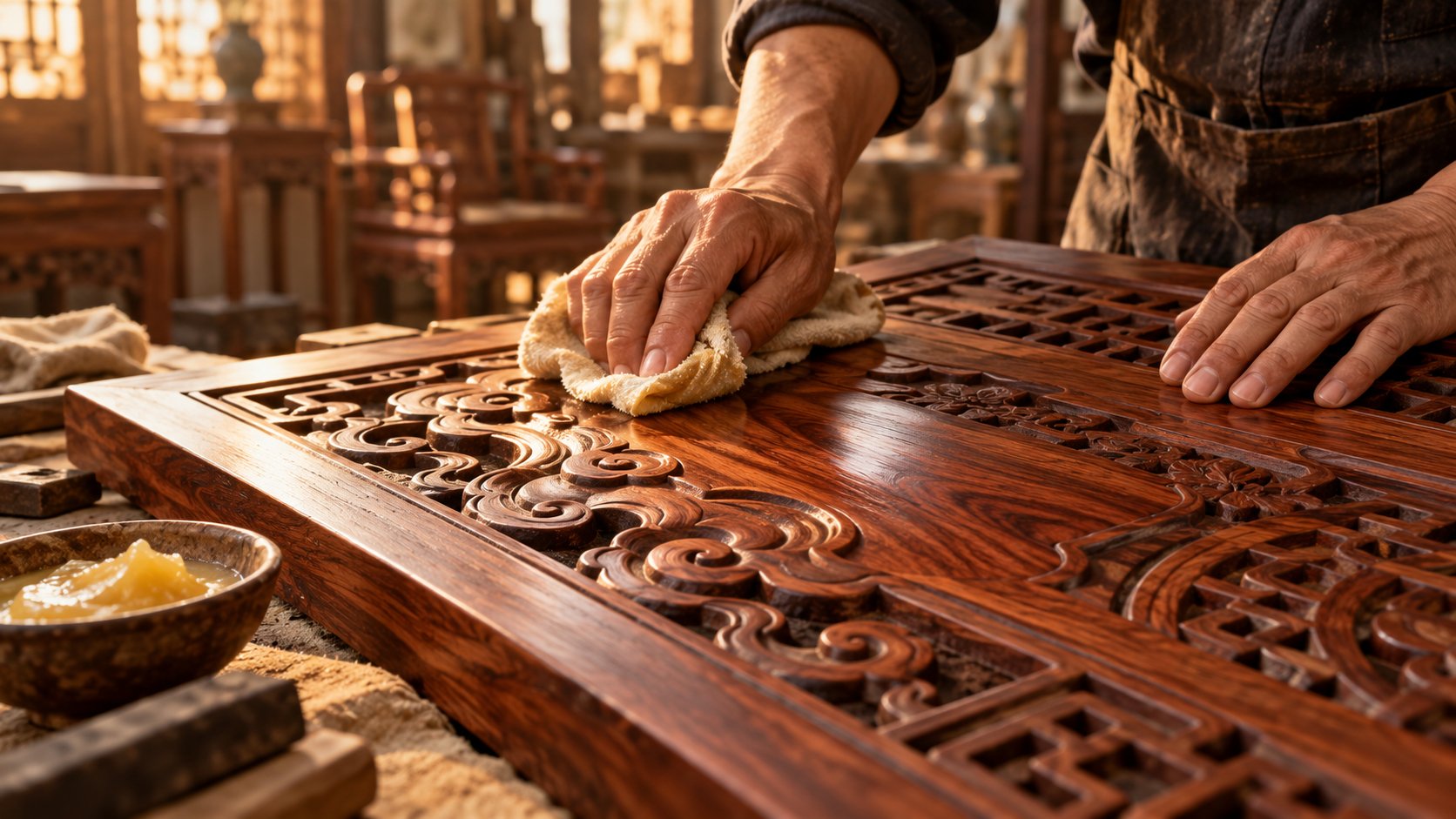
The finish itself is where the EU REACH and US CARB question becomes concrete. Our workshop finishes carved rosewood with natural beeswax and an eco-friendly lacquer system chosen to meet EU REACH and US CARB standards. In practice the process runs like this: after carving and final sanding, surfaces are sealed and coated with the lacquer system in controlled coats, and wax is hand-rubbed into the wood to produce a satin sheen that deepens with age. The wax protects the wood, allows it to breathe, and can be renewed by the owner with simple care; the lacquer provides the durable sealed surface that modern households and hospitality operators expect.
Because the coating system is deliberately simple — natural wax plus a compliant lacquer rather than a stack of solvent-heavy synthetic layers — the number of chemical inputs to screen under REACH stays small, and the finished surface avoids the strong solvent odors that hotel operators and homeowners associate with cheap finishing. The exact point deserves emphasis for buyers comparing suppliers: a factory that finishes with a minimal, documented coating system can give you a short, credible answer about what is in the product. A factory that sources whatever lacquer is cheapest that week cannot.
Step Five: Quality Control Before Packing
Finished pieces pass through internal quality control covering joint fit, surface smoothness, finish consistency and carving integrity before packing. Export orders are packed to ISPM 15 heat-treated packaging standards with custom crating, moisture barriers and bracing to protect carved details in transit — because a compliant product that arrives damaged has failed the customer anyway. The internal team prepares full export documents, and shipments for long-term partners can be split into partial deliveries.
The Compliance Document Checklist: What to Request Before You Sign a Purchase Order
Regulatory knowledge only protects you if it reaches your file in the form of documents. Based on the requirements summarized above, here is the checklist we recommend to every B2B buyer evaluating a rosewood furniture supplier for EU or US markets. A capable factory will recognize every item; hesitation or vagueness on any of them is information.
- Finish and coating declaration. Ask the factory to state in writing what the finish system is — wax type, lacquer base, and whether coatings are sourced with supplier declarations supporting REACH SVHC screening for the finished article.
- SVHC position statement. For the specific articles you are buying, request the factory's position on SVHC content above 0.1 percent by weight, so you can meet your own communication duties downstream in the EU.
- Component bill of materials for regulated panels. Ask which components, if any, use HWPW, particleboard or MDF, and request the certification status and labeling plan for those components under CARB ATCM and TSCA Title VI. On all-solid designs, ask the factory to confirm which parts are solid timber and which are panels — the answer should be component-specific, not a general assurance.
- Timber legality documentation. Species identification, sourcing records, and FSC chain-of-custody documentation where offered. Shipments of protected rosewood species must also carry CITES export permits issued by the Chinese CITES Management Authority; ask which species in your order require them.
- Packing and phytosanitary standards. Confirm ISPM 15 heat-treated packaging for all export crates, plus the factory's moisture-barrier and bracing protocol for carved goods.
- Labeling and recordkeeping plan. For US-bound finished goods containing regulated composite panels, confirm who applies the compliance label and where the records live. For all-solid shipments, confirm what documentation accompanies the shipment.
- Sample policy. Order a trial single set or refundable sample before committing to container volume, and inspect the finish, joints and odor in person. A factory confident in its finishing process encourages this step; ours offers trial single sets and refundable samples precisely because the finish must survive inspection anywhere in the world.
Note what this checklist does not ask for: it does not ask a supplier to "guarantee compliance forever," which no honest factory can offer, because regulations evolve and the candidate list is updated. It asks for the documents and process transparency that let you and your compliance advisor make the determination for your market. That division of labor — factory documents, buyer verification — is exactly how mature sourcing organizations operate.
OEM and ODM Custom Orders: Keeping Compliance Intact When Designs Change
Customization is where chemical compliance most often slips. A hotel project or a distributor's private-label line will request modified dimensions, added cabinets, upholstered accents, or new panel insert designs — and each change can introduce new materials into the bill of materials. A factory with an OEM and ODM process built around documentation handles this differently from one built around improvisation.
When we customize sizes and carved patterns for villas, resorts, hotels and distributor programs, the customization is evaluated at the design stage: which components remain solid rosewood, where any panel elements appear and what their specification is, what finish the new elements receive, and what documentation the finished article will carry. The buyer receives this component picture together with the layout drawings and quotation, so compliance questions are answered before tooling begins rather than after goods arrive. Free layout drawings for projects are part of this service — because a buyer who can see the design can also see what is in it.
For private-label and ODM buyers in Europe and North America, the same logic extends to branding: your label goes on a product whose material story you can retell to your own customers with confidence. That retelling — solid rosewood, mortise-and-tenon joinery, beeswax and compliant lacquer finishing, documented timber sourcing — is increasingly part of what premium furniture customers expect to hear.
Where These Standards Matter Most: Villas, Hotels, Resorts and Family Homes
Different buyer segments weight chemical compliance differently, and it is worth seeing the pattern.
Hotels and resorts operate rooms continuously and cannot tolerate strong off-gassing after installation. Furnishing programs for guest suites, lobbies and restaurants increasingly reference EU REACH and US CARB standards even in markets that do not enforce them directly, because international operators standardize their specifications globally. A classical rosewood suite in a resort villa — carved beds, wardrobes, writing desks — must therefore arrive ready for immediate use, with a finish that does not emit noticeable odor.
Villa and residential developers serving high-end buyers face customers who ask what the furniture is finished with, particularly for children's rooms and bedrooms. Natural beeswax finishing gives sales teams a clear, honest answer: the surface is wax and wood, renewable with simple care, without heavy synthetic coating layers.
Wholesalers and distributors carry the regulatory file for every SKU they list. The lighter and better organized the factory's documentation, the faster the distributor's compliance review runs — which in practice means the product reaches the market earlier.
Restaurants and banquet halls add a different stressor: commercial cleaning. Finishes on dining sets that see daily wipe-downs must tolerate mild cleaning agents, which is another reason the lacquer-plus-wax system matters — the lacquer seals the surface for cleanability while the wax maintains the hand-rubbed luster of classical furniture.
Frequently Asked Questions from Importers on REACH, CARB and Rosewood Finishing
Is solid rosewood furniture exempt from CARB rules?
Solid sawn timber is not a composite wood product, so the panel emission limits do not apply to solid-wood components the way they apply to particleboard or MDF. The duties attach to the bonded panels: if a finished good contains hardwood plywood, particleboard or MDF, those components and the finished good must meet the ATCM and TSCA Title VI requirements, including labeling and records. On all-solid classical furniture designs, the practical question is confirming which components are solid and whether any panel elements exist in the specific article — which is why we recommend the component-level question described earlier rather than a yes-or-no assumption in either direction.
What exactly should I ask a factory about its lacquer?
Three questions produce a clear picture: what the lacquer base is, whether the coating supplier provides declarations that support REACH SVHC screening for the finished article, and what the factory's odor profile is on freshly finished goods. A specialist workshop answers all three from its process documents; the answer should name materials, not just repeat the word "eco-friendly."
Does beeswax finishing affect durability for hotel use?
Beeswax and lacquer serve complementary roles in our finishing system: the lacquer provides the sealed, cleanable surface for daily use, while the hand-rubbed wax maintains luster and allows simple renewal by maintenance staff. Hotels that maintain classical furniture with periodic wax care keep the surface looking correct for years; the care routine is simple and we provide guidance with shipments. For a technical comparison of the finish options, see our article on traditional lacquer finishing for export markets.
Will the furniture smell when it arrives?
A minimal, compliant finishing system is chosen partly for this reason. Goods finished with natural wax and compliant lacquer, packed with moisture barriers in ISPM 15 heat-treated crates, arrive without the strong solvent odor associated with heavy synthetic coating systems. Buyers who want to verify this before committing should use the trial single set or refundable sample policy and inspect goods on arrival.
Which documents travel with a rosewood shipment to the EU or US?
The internal export team prepares full export documents for every shipment, FSC chain-of-custody documentation where applicable to the order, and CITES export permits issued by the Chinese CITES Management Authority for shipments of species that require them. Packaging follows ISPM 15 heat-treated standards. The compliance documents specific to your market — finish declarations, SVHC position, component panel status — are prepared per order, so tell us the destination market when you request a quotation so the file is built correctly from the start.
How do REACH and CARB interact with timber legality rules?
They are separate frameworks that cover different risks — REACH covers chemicals, the EU Timber Regulation and US Lacey Act cover timber legality — but they share one operational consequence: both demand supply-chain records. A factory that already maintains species identification, sourcing documentation and chain-of-custody files for timber can extend the same file with coating and panel documentation. For a deeper walkthrough, read our guide to FSC-certified timber compliance when importing rosewood furniture from China and our article on how EU Timber Regulation and US Lacey Act affect redwood furniture imports.
What about CITES for rosewood species?
Several rosewood-family species are CITES-listed, and the rules have been tightening globally. Shipments of listed species require export permits, and importers should verify the listing status of each species in their order. Our overview of how CITES regulations are reshaping the rosewood furniture trade explains what importers must prepare now.
Can I get custom sizes and patterns without losing compliance documentation?
Yes — customization is evaluated at the design stage precisely so the documentation follows the finished article. When you request OEM or ODM modifications, the quotation and layout drawings reflect the component structure of the custom design, so the compliance file matches what is actually built rather than a standard catalog model.
From Inquiry to Container: How the Process Runs for Compliance-Minded Buyers
For buyers planning an order around EU REACH and US CARB requirements, the working process looks like this. First, share your target market and product direction — sofa sets, dining sets, bedroom suites or whole-house programs — and tell us the destination country so the compliance file is scoped correctly. Second, review the quotation together with the component and finish documentation for the articles you selected; ask your questions at this stage, when changes cost nothing. Third, confirm trial single sets or refundable samples if you are testing a new supplier relationship, and inspect finish, joints and packing on arrival. Fourth, place the container order; production runs 45 to 60 working days after deposit, with partial shipments available for long-term partners. Fifth, receive the shipment with its export document set, and keep the compliance file with your product records for your market's authorities.
Buyers who follow this sequence report a quieter importing life: no last-minute documentation scrambles, no relabeling at destination, and a product story — solid rosewood, mortise-and-tenon joinery, beeswax finishing, documented timber — that holds up in front of their own customers and inspectors alike.
Three Common Mistakes Buyers Make on Chemical Compliance — and How to Avoid Them
Before closing, three patterns recur in this corner of the furniture trade, and each has a cheap fix.
Mistake one: treating compliance as a certificate hunt. Buyers sometimes collect certificates without understanding what each one covers, then discover at customs or during a retail audit that the file answers a different question than the one asked. The fix is the component-and-material approach used throughout this article: know what is in the specific article, then match documents to those components. A short, accurate file beats a thick, vague one.
Mistake two: asking compliance questions after production starts. When a buyer requests finish changes or documentation after the deposit, the factory must choose between delaying the shipment and shipping goods that do not match the buyer's market requirements. Both outcomes are expensive. Every question in the checklist above costs nothing at the quotation stage — which is why serious factories welcome them there.
Mistake three: assuming all "eco-friendly" claims are equal. The word appears on thousands of supplier pages with no supporting content behind it. The productive response is not cynicism but specificity: ask what the finish is made of, what is screened, and what documentation supports the claim. Factories with real systems produce specifics in a day; factories without them produce another adjective.
Related Reading for Importers
The topics in this article connect to a wider compliance and craft library on our site. If you are preparing an EU or US sourcing file, these guides go deeper on the neighboring requirements:
- How Does FSC-Certified Timber Compliance Work When Importing Rosewood Furniture from China?
- How Do EU Timber Regulation and US Lacey Act Affect Redwood Furniture Imports?
- How Will CITES Regulations Reshape the Global Rosewood Furniture Trade in 2026 — and What Importers Must Do Now
- Why Does Traditional Lacquer Finishing Matter When Sourcing Rosewood Furniture for Export Markets?
- Why Does Kiln Drying Matter When Buying Rosewood Furniture from China?
And if you are evaluating specific product programs — carved sofa sets for hotel receptions, all-solid bedroom suites with floating-panel wardrobes, or Ming-style dining sets for restaurant projects — the product pages describe the construction of each series in the same component terms used in this article:
- Classical Siamese Rosewood Wardrobe with Carved Panel Doors
- Classical Four-Poster Redwood Bedroom Suite 5-Piece
- Imperial Dragon Carved Redwood Sofa 10-Seat Set
- Ming Style Round Redwood Dining Table 8-Seat Set
Caring for a Wax-and-Lacquer Finish After Delivery: Guidance You Can Pass to Your Customers
Compliance does not end at the port of discharge; the finish must also survive years of real use, and end customers judge a supplier by how the furniture looks after year three, not year three days. Distributors and hotel operators who understand the maintenance routine can protect the investment with simple habits.
For daily care, dust with a soft dry cloth and wipe spills promptly; the sealed lacquer surface handles ordinary household and hospitality cleaning well. For periodic care — typically every few months depending on use — a thin application of natural beeswax, worked along the grain with a soft cloth and buffed lightly, renews the satin luster that defines classical rosewood furniture. Avoid aggressive chemical cleaners, abrasive pads, and prolonged direct sunlight or heat sources next to the furniture, which are the usual causes of finish dulling in any wood furniture category. In very dry climates, moderate indoor humidity helps both the wood and the finish; in coastal humidity, ventilation matters more.
These habits cost almost nothing, and they give your sales teams a credible service story: the finish is renewable, the furniture is repairable, and the material grows more beautiful with age. That narrative — longevity rather than replacement — is precisely why classical solid rosewood furniture sells into premium homes and hospitality projects, and it is only credible when the finishing system underneath was chosen correctly at the factory.
A Closing Note on Asking the Right Question Early
Across this article one habit separates smooth importing from stressful importing: asking material questions before the order, not after the goods. "What is in the finish? Which components are panels? What documents travel with the shipment?" — these take minutes to ask and can save a season of delay. Suppliers with genuine systems answer quickly because the answers already exist in their process files. Suppliers without them will ask for time, and the pattern of what they can and cannot produce tells you what you need to know.
The Bottom Line for B2B Buyers
Do rosewood furniture exports meet EU REACH and US CARB standards? The honest answer is that compliance is built, not born — it depends on what a specific factory puts in its timber, its joints, its panels and its finishing tanks, and on whether that factory can document all four. Classical rosewood furniture starts with structural advantages: solid legally certified timber instead of bonded panels, mortise-and-tenon joinery without metal nails, and a minimal finishing system of natural beeswax and compliant lacquer designed to meet EU REACH and US CARB standards. Those advantages become real compliance only when a factory maintains the files — species records, chain-of-custody documentation, coating declarations, component bills of materials, ISPM 15 packing records — that turn process into evidence.
At Yunxiao Rosewood Furniture, this system has been the operating standard since the workshop opened in 2008 in Xianyou County, Fujian: 36-day constant-humidity drying, hand carving by experienced artisans, assembly without metal nails, and finishing chosen for the export markets we serve across Europe, North America, Southeast Asia and Australia. Whether you are a wholesaler building a classical furniture program, a hotel group furnishing villas and suites, or a design firm specifying custom pieces for a private residence, the fastest way to test the system is concrete: request the checklist documents for the articles you have in mind, and order a trial single set with refundable sample terms. Send us your target market and the product direction you are planning, and our export team will prepare the quotation together with the compliance file that matches it — so the furniture you place in front of your customers is as sound on paper as it is in the hand.