
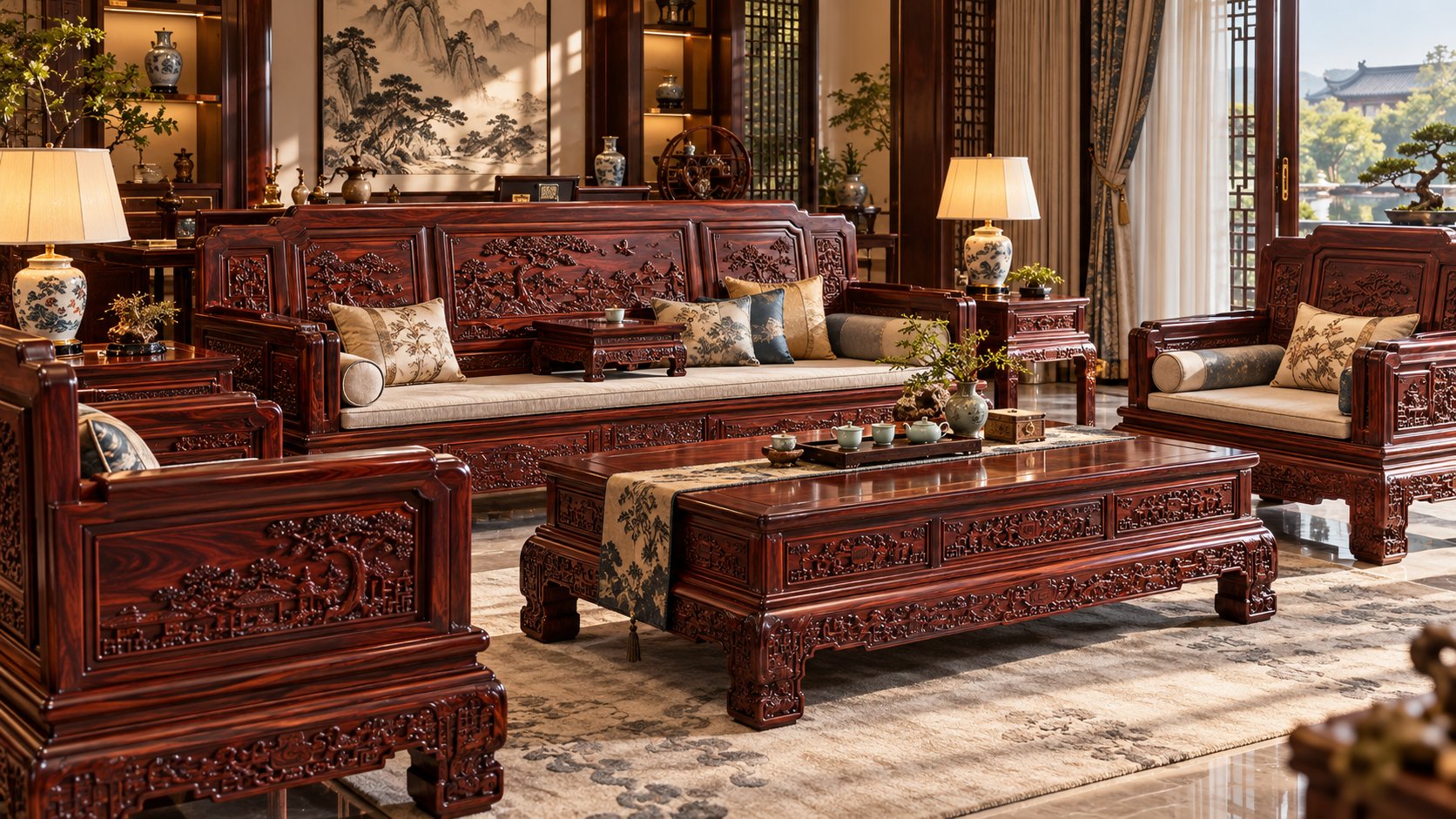
A B2B guide to what determines the long-term value of rosewood furniture: timber species, mortise-and-tenon construction, lacquer finishing, CITES and FSC documentation, 2026 market signals and pre-order verification steps.
B2B buyers rarely ask whether rosewood furniture looks impressive. The question that decides an order is more practical: will this container of furniture still be worth something in five, ten, or twenty years? For importers, distributors, hospitality procurement teams, and interior design studios, rosewood furniture occupies an unusual position among wood products. Most furniture depreciates the day it leaves the showroom. Classical rosewood furniture, when it is made from the right timber, built with the right joinery, finished correctly, and documented properly, behaves differently. It can hold value, and in some market segments it has appreciated.
That promise, however, is not automatic. Two containers of "rosewood furniture" can age in completely different ways depending on species, construction, finishing, and paperwork. This guide examines, from a sourcing and procurement perspective, what actually determines the long-term value of rosewood furniture, which market signals in 2026 matter, how to evaluate a supplier's offer before committing capital, and which mistakes quietly destroy resale value after delivery.
Why Value Retention Is a Sourcing Question, Not a Marketing Claim
Every furniture supplier will tell you their products are an investment. The claim means nothing by itself. What matters is whether the specific attributes that historically preserved value in classical Chinese furniture are present in the pieces you are buying, and whether you can verify them before the container ships.
Think of the question the way an appraiser does. An appraiser looking at a classical Chinese piece asks four things in roughly this order: What is the timber, and can it be identified with confidence? How is the piece engineered, and will the structure survive another century of use and climate changes? What is the surface finish, and was it applied in a way that can be maintained? Is there documentation connecting the object to a traceable origin? The same four questions apply, with appropriate adjustments, to newly manufactured classical rosewood furniture for export markets. A buyer who can answer all four has a defensible position on long-term value. A buyer who cannot is speculating.
This framing matters for B2B purchasing in particular. A hotel group furnishing a lobby, a distributor stocking a showroom, or a design studio specifying a villa project all need furniture that will still look right, perform right, and carry defensible provenance years after installation. Depreciation in commercial furniture is usually driven by wear and style. Classical rosewood furniture avoids the style problem — Ming and Qing derived forms have remained collectible for centuries — but only if wear and provenance are controlled at the point of manufacture.
What Determines the Long-Term Value of Rosewood Furniture?
Four factors dominate. They interact, but each can be evaluated separately, and each can be verified with the supplier before you place an order.
1. Timber Species and Scarcity
The single largest driver of long-term value is what the furniture is actually made of. In the classical Chinese furniture world, the premium historical timbers — huanghuali (Dalbergia odorifera) and zitan — are effectively unavailable in commercial quantities, which is why antique pieces in these woods command extraordinary prices at auction. For newly manufactured export furniture, the practical premium material is Siamese rosewood (Dalbergia cochinchinensis), a dense, oil-rich rosewood in the same botanical genus, listed on CITES Appendix II. Density, natural oil content, and fine grain give Siamese rosewood the working properties and the visual depth that made its relatives famous, and its regulated status means supply is structurally constrained rather than expanding.
Scarcity supports value in a straightforward way: timber that becomes harder to legally harvest tends to rise in raw material cost over time, and finished pieces made from it inherit that pressure. Buyers should be precise about species names. "Rosewood" is used loosely across the trade for several Dalbergia species and for a number of woods that are not rosewoods at all. Ask the supplier to state the botanical species in writing. A factory that works in genuine Siamese rosewood will answer without hesitation; vague answers are a screening signal.
2. Joinery and Structural Engineering
The second driver is how the piece is put together. Classical Chinese furniture is defined by mortise-and-tenon construction: joints cut directly into the wood, locking members together without screws or glue as the primary structure. This is not only an aesthetic tradition. Mechanically, a well-cut mortise-and-tenon joint allows the wood to move with seasonal humidity changes while remaining tight, which is why well-made classical pieces survive centuries of use and why poorly made pieces develop wobble, splits, and failed corners within a few export shipping cycles.
For a B2B buyer, joinery quality is verifiable. Ask how the joints are cut, request close-up photographs of tenons and internal frames, and ask what happens when a component is damaged in transit — whether the piece can be disassembled and repaired by a skilled local carpenter, or whether a failed joint means a written-off piece. Furniture that can be repaired holds value; furniture that cannot does not. This is also why disassembly-friendly construction matters for overseas projects: pieces that knock down into smaller components ship in smaller volumes, survive handling better, and can be reassembled on site by trained teams with remote guidance from the factory.
3. Surface Finishing
The finish determines both the day-one impression and the decade-five condition. Traditional raw lacquer finishing, applied in multiple coats with curing between each, protects the wood while allowing its natural color and grain to deepen with age — the patina development that collectors specifically prize. sprayed polyurethane coatings, by contrast, can look uniform on delivery but age as a film: they scratch, peel, and cannot be locally repaired without refinishing the whole panel.
Coat count is a reasonable proxy for finishing seriousness. Current Siamese rosewood production in the Yunxiao catalog ranges from six coats on tea tables and chairs to eight or nine coats on flagship carved sofa sets, with dining surfaces finished to the FDA 21 CFR 175.300 food-contact specification for North American and European buyers. Ask your supplier to state the number of coats, the type of lacquer, and whether the finish meets a named standard. These are checkable claims, and a factory confident in its finishing will provide them.
4. Documentation and Traceable Origin
The fourth driver has grown dramatically in importance over the past five years: paper. Legally harvested, traceably sourced timber, supported by documentation, is no longer a compliance nicety — it is a condition of market access in the EU and the US, and increasingly a condition of resale value everywhere. Two document families matter most:
- CITES documentation. Siamese rosewood is listed on CITES Appendix II, so international trade requires export permits. Pieces that ship with complete CITES paperwork can be legally re-exported and resold in most markets; pieces with questionable origin can become unsellable.
- FSC chain-of-custody certification. FSC documentation connects the timber through the supply chain from forest to factory, which satisfies due-diligence requirements under the EU Timber Regulation regime and strengthens sustainability positioning for hospitality and residential projects.
Current production in the Yunxiao range ships with FSC chain-of-custody documentation and CITES export documentation included, and dining sets are specified with FDA-compliant food-contact surfaces. For a buyer, the practical question is simple: can the supplier put these documents in front of you before you pay? If the answer is "after shipment," treat the value-retention story as unproven.
How Does Siamese Rosewood Compare with Other Timbers for Value Retention?
Buyers evaluating long-term worth usually compare candidates across the same grid: availability, regulatory status, working properties, appearance stability, and market depth. Here is how Siamese rosewood stacks up against the woods most often considered for classical furniture export.
| Criterion | Siamese rosewood | Huanghuali (antique trade) | Common plantation hardwoods |
|---|---|---|---|
| Availability for new production | Available in commercial quantities, supply constrained by CITES II listing | Effectively unavailable; auction and collector trade only | Widely available |
| Regulatory burden | CITES export permit, manageable with an experienced factory | Severe; most trade is antiques with provenance requirements | Minimal, but FSC increasingly expected |
| Density and durability | Very high density, natural oils, termite resistant | Exceptional | Varies widely by species |
| Value trajectory of finished pieces | Supported by rising raw material costs and collector-adjacent demand | Historically strong appreciation | Ordinary depreciation typical |
| Practical B2B role | New classical furniture for hotels, villas, distributors | Reference point for design and provenance standards | Budget and volume segments |
The comparison explains why Siamese rosewood has become the default choice for serious new classical furniture production: it is the closest practical material to the historical premium timbers, with a regulatory pathway that an experienced exporter can manage. Buyers should nonetheless verify species identity in contracts and pre-shipment inspection, because substitution or mislabeling in the broader "rosewood" trade is a known risk. Our earlier guide on verifying rosewood quality grades before a bulk order covers the inspection points in detail.
Why Do Craftsmanship and Carving Details Affect Resale Value?
Timber and joinery determine whether a piece survives. Craftsmanship determines whether anyone wants it to. In the classical furniture market, the depth and quality of carving, the crispness of moldings, and the proportion of the piece relative to historical models are what separate furniture that appreciates from furniture that merely endures.
Three specific craft attributes are worth evaluating as a buyer:
- Hand carving depth and continuity. Deep-relief carving — phoenix and peony panels, dragon armrests, lattice work, auspicious cloud aprons — is executed by trained carvers over many hours per panel. Machine carving produces uniform shallow relief that reads flatly under raking light. On a showroom floor either may look acceptable; in a luxury hotel lobby five years later, the difference is obvious.
- Proportion and design fidelity. Classical forms carry centuries of refinement in their geometry. A Ming-style open-slat backrest with cloud-and-bat motifs or a horse-hoof leg profile that is correctly drawn looks "right" to trained eyes even when they cannot articulate why. Factories whose design teams work from classical references produce pieces that age aesthetically; factories that improvise proportions produce pieces that date quickly.
- Surface preparation before finishing. The number of lacquer coats only matters if each coat is applied over properly prepared, cured surfaces. Ask to see finish samples under both natural and artificial light.
Carving themes also carry cultural and commercial meaning that affects salability. Motifs such as the ruyi scepter (authority and wish-fulfillment), phoenix and peony (prosperity), and the longevity character (long life) are not decoration chosen at random; they are part of what end-customers in heritage-conscious markets are buying. A distributor who can explain these meanings sells furniture faster and at better margins. Our overview of traditional carving motifs for import catalogs gives a practical reference.
For buyers who cannot visit the carving workshop, remote verification is straightforward: request close-up photographs of finished carving panels at an angle, ask which components are hand-carved versus machine-assisted, and ask how long a typical carved panel takes. Honest factories answer these questions specifically because they are proud of the answer.
Which Rosewood Furniture Categories Hold Value Best Over Time?
Not every product category behaves the same way over a ten-year horizon. Demand depth, replacement cost, and the service life of each form all influence which pieces are most likely to hold or gain value.
Sofa and reception sets
Classical rosewood sofa sets are the anchor category for value retention. They occupy the most visible position in a residential or hospitality interior, they are the category with the deepest collector-adjacent demand, and flagship configurations — six-piece reception sets with phoenix carving, nine-seat imperial dragon banquet arrangements, Ming-style seven- and nine-piece living room suites — have no cheap substitute that reads equivalently. A nine-coat lacquer finish on a carved sofa set is a meaningful cost commitment by the factory, and that cost is recoverable in the secondary market precisely because the finish can be maintained rather than replaced.
Dining sets
Dining sets in four-to-twelve seat configurations hold value well for a different reason: they work hard. Commercial dining furniture takes daily abuse, and solid rosewood with FDA-compliant food-contact finishing is one of very few materials that survives hotel and banquet service while remaining repairable. Rectangular ten-seat sets with carved chairs and twelve-seat dual-pedestal banqueting sets serve a hospitality segment where the alternative — replacing cheaper tables every few years — is visibly more expensive over a decade. The size selection question for hotels and restaurants is covered in our guide to choosing dining table set sizes for hotels, villas and restaurants.
Bedroom suites
Canopy beds, four-poster suites, and panel-bed bedroom sets hold value strongly in villa and boutique-hotel contexts, where the bed is the visual centerpiece of the room. Floating-panel construction and mortise-and-tenon frames handle climate cycling in overseas bedrooms well, and dovetail-drawer dressers and nightstands signal construction seriousness that appraisers and design-aware guests both notice.
Tea tables, sideboards, display cabinets and single pieces
Smaller pieces — tea tables with carved or stone-inlaid aprons, sideboards with dovetail drawers, display cabinets with lattice doors, armchairs and folding stools — play a portfolio role. They are the entry point through which end customers begin a rosewood collection, they fill lobbies and entryways in hospitality projects, and their lower unit value makes them the category where a distributor can most easily demonstrate craftsmanship quality to walk-in buyers. As single pieces they also appreciate in a specific way: when a production run ends and a design is discontinued, surviving examples of a well-made piece begin trading above their original price within the collector-adjacent market.
The portfolio logic
For a B2B inventory, the practical allocation mirrors what works in showrooms: anchor with one or two flagship sofa or dining configurations, hold bedroom suites for villa and suite projects, and stock tea tables, cabinets and accent pieces as accessible entry points. This is the same logic that governs whole-house furnishing projects, where sofa, dining and bedroom programs are specified to share timber, finish and design language across a property — a coherence that itself protects project value, as discussed in our guide to whole house rosewood furniture projects.
What Do 2026 Market Signals Say About Classical Furniture Value?
B2B buyers do not need to become auction specialists, but they should track the top of the market, because the top sets the reference prices that the entire category trades against. Two developments in 2026 are directly relevant.
First, dedicated classical Chinese furniture sales continue at the major auction houses. In March 2026, Sotheby's held a dedicated New York sale — Huanghuali for the Scholar's Studio: An Important Private Collection of Classical Chinese Furniture — presenting a single-owner collection of classical pieces in the most historically prized timber. The existence of a dedicated, single-collection evening-scale sale at a major house is itself a demand signal: auction houses program such sales when consignment supply and bidder depth both exist. Trade press through 2026 has similarly reported sustained competitive bidding for documented Ming-style pieces in New York salesrooms.
Second, raw material pressure continues. CITES Appendix II controls on rosewood species, export restrictions in source countries, and rising legal-harvest costs have pushed input prices upward across the industry — a trend we examined in why solid rosewood furniture is becoming more expensive for global buyers. When the cost floor of legally sourced timber rises, existing inventory made from the same timber tends to hold its nominal value better than furniture categories built on commodity wood.
Neither signal guarantees that a specific production run will appreciate. What they establish is the market context: documented classical furniture in premium rosewoods has an active high-end reference market, and the raw material basis of new production is tightening rather than loosening. For a distributor, that combination is the economic case for stocking classical rosewood rather than commodity furniture lines.
A caution belongs here. Auction headlines describe antique pieces whose value reflects age, provenance, and irreplaceability. Newly manufactured furniture participates in that market only partially — through design lineage, material quality, and craftsmanship. Buyers should treat appreciation as a possibility concentrated in the best-made pieces, and value retention as the realistic base case for well-documented, well-built production. Marketing that promises guaranteed appreciation for new furniture should be read as a red flag, not a reason to buy.
How Should B2B Buyers Evaluate Value Before Ordering a Container?
Value retention is built at the ordering stage or not at all. The following evaluation sequence turns the four value drivers into concrete pre-order checks.
Step 1: Fix the species in writing
Require the quotation and proforma invoice to state the botanical species (for example, Dalbergia cochinchinensis — Siamese rosewood), not just "rosewood" or "redwood." This single line protects you against downgrade substitution and is the foundation of every later claim about the piece.
Step 2: Verify construction on representative pieces
Request photographs or video of: tenon joints on an actual production piece (not a display model), a drawer pulled out to show dovetail construction, the underside of a seat or table showing frame construction, and a carved panel photographed at an angle to show relief depth. If you work with a third-party inspector, put these points in the inspection checklist. Pre-shipment inspection guidance is covered in our pre-shipment inspection checklist for importers.
Step 3: Specify the finish and its standard
Ask for the number of lacquer coats per category, the lacquer type (traditional raw lacquer versus sprayed coatings), and any food-contact compliance for dining surfaces. For projects in North America and Europe, specifying FDA 21 CFR 175.300-compliant finishing on dining surfaces is now standard practice in serious production and should appear in your purchase specification.
Step 4: Secure the documentation package
Confirm before payment that the shipment will include CITES export documentation and, where applicable, FSC chain-of-custody documentation, and ask for copies of prior shipments' documents as evidence the factory actually delivers them. Documented pieces are re-sellable pieces; undocumented pieces carry a permanent discount in informed markets. Our explainer on FSC-certified timber compliance when importing rosewood furniture details what to expect from a compliant document package.
Step 5: Model the total cost of ownership
Value retention only matters relative to total cost. A useful comparison for any hospitality or distribution buyer:
| Cost element | Commodity furniture line | Classical rosewood line |
|---|---|---|
| Initial purchase | Lower | Higher |
| Expected service life in commercial use | 3–7 years typical before visible wear drives replacement | Decades with maintenance; repairable construction |
| Refinishing / repair economics | Often not economical; replacement is default | Local repair and re-lacquer feasible; joints re-tightenable |
| End-of-period residual value | Near zero | Meaningful, especially for documented flagship pieces |
| Brand and positioning benefit | Neutral | Supports heritage, luxury and sustainability narratives |
Run this comparison at your own price points and duty assumptions — import duties vary significantly by destination and are covered in our guide to import duties and tariffs for rosewood furniture from China. In most hospitality and premium residential scenarios the rosewood line wins on total cost of ownership even before any appreciation, because the replacement cycle is the dominant cost in the commodity scenario.
Step 6: Match the specification to the climate
Timber movement is the main physical threat to value in overseas markets. Kiln-dried timber at the correct moisture content for the destination climate, floating-panel construction that allows seasonal movement, and mortise-and-tenon structures that tolerate movement are what keep pieces tight after years of air-conditioning cycles or tropical humidity. Ask what moisture content the timber is dried to and how it is matched to your destination climate; this is a technical question a serious factory answers precisely, and it is treated in depth in our piece on why kiln drying and moisture control matter.
How Do Compliance Documents Affect Future Resale Value?
Documentation deserves its own section because its effect on value is mechanical, not sentimental. Consider the position of a hotel group or interior studio that, five years after a project, wants to order matching pieces, or a distributor that wants to clear a slow-moving SKU to another market. Every one of those transactions requires the furniture to be legally tradeable.
- CITES export documentation establishes that the rosewood in the shipment was legally traded under the Convention. With it, re-export and resale proceed normally. Without it, the timber's regulated status can block the transaction entirely — the piece becomes economically stranded no matter how good it is.
- FSC chain-of-custody documentation supports due-diligence obligations under timber regulations in the EU and analogous regimes elsewhere, and satisfies the sustainability questionnaires that hospitality groups and government-adjacent projects now routinely issue. In tender situations, documentation is frequently the difference between qualifying and not qualifying.
- Food-contact compliant finishing on dining surfaces (FDA 21 CFR 175.300) does the same work for the surface: it allows a restaurant or hotel to state, in procurement files, that the tables meet a named standard. That statement survives into the building's operations documentation and supports the property's value story when it is eventually sold or rebranded.
The pattern generalizes: every document attached to a piece converts an uncertain claim into a transferable fact, and transferable facts are what secondary markets price. This is also why the documentation request belongs in the purchase order, not in the follow-up email after arrival.
Which Care Practices Protect Furniture Value After Delivery?
Value retention does not end at the port. The condition a piece reaches in year five depends on how it was installed and maintained in years one through five. Four practices carry most of the weight, and all four can be handed to your end customers as part of the product's after-sales narrative.
- Acclimatize before installation. Let pieces rest in their destination environment, unpacked, for several days before final placement so the timber adjusts to local humidity. This is especially important for pieces moving from a port-side warehouse into air-conditioned interiors.
- Control the immediate environment. Stable humidity and avoidance of direct heat sources, prolonged direct sunlight, and standing water protect both the lacquer and the timber. For commercial dining, coaster and tablecloth protocols during service protect the food-contact finish.
- Maintain the finish, do not replace it. Raw lacquer finishes are maintained with soft dry or barely damp cloths and, where recommended by the factory, appropriate wood wax. The multi-coat structure means minor wear can be locally attended rather than triggering a full refinishing.
- Repair structurally, early. A joint that loosens should be re-tightened by a carpenter familiar with mortise-and-tenon construction promptly; disassembly-friendly classical construction makes this a routine task rather than a destruction event.
These points are expanded for commercial operators in our guide to caring for wood dining tables in hotels, restaurants and banquet halls and for residential owners in our maintenance guide for solid rosewood furniture care and long-lasting value. Distributors who include a printed care card with each set consistently report fewer warranty conversations and better showroom condition over time.
Which Mistakes Quietly Erode Rosewood Furniture Value?
Most value destruction we see in the trade comes from a short list of avoidable errors. Checking your own operation against this list is faster than learning the lessons in damaged inventory.
- Buying on price alone from an unverified source. A container priced far below the genuine Siamese rosewood cost floor is telling you something about the timber. Species substitution is the single most common way buyers acquire furniture that cannot hold value.
- Accepting undocumented shipments. Missing CITES or FSC papers convert a good piece into a stranded asset in regulated markets. The discount applies at resale, not just at customs.
- Storing inventory badly. Warehousing furniture against exterior walls, under HVAC outlets, or in uncontrolled humidity for years creates the very movement damage the joinery was designed to tolerate in use. Rotate stock and keep storage conditions reasonable.
- Ignoring small damage. A lifted veneer, a loose joint, or a scratched panel left unattended compounds. Classical construction rewards early, local repair.
- Mismatching pieces to projects. Placing delicate carved accent pieces in high-traffic banquet service, or budget-conscious commodity pieces in flagship lobbies, erodes value in both directions. Match category to service intensity.
- Relabeling and repainting. Refinishing a raw-lacquer piece with modern spray coatings to "refresh" it usually reduces value, because the repairable, patina-capable finish is replaced with a film that cannot be locally maintained.
How Should Importers Position Long-Term Value to End Customers?
If you distribute or specify rosewood furniture, the value-retention case is one of your strongest sales narratives — provided you present it accurately. Three positioning approaches work in showrooms, project proposals, and e-commerce listings alike.
Lead with verifiable specifics. "Solid Siamese rosewood, mortise-and-tenon construction, nine-coat raw lacquer finish, CITES and FSC documentation included" is a sentence an informed customer can check and a competitor selling veneered commodity product cannot copy. Specifics are what convert value-retention claims from marketing into procurement facts.
Frame the comparison honestly. Present the total-cost-of-ownership comparison against commodity furniture rather than promising appreciation. Customers who buy on honest comparisons return; customers who bought on inflated promises become refund cases.
Sell the care relationship. A care card, a maintenance service, or an annual wax-check offer keeps your brand attached to the furniture for the years in which its value story plays out — and generates the repeat trade (matching nightstands, a dining set for the next home) that makes the category commercially deep.
Frequently Asked Questions
Does rosewood furniture actually increase in value?
Antique pieces in the historical premium timbers have appreciated strongly at auction for decades, and 2026's dedicated classical furniture sales at major houses show that demand remains active. Newly manufactured furniture should be evaluated more conservatively: well-made, well-documented pieces in genuine Siamese rosewood hold value well because the timber's cost floor is rising and the construction is repairable, and flagship or discontinued designs can appreciate. No responsible supplier should promise guaranteed appreciation for new furniture.
Is Siamese rosewood a good material for long-term value?
It is currently the most practical premium material for new classical furniture: a true Dalbergia rosewood with high density, natural oils, and fine grain, listed on CITES Appendix II so supply is constrained. Its regulatory status is manageable when the factory ships with complete CITES documentation — which is exactly why the paperwork request belongs in the purchase order.
What documents should I receive with a rosewood furniture shipment?
At minimum: CITES export documentation for the rosewood timber, FSC chain-of-custody documentation where applicable, and the commercial invoice stating the botanical species. For dining furniture destined for North American or European projects, written confirmation that food-contact surfaces meet FDA 21 CFR 175.300 belongs in the specification.
How long does classical rosewood furniture last in commercial use?
With correct moisture content for the destination climate, mortise-and-tenon construction, and maintained lacquer finishing, solid rosewood furniture is measured in decades of commercial service, not years. The repairable joint construction is the key difference: wear is serviced locally instead of triggering replacement.
Can damaged rosewood furniture be repaired, or is it written off?
Classical construction is designed to be repairable. Loosened joints can be re-tightened, components can be disassembled and replaced, and multi-coat raw lacquer allows local attention to wear. Factories that support overseas projects typically provide remote installation and repair guidance — one of the after-sales capabilities worth confirming before ordering.
Which pieces should a new distributor stock first?
A practical first container combines one flagship carved sofa or dining configuration as the anchor, one bedroom suite for villa and suite projects, and a run of tea tables, sideboards, and accent chairs as accessible entry points. This mix demonstrates the full craft range at several price levels and generates the fastest sell-through feedback on which designs your market wants next.
Can I order additional matching pieces years after the first container?
This depends entirely on whether the factory keeps production records for your order — timber batch, finish recipe, carving masters, and hardware specifications. It is a question worth asking before the first order, because the answer determines whether your showroom or project can grow coherently. Factories that maintain these records can extend sets in matching timber and finish; factories that cannot will offer "similar" pieces that rarely match closely.
How Does Factory After-Sales Support Affect Long-Term Value?
One value factor that never appears on a quotation is the supplier's behavior after the container lands. It matters more than most buyers expect, because the economics of repairable furniture only work if someone can tell your local carpenter how to execute the repair. When evaluating a supplier's contribution to long-term value, four after-sales capabilities are worth confirming explicitly:
- Remote installation guidance. Classical furniture that knocks down into components needs correct reassembly on site. Factories that provide video-call guidance, illustrated assembly sequences, and named contact points turn delivery day from a risk event into a routine one. Poorly guided first assemblies are a common source of avoidable joint damage.
- Spare parts and matching components. Ask whether the factory retains production records for your order, so a damaged panel, a replacement glass shelf for a display cabinet, or additional matching chairs for an expanding restaurant can be produced in the same timber batch and finish years later. The ability to extend a set protects the value of the whole set.
- Finish maintenance instructions. A supplier confident in its lacquer system tells you exactly how to maintain it — which waxes, what to avoid, how often — in writing. Vague care instructions usually accompany finishes that cannot be locally serviced.
- Climate-specific advice. A factory exporting to both tropical Southeast Asia and heated North American interiors adjusts moisture targets and packing to the destination. Ask what they recommend for your specific market and how it differs from their default.
After-sales capability is also the most honest signal of manufacturing seriousness available to a remote buyer. Sales claims can be copied; a willingness to be accountable for a piece five years after shipment cannot. When a supplier's export team answers after-sales questions with the same specificity as pre-sales questions, you have found a partner whose furniture can carry a long-term value story.
The Bottom Line for B2B Buyers
Rosewood furniture holds value when four things are true at once: the timber is genuinely a premium rosewood species and says so on the invoice; the construction is classical mortise-and-tenon that can be repaired rather than replaced; the finish is a multi-coat traditional lacquer that can be maintained; and the paperwork — CITES, FSC, species declarations — makes every piece legally and credibly tradeable for its whole life. Market conditions in 2026 support that case: high-end demand for documented classical Chinese furniture remains active at the major auction houses, and the legal supply of premium rosewood continues to tighten.
None of this is automatic. It is the result of specifications you set and verifications you run before the container ships. Buyers who treat value retention as a sourcing discipline — species in writing, construction verified, finishing specified, documentation secured — acquire furniture that serves its project for decades and still commands a price at the end of that service. Buyers who treat it as a slogan acquire expensive inventory problems.
If you are planning a hospitality project, building a classical furniture program for your market, or comparing rosewood specifications for an upcoming container, contact Yunxiao Rosewood Furniture for current Siamese rosewood availability, sample documentation packages, and project-specific quotations. Our team works with distributors, hotel groups, and design studios across Southeast Asia, Australia, Europe, and North America, and we are glad to walk through the verification steps in this guide with your procurement file open.