
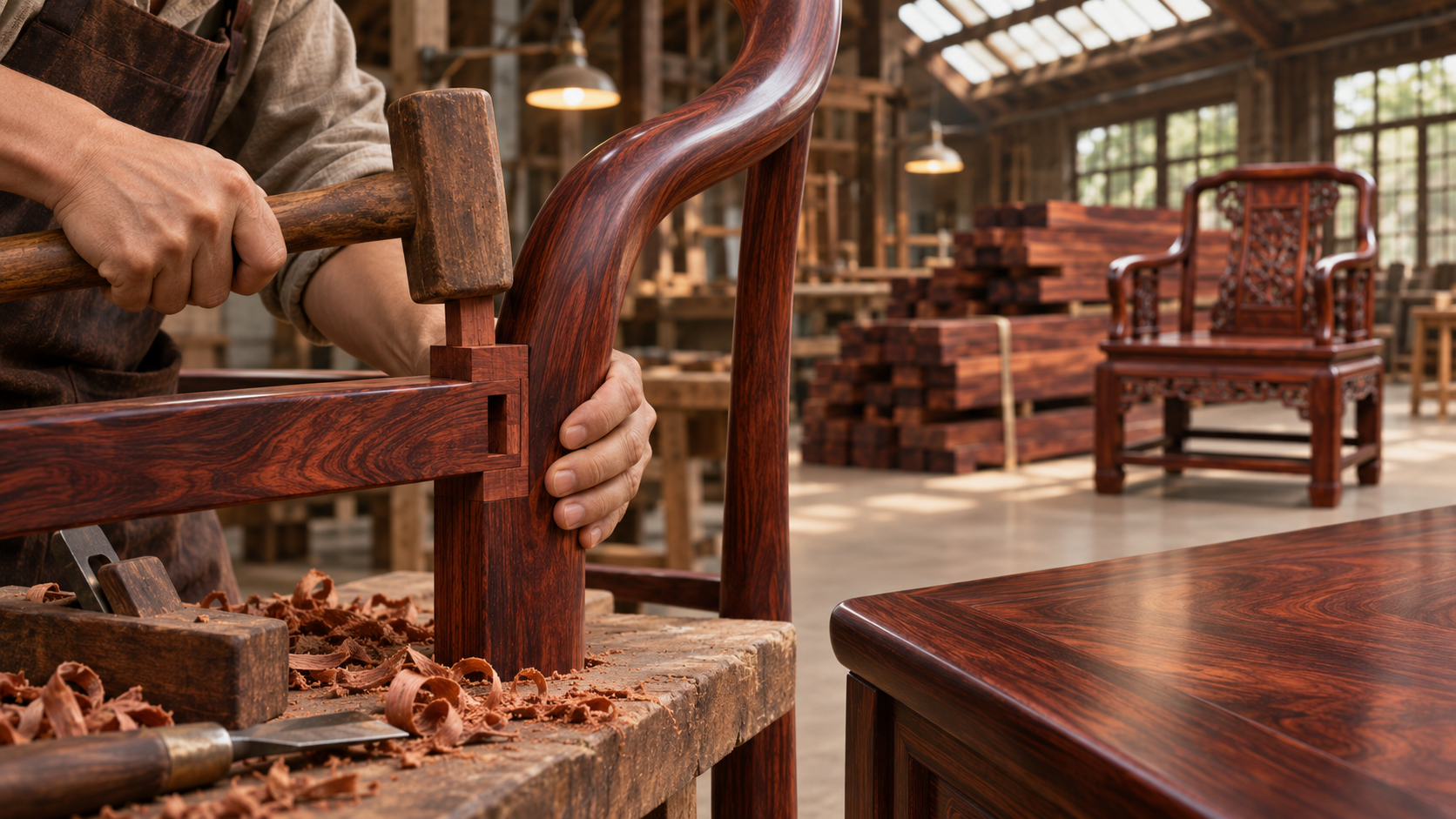
A practical, step-by-step B2B guide to buying rosewood furniture direct from the manufacturer: writing RFQs, ordering samples and trial sets, auditing factories, understanding quotes, payment terms, and export logistics.
Most B2B buyers already know the theory: cut out the middleman, get better pricing, control quality at the source. What they struggle with is the sequence. Which message do you send first? What does a serious RFQ look like? When do you ask for samples, when do you book a flight, and when is it safe to wire a deposit for a full container?
This article answers the practical question of how to buy furniture direct from manufacturer operations like ours, step by step, from first contact to a running direct-supply relationship. We write it from inside the process: Yunxiao Rosewood Furniture Co., Ltd. has manufactured classical rosewood furniture in Xianyou County, Putian, Fujian Province since 2008, in a 12,000 square meter factory that exports to Europe, North America, Southeast Asia, and Australia. Everything below reflects what actually happens on our production floor and in our correspondence with overseas buyers every week.
We will not re-argue the case for direct buying here. If you want the commercial rationale, read our earlier piece on why B2B buyers should buy furniture direct from a rosewood furniture manufacturer. And if you are still trying to figure out whether the supplier answering your email is a genuine factory or a trading company wearing a factory badge, that verification question is covered separately in our guide to verifying a genuine rosewood furniture manufacturer. This article assumes you have found a real factory and focuses on the working process that follows.
Step 1: Know What You Are Actually Buying Before You Ask for a Price
The single biggest mistake first-time buyers make is opening with a price question. "How much for a rosewood dining set?" is unanswerable in any meaningful way, and any factory that answers it instantly with a single number is either quoting a low-grade product or quoting you carelessly. Rosewood furniture pricing is driven by variables that can move the same visual design by hundreds or thousands of dollars per set.
Before you request quotes, get clear on these five variables for yourself:
- Species and grade. Rosewood is a category, not a material. At our factory we work in three declared material lines: legally certified Machilus Nanmu, aged red wood, and Grade-A tropical hardwood. Each has a different cost base, density, grain character, and suitable price positioning in your market. A buyer who says "aged red wood dining set, 8 seats" will get a usable quote. A buyer who says "rosewood dining set" will get a guess.
- Carving density. Classical Chinese furniture ranges from clean Ming-style lines with minimal ornamentation to dense Cantonese-style deep relief carving covering the aprons, backrests, and legs. Carving is hand-intensive time. Two sofa sets with the same frame dimensions can differ in labor cost by a wide margin depending on carving depth and coverage. Ask the factory to quote carving as a separate line item so you can trade it against budget.
- Construction method. Proper classical construction means traditional mortise-and-tenon joinery throughout, with no metal nails. This matters not only for authenticity but for export durability: a mortise-and-tenon frame survives the humidity swing between a Fujian workshop and a heated European living room far better than a glued-and-nailed frame. Confirm in writing that the joinery is fully traditional.
- Finish. Beeswax and lacquer are the standard finishes for classical rosewood furniture, but the compliance requirements differ by destination market. Our finishing is done to meet EU REACH and US CARB requirements. If you sell into Europe or North America, state your market explicitly in the RFQ so the factory applies the correct finish specification from the start rather than retrofitting it later.
- Quantity and packaging. One sofa set versus a mixed 40-foot container changes the unit price, the packaging method, and the shipping cost per piece. Export packing should be ISPM 15 heat-treated material for all wooden packaging crossing borders. State your expected volume even if it is approximate.
Where to buy furniture directly from the manufacturer is, in practice, less about finding addresses and more about finding factories that will answer these five questions precisely. A factory that responds to your first inquiry with clarifying questions about species, carving, finish, and destination market is a factory that has actually read your email. That is a good sign.
For a broader orientation on sourcing channels and how the Chinese rosewood cluster is organized geographically, our article on where to buy rosewood furniture from China gives useful background on why Xianyou County matters as a production hub.
Step 2: Write an RFQ That Gets an Accurate Quote
Once you know what you want, the RFQ (request for quotation) is where direct buying either starts working or starts going sideways. Trading companies love vague RFQs because a vague RFQ lets them pick whatever margin suits them. A good factory prefers precise RFQs because precision means fewer misunderstandings later. Here is what a complete RFQ for classical rosewood furniture contains:
The RFQ checklist
- Product list with quantities. Item names, seat counts, dimensions if you have them, and quantities per item. If you are planning a mixed container, list every SKU you want included. If you are unsure about mixing a container, see our article on minimum order quantities and mixed containers, which explains how factories cube out a container across different product lines.
- Material specification. Name the species or ask the factory to quote two or three material options side by side. Comparing the same sofa set in Machilus Nanmu versus Grade-A tropical hardwood in one quotation table is the fastest way to understand your own cost structure.
- Finish and compliance requirements. Destination country, any regulatory requirements (REACH for the EU, CARB for California/US), and preferred finish (beeswax or lacquer).
- Customization requests. If you need OEM or ODM work, changed dimensions, adjusted seat counts, a different carving motif, or your brand on the packaging, say so in the RFQ. Custom work changes the quote and the lead time, and it is far cheaper to state it up front than to discover it after production starts.
- Incoterms and destination port. FOB Xiamen or FOB Fuzhou, CIF Rotterdam, DDP Los Angeles: the term you choose changes the quoted price and allocates risk differently. State the term and the port. If you are new to Incoterms, our complete guide to importing rosewood furniture from China walks through how each term plays out for furniture specifically.
- Timeline. When do you need goods at the port? A realistic expectation for a container order at our factory is 45-60 working days after deposit. If your timeline is shorter than that, say so and hear what the factory says. A factory that promises the impossible to win the order is telling you something about how it will treat you later.
- Your business context. One sentence: are you a retailer, wholesaler, or project buyer (hotel, villa, restaurant)? Furniture suppliers for retailers price and pack differently than suppliers for a one-off villa project. Context helps the factory propose the right order structure.
Two practical details separate a professional RFQ from an amateur one. First, attach reference images: photographs of designs you like, or drawings with dimensions in millimeters, marked "reference only" if the exact design is not required. A single clear image eliminates pages of description. Second, separate "must have" from "nice to have" in a short line at the bottom: must-have means the quote is invalid without it; nice-to-have means quote it as an option. Factories triage inquiries by how quotable they are, and a buyer who makes quotability easy gets faster, sharper answers.
Send the RFQ to two or three factories, no more. Sending the same RFQ to fifteen suppliers produces fifteen slightly different quotes for fifteen slightly different products, and you will not be able to compare any of them. Three well-chosen factories, quoted against the same specification, give you a real comparison.
Step 3: Understand What a Factory Quote Actually Contains
When the quotes come back, read them the way a factory writes them. A legitimate rosewood furniture quote breaks down along these lines:
| Cost component | What it covers | What moves it |
|---|---|---|
| Material | Timber cost per cubic meter, including drying loss and waste | Species, grade, board thickness, current timber market |
| Labor | Mortise-and-tenon cutting, hand carving, assembly, sanding | Carving density, design complexity, seat count |
| Finishing | Beeswax or lacquer application, compliance-grade materials | Finish type, REACH/CARB requirements |
| Packaging | ISPM 15 heat-treated crates, foam, corner protection | Fragility, container vs. LCL, destination handling |
| Overhead and margin | Factory operation, drying kilns, quality control, profit | Order size, repeat business, customization |
How a quote is built up, line by line
To make the table concrete, walk through how a single seven-piece living room set gets priced in our estimating sheet. Start with timber volume: the frame, panels, and seat boards of a seven-piece set consume a calculable cubic meterage of rough boards, and rosewood cutting yields roughly fifty to sixty-five percent usable parts once edges, defects, and grain-matching offcuts are removed, so the estimator divides usable volume by yield. Drying loss and kiln energy sit inside that material figure. Then labor is estimated in two blocks: joinery hours (cutting, fitting, dry assembly, sanding) and carving hours, where a densely carved backrest panel might carry several days of one carver's time on its own. Finish follows: beeswax work is faster but less forgiving; compliance-grade lacquer adds material cost and cure time. Packaging is costed per crate against crate lumber, foam, and labor. Only then is overhead allocated and a margin applied, adjusted for order size. This is why a quote can be revised precisely when you change one variable: increase the seat count and the joinery and carving hours move; switch from lacquer to beeswax and the finish line drops. A factory that cannot explain its quote in these terms is a factory quoting by feel.
Why does this breakdown matter to you? Because it tells you where the negotiating room is and where it is not. Material and labor are largely fixed; a factory quoting below the material cost of its timber is substituting something you did not ask for. Packaging is where careless suppliers cut corners, and thin crates show up as freight damage claims in your warehouse three months later. Overhead and margin are where volume and repeat-order relationships genuinely lower your unit price.
It also explains why the same sofa set quotes differently from a factory, a trading company, and wholesale furniture vendors in your own market. The factory quote is the raw cost structure plus one margin. Every layer added after that adds its own margin on top of the factory price plus its own risk buffer, because a middleman who has not seen the product is pricing in uncertainty. When you buy rosewood furniture direct from the manufacturer, you are paying the actual cost of timber, drying, carving, finishing, and packing, with one transparent margin instead of three.
A quote should also state what is included: export documentation, ISPM 15 packing, FSC certificate availability if you need chain-of-custody paperwork, and whether layout or arrangement drawings are provided free. At our factory, layout and arrangement drawings for a project space are provided on request at no cost, because a correct furniture layout is part of getting the order right, not a billable extra.
Step 4: Order Samples and Understand What a Sample Can and Cannot Prove
After the quote comes the sample stage, and this is where honest factories and buyers need to have a frank conversation. Here is what a sample can and cannot tell you.
What a sample proves
- Finish quality in person: how the beeswax or lacquer looks under your light, on your showroom floor, next to your existing stock.
- Color accuracy against the photographs and against your market's expectations. Rosewood tones photograph differently in every light; no amount of photos replaces seeing the wood.
- Carving detail at close range: depth, crispness, clean undercutting, no chipped edges.
- Packaging quality, if the factory ships the sample in export-grade packing, which we recommend asking for.
What a sample cannot prove
- Consistency across 30 sets. One sample carved by the factory's best craftsman does not guarantee that set number 27 matches it. Ask the factory what its quality control process catches between sample and bulk, and whether a pre-shipment inspection is offered.
- Long-term joinery stability. A mortise-and-tenon frame proves itself over seasons of humidity cycling, not in two weeks on your desk.
- Container-level packing performance. A single crate handled carefully is not the same as 30 crates stacked in a 40-foot container for 30 days at sea.
When you request a sample, be specific about which item it should be. The most informative sample is usually a chair or a single-seat piece, because it contains every construction element of a larger set at the lowest freight cost: frame joinery, carved panels, seat construction, finish, and packing. Requesting a full sofa as your sample spends money on repetition. Also ask what the sample lead time is; at our factory a standard sample typically leaves the workshop within one to two weeks, while a custom-motif sample takes longer because a carver must interpret your drawing first. And once the sample arrives, handle it as an instrument, not furniture: open it, look underneath, check the underside of seats and the back of carved panels, where finishing shortcuts show first. The places a factory expects nobody to look are the places that reveal its standards.
A good factory will volunteer these limits rather than oversell the sample. Our own policy is a refundable sample fee: the sample cost is returned when it converts into a container order. That structure aligns incentives. We are not trying to make money on samples; we are trying to make the sample good enough that the container order follows.
If you want a deeper treatment of the evaluation stage, our article on how first-time buyers can test a rosewood furniture supplier before a full container covers the trial-order sequence in more detail.
Step 5: Use Trial Orders Before Container Commitments
The trial order is the most underused tool in furniture importing. Many buyers assume that factories only want full containers, and some do. But a factory confident in its production accepts trial single-set orders, and ours does exactly that. Here is why the trial order matters more than the sample, and how to run one:
- Order one set, or one small mixed batch, at trial-order terms. The unit price will be higher than container pricing. Accept that. You are paying for information: how the factory handles a real order end to end, from deposit to export packing to shipping documents.
- Run the trial through the full export process. Do not ask the factory to send the trial set by courier to skip the paperwork. You want to see the export documentation, the ISPM 15 stamped packing, the bill of lading, the way the crate survives an actual freight journey. A trial that skips the shipping leg tests nothing.
- Inspect against the sample and the specification. Compare the trial set to the sample: same material color, same carving depth, same finish, same hardware-free joinery. Photograph everything, including any defects, and send the photos to the factory. How a factory responds to defect photos on a small trial order predicts exactly how it will respond on a container problem.
- Time it. Note the actual days from deposit to shipment against the promised lead time. Our stated commitment for container orders is 45-60 working days after deposit, and your trial will show whether the factory's scheduling discipline holds at small scale before you bet a container on it.
- Decide on the container. If the trial passes, you negotiate container pricing with real confidence. If it fails, you have spent a few hundred dollars in price premium and freight to avoid a container of expensive furniture arriving wrong.
Two small habits make a trial order worth more. Keep every document from the trial in one folder: proforma invoice, final invoice, packing list, bill of lading, certificates. When you later place the container order, that folder becomes your template and your evidence of what was agreed. And write a short debrief to the factory afterwards, even when everything was fine: two things that were excellent, one thing to improve. Factories remember buyers who communicate like partners, and that memory shows up in how your container order is scheduled.
The trial order also changes the tone of every later conversation. A factory that has shipped you a clean trial set knows you inspect. A buyer who has run a clean trial knows the factory's real capabilities. Everything after that is a working relationship between two parties who have seen each other's work.
Step 6: Audit the Factory, On Site or Remotely
Between the trial order and the container order is the audit, and the question buyers always ask is whether a visit is necessary. Our honest answer: for a container-level commitment to a new supplier, some form of audit is worth doing, and a site visit is the strongest form. Classical rosewood furniture has too much hand labor and too much room for material substitution to be verified from a brochure.
What to look for if you visit
If you can travel to Fujian, plan at least a half day. A real rosewood factory tour should include the drying area first. Ask how long the timber is dried before production and what controls it. Our own process is 36 days of temperature- and humidity-controlled drying before any wood is cut, because insufficiently dried rosewood is the root cause of most cracking and joint failure complaints in export furniture. If a factory cannot show you a controlled drying process, or gives a vague answer about "natural drying, maybe," that is a finding.
Then walk the workshop in production order: cutting, mortise-and-tenon machining, hand carving stations, assembly, sanding, finishing, and packing. Look for wood offcuts and dust matching the species you ordered. Look at pieces in assembly for visible tenons and clean joints with no nails or metal fasteners. Look at the finishing area for ventilation and compliance-grade materials. Ask to see the packing zone and confirm heat-treated, ISPM 15 stamped crate material.
We open our doors for exactly this purpose, and our article on visiting the Yunxiao B2B factory tour, showroom, and sample room describes what a visit includes and how to schedule one.
What to do if you cannot visit
Many buyers cannot fly to China for a first order, and a structured remote audit is a reasonable substitute. Ask for a live video walk-through of the same route: drying, workshop, finishing, packing, with the camera staying on site the whole time. Ask for documentation: business license, FSC certificate, and any quality management system certification the factory holds. Certification alone does not prove product quality, but it does show that the factory has submitted its processes to external audit and maintains documented procedures. Our factory operates under an ISO 9001 quality management system, and our article on what ISO 9001 means inside a certified rosewood factory explains what those documented procedures cover in practice. For the full audit framework, including what to check in documentation versus what requires eyes on the floor, see our dedicated guide on how to audit a rosewood furniture factory before your first container order.
What a remote audit verifies, and what only a visit can
Buyers should be clear-eyed about the difference between the two formats. A structured video audit verifies that the facility exists, that the equipment and workforce are real and at the claimed scale, that the drying process is controlled, and that the workflow matches what the sales team has described. It also tests responsiveness: whether the factory can produce a live, unedited walk-through on short notice says a lot about what it has to hide. What video cannot verify is material identity at the grain level, workshop atmosphere and craftsmanship culture, the condition of the timber stock behind the camera, or the accuracy of anything not shown. That is why we recommend a tiered approach: a video audit before the trial order, a third-party inspection at the trial's pre-shipment stage, and an on-site visit before or with the first container order. Each layer covers what the previous one cannot. If your first container is large, or carries custom designs you have paid to develop, the visit stops being optional and becomes part of protecting that investment.
Step 7: Negotiate Payment Terms That Protect Both Sides
Payment terms are where direct buying becomes a negotiation between equals rather than a transaction, and the terms you agree on allocate risk in ways most first-time buyers do not fully map. The standard structure for export furniture is a deposit with the balance before shipment, commonly 30/70. Here is how to think about it from both chairs.
Why the deposit exists
Rosewood furniture is made to order. When you order a carved sofa set in a specific material and finish, the factory buys timber, schedules carvers, and commits workshop capacity to your order. The deposit covers material outlay and reserves production slots. Without a deposit, a buyer who cancels after production starts leaves the factory holding customized inventory it cannot resell. This is why no genuine factory produces to order with zero deposit, and any supplier offering that should make you ask what it is actually doing with your order.
What protects you
Your protections live in the balance payment structure and the documents. Never pay 100% up front. Structure the balance against a verifiable milestone: balance against photos and video of finished, packed goods before shipment, or balance against a copy bill of lading if your risk tolerance and the relationship support it. Tie inspections to the balance: if you have arranged a third-party inspection, the balance is payable after the inspection report is clean.
How payment milestones map to production stages
The cleanest way to negotiate is to match each payment to the stage of work it funds, so neither side is ever financing the other more than necessary. A typical mapping at our factory looks like this: the 30% deposit funds timber preparation, drying confirmation, and the reservation of carving capacity, and it is payable against a countersigned proforma invoice. The first balance installment, if you have negotiated a split rather than a single 70%, falls due at dry-fit completion, when your order exists as joined bare frames and can be evidenced with timestamped photographs showing joinery, carving, and material grain. The final balance falls due at packing completion, against full packing photos, crate markings, and the completed pre-shipment inspection if one has been arranged. Buyers sometimes ask why the final balance cannot wait until the goods arrive. The answer is practical: title to the goods transfers with the bill of lading under most terms, and a factory that must wait weeks for its final payment on goods already at sea is extending unsecured credit on a fully customized product. If arrival payment is essential to you, trade something for it, such as a larger deposit or a documented long-term commitment, and put the arrangement in the contract rather than the email thread.
What to negotiate as the relationship matures
First orders justify caution on both sides. Repeat orders justify better terms: lower deposit percentages, balance against documents, and eventually credit arrangements for established partners. Payment terms should evolve with demonstrated performance, which is one of the compounding advantages of a long-term direct relationship that no trading company arrangement can replicate.
We have written a full treatment of this subject, including the specific protections each structure offers, in what payment terms to negotiate when ordering rosewood furniture from China. Read it before your first negotiation, not after.
Step 8: Production, Quality Control, and Export Logistics
Once the deposit is paid, the production clock starts. At our factory, container orders are delivered 45-60 working days after deposit. Here is what happens inside that window, and what you should be doing as the buyer during each phase.
Weeks 1-2: Material preparation and cutting
Timber for your order comes out of the drying cycle, is graded, and is cut. The 36-day controlled drying has already happened for stock material; if your order requires freshly acquired timber, the drying time is part of why lead times cannot compress to three weeks. During this phase, ask the factory for material photos: the raw boards before cutting, showing grain and color. This is your last cheap chance to catch a material substitution.
Weeks 2-5: Joinery, carving, and assembly
Mortises and tenons are cut and fitted, carvers work the panels and aprons, and frames are dry-assembled and checked before finishing. Carving is the long pole: a densely carved sofa set represents weeks of hand work. Request progress photos at the dry-fit stage, when the bare frame shows the joinery quality with nowhere to hide. Any factory that resists progress photos on a paid order is a factory you should be worried about.
Weeks 5-7: Finishing and packing
Beeswax or lacquer finishing goes on, in the specification agreed for your destination market's compliance requirements, and pieces cure. Then export packing: foam, corner protection, and ISPM 15 heat-treated crates marked for container loading. Ask for packing photos before the crates close, and ask whether the factory offers pre-shipment inspection access, either by your agent or by video.
Container loading, done properly
Loading is a skill, and it is worth understanding what happens in the two to four hours a container load takes. Classical furniture ships in component form: seats, backrests, panels, and legs packed in numbered crates, with glass-free assemblies protected by foam and edge guards. The loading plan is worked out in advance against the container's internal dimensions, heavy crates on the floor, lighter ones above, with dunnage between layers so nothing shifts under sea motion. A well-loaded 40-foot container of mixed classical furniture might hold anywhere from a few dozen chairs and tables to two or three full living and dining room sets, depending on carving bulk and crate size; the factory should give you an estimated loading plan with your quotation rather than discovering the arithmetic at the port. Ask whether loading is supervised and photographed. A short photo sequence of the open container, the half-loaded container, and the sealed doors, with the seal number visible, costs the factory ten minutes and gives you the evidence trail for any insurance discussion later.
Shipping and documentation
Under FOB terms, your freight forwarder books the vessel and the factory delivers to the port and hands over the export documentation. Under CIF, the factory arranges main carriage. Either way, confirm the document set before the container sails: commercial invoice, packing list, bill of lading, certificate of origin as needed, FSC certificate if your order requires chain-of-custody documentation, and fumigation or heat-treatment declaration for the wooden packaging. A full-container order should ship with every document correct the first time; chasing amendments after sailing costs time and money you should not have to spend.
On arrival, inspect before signing off on any visible damage, and photograph any crate damage before opening. Direct supply furniture means the factory is your counterparty for freight damage discussions; there is no importer-of-record middleman to absorb the problem, which is precisely why a factory with disciplined packing matters.
Common Risks When Bypassing Middlemen, and How to Manage Them
DIRECT buying removes margin layers, but it also removes the insulation those layers provided. Being honest about the risks, and their fixes, is part of doing this well.
- Communication gap. A trading company's main product is translation: language, expectations, and spec. Direct, you deal with the factory's export team, whose English may be functional rather than fluent. Manage it by putting every specification in writing, using dimensioned drawings instead of adjectives, and confirming understanding by having the factory repeat the spec back in its own words. Ask for free layout and arrangement drawings, as we provide on request; a drawing is worth twenty emails.
- No local recourse. If something goes wrong, you cannot visit a middleman's local warehouse. Manage it with the structures already described: trial orders, milestone-based payments, pre-shipment inspection, and a written agreement on how defects are handled (replacement parts, credit, or discount on the next order). Factories that ship internationally regularly know how to send replacement carved panels or hardware by air freight when needed; agree on this before it is needed.
- Consistency risk at scale. Hand-carved furniture varies piece to piece by nature. Manage it by agreeing on a reference sample sealed by both sides, and by asking what tolerance the factory applies to color and carving variation. Perfection in handwork is not the standard; documented, agreed variation is.
- Compliance risk. Finish chemicals, timber legality, and packaging treatment are all regulated differently in your market than in ours. Manage it by stating your market in the RFQ, requesting the FSC certificate when your customers require it, and confirming REACH/CARB-grade finishing in the contract, not in conversation.
- Timeline risk. Chinese New Year, timber supply swings, and port congestion are real. Manage it by ordering with buffer, asking the factory directly about the holiday calendar, and treating a 45-60 working day commitment as a commitment with defined exceptions rather than a wish.
None of these risks argue for going back to middlemen. They argue for running the direct process with the same professional structures any serious B2B category requires.
Building a Long-Term Direct-Supply Relationship
The first container is the expensive one, in attention if not in price. The relationship that follows is where direct supply actually pays. Here is what a mature relationship looks like from the factory side:
- Pricing improves with history. A buyer on their fourth container gets better material allocation priority, better unit pricing, and more scheduling flexibility than a first-time inquirer. That is not favoritism; it is planning certainty, which has real value in a hand-production workshop.
- OEM and ODM deepen. Once a factory knows your market's taste, it can propose designs: a dining set with a seat count adjusted for your customers' dining rooms, a sofa carving scaled for local preferences, exclusive models not offered to your competitors. We support OEM/ODM customization precisely because the second-year relationship is where custom work becomes worthwhile for both sides.
- Your specifications become standing instructions. Finish grade, packing method, document set, carton marking: after two or three orders, your account runs on a remembered spec, and the error rate drops accordingly.
- Project support becomes available. Hotel, villa, and restaurant buyers benefit most from this: layout drawings, phased deliveries matched to fit-out schedules, and mixed containers across product lines for a single property.
Structuring the ongoing agreement: forecasting, annual pricing, and exclusivity
Buyers who settle into direct supply usually formalize it, and a light annual framework beats a heavy contract nobody reads. In practice, a working annual agreement covers four things. First, an annual price schedule: timber markets move, so the schedule fixes prices for a defined period with a stated review trigger, which protects you from mid-season repricing and protects the factory from absorbing timber spikes silently. Second, a rolling forecast: even a rough quarterly forecast, twelve containers a year, three in the spring, one before your holiday season, lets the factory pre-dry timber and hold carving capacity for you, which in turn is what makes the preferential pricing real rather than nominal. Third, exclusive designs: if you have paid to develop a model, or the factory has developed one for your market, the agreement records which designs are exclusive to you, for how long, and in which territory, so the sofa you built your showroom around does not appear in a competitor's catalog. Fourth, a service annex: defect-handling procedure, replacement-part commitments, lead-time guarantees, and the communication cadence you both expect. None of this needs lawyers on every page; it needs clarity, signatures, and a review once a year. The agreements that fail are the ones that assume goodwill will remember what was discussed eighteen months earlier.
Retailers and wholesalers evaluating furniture suppliers for retailers should weight this dimension heavily. A vendor relationship that gets better every year is worth more than a permanently lower first quote from a supplier you will have to replace.
Frequently Asked Questions
Can I order a single set instead of a full container?
Yes, at our factory trial single-set orders are accepted. The unit price is higher and shipping is less efficient, but it is the right way to test a new supplier before committing to a container.
Is the sample fee refundable?
Our sample policy is refundable: the sample cost is credited back when the sample converts into a container order. Policies vary between factories, so confirm this in writing before ordering any sample.
How long does a full container order take?
Container orders are delivered 45-60 working days after the deposit is received. Orders requiring newly acquired timber or heavy custom carving can sit at the top of that range, so build your retail calendar around the longer figure.
Do you provide FSC certification?
An FSC certificate is available for export orders that require chain-of-custody documentation. Request it during the RFQ stage so it is included in the document set rather than added afterward.
What materials do you actually use?
Legally certified Machilus Nanmu, aged red wood, and Grade-A tropical hardwood. Ask for the material specification in writing on the proforma invoice so the contract matches the sample.
Can I get my own designs made?
Yes. OEM and ODM customization is supported, including dimension changes, seat count adjustments, carving motif changes, and branded packaging. Provide drawings or reference photos for accurate quoting.
What happens if furniture arrives damaged?
Photograph the crate damage before opening and report within the claim window in your agreement. With ISPM 15 heat-treated packing and container orders shipped with full documentation, claims are handled directly between you and the factory, which is one of the practical advantages of the direct relationship.
Do you help with installation after delivery?
Remote installation guidance is provided. Classical rosewood furniture ships in component form within protective crates, and our team walks your assembly staff or local installers through the process by video and written instructions.
How many sets fit in one 40-foot container?
It depends on the mix. As a rough planning figure, a 40-foot high-cube container typically holds two to three seven-piece living or dining room sets, or a larger count of chairs, side tables, and cabinet pieces. Give the factory your target product list and it will return an estimated cube-out before you commit, so you can rebalance the mix rather than pay for wasted container space.
Which Incoterm should a first-time buyer choose?
FOB from a major nearby port is the most common starting point, because you keep control of ocean freight through your own forwarder while the factory handles inland transport, export clearance, and port delivery. CIF is easier administratively but gives you less visibility over the freight leg, and DDP requires import expertise on the factory side that most will not hold for your market. Most buyers move toward FOB as their volumes grow.
Can you hold quoted prices for a future order?
Price validity is stated on every quotation, typically for a defined window long enough for you to complete sampling and a trial. Beyond that, prices can be secured through the annual framework described above, where a review trigger rather than a fixed expiry governs adjustments. Ask for the validity period to be printed on the proforma invoice so there is no ambiguity at reorder time.
Do you offer exclusive designs for a single buyer?
Yes, exclusivity can be agreed for specific models, territories, and durations, usually alongside a minimum volume commitment that makes the exclusivity workable for both sides. Raise it at the RFQ stage if exclusivity is part of your business model, since it affects how custom development costs are amortized.
Start the Process: What Your First Message Should Contain
You now have the complete sequence: specify your material and finish requirements, send a precise RFQ to two or three factories, compare line-item quotes, order a sample on refundable terms, run a trial single-set order through the full export process, audit the factory on site or by structured video, negotiate milestone-based payment terms, and manage production with progress photos and pre-shipment inspection.
To start it with us, send an inquiry that includes your product list and quantities, your destination market and port, your preferred Incoterm, and any compliance requirements. Tell us if you want a trial set first or a container quote directly, and whether layout drawings would help you plan the order. If you would rather see the workshop before committing, ask about scheduling a factory visit; the drying rooms, carving stations, and sample room are open to B2B buyers, and we would rather answer hard questions in person than in email.
Direct buying rewards buyers who bring precision and patience in the first order and loyalty in the ones after. We have been building those relationships since 2008, and the first message is the only step you have to take alone. Send us your inquiry, and we will come back with questions, a quotation, and a clear path from sample to container.