
A plain-language explanation of what an ISO 9001 quality management system is, and an inside look at how Yunxiao's certified rosewood factory applies it to timber sorting, moisture control, joinery, finishing, AQL inspection and export documentation.
What is an ISO 9001 quality management system, and why should it matter to you when the product in question is a hand-carved rosewood sofa set rather than a pallet of machine parts? This is one of the most common questions our export team now receives from wholesalers, hotel procurement managers and distributors across North America, Europe and Southeast Asia. Many of them have seen the phrase "ISO 9001 certified" on supplier websites and trade fair banners for years, yet few have had the chance to see what the standard actually changes inside a furniture factory — day to day, bench by bench, container by container.
This article answers that question in two parts. First, we explain in plain language what an ISO 9001 quality management system is: what the standard requires, what it deliberately does not promise, and why it has become the world's most widely recognized framework for manufacturing quality. Second, we open our own doors. Yunxiao Rosewood Furniture Co., Ltd has manufactured and exported classical solid redwood furniture from Xianyou County, Putian City, Fujian Province since 2008, operating a 12,000-square-meter factory that produces complete sofa, dining, bedroom, tea table and storage collections in classical Siamese rosewood. Below we show exactly how the disciplines of an ISO 9001 quality management system are applied to the specific, craft-intensive realities of rosewood furniture: material sorting at the timber yard, moisture content management in the drying operation, mortise-and-tenon joinery at the assembly benches, hand-rubbed lacquer finishing, AQL-based final inspection, and the export documentation that accompanies every container.
The goal is practical, not promotional. By the end of this article you should be able to judge — for any furniture supplier, including us — whether the words "quality management system" describe a real operating discipline or just a certificate framed on an office wall.
What Is an ISO 9001 Quality Management System?
An ISO 9001 quality management system is a documented, organization-wide framework for consistently delivering products that meet customer requirements and applicable regulations — and for improving the processes that produce them. ISO 9001 is the international standard, published by the International Organization for Standardization, that defines the requirements such a system must satisfy. When a factory is described as "ISO 9001 certified," it means an independent accredited certification body has audited the company and confirmed that its quality management system conforms to the standard's requirements, and it must pass surveillance audits to keep that certificate current.
It helps to be precise about what the standard is and what it is not. ISO 9001 is not a product quality standard: it does not specify how thick a tabletop must be, what moisture content timber must reach, or how many lacquer coats a chair should receive. Those numbers belong to product specifications, engineering drawings and market regulations. What ISO 9001 requires is something more fundamental — that the organization defines what it intends to achieve, establishes controlled and repeatable processes to achieve it, verifies the results with evidence, and corrects and improves the system when results drift. In other words, the standard governs how a factory manages quality, not the quality level itself. Two factories can both hold ISO 9001 certificates and produce furniture at very different quality tiers; what the certificate tells you is that each of them runs a governed, auditable system rather than improvising.
The current version of the standard is built around seven quality management principles that shape every clause: customer focus, leadership, engagement of people, process approach, improvement, evidence-based decision making, and relationship management. It also asks organizations to apply the Plan-Do-Check-Act (PDCA) cycle and risk-based thinking across their operations. For a manufacturing company like ours, this translates into a chain of responsibilities that runs from the managing director's quality policy down to the moisture meter readings recorded at a drying kiln — all connected, all documented, all open to audit.
That is the honest, uncomplicated definition. The rest of this article shows what it looks like when the framework is applied to a craft as old as Chinese classical cabinetmaking.
What Does the ISO 9001 Standard Actually Ask a Factory to Do?
Before we walk through our own operations, it is worth summarizing the structure of the standard itself, because understanding its logic makes it much easier to evaluate any certified supplier. The requirements of ISO 9001 are organized into several major clause groups, and each one answers a practical question a buyer would ask if they could design a factory from scratch.
Context and scope. The organization must understand the issues that affect its ability to deliver consistent quality, the needs of its customers and other relevant parties, and the scope of its quality management system. For a rosewood furniture exporter, this means honestly defining what we make, for whom, and under which constraints — the species we work in, the markets we serve, the regulatory environment of furniture export.
Leadership. Top management must demonstrate leadership by establishing a quality policy, assigning clear roles and authorities, and making sure the quality management system gets the resources and attention it needs. A system run only by the QC department is not a system; ISO 9001 makes quality a leadership obligation.
Planning. The organization must identify risks and opportunities that could affect conformity of products and services, set measurable quality objectives, and plan the changes needed to achieve them. In our industry the risk register is easy to populate: timber is a natural material with natural variability, furniture crosses oceans and climate zones, and craft processes depend on human skill that must be trained and maintained.
Support. The organization must provide the resources, competent people, documented information, working environments and monitoring equipment the system needs. This is the clause that turns "our workers know what to do" into "our procedures, work instructions and records show who does what, how, and with which calibrated instruments."
Operation. This is the largest group of requirements and covers the entire production lifecycle: how customer requirements are reviewed and confirmed, how designs and specifications are controlled, how external providers such as timber suppliers are selected and monitored, how production is carried out under controlled conditions, how identification and traceability are maintained, and how outputs are verified before release to the customer.
Performance evaluation. The organization must monitor, measure, analyze and evaluate whether its quality management system actually works: customer satisfaction, conformity of products, process performance, and the results of internal audits.
Improvement. Finally, the organization must react to nonconformities, take corrective action, and continually improve the system. A certificate is not a finish line; under ISO 9001 it is a commitment to a cycle that never stops.
Notice what is missing from this list: any guarantee of specific product performance. The standard's authors understood that a furniture factory in Fujian and an aerospace supplier in Seattle face completely different technical requirements. What they standardized is the management discipline itself — and that discipline, applied honestly, is what produces consistent output in either industry.
Why Does ISO 9001 Matter When You Buy Furniture from a Chinese Factory?
For a B2B buyer, the practical value of an ISO 9001 quality management system lies in what it predicts about future orders, not what it says about the past. Anyone can ship one good container. The question that decides whether a supplier is worth a long-term program is whether container number two, number five and number twenty will match the approved sample — and that is precisely the question a functioning quality management system is designed to answer.
Consider the failure modes that experienced furniture importers know too well. A second-order dining set arrives with a slightly different wood tone because the finishing team mixed the stain "by eye" without a documented formula. A bedroom suite develops joint gaps in a dry European winter because the drying process was shortened to catch a shipment window. A carved reception panel shows machine-like repetition that contradicts the "hand carved" description because nobody verified the carving stage. A shipment reaches the port without complete documentation and sits in customs. None of these failures come from a lack of craftsmanship; they come from a lack of system. Every one of them is preventable by the mechanisms ISO 9001 exists to enforce: controlled processes, defined responsibilities, verification at defined points, and records that make the whole chain traceable.
There is also a communication benefit that buyers notice quickly. A certified quality management system gives both sides a shared vocabulary. When our export team tells a purchasing manager that a concern will be raised through the nonconformity process, reviewed at the next quality meeting, and answered with a corrective action report, those are not vague reassurances — they are specific commitments from a framework the buyer can independently verify with the certification body's registry.
Finally, ISO 9001 matters because of what it says about management intent. Earning and maintaining a certificate requires sustained investment: training hours, calibrated instruments, audit fees, management review time, and the willingness to have outsiders read your records and question your people. A factory that makes that investment is signaling, in a verifiable way, that it plans to be in this business — and accountable to this standard — for the long term.
How Does a Quality Management System Work in a Craft Furniture Factory?
The most common skepticism we hear goes like this: "ISO 9001 makes sense for a plant stamping out identical metal brackets. How can a documented system govern work that depends on hand carving, natural wood grain and generational skill?" It is a fair question, and the answer reveals why the process approach at the heart of the standard is so well suited to craft manufacturing.
The key insight is that ISO 9001 does not ask a factory to eliminate craft judgment — it asks the factory to support and verify it. A master carver still decides how deep to cut a cloud apron. But the quality management system ensures that the carver works from an approved pattern reference, that the carving stage has defined acceptance criteria, that the output is inspected by a second trained person, and that a panel which does not meet the criteria is routed to rework rather than quietly accepted. The artisan's skill remains the source of the value; the system guarantees that the skill is applied under conditions where the customer's requirements are known, the method is consistent, and the result is checked.
In practice, our quality management system at Yunxiao is built as a chain of controlled processes. Each process has an owner, defined inputs and outputs, work instructions, monitoring points, and records. The timber yard controls material identification and sorting. The drying operation controls moisture content against documented targets. The joinery and assembly benches control fit and structural accuracy. The finishing room controls surface quality and coat counts. The inspection team controls final verification using AQL sampling. The export team controls documentation completeness. None of these processes is remarkable in isolation — every serious factory does versions of them. What the quality management system adds is the connective tissue: the same specifications everywhere, records that link each container back to its material batches, and management review that turns failures into corrections instead of anecdotes.
With that framework in place, the following sections walk through the processes our buyers ask about most.
Material Sorting at the Timber Yard: Process Control Begins Before the First Cut
Under our ISO 9001 quality management system, quality control begins at goods-in, before any cutting or carving takes place. Every shipment of raw timber arriving at our 12,000-square-meter factory in Xianyou County is inspected against defined receiving criteria before it is accepted into production stock. This is the "operation — control of externally provided processes, products and services" requirement of the standard applied to the single most consequential input we buy.
The receiving inspection covers the characteristics that determine whether a board can serve its intended component. Inspectors examine grain pattern, color consistency and density, and confirm that the material matches the species and grade ordered. Boards are sorted by density range and grain orientation; timber destined for structural components — table rails, chair legs, frame members — is graded to stricter criteria than material for decorative panels. Boards whose grain deviates beyond the allowed angle from the board axis are diverted to shorter components where the deviation does not compromise strength. This sorting discipline is not a stylistic preference; it is the process control that determines whether a mortise-and-tenon joint will stay tight through decades of seasonal movement.
Every accepted timber batch is assigned a tracking number that follows it through every subsequent production stage. The number appears on the drying log, the production batch record and the final product specification sheet. This is the identification and traceability requirement of ISO 9001 made concrete: when a buyer asks which timber lot went into their order, the answer is a record, not a recollection. When a supplier-quality issue is discovered upstream, affected batches can be located and quarantined within minutes rather than guessed at.
Buyers who want to dig deeper into how raw material grade affects a bulk order can read our guide on how to verify the quality grade of rosewood before placing a bulk furniture order, which covers the grading criteria in detail. And if you prefer to see the sorting with your own eyes, our article on visiting a rosewood furniture factory before ordering explains what a factory tour at our facility covers, timber yard included.
Moisture Content Management: A Measured Process, Not a Promise
If one process decides whether exported rosewood furniture survives its destination climate, it is drying — and it is the process where a documented quality management system delivers the most visible protection for buyers. Solid wood that is not dried and conditioned correctly will warp, crack or open at the joints months after delivery, when the furniture is sitting in a heated European apartment or an air-conditioned Gulf hotel lobby and the cost of a warranty claim lands on the importer.
Under our quality management system, drying is a monitored process with defined parameters, not a schedule held in a supervisor's memory. Every component passes through a 36-day constant-humidity drying process, and timber is conditioned to a moisture content of roughly 8 to 12 percent with an equalization period before use. The kiln log records the temperature curve, humidity settings and duration for each batch. After drying, our QC team tests the timber with calibrated pin-type moisture meters, taking readings at multiple points on each plank — end grain, center and intermediate positions — and the readings are recorded on the batch log. Timber that reads above the acceptance threshold for its destination climate is returned to the kiln for an additional equalizing cycle rather than released to production.
The phrase "calibrated moisture meters" carries specific weight under ISO 9001. The standard requires that monitoring and measuring resources be suitable, maintained and — where measurements are valid for conformity — traceable and calibrated. A moisture meter that has drifted out of calibration produces confident nonsense. Our instruments are calibrated on schedule, and the calibration status is part of the documented information the system maintains. This is the difference between a measurement a buyer can rely on and a number that merely looks convincing on a report.
The system also treats drying as a risk area under continuous review. Several years ago we identified a pattern of hairline cracks on the end-grain surfaces of dining tabletops shipped to Northern Europe during winter. The investigation traced the issue to insufficient equalizing time in the kiln cycle, and the equalizing phase was extended — a correction applied through the quality management system, verified by the drop in recurrence, and retained in our process documentation since. That is Plan-Do-Check-Act operating exactly as intended: a real defect, a root cause, a documented correction, and an improved standard process. You can read the full seven-stage version of this story in our article on rosewood furniture quality control for B2B buyers.
Mortise-and-Tenon Joinery as a Controlled Process
Classical Chinese furniture holds together without metal fasteners. Every sofa, table, bed and cabinet we build is assembled with traditional mortise-and-tenon joinery reinforced with wooden and bamboo dowels, because wood and metal move at different rates with temperature and humidity — over years of seasonal change in an overseas climate, metal fasteners work loose and split the surrounding wood, while a well-cut joint flexes with the material it is made from. But joinery tradition is only reliable when joint cutting is controlled, and this is where our quality management system defines measurable criteria for an otherwise artisanal stage.
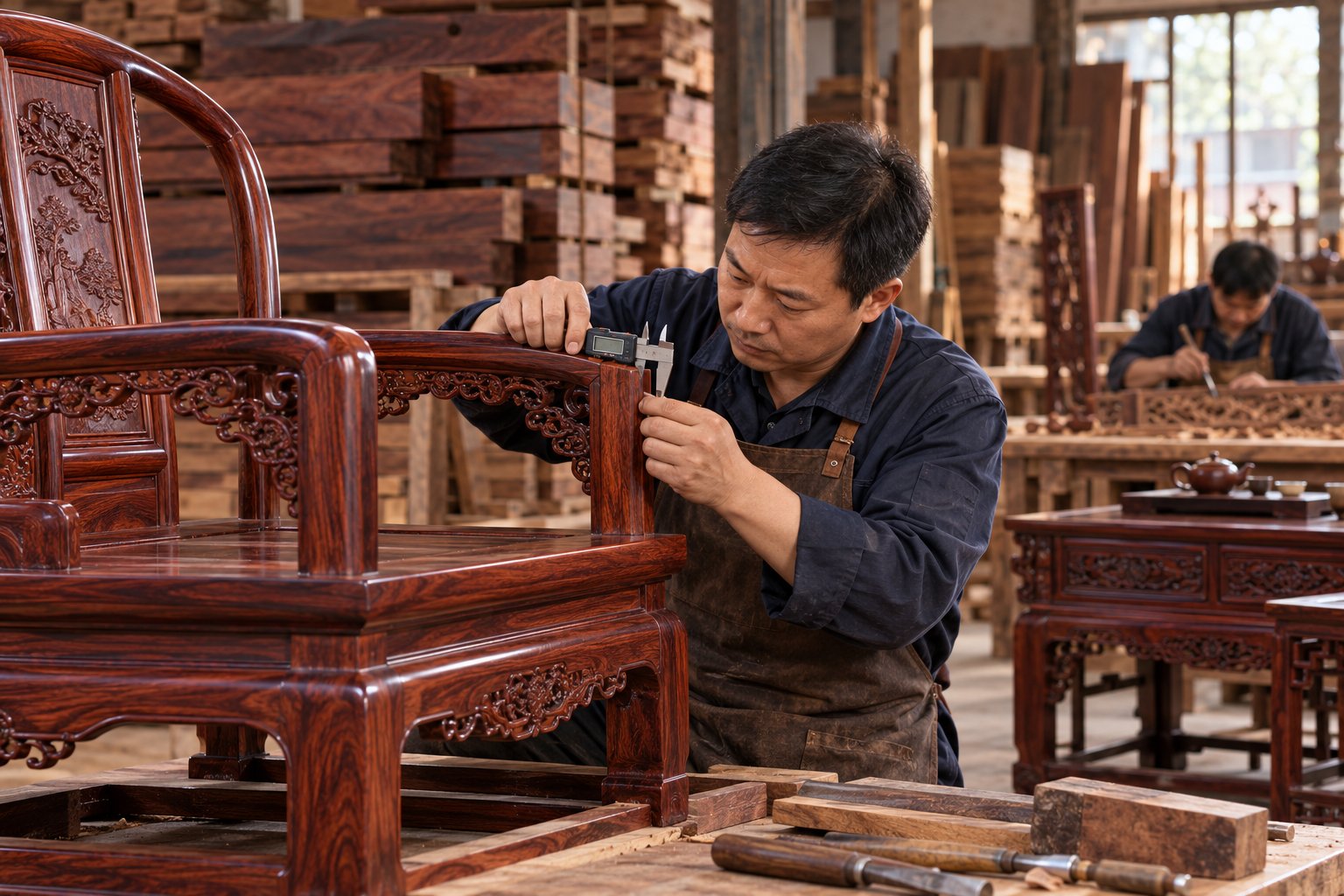
Our standard clearance between tenon and mortise is 0.1 millimeters — a fit that slides together under firm hand pressure and holds securely. The QC process verifies joint precision at three defined points. First, after initial machine cutting, a sample of tenons and mortises is measured with digital calipers to verify dimensional accuracy. Second, during assembly, each joint is dry-fitted without glue to confirm the friction hold: a joint loose enough for the tenon to fall out under its own weight is rejected and recut, and a joint tight enough to require a mallet strike is also rejected, because over-tight fit can split the wood in a dry destination climate. Third, after full assembly, every piece undergoes a stability check — the inspector presses down on each corner in sequence, and any clicking, creaking or visible movement at the joint lines sends the piece back for correction.
Under the quality management system, these checks are not the personal habits of one experienced assembler. They are defined in work instructions, applied identically across shifts, and recorded. The structural verification extends to load testing: dining chairs in our dining-set production, for example, are individually load-tested with a 100-kilogram static weight for 24 hours as part of internal QC. A buyer ordering fifty dining sets is not trusting one foreman's eye; they are buying the output of a process that measures, records and rejects.
The same traceability that begins at the timber yard runs through this stage: the batch tracking number on the production record ties each assembled piece back to its dried timber, so if any question arises later about a joint, the investigation has data rather than memory to work from.
Finishing and Surface Quality Under Documented Procedures
The surface of classical rosewood furniture is where craft is most visible and where inconsistency is most immediately obvious to an end customer. Our finishing combines traditional hand-rubbed raw lacquer and beeswax techniques; depending on the product, finishing runs to six or seven hand-rubbed coats, each cured before the next, producing a deep satin sheen that penetrates the wood rather than sitting on top of it. The finishing room, like every other stage, operates inside the quality management system rather than beside it.
Documented procedures govern the coat sequence, cure times between coats, and the rubbing method. Finish consistency is verified by comparing each piece against the approved finish sample under standardized lighting, and inspectors check surfaces for blistering, clouding or uneven texture that would indicate application to improperly prepared wood or in unfavorable humidity. A clean-cloth wipe test across surfaces — especially carved recesses — verifies that the finish is fully cured with no color transfer before a piece is released toward packing. For custom orders with a specified color target, the finishing team works in small batches, verifying each batch against the approved sample before proceeding, so that a hundred-piece order does not drift from the prototype a buyer signed off on.
Hand carving, which immediately precedes finishing, is verified with equal discipline. Inspectors examine carved panels under raking light — a flashlight held at a low angle to the surface — which reveals tool marks, flat spots and inconsistent depth invisible under normal lighting. For repeating motifs across a multi-piece order, panels are compared side by side: similar, because each is carved by hand; not pixel-identical, which would indicate machine work. Carving hours are real and known — a carved ruyi armrest panel represents roughly 18 hours of carving, a bamboo-motif chair backrest around 16 — which is precisely why the acceptance criteria and second-person verification exist. A stage that consumes that much labor deserves a system that protects the result.
Final Inspection and AQL Sampling in an ISO 9001 Framework
The verification requirement at the heart of ISO 9001 — that the organization confirm outputs meet acceptance criteria before release — takes a specific, internationally understood form in export manufacturing: inspection sampling against AQL, the Acceptable Quality Limit defined in the ISO 2859 / ANSI ASQ Z1.4 sampling standards.
In plain terms, AQL inspection answers the buyer's real question: "If I inspect this order myself on arrival, what defect rate am I agreeing to accept?" Rather than inspecting nothing and hoping, or pretending to inspect every one of hundreds of pieces, AQL defines statistically grounded sample sizes — how many pieces to draw from an order of a given size — and acceptance thresholds for critical, major and minor defects. Critical defects (safety failures, structural breaks) are essentially not tolerated at all; major defects (a warped door, a loose joint, a color mismatch against the approved sample) have tight limits; minor defects (a tiny finish blemish in an inconspicuous area) are allowed within defined bounds. Because the sampling plan is standard, both sides read the same numbers from the same table, and inspection results are comparable across orders and across suppliers.
Within our quality management system, final inspection is the last defined verification gate before packing. Pieces reach it only after passing the in-process checks at drying, joinery, carving and finishing — and the final inspection is still performed on the fully assembled product, because some defects only reveal themselves when the piece stands complete: a door that binds, a drawer that racks, a set whose pieces do not match in tone. Every sofa set, dining set and bedroom suite is fully assembled in the factory and inspected as a complete collection; the inspector photographs the assembled set from multiple angles under daylight conditions, both as pre-shipment confirmation for the buyer and as a permanent record. Dimensional accuracy is verified against the production drawings, with deviations beyond the specified tolerance triggering rework before packaging is approved.
Monthly rejection-rate statistics from final inspection are tracked across our product catalogue, and the figure consistently runs below 3 percent — meaning more than 97 percent of pieces pass all verification stages on the first attempt. Buyers may request this data; under our quality management system it is a report we already produce, not a favor we arrange. The number matters less as a boast than as evidence of what the standard calls "monitoring and measurement": the system watches itself, in numbers, order after order.
Controlling Nonconforming Product: What Happens When a Piece Fails
No honest quality management system claims zero defects; ISO 9001 instead requires a defined, controlled response when something does not conform. Our procedure is unglamorous and effective. A piece that fails any checkpoint is immediately removed from the production flow and tagged with a red rejection tag identifying the stage where the failure was detected, the nature of the defect and the corrective action required. The piece is routed to the appropriate rework station — back to the kiln for further drying, to the joinery shop for recutting, to the carving workshop for detail correction, or to the finishing room for re-sanding and recoating.
After rework, the piece re-enters the inspection pipeline at the stage where it originally failed and must pass the same criteria as a new piece. If a piece fails the same checkpoint twice, it is permanently rejected and a replacement is started from raw material. This zero-tolerance rule for repeated defects exists because a twice-reworked piece carries compounded risk: the second fix is built on a first failure, and under a quality management system the disciplined answer is replacement, not hope.
The nonconformity procedure feeds the improvement cycle. Rejection tags are not thrown away after the piece is fixed — they are data. Recurring defect patterns are analyzed, root causes are investigated, and the corrective actions that result update the work instructions and inspection criteria themselves. When our export team tells a buyer that a concern will "go through the nonconformity process," this is the machinery they are referring to: identification, containment, correction, root-cause analysis and systemic follow-up, in that order.
Export Documentation as Documented Information
One clause of ISO 9001 that buyers rarely think about, but feel directly, is the requirement for "documented information" — the records and documents that prove work was done as specified. In furniture export, the most consequential documented information is the paperwork that travels with the container.
Our documentation package for every shipment is assembled and checked under the quality management system: kiln drying records showing the temperature curve, humidity settings and moisture readings for the timber used in the order; full-set assembly photographs taken before packaging; dimensional inspection records; product specification sheets carrying the batch traceability numbers; and the commercial and customs documents the shipment requires. The export team verifies completeness before the container is released, because an order that arrives on time but cannot clear customs efficiently has still failed the customer's requirements — and under the standard, meeting customer requirements is the entire point.
Buyers experienced with sourcing in China will recognize why this matters. Documentation failures are among the most avoidable and most expensive defects in international trade, and they almost always trace back to a factory where document control is informal — where the person who knows which permit goes with which order is one person, on leave. A quality management system distributes that knowledge into controlled documents and checklists, so the shipment does not depend on anyone's memory.
The same discipline governs the records we keep on our side of the relationship: order confirmations, approved samples and specifications, pre-shipment photos and inspection reports are retained and retrievable. When a buyer calls two years later asking about the moisture readings for the timber in a specific order, the answer comes from an archive, not from guesswork.
Performance Evaluation: KPIs, Customer Feedback and Management Review
A quality management system that only inspects products is half a system. ISO 9001 requires the organization to evaluate whether the system itself is performing — through monitoring of processes and products, analysis of data, assessment of customer satisfaction, and internal audit — and top management must formally review those results and act on them.
At Yunxiao this requirement takes several concrete forms. Process performance is tracked in the operational metrics the earlier sections described: moisture readings, joinery measurements, dimensional checks and final-inspection rejection rates, reviewed monthly. Customer feedback is captured systematically — every post-delivery issue reported by a buyer is logged, traced back through production records to the checkpoint that should have caught it, and answered with corrective action. That trace-back habit is one of the most valuable disciplines in the entire system, because it converts each complaint into a permanent strengthening of the process instead of a one-time apology.
Internal audits examine whether the processes on the floor match the documented procedures — and whether the procedures themselves still serve the people using them. Findings feed the management review, where leadership examines the quality objectives, audit results, customer feedback, nonconformity data and improvement actions, and decides where the system goes next. We review our QC protocols quarterly, analyzing rejection data, buyer feedback and post-delivery reports to identify where the system needs to evolve. None of this is ceremonial; a management review that produces no decisions is itself a nonconformity.
For buyers, the practical significance is this: when you choose a supplier with a functioning ISO 9001 quality management system, you are also choosing a supplier whose leadership formally examines quality performance on a schedule — and whose corrective actions come from that examination rather than from whoever shouted loudest that week.
Continual Improvement: What the PDCA Cycle Looks Like in Our Workshop
The Plan-Do-Check-Act cycle is the engine of ISO 9001, and it is easiest to explain with real examples from our production floor rather than diagrams.
The extended kiln equalization mentioned earlier is one. A defect pattern (end-grain cracking in Northern European winter shipments) was detected through post-delivery feedback; investigation identified insufficient equalizing time as the root cause; the drying process was changed; recurrence dropped to near zero; the revised process became the new standard, verified in subsequent batches. Plan, do, check, act — written in wood.
Another example comes from finishing consistency on multi-carver orders. For repeating carving motifs across large custom orders, we introduced master templates that guide every carver toward consistent depth, proportion and detail, and the QC team uses those templates as reference standards during carving inspection. The change was prompted by the risk of visual drift when several artisans work the same design in parallel — a risk identified in planning, addressed with a documented control, and verified through the inspection records that followed.
Team capability is developed through the same loop. Our inspectors and craftsmen receive ongoing training on process requirements and inspection methods, because competence of personnel is a support requirement of the standard, not an optional nicety. Records of training and defined responsibilities ensure that the person signing an inspection result is qualified to sign it.
Continual improvement also has a modest, unglamorous daily face: updating a work instruction after a recurring defect, adjusting a sampling plan after a near-miss, tightening a tolerance after a buyer's feedback. None of these actions makes a press release. Together, over years, they are the difference between a factory that repeats its first year forever and a factory whose container number fifty is better documented, more consistent and lower-risk than its container number five.
What Should B2B Buyers Ask an ISO 9001 Certified Furniture Factory?
If you are evaluating a supplier that presents itself as ISO 9001 certified — us included — the certificate alone should be the beginning of your questions, not the end. Here are the questions our export team considers fair, and answers them readily, because a real quality management system generates the answers as routine output:
- What is the scope of the certificate? It should cover the design and manufacture of the products you are actually buying, not an unrelated activity.
- Which processes have defined acceptance criteria, and can we see the relevant specifications? A factory that cannot share its own standards for moisture content, joinery fit or finish coats is describing aspirations, not a system.
- What records accompany an order? Ask for the documentation package list: drying logs, inspection reports, assembly photos, specification sheets. Ours is described above; a serious supplier will have an equivalent.
- How are nonconforming pieces handled? The answer should include containment, rework criteria, re-inspection and a rule for repeat failures — not "rarely happens."
- What performance data does the system produce? Rejection rates, corrective actions and customer-feedback handling are all routine outputs of a functioning QMS.
- Can we verify processes on site? A factory confident in its system invites eyes on it. Our B2B factory tour program exists precisely for this, and remote buyers can run a structured evaluation through our guide to a virtual factory audit before ordering.
The pattern across all six questions is the same: a genuine ISO 9001 quality management system produces evidence as a by-product of operating. If answers arrive quickly, in documents, with numbers — the system is real. If every question requires a special effort and returns adjectives instead of records, treat the certificate as wallpaper until proven otherwise.
Conclusion: A Certified System Behind a Craft Product
An ISO 9001 quality management system does not replace craftsmanship — it protects it. In a rosewood furniture factory, the standard's requirements become a timber yard where every batch is identified and traceable; a drying operation measured with calibrated instruments against documented targets; assembly benches where a 0.1-millimeter joint clearance is checked three ways and load-tested chairs carry records, not reputation; a finishing room governed by approved samples and raking-light inspection; a final gate where AQL sampling, full-set assembly verification and photographic records stand between production and the container; a nonconformity process with teeth; and a management review that turns every failure into a stronger procedure.
Yunxiao Rosewood Furniture Co., Ltd has been manufacturing and exporting classical solid redwood furniture from Xianyou, Fujian since 2008 — sofa sets, dining sets, bedroom suites, tea tables and storage pieces in classical Siamese rosewood, from compact pieces like our tea table with bamboo carved apron and armchair with carved ruyi backrest to full-scale programs built around pieces such as our sideboard with dovetail drawers. What our ISO 9001 quality management system adds to that craft heritage is exactly what a B2B buyer needs it to add: consistency across repeat orders, evidence behind every claim, and a documented mechanism that finds and fixes problems before they reach your warehouse.
If you would like to see the system for yourself — request sample documentation, discuss a sourcing program, or plan a factory visit — our export team welcomes the conversation. We believe a certified quality management system is not something a factory should have to persuade you about; it is something you should be able to inspect, question and verify. Contact us through the inquiry form on this website, and let the records speak.