
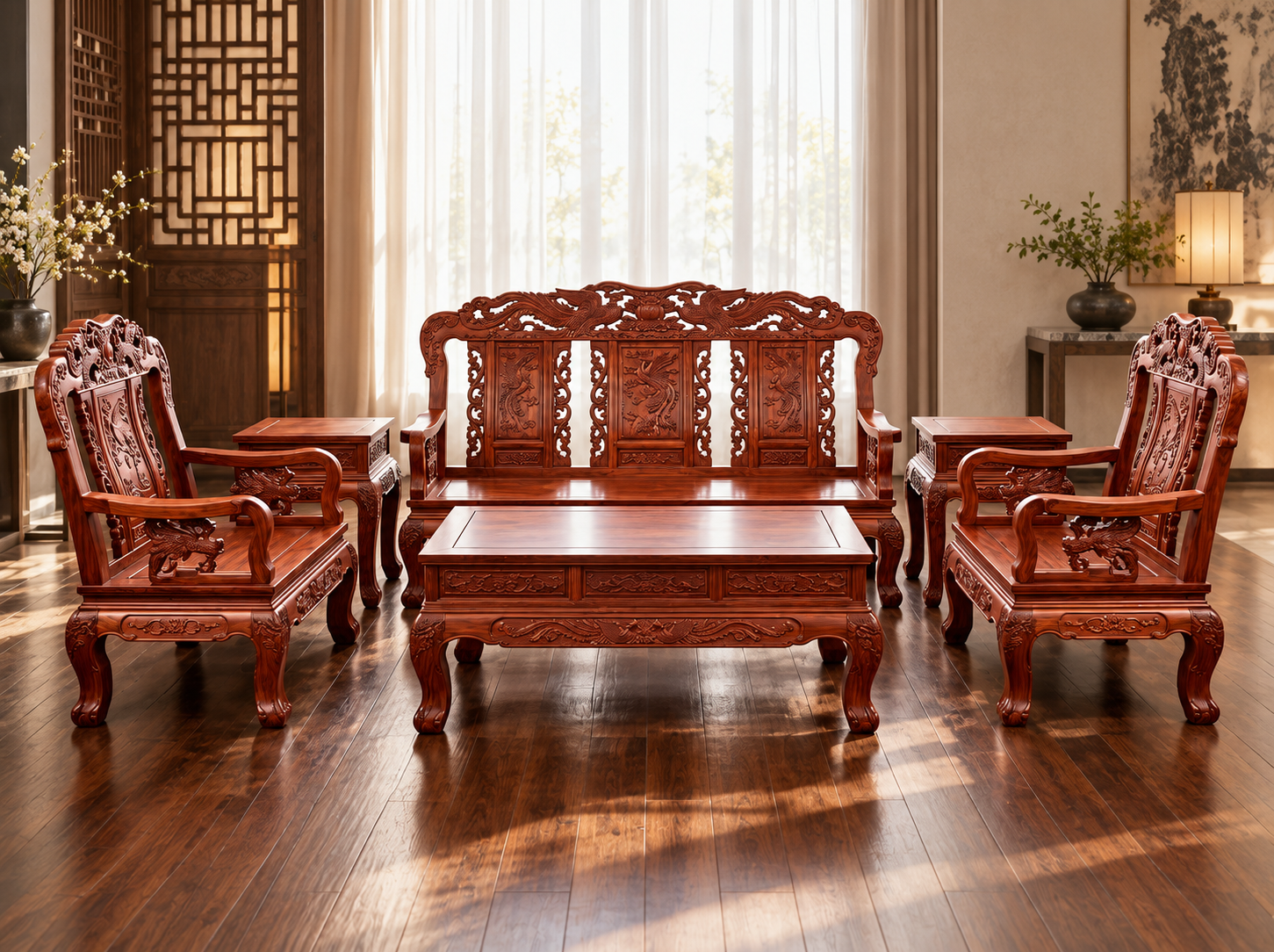
A six-step B2B guide to choosing a rosewood sofa set for living room and lobby projects, comparing Yunxiao's six Siamese rosewood sofa sets on room fit, Ming vs Qing carving styles, CITES/FSC documentation, raw-lacquer finishing, container loading, MOQ and lead times.
Quick answer: choose a rosewood sofa set by matching five things to your project — the set configuration to your floor area, the style and carving depth to your client's expectations, the timber and joinery documentation to your market's compliance rules, the finish to the level of use the room will see, and the order terms (MOQ, container loading, lead time, export documents) to your delivery schedule. Yunxiao currently builds six rosewood sofa sets in Siamese rosewood (Dalbergia cochinchinensis), from a compact three-piece set for 15–20 square metre living rooms to a nine-seat carved set for grand lobbies of 40–60 square metres. This guide walks through each decision step with the actual specifications, workshop processes and order terms behind those sets, so you can compare them line by line before requesting a quotation.
This article is written for B2B buyers — furniture importers, wholesalers, interior contractors and hospitality project procurement teams in Southeast Asia, Australia, Europe and North America — who are deciding which rosewood sofa set to add to a catalog or specify for a living room or lobby project. Every figure quoted below comes from the current published specifications of the six sets in the Yunxiao range; where a figure is a species-level reference rather than a batch-measured value, the text says so explicitly, because knowing what is documented and what is a general industry reference is itself part of a professional sourcing decision.
What a Rosewood Sofa Set Actually Includes (and What "Pieces" Means)
The first confusion to clear up is the difference between pieces, components and seats. In the Yunxiao range, a "three-piece set" is three components — one two-seat sofa, two single-seat armchairs — plus a companion coffee table, which makes four pieces of furniture and four seats; the coffee table is a companion piece, not a seat. A "six-piece reception set" is six pieces of furniture (one three-seat sofa, two armchairs, one coffee table, two end tables) with five seats. A "nine-piece grand set" is nine pieces including a console table, seating five to seven people depending on layout. If you are quoting floor plans or writing product copy for your own catalog, count seats for occupancy planning and count pieces for logistics, because crate volume follows pieces, not seats.
Why does this matter commercially? Because the gap between the smallest and largest set in the range is enormous in both footprint and freight. The compact three-piece set ships in two crates totalling 3.8 CBM and 320 kg gross, and a 20-foot container with 22 CBM of usable capacity takes five sets (19.0 CBM). The nine-piece grand set ships in four crates totalling roughly 4.6 CBM and 260 kg, but because those crates are not stackable and each set must be braced against movement in transit, a 20-foot container takes approximately two sets, with the remaining capacity reserved for stowage clearance and lashing. Choosing between a four-set-per-container product and a two-set-per-container product changes your freight cost per set by a wide margin, so configuration is a logistics decision as much as a design decision.
The current range covers six configurations, all in solid Siamese rosewood:
- Three-piece set (YX-SF-03R) — one two-seat sofa (165 × 62 × 88 cm), two armchairs (62 × 58 × 88 cm), one coffee table (90 × 50 × 45 cm); four seats; hand-carved ruyi sceptre armrest panels; six-coat raw lacquer.
- Qing-style five-piece set (YX-SF-05Q) — one three-seat sofa (185 × 65 × 90 cm), two armchairs, one coffee table (110 × 60 cm), one end table (45 × 45 cm); hand-cut lattice-and-phoenix backrest panels; nine-coat raw lacquer.
- Phoenix six-piece reception set (YX-SF-06P) — one three-seat sofa (195 × 66 × 94 cm), two armchairs, one coffee table (115 × 60 cm), two end tables (48 × 48 cm); three-step phoenix-and-peony relief carving; eight-coat raw lacquer.
- Ming-style seven-piece set (YX-SF-07M) — one three-seat sofa (198 × 68 × 92 cm), two two-seat side sofas (147 cm each), two armchairs, one coffee table (120 × 65 cm), one end table (48 × 48 cm); carved cloud-and-bat backrest panels; seven-coat raw lacquer.
- Ming-style nine-piece grand set (YX-SF-09G) — one three-seat central sofa (205 × 70 × 95 cm), two two-seat side sofas, two armchairs, one coffee table (130 × 70 cm), one console table (120 × 40 cm), two end tables (50 × 50 cm); open-slat backrests with carved chrysanthemum medallions; seven-coat raw lacquer.
- Imperial dragon nine-seat set (YX-SF-10D) — one three-seat central sofa (213 cm length), two two-seat side sofas, two armchairs, three tables; hand-carved five-claw dragon armrests; nine-coat raw lacquer; nine seats across eight pieces.
All six share the same structural logic — mortise-and-tenon joinery with bamboo dowel pins and solid wood corner blocks, no metal fasteners in the primary seating frame — and the same export documentation baseline, which the later sections of this guide break down in detail.
Step 1: Match the Set Size to the Room — Floor Area, Not Just Taste
The most common sourcing failure with classical Chinese seating is ordering a set whose proportions do not fit the room it is destined for. Qing-style sets built at banqueting-hall proportions overwhelm a standard European or North American living room; compact three-piece groupings look sparse in a 50-square-metre hotel lobby. The Yunxiao range is therefore sized in three clear bands, and the published dimensions let you verify fit before you order.
Band 1: compact living rooms of 15–20 square metres. The three-piece set was designed for exactly this footprint — European apartments and North American condominiums where a five-piece or seven-piece grouping would block the circulation path. The two-seat sofa is 165 cm long and 62 cm deep, the armchairs 62 cm wide, and the grouping fits the room without crowding walkways. Seat height is 43 cm. If your end market is urban residential, this is the set whose dimensions were drawn around your room sizes.
Band 2: standard residential living rooms of 25–35 square metres. The Qing-style five-piece set is explicitly sized for this band: its central three-seat sofa measures 185 cm — deliberately shorter than banqueting-hall Qing sets — with 90 cm backrest height. The seven-piece Ming-style set, with a 198 cm central sofa and two 147 cm side sofas, also works in this band and adds a symmetrical seven-item layout that photographs well for showrooms and catalogues.
Band 3: grand living rooms, embassy reception halls and large boutique hotel lobbies of 40–60 square metres. Here the nine-piece grand set and the imperial dragon nine-seat set are the intended choices. The nine-piece configuration needs roughly 5.5 × 3.5 metres of clear floor for the seating group, leaving a circulation path of at least 90 cm around the group in a 40–60 square metre room. The dragon set's central sofa is 213 cm long — the visual anchor for a lobby where the seating is seen from the entrance across 2–4 metres.
Three practical checks belong in your pre-order routine, whatever set you choose. First, measure the delivery route, not just the room: the central sofa is the largest single piece in every configuration, so confirm that the entrance, corridor and lift can pass it and that the floor can carry the loaded weight — the nine-piece set arrives in crates with a combined gross weight of approximately 260 kg, and the dragon set approximately 280 kg. Second, confirm doorway clearance at the inquiry stage; the factory will advise on layout and delivery access if you send room dimensions with your request. Third, remember that in rooms under 40 square metres the nine-piece set's console table can be omitted to form an eight-piece configuration — a cheaper way to keep the style when the full layout will not fit.
For a worked comparison of how set selection interacts with other furniture groups in the same project, see the guide on how rosewood sofa, dining and bedroom sets work together for whole-house furniture projects. It covers the coordination questions — matching timber tone across rooms, sequencing deliveries, and consolidating containers — that a single-room sofa decision quickly runs into.
Step 2: Choose the Style and Carving Depth Your Client Will Recognize
Style is where a rosewood sofa set earns or loses its premium. The six sets divide into two classical lineages and five distinct carving programs, and the differences are concrete enough to specify in a purchase order.
Ming-style sets (seven-piece and nine-piece) are defined by line, not density of carving. The seven-piece set carries the cloud-and-bat (yun bian) auspicious motif on its backrest panels — a classical Ming pattern symbolizing good fortune and longevity — with each panel taking approximately 25 carving hours. The nine-piece grand set uses the Ming open-slat backrest with a hand-carved chrysanthemum medallion at each rail centre, cut in shallow relief at 1.5–3 mm depth. If your client's brief says "restrained, architectural, gallery-like," these are the two sets that read that way.
Qing-style and figural sets carry denser, deeper carving and a courtly vocabulary. The five-piece Qing set features hand-cut lattice-and-phoenix panels: the lattice grid is laid out at 12 mm spacing, openings are cut with a fitting saw to 8 mm depth and widened with a carving gouge to 12 mm final width, and each panel takes roughly 30 carving hours. The six-piece reception set carves a phoenix flying among peony blossoms in three relief stages — the phoenix body outlined at 2 mm depth, peony blossoms at 4 mm, and the background recessed — with a working tolerance of plus or minus 0.5 mm checked at five points per panel, and about 35 carving hours per panel. The dragon set's armrests carry five-claw Qing court dragon motifs, historically reserved for imperial furniture, carved at roughly 40 hours per armrest — the single most labour-intensive carving program in the range.
The three-piece set occupies its own niche with ruyi sceptre cloud-head motifs carved in relief to 2–4 mm depth on the armrest panels, about 18 carving hours per panel — enough hand-carved detail to justify a premium price point in a compact footprint.
One distinction worth explaining to your end clients, because it is the difference they can actually see: hand-carved panels show natural dimensional variation — the lattice openings of the Qing set vary by plus or minus 0.5 mm, and relief depth varies with the grain of each individual board. Machine-routed carving is uniform and shallow, and to a discerning client it reads instantly as fake handwork. The workshop treats grain-responsive variation as a characteristic of hand work, not a defect, and inspects each panel under magnification for chisel marks that indicate tool slippage — a different standard than cosmetic uniformity. If you need a deeper treatment of this topic, the article on how carved rosewood sofa sets combine hand carving with mortise-and-tenon joinery for export markets walks through the carving-to-joinery sequence in detail.
For catalog planning, the choice between Ming restraint and Qing richness is also a market question: the guide on Ming or Qing style for your import catalog compares how the two lineages position in European and North American retail, and which buyer segments respond to each.
Step 3: Verify the Material, Joinery and Compliance Documents
Every set in the range is built from solid Siamese rosewood (Dalbergia cochinchinensis) — no particleboard, MDF, plywood or veneer in the load-bearing structure. That species choice carries two compliance consequences that belong in your sourcing checklist, not in fine print.
First, CITES. Dalbergia cochinchinensis is listed in CITES Appendix II, so every shipment travels with a species-specific CITES export permit, and importing buyers must apply for the corresponding import permit in their own country. This is an export authorisation document, not a certification — a distinction the product documentation is careful to draw, and one your customs broker will confirm. Confirm the permit lead time with your broker before fixing a delivery date, because it sits on the critical path of any first order.
Second, FSC chain-of-custody. The workshop maintains FSC chain-of-custody documentation covering timber procurement, and a certificate copy is included with each shipment. The nine-piece set's documentation is explicit that this certifies the timber supply chain, not the finished furniture — which is exactly the honest framing you need when your own customers ask what "FSC" means on your spec sheet. Certificate numbers are available on request, so you can verify status before you order rather than after.
Joinery is the other half of the structural story. All six sets use mortise-and-tenon joints reinforced with bamboo dowel pins driven through the tenon, plus solid wood corner blocks at every right-angle intersection; no metal fasteners are used in the primary seating frame. The reason is mechanical, not romantic: wood expands and contracts with seasonal humidity, and a frame joined with wood-to-wood connections lets that movement happen without stressing a screw hole. Tenon depths are specified per set — 18 mm on seat rails and 15 mm on backrest stiles for the seven-piece set, 18 mm seat rails and 16 mm backrest stiles for the nine-piece and six-piece sets, 20 mm seat rails and 18 mm backrest stiles for the dragon set, whose 38 mm thick solid rosewood seat rails are dimensioned to carry three adults without mid-span deflection. The three-piece set uses 16 mm seat-rail tenons and 14 mm armrest-to-back-post tenons.
Moisture content is specified and audited, not asserted. The Ming seven-piece and the three-piece sets target 8–12% moisture, verified with a pin-type meter at three points per piece (seat rail, backrest stile, armrest), with readings outside the range triggering re-conditioning before packing. The Qing five-piece is audited to an 8–14% range with final conditioning adjusted to the destination climate before shipment — buyers are asked to state the destination country and typical indoor humidity so the timber can be equalized to that environment. The dragon set adds a 36-day constant-humidity conditioning cycle after kiln-drying. The nine-piece and three-piece sets are additionally density-sorted to a 0.90–1.00 g/cm³ band so all pieces in one set respond to humidity at the same rate — which is what keeps colour and grain consistent across a multi-piece set cut from a single timber batch.
Joint testing is documented per set. The nine-piece, six-piece, Qing and dragon sets are loaded with 120 kg of distributed weight for 24 hours at each mortise-and-tenon connection (or, for the nine-piece, 120 kg of horizontal force over 24 hours at the joint); the seven-piece set applies 15 kg of horizontal force per joint; the three-piece set applies 12 kg of lateral force. Any joint showing visible movement is re-fitted before the set proceeds, and test records can be provided with order documents. A batch-specific hardness test can be arranged on request; published Janka figures for Dalbergia cochinchinensis (approximately 1,000–1,300 lbf) are species-level public reference values, not batch-measured data — the documentation says so directly, and so should your spec sheets.
For buyers who want the material background in one place, the article on what rosewood furniture is made of covers Siamese rosewood's properties and the workshop's material controls, and the piece on why rosewood furniture cracks in overseas climates explains the moisture-management logic behind the 8–14% conditioning targets.
Step 4: Understand the Finish — Raw Lacquer, Coat by Coat
Every set is finished with hand-rubbed raw lacquer, a natural plant-based finish applied in multiple coats — six on the three-piece set, seven on the two Ming-style sets, eight on the phoenix reception set, nine on the Qing five-piece and the dragon set. Each coat is cured for 24 hours and rubbed back with pumice stone before the next is applied, and the final coat is polished to a satin sheen that leaves the grain visible beneath. The practical significance for a B2B buyer is that raw lacquer penetrates the wood pores rather than forming a brittle surface film, so it moves with the frame instead of cracking when the joinery breathes through seasonal humidity swings — the failure mode that shows up on film finishes after the first heating season.
Coat count correlates with carving depth and commercial use. The sets with the deepest relief work (phoenix-and-peony, five-claw dragon, lattice-and-phoenix) carry eight or nine coats, partly because deeper carving presents more surface to protect and partly because more hand-rubbing rounds deepen the final sheen. Finish quality is verified under 5000K daylight-balanced LED lighting at 30 cm distance, with runs, sags or uncured spots reworked before packing, and colour consistency across all pieces in a set checked against a reference panel — the checkpoint that prevents the "one armchair lighter than the sofa" complaint that hospitality contractors fear most.
Care expectations are part of the product's honest specification, and they are worth passing to your end customers verbatim. Raw lacquer surfaces should be dusted with a soft dry cloth and wiped spills dried immediately; alcohol, acetone, ammonia-based cleaners and abrasive pads can dull or strip the finish. Hot items above roughly 60°C can leave marks — coasters and trivets under tableware are the norm, not a defect disclaimer. Indoor relative humidity in the 40–60% range keeps the solid wood stable; sustained humidity below 35% can open joints. And two documentation points differ between sets, so check the one you are ordering: the seven-piece set's cured lacquer can be assessed for food-contact use with test reports available on request, while the dragon set's documentation states plainly that the cured lacquer is a decorative coating and not certified for direct food contact. Quote the standard that applies to your set, not a generic claim.
Step 5: Living Room Projects versus Lobby Projects — Different Buying Logic
The same six sets serve two very different buyers, and the selection logic differs more than most catalogs acknowledge.
For residential and retail buyers — importers stocking showrooms, distributors furnishing villas, developers fitting out model homes — the decision drivers are room fit (Step 1), style positioning (Step 2), and per-unit economics. The three-piece set exists because the urban residential segment needs a full classical grouping in a 15–20 square metre room; the Qing five-piece hits the 25–35 square metre mainstream at banqueting-quality carving; the seven-piece Ming set gives retailers a photogenic seven-item symmetrical layout. Container economics favour the compact sets: five three-piece sets or five Qing five-piece sets fill a 20-foot container, against four seven-piece sets or four phoenix six-piece sets, and two of the grand nine-piece configurations. If your order is a mixed container, the compact sets are the ones that let you combine product lines without exceeding 22 CBM.
For hospitality and corporate reception buyers — hotel lobbies, boutique hotel lounges, embassy reception halls, corporate reception areas — the drivers shift to durability under commercial use, visual scale from the entrance, and documentation the contractor can hand to a client. The phoenix six-piece reception set was designed for this brief: a 195 cm central sofa whose 94 cm backrest carving reads at eye level when guests enter, sized so the full set ships in three crates totalling roughly 1.6 cubic metres and 180 kg — a volume that keeps a single-set order LCL-compatible, which matters for phased hotel fit-outs that start with one reception area. The nine-piece grand set and the dragon nine-seat set serve lobbies of 40–60 square metres where the seating group is a focal element; both are built and tested to the 120 kg joint standard, and both arrive with per-shipment CITES permits and wood drying certificates that a project's compliance file needs. Reception-area placement guidance from the product documentation is concrete: position the central sofa against the tallest wall so the backrest carving is visible at eye level, and confirm the delivery route before ordering.
Project buyers should also read the sourcing guide on classical rosewood furniture for luxury hotel and villa projects, which covers the project sequence — layout drawings, sample approval, phased delivery — around the sofa decision, and the tea-table selection guide for villa and hotel lobby projects, since the coffee table in any of these sets is usually the piece guests actually touch first. For a broader market view, the 2026 article on Western buyers choosing Chinese rosewood furniture explains why hospitality demand for carved classical seating has been rising in Europe and North America.
Step 6: Order Terms — MOQ, Containers, Lead Time and Documents
All six sets share a commercial baseline that makes first orders unusually accessible for a carved hardwood category: MOQ is one complete set, standard terms are a 30% T/T deposit with balance before shipment, FOB Xiamen is the default Incoterm with CIF and DDP available on request, and LCL consolidation works for single-set orders. L/C is accepted above set-count thresholds that vary by model (five sets for the compact sets, three for the phoenix set, two for the grand configurations) — confirm at quotation.
Container loading, from the published packing data:
- Three-piece set — two crates, 3.8 CBM, 320 kg; a 20-foot container takes five sets (19.0 CBM; six would need 22.8 and exceed capacity).
- Qing five-piece set — two crates, approximately 140 kg combined; a 20-foot container fits approximately five sets.
- Phoenix six-piece set — three crates, roughly 1.6 CBM and 180 kg; a 20-foot container fits approximately four sets.
- Ming seven-piece set — a 20-foot container fits approximately four sets.
- Ming nine-piece set — four crates, 4.6 CBM, 260 kg; approximately two sets per 20-foot container, crates not stackable.
- Dragon nine-seat set — four crates, approximately 280 kg; approximately two sets per 20-foot container.
Lead times, from deposit confirmation: 40–55 days for a single three-piece set (65–80 at five sets and above); 55–70 days for a single Qing five-piece or phoenix six-piece (75–90 at three sets and above); 50–65 days for a single seven-piece set (75–90 at three sets and above); 60–75 days for a single nine-piece or dragon set (80–95 at two sets and above). Air-dried timber is held in stock, so the 12-month air-drying period does not add to your order lead time. On the dragon set, the carving stage accounts for roughly half the production window — a fact worth knowing when you promise a client an installation date on a heavily carved configuration.
Sampling before commitment is supported across the range: a single armchair can be ordered as a sample piece, and if a qualifying full-set order follows within 90 days, part or all of the sample cost is credited against the set invoice (the credit formula and cap are confirmed at quotation and differ slightly by model).
Export documents travel with every shipment: the species-specific CITES Appendix II export permit, the FSC chain-of-custody certificate copy, a commercial invoice with HS code 9403.60 (9401.61 for the sofas on the nine-piece set's combined documentation), a packing list with crate dimensions and gross weight per piece — including the timber batch number on the nine-piece set — and a wood drying certificate showing the audited moisture range. Scanned copies can be shared before you place an order so your customs broker can verify compliance in advance. Every crate is ISPM-15 heat-treated with acid-free tissue wrap, corrugated cardboard and EPS foam corner blocks; packaging has passed 1-metre six-face drop testing under the workshop's in-house procedure, with records available at inquiry.
For the inspection step between production and shipment, the buyer's checklist on inspecting rosewood furniture before shipment sets out what to verify — joints, moisture readings, carving detail, finish uniformity — and maps to the four-checkpoint protocol every set passes before packing.
OEM, ODM and Project Customization
All six sets support OEM and ODM work with a 15-day design approval cycle that starts from the day the factory receives your drawings or reference images and covers a dimension drawing and a carving layout for your confirmation. In practice that means custom carving motifs — family crests, alternate classical patterns, buyer logos — incorporated into backrest panels or armrests; custom dimensions for hotel projects; configuration substitutions (the seven-piece set's two armchairs can be replaced by a third two-seat sofa at the same package volume; the dragon set's armchairs can be swapped for two-seat sofas to reach a ten-seat layout); and finish-tone adjustments agreed at the design stage. For distributors building a private-label line around classical seating, the guide to private-label rosewood furniture manufacturing covers what is included and how the approval cycle fits a catalog launch.
Two customization boundaries are worth stating as clearly to your clients as the workshop states them internally. First, hand carving follows the grain of each individual board, so no two carved panels are identical — a genuine OEM selling point, not a tolerance problem, and one you should present that way. Second, destination-climate conditioning is a customization input: telling the factory the destination country and typical indoor humidity range lets the timber be equalized before packing, which is the single most effective step against seasonal joint movement in heated or air-conditioned interiors.
Common Mistakes B2B Buyers Make When Ordering a Rosewood Sofa Set
Across first-time and repeat orders for carved classical seating, the same handful of preventable mistakes shows up again and again. None of them are about taste; all of them are about process. Treat this section as the pre-order checklist that keeps your first container of rosewood sofa sets out of the claims file.
Mistake 1: choosing from photographs alone. A carved sofa set photographed in a generous showroom can read very differently in a 28-square-metre living room with a lower ceiling. Every configuration in this range publishes its piece-by-piece dimensions, and for sets where depth, overall height and table heights are not on the web page — the dragon nine-seat set is the clearest example — the full three-dimensional dimension sheet is included in the packing list that ships with every order and can be requested at the inquiry stage for floor planning before you commit. Asking for the dimension sheet is a two-minute email that prevents the most expensive kind of surprise: furniture that arrives beautiful and does not fit.
Mistake 2: staying silent about destination climate. The Qing five-piece set's documentation makes the protocol explicit: buyers are asked to state the destination country and the typical indoor humidity range at the point of use so the timber can be equalized to that environment before packing. Buyers who skip this step receive timber conditioned for a generic indoor environment, and then see joint lines open in a heated winter or panels swell in a monsoon-season coastal city. The fix costs nothing — put your city and indoor humidity range in the first inquiry, and ask for the three-point moisture readings per piece to be included in your order documents so you can verify the conditioning claim on arrival.
Mistake 3: not aligning on who inspects, and against what. Every set passes a four-checkpoint protocol before packing — joint integrity, moisture verification, carving detail and finish uniformity — and the results can travel with your order documents. If you appoint a third-party inspector, give them the same checkpoints and acceptance criteria in writing before production finishes: the 120 kg distributed-load joint standard (or the per-set force figures listed in Step 3), the moisture band for your specific set, the depth-gauge points for carved panels, and the 5000K finish-inspection condition. An inspector who arrives with the factory's own acceptance criteria produces a report both sides can act on; an inspector who invents criteria produces a dispute.
Mistake 4: treating the sample as a formality. The sample armchair is not just a sales gesture — it is the calibration piece for your entire order. Check it against the same criteria you will apply to the container: joint tightness, lacquer sheen, carving crispness, colour tone against your showroom lighting. And note the commercial mechanics: the sample cost credit applies to a qualifying full-set order placed within 90 days, with the formula and any cap confirmed in your quotation. Buyers who order a sample, shelve the decision for five months, and then expect the credit retroactively create avoidable friction.
Mistake 5: quoting installation dates off the production clock alone. Lead times in this guide run from deposit confirmation, but two things sit outside them: the CITES import-permit process in your own country, and — on heavily carved configurations — the proportion of the production window consumed by carving. On the dragon set, carving accounts for roughly half the 60–75 day single-set lead time, and a ten-seat substitution adds pieces to that carving queue. Build both into the schedule you promise your client, and your delivery date becomes a commitment you can keep.
Mistake 6: comparing quotations across suppliers without normalizing the document set. A lower unit price that excludes CITES export permit processing, ISPM-15 crating, or the wood drying certificate is not a lower price — it is a smaller scope. When you benchmark, ask each supplier the same scope question: does the quoted price include per-shipment export permits, heat-treated crating with corner protection, the full document list, and the joint and moisture test records? The honest answer, on this range, is yes to all four; that is the baseline your comparison should assume.
How to Read Your Quotation and Production Documents
Once the decision is made, the paperwork is where a professional buyer earns back the margin. A complete quotation for a rosewood sofa set should let you verify six things without a follow-up email: the model and SKU with the exact configuration (including any substitutions you requested, such as the seven-piece set's third two-seat sofa in place of the two armchairs); the price basis and Incoterm (FOB Xiamen by default, with CIF or DDP as requested); the crate plan with per-crate dimensions and gross weights; the lead time running from deposit confirmation; the full export document list for your market; and the warranty terms with their conditions. If any of the six is missing, ask for it in writing before you pay the deposit — every one of them is standard on this range, so their absence from a quote is a question, not a negotiation position.
During production, the document that matters most is the per-piece inspection record. The phoenix six-piece reception set's specification describes it concretely: results are recorded per piece and issued as a PDF inspection sheet with the shipping documents, covering the moisture readings, the joint load test and the carving depth verification. When your goods arrive, your receiving team can match crates to the packing list — and, on the nine-piece set, to the timber batch number printed on it — and check the delivered condition against the recorded one. That chain of paper is what turns a quality claim from an argument into a lookup.
Finally, keep the door open to seeing the work in person. Buyers visiting Fujian can arrange a workshop tour covering timber storage, joinery stations, carving benches and the lacquer curing room — the four stages where the claims in this guide are either true or not. A supplier that welcomes that visit, and that publishes certificate copies and test-record availability on request rather than in marketing copy, is telling you how it expects the relationship to work: on documents, not on promises.
Buyer FAQ
How many seats does each configuration actually provide? Three-piece set: four seats (one two-seat sofa plus two armchairs; the coffee table is not a seat). Qing five-piece: five seats. Phoenix six-piece: five seats across one three-seat sofa and two armchairs. Seven-piece Ming set: seven seats (3 + 2 + 2). Nine-piece grand set: seven seats across the seating pieces. Dragon set: nine seats across five seating pieces.
Can I mix configurations in one container? Yes — LCL consolidation works for small quantities and mixed FCL loads are planned per crate dimensions. Send your quantity list per model and the factory will confirm the stowage plan, since the grand sets' non-stackable crates affect mixed-load capacity.
Which set should I choose for a boutique hotel lounge around 30 square metres? The Qing five-piece (185 cm central sofa) or the phoenix six-piece reception set (195 cm) both fit that band; the six-piece adds two end tables and the LCL-friendly 1.6 CBM packing that suits phased fit-outs. Confirm room dimensions and delivery access at inquiry.
What documentation proves the wood is legal to import? Each shipment includes a species-specific CITES Appendix II export permit for Dalbergia cochinchinensis and an FSC chain-of-custody certificate copy; you must apply for the import permit in your own country. Sample document copies are available before ordering for broker verification.
Is the finish food-safe for tea service on the coffee table? It depends on the set: the seven-piece Ming set's fully cured lacquer can be assessed for food-contact use with test reports available on request, while the dragon set's lacquer is documented as a decorative coating not certified for direct food contact. Ask for the applicable test scope for your destination market at the inquiry stage.
How is colour consistency across a multi-piece set guaranteed? Each set is cut from a single timber batch (the nine-piece and three-piece sets are additionally density-sorted to 0.90–1.00 g/cm³), boards are tone-sorted before production, and final colour of every piece is compared against a reference panel under 5000K lighting before packing. Because the timber is solid and natural, minor figure variation between pieces is normal and not treated as a defect.
What warranty applies, and what voids it? A 24-month structural warranty covers joinery failure and frame cracking under normal indoor use, counted from shipment. It does not cover damage from dragging pieces, standing on them, heat sources, direct sunlight, sustained humidity outside the 40–60% range, or unheated/damp storage — the same conditions the care guidelines ask you to brief your end customers on.
Can we order a sample before a container? Yes. A single armchair from any set can be ordered as a sample, and a qualifying full-set order within 90 days earns a credit of part of the sample cost against the set invoice — the exact formula is confirmed with your quotation.
My project needs a layout that is not in the standard configurations. What are my options? Start with the published substitutions: the seven-piece set can exchange its two armchairs for a third two-seat sofa at the same package volume, the dragon set can take two additional two-seat sofas in place of its armchairs for a ten-seat layout, and the nine-piece set's console table can be omitted for rooms under 40 square metres. Beyond those, custom configurations run through the 15-day design approval cycle — send your room dimensions and the required seating count, and you will receive a dimension drawing and a carving layout to confirm before production.
How can I verify a supplier's rosewood claims before the first order? Three checks, all available before any money changes hands: request the sample CITES and FSC document copies so your customs broker can verify them; ask for the FSC certificate number and the packing-list batch-number practice; and order the sample armchair to inspect joinery, lacquer and carving against the published specifications. Buyers attending Canton Fair or the Shanghai International Furniture Fair channels can also schedule a workshop visit in Xianyou to see timber stock, carving stations and the lacquer curing room in person.
The Six Sets at a Glance
| Set (SKU) | Pieces / Seats | Central sofa | Carving | Lacquer | Lead time (1 set) | 20-ft container |
|---|---|---|---|---|---|---|
| Classical 3-piece (YX-SF-03R) | 4 pieces / 4 seats | 165 × 62 × 88 cm (2-seat) | Ruyi armrest, ~18 h/panel | 6 coats | 40–55 days | 5 sets |
| Qing 5-piece (YX-SF-05Q) | 5 pieces / 5 seats | 185 × 65 × 90 cm | Lattice-phoenix, ~30 h/panel | 9 coats | 55–70 days | ~5 sets |
| Phoenix 6-piece (YX-SF-06P) | 6 pieces / 5 seats | 195 × 66 × 94 cm | Phoenix-peony 3-step, ~35 h/panel | 8 coats | 55–70 days | ~4 sets |
| Ming 7-piece (YX-SF-07M) | 7 pieces / 7 seats | 198 × 68 × 92 cm | Cloud-and-bat, ~25 h/panel | 7 coats | 50–65 days | ~4 sets |
| Ming 9-piece grand (YX-SF-09G) | 9 pieces / 7 seats | 205 × 70 × 95 cm | Chrysanthemum medallion, 1.5–3 mm relief | 7 coats | 60–75 days | ~2 sets |
| Imperial dragon 9-seat (YX-SF-10D) | 8 pieces / 9 seats | 213 cm length | Five-claw dragon, ~40 h/armrest | 9 coats | 60–75 days | ~2 sets |
How to Request a Quotation
When you are ready to compare real numbers, send the factory five things with your inquiry: the set (or sets) you are considering, your destination port and preferred Incoterm, your order quantity, the destination country and typical indoor humidity at the point of use, and any CITES import-permit requirements or custom carving needs for your market. With those inputs the quotation will include confirmed lead time, container stowage, the document set your customs broker needs, and — for OEM projects — the 15-day design-approval schedule.
Each set's own product page carries its full specification: the three-piece ruyi-carved set, the Qing-style five-piece set, the phoenix six-piece reception set, the Ming-style seven-piece set, the Ming-style nine-piece grand set, and the imperial dragon nine-seat set. Choosing a rosewood sofa set for a living room or lobby project is ultimately a sequence of checkable decisions — floor area, style depth, material documentation, finish grade, order terms — and every one of them can be verified against documents before your deposit is paid, which is exactly how a professional furniture purchase should work.