
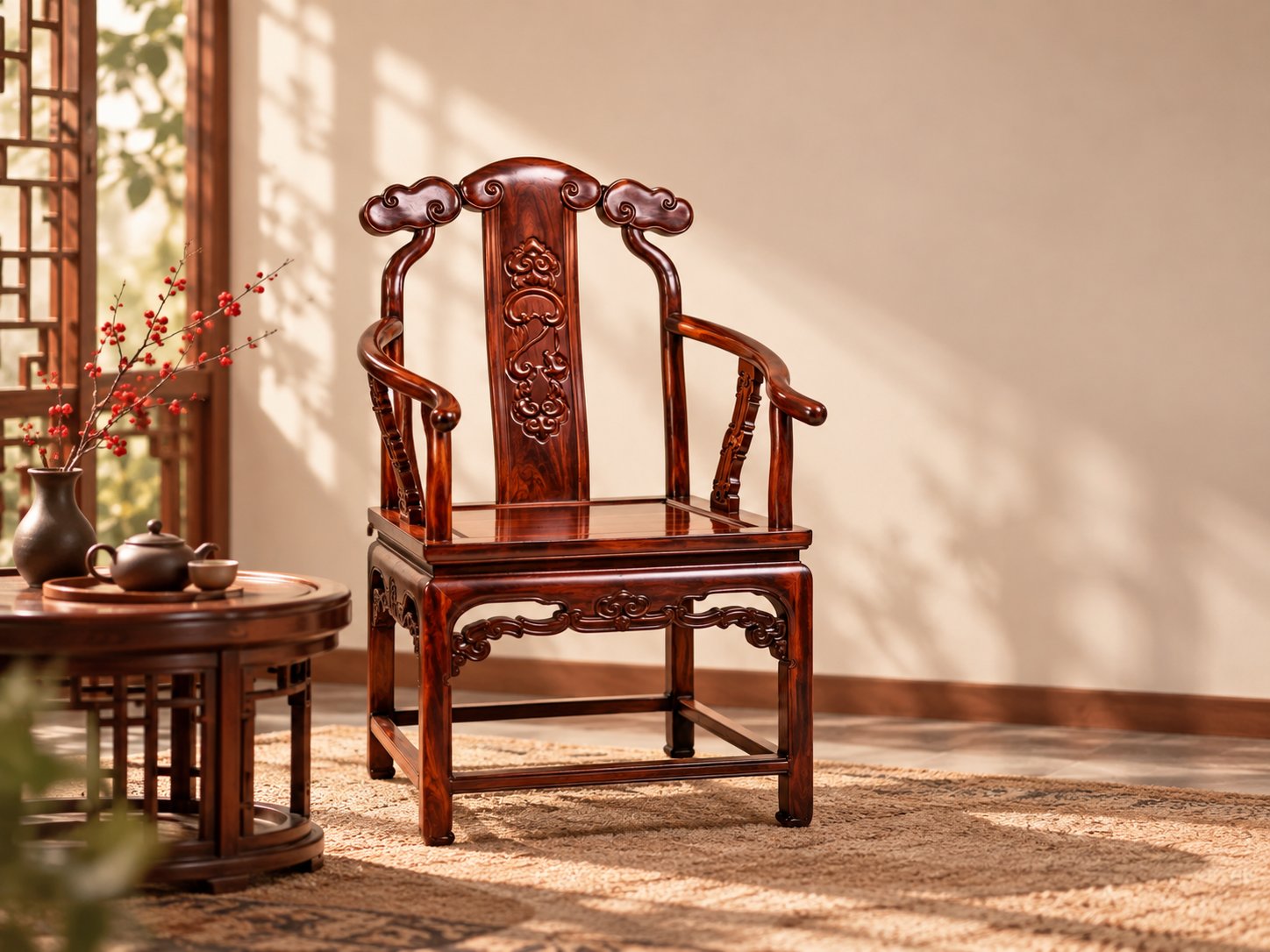
A B2B buyer's guide to choosing the right rosewood armchair for hotels, villas and tea rooms, covering Siamese rosewood species and moisture standards, mortise-and-tenon joinery, hand carving, six-coat raw lacquer finishing, FSC/CITES documentation, MOQ, samples and lead times.
Ask a hotel procurement manager which piece of furniture guests remember most, and the answer is rarely the sofa set or the dining table. It is usually the single chair in the corner of the lobby, the reading chair by the window of a villa suite, or the small carved seat that framed a tea service. Accent seating is small in footprint but heavy in impression, and for B2B buyers it is also the category where quality problems surface first: a wobbly armchair in a showroom is noticed before any defect hidden inside a sofa.
That is why we wrote this guide. Yunxiao Rosewood Furniture Co., Ltd. has manufactured classical solid redwood furniture in Xianyou County, Fujian, since 2008, supplying wholesalers, hotels and design firms across Europe, North America, Southeast Asia and Australia. Every week our export team answers variations of the same question: how do you choose the right rosewood armchair for a hotel, villa or tea-room project, and what exactly should be verified before a container is committed?
This article answers that question the way we answer it at the factory floor level, using three pieces from our own seating line as working examples: the Classical Siamese Rosewood Armchair with Carved Ruyi Backrest, the Classical Siamese Rosewood Lounge Chair with Carved Backrest, and the Classical Siamese Rosewood Folding Stool with Carved Seat. Rather than generic advice, the sections below explain the specific material, joinery, carving, finishing, documentation and logistics standards that separate a workshop-built rosewood armchair from a mass-produced imitation, so you can compare suppliers on facts instead of catalog photos.
Why Accent Seating Deserves Its Own Sourcing Strategy
Many importers treat accent chairs as a minor line item attached to a larger container of sofa sets and dining tables. That approach usually costs money later. Accent seating behaves differently from large case goods in three ways that matter to a B2B buyer.
First, accent chairs are touched. Guests pull them, tilt them, scoot them across tile floors and drop into them after a long flight. A sofa distributes load across a wide frame; a chair concentrates the same abuse on four joints and two armrests. If a supplier cuts corners anywhere in the frame, an armchair is where the corner-cutting becomes visible within a season.
Second, accent seating ships in numbers. A hotel project that orders six sofa sets may order forty armchairs and sixty stools. Small defects multiply: a one-in-fifty wobble rate is a footnote on a sofa order and a service problem on a chair order. This is why our own inspection protocol treats chairs more strictly than larger pieces, with a 24-hour, 120 kg distributed load test on every assembled frame before packing.
Third, accent chairs cross climate zones in small, dense crates. The same chair may be specified for a humid resort in Southeast Asia, a heated alpine villa and an air-conditioned city hotel in North America. Wood movement, joint design and moisture content matter more for a compact chair that spends weeks inside a mixed container than for a wardrobe that ships in its own crate. A sourcing strategy that only compares price per chair ignores the cost profile that actually decides profitability: returns, on-site repairs and replacement claims.
The practical conclusion for importers is simple. Choose accent seating the way you would choose a structural component, not a decoration. The rest of this guide explains what to check, in the order we recommend checking it.
Meet the Three Accent Chairs in the Yunxiao Seating Line
Before discussing standards, it helps to know the reference points. Our seating line currently covers three accent pieces, each designed for a different placement inside hospitality and residential projects, and each built on the same material and joinery platform.
The Classical Siamese Rosewood Armchair with Carved Ruyi Backrest is a Ming-style open-slat armchair, 62 cm wide, 58 cm deep and 88 cm high at the backrest, with a seat height of 43 cm. The backrest panel carries a hand-carved ruyi sceptre motif, a classical Chinese symbol of authority and good fortune, cut in relief over roughly 18 carving hours. It is the piece we recommend most often for reception areas, studies and boutique hotel lounges where a single chair must carry the classical message of the whole room.
The Classical Siamese Rosewood Lounge Chair with Carved Backrest is slightly larger, at 66 cm wide, 60 cm deep and 92 cm high, with a 44 cm seat height and a deeper 44 cm seat. Its backrest carries a floral and botanical relief carved over approximately 20 hours, and its armrests are cut as single curved sections following the natural grain. This is the reading chair: the piece for villa suites, residence living rooms and hotel corners where a guest is expected to actually sit for an hour, not just look.
The Classical Siamese Rosewood Folding Stool with Carved Seat is the compact piece: a 35 by 35 cm square seat at 45 cm height with splayed outer legs and central straight legs, folding on a traditional wooden pivot rather than a metal hinge. Its carved seat panel takes about 8 carving hours. It serves tea rooms, entryways and boutique hotel lounges as an accent that can be folded, stored and redeployed as the room's use changes.
All three pieces pair naturally with our tea tables, including the Classical Siamese Rosewood Round Tea Table with Carved Apron, and with the sofa, dining and bedroom sets that make up the rest of the catalogue. The sections that follow use these three chairs as concrete examples of what a buyer should verify in any rosewood armchair, from any supplier.
Start with the Species: What Siamese Rosewood Actually Is
The single most important decision in buying a rosewood armchair is not the carving pattern or the cushion fabric. It is the species printed on the wood drying certificate.
The timber in our seating line is Dalbergia cochinchinensis, known in the trade as Siamese rosewood and in the Chinese national standard for hongmu as one of the classical rosewood species. This distinction matters commercially. A large share of furniture marketed internationally as "rosewood" is in fact stained rubberwood, engineered board with a rosewood veneer, or mixed hardwood of unstated origin. None of those materials hold carved detail the way genuine rosewood does, and none of them support the CITES and FSC documentation that serious hotel groups and government-adjacent projects increasingly require.
Dalbergia cochinchinensis is a dense hardwood by any published measure. The species-wide reference figures under the national standard place Janka hardness in the range of roughly 1,520 to 3,680 lbf and air-dry density between 0.8 and 1.33 g/cm³. These are published species ranges, not measurements of a single board, and we state them that way in our own specifications. What we control is where our timber sits inside that range: our selection process admits only boards with more than 80 percent heartwood into the seating line, and heartwood is both the denser and the more dimensionally stable part of the board. Boards exceeding 20 percent sapwood are diverted to other product lines.
Why does heartwood ratio matter to a buyer who will never see the inside of a board? Two practical reasons. Heartwood holds fine carving detail more cleanly than sapwood, which directly affects how the ruyi or floral relief on a backrest panel reads after five years of cleaning and polishing. And heartwood's dimensional stability reduces the seasonal movement that, in a poorly selected board, gradually opens the joints of an armchair frame. When a supplier cannot tell you the species, the heartwood policy and the moisture specification in the same sentence, that is the first signal to keep looking.
Buyers should also note that Dalbergia cochinchinensis is listed on CITES Appendix II. This is not a barrier; it is a filter. It means every legitimate export shipment carries a CITES export permit from our side and, in most destination countries, requires an import permit on the buyer's side. A supplier who can produce these documents on request is demonstrably trading in legally sourced timber; a supplier who changes the subject when asked for them is telling you something about their supply chain.
Kiln Drying and Moisture Content: The Number That Prevents Wobble
If you take one number away from this guide, take this one: 8 to 12 percent. That is the moisture content range to which every board in our seating line is kiln-dried before a single joint is cut.
The process matters as much as the number. Selected timber enters a four-week kiln cycle with gradual temperature ramping; rapid drying saves schedule but case-hardens the outer shell of a dense hardwood like rosewood, trapping internal stress that releases later as cracking or warping. After the kiln cycle, the boards rest through a 48-hour equalization period so that moisture evens out between the surface and the core before cutting and joinery. Each finished chair is then audited with three-point moisture readings, and any piece reading outside the 8 to 12 percent window goes back to conditioning rather than to packing.
The reason this specification matters to an importer is climate. Solid wood equilibrates toward the humidity of its environment. A chair dried to the right range for a temperate showroom will move if it spends a year in a tropical resort at 80 percent relative humidity, and the movement expresses itself at the joints first. Keeping indoor relative humidity within roughly 40 to 60 percent, which matches the 8 to 12 percent moisture content, keeps a mortise-and-tenon frame tight; our care guidance says exactly this to every buyer, in writing, with every quotation.
For buyers in climates that sit outside that range for whole seasons, the honest advice is not that the chair will never move. Solid wood is solid wood. The advice is to let chairs acclimatize gradually on arrival, inspect joints periodically during the first year, and buy from a supplier whose joinery design tolerates normal movement — which is the subject of the next section. A batch-specific wood drying certificate accompanies every shipment we make, so the moisture claim can be verified per order rather than taken on faith from a catalog page.
Joinery Without Metal: Mortise-and-Tenon with Bamboo Dowels
Open the seat rail junction of most commercially priced wooden armchairs and you will find the real frame: metal brackets, screws and corner plates. This construction is fast and cheap, and it is also the most common root cause of the warranty claims we hear about from buyers who switched to us. Screws back out on the road. Brackets corrode inside a humid container. Joints that felt tight at the factory develop play after a few months of hotel use, and the claim lands on the importer's desk, not the factory's.
Our seating line is joined the way classical Chinese furniture has been joined for centuries, engineered to modern tolerances. Every load-bearing connection is a mortise-and-tenon joint: 18 mm tenon depth on seat rails, 16 mm on backrest stiles, and 14 mm on the folding stool's leg-to-seat pivot. Each joint is reinforced with bamboo dowel pins fitted dry before glue is applied. Bamboo is chosen deliberately: its silica-rich fiber compresses rather than splits when a joint flexes through seasonal humidity swings, so the pin keeps clamping pressure on the tenon instead of working loose the way a metal screw does in end grain. Corner blocks are installed at every right-angle intersection to prevent racking — the side-to-side wobble that develops when a rectangular frame loses its squareness.
The result is a frame with no metal fasteners carrying load anywhere. There is nothing to rust inside a container, nothing to shake loose on a cobbled hotel driveway, and no galvanic corrosion between dissimilar metals and tannin-rich hardwood. This is not romantic traditionalism; it is a failure-mode decision. The most common ways a chair fails — loose joints, wobble, cracked brackets — are engineered out at the design level rather than patched by thicker hardware.
Every assembled frame must still prove it. Before packing, each chair spends 24 hours under 120 kg of distributed weight. Any joint showing visible separation is re-fitted — re-fitted, not patched with glue and a clamp — and only frames that pass proceed to finishing and crating. This load test, together with the moisture audit, is the mechanical basis of the 24-month structural warranty on joinery and frame cracking that covers all three chairs in the line under normal indoor use.
When you compare armchairs across suppliers, ask specifically: what is the tenon depth, how are the joints reinforced, and is there a load test before packing? These three questions separate a workshop-built rosewood armchair from an assembled one faster than any photograph.
Hand Carving: Relief Depth, Carving Hours and Why Machines Fall Short
Carving is where classical rosewood furniture earns its premium, and also where shortcuts are easiest to hide behind a filter of varnish. Understanding what to look for turns carving from a matter of taste into a matter of measurable standards.
On our seating line, every carved panel is cut by hand in relief. The armchair's ruyi sceptre motif is carved at 2 to 4 mm depth over a recessed background, taking approximately 18 carving hours per backrest. The lounge chair's floral and botanical panel runs at the same relief depth over roughly 20 hours. The folding stool's decorative seat panel is cut in shallower relief, 1.5 to 2.5 mm, over about 8 hours. Relief depth is not decorative trivia: it is what creates the shadow play that makes a panel read differently as a guest walks past it, and it is the attribute machine carving cannot reproduce, because CNC spindles cut uniform depths and rounded internal corners that flatten the very shadows hand tools leave.
The working details are worth knowing because they predict durability. Our carvers use chisels from 2 mm to 12 mm width depending on the panel, and the most technically demanding elements are the flowing curves — the ruyi head, the botanical scrollwork — which require continuous cuts along the grain. Siamese rosewood is dense enough that one careless stroke splinters the surface and scraps the panel; there is no filler-and-sand rescue on a genuine relief carving in heartwood. Relief depths are verified with a depth gauge at three points per panel as part of pre-packing inspection, so the depth quoted in the specification is checked, not assumed.
For B2B buyers, hand carving has one further commercial meaning: it is the gateway to customization. Because carvers work panels individually rather than from fixed tooling, buyer-specified motifs, brand-relevant symbols and project themes can be accepted as OEM orders after a 15-day design approval cycle. A hotel chain that wants its own auspicious motif carved into lobby seating, or a villa developer matching a regional design language, is commissioning craft, not retooling a factory. The carving hours quoted above are also the honest basis for understanding price differences between suppliers: 18 to 20 hours of skilled hand work per backrest cannot coexist with the lowest quoted price in a category — something in the quote has given way, and it is usually the hours, the wood or both.
The Six-Coat Raw Lacquer Finish: What It Is and Why It Matters
The finish on a rosewood armchair is the surface your guests touch and the surface your cleaning staff fight with. Our seating line is finished with six coats of natural raw lacquer, each coat cured for 24 hours and hand-rubbed with pumice stone before the next is applied. The result is a penetrating satin sheen rather than a plastic film: the lacquer sits in the wood as much as on it, so the grain remains visible and the surface does not produce the yellowed, plastics-like reflectivity that thick polyurethane coatings develop under hotel lighting.
Two practical advantages follow for commercial buyers. First, maintainability: because the lacquer penetrates rather than films, minor surface marks can be spot-repaired on site without refinishing the whole chair — a real cost difference across a fifty-chair order over a five-year refresh cycle. Second, environmental profile: the structure uses solid rosewood with natural raw lacquer and no engineered boards or solvent-based coatings, so the construction introduces no formaldehyde or benzene sources from adhesives or composite panels. A third-party emission test report is provided with quotations, which hotel groups and public-sector buyers increasingly require alongside fire and structural documentation.
Heat tolerance is the question buyers in hot climates ask first, and the answer should be given with test evidence rather than adjectives. The finished lacquer surface on our lounge chair has passed heat testing at 70°C under dry heat and 85°C under wet heat, with the applicable test standard designation and report number stated on the report provided with your quotation. The timber itself begins to degrade above 120°C. In daily terms, normal indoor use sits comfortably inside the tested range; the standing guidance, which we put in writing with every quotation, is that boiling cookware and freshly heated items should sit on a coaster or trivet, never directly on the lacquer surface. Finish uniformity is inspected under 5000K LED lighting against a reference panel so that chairs within one order read as one visual family — a detail that matters when forty armchairs line a single corridor.
Side by Side: Choosing Between the Armchair, the Lounge Chair and the Folding Stool
With the shared platform explained — one species, one moisture standard, one joinery system, one finishing process — the choice between the three pieces becomes a planning decision rather than a quality decision. The table below summarizes the working differences.
| Attribute | Armchair (Ruyi) | Lounge Chair | Folding Stool |
|---|---|---|---|
| Overall size | 62 × 58 cm, 88 cm backrest | 66 × 60 cm, 92 cm backrest | 35 × 35 cm seat, 45 cm height |
| Seat height / depth | 43 cm / 42 cm | 44 cm / 44 cm | 45 cm seat height |
| Carved element | Ruyi backrest, ~18 hours, 2–4 mm relief | Floral backrest, ~20 hours, 2–4 mm relief | Seat panel, ~8 hours, 1.5–2.5 mm relief |
| Signature structure | Ming-style open slat back | Single-section curved armrests | Wooden folding pivot, splayed legs |
| Typical placement | Reception, study, boutique lounge | Reading corners, villa suites | Tea rooms, entryways, flexible seating |
| Lead time | 35–50 days single; 60–75 days for 5+ | 35–50 days single; 60–75 days for 5+ | 30–45 days single; 55–70 days for 20+ |
Three planning notes go with the table. First, seat height: at 43 to 45 cm all three pieces sit slightly higher than typical upholstered lounge chairs, which is correct for classical Chinese proportions and for pairing with our tea tables, but worth checking against any existing furniture a project must match. Second, the folding stool is the only piece that changes footprint in use, which makes it the natural choice for multi-function rooms, tea ceremonies and events spaces where seating is deployed and stored daily. Third, the lounge chair's deeper seat and curved armrests are the comfort spec: for rooms where guests genuinely sit for long periods, it is the piece we specify first.
Specifying Rosewood Armchairs for Hotel Projects
Hotel work concentrates every requirement in this guide into one procurement file, so it is worth walking through how the standards map onto a typical boutique hotel or resort brief.
In lobbies and reception areas, the armchair with the carved ruyi backrest does the symbolic work: it announces the classical Chinese design language of the property from the moment a guest enters, in a footprint that leaves circulation space for luggage carts. Its compact 62 cm width allows pairs to flank a doorway or console without crowding, and the six-coat raw lacquer finish withstands the daily cleaning rotation of a public area, with spot repair available on site for the scuffs that public-area seating inevitably collects.
In guest suites and corridors, the lounge chair is the sit-down piece. The deeper 44 cm seat, the curved single-section armrests and the 92 cm backrest give a guest a genuine reading position rather than a decorative perch. For suites marketed at premium rates, a hand-carved backrest panel at 2 to 4 mm relief photographs distinctly — the shadow play reads in marketing imagery in a way flat machined panels do not.
For tea corners, spa lounges and flexible function rooms, the folding stool earns its place. It folds on a wooden mortise-and-tenon pivot with no metal hinge to loosen, stores flat in small service areas and deploys quickly for tea service or overflow seating. Its carved seat panel keeps it presentable in guest-facing use rather than reading as back-of-house equipment.
Two project-level practices protect the buyer. Order combined lots where consistency matters: when armchairs, tea tables and sofa sets appear in the same sight line, tell us at inquiry and we will select timber from matching stock for the whole order, because wood color and grain vary between boards. And book lead time against the project schedule honestly: batch orders of five or more chairs run 60 to 75 days from deposit, and CITES import-permit timing on the buyer's side can add weeks in some jurisdictions — confirm your country's process with your customs broker early, as our export team advises in every hotel quotation.
Specifying Accent Seating for Villas and Private Residences
Villa and residential projects share the material standards of hotel work but weight the decision differently: comfort, proportion and long-term ownership replace throughput and cleaning cycles as the leading criteria.
In living rooms where a full classical sofa set is the anchor, a pair of ruyi armchairs balances the arrangement and provides the upright, conversational seating that classical Chinese layouts intend. In denser urban apartments — a growing segment for our European buyers — a single lounge chair with a round tea table forms a complete classical corner in under 1.5 square meters, which is precisely why both pieces were dimensioned compactly: 62 and 66 cm widths fit rooms where a full sofa set will not go. Design firms commonly order one or two pieces first to test the fit in a show flat, then scale up; this is why the minimum order quantity on the seating line is one piece rather than a container.
For private owners, the longevity argument is the strongest sales argument an importer can make. Solid heartwood rosewood, joinery with no metal to fail, a penetrating lacquer finish that can be spot-repaired and re-rubbed rather than stripped: these are the attributes behind the well-documented durability of classical Chinese furniture, which is why genuine pieces survive generations of use. A 24-month structural warranty covers the joinery and frame in the meantime, and replacement parts can be ordered for transit damage — the two commitments that matter most to a residential customer deciding between a genuine rosewood armchair and a veneered imitation at half the price.
Residential buyers also ask about wood movement in air-conditioned or heated homes. The guidance is the same as for hotels: hold indoor relative humidity roughly within 40 to 60 percent, acclimatize gradually on arrival, and inspect joints periodically in the first year. A chair built correctly rewards that small routine with decades of tight joints; a chair built with screws needs it anyway and still loses.
Tea Rooms, Tea Service and Commercial Tea Spaces
Tea culture is the use case that shaped most classical Chinese seating in the first place, and it remains the sharpest test of an accent chair's proportions. A tea seat positions the drinker upright, close to the table edge, with forearms able to rest toward the tray; the 43 to 45 cm seat heights across our line are calibrated for exactly this posture, matching the heights of our tea tables.
For commercial tea rooms and hotel tea services, the folding stool is the workhorse: its 35 by 35 cm footprint arranges flexibly around low tables, it folds flat for storage between services, and its carved seat panel — cut in shallow relief over about 8 hours — keeps the setting guest-ready. The splayed outer legs with central straight legs follow the traditional Chinese folding stool silhouette and distribute weight efficiently through dense heartwood rather than through a metal hinge, which is the failure point of commodity folding stools. Our folding pivot is a 14 mm mortise-and-tenon joint reinforced with bamboo dowels, and each stool's pivot is checked for smooth, binding-free movement before packing — the inspection point that matters most on this piece.
For the tea table itself, our line includes several carved-apron and inlaid-top pieces, and buyers building complete tea settings typically order stools and table as one lot for unified wood selection and color matching. High-volume tea-room operators should note the volume breakpoints: orders of 10 to 19 stools add up to 15 days to the standard lead time, and batch orders of 20 or more run 55 to 70 days, with L/C payment accepted from 10 pieces — terms designed around exactly this kind of repeat commercial program.
One maintenance note specific to tea service: lacquer surfaces shrug off tea spills if wiped promptly, which is standard practice in any case. The standing care guidance for all three pieces is short enough to print for staff: dust with a soft dry cloth, wipe spills promptly, avoid prolonged direct sunlight and radiators, and use a trivet for anything hot.
Customization: OEM and ODM Without Losing the Craft Standard
A recurring worry among buyers considering custom classical furniture is that customization means loosening standards — that a special carving or a non-standard size will be produced on a parallel, less disciplined line. On our seating line, customization and the standards described in this guide are the same process, not competing ones.
OEM customization covers buyer-specified carving motifs and logo integration on any of the three chairs. Because carving is done by hand panel by panel, a hotel group's own auspicious symbol, a developer's regional motif or a brand mark can be commissioned after a 15-day design approval cycle, cut by the same carvers at the same relief depths and verified with the same depth-gauge checks as the standard ruyi and floral panels. ODM development goes further: buyers bring a concept, period reference or site constraint, and the design is developed and dimensioned against the platform — the same 80 percent heartwood selection, 8 to 12 percent kiln moisture, mortise-and-tenon with bamboo dowels, and six-coat lacquer finishing.
Dimension customization follows the same logic. Seat heights, widths and depths can be adjusted for specific room requirements — a European apartment needing a slimmer lounge chair, or a tea house needing a lower stool — while the structural rules (tenon depths, corner blocking, load testing) carry over unchanged. This is the practical meaning of a build-to-order workshop rather than a stock-and-ship factory: the product is a manufacturing capability, not a fixed SKU list.
Buyers planning custom work should sequence it realistically. The design approval cycle is 15 days; lead times then follow the standard schedule — 35 to 50 days for a single custom piece, 60 to 75 days for batches of five or more. Sample-first purchasing is fully supported: a single piece can be ordered as a sample, and if a bulk order follows, part of the sample cost is credited against the bulk payment (on the lounge chair, for example, 25 percent of the sample fee is credited against a formal bulk order, with the exact arrangement confirmed in writing with your quotation). Customization on a genuine craft platform is slower than buying stock, and deliberately so: the 15 days of design approval is where a buyer's brand becomes a carveable, durable specification rather than a sticker.
Quality Inspection: What Is Actually Checked Before Packing
Buyers rightly distrust inspection claims that consist of the word "strict." Here is the actual checklist each chair in the seating line passes before crating, in the order it is applied, so you can audit against it, mirror it in your own third-party inspection, or ask any supplier to match it.
- Heartwood ratio verification: every board is visually inspected for sapwood percentage before it enters the line; boards exceeding 20 percent sapwood are diverted to other product lines.
- Kiln and moisture audit: timber is kiln-dried to 8 to 12 percent moisture over a four-week cycle with gradual temperature ramping and a 48-hour equalization period; each finished chair is audited with three-point moisture readings, and any reading outside the window returns to conditioning.
- Joint fit verification: every mortise-and-tenon joint is checked for tight, even fit; the folding stool's pivot is additionally cycled and checked for smooth, binding-free movement.
- Load stress test: each assembled frame is loaded with 120 kg of distributed weight for 24 hours; any joint showing visible separation is re-fitted, not patched.
- Carving relief depth check: relief depths are verified with a depth gauge at three points per carved panel.
- Finish uniformity: the lacquer surface is inspected under 5000K LED lighting against a reference panel for color consistency across the order.
- Folding mechanism check (stool): each pivot is operated before packing to confirm smooth folding without binding.
Two things about this list matter for B2B buyers. First, it is verifiable: moisture readings, load test duration and relief depths are all numeric, so a third-party inspector on your behalf can confirm each one in an afternoon at our workshop or on goods in your warehouse. Second, it is uniform: the same standards apply whether a chair is a one-piece sample or part of a hundred-piece hotel program, because the checks are built into the workflow rather than triggered by order size. When comparing suppliers, ask for their equivalent checklist in writing. A workshop with a real process produces it in minutes; an assembler producing from several subcontractors usually cannot.
Documentation and Compliance: FSC, CITES and ISPM-15
For hotel groups, government-linked projects and increasingly for mainstream retail in the EU and North America, timber documentation is no longer a nice-to-have; it is a gate. This is the area where a legally-structured factory differs most sharply from a trader assembling goods from workshops it does not control.
Three document layers cover every shipment from our seating line. First, species-level legality: Dalbergia cochinchinensis is listed on CITES Appendix II, so every shipment carries CITES export permits prepared by our in-house documentation team, and buyers in most destination countries need to secure an import permit from their own national authority before the goods ship — our team provides the export-side documentation required for that application, and we advise confirming your country's process and lead time early because permit timing can affect delivery schedules. Second, chain-of-custody: the workshop maintains FSC chain-of-custody documentation, and the FSC certificate accompanies shipments; certificate copies and a sample CITES export permit are available on request before you order, so you can verify documents against your country's requirements before signing rather than after. Third, phytosanitary packaging: all export crates are ISPM-15 heat-treated, the international standard that prevents customs delays and re-export orders over untreated wood packaging.
Each shipment also carries a commercial invoice with HS code 9403.60 and a batch-specific wood drying certificate — the document that substantiates the moisture specification discussed earlier. Buyers importing Dalbergia species for the first time should treat the documentation conversation as a selection criterion in itself: ask each shortlisted supplier for a sample CITES export permit and their FSC certificate number, issuing body and validity period, in writing, at the inquiry stage. The answers arrive quickly from suppliers who actually hold the registrations, and slowly or not at all from suppliers who will discover the requirements at your expense, at the border.
For EU-bound buyers, our site's buyer resources also cover how the EU Timber Regulation and the US Lacey Act interact with rosewood imports — the two due-diligence regimes most likely to touch a classical hardwood furniture shipment, and the reason we recommend buyers involve their customs broker in the CITES timeline from the first quotation rather than after the deposit.
MOQ, Samples and Lead Times: Planning a Realistic Order
Accent seating is one of the few classical furniture categories where a buyer can test a supplier with a single piece before committing capital, and our commercial terms are built to encourage exactly that.
The minimum order quantity is one piece across all three chairs. A single armchair or lounge chair can be ordered as a sample; if a bulk order follows within the stated window (90 days on the armchair and stool), part of the sample cost is credited — on the lounge chair, 25 percent of the sample fee is credited against a formal bulk order, with the exact arrangement confirmed in writing with your quotation. Volume pricing applies from 10 pieces on the armchair and lounge chair and from 20 pieces on the folding stool, which matches the real quantity breakpoints of tea-room and hotel programs.
Lead times follow the production reality of hand carving and kiln scheduling. Single pieces run 35 to 50 days from deposit confirmation on the armchair and lounge chair, and 30 to 45 days on the folding stool; orders of 10 to 19 stools add up to 15 days, and batch orders of 20 or more stools run 55 to 70 days. Batches of five or more armchairs or lounge chairs run 60 to 75 days. These figures are quoted from deposit confirmation, not from inquiry, and they assume confirmed designs — custom motifs add the 15-day design approval cycle ahead of production.
Payment terms are 30 percent T/T deposit with the balance before shipment; L/C is accepted for orders of five or more pieces on the armchair and lounge chair and from ten pieces on the stool, issued in USD. Shipping terms default to FOB Xiamen, with CIF and DDP available on request. LCL consolidation works for single-piece and small orders, and FCL is recommended from 50 or more armchairs or 100 or more stools, where per-unit freight economics flip decisively toward full containers. A 20-foot container fits approximately 120 armchairs in standard crating — a useful planning figure for mixed containers of seating plus case goods.
The practical sequence we recommend to first-time buyers is deliberately unglamorous: order one sample chair, put it in front of your end client or in your showroom, put a third-party inspector's eyes on a second piece at our workshop if the program is large, and scale the order only after the sample survives real use. The one-piece MOQ exists because we would rather prove the standard on a single chair than argue about it after a container lands.
Packaging and Transit Protection for Carved Seating
Carved relief is the most fragile-value element of a rosewood armchair, and packaging is where that value is protected or lost. Each chair in the line is wrapped in acid-free tissue paper and corrugated cardboard, then packed in an individual ISPM-15 heat-treated wooden crate with EPS foam corner blocks — the corners being where transit impacts concentrate. Gross weight per crate runs approximately 28 kg for the armchair and 30 kg for the lounge chair.
Our packaging has passed a 1-metre drop test in-house; buyers whose logistics standards require third-party drop-test certification can raise this at inquiry, and we confirm in writing what documentation we can provide. Because every piece ships fully assembled, no on-site assembly is required at the destination — an advantage for hotel engineering teams and for residential deliveries alike, since the frame's factory-set joint tightness is what the 24-hour load test validated, and re-assembly on site is exactly where that assurance would otherwise be lost.
Two container-planning notes for mixed orders. Crates are individual per piece, which lets buyers consolidate seating with tea tables and case goods in mixed containers and unload them in the order the project needs. And because carved panels face protected inside each crate, carton-handling orientation is marked for forklift and manual handling, which matters when crates transfer between ocean, rail and last-mile trucking on a single journey. Buyers planning long multi-leg routings to island markets in Southeast Asia or inland North American destinations should say so at inquiry; crating and container stowage plans are adjusted for the routing, not assumed.
Caring for Rosewood Accent Chairs in Overseas Climates
A correctly built rosewood armchair asks little of its owner, and the care guidance we ship in writing with every quotation fits on one page. It is worth reproducing the logic here, because importers are often the ones answering end-client questions in the first year.
Routine care is minimal: dust with a soft dry cloth, wipe spills promptly, and avoid prolonged direct sunlight, radiators and other heat sources. The penetrating raw lacquer finish tolerates normal commercial cleaning; its satin sheen can be renewed by re-rubbing rather than by stripping and recoating, which is why spot repair is practical on site. Hot items belong on a coaster or trivet — the lacquer surface has passed heat testing at 70°C dry heat and 85°C wet heat, but boiling cookware should never sit directly on any fine furniture finish.
Climate care is the one area where honest guidance matters more than reassurance. Solid wood equilibrates toward its environment; holding indoor relative humidity within roughly 40 to 60 percent matches the 8 to 12 percent moisture content the timber was dried to, and within that range the mortise-and-tenon frames stay tight. In climates that sit outside that range for whole seasons — persistently humid coastal resorts or dry continental winters with heavy heating — the guidance is gradual acclimatization on arrival and periodic joint checks during the first year. This is the same advice we give in writing with every quotation, because a buyer who knows what to expect never confuses normal seasonal movement with a defect, and a supplier whose frames cannot tolerate honest guidance has a bigger problem than a FAQ section.
For hotel and villa operators, the maintenance economics close the case: no metal joints to service, a finish that spot-repairs, a structure that carries a 24-month warranty on joinery and frame under normal indoor use, and replacement parts available for transit damage. The chair is designed so that the cheapest maintenance year is also the first one.
How to Compare Rosewood Accent Chairs Across Suppliers: A Four-Point Framework
Most buyers compare accent chairs on photos and price, which is exactly how an assembled, veneered chair ends up in a five-star lobby. We recommend a four-point comparison framework that fits on one email to any shortlisted supplier — including, of course, to us.
First, wood: species and moisture. Ask for the botanical species in writing, the heartwood selection policy, the kiln-drying specification, and whether a batch-specific wood drying certificate ships with the goods. "Rosewood" without a Latin name is a marketing word, not a material.
Second, structure: joinery method. Ask whether load-bearing joints are mortise-and-tenon or metal-bracket-and-screw, what reinforces them (bamboo dowels in our case), and whether every assembled frame passes a documented load test before packing. This single question predicts most of the warranty profile.
Third, craft: carving and finish. Ask whether carved panels are hand-cut or machine-carved, at what relief depth, and how depth is verified; ask for the finishing process and any heat-test or emission-test reports. Hand relief at 2 to 4 mm depth with depth-gauge verification is a different product category from uniform machine engraving under a thick film.
Fourth, documentation: what ships with the goods. CITES export permits, FSC chain-of-custody certificate, ISPM-15 crating, HS-coded commercial invoice and the wood drying certificate should all be listed without hesitation. Then, the commercial reality check: compare the quoted price against the claimed carving hours and materials. Eighteen to twenty hours of hand carving per backrest cannot exist at commodity pricing; when a quote and a specification contradict each other, believe the price.
Run all four points against any supplier's written answers and the field narrows quickly. The remaining choice becomes taste and fit — which is where it should have been all along.
Frequently Asked Questions from B2B Buyers
What is the minimum order quantity, and can I start with one sample chair? Yes — MOQ is one piece across the armchair, lounge chair and folding stool. A single piece can be ordered as a sample, and when a bulk order follows, part of the sample cost is credited against the bulk payment (25 percent of the sample fee on the lounge chair, with exact arrangements confirmed in writing with your quotation). Volume pricing applies from 10 pieces on the chairs and 20 on the stool.
What are the realistic lead times? Single armchairs and lounge chairs: 35 to 50 days from deposit confirmation; batches of five or more: 60 to 75 days. Folding stools: 30 to 45 days single, 10 to 19 pieces add up to 15 days, 20 or more: 55 to 70 days. Custom carving adds a 15-day design approval cycle before production begins.
Which payment and shipping terms do you support? Thirty percent T/T deposit with balance before shipment; L/C accepted from five pieces (chairs) or ten pieces (stools), in USD. FOB Xiamen is the default Incoterm, with CIF and DDP available on request. LCL consolidation works for small orders; FCL is recommended from 50 chairs or 100 stools. A 20-foot container fits approximately 120 armchairs in standard crating.
Is Siamese rosewood legal to import, and what documents do I need? Yes, with documentation. Dalbergia cochinchinensis is CITES Appendix II listed: every shipment includes CITES export permits and FSC chain-of-custody certification from our side, and most destination countries require an import permit on the buyer's side before shipment. Confirm your country's process with your customs broker early; our team provides the export-side paperwork and can supply certificate copies before you order.
How suitable are these chairs for humid tropical climates? Within normal indoor relative humidity of roughly 40 to 60 percent, the mortise-and-tenon frames stay tight because there are no metal fasteners to rust. In persistently humid or very dry climates, we advise gradual acclimatization on arrival and periodic joint checks in the first year — the same guidance we provide in writing with every quotation.
Can the carving, dimensions or branding be customized? Yes. OEM and ODM are supported with a 15-day design approval cycle: custom carving motifs, buyer logos and adjusted dimensions are produced by the same carvers and under the same inspection standards as the standard pieces, on the same material and joinery platform.
What warranty applies? A 24-month structural warranty covers joinery failure and frame cracking under normal indoor use on all three pieces, and replacement parts can be ordered for transit damage.
How hard is Siamese rosewood compared with other hardwoods? The published species-wide reference figures for Dalbergia cochinchinensis place Janka hardness between roughly 1,520 and 3,680 lbf and air-dry density between 0.8 and 1.33 g/cm³. Our selection — 80 percent-plus heartwood and kiln-drying to 8 to 12 percent moisture — controls timber toward the dense, stable end of that range, and the batch-specific drying certificate lets you verify the claim per shipment rather than per brochure.
Conclusion: Choose the Chair the Way the Workshop Builds It
A rosewood armchair looks, at first glance, like a simple purchase: pick a carving you like, compare two prices, order a container. The reality that experienced importers know is that the chair is the visible end of a chain of verifiable decisions — the species and heartwood of the board, the moisture the kiln reached, the depth of every tenon, the hours a carver spent on a panel, the documents that travel with the crate.
The three chairs used as examples in this guide — the ruyi-backrest armchair, the lounge chair and the folding stool — were described in detail not because they are the only options in classical accent seating, but because they show what a coherent standard looks like when one workshop controls the whole chain: one species policy, one moisture window, one joinery system, one finishing process, one inspection checklist and one documentation set, applied identically to a single sample chair and to a hundred-piece hotel program. That coherence is what you are actually buying when you buy from a workshop rather than an assembler, and it is checkable in an afternoon, on site or by a third-party inspector.
If you are planning a hotel, villa or tea-room program and want to put these standards to work on your project, request a detailed quotation from our export team: include your destination port, preferred Incoterm, order quantity, and any custom carving or dimension requirements — and mention your country so we can align CITES document timing with your schedule. Single-piece samples are welcome; that is how most of our longest partnerships started.