
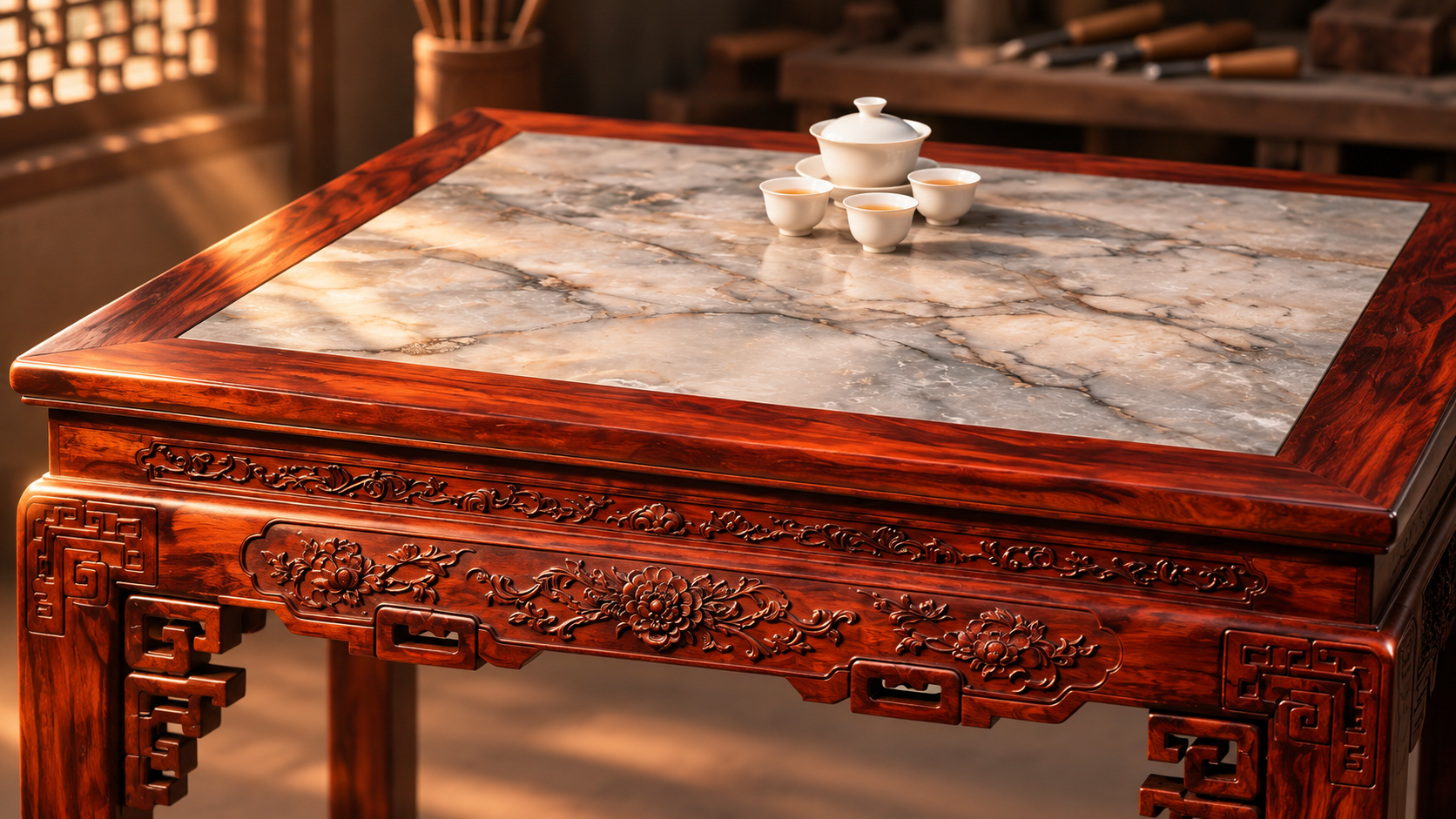
A workshop-side guide to stone inlay on Chinese rosewood furniture: how the grey-veined stone panel is set into a recessed groove, how wood movement is managed for overseas climates, and what B2B buyers should verify before ordering.
Ask a room full of furniture importers what they most want to understand about Chinese rosewood furniture, and the conversation almost always circles back to one question: how is the stone actually put in? Stone inlay rosewood furniture occupies a curious position in the export market. Buyers see the finished piece — a rosewood tea table with a quiet grey-veined stone panel set flush into the frame — and they recognize immediately that this is not a loose slab dropped into an opening, nor a thin veneer glued over particleboard. But the joinery underneath, the conditioning of the timber, and the logic that determines whether the panel stays seated for ten years or cracks in its first heated winter are rarely explained in supplier catalogs. That gap in information is understandable, because the process happens inside a workshop and rarely gets photographed, but it is a costly gap for a buyer who is about to commit a container load to a construction method they cannot inspect in person.
The consequences of badly executed inlay are specific and expensive. When the recess that holds a stone panel is cut without allowance for seasonal wood movement, the frame itself becomes the failure point: the rosewood swells against a rigid panel, stresses concentrate at the corners of the opening, and hairline cracks appear along the groove — often months after the furniture has been delivered, installed, and photographed for a hotel website. Conversely, when a panel is seated too loosely and bedded in filler rather than fitted into a precise groove, it shifts under daily use, rocks under a teapot, and eventually works free at one edge. Buyers in dry North American interiors and humid Southeast Asian coastal markets are buying the same construction into radically different climates, which makes the engineering of the inlay — not just the appearance of it — the central technical question of the category.
This guide is written from the workshop side of that question. We manufacture classical rosewood sets in Xianyou County, Fujian, and we will walk through the entire logic of stone inlay as we practice it, using one piece as a running example: our Classical Siamese Rosewood Square Tea Table with Inlaid Stone Top, an 85 x 85 cm table with a natural grey-veined stone panel set into a solid Dalbergia cochinchinensis frame. The first half of this guide explains why artisans inlay stone into rosewood in the first place, what materials are traditionally used, how the panel is actually set, and how the design accommodates wood movement in overseas climates. The second half follows with a material comparison, a buyer's inspection checklist, order and lead-time specifics, and answers to the questions importers most frequently raise at inquiry stage. Nothing here is a substitute for an inspection visit, but it should let you ask sharper questions — and recognize a well-made answer when you hear one.
Why Do Chinese Artisans Inlay Stone into Rosewood Furniture?
The pairing of hardwood and stone in Chinese furniture has roots that reach back well before the export market existed. Scholars of Chinese furniture generally point to the Ming dynasty (1368–1644) as the period when classical forms were codified: clean structural lines, hardwood frames joined with dismountable mortise-and-tenon connections, and a growing taste for contrasting materials set into those frames. Hardwood of the density rosewood buyers know today was difficult to work and therefore valued, and the great Ming literati tradition favored restraint — but even within that restraint, panels of mottled stone, particularly the swirling marble from Yunnan Province known as Dali stone, became sought-after surfaces for screens, table tops, and chair back splats. The stone was appreciated the way a collector appreciates ink paintings: each slab's veining was unique, and connoisseurs graded slabs by how much landscape — mountains, mists, rivers — they could read in the pattern.
The Qing dynasty (1644–1912) expanded both the vocabulary and the ambition of inlay work. Imperial and wealthy household workshops combined mother-of-pearl, hardstones, jade, agate, and even coral into furniture surfaces, sometimes in dense pictorial compositions and sometimes as thin outlines of floral or geometric motifs. Palace furniture of the period, much of it preserved in museum collections today, shows artisans inlaying materials into huanghuali and zitan with joints so fine the borders read as drawn lines. This was partly a demonstration of wealth and status — inlaid furniture is labor-intensive by definition — and partly an aesthetic position: the contrast between a dark, dense wood and a luminous or veined inlay gives a surface depth that neither material achieves alone. The tradition was carried forward by the regional schools, including the southern workshop culture of Fujian and Guangdong, where access to traded hardwoods and stone kept classical styles in continuous production even as dynasties changed.
Symbolism ran through much of this work, and it still matters to buyers who sell into markets where Chinese classical furniture is purchased partly for its cultural reading. Stone panels suggesting landscapes carried associations of stability, endurance, and the cultivated scholar's ideal of possessing mountains in miniature. Mother-of-pearl, with its cool iridescence, was associated with the moon and with water. Floral and cloud motifs carved or inlaid around an apron carried wishes for prosperity and continuity. We do not suggest that a hotel buyer needs to explain any of this to their guests, but we have watched project buyers use exactly these narratives — the landscape in the stone, the ruyi in the backrest — to position a furniture package at a higher price point than plain contemporary pieces achieve.
Set the romance aside, however, and a more practical rationale emerges, and this is the part that should interest a hospitality buyer most directly. A tea table is a working surface with an unusually hostile duty cycle. Hot teapots are set down on it repeatedly; water is spilled during pouring; cups leave rings; the surface is wiped dozens of times a day, often with a damp cloth. Dense rosewood tolerates this better than softwoods, but a solid wood top is still a wood top: repeated heat can mark the finish, standing water can leave whitening under lacquer, and daily wipe-downs accelerate wear on any film coating. A properly selected natural stone panel solves the two worst of those problems outright. Stone does not care about a hot teapot. Stone does not whiten under a splash. The rosewood frame then supplies what stone cannot: warm visual tone, structural strength, and hand-carved detail at the edges where hands and eyes actually travel.
This division of labor — stone as the working surface, wood as the structure and the ornament — is why the inlaid tea table has survived as a living form rather than a museum reproduction. In Chinese tea culture the table is the stage for the entire gongfu ritual: the kettle, the pitcher, the cups, the spilled first rinse. A surface that shrugs off heat and moisture is not a luxury feature on such a table; it is the feature. Our flagship example exists precisely because our domestic customers, who use these tables daily and unsentimentally, kept confirming that the stone-inlaid top outlasted every alternative in real tea service.
For overseas buyers the same logic translates with very little adaptation. Tea rooms, hotel lounges with Asian tea programs, restaurant private-dining rooms, and spa relaxation areas all subject a table to heat, water, and constant cleaning — and all of them want the visual richness of Chinese rosewood furniture without a maintenance burden their housekeeping teams will resent. An inlaid stone tabletop delivers a hard, wipe-clean, heat-tolerant surface wrapped in a classical carved frame. In our experience, that combination is the single most common reason project buyers specify this construction over an all-wood top.
There is one more rationale worth naming, because it shapes how the inlay must be engineered. Wood and stone move differently. Wood expands and contracts across the grain with every change in humidity; stone is dimensionally stable but brittle, and it has no capacity to forgive an enclosure that shrinks around it. The entire craft of setting stone into rosewood, then, is really the craft of managing that mismatch — letting the wood breathe while the stone stays put. That is not a modern insight; Qing-era artisans dealt with the same physics in the same climate. But it becomes sharply more important when a table built in humid coastal Fujian is shipped to a heated Colorado interior or an air-conditioned Singapore tower. The rest of this guide is largely about how we handle that translation.
What Materials Are Used for Inlay in Classical Chinese Furniture?
When buyers ask what goes "into" the inlay, they are usually picturing one material, but the classical repertoire is broader. The major traditions, as documented in museum scholarship and still practiced in workshops today, include hardstone panels, mother-of-pearl, and a family of related materials. A short orientation helps buyers read a piece — or a supplier's catalog — with a more accurate eye.
- Hardstone panels: natural decorative stone — most famously the veined marble tradition associated with Dali in Yunnan, along with other marbles and denser decorative stones — cut into slabs and set into screens, table tops, and chair back splats. The veining is entirely natural; no two panels are identical.
- Mother-of-pearl: thin sections of nacre from shell, inlaid flush into carved recesses to form motifs, borders, or full pictorial scenes. Historically associated especially with furniture from southern China, where the iridescent line-work against dark rosewood became a recognizable regional signature.
- Related materials: across different periods and workshops, artisans have also worked with jade, agate, and other semiprecious stones, generally for small decorative elements rather than structural panels. These appear more often in high-style revival pieces than in export production.
Of these, hardstone panels are the tradition most relevant to tea tables and other working surfaces, for the practical reasons outlined above: a stone panel is a genuinely durable top, whereas mother-of-pearl, for all its beauty, is a decorative surface meant to be admired rather than teapot-tested. General histories of Chinese decorative arts attribute the prestige of stone inlay largely to the connoisseurship of veining — the practice of reading landscapes in marble — and while we frame that as art-historical context rather than a claim about any particular workshop lineage, the underlying point is verifiable on any inlaid piece: every natural stone panel carries a pattern that cannot be repeated. For a buyer, that has two implications worth noting at inquiry stage. First, the panel you approve in a sample photo will not be the exact panel in a production run; a good supplier will send panel photos for approval on batch orders. Second, "natural stone" should mean exactly that — resin-filled or printed imitations exist in the wider market, and part of a buyer's inspection routine (covered later in this guide) should be confirming the panel is genuine stone with natural veining on both faces.
The panel in our flagship tea table is a natural grey-veined stone selected specifically for tea-service duty. At 1.5 cm thick, it has enough body to sit rigidly in the frame and to tolerate the thermal shocks of a working tea table — a kettle freshly off the boil, a cast-iron pot, a stack of warm cups — without the risks that a thinner, more brittle panel would carry. The grey veining reads as quiet against the deep red-brown of Siamese rosewood, which suits buyers who want the classical silhouette and the material contrast without the high-contrast drama of strongly figured marble. In showroom terms, it photographs as understated; in service terms, it wipes clean and does not stain from tea in normal use. We select the stone for heat and moisture resistance precisely because those are the two failure modes that generate warranty conversations in this category, and repeated contact with hot teapots and water spillage is not an edge case but the ordinary life of the product.
A note on the wood side of the pairing, because the stone is only half of the material question. Dalbergia cochinchinensis — Siamese rosewood — is among the densest of the rosewoods traded today. The Wood Database, a widely cited independent reference, lists it at approximately 2,430 lbf on the Janka hardness scale and around 1,035 kg/m3 average dried weight, with the caveat that individual boards vary. In practical terms, that density is what allows the frame to hold a crisp recessed groove over years of handling, and what lets carved apron details survive transport and daily cleaning. It is also why the timber demands careful drying before any inlay work begins — a point that becomes central in the next section. Buyers should be aware that D. cochinchinensis is a CITES Appendix II species, which affects documentation rather than quality; we return to that later in this guide.
Finally, a word on how materials interact at the seat of the inlay. The joint between stone and wood is where material science becomes craftsmanship. The stone needs a seat that is flat and evenly supported; the wood around it needs a finish that resists the water that will inevitably pool at the stone's edge during tea service; and the whole assembly needs geometry that tolerates the wood's seasonal movement without loading the stone. Different workshops resolve this differently — some bed panels in adhesive, some in flexible sealants, some in machined recesses with mechanical retention. We will describe our own approach honestly in the next section, including the inspection steps we use to catch a panel that is not properly seated, because a buyer who understands the joint is far better positioned to audit it.
How Is Stone Inlay Set into a Solid Rosewood Tabletop?
With the "why" established, we can now walk through the "how" as it actually happens on our floor in Xianyou, using the Classical Siamese Rosewood Square Tea Table with Inlaid Stone Top as the reference piece. The sequence below is the real production order, and each stage exists to protect a specific failure point. Buyers who visit factories will recognize the stages; buyers who don't can use this as a script for questioning any supplier in the category.
- Stage 1 — Timber selection and heartwood grading.
- Stage 2 — Kiln conditioning to 8–12% moisture content.
- Stage 3 — Frame joinery: mortise-and-tenon with bamboo dowels.
- Stage 4 — Cutting the recessed groove for the stone.
- Stage 5 — Seating and fitting the 1.5 cm stone panel.
- Stage 6 — Fit inspection of the inlay.
- Stage 7 — Hand-carving the apron motif.
- Stage 8 — Six-coat raw lacquer finish.
Stage 1 — Timber selection and heartwood grading. Every board destined for the frame is graded first, and the decisive criterion is the heartwood-to-sapwood ratio. Boards showing more than 20% sapwood are diverted to other product lines and never enter the primary frame of the tea table. This is not cosmetic fastidiousness: sapwood is markedly less dense and less dimensionally stable than heartwood, and a rail or leg containing a sapwood band will move differently from the pure heartwood around it — exactly the differential movement that, at a recessed stone seat, translates into a stressed inlay. Grading at the board stage is cheaper than discovering the consequence after the table is lacquered.
Stage 2 — Kiln conditioning to 8–12% moisture content. The graded timber then goes through a four-week kiln cycle. We condition to 8–12% moisture content using a gradual temperature ramp, and the cycle ends with a 48-hour equalization period — a hold at final conditions that lets moisture redistribute through the full thickness of each board so the surface reading reflects the core. The equalization stage is the one impatient schedules are most tempted to cut, and it is the one we protect most firmly. Wood that is dried on the outside but wet in the core will continue equalizing after manufacture, moving the frame around the stone panel months later. The 8–12% target is a deliberate middle band: low enough for heated interior climates, high enough not to over-dry the timber for humid ones. Our QC then re-verifies with a three-point moisture audit on finished components — readings outside the 8–12% window send the piece back for re-conditioning, not into the finishing room.
Stage 3 — Frame joinery. The frame is assembled with mortise-and-tenon joints cut to a 16 mm tenon depth on the apron-to-leg connections, reinforced with bamboo dowel pins. There are no metal fasteners in the primary frame. The 16 mm depth is not arbitrary: it gives the tenon enough bearing face to resist racking loads — the twisting force a table takes when someone leans on an edge — while leaving adequate wood section on either side of the mortise in an 85 x 85 cm frame carrying a stone panel. Bamboo dowels, swelled into the drilled holes, lock the joints mechanically and keep the assembly fully wooden. This matters for inlay work more than buyers might expect: a frame joined with rigid metal screws does not flex seasonally the way a traditional wooden joint does, and the difference concentrates stress at the stiffest point — often right beside the stone recess.
Stage 4 — Cutting the recessed groove. The stone's seat is a recessed groove machined into the rosewood frame, sized for the 1.5 cm panel. The key design decision is that the groove is recessed — the stone sits down inside the frame below the wood's sightline — rather than surface-mounted. A recessed seat provides even, all-around support under the panel, protects the stone's edge from knocks, and keeps the stone's perimeter sheltered from the spills that pool on a tea table. The groove's geometry is cut to accommodate the panel with the intended clearance, which is the mechanism that lets the surrounding wood expand and contract with humidity changes without transmitting those forces into the stone or cracking either material. In our construction, that clearance — together with the moisture conditioning above — is the engineered answer to wood movement; the next section discusses the philosophy in more depth.
Stage 5 — Seating the stone panel. The 1.5 cm stone panel is then set into the groove. The objectives at this stage are flat seating (no rocking, no voids under the panel that could become flex points) and even bearing around the perimeter. Because the panel is natural stone, each one is handled individually — veining orientation is checked, thickness verified against the groove depth, and the fit made panel-by-panel rather than assumed from a nominal dimension. A stone panel that is force-fitted into a slightly undersized groove may look correct at delivery and fail in a dry season; a panel left floating loosely will shift under use. The correct fit is snug at rest with the designed clearance preserved for movement, and achieving it on natural material means hand-fitting, every time.
Stage 6 — The fit inspection. Every inlaid top goes through a dedicated seating and fit inspection: the panel is checked for shift, and any panel that moves is re-set before the piece proceeds. This QC gate exists because seating problems are invisible once lacquer and packaging hide them, and because the cost asymmetry is enormous — re-setting a panel on the bench takes minutes; replacing a cracked panel in a delivered hotel lounge takes a freight claim. Buyers auditing a supplier should ask exactly this question: is inlay seating a named inspection point with a pass/fail criterion, or is it folded into a general "final check"? The specificity of the answer tells you a great deal.
Stage 7 — Hand-carving the apron. With the inlay proven sound, the aprons receive their carved decoration: a floral and geometric motif worked in shallow relief at a depth of 2–3 mm, using chisels of 2–8 mm width. Each table takes approximately 14 carving hours. Shallow relief is a deliberate choice, not a shortcut — at 2–3 mm the carving reads clearly, keeps its crisp edges under cleaning, and does not remove enough wood section from the apron to weaken the members that carry the top. Depth is verified with a depth gauge at five points per apron section, which keeps the relief consistent across a batch and gives QC an objective measurement rather than a subjective opinion. For buyers, carved depth is one of the easiest things to check on a sample: too-shallow carving looks flat and printed; too-deep carving on an apron this size would raise legitimate structural questions.
Stage 8 — Six-coat raw lacquer. The finish is built from six coats of raw lacquer, each cured for 24 hours and hand-rubbed with pumice stone before the next. The hand-rubbing between coats is what produces the deep, quiet surface associated with classical Chinese furniture — each coat burnishes the previous one, and the pumice removes dust nibs and evens the film so no single coat reads as a layer. Around the stone, the lacquer system serves a functional role as well: the sealed wood at the groove's edge is far more resistant to the water that pools at the inlay line during tea service than bare or lightly finished timber would be. Six coats over four-plus weeks of curing time is a genuine cost, and buyers comparing quotations across suppliers should treat an implausibly fast or cheap finish claim as a data point about what else may have been shortened.
One honest caveat closes this section. Our load verification — a 60 kg distributed load held for 24 hours on 15% of each production batch — is an internal workshop procedure, not a third-party certified test. We state it as evidence of consistent in-house process, and buyers who need certified structural data for their own compliance files should raise that requirement at inquiry so we can discuss what documentation is and is not available. We would rather a buyer know the exact provenance of every claim in this section than treat any of it as more than it is.
How Does Stone Inlay Interact with Wood Movement in Overseas Climates?
Every import buyer eventually meets wood movement, usually in the form of a complaint that arrived nine months after delivery: a top that no longer sits flat, a hairline at a joint, a panel edge that has risen. Solid wood is hygroscopic — it exchanges moisture with the air and changes dimension across the grain as it does. Dense rosewood moves less than many woods, but it moves. A table kiln-dried in coastal Fujian and installed in a dry, heated North American interior will slowly lose moisture and shrink across the grain; the same table in a humid Southeast Asian monsoon season will gain moisture and swell. Neither direction is a defect in the wood; both are physics. The design question is whether the furniture is built to absorb that movement or to fight it.
Our approach to the stone-inlaid tea table is to make the enclosure around the stone forgiving rather than rigid. As described above, the panel sits in a recessed groove engineered with clearance, so that as the rosewood frame expands and contracts with seasonal humidity, the wood moves within its designed allowance instead of pressing against the dimensionally stable stone. The kiln conditioning to 8–12% moisture content is the other half of the strategy: by bringing the timber to a moisture level that sits between the extremes of dry-heated and humid-climate interiors, we reduce the amplitude of movement the frame will experience in service, wherever it is installed. We describe this carefully as design intent: sound conditioning and clearance dramatically reduce the risk of cracking or panel stress, but no solid-wood furniture can be promised to be movement-free in every possible interior, and a supplier who promises otherwise should be treated with caution.
The same philosophy can be executed in a second way, and our sister product shows it. The Classical Siamese Rosewood Tea Table with Carved Cloud Apron — 80 x 50 x 38 cm, with roughly 12 carving hours in its cloud motif — uses a floating-panel tabletop: the panel is fitted inside the frame groove with a 4 mm expansion gap on each side, so seasonal movement is absorbed by the structure itself. The frame holds the panel's edges but never clamps its faces; when the panel shrinks in a dry winter, the gap simply widens slightly, and when it swells in a humid summer, the gap takes up the expansion. This is the same principle traditional Chinese joiners have applied for centuries in panelled doors and table tops, and it remains the cleanest solution in solid-wood construction. For an inlaid stone top, the floating concept must be adapted — stone cannot be left with a visible gap at its edge in the same way — which is why the recessed-groove approach with engineered clearance is our chosen method for the flagship piece.
Buyers can support this engineering with a simple, free intervention: humidity guidance at the point of installation. For the floating-panel table we recommend an indoor relative humidity of 40–60%, and that range is sound guidance for solid rosewood furniture generally. Most hotel, restaurant, and office interiors already operate within or near that band for human comfort; the environments that threaten rosewood are the extremes — unheated vacation properties, rooms with aggressive dehumidification, furniture placed directly against blowing HVAC vents or next to radiators. We advise project buyers to include basic placement guidance in their own installation documentation: keep solid rosewood out of direct airflow from heating and cooling outlets and away from windows with intense direct sun. None of this replaces good construction; it simply removes the abnormal stresses that even good construction is not designed to absorb.
Finally, buyers should understand what this means for sourcing decisions across a whole container. Because the 8–12% conditioning target and the movement-accommodating joinery are baked into production rather than added afterward, there is no configuration option to trade away — a supplier offering solid rosewood at a price that implies shorter drying cycles or glued, fastened frames is offering different physics, not a better deal. The questions we suggest buyers put to any supplier in this category are straightforward: What is the target moisture content, and how is it verified after manufacture? How is the inlaid panel retained, and what clearance is designed for movement? Is there a named inspection for panel seating? We answer all three in this article because we are comfortable with our answers; The second half of this guide turns to the commercial side — comparing inlay materials, a buyer's inspection checklist, ordering and lead-time details, and how to match construction to project type.
Stone Inlay vs Mother-of-Pearl Inlay: Which Suits Your Product Range?
Walk through any showroom of classical Chinese rosewood furniture and you will eventually find yourself comparing two very different inlay traditions sitting side by side: stone inlay and mother-of-pearl inlay. Both have long histories in Chinese decorative woodworking, and both continue to be produced in workshops today, though the specifics of any given workshop's methods vary. For an importer building a catalog, the choice between them is less about which is "better" and more about which behavior, cost profile, and visual language fits the products you sell and the customers you sell to.
| Comparison Point | Stone Inlay | Mother-of-Pearl Inlay |
|---|---|---|
| Look and feel | Broad, continuous surfaces with natural veining; a cool, matte-to-soft sheen that reads as architectural. Each panel is unique in its grain pattern. | Small-scale, iridescent detail worked into carved or flat grounds; catches and shifts light at angles. Reads as fine, jewelry-like ornamentation. |
| Best use | Tabletops and large functional surfaces — tea tables, dining tables, console tops — where the surface itself is the design statement. | Accent detail on cabinet fronts, chair rails, aprons, and smaller decorative fields; often combined with carving rather than replacing it. |
| Heat and moisture behaviour | The grey-veined stone used on our tea table is selected specifically for heat and moisture resistance, because it will meet hot teapots and spilled water repeatedly. General stone behaviour varies by type, so buyers should confirm the specific material. | Shell is organic and comparatively thin; prolonged heat or standing moisture is generally not its friend, so it is usually specified away from primary hot-contact zones. Buyers should treat this as a general tendency, not a laboratory result. |
| Carving/craft time implications | Time concentrates in stone selection, cutting, and seating the panel into the frame groove; the surrounding carving (on our square tea table, about 14 hours of shallow-relief floral and geometric work) proceeds on the wood itself. | Time concentrates in cutting, shaping, and setting many small pieces; labor accumulates piece by piece, which typically makes fine pearl work slower per decorated area. Exact hours depend on pattern density in any workshop. |
| Typical project fit | Hospitality and contract settings — hotel tea rooms, lobbies, villa living rooms — where surfaces must survive real daily use and still look distinctive. | Retail and collector-oriented lines, gift-format pieces, and heritage-style cabinets where visual delicacy is part of the appeal and handling is gentler. |
The practical difference for importers comes down to where the piece will live. A rosewood tea table destined for a hotel tea room takes hot pots, wet cups, and cleaning cloths every day. That is exactly the brief our Classical Siamese Rosewood Square Tea Table with Inlaid Stone Top was built around: the 1.5 cm grey-veined stone panel is chosen for heat and moisture resistance, and the recessed groove it sits in allows the rosewood frame to expand and contract with humidity changes without cracking either the stone or the frame. Mother-of-pearl, by contrast, is usually happiest as ornament rather than work surface.
There is also a merchandising argument. An inlaid stone tabletop gives you a story you can put in a single photograph — the veining is unique per table, which is genuinely useful in product listings because no two units look identical. Pearl inlay tells its story in close-up detail shots. If your e-commerce or trade-show presentation rewards hero images of large surfaces, stone leads; if it rewards craftsmanship close-ups, pearl earns its place.
Finally, consider mixing the two across a range rather than within one SKU. Many importers of Chinese rosewood furniture carry a stone-inlaid tea and dining line as their contract backbone and a carved or pearl-accented line for higher-margin boutique pieces. The manufacturing logic supports this: the same frame joinery, the same lacquer process, and the same drying discipline carry over; only the surface treatment and the labor allocation change.
What Should B2B Buyers Verify Before Ordering Inlaid Rosewood Furniture?
Inlay is one of those features where problems do not show up in a photograph. A stone panel can look perfectly seated in a catalog image and still work loose after its first humid summer in a Florida warehouse. The checklist below is what we would ask any supplier — including ourselves — before committing to a container of stone inlay rosewood furniture.
- Stone seating and fit: ask how the panel is held in the frame and what happens if it does not fit. Is it bedded in a recessed groove that tolerates wood movement, or simply glued into a cutout?
- Wood moisture conditioning: ask what moisture content the timber is dried to, over what schedule, and whether equalization is part of the cycle.
- Joinery method: confirm whether the primary frame uses mortise-and-tenon construction and what reinforces the joints, or whether metal fasteners carry the load.
- Lacquer build: ask how many coats are applied, how each cures, and whether the surface is hand-rubbed between coats.
- Sample ordering: confirm the minimum order for a single evaluation piece and what lead time applies to it.
- Documentation: confirm exactly which export documents ship with the goods — species permits, HS classification, drying records.
- Warranty scope: ask precisely which components are covered, for how long, and under what conditions of use.
On stone seating: the point is not merely that the stone fits on day one, but that it continues to fit as the wood around it moves. Our square tea table sets the stone panel into a recessed groove in the rosewood frame for exactly this reason, and our QC includes a stone inlay seating and fit inspection in which any panel that shifts is re-set before it leaves the workshop. When you evaluate a supplier, ask them to describe their rejection criterion, not just their assembly method. A workshop that can tell you "a panel that shifts is re-set" has thought about the failure mode; one that only says "the stone is glued in tightly" has not.
On moisture: rosewood that is not properly conditioned will move, and the first casualty is usually the inlay it surrounds. Our timber is kiln-conditioned to 8–12% moisture content over a four-week cycle with gradual temperature ramping, followed by a 48-hour equalization period, and QC includes a three-point moisture audit in which any reading outside the 8–12% band sends the board back for re-conditioning. Ask prospective suppliers for their target range and their audit method. A single moisture meter reading at final inspection is worth far less than an audit at multiple points on every board.
On joinery and finish, the same logic applies: you want process descriptions, not adjectives. Our apron-to-leg connections are cut as mortise-and-tenon joints with 16 mm tenon depth, reinforced with bamboo dowel pins, with no metal fasteners in the primary frame — a construction choice that matters for anything crossing an ocean, because rigid metal joints and shrinking wood fight each other. The finish on our tea table is a six-coat raw lacquer process, each coat cured for 24 hours and hand-rubbed with pumice stone. If a supplier cannot describe their lacquer schedule in comparable terms, that is information too.
On samples and documentation: order a physical sample before any volume commitment, and insist on paperwork before the container books. Our shipments include CITES export permits (Dalbergia cochinchinensis is listed in CITES Appendix II), a commercial invoice with HS code 9403.60, and a wood drying certificate, and our FSC chain-of-custody certification is in progress. Buyers who need third-party certified test data should raise that requirement at inquiry — our load checking, for instance, is an in-house workshop procedure (a 60 kg distributed load for 24 hours on 15% of each batch), not a third-party test report, and we say so plainly rather than letting buyers assume otherwise.
Finally, put the warranty in writing and read what it actually names. Our 24-month structural warranty covers the joinery, the frame, and the stone inlay seating under normal indoor use. That last qualifier matters: an inlaid stone tabletop installed outdoors, or in an unheated warehouse at 20% relative humidity, is outside any reasonable definition of normal indoor use, and a supplier who promises otherwise is promising something no solid-wood product can keep. The honest version of this conversation is the one worth having before the deposit, not after the claim.
How Do Inlay Details Affect MOQ, Lead Time and Logistics?
Inlay changes the commercial math of an order less than buyers often fear — but in a few specific places that are worth knowing in advance. Here is how it actually works on our floor, using the square tea table as the reference product.
On quantity: our minimum order is 1 piece, with volume pricing from 10 pieces. That single-piece MOQ exists partly because an inlaid piece is a complete product in itself — a buyer can order one tea table, evaluate the stone fit, the lacquer, the carving, and the packaging, and make a decision on evidence rather than on renderings. A 20-ft container fits roughly 65 of these 85 x 85 cm tables, so the step from sample to full container is well defined.
On lead time: 1–4 pieces run 35–50 days from deposit confirmation, excluding shipping, while batch orders of 5 or more run 60–75 days. The extra time for batches is not padding. Stone selection is inherently sequential — panels are matched and graded, and a batch order means matching more panels — and the QC load scales with it: carving relief depth is checked with a depth gauge at five points per apron section, and every panel goes through the seating inspection. Carving time alone is roughly 14 hours per table for the floral and geometric apron motif, cut with chisels from 2–8 mm in width at a 2–3 mm relief depth, and that labor does not compress.
On customization timelines: if you want your own motif or dimensions, our OEM/ODM design approval cycle runs 15 days, and that approval period sits ahead of production. A buyer who finalizes drawings in week one can realistically hold a standard 60–75 day batch schedule; a buyer who revises drawings three times should not be surprised when the calendar moves. Build the approval window into your buying calendar explicitly.
On logistics: inlaid pieces ship in ISPM-15 heat-treated wooden crates with EPS foam corner blocks and acid-free tissue wrap, and the packaging has passed a 1-metre drop test. The corner-blocking matters specifically for stone-inlaid tops, because the most common transit damage to any table is a corner impact transmitted into the top. If your supplier's packaging specification does not mention how corners are protected, ask.
| Order Scenario | Quantity | Lead Time (from deposit, excl. shipping) |
|---|---|---|
| Sample / evaluation order | 1–4 pieces | 35–50 days |
| Batch order | 5+ pieces | 60–75 days |
| Full container reference | ~65 tea tables | Per 20-ft container |
Can Inlay Patterns and Stone Choices Be Customized for Your Brand?
Yes — within the honest limits of the craft. Our OEM/ODM program supports customization of motifs, dimensions, and surface treatments, with a 15-day design approval cycle from the time a workable drawing reaches our design team. For a brand building a signature line of Chinese rosewood furniture, that approval cycle is where your identity gets baked into the product, and it is worth treating as a real milestone rather than a formality.
What should you prepare? Three things shorten the cycle and improve the outcome. First, motif references: photographs or line drawings of the carving style you want — cloud motifs, floral relief, geometric borders — ideally showing depth and density, since a 2–3 mm shallow relief reads very differently from deep carving. Second, dimensions and proportions: our standard tea table tops at 85 x 85 x 42 cm, but if your villa or hospitality project needs a different footprint, tell us early, because panel size changes stone selection and frame engineering together. Third, stone preferences: if you have seen a veining character you like — tighter, greyer, more dramatic — send a reference image. Natural stone varies slab to slab, so references set expectations better than exact-match promises ever could.
What are the honest limits? A few. Natural stone means we can select for veining character but not guarantee an identical pattern across every unit — that uniqueness is a property of the material, and frankly one of its selling points. Carving depth and density affect labor hours, and significant changes to motif complexity will move the lead time accordingly. And where our facts end, we say so: buyers needing third-party certified test data, specific FSC status beyond our in-progress chain-of-custody certification, or unusual stone types should raise those at inquiry so we can confirm feasibility before the deposit rather than negotiate afterward. A supplier who confirms everything cheerfully at first contact and discovers problems at production is not doing you a favor.
One practical suggestion for brand buyers: customize the apron motif before you customize the stone. Carving is where a range becomes recognizably yours — a signature ruyi scroll or cloud border on the apron ties a whole product family together across tea tables, armchairs, and cabinets, while the stone surface remains the naturally varied counterpoint. Our carved cloud apron tea table, with roughly 12 hours of hand carving, is an example of how a single motif decision shapes the identity of an entire SKU.
Which Projects and Spaces Fit Inlaid Rosewood Furniture Best?
The strongest fit for an inlaid stone tabletop is anywhere a surface must be both decorative and durable. Tea rooms are the archetype: a rosewood tea table with a stone-inlaid top takes hot teapots and repeated water contact directly on the surface — which is precisely the duty the grey-veined stone on our square tea table was selected for — while the shallow-relief carving on the apron keeps the piece rooted in the classical tradition tea culture expects.
Hotel lobbies and reception areas are the second natural home. These are spaces where furniture is seen up close but used constantly, and where a single distinctive hero piece often carries the design brief. An 85 x 85 cm tea table with a naturally veined stone top and hand-carved apron works as that anchor piece beside a seating group, and the six-coat hand-rubbed lacquer finish holds up to the cleaning regimes contract environments demand far better than fragile surface treatments.
Villa living rooms and high-end residential projects make up the third category, and here the argument shifts from durability to provenance. Buyers at this level respond to the story — solid Dalbergia cochinchinensis, mortise-and-tenon construction with bamboo dowel pins, fourteen hours of hand carving, no metal fasteners in the primary frame. For interior designers specifying Chinese rosewood furniture for a villa, those details are the difference between "Asian-style furniture" and a piece with a documented making process.
Boutique hospitality — boutique hotels, private clubs, high-end tea houses and restaurants — combines the two arguments. These projects need surfaces that survive commercial use, but they also need every piece to feel singular. Natural stone veining delivers that singularity for free: no two tabletops in a twenty-cover tea room will look alike, which guests notice and photograph. For buyers assembling mixed spaces, the carved cloud apron tea table at 80 x 50 x 38 cm offers a smaller footprint for tight floor plans, with a floating-panel top set with a 4 mm expansion gap on each side and a recommended indoor relative humidity of 40–60% — a useful specification to pass along to the facility's building management.
A styling note for project buyers: stone-inlaid rosewood reads most convincingly in spaces with natural materials and directional light. The veining in the stone and the grain of the rosewood both respond to side light, so positioning these pieces near windows or under warm spot lighting does more for them than any accessory styling. Conversely, in dim, heavily carpeted settings, the same piece can read heavy — worth flagging to your design clients before the container lands.
Where Can You See These Inlay Techniques in a Real Product Line?
Everything discussed above — the recessed groove, the moisture conditioning, the carving depth checks, the CITES paperwork — is not theoretical. It is visible in specific products in our current line, and the fastest way to evaluate any of it is to look at the pieces themselves. Three starting points:
- Classical Siamese Rosewood Square Tea Table with Inlaid Stone Top — the reference product for this entire guide, showing the heat- and moisture-resistant grey-veined stone panel seated in a recessed groove of the rosewood frame, with the 14-hour carved apron and full QC and documentation package described above.
- Classical Siamese Rosewood Tea Table with Carved Cloud Apron — the floating-panel comparison piece, with a 4 mm expansion gap per side and a 12-hour hand-carved cloud motif, useful for buyers deciding between stone-set and movement-tolerant wood-panel tops.
- Classical Siamese Rosewood Armchair with Carved Ruyi Backrest — the natural companion seating for either tea table, showing how a shared motif family carries across a set for hospitality or villa projects.
Key Takeaways for Importers
- Stone inlay is a structural decision, not a decorative one: the recessed-groove method exists so wood movement cannot crack the panel, and it is the first thing to verify with any supplier.
- Stone-inlaid tops suit functional, contract-grade surfaces; mother-of-pearl suits accent and collector pieces — build your range accordingly rather than forcing one material into every role.
- Ask for process specifics, not adjectives: moisture targets (ours: 8–12% with a 48-hour equalization), tenon dimensions (ours: 16 mm with bamboo dowel pins), lacquer coats (ours: six, cured 24 hours each, hand-rubbed).
- Order a single sample first — the MOQ is 1 piece for a reason — then scale to volume pricing from 10 pieces, roughly 65 tables per 20-ft container.
- Budget the 15-day OEM/ODM design approval cycle into your calendar, and finalize motif, dimensions, and stone references before the deposit to protect the 35–50 or 60–75 day lead times.
- Confirm documentation before booking: CITES export permits for Dalbergia cochinchinensis, HS code 9403.60 invoicing, and the wood drying certificate should be standard, not negotiable.
Buyer FAQ
Does stone inlay crack during shipping?
It should not, when the crate is engineered for it. Our pieces ship in ISPM-15 heat-treated wooden crates with EPS foam corner blocks and acid-free tissue wrap, and the packaging has passed a 1-metre drop test. The recessed-groove seating also means the stone is not rigidly bonded to wood that may shift in transit humidity.
Can I order a single sample piece with inlay?
Yes. Our minimum order quantity is 1 piece, and sample orders of 1–4 pieces run 35–50 days from deposit confirmation, excluding shipping. Volume pricing begins at 10 pieces once you are ready to scale.
What documentation ships with an inlaid rosewood order?
Every shipment includes CITES export permits for Dalbergia cochinchinensis, a commercial invoice with HS code 9403.60, and a wood drying certificate. FSC chain-of-custody certification is currently in progress; if your compliance program requires certified timber claims, please confirm the status at inquiry.
How should inlaid pieces be cleaned and maintained?
Treat the stone top as a working surface — it is selected for heat and moisture resistance against hot teapots and spills — but clean it with a soft, damp cloth and avoid abrasive or acidic cleaners, which is sensible guidance for any natural stone. Keep indoor relative humidity in the 40–60% range recommended for our floating-panel pieces, and place the furniture away from direct heat sources and prolonged strong sunlight. Our 24-month structural warranty covers joinery, frame, and stone inlay seating under normal indoor use.
Is Dalbergia cochinchinensis regulated, and what does that mean for my import?
Yes. Dalbergia cochinchinensis is listed in CITES Appendix II, so international trade requires CITES export permits, which we supply with every shipment. For your side, that means your import documentation should reference the same species listing; buyers importing into the EU, US, or Australia should confirm their national implementation requirements with their customs broker, as procedures vary by destination.
Can the inlay stone be swapped for another material?
Stone selection can be discussed through our OEM/ODM program, subject to the 15-day design approval cycle, and we will confirm feasibility honestly at inquiry. What we will not do is promise an exact vein match across units, because natural stone varies slab to slab. If you are considering a non-stone material for the inlaid tabletop, raise it early so heat, moisture, and movement behaviour can be assessed before production rather than after.
If any of this matches what your market needs, the next step is simple: send us your destination port, your preferred Incoterm, your target quantity, and any customization requirements — motif references, dimensions, or stone preferences — and we will respond with a concrete quotation and timeline. A single sample order is the lowest-risk way to see the inlay, the joinery, and the finish for yourself before committing to a container, and our team in Xianyou is happy to walk you through the specification piece by piece.
We exhibit at the Canton Fair and the Shanghai International Furniture Fair, so if you would rather evaluate these techniques in person before ordering, let us know and we can arrange a meeting or a factory visit around the next show. However you start the conversation, bring your questions about moisture, seating, and paperwork — the suppliers who answer them precisely are the ones worth shipping with.