
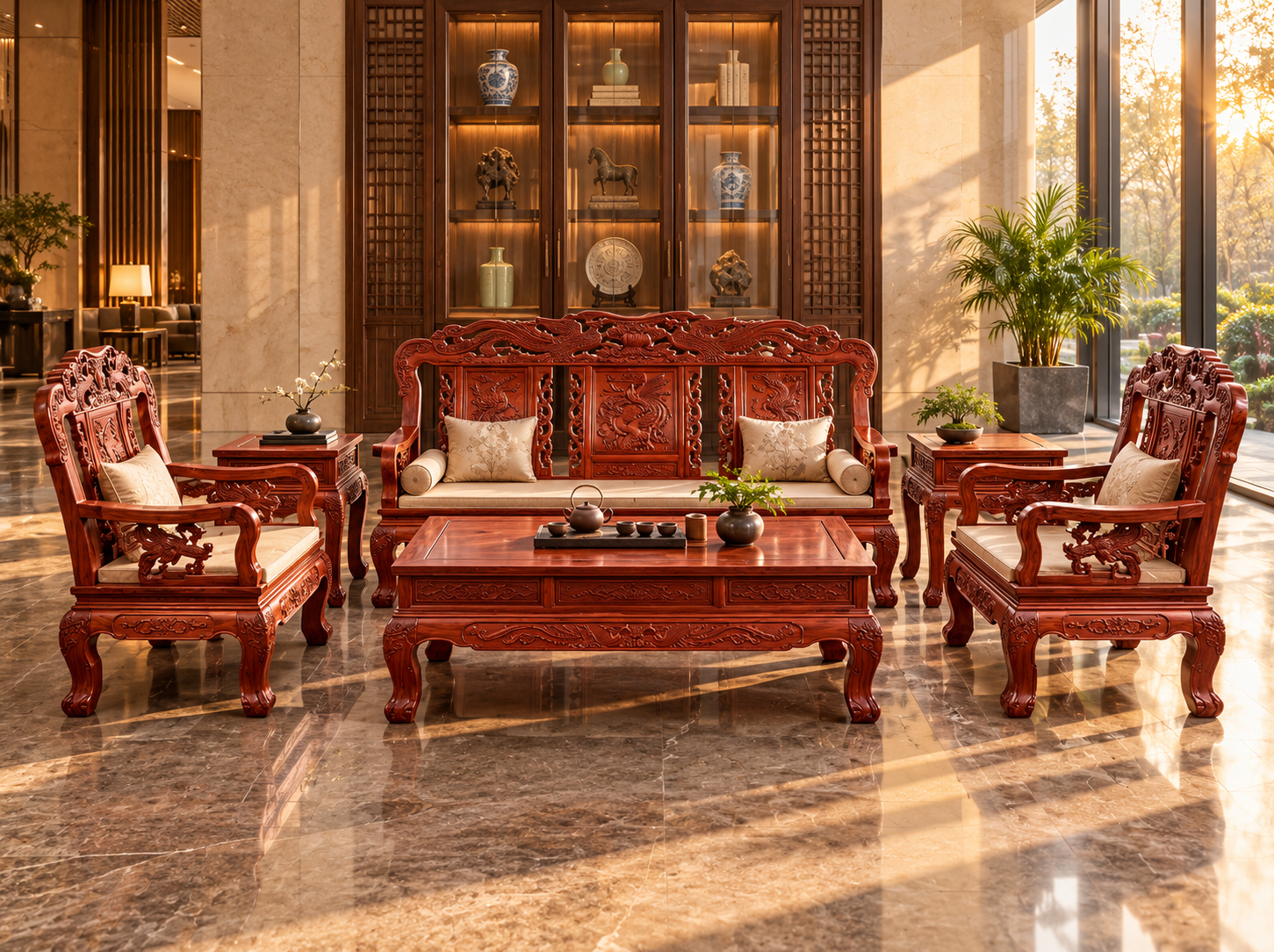
A six-criterion evaluation and shortlisting checklist for hotels, resorts and villa projects: customization depth, production capacity, timber compliance, pre-shipment QC, export packaging and after-sales terms when choosing a rosewood hospitality furniture manufacturer.
Why the Manufacturer Decision, Not the Product Photo, Decides the Outcome of a Hospitality Project
Most hospitality procurement teams begin their search for hospitality furniture manufacturers the same way: with a photograph. A carved rosewood sofa set in a well-lit lobby, a twelve-seat dining arrangement, a lattice-fronted display cabinet. The photograph answers one question — does this piece look right for our property? It answers nothing about the questions that actually determine whether a hotel, resort or villa project lands on time, on budget and to specification: whether the factory can adapt that piece to your floor plan, whether it can repeat the same finish across dozens of units months apart, whether it can document the timber legally, and whether it packs and loads furniture so that it survives a container journey and a hotel installation schedule.
This distinction matters more in classical rosewood furniture than in almost any other FF&E category. A sofa upholstered in a contract fabric from a catalogue is largely a specification exercise. A hand-carved Siamese rosewood reception set — such as our Auspicious Phoenix Carved Redwood Sofa 6-Piece Reception Set, with its hand-carved phoenix-and-peony backrest panels and eight-coat raw lacquer finish — is a piece of manufacturing with a long production chain behind it: timber selection, seasoned material, carving benches, layered lacquer work that cannot be compressed by adding shifts. Choosing the photograph is easy. Choosing the hospitality furniture factory that can deliver that photograph at project scale is the real procurement decision, and this guide is written to help buyers do it methodically.
We write from the standpoint of a manufacturer. Yunxiao Rosewood Furniture Co., Ltd. specializes in classical redwood furniture sets — sofa, dining and bedroom lines — in Siamese rosewood (Dalbergia cochinchinensis), and we export to B2B buyers including hotels, resorts and villa projects. In this article we deliberately avoid telling you where to source or how to audit a supplier; other articles on our site cover sourcing channels and factory verification. Here we focus on the evaluation criteria themselves: what separates a manufacturer that can support a hospitality specification from one that can only fulfil a retail order, and what evidence a buyer should demand at each stage of shortlisting rosewood hotel furniture suppliers.
What "Hospitality-Grade" Rosewood Furniture Actually Requires
Before evaluating any manufacturer, it is worth being precise about what a hotel, resort or villa specification demands that a residential retail order does not. Buyers who can articulate these four requirements clearly will find that many suppliers disqualify themselves early — which is exactly what an efficient shortlisting process should achieve.
Public-area traffic and longevity expectations
Hotel lobby seating is used continuously by guests with luggage, in varied climates, often around the clock. Solid rosewood construction handles this well — Dalbergia cochinchinensis is dense and stable — but the finishing system matters as much as the timber. Our sofa and dining lines use traditional raw lacquer applied in multiple coats (six coats on the Classical Siamese Rosewood Tea Table with Bamboo Carved Apron, eight coats on the Phoenix reception set), and our dining line applies FDA-compliant glossy lacquer where food contact is a factor. When you evaluate hospitality furniture manufacturers, ask what the finishing system is, how many coats are specified, and what the lacquer is rated for — not simply whether a piece "looks finished."
Consistency across rooms, units and phases
A villa project might need twelve identical tea tables. A resort might need the same dining set in three restaurant phases delivered six months apart. Repeating carved, hand-finished solid-wood furniture to a consistent standard is a genuine manufacturing discipline: colour matching across timber batches, carving depth held to a common pattern, lacquer tone held to a reference. When we produce a set like the Ming Style Siamese Rosewood Sofa 9-Piece Grand Living Room Set — with open-slat backrests and carved chrysanthemum medallions designed for 40–60 sqm hospitality and residential spaces — the ninth piece must match the first. Ask any manufacturer you shortlist how they control that, and ask to see it demonstrated, not described.
Documentation for import compliance
Rosewood species are regulated. Our dining line, the Square Redwood Dining Table 12-Seat Banqueting Set with Carved Chairs, is supplied with FSC plus CITES documentation for hospitality buyers — the site also publishes an article on how FSC-certified timber compliance works when importing rosewood furniture from China. A manufacturer that cannot state precisely which documentation applies to which species and destination is a compliance risk transferred onto your project. This is a shortlisting question, not a post-order detail.
Mixed custom and catalogue scope
Almost every hotel project combines catalogue adaptation with genuine customization: a standard reception set in the lobby, modified display cabinets for the library lounge, dining seating matched to the F&B designer's concept. A capable supplier moves fluently between the two. Our Classical Siamese Rosewood Display Cabinet with Carved Lattice Doors — 100 x 40 x 180 cm, hand-carved lattice glass doors, floating-panel construction, hand-cut dovetail drawers, seven-coat raw lacquer — is a typical example of a catalogue piece that hotel buyers regularly adapt in dimensions, glass specification or carved detail. The evaluation question is not "do you have a catalogue" but "how deep does your customization go behind the catalogue?"
Evaluation Criterion 1 — Customization Depth: OEM/ODM Drawings, Sampling and Finish Matching
Customization depth is the first and most revealing criterion, because it exposes the difference between a trading company that forwards drawings and a hospitality furniture factory that engineers them. Rosewood furniture OEM for hotels is not a matter of printing a logo; it is a matter of translating an interior designer's intent into joinery, carving and finish that a carving bench and a lacquer room can actually execute.
What to examine in the drawing stage
A capable rosewood furniture manufacturer should be able to work from three levels of input:
- Layout drawings from your side. Your FF&E consultant or designer provides furniture layouts, elevations or reference images. Ask the supplier to translate these into technical production drawings — dimensions, joinery method, carving placement, finish specification — and to flag where a designer's intent conflicts with what solid rosewood construction allows. A supplier who never pushes back is a supplier who has not understood the drawing.
- Catalogue adaptation. For pieces like the Ming-style nine-piece set or the display cabinet line, ask what parameters can genuinely change: seat dimensions, table height, cabinet width, carving motif, glass type, lacquer sheen. Get the answers in writing against each product line, because the honest answer differs by piece.
- Carved-motif adaptation. Hand carving is the heart of classical rosewood work and also the area where customization claims most often collapse. Our Phoenix reception set carries hand-carved phoenix-and-peony backrest panels; a hotel buyer may want a different motif tied to the property's story. Ask how a new motif is developed: who draws it, who carves the master panel, how the pattern is reproduced consistently across panels and across future repeat orders.
What sampling demonstrates
The sample stage is where you learn whether the supplier's words describe a real workshop. A capable hospitality furniture factory will typically demonstrate:
- Prototype iteration. Not a single museum-grade showpiece, but a working prototype that matches the production method — same joinery, same carving process, same finishing sequence — so that what you approve is what ships.
- Finish matching to a reference swatch. Provide your designer's colour and sheen reference and ask for a lacquer sample panel produced on the same timber and with the same coat count as production. Raw lacquer tone develops through the coats; a finish matched on a different substrate or with fewer coats will not hold true in production.
- Honest limits. Ask what the factory will not do. On our tea table line, for example, the mortise-and-tenon joinery and horse-hoof legs are structural Ming-style features we would not substitute with cheaper joinery, even if a drawing suggested it — and our tea-table line is well suited to buyers testing a design before committing to volume. A manufacturer who names its constraints is easier to work with than one who accepts everything and negotiates quality later.
Questions to put to every shortlisted supplier
- Who produces the technical drawings, and in what format will we review them?
- How many sample/prototype rounds are included, and what does each round change?
- Can you match a finish swatch on the same species and coat count as production?
- How is a new carved motif archived so repeat orders match the first delivery?
- Which of our specified changes would you decline, and why?
The answers — and, more importantly, the willingness to answer in specifics rather than assurances — should directly shape your shortlist. Our own article on how a rosewood furniture factory supports hotel and villa projects from layout drawings to container delivery describes the workflow behind these questions in detail.
Evaluation Criterion 2 — Production Capacity and Repeat-Container Delivery
Capacity is the criterion buyers most often misjudge, because capacity in carved solid-wood furniture does not behave like capacity in upholstered or panel furniture. A hospitality furniture factory working in Siamese rosewood cannot simply add a shift and double output, and a buyer who understands why will ask far better questions.
What actually constrains output
- Timber seasoning. Solid Dalbergia cochinchinensis must be properly seasoned before construction. You cannot rush wood to a deadline; a factory's seasoned-stock position is a genuine capacity constraint and a fair question to ask.
- Carving benches and carving skill. Every phoenix-and-peony panel or chrysanthemum medallion is carved by hand. Output scales with skilled carvers and bench availability, not with machine hours. Ask how many carving stations the workshop runs and how a multi-unit order is scheduled through them.
- Lacquer wall-clock time. Raw lacquer finishing in six, seven or eight coats depends on each coat curing before the next. This sequence takes the time it takes. Any supplier promising to compress a lacquer schedule should be asked exactly how — and the credible answer usually involves earlier booking of production slots, not faster chemistry.
- Joinery bench time. Floating-panel construction, hand-cut dovetails and mortise-and-tenon assembly are bench operations. They are the reason a nine-piece Ming-style set represents substantially more workshop time than its piece count suggests.
Phased deliveries for multi-phase projects
Resorts and large villa developments rarely take delivery in one lot. Lobbies are fitted first, restaurants later, villas in phases. When evaluating rosewood hotel furniture suppliers, ask how the factory handles phased delivery:
- Production slotting. Can the factory reserve capacity for phase two and phase three, and on what terms? Get the reservation mechanism in writing rather than as a verbal assurance.
- Repeat-order consistency. A phase-two dining set must match phase one: same lacquer tone, same carving depth, same timber colour family. Ask what reference records the factory keeps — master panels, finish swatches, timber batch records — to make repeat containers consistent with the first.
- Container planning. Ask how mixed orders (for example, dining sets plus display cabinets plus tea tables) are consolidated into containers and how the loading plan is documented, because this connects directly to the packaging and loading criterion discussed later in this guide.
What evidence to request instead of accepting claims
As a manufacturer, we would rather a buyer ask for verifiable evidence than accept a brochure. Reasonable requests include: the factory's ISO 9001 certification (our own factory is ISO 9001 certified — our site publishes an article, "Inside Yunxiao's Certified Rosewood Factory," describing the certified production environment); the FSC chain-of-custody and CITES documentation available on the relevant product lines; a description of the seasoning, carving and finishing sequence with realistic durations per stage; and references to the product lines — such as the twelve-seat banqueting set — that are already engineered for hospitality-scale orders. Where a number cannot be stated honestly (for instance, exact lead time for your specific configuration), a good supplier will say so and explain what determines it, rather than quoting a generic figure that later becomes a dispute.
Buyers who pressure-test capacity this way usually find that the field of credible rosewood hospitality furniture manufacturers narrows quickly — and that the survivors are the factories whose production rhythm, documentation and consistency controls were built for repeat container business rather than one-off retail shipments. In the remainder of this guide, we turn to the remaining four criteria: certification and timber compliance, pre-shipment quality control, export packaging and container loading, and after-sales terms.
Continuing our evaluation framework for hospitality furniture manufacturers, the following sections cover the four criteria that most often decide which shortlisted factory actually earns the purchase order: certification and timber compliance, pre-shipment quality control, export packaging, and after-sales terms. These are the areas where a manufacturer either demonstrates documented capability or gives vague assurances — and where honest buyers should push hardest. Together with the customization-depth and production-capacity criteria covered earlier in this guide, these four complete a full evaluation framework for shortlisting.
Evaluation Criterion 3 — Certification and Timber Compliance
For any rosewood hotel furniture order crossing an international border, compliance documentation is not a courtesy — it is a condition of import. Siamese rosewood (Dalbergia cochinchinensis) is the timber we work with, and it is a CITES-regulated species requiring export documentation. That means every export shipment requires CITES export documentation, and buyers importing into the EU, US, Australia or other regulated markets need to plan for this before the order is placed, not when the container is at the port.
CITES documentation for Dalbergia species
When you evaluate a hospitality furniture factory, ask a specific question: who applies for the CITES export permit, and what is the realistic timeline? A factory that regularly exports Dalbergia-based products will have an established process for this. A factory that mostly serves the domestic market may struggle with it, and the delay lands on your project schedule. We handle CITES export documentation on the relevant product lines — for example, our Square Redwood Dining Table 12-Seat Banqueting Set with Carved Chairs ships to hospitality buyers with FSC plus CITES documentation — but every serious supplier should be able to describe their process in concrete terms: which authority issues the permit, what species declaration is required, and how long their recent permits took to clear.
FSC chain of custody for timber procurement
CITES tells customs that the shipment is legal to export. FSC tells your client's sustainability reporting that the timber came from a traceable, responsibly managed supply chain. These are different questions, and luxury hotel and resort projects increasingly require both. An FSC certified furniture manufacturer maintains chain-of-custody documentation covering timber procurement — meaning the logs or sawn timber entering the factory can be traced through production to the finished goods shipped out.
When you verify this, do not stop at the certificate itself. Ask which products in the supplier's range are covered by the chain of custody, and whether project-specific orders can carry FSC claims on shipping documents. A factory that has genuinely served hotel projects can usually answer this immediately. If the answer is vague — "yes, we have FSC" without specifying scope — treat it as a gap to close before contracting. For a detailed walkthrough of how this works in practice when importing from China, see our article on how FSC certified timber compliance works when importing rosewood furniture from China.
ISO 9001 and factory-level quality systems
ISO 9001 certification says something different again: that the factory operates a documented quality management system — standard procedures, records, corrective actions. For a rosewood furniture OEM for hotels, this matters most when you are ordering across multiple production phases. A certified factory should be able to reproduce the same specification six months later, because the specification lives in a system, not in one supervisor's memory. We are an ISO 9001 certified factory, and we publish a behind-the-scenes article, "Inside Yunxiao's Certified Rosewood Factory," precisely because buyers rightly want to see what certification looks like on the workshop floor.
Finish compliance: FDA-compliant lacquer on dining lines
One compliance area that buyers frequently overlook is finish safety on food-contact surfaces. For a banqueting or restaurant dining line, the lacquer on the table surface may be subject to food-contact regulations in the destination market. Our dining line uses FDA-compliant glossy lacquer for this reason. When shortlisting a hotel furniture supplier in China for restaurant or banquet areas, ask specifically what finish is applied to dining table tops and whether it carries food-contact compliance documentation for your market. A general-purpose finish with no documentation may pass unnoticed in a lobby but create a real problem in an F&B area.
EU and US timber import rules to plan for
Depending on the destination, buyers should also plan for the broader regulatory picture: timber due-diligence and import declaration requirements that apply in regulated destination markets, and any treatment requirements for solid wood packaging. A capable hospitality furniture factory will not necessarily handle your customs brokerage — that remains the importer's responsibility — but it should supply the underlying documentation cleanly and consistently. The evaluation question is simple: ask the factory to list every document that accompanies a typical export shipment, and judge the completeness of the answer.
Evaluation Criterion 4 — Pre-Shipment Quality Control
Classical rosewood furniture is unforgiving. Mortise-and-tenon joinery either fits or it does not; carved panels either match across a set or they visibly do not; raw lacquer either receives its full coat schedule or the finish ages poorly. Because most defects in this category are built in during production rather than introduced at the end, the question for buyers is not whether the factory "inspects" — everyone says they do — but where in the process inspection happens.
In-process checks that matter
Ask the factory to describe checks at these stages:
- Joinery fit before assembly: mortises and tenons should be checked for tight fit before glue and assembly. On a nine-piece Ming-style set such as our Ming Style Siamese Rosewood Sofa 9-Piece Grand Living Room Set, open-slat backrests expose every joint to view — there is no upholstery to hide a loose frame, so joint fit must be verified piece by piece.
- Carve depth and pattern consistency: on sets with matched carved panels, such as the phoenix-and-peony backrest panels on our Auspicious Phoenix Carved Redwood Sofa 6-Piece Reception Set, the carving across multiple backrests must be consistent in depth and alignment. Ask how the workshop ensures panels carved by different hands still read as one set.
- Lacquer coat count: our raw lacquer finishing runs six coats on some products and eight on others — the six-coat schedule on pieces like the Classical Siamese Rosewood Tea Table with Bamboo Carved Apron versus the eight-coat finish on the phoenix reception set is a specification, not a marketing phrase. Ask the factory to state the coat schedule per product and how each coat is verified before the next is applied. Rushed lacquer schedules are one of the most common ways a factory quietly saves cost.
- Hardware and moving parts: on case goods such as the Classical Siamese Rosewood Display Cabinet with Carved Lattice Doors, hand-cut dovetail drawers and lattice glass doors should be checked for smooth operation and alignment before packing, not after installation on site.
Final inspection and evidence
Before packing, every item in a hotel order should receive a final inspection covering dimensions, finish condition, hardware function, and completeness against the packing list. For B2B project orders, the more important question is what evidence the factory provides. Ask whether they can supply:
- Date-stamped photos of each finished item before crating, including close-ups of carvings, joints and finish.
- Video of key items — a slow pan across a carved sofa backrest tells an FF&E consultant more than a page of text.
- Access for third-party inspection. If your project requires an independent inspection agency to visit before shipment, confirm the factory accepts this and can coordinate access. A factory confident in its QC has no reason to refuse; hesitation is information.
What a QC report should contain
When you compare hospitality furniture manufacturers, ask each for a sample pre-shipment QC report. A usable report should identify the product and order reference, list the inspection checkpoints actually performed (not generic checkboxes), record measured dimensions where tolerances matter, note any deviations and their resolution, and be signed or attributed to a named inspector. If the factory cannot produce a sample report, or produces one so generic it could describe any product, that tells you what your own reports will look like.
Evaluation Criterion 5 — Export Packaging and Container Loading
Rosewood furniture is dense, heavy and — in the case of carved profiles — genuinely fragile. The journey from a workshop in China to an installed hotel lobby is where many otherwise good orders are damaged, and packaging is where a factory's export experience shows most clearly.
Packaging for carved profiles and finished surfaces
Ask the factory how they pack items with protruding carvings. Foam protection should cushion carved edges and medallions individually, not rely on a single wrap around the whole piece. Finished surfaces should be protected against abrasion, since raw lacquer can be scratched by contact with packing materials or adjacent components. Arms, legs, finials and aprons on the tea table and dining chairs all need targeted protection. Then ask to see photos of an actual packed shipment — not a diagram, real crates from a real order.
Moisture and climate considerations
Timber furniture moves between climates, and a container can experience significant humidity swings in transit. Ask what the factory does about moisture in packaging — desiccants, barrier wrapping, ventilation choices — and how pieces are conditioned before packing. A factory experienced in shipping to humid coastal destinations versus dry inland ones will have opinions on this; a factory that has never thought about it probably has not shipped far.
Loading plans and mixed-container consolidation
For hotel projects, the practical question is rarely "can you ship one sofa set" — it is "can you load a complete phase of the project into containers efficiently and without damage." Ask the factory:
- Whether they produce a container loading plan showing how each item is positioned and braced.
- Whether heavy and light items are segregated so that, for example, a dense solid-wood dining table base is not loaded above cushioned seating components.
- Whether they can consolidate mixed products from one project into a single container — for instance, a six-piece reception sofa set together with tea tables and display cabinets — and how the packing list maps each carton and crate to the overall project breakdown. This matters enormously at the receiving end, where a hotel's FF&E team must check deliveries room by room.
A hospitality furniture factory that regularly loads project containers will speak in terms of container utilization, loading sequences and unloading order. One that treats export as an afterthought will speak in terms of "we will pack it well." The difference shows up on site.
Evaluation Criterion 6 — After-Sales Terms and Project Support
Hotel and villa projects are not one-off retail purchases. They run in phases, furniture gets damaged in service, and specifications get repeated for extensions. After-sales terms are therefore a genuine selection criterion, not fine print.
Spare parts and consumables
Ask specifically what the factory can supply post-delivery: replacement glass panels for display cabinet doors, replacement hardware, and touch-up finishing materials for the lacquer. For example, glass in the lattice doors of a display cabinet and glass panels on a reception-area display cabinet are among the components most likely to need replacement during a hotel's life of the furniture. A manufacturer who keeps the specifications on file can supply matching parts years later; one who does not will tell you to send a sample and hope.
Replacement carving feasibility
Carved components are the hardest to replace — a broken carved arm or backrest panel cannot be sourced from a catalog. Ask the factory whether they retain the carving patterns and tooling for your order, and whether a single replacement panel can be carved to match the rest of the set. An honest answer will acknowledge that a new carving will not be identical to panels that have aged differently, but that patterns and depth references make a close match achievable. A factory that keeps these records is demonstrating exactly the documentation discipline you want to see elsewhere.
Documentation retention for reorders
For phased projects — a resort built in stages, or a hotel brand rolling out a design across properties — the factory's ability to reproduce an order months or years later depends entirely on retained documentation: final approved drawings, timber specifications, lacquer coat schedules, hardware references and packing configurations. Ask how long the factory retains project documentation and what the reorder process looks like. This is also where ISO 9001 certification pays off practically, since a certified quality system requires controlled records.
Communication cadence during production
Finally, agree in advance on how the factory communicates during production: what is reported, how often, in what format, and who your single point of contact is. For a long rosewood production cycle, buyers need progress visibility at defined milestones — material preparation, carving, assembly, lacquering, packing — not silence followed by a shipping notice. Put the cadence in the contract.
A Practical Shortlisting Workflow for Hospitality Furniture Manufacturers
With all six criteria in hand, here is a gate-by-gate workflow we recommend to procurement teams and FF&E consultants comparing suppliers.
Gate 1 — RFI (request for information). Send a structured RFI covering all six evaluation areas: customization capability, capacity, certifications, QC process, packaging, after-sales. Score the specificity of answers. Shortlist perhaps three or four factories. At this stage you are eliminating suppliers who cannot document what they claim, not choosing a winner.
Gate 2 — Drawing and sample stage. Give one or two shortlisted factories a real layout or a real product brief — for example, a lobby reception area sized for a six-piece carved sofa set, or a dining room for a twelve-seat banqueting table — and evaluate the quality of the response: does the proposal address your space, your climate, your compliance market, or is it a catalog page? Order samples of representative pieces and finish panels. Inspect the lacquer coat build, the joinery and the carving against what the RFI promised. This is also where OEM/ODM depth becomes visible: a factory that can modify a design, propose construction alternatives and quote from your drawings is a different class of partner from one that only sells standard models.
Gate 3 — Pilot order or first container. Place a limited first order — a single set plus ancillary pieces, or one container for a pilot floor or villa phase — with the full documentation requirements switched on: CITES and FSC paperwork, QC reports, loading plans, pre-shipment photos. Evaluate the entire chain, not just the furniture. How the factory handles the first container predicts how it will handle the tenth.
Gate 4 — Framework agreement for phases. If the pilot performs, negotiate a framework covering subsequent phases: locked specifications, documentation retention, reorder terms, spare-part provisions and the agreed communication cadence. This converts a successful transaction into a repeatable supply relationship — which is what multi-phase hotel and resort projects actually need.
For context on the broader sourcing journey, our article on sourcing classical rosewood furniture for a luxury hotel or villa project in 2026 covers the buyer's side of the process, and our piece on how a rosewood furniture factory supports hotel and villa projects from layout drawings to container delivery shows the same workflow from the manufacturer's side.
Common Red Flags When Vetting a Hotel Furniture Supplier in China
Across the criteria above, certain answers should lower your score immediately:
- Generic answers on timber origin. "We use good rosewood" is not an answer. A credible manufacturer names the species — in our case, Siamese rosewood (Dalbergia cochinchinensis) — and explains its sourcing and documentation. Evasion here usually signals a documentation problem downstream.
- No compliance documentation. If a supplier cannot state clearly which products carry CITES export documentation and FSC chain-of-custody coverage, assume the paperwork does not exist until proven otherwise.
- Finish samples that skip coats. Compare a sample against the stated coat schedule. A six-coat raw lacquer finish feels and looks different from a two-coat shortcut, and an experienced buyer can feel the difference in the sample's depth and surface. If the sample does not match the specification, believe the sample.
- No mechanism for repeat-order references. We are not asking a supplier to disclose confidential client names — reputable factories should not — but a factory serving hotel projects should be able to describe how it handles repeat orders: documentation retention, reorder procedures, spare-part matching. If there is no described mechanism, there is probably no repeat business, and you should ask why.
- Refusal of third-party inspection. Few things speak louder.
Balancing Catalog Sets and Fully Custom Pieces in a Hotel Specification
In most hotel and resort projects we see, the specification is never 100% custom and never 100% catalog. The practical split usually looks like this: catalog sets anchor the high-traffic, high-volume areas, while a handful of fully custom pieces carry the design statement. A twelve-seat square redwood dining table with carved chairs works well as a catalog item for a restaurant or banquet room because the seat count, footprint and durability requirements are broadly predictable. Tea tables and display cabinets are similar — a bamboo-carved tea table in a lounge or a lattice-door display cabinet in a boutique lobby solves a defined need without reinventing anything.
Custom work concentrates where the architecture demands it: a statement piece behind the front desk, a villa package matched to room dimensions, or a scaled version of a signature motif. This is where the manufacturer's product architecture matters more than the catalog itself. A nine-piece Ming-style Siamese rosewood sofa set, for example, is a genuine platform — the open-slat backrests and chrysanthemum medallions can be adapted in dimension or piece count for a suite layout without designing from zero. The same applies to a six-piece phoenix-carved reception set: if a lobby needs a longer three-seat sofa or an extra end table, adapting an existing carved platform is faster and cheaper than a ground-up commission.
Why does this mix matter when you evaluate a rosewood hotel furniture supplier? Because the cost and lead-time risk sits almost entirely in the custom share. A factory that can only quote from catalog pages will struggle with the villa package; a workshop that treats every project as bespoke will inflate the price of the forty dining chairs you could have bought from the line. The strongest rosewood furniture OEM for hotels works in both modes and can show you exactly how a carved motif or dimension moves from an existing platform to a modified drawing. Each adaptation that starts from a proven frame also reduces sample rounds — you are approving a variation, not a new design, which shortens the approval cycle and protects your budget.
When specifying, define the split explicitly in your tender: list the catalog line items, list the custom pieces, and state which custom items may be derived from catalog platforms. Then ask the manufacturer to demonstrate flexibility, not just claim it. Useful questions include:
- Which of your existing sets can be adapted in piece count, seat width or overall dimensions for suite and villa layouts?
- Can you show a project where a carved motif was carried from a catalog platform onto a custom piece, and what did that do to tooling cost?
- How many sample rounds did a platform-derived adaptation require compared with a fully custom commission?
- For our catalog line items, can you hold finish, lacquer coat count and carving depth consistent across repeat orders?
- What documentation — FSC chain-of-custody and CITES where applicable — covers both the catalog and the adapted custom pieces?
A manufacturer who answers these with specific platforms, not promises, is the one who can deliver a mixed specification on time and on budget.
Frequently Asked Questions
Can we mix products from different set lines in one project order?
Yes, and for most hotel projects you should. A lobby needs a reception sofa set, guest lounges need tea tables, suites need display cabinets, and F&B areas need the dining line. Mixing these into consolidated project containers is standard practice for an experienced hospitality furniture factory — the evaluation point is whether the supplier can produce a coherent packing list that maps every item to your installation schedule.
Is FSC documentation available on every product?
Coverage should be confirmed per product line rather than assumed across a catalog. Our site states FSC chain-of-custody documentation for timber procurement and CITES export documentation on relevant product lines — for instance, the twelve-seat banqueting dining set is documented with FSC plus CITES for hospitality buyers. When you issue your RFI, list the exact SKUs you intend to order and ask which of them carry which documentation.
What is the minimum order for a trial?
Minimums vary by product type, and our tea table is a compact, low-commitment item for a first trial order or a finish and construction sample. For full sofa, dining and bedroom sets, ask each shortlisted factory to state MOQs per line in writing so you can compare like for like — we deliberately do not quote numbers here because MOQs depend on the product and the project scope.
How many lacquer coats should I expect, and does it vary by product?
Yes — and the variation is deliberate. Our raw lacquer finishing runs in six, seven or eight coats depending on the product: six coats on pieces like the bamboo-apron tea table, eight coats on the phoenix-carved reception sofa set, and seven coats on the display cabinet. The correct question to any manufacturer is not "how many coats" in the abstract but "what is the coat schedule for the exact product I am buying, and how is it verified."
Can the factory work from our FF&E consultant's drawings?
This is the defining question of OEM/ODM capability. A factory doing genuine rosewood furniture OEM for hotels can take your layout drawings and project specifications, flag construction or timber implications, propose modifications where classical joinery requires it, and quote from your documents. If a supplier can only quote from its own catalog, it is a reseller relationship, not a manufacturing partnership — which may still suit simple projects but will limit customization depth on signature pieces.
Closing: Shortlist on Evidence, Not Promises
Across all six criteria — customization depth, capacity, compliance, QC, packaging and after-sales — the common thread is this: a credible hospitality furniture manufacturer answers specific questions with specific, verifiable answers, and is candid about what it does not know. Vague claims, undocumented certifications and refusal of inspection tell you more than any brochure. Take the RFI framework in this article, run two or three factories through the same gates, and let the differences in documentation quality make the decision for you.
If you are evaluating manufacturers for a hotel, resort or villa project, send us your layout drawings, product schedule or simply a description of the spaces you are furnishing. Our team will review your requirements and come back with an OEM/ODM assessment — what we can build to your specification, what we would modify and why, and which documentation your destination market will require. You can also explore the individual pieces referenced in this article — the Auspicious Phoenix Carved Redwood Sofa 6-Piece Reception Set, the Ming Style Siamese Rosewood Sofa 9-Piece Grand Living Room Set, and the Square Redwood Dining Table 12-Seat Banqueting Set with Carved Chairs — each with its own specifications.
Further reading: for the buyer-side view of the process, see how to source classical rosewood furniture for a luxury hotel or villa project in 2026; for the factory-side workflow, see how a rosewood furniture factory supports hotel and villa projects from layout drawings to container delivery; and for the compliance deep-dive, see how FSC certified timber compliance works when importing rosewood furniture from China.