
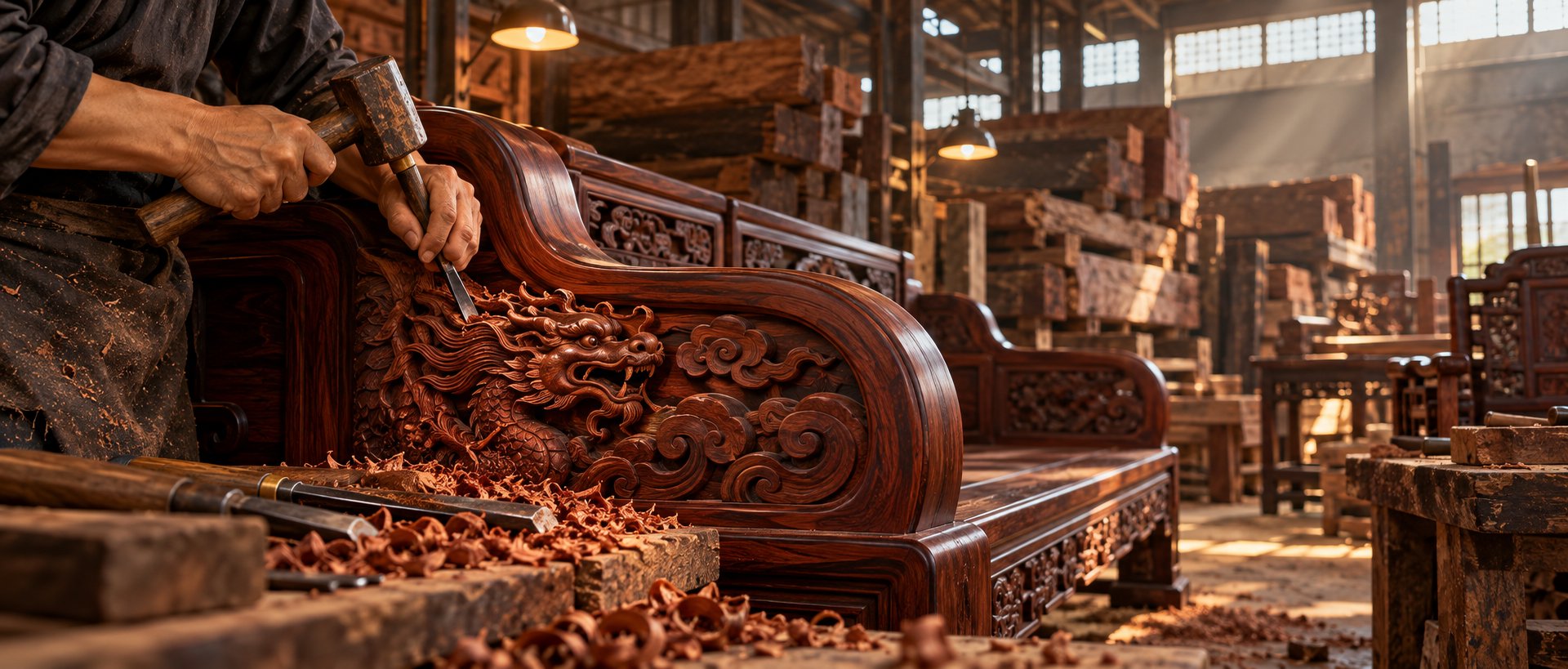
A factory-side guide to planning B2B rosewood furniture orders around Chinese New Year 2027: real production timelines, order-by dates, risks of late ordering, and a practical buyer checklist.
Chinese New Year 2027 falls on Saturday, 6 February 2027, and the official public holiday in China runs from 5 to 12 February. For most industries that is a one-week calendar footnote. For anyone sourcing solid rosewood furniture from China, it is the single most important date on the entire sourcing calendar — because classical carved furniture cannot be rushed, and the weeks surrounding the holiday compress production, freight, and inspection capacity all at the same time.
If you are a wholesaler, hotel project buyer, villa developer, or furniture distributor planning spring 2027 deliveries of rosewood sofa sets, dining sets, or bedroom suites, your realistic ordering window is effectively October and early November 2026. Order inside that window and a well-organised factory can complete production, inspection, and export packing before the holiday slowdown. Order in December and you are competing for the last production slots, the last container space, and the last patient freight forwarder of the year.
This article is written from the factory side of that conversation. We are Yunxiao Rosewood Furniture, a Chinese rosewood furniture factory founded in 2008, operating a 12,000㎡ workshop in Xianyou County, Putian City, Fujian — a region known across China for traditional hardwood craftsmanship. Every year we help B2B buyers in Southeast Asia, Australia, Europe, and North America plan their orders around Chinese New Year, and every year we see the same avoidable mistakes. Below we share the real production timeline, the backward-planning method we use with clients, the risks of ordering too late, and a practical checklist you can apply to any rosewood furniture supplier — including us.
1. Why Chinese New Year 2027 Changes Your Sourcing Calendar
Chinese New Year 2027 begins the Year of the Fire Goat on 6 February 2027. The official public holiday lasts eight days, from 5 to 12 February (for reference dates, see China Highlights). But the official holiday is only the visible tip of the disruption. In practice, furniture manufacturing capacity in China contracts for roughly four to six weeks around the holiday — from late January, when workers begin travelling home to provinces far from the coastal factory belt, through the holiday week itself, and well into late February or early March as the workforce returns unevenly.
Why does this matter more for classical rosewood furniture than for, say, phone accessories? Three reasons:
- The production cycle is long. A container of carved solid rosewood furniture typically needs 45–60 working days from deposit to export-ready at our factory — and similar timelines apply across the classical furniture cluster in Fujian and Guangdong. That is nine to thirteen calendar weeks before a single carton is booked.
- The work is hand-intensive. Relief carving, grain matching, mortise-and-tenon fitting, and multi-coat lacquer finishing depend on skilled artisans who cannot simply be substituted in January by temporary workers.
- The upstream supply chain slows too. Timber yards, lacquer and beeswax suppliers, packaging plants, and heat-treatment facilities all run on the same holiday calendar. A missing crate or a delayed lacquer batch in late January cannot be fixed until after the holiday.
Add the freight dimension — container space tightens in January as factories push final shipments — and the conclusion is simple: the practical deadline to start production for pre-Chinese New Year shipment is October to mid-November 2026. That is why we publish this article in October rather than December.
2. What Actually Happens Inside a Rosewood Furniture Factory Between Deposit and Shipment
Most B2B sourcing guides discuss lead times as a black box: “45–60 working days” sounds like a queue you wait in. Understanding what happens inside those days is what separates buyers who plan confidently from buyers who panic in December. Here is the real sequence at our workshop in Xianyou, stage by stage, and why each stage consumes the time it does.
Stage 1: Order confirmation and material allocation (roughly week 1)
Once the deposit clears and drawings or model selections are confirmed, the first real task is timber allocation. Classical sets in our catalogue — from the Imperial Dragon Carved Redwood Sofa 10-Seat Set to Ming-style dining collections — are built from legally certified materials such as Siamese rosewood (Dalbergia cochinchinensis), Machilus nanmu, aged red wood, and Grade-A tropical hardwood. Matching colour and grain across a full container is not a formality: boards are selected so that a nine-piece sofa set reads as one visual family when it lands in a hotel lobby. Allocating consistent material for a whole order is easiest when the yard is fully stocked — another reason early orders are smoother to execute.
Stage 2: Kiln drying and humidity conditioning (the 36-day foundation)
Solid hardwood must be dried to a moisture level appropriate for its destination climate before anything is cut into furniture. Our workshop runs a 36-day constant-humidity drying and conditioning process. Skipping or compressing this stage is the classic cause of overseas complaints — joints opening, panels cracking, drawers binding — because wood that leaves Fujian too wet will keep moving in a heated villa in Melbourne or a humid resort in Bangkok. This stage runs on the clock, not on overtime. It cannot be accelerated by adding people; it can only be ruined by impatience.
Stage 3: Carving, joinery, and assembly (the longest stage)
This is where classical furniture earns its name and where the calendar is least flexible. Carved elements — dragon and phoenix panels, cloud aprons, lattice doors, ruyi backrests — are chiselled in relief by hand. As a concrete reference point from our own production records: the carved apron of a single classical tea table takes approximately twelve hours of carving at 2–3 mm relief depth; a large sofa set with multiple carved faces multiplies that many times over. A 10-seat carved dining collection or a six-piece reception sofa set represents hundreds of artisan hours, and the artisans available in November and December are the same artisans your competitors' orders are queuing for.
Joinery runs in parallel: classical frames are assembled with mortise-and-tenon joints pinned with bamboo dowels — no metal fasteners in the primary structure. This is not romantic conservatism; it is why solid rosewood furniture survives shipping and decades of seasonal movement abroad. But mortise-and-tenon work rewards unhurried fitting. Corners cut here show up as wobble, gaps, or split rails — after the container has crossed an ocean.
Stage 4: Finishing — lacquer and beeswax (days that cannot overlap)
Finishing a classical piece properly means multiple coats applied sequentially. A typical piece in our range receives six coats of raw lacquer, each cured for 24 hours and hand-rubbed, before a final eco-friendly beeswax finish that meets EU REACH and US CARB chemical-compliance expectations. Nine coats of curing time alone add roughly a fortnight that no amount of planning can remove — the coats must dry one after another, in order.
Stage 5: Inspection, export packing, and documentation (the final week)
Before anything is crated, finished pieces are inspected against the confirmed specification — dimensions, carving depth, finish quality, hardware-free joints, colour consistency across the set. Then export packing begins: ISPM 15 heat-treated crating, moisture barriers, corner protection, and bracing engineered for relief-carved surfaces. Our internal team prepares the full export document set, including FSC certificates where the order requires them. Compressing this stage is how damaged shipments happen; scheduling it comfortably is one of the quiet advantages of ordering early.
Stack the stages honestly — allocation, 36 days of drying, carving and joinery, sequential finishing, inspection and packing — and you arrive at the quoted 45–60 working days after deposit. That is not padding; it is physics and craftsmanship. (For a deeper dive into lead-time structure, see our guide: How Long Does It Take to Manufacture and Deliver Custom Rosewood Furniture?)
3. Backward Planning: Working Out Your Personal Order-by Date
The most reliable way to decide when to order is to plan backwards from your delivery requirement. The method takes ten minutes and removes most of the anxiety from the conversation. Here is how we walk clients through it.
Step 1 — Fix your must-arrive date. Is the container needed for a hotel opening in April? For retail stock before a spring promotion? For a villa handover? Write down the date the furniture must be on site, not the date you would like it to sail.
Step 2 — Subtract ocean transit. As rough planning ranges from South China ports: Southeast Asia (Singapore, Bangkok, Manila, Ho Chi Minh City) runs approximately one to two weeks; Australian east-coast ports (Sydney, Melbourne, Brisbane) approximately three to four weeks; US West Coast approximately two and a half to four weeks, US East Coast four to six; North Europe approximately five to six weeks. Your forwarder will quote exact sailings, but these ranges are reliable enough for planning.
Step 3 — Subtract production. Reserve 45–60 working days (nine to thirteen calendar weeks) for production, and add a one-to-two-week buffer for inspection, packing, and vessel availability. In the weeks before Chinese New Year, add another one-to-two weeks of congestion buffer, because every factory is shipping at once and space gets tight.
Step 4 — Check the result against the CNY wall. If your production window would still be open in late January, you have a problem: the final carving, finishing, or crating would happen while the workshop is emptying. Pull the start date earlier until the whole production tail ends by mid-January.
Applied to Chinese New Year 2027, the practical conclusions look like this:
| Order confirmed by | Production completes | What you can expect |
|---|---|---|
| Mid-October 2026 | Late December 2026 – early January 2027 | Comfortable schedule; full material choice; sails well before holiday congestion; arrival January–March depending on destination |
| Early–mid November 2026 | Mid–late January 2027 | Feasible for pre-CNY shipment but tighter; sailing slots in mid-January need early booking; less slack for revisions |
| Late November – December 2026 | Late January – February 2027 | Production will straddle the holiday; expect completion after the workforce returns, typically March 2027, in queue behind pre-CNY orders |
| January 2027 or later | March–April 2027 | Effectively a post-CNY order; plan for full post-holiday ramp-up timelines |
Read the table honestly and the message is clear: for furniture that must leave China before the holiday slowdown, October and the first half of November are the real ordering season. December orders are not impossible, but they are post-CNY orders wearing a pre-CNY costume. Exact dates for your specific mix and quantity should always be confirmed with the factory — production slots depend on order size, carving complexity, and how many containers are already in the queue.
4. What Changes on the Ground in the Six Weeks Around Chinese New Year
Buyers who have not been through a Chinese New Year cycle often imagine it as a long weekend. The reality on the ground looks more like a tide going out. Here is what changes, week by week, from the factory's point of view.
From about three weeks before the holiday: carvers, joiners, and finishing staff begin leaving in waves. Workers from Sichuan, Hunan, Guizhou, and other inland provinces travel a day or more to get home, and many leave before the official holiday starts. Factories run on skeleton crews and prioritise orders that are already close to completion. Supplier output declines in step — the packaging plant, the heat-treatment facility, the lacquer and beeswax suppliers, and the timber yards all face the same departures.
During the holiday week: production stops almost entirely. The official 2027 holiday runs 5–12 February, and in the furniture clusters of Fujian and Guangdong the workshop floor genuinely goes quiet. Office staff may answer emails sporadically, but nothing moves physically.
In the two to four weeks after: the workforce returns unevenly. Some artisans come back late, some change jobs after the holiday, and every workshop re-ramps at its own speed. Meanwhile a queue of orders accepted before the holiday — all promised for completion “after CNY” — is waiting. An order placed in January is not first in that queue; it is last in it. This is the single most misunderstood aspect of the season: post-CNY delivery times are long not because factories are slow, but because the queue was formed months earlier.
On the freight side: January is a seller's market for container space. Factories rush final shipments, carriers consolidate or blank sailings around the holiday, and rates rise. A container that could be booked in 48 hours in November may take a week of negotiation in mid-January. Buyers shipping to Australia, North America, and Europe from South China all feel this simultaneously.
None of this is a complaint about the holiday — it is the most important family occasion of the year, and our artisans have earned it. It is simply a physical constraint of the calendar that planning either respects or collides with.
5. Five Risks of Ordering Too Late
Every December we speak with buyers who hoped to “squeeze in one more container before the holiday”. Sometimes it works. More often it produces one of these five outcomes — all of which cost more than ordering in October would have.
Risk 1: Rushed finishing. When a completion date becomes non-negotiable, the stages that quietly absorb pressure are drying, curing, and hand-rubbing. A lacquer programme designed for six coats over sequential 24-hour cures does not compress safely; rushing it shows up months later as dull patches, adhesive failures in the finish, or uneven sheen under hotel lighting. Early orders protect the finishing schedule, which is what your customers actually see and touch.
Risk 2: Compressed inspection and packing. Pre-shipment inspection, correction, and re-inspection need calendar room. In a squeezed schedule, an imperfection discovered on a Friday may be corrected without the full re-check it deserves, or crating crews work overnight to catch a sailing. Carved surfaces are unforgiving of hasty crating — bracing and moisture barriers exist precisely for the eight weeks a container spends at sea.
Risk 3: Freight cost and space. Waiting until January to book means paying peak-season rates for space that is genuinely scarce. The same container booked in November for a January sailing is routinely cheaper and easier to secure. On a full container of solid hardwood furniture — dense, heavy cargo — freight is a material line item, not a rounding error.
Risk 4: Material allocation compromises. Colour and grain matching across a large set depends on having enough consistently toned timber on hand. Late in the year, the best-matched stock for popular species has been allocated to earlier orders. An October order chooses from the full yard; a December order sometimes negotiates over one board less ideal for a visible panel.
Risk 5: The post-CNY queue. Perhaps the most expensive risk is invisible: the order that could not be finished pre-holiday joins the after-holiday queue behind every other rolled-over order. Buyers who expected March receive April. For a hotel project, that slippage can collide with the opening date; for a wholesaler, it means missing the spring selling window entirely. The queue position, not the factory speed, determines the delay — and queue position is bought by ordering early.
There is a sixth, quieter cost worth naming: decision quality. Buyers who engage a factory in October get full attention — drawings reviewed, dimensions and OEM/ODM modifications discussed properly, samples arranged, questions answered. Buyers who engage in mid-January get whatever attention a skeleton crew can spare.
6. How We Structure Pre-CNY Orders at Yunxiao
We have managed production through eighteen Chinese New Year cycles since founding our workshop in 2008, and the way we structure pre-holiday orders reflects that experience. Nothing below is a special October promotion — it is how a well-organised classical furniture factory handles a predictable annual event.
Capacity planning across repeat orders. Because we manufacture full sets — carved sofa sets with tea tables, 6–12-seat dining collections, complete bedroom suites — we plan carving and joinery capacity across the whole pre-CNY order book, not order by order. Buyers who commit in October effectively reserve artisan hours in November and December. This is also why we ask early customers to confirm model selections and any OEM/ODM size or pattern modifications early: a custom dimension is easy to accommodate in the drawing stage and disruptive in the carving stage.
Trial before commitment. First-time buyers rarely need to take the pre-CNY risk blind. We offer trial single sets and refundable samples, so a distributor can evaluate finish quality, joinery, and colour on one set before committing to a container. Many of our long-term wholesale partners in Southeast Asia and Australia started exactly this way — and several of them now deliberately place their main annual container in the October–November window precisely because of the schedule certainty it buys.
Mixed containers and partial shipments. For long-term partners we support mixed loading — combining, for example, a three-piece canopy bedroom set, a 10-seat carved dining collection, and a six-piece wardrobe suite in one container — and partial shipments when a full programme cannot sail at once. Mixed loading needs more planning than a single-SKU container, which is one more reason to start early rather than late. (See also our guide: What Is the Minimum Order Quantity for Rosewood Furniture and Can You Mix a Container?)
Documentation and compliance built in. Our internal export team prepares the full document set — commercial invoice, packing list, bills of lading, certificates of origin, FSC documentation where required — and every shipment uses ISPM 15 heat-treated packaging. Finishing materials are chosen to meet EU REACH and US CARB expectations. For buyers in regulated markets, this documentation is not seasonal; but pre-CNY paperwork volumes across the industry surge in January, and buyers whose documents were prepared early board the last sailings without the scramble.
After-arrival support. For hotel and villa projects, we provide free layout drawings during the planning stage and remote installation guidance after arrival, so that furniture landing in January or February is assembled correctly even if our team cannot be on site. These services exist year-round, but they matter most in the compressed season when local crews are working against a project deadline.
7. A Pre-CNY Ordering Checklist for B2B Buyers
Whether you order from us or from another Chinese rosewood furniture factory, this is the checklist we would hand a new buyer in October. It converts the abstract advice above into ten concrete actions.
- Fix the must-arrive date and work backwards through transit time, production time, and buffer — in writing, with the factory, not just in your head.
- Confirm the model list and quantities now. Every day a model decision slips, the production start slips with it. Custom sizes and carving patterns must be agreed at the drawing stage.
- Agree the material specification explicitly — species, grade, finish — and how colour and grain matching will be handled across the set. Ask how the factory documents this.
- Ask for a production schedule by stage (allocation, drying, carving, finishing, inspection, packing) rather than a single ship date. Stage schedules reveal whether the plan is real.
- Book production slot and container space as two separate actions. A confirmed production slot does not automatically hold a January sailing.
- Define the inspection standard before production starts: who inspects, against what, with photo or video evidence, and what happens on correction.
- Confirm the document set early — certificates of origin, FSC where required, ISPM 15 packing declaration — especially for the EU, US, and Australia.
- If it is your first order, use the trial mechanism — a single set or sample — rather than staking a container on a first transaction, however confident you feel.
- Plan payment timing against the schedule. Deposit triggers timber allocation and drying; final payment should align with inspection, not be discovered as an obstacle on loading day.
- Have an honest fallback. If the schedule slips past mid-January, decide deliberately between waiting for post-CNY completion or adjusting the mix to items already near completion — rather than accepting a rushed finish by default.
A factory that answers all ten points clearly and without defensiveness is telling you something important about how the next twelve weeks will go.
8. A Worked Example: Week-by-Week Through the Pre-CNY Calendar
To make the backward-planning method concrete, here is an illustrative timeline for a typical mixed order — a 40-foot container combining a carved reception sofa set with a tea table, a 10-seat dining collection, and a four-piece bedroom set — confirmed in mid-October 2026. Treat it as a worked illustration of the stage model above, not a promise: your actual dates will be confirmed on your quotation and stage-by-stage production schedule.
Weeks 1–2 (mid-to-late October). Deposit received, drawings and model list locked, and any OEM/ODM dimensions confirmed at the drawing stage. Timber is allocated from the yard — boards matched for colour and grain across all three sets, because they will share one hotel floor or one showroom wall and must read as one family.
Weeks 3–8 (late October to early December). The 36-day constant-humidity drying and conditioning cycle runs on the clock. In parallel, templates for carved aprons and panels are prepared and the joinery stock is dimensioned. Nothing is rushed in this window; this is the stage that protects joints and finishes in your destination climate months later.
Weeks 9–14 (December). The carving and joinery calendar at full stretch. Aprons, lattice doors, ruyi backrests, and dragon or phoenix panels are chiselled in relief; frames are dry-fitted, then assembled with mortise-and-tenon joints pinned with bamboo dowels. This is the stage where we recommend buyers request weekly photo or video updates — progress is visible, and any dimension query is cheap to resolve now and expensive to resolve after finishing.
Weeks 15–16 (late December to early January). Finishing runs sequentially: six coats of raw lacquer, each cured for 24 hours and hand-rubbed, then the eco-friendly beeswax finish. The coats cannot overlap; the calendar simply has to hold, which is why this window was protected when the order was confirmed back in October.
Week 17 (early-to-mid January). Final inspection against the confirmed specification, export packing in ISPM 15 heat-treated crates with moisture barriers and bracing, documents issued, container loaded and sealed. Estimated departure from a South China port in mid-January — ahead of the peak congestion window and with the paperwork already done.
From there, transit takes over: roughly one to two weeks to Southeast Asia, three to four to the Australian east coast, two-and-a-half to six to North America depending on coast, and five to six to North Europe. A mid-October start therefore puts furniture on site between late January and early March 2027 — before the factory belt has fully re-ramped, and weeks ahead of the identical order if it had been confirmed in December.
Now run the same exercise backwards for a December confirmation and the contrast is obvious: the carving tail lands in the last fortnight of January when artisans are already travelling home, finishing cures collide with the holiday week, and the container joins the post-CNY queue for inspection, crating, and sailing. Same furniture, same factory, same craftsmanship — five to eight weeks later on site, purely because of the calendar. When you review your own project dates, that comparison is the fastest way to decide whether your order belongs in this year's pre-CNY book or next year's post-CNY plan. Either answer can be correct; only the deliberate one is.
9. Destination-Specific Notes: Southeast Asia, Australia, and North America
The CNY calendar is the same for everyone; how it bites differs by market. These are the regional notes we give buyers when planning a pre-holiday order.
Southeast Asia (Singapore, Malaysia, Thailand, the Philippines, Vietnam, Indonesia). Distances are short and transit is one to two weeks, which tempts buyers into late ordering. Two factors push the other way. First, hospitality demand — hotels, resorts, and tea-room projects — is strong in the first quarter, so factory slots for the carved reception and lobby sets that dominate this market fill earliest. Second, tropical humidity makes the drying and finishing stages non-negotiable: solid rosewood arriving insufficiently conditioned will move in monsoon-season humidity no matter how good the joinery is. Buyers in equatorial climates should weight the kiln-drying conversation more heavily, not less, and ask specifically how moisture content is conditioned for a humid destination.
Australia. The east-coast run adds three to four weeks of transit, and February is peak season for villa and residential projects after the summer break. Furniture for March–April installations therefore needs to sail in January — inside the congestion window — which makes the October–November production start effectively mandatory for those dates. Australian buyers also tend to ask early about timber compliance documentation; FSC documentation and ISPM 15 packing are part of our standard order pack, but destination-specific requirements should be confirmed with your customs broker before the January paperwork rush.
North America and Europe. Longer transit — roughly two-and-a-half to six weeks to the United States depending on coast, and five to six to North Europe — plus customs clearance means spring delivery targets require winter sailings. These markets also ask the most about chemical compliance for finishes, EU REACH and US CARB expectations, and about documentation for carved hardwoods under timber import regulations. None of that changes with the calendar; all of it is easier to arrange in October than in the January rush.
One more note that applies everywhere: container consolidation. Buyers in smaller markets — New Zealand, island Southeast Asia, secondary North American ports — often wait to consolidate with other cargo to fill a container. That consolidation step is exactly the kind of activity that stalls around Chinese New Year, because every party in the chain is short of hands. If your logistics plan includes consolidation, start it earlier, not later, and tell your factory the plan so packing dates can be coordinated.
10. Frequently Asked Questions
Q1: Is 45–60 working days a fixed rule, or can a smaller order go faster?
It is a realistic range for full container orders of classical sets, and smaller orders — a single sofa set, for instance — can sometimes be scheduled faster if suitable material is already conditioned and the carving calendar allows. Conversely, heavily carved custom programmes can take longer. The honest answer is always stage-based: ask what stage your order enters at, not just when it ships.
Q2: I missed the October–November window. Should I still order before Chinese New Year?
Yes, with clear expectations. An order confirmed in December will likely complete after the holiday, in queue behind pre-CNY orders. If your delivery date tolerates March–April arrival, ordering December–January with a post-CNY schedule is perfectly rational — and locks material and queue position earlier than waiting until spring. What to avoid is December ordering with a January completion expectation.
Q3: Can I really mix sofa, dining, and bedroom sets in one container?
For most partners, yes. Mixed containers are standard practice for distributors building a showroom-ready assortment. They require coordinated planning — different sets finish at different times — so tell the factory at the start that the order is mixed, and expect the loading plan to be engineered rather than improvised. Our article on container loading for carved sets covers the protection side in detail.
Q4: What documents come with a shipment to Australia or North America?
The standard set includes commercial invoice, packing list, bill of lading, and certificate of origin; FSC documentation is provided where the order specifies certified timber. Packaging is ISPM 15 heat-treated, and finishes are selected with EU REACH and US CARB expectations in mind. Confirm any destination-specific requirements with your customs broker early — before the January paperwork rush.
Q5: How does Chinese New Year affect pricing?
Two forces move prices around the holiday. Raw material costs for quality hardwood have trended upward in recent years as supply tightens, and post-holiday factories often adjust quotations after reviewing new material costs. Order and lock pricing in October–November, and you remove that variable from your planning entirely. We do not publish price promises in an article — ask us for a current quotation for your specific mix.
Q6: We need custom dimensions and carving patterns for a villa project. Is pre-CNY still realistic?
Custom work is exactly the kind of order that benefits most from starting early. OEM and ODM modifications — sizes, patterns, configurations — need drawing confirmation before carving begins, and revisions during production are the schedule killer. Bring drawings in October and the calendar works with you; bring them in December and each round of revision pushes completion into the post-CNY queue.
Q7: What happens if carved pieces are damaged in transit?
Prevention does most of the work: ISPM 15 crating, moisture barriers, and engineered bracing for carved surfaces are designed for the voyage, not just the warehouse. If damage nonetheless occurs, document it with photos at unloading and notify the supplier immediately — resolution depends on the trade terms agreed in the contract, which is one more reason to agree inspection and claims terms before production, not after arrival.
Q8: Can any production continue during the holiday week itself?
For classical carved furniture, effectively no. The artisans who chisel the panels and fit the joints travel home for the most important family holiday of the year, and the specialized steps in our process — hand carving, multi-coat lacquer curing, hand-rubbing — cannot be delegated to temporary staff without compromising the result. Some manufacturers of standardised, machine-led product lines do run reduced schedules through the holiday, which is why generic “CNY survival” advice sometimes claims otherwise. Plan around a full stop for the official week plus the uneven weeks either side, and any schedule that survives that assumption is a safe one.
Q9: Is there such a thing as ordering too early?
Rarely for carved solid-wood furniture, but there are practical limits worth knowing. Very early commitments can leave you storing goods you cannot ship yet, or holding inventory before your showroom has space. The balanced approach we recommend: confirm models and reserve production capacity early, agree pricing against the current quotation, and schedule the container against your real delivery dates. Capacity and material choice are the things that genuinely run out before the holiday; finished-goods storage is usually the cheaper problem to manage.
The Practical Answer: Order in October, Sleep in December
Chinese New Year 2027 will arrive on 6 February whether or not anyone's container is ready. The factories that serve their buyers well through that season are the ones that planned the order book in October; the buyers who arrive in January asking for favours discover that the calendar does not negotiate.
The arithmetic in this article is deliberately simple: 45–60 working days of genuine production, one to six weeks of ocean transit depending on destination, four to six weeks of holiday-related slowdown, and a queue that was formed by whoever ordered first. Every element is visible months in advance. The only truly scarce resources are carving hours in November and container space in January — and both go to the buyers who asked early.
If you are planning rosewood sofa, dining, or bedroom sets for delivery in the first half of 2027 — whether for wholesale programmes, hotel and resort projects, or villa developments — our team is happy to review your model list, confirm a stage-by-stage production schedule, and quote your container mix. You can start the conversation with a single trial set, ask for layout drawings for your project, and see exactly where your order would sit in the pre-CNY calendar. Reach out through the enquiry form on any product page or our contact page, and let's put your order on the right side of the holiday.