
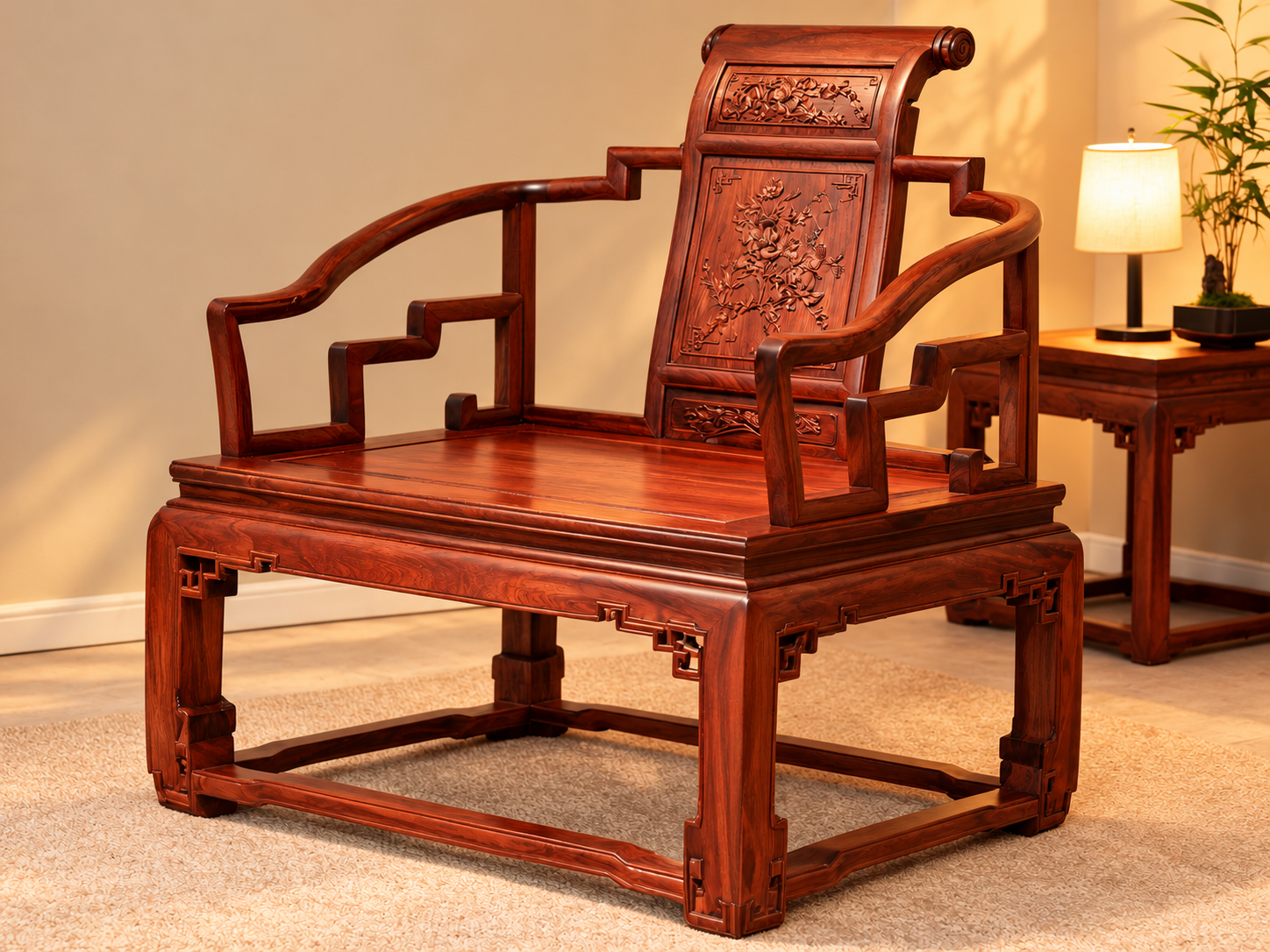
A B2B sourcing guide to the rosewood lounge chair: Siamese rosewood timber selection, kiln drying, mortise-and-tenon joinery, hand carving, raw lacquer finish, CITES and FSC documents, and hotel or villa project fit.
Ordering a standard sofa set from a catalogue is mostly a pricing exercise: pick a fabric, confirm dimensions, compare quotations. Sourcing a rosewood lounge chair is not that kind of transaction. It is a verification exercise, because a classical Siamese rosewood chair is a solid-timber product whose long-term performance depends on things you cannot see in a product photo - the heartwood ratio of the boards, the moisture content at packing, the depth of the tenons inside the frame, and whether the lacquer was cured properly or just flashed off quickly to hit a shipping date.
Over the past fifteen-odd years at our workshop in Xianyou, Fujian, we have answered thousands of buyer questions about exactly these points. The buyers who end up satisfied - hotel project procurement teams, distributors, villa developers - are the ones who asked to verify the process, not just the price. The buyers who ran into trouble with other suppliers usually skipped that step and wired a deposit against a nice render.
This guide is written for overseas B2B buyers: importers and wholesalers in Southeast Asia, Australia, North America and Europe who are evaluating a rosewood lounge chair for retail, for a hotel or resort specification, or for a villa project. It walks through each stage of how the chair is actually made - timber selection, kiln drying, joinery, carving, lacquer - and, just as importantly, tells you what you should be able to verify before any money moves: a species-correct timber identification, a batch-specific drying certificate, a documented load test, and an emission test report with the quotation. If a supplier cannot produce any of these, that is information too. Everything described below reflects Yunxiao's own documented practices and published species data; where a figure is a species-wide range rather than a measurement of your specific batch, we say so plainly.
Why Hotel and Villa Projects Keep Adding a Rosewood Lounge Chair to the Spec
For hospitality procurement, a classical rosewood lounge chair solves a specific layout problem. A full sofa set - three-seat, loveseat, two armchairs - commits a room to one configuration and eats floor area fast. A single lounge chair at 66 cm wide by 60 cm deep occupies roughly the footprint of an office chair with room to breathe. That makes it the piece of choice for the corners where a sofa set simply will not fit: the reading nook in a suite, the bay window in a villa living room, the tea area in a lobby, the landing on a mezzanine.
It also works commercially as a statement piece rather than a fill piece. In boutique hotel suites and villa projects across Southeast Asia, we see the pattern repeatedly: neutral upholstery does the seating volume, and one hand carved rosewood lounge chair carries the cultural character of the interior. Because the chair is carved by hand and finished in natural raw lacquer, it reads as an artifact, not a furniture SKU - which is precisely the impression a lobby or suite is trying to make. For a fuller discussion of how rosewood seating works in shared spaces, see how to choose a rosewood sofa set for living room and lobby projects, which covers the same logic at room scale.
Regional demand patterns differ in ways worth knowing before you spec. In Southeast Asia, Siamese rosewood is regionally familiar - buyers in Thailand, Vietnam, Malaysia and Singapore understand the species and expect classical forms, and high ambient humidity makes the moisture-content and joinery discussion below particularly relevant. In Australia, demand skews toward villa and private-residence projects, with buyers attentive to compliance documentation and timber legality - CITES and FSC paperwork matters there. North American buyers, mostly distributors and interior designers, tend to order single pieces or small mixed lots and care most about indoor air quality claims and the emission documentation. In Europe, the same applies with even more emphasis on traceability and finish standards.
One practical note for project buyers: the chair is designed to pair. It can be ordered alongside Yunxiao rosewood sofa sets and tea tables as a single lot, which matters because rosewood colour and grain vary between boards. When the chair ships from the same timber selection batch as the matching tea table, the tone reads as a set. When it ships from two different production runs a year apart, it may not. For hotel bedroom and guest-suite programs where rosewood pieces appear across many rooms, see how durable hotel bedroom furniture needs to be - the same turnover and maintenance pressures apply to lounge seating in lobbies and suites.
Start With the Timber: What Siamese Rosewood Should Look Like on Paper
The timber behind this chair is Siamese rosewood, Dalbergia cochinchinensis - one of the classical Hongmu-category rosewoods, dense, oily, and deep red-brown in the heartwood. Get the species name exactly right on paper, because it has consequences beyond aesthetics: Dalbergia cochinchinensis is listed on CITES Appendix II, which means every export requires a CITES export permit and, in most destination countries, an importer-side permit obtained before the goods ship. It also affects duty classification and, frankly, whether the wood you are paying rosewood prices for is actually rosewood. A supplier who writes "red sandalwood" or a vague trade name on the invoice is either careless or hiding something; the Latin name should appear on the documentation.
Now the honest part about performance figures. Published species-wide figures - the kind you will find cited against the national standard - give Janka hardness of 1520 to 3680 lbf and air-dry density of 0.8 to 1.33 g/cm3. Those are ranges for the species, not measurements of any particular board, and the spread is enormous. Anyone quoting you a single hardness number for "Siamese rosewood" is quoting species marketing, not their timber.
So what determines where in that range your chair actually lands? Two things a manufacturer can control. First, heartwood selection: sapwood in rosewoods is pale, softer and less oily, and it is the heartwood that carries the density, the colour and the natural durability. Yunxiao's selection rule for this line is that only boards exceeding 80% heartwood enter production, and that ratio is verified board by board during QC. Second, kiln drying to the correct moisture content, which pushes dimensional stability toward the dense end of the species behaviour. The combination of strict heartwood selection and a controlled drying cycle is why our chairs perform at the upper end of what the published species range suggests.
What should you be able to verify here? Ask any supplier: the Latin species name in writing, the heartwood ratio standard they apply, and whether a batch-specific wood drying certificate ships with the order - ours does. For a deeper explanation of the drying side, read how rosewood furniture is kiln-dried and why moisture control matters. And for the compliance paper trail around Dalbergia species - FSC chain of custody and the CITES permit sequence - we cover the process in dedicated articles linked later in this guide.
A note on what you will see and feel: because no two rosewood boards are identical, expect grain and tone variation between chairs. That is a property of solid wood, not a defect. If a supplier's showroom photos show ten chairs with perfectly matched grain, either they photograph one chair or the product is not solid wood throughout.
Kiln Drying and Moisture Content: The Number That Predicts Whether Joints Survive the Trip
If you could ask only one question before ordering a solid wood lounge chair for export, ask about moisture content. Rosewood that leaves the workshop at the wrong moisture content will move after arrival - and when solid wood moves, something has to give, and it is usually a joint or a panel. Most "quality problems" reported six months after delivery trace back to drying, not to craftsmanship.
Yunxiao's target for this line is 8-12% moisture content, and the process behind that number is slower than the industry shortcut. Boards go through a 4-week kiln cycle with a gradual temperature ramp - forcing the temperature up quickly is how you get case-hardening and surface checking - followed by a 48-hour equalization period at the end, which lets the moisture gradient even out between the core and the surface of the board. Skipping equalization produces timber that measures fine on the surface and is still wet in the middle; the board will move later anyway. Every chair in this line ships with a batch-specific wood drying certificate, so the MC claim is documented, not asserted.
At final QC, each chair gets a three-point moisture audit, and any chair reading out of range goes back to conditioning rather than being packed on a schedule. We would rather hold a shipment than let a marginal board meet a container.
What happens after delivery is partly your side of the transaction, and honest guidance matters here. Solid wood expands and contracts with ambient humidity; that is wood science, not a manufacturing defect. Keep indoor relative humidity roughly in the 40-60% band. When the chairs arrive, let them acclimatize gradually - a week in the destination room before heavy use is a reasonable rule - rather than moving them straight from a cold container into a heated, dry lobby. And in climates that stay persistently humid or persistently dry, plan a periodic joint check during the first year while the timber settles into its new equilibrium. These are general solid-wood recommendations, not a warranty disclaimer: our 24-month structural warranty covers joinery failure and frame cracking under normal indoor use. But a buyer who understands wood movement will never mistake a seasonal hairline in a finish for a structural fault, and that distinction saves everyone an argument.
Joinery: Why Mortise-and-Tenon With Bamboo Dowels Beats Screws for Export Furniture
Classical Chinese joinery was not a stylistic choice; it was an engineering answer to a material that moves. The same logic applies to a rosewood lounge chair crossing an ocean in a container. Yunxiao builds this chair with full mortise-and-tenon joinery pinned with bamboo dowels, and no metal fasteners carry load anywhere in the frame. The structural specifics, in case you want to check them against another supplier's specification:
- Seat rails: 18 mm tenon depth
- Backrest stiles: 16 mm tenon depth
- Corner blocks at every right-angle intersection
- Armrests cut from single solid sections along the grain - not spliced, not laminated
- Every joint is dry-fitted before glue, so fit problems are caught before the glue bottle comes out, not discovered after cure
Why insist on no metal fasteners in load-bearing positions? Two reasons that matter specifically for export furniture. First, container environments cycle humidity hard - a steel screw embedded in swelling and shrinking rosewood works loose or, worse, splits the wood around it as the timber moves and the screw does not. A bamboo dowel moves with the timber; that is the whole point. Second, road and sea vibration finds every rigid point. A rigid glued-and-screwed joint transmits stress; a proper mortise-and-tenon distributes it across a large glued surface. Fifteen years of export history is what convinced us, and it is also why traditional furniture built this way survives centuries.
Before any chair is packed, the assembled frame spends 24 hours under a 120 kg distributed load. Joints that show visible separation are re-fitted, not patched - a distinction we take seriously, because a patched joint passes a visual inspection and fails a year later, while a re-fitted joint is a correct joint. This load test, the heartwood verification, the moisture audit and the finish check together form our pre-packing QC gate; the full sequence is described in our rosewood furniture quality control process for B2B buyers, and if you plan third-party inspection before shipment, that article doubles as a good briefing document for your inspector.
When you compare suppliers, this is where to dig. Ask for tenon depths. Ask whether joints are dry-fitted. Ask what happens to a chair that fails the load test - the honest answer involves rework and a schedule hit, not "this has never happened."
The Carved Backrest: What Hand Work Actually Looks Like
The backrest panel of this lounge chair carries hand-carved floral and botanical relief, and buyers deserve a realistic picture of what "hand carved" means in production terms, because the phrase gets abused.
Each panel takes roughly 20 carving hours. The carvers work with chisels from 2 mm to 12 mm - the fine tools for petal edges and leaf veins, the larger ones for roughing out the pattern and clearing the background. The relief stands 2-4 mm proud of a recessed background: deep enough to catch light and cast a shadow line that changes through the day, shallow enough not to compromise the panel's strength. The recessed background is what gives classical relief its depth; flush surface engraving looks flat from two metres away.
Because the timber is carved along its grain, grain direction is a real production risk - carve against a reversing grain and you get tear-out that no amount of sanding hides. That is one reason carving is done by experienced hands rather than by whichever worker is free, and why our QC includes a relief depth gauge check at three points per panel: it verifies both the carving consistency and, indirectly, that the pattern was cut to the approved depth rather than thinned to save time.
For buyers with a design brief: OEM motifs are accepted. If your hotel project or brand needs a specific botanical pattern, a family crest-style emblem, or a motif drawn from regional tradition, submit the design and it goes through a 15-day design approval cycle - the carver produces a sample section or panel mock-up, you approve, and production proceeds against the approved reference. This keeps the buyer and the workshop looking at the same thing before twenty hours of carving go into each panel of a batch order. Realistic planning note: approval cycle plus carving time means custom-carved orders should be scheduled earlier than standard ones; production lead times for custom rosewood furniture are discussed in a dedicated guide linked in the sourcing section below.
Six Coats of Raw Lacquer: Finish, Feel and Indoor Air
The finish on this chair is natural raw lacquer, applied in six coats, with each coat cured for 24 hours and then hand-rubbed with pumice stone before the next goes on. The result is a deep satin sheen - not the glassy plasticky gloss of a spray lacquer, but a surface that feels like polished stone and improves with handling. This process is slow and it is one of the main reasons raw-lacquer furniture costs more than PU-coated furniture; it is also why the finish ages gracefully instead of peeling.
The indoor-air angle is the one that matters most to hotel, villa and North American and European buyers. Because the structure uses solid boards throughout - no engineered boards, no MDF, no veneer substrates - and the coating is natural lacquer with no solvent-based chemicals, the chair introduces no formaldehyde or benzene sources from adhesives or composite panels. A third-party emission test report is provided with the quotation, so this is a documented claim rather than a marketing line. For projects with green-building requirements or strict VOC budgets, put that report in front of your consultant early.
Heat tolerance is a documented, bounded fact, so here are the exact limits. The lacquer has passed heat testing at 70°C dry heat and 85°C wet heat (the test standard designation and report number are stated on the report supplied with the quotation). The timber itself begins to degrade above 120°C. The practical instruction for your housekeeping or end-customer manual: do not place boiling-hot items directly on the surface. A teapot on a tray is fine; a kettle straight off the element is not. Write that into the care card you ship with the product and you will avoid 90% of finish complaints.
From a sourcing standpoint, the finish is one more thing to verify rather than trust: ask for the emission report, ask which lacquer system is used, and if you are inspecting before shipment, check finish uniformity under a defined light source - our QC checks each chair under 5000K LED lighting against a reference panel, and a good inspector can replicate that in ten minutes.
Dimensions and Space Planning: Will a 66 cm Lounge Chair Fit Your Project?
Before any hotel group or villa developer commits to a solid wood lounge chair, the first practical question is not price or finish - it is whether the piece physically fits the room and reads correctly in scale against other furniture. The Yunxiao classical rosewood lounge chair measures 66 cm in overall width, 60 cm in overall depth, and 92 cm in backrest height. The seat sits at 44 cm with a seat depth of 44 cm. These are the numbers to mark up on your floor plan before anything else.
A 44 cm seat height is deliberately conservative. It suits the low-slung, grounded proportions of classical Chinese furniture, and it works well beside low tea tables - the standard pairing in tea rooms and villa reading corners. Buyers sourcing for elderly guests or accessibility-conscious hotel suites should note that 44 cm is slightly lower than the 45-47 cm common in Western contract seating; this is a design characteristic of the classical form, not a defect, and it is worth confirming with your interior designer early.
In practice, we see this chair specified in four settings. In hotel suites, a single chair with a side table fills the corner between window and wardrobe without crowding circulation paths - the 66 cm width clears a standard 90 cm doorway with margin. In villa reading corners, it is often ordered as a pair flanking a console. Boutique lobbies use it as an accent piece against neutral upholstery. And in tea rooms and resort spas, it is the natural companion to a rosewood tea table. Buyers planning lounge or lobby schemes in depth should also read how to choose a rosewood sofa set for living room and lobby projects, since the same space-planning logic applies to larger seating groups.
One point that matters more than most buyers expect: colour and grain vary between boards. Siamese rosewood ranges from deep red-brown to lighter orange-brown tones, and no honest manufacturer can promise two separately produced batches will match exactly. If you are ordering lounge chairs alongside rosewood sofa sets and tea tables for the same project, place the combined order as one production lot. That allows our timber selectors to draw from matching stock, so the chair beside your sofa reads as a set rather than a near-match. This is the same batch-level control discipline described in how rosewood furniture is kiln-dried and why moisture control matters - batch-level control, applied from the board up.
A Pre-Order Sourcing Checklist for the Rosewood Lounge Chair
After years of fielding inquiries from importers and project procurement teams, we have learned that most B2B sourcing problems trace back to questions nobody asked before the deposit was paid. The checklist below is one you can copy into your own supplier evaluation file. It lists what to ask any rosewood furniture supplier, and what a documented supplier - including Yunxiao - should be able to put in writing.
| What to Ask the Supplier | What a Documented Supplier Provides |
|---|---|
| Is the species genuinely Siamese rosewood (Dalbergia cochinchinensis), solid throughout? | Species confirmed in writing on the quotation; no veneer, no MDF, no finger joints in load-bearing components; CITES Appendix II export permit issued per shipment |
| What is the actual moisture content of the timber in my order? | Kiln-dried to 8-12% over a 4-week cycle with gradual temperature ramping and 48-hour equalization; a batch-specific wood drying certificate ships with every order |
| What joinery carries the load? | Full mortise-and-tenon with bamboo dowel pins, no metal fasteners in load-bearing positions; 18 mm seat rail tenons, 16 mm backrest stile tenons, corner blocks at every right-angle intersection; joints dry-fitted before glue |
| Is the carving genuinely hand-carved, and how deep? | Hand-carved relief, 2-4 mm depth over a recessed background, roughly 20 carving hours per panel; relief depth gauge-checked at three points per panel |
| What is the finish, and is it safe for indoor contract use? | Six coats of natural raw lacquer, each cured 24 hours and hand-rubbed with pumice; no solvent-based coatings, so no formaldehyde or benzene introduced by the finish; third-party emission test report provided with the quotation |
| How is the chair tested before packing? | Every assembled frame spends 24 hours under 120 kg distributed weight; joints with visible separation are re-fitted, not patched; moisture audited at three points per chair |
| What does the warranty cover, in writing? | 24-month structural warranty covering joinery failure and frame cracking under normal indoor use; replacement parts available for transit damage |
| Can we verify quality before committing to volume? | MOQ of 1 piece for sample orders; 25% of the paid sample fee creditable against a subsequent bulk order, confirmed in writing |
Two items on this list deserve emphasis. First, species confirmation in writing. Rosewood trade names are notoriously loose - "rosewood" is applied to everything from genuine Dalbergia species to lookalike legumes. Ask the supplier to state the scientific name on the quotation, and ask whether boards are selected for heartwood ratio; our line accepts only boards exceeding 80% heartwood. Second, the heat test report. Our lacquer finish has passed dry heat testing at 70°C and wet heat at 85°C, with the test standard designation and report number stated on the report provided with the quotation. If a supplier cannot name the test standard, the claim is not verifiable.
The sample-first strategy is the single cheapest form of insurance in B2B sourcing. At a minimum order quantity of one piece, you can hold the actual chair in your hands - weigh the joinery, feel the lacquer, measure the seat - before any volume commitment. And with 25% of the sample fee credited against a subsequent bulk order, the cost of that verification is partly recoverable. For a fuller framework on evaluating suppliers for contract projects, see what to look for in a rosewood hospitality furniture manufacturer.
Documents That Must Travel With the Shipment
Customs paperwork is where well-run rosewood orders succeed or stall. Dalbergia cochinchinensis is listed on CITES Appendix II, which means international trade requires an export permit from the Chinese authorities and, in most destination countries, an importer-side CITES permit obtained before the goods ship. This is the single most common timing mistake we see: buyers assume the exporter handles everything, then discover their own customs broker needs weeks to secure the import permit. Our advice is blunt - engage your customs broker at the quotation stage, not at the shipping stage. We maintain CITES export permit registration at our workshop and issue the permit per shipment, but the importer-side application sits with you. For a deeper briefing, read how CITES regulations affect the rosewood furniture trade.
Each Yunxiao shipment travels with four documents. The CITES export permit, as above. The FSC chain-of-custody certificate, which our workshop maintains and which many European and North American buyers need for their own compliance and procurement reporting - the mechanics of this are covered in FSC-certified timber compliance when importing rosewood furniture. The commercial invoice stating HS code 9403.60, which determines duty treatment in most tariff schedules. And the batch-specific wood drying certificate, which confirms the timber left our kilns at 8-12% moisture content and which your QC team can cross-check against on-arrival moisture readings.
On timing: build the CITES permit cycle into your project schedule. Allow buffer between production completion and vessel booking, and confirm with your broker which documents must be originals versus scans. A chair that passed every factory test can still sit in a bonded warehouse for weeks because a permit was applied for too late - and that is a logistics failure, not a manufacturing one.
Order Terms: MOQ, Samples, Lead Times and Payment
Yunxiao's commercial terms are deliberately structured so that a buyer can start small and scale with evidence. The minimum order quantity is 1 piece - sample orders are welcome, and this is how most first-time buyers engage with us. Volume pricing applies at 10 pieces and above, and 25% of the paid sample fee is creditable against a subsequent bulk order, confirmed in writing on the order documents. For buyers wondering how small orders work in practice, see minimum order quantities and mixed-container orders.
Payment is a standard 30% T/T deposit with the balance before shipment. For orders of 5 pieces or more, we accept letters of credit (L/C), which many procurement departments and their banks prefer for contract volumes. Trade terms default to FOB Xiamen, the natural deep-water port for Xianyou-origin cargo; CIF and DDP are available on request, depending on destination and your import setup.
Shipping mode follows order size. A single-piece order ships as LCL consolidation - the chair is crated and consolidated with other cargo, which is economical but exposes it to more handling. At 50 pieces and above, FCL (full container) is recommended, since the crate is loaded once and opened at destination.
Lead times are 35-50 days for a single piece and 60-75 days for batch orders of 5+. What sits inside those windows matters: timber selection and kiln-drying run on a 4-week cycle before a single tenon is cut, and each backrest panel absorbs roughly 20 hours of hand carving, followed by six lacquer coats each curing 24 hours. Time can extend further for OEM carving motifs, which require a 15-day design approval cycle, or when peak-season vessel space tightens. The full picture of what moves a schedule - and how to plan around it - is in production lead times for custom rosewood furniture.
Packing, Container Loading and Arrival Checks
Solid wood furniture survives the ocean freight journey or it does not - and most transit damage happens at handling points, not at sea. Yunxiao's export packing is built around that reality. Each rosewood lounge chair is first wrapped in acid-free tissue paper, which protects the hand-rubbed lacquer surface from abrasion and, unlike printed newsprint, will not transfer ink. Corrugated cardboard goes on over the tissue. The chair then sits in an ISPM-15 heat-treated wooden crate - the international standard that prevents your crate being held or destroyed at customs for untreated wood - with EPS foam corner blocks absorbing the shocks that concentrate at corners. Gross weight is approximately 30 kg per crate, which your freight forwarder will want for the booking.
Internally, every packed chair passes our in-house 1-metre drop test before the packing method is approved for that product. Third-party drop-test documentation can be discussed at inquiry stage if your compliance process requires it. The full sequence, from workshop floor to container, is described in how rosewood furniture is packaged for export shipping.
On your side, receiving discipline matters as much as packing discipline. Inspect the crate before signing the carrier's receipt - photograph any crush damage, punctures, or water staining, and note it on the delivery document. Open promptly, check the moisture-appropriate acclimatization conditions are in place (more on that below), and inspect the chair against a structured checklist rather than a glance. For a rigorous framework, use pre-shipment inspection checklist for rosewood furniture - it applies equally on arrival. If transit damage is found, contact us with photographs; replacement parts are available for transit damage under our trade terms, and documenting the damage at receipt is what makes that claim straightforward.
Keeping the Chair Right in Hotels, Villas and Showrooms
A solid wood lounge chair in a commercial setting faces conditions a domestic buyer never creates: daily cleaning cycles, variable HVAC, window sunlight for eight hours a day, and guests who set coffee cups down anywhere. The care requirements are simple but non-negotiable, and they should be written into your housekeeping procedures, not left to verbal instruction.
Humidity first. Keep indoor relative humidity roughly 40-60%. Siamese rosewood is a solid natural material - it expands and contracts with ambient moisture, and no finish changes that physics. In persistently humid coastal properties or very dry climates with heavy air-conditioning or heating, schedule periodic joint checks during the first year while the timber acclimatizes fully to your building's environment. Allow gradual acclimatization on arrival: unpack in the installation room and let the chair sit for a period before it enters daily service, rather than moving it from a cold container into a heated lobby within the hour. The underlying wood science and prevention strategies are covered in why rosewood furniture cracks in overseas climates and how to prevent it.
Heat and sunlight second. The lacquer finish passed heat testing at 70°C dry and 85°C wet, but the timber itself begins to degrade above 120°C - so never place boiling-hot items directly on the surface. Train housekeeping to use coasters and trivets as standard, and to use only the cleaning agents specified for lacquered surfaces. Position chairs away from prolonged direct sunlight where possible; even through glass, sustained solar exposure will shift the wood's tone over time.
Backup and accountability third. The chair carries a 24-month structural warranty covering joinery failure and frame cracking under normal indoor use - the same coverage philosophy we apply across our contract furniture, which is examined in more depth in how durable hotel bedroom furniture needs to be. The 120 kg / 24-hour load test every frame passes before packing is the reason we can stand behind that warranty in high-turnover settings. The warranty does not cover damage outside normal use - impact damage, flooding, or finishes degraded by improper cleaning agents - so housekeeping training is your first line of asset protection, and the warranty is the second.
Frequently Asked Questions Before Ordering a Rosewood Lounge Chair
Can I order a single sample, and is the sample fee credited?
Yes. The minimum order quantity is one piece, and sample orders are an established part of our business - a large share of our volume buyers began with a single chair. When you place a subsequent bulk order, 25% of the paid sample fee is credited against it. This credit is confirmed in writing on the order documentation, not as a verbal assurance, so your finance team can book it with confidence. If your evaluation requires several configurations or finishes, discuss the sample plan with us at inquiry so the credit structure is clear before you pay.
What Incoterms and ports do you ship from?
The default trade term is FOB Xiamen, which suits buyers with their own freight forwarders or existing China import programs. CIF and DDP are available on request - DDP is most often used by buyers in Southeast Asia and Australia handling their first rosewood import who prefer us to carry the freight and clearance arrangements. Single-piece orders ship as LCL consolidation; at 50 pieces and above we recommend FCL. Your forwarder will need the crate gross weight of approximately 30 kg per chair for the booking, and all customs documents travel with the shipment as standard.
How is moisture content actually verified?
Twice. Before manufacturing, timber is kiln-dried to 8-12% moisture content over a 4-week cycle with gradual temperature ramping and a 48-hour equalization phase, and each batch receives a wood drying certificate that ships with your order. Before packing, every individual chair passes a moisture audit with three-point readings; any chair reading out of range goes back to conditioning rather than into a crate. If you want independent verification, your inspector can take readings on site pre-shipment - the batch certificate gives you the baseline to compare against.
Can the carving motif or the size be customized?
Carving yes - we accept OEM buyer motifs on the hand-carved backrest panel, subject to a 15-day design approval cycle during which the motif is converted into carving instructions and confirmed with you before production. ODM design development is also available through the same approval process. Dimensional changes are a different matter: the chair's proportions are classical, and the joinery geometry - 18 mm seat rail tenons, 16 mm backrest stile tenons, corner block placement - is engineered around the current frame. Discuss any dimensional requirement with us at inquiry so the structural implications can be assessed honestly rather than improvised.
What exactly does the 24-month warranty cover - and not cover?
The warranty covers structural failure under normal indoor use: joinery failure and frame cracking. That is the substance of the 120 kg / 24-hour load test each frame passes, so the coverage is specific to the qualities we test. It does not extend to damage outside normal use - impacts, water immersion, or surface degradation from unsuitable cleaning agents - and it does not cover the natural tonal shifts solid wood undergoes, which are a material characteristic rather than a defect. Transit damage is handled separately through replacement parts. Read the warranty terms as written on your order documents; that text, not this article, is the binding version.
How can I verify the timber species before shipment?
Three practical routes. First, the quotation and commercial invoice state the species as Dalbergia cochinchinensis and the shipment includes the CITES export permit, which is issued against the declared scientific name - a documentary chain that customs authorities in both countries check. Second, the FSC chain-of-custody certificate corroborates the timber's documented origin through the supply chain. Third, for buyers who want physical confirmation, a pre-shipment third-party inspection can include species verification, and workshop visits in Xianyou are welcome so you can inspect timber stock yourself before production begins.
The Short Version for Busy Buyers
If you have read this far, you already know more about this chair than most procurement briefs contain. Condensed: it is a rosewood lounge chair in solid Siamese rosewood (Dalbergia cochinchinensis), boards that pass our 80%-heartwood selection, kiln-dried to 8-12% moisture with a batch certificate, joined entirely with mortise-and-tenon and bamboo dowels, load-tested at 120 kg for 24 hours, hand-carved at roughly 20 hours per backrest panel, and finished in six hand-rubbed coats of natural raw lacquer. It ships with CITES, FSC, invoice (HS 9403.60) and drying certificate documentation. It carries a 24-month structural warranty. You can start with one sample piece and recover 25% of the sample fee against a bulk order.
The honest caveats are on the table: solid wood moves with humidity and needs 40-60% RH and first-year joint checks in extreme climates; the finish is not rated for boiling-hot items; colour varies between boards unless you order combined pieces as one lot; and CITES importer-side permits are your responsibility and your timeline.
If that profile fits your project, send us an inquiry through the channel on this site with three things: your destination port, your estimated quantity, and whether you need custom carving motifs or plan to match the chair with other rosewood pieces. We will come back with pricing, the current lead time, and the documentation set for your market. A workshop visit in Xianyou - timber stock, carving stations, lacquer curing room - can be arranged for serious buyers, and we exhibit at the Canton Fair and the Shanghai International Furniture Fair if you would rather meet in person first.