
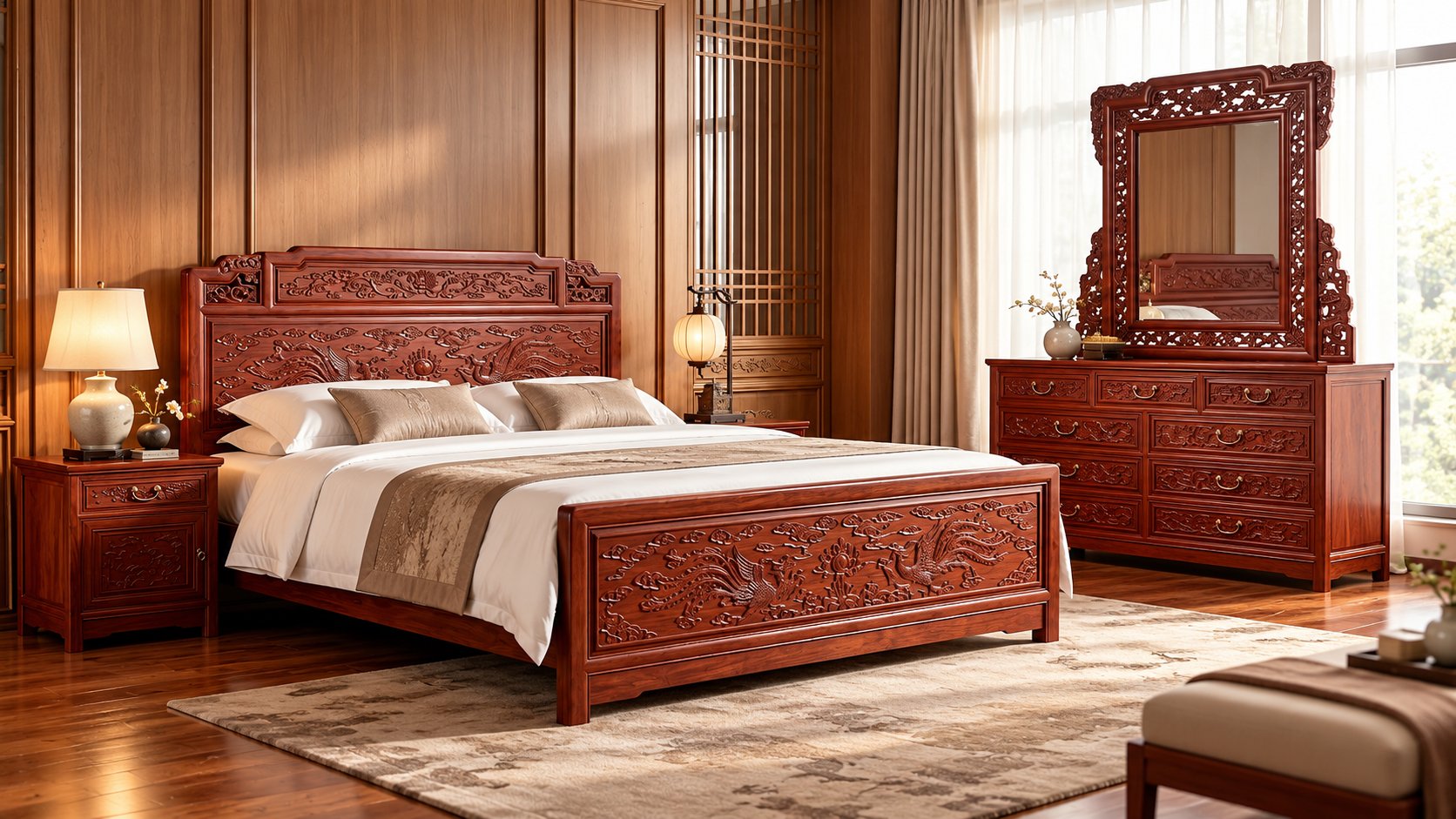
A manufacturer's guide to how durable hotel bedroom furniture needs to be for high-turnover guest rooms: FF&E durability standards, wood and joinery specs, finish systems, acceptance checks and refurbishment planning.
A guest room is the most demanding room a piece of furniture will ever work in. Between check-in and check-out, a bed frame is climbed onto with luggage in hand, a dresser drawer is dragged open dozens of times by housekeeping, and a hotel headboard is leaned against by hundreds of different guests in a single season. Yet most procurement teams still evaluate hotel bedroom furniture with the same questions they use for a home: Does it look good? What is the price per set? The result, on too many projects, is furniture that photographs well in the opening brochure and starts failing commercially within the first year of operation.
This article answers a different question, the one that actually decides your total cost of ownership: how durable does hotel bedroom furniture need to be for high-turnover guest rooms? We will define what durability means in a real hotel FF&E specification, translate it into wood, joinery, finish and inspection requirements you can put in writing, and show how the acceptance process should work before your rooms open. The perspective throughout is that of a manufacturer: we have built classical solid rosewood bedroom suites at our 12,000-square-metre workshop in Xianyou County, Fujian, since 2008, and we supply wholesalers, hotels and designers across Europe, North America, Southeast Asia and Australia. What follows combines that production-floor experience with the practical checks our hotel-project buyers use when they audit furniture before signing an acceptance sheet.
Why Do High-Turnover Guest Rooms Punish Furniture Faster Than Homes?
The core difference between residential and hotel room furniture is not aesthetic — it is usage intensity. A bedroom set in a private home might see one sleep cycle per night, gentle handling from a small number of people who own the furniture, and cleaning on an occasional schedule. A guest room set absorbs the same sleep cycle plus luggage impact, cleaning-cart collisions, industrial-strength cleaning agents, mattress changes, TV upgrades, and the occasional guest who treats a drawer front as a step stool. Multiply that by 365 nights, and a three-year-old hotel room has experienced more furniture stress than a residential bedroom sees in a decade.
Three failure patterns dominate in commercial bedrooms, and none of them are random. First, structural loosening: frames joined with metal bolts into particle board or under-dried timber work loose as humidity swings and repeated loads open the joints, producing wobbly bed frames and creaking rails that guests notice and complain about. Second, surface failure: thin sprayed coatings that look flawless on delivery chip when a housekeeping cart clips a corner, and once the film is broken the substrate absorbs moisture and stains. Third, drawer and door wear: undersized runners and cheap slides bind, sag, or fall out under the daily opening cycles of commercial housekeeping. Each of these failures is predictable, and each of them traces back to a decision made before the furniture was ever packed — the timber, the joint, the finish, and the moisture content.
For a buyer, the practical conclusion is that durability is not a bonus feature of hotel bedroom furniture; it is the specification. A set that costs 15 percent more but holds its joints and finish through five years of operation is dramatically cheaper than a bargain set that needs on-site repairs, room downtime, and guest compensation in year two. The rest of this article turns that principle into checkable requirements.
What Does "Durable" Mean in a Hotel FF&E Specification?
In hotel projects, furniture is normally procured under the FF&E umbrella — furniture, fixtures and equipment — and FF&E documentation treats durability as a written requirement, not a hope. When we review a buyer's specification before quoting, the durability section almost always asks for the same categories of evidence, whether the project is a 40-room boutique property or a full resort: timber species and grade, joinery method, finish system and its chemical compliance, structural load performance, moisture-content targets matched to the destination climate, and a warranty that names what is actually covered.
"Contract grade" is the industry shorthand buyers use, and it is worth unpacking, because the term itself guarantees nothing. In practice, a contract-grade claim should be backed by four verifiable things. One: a defined material — a named species such as Siamese rosewood (Dalbergia cochinchinensis), not "solid wood". Two: a defined structure — for example, mortise-and-tenon frames with a stated tenon depth, not "reinforced corners". Three: defined performance evidence — an internal or third-party test record the supplier can produce, such as a static load test on the bed frame or a drawer cycling count. Four: defined compliance — documentation such as FSC chain-of-custody and CITES export permits for controlled species, and finish-material statements relevant to EU REACH or US CARB expectations. If a quotation offers "contract grade" without those four definitions, the phrase is doing marketing work, not specification work.
A note on standards: buyers frequently ask us to align guest room furniture with commercial test standards such as BIFMA or EN performance methods, and it is reasonable to ask any supplier which procedures their internal tests follow. What matters is that the test method, the sample, the date and the result travel together. A durability number without a method is a marketing sentence. Throughout this article, when we cite our own figures, they come from our internal quality-control procedures at the Xianyou workshop — for example, the 150-kilogram static load test applied to every assembled bed frame — and the records for your production batch can be requested together with the quotation.
How Many Uses Per Day Does Hotel Bedroom Furniture Actually Absorb?
Quantifying daily abuse is the fastest way to see why residential construction methods fail in guest rooms. Consider one occupied room over a single week of normal operation, using conservative assumptions you can adjust to your own property:
- The bed frame carries full body weight for 7 to 9 hours per night, plus sitting loads on the rail and hotel headboard during the evening — and guests do not distribute their weight the way a test dummy does.
- Each nightstand drawer is opened and closed roughly 4 to 6 times per day (remote controls, chargers, notepads, amenity restocking), which is 150 to 200 cycles per month on a single drawer.
- The dresser or wardrobe doors swing through 10 or more cycles daily between housekeeping turndown service and guest use, and housekeeping opens every drawer and door daily during cleaning.
- The surfaces receive at least one full wipe-down per day, often with stronger cleaning agents than any home would use, and the bed moves several centimetres across the floor every time linen is changed.
Over a year, that modest arithmetic produces thousands of drawer cycles, more than a thousand wet wipe-downs, and continuous structural loading — in a room where any defect is immediately visible to a paying guest. A drawer that survives 20 cycles in a showroom can still fail at cycle 4,000; the difference between the two is joinery depth, runner material, and moisture control, not luck.
This is also why the durability question cannot be answered by warranty length alone. A 24-month structural warranty is useful, and ours is stated in every contract, but warranty terms respond to failures after they happen. The specification prevents them from happening. Buyers who write cycle counts, load figures and moisture ranges into the purchase order — and require batch test records against them — consistently report fewer post-installation problems than buyers who rely on the warranty as a safety net.
Which Materials Hold Up Best in Hotel Bedroom Furniture?
Material choice is the first durability decision, and for guest room furniture it comes down to three questions: how dense is the wood, how well was it dried, and how consistent is the batch.
Density and hardness. Dense tropical hardwoods resist indentation, hold screw and tenon engagement better, and wear rather than crumble under impact. Siamese rosewood, the species we use across our bedroom collections, is a dense hardwood with tight, interlocked grain; published reference data such as The Wood Database places its Janka hardness at approximately 2,430 lbf — a species-level reference figure, not a batch-specific measurement, and we provide batch records on request. For comparison, the softwoods and low-density hardwoods common in budget hotel casegoods sit far lower on that scale, which is why their edges show grey compression marks within months of housekeeping carts passing.
Drying and moisture content. Density without correct drying is useless in a commercial setting. Timber that goes into joinery above the equilibrium moisture content of the destination climate will shrink after installation, and shrinking is what opens joints. Our process dries timber for approximately 36 days under constant-humidity conditions and controls finished moisture content at 8 to 12 percent before any component is cut. For a hotel in Southeast Asia or coastal Australia, that range matters more than any other number in the specification, because it is the difference between a frame that stays tight and a frame that creaks after the first wet season. Buyers shipping to very dry interior climates or heated European winters should raise the moisture question explicitly — equilibrium targets differ by destination, and a supplier who cannot answer the question is guessing.
Batch consistency. Hotels usually order furniture in tens of suites, not ones, and visual consistency across rooms is part of the guest experience. We allocate timber batch by batch and density-sort boards — for our compact four-piece set, structural boards are grouped within a 0.90 to 1.00 g/cm³ air-dry density range — so that grain tone and structural response stay consistent across every piece and every room. Grain matching is done at the workshop, not at the warehouse: by the time crates reach your project site, the colour relationship between the bed, nightstands, and dresser has already been fixed, and it cannot be fixed again on site.
Practical takeaway for your specification: name the species, require the moisture range in writing, and ask how boards are sorted for density and grain across multi-room orders. Those three lines eliminate most of the material-related failures we are called to advise on.
What Joinery Standards Should You Specify for Hotel Style Bed Frames?
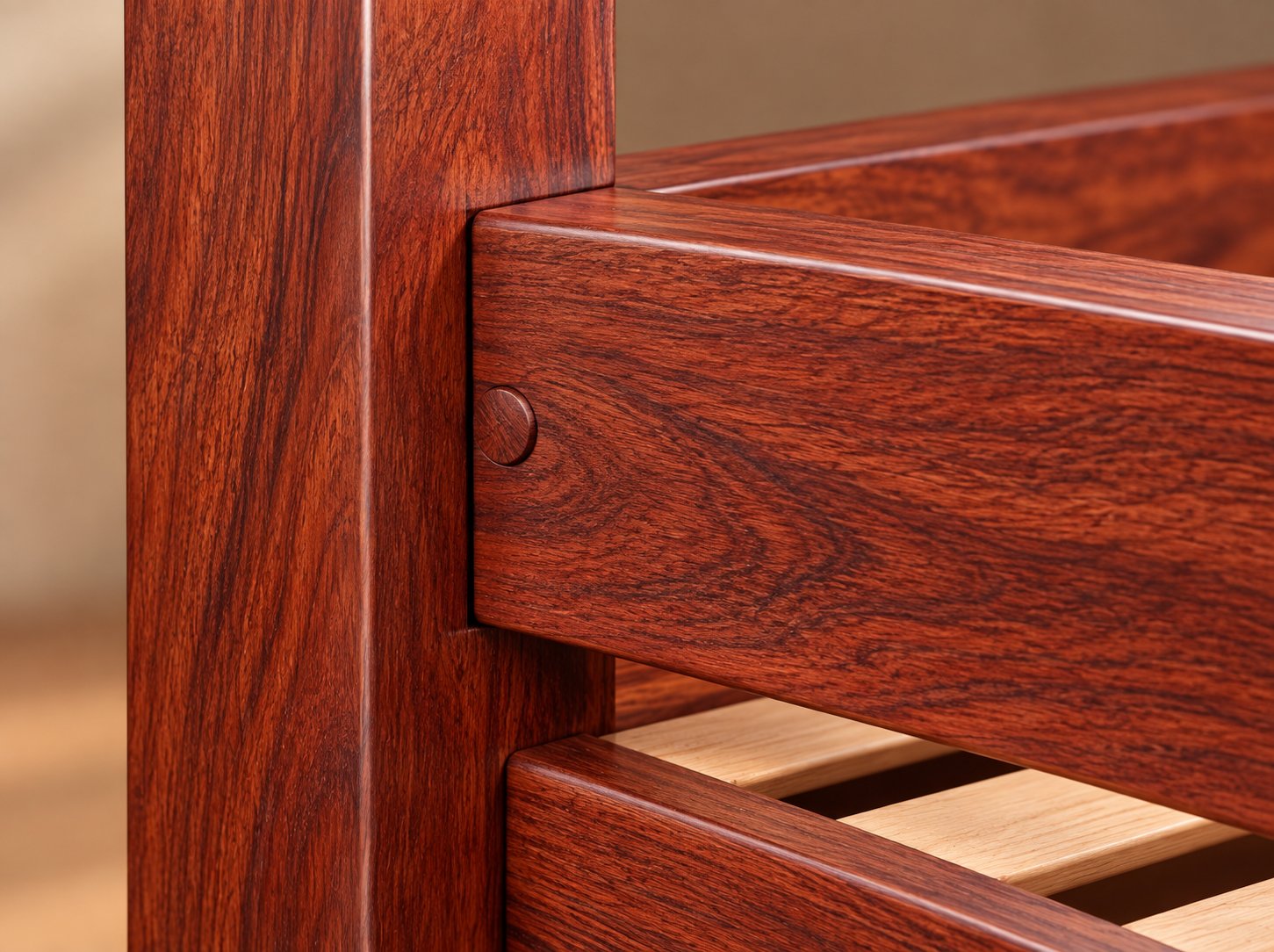
The bed is the structural anchor of any guest room, and the joinery standard you write for it will decide whether the hotel style bed frame you ordered is still silent and solid after three years of turnovers. Classical Chinese furniture construction offers a proven answer, refined over centuries of use precisely because it was built to be serviced and to endure: mortise-and-tenon joinery.
In our workshop, bed frame post-to-rail connections use 18 mm tenon-depth mortise-and-tenon joints secured with wooden dowels, and the primary frame contains no metal fasteners at all. This is not romantic traditionalism — it is a mechanical decision. Metal screws driven into dense hardwood concentrate stress at the thread and work loose as the wood moves seasonally; a properly fitted tenon distributes load across its full face and gets tighter, not looser, as minor wood movement seats it. Hotel beds experience lateral loads — guests sitting on rails, luggage dropped on corners, mattress teams lifting frames — that exceed anything a residential bed sees, and distributed-load joints handle them without the incremental loosening that defeats bolted construction.
The same logic extends to every moving component. Dresser and nightstand drawers in our bedroom sets use hand-cut dovetail joints — half-blind at the front corners, through-dovetails at the rear — cut to the traditional 1:6 pin ratio for hardwood drawers, sliding on wooden runners rather than metal slides. Wooden runners are quieter under repeated use, cannot corrode in humid coastal climates, and allow a worn drawer to be repaired by re-fitting the joint instead of replacing the whole case. Wardrobe and dresser panels are floating-panel construction: the solid panel is seated in a grooved frame with room to expand and contract, so seasonal humidity swings in heated winters or air-conditioned summers do not split the panel or rack the frame.
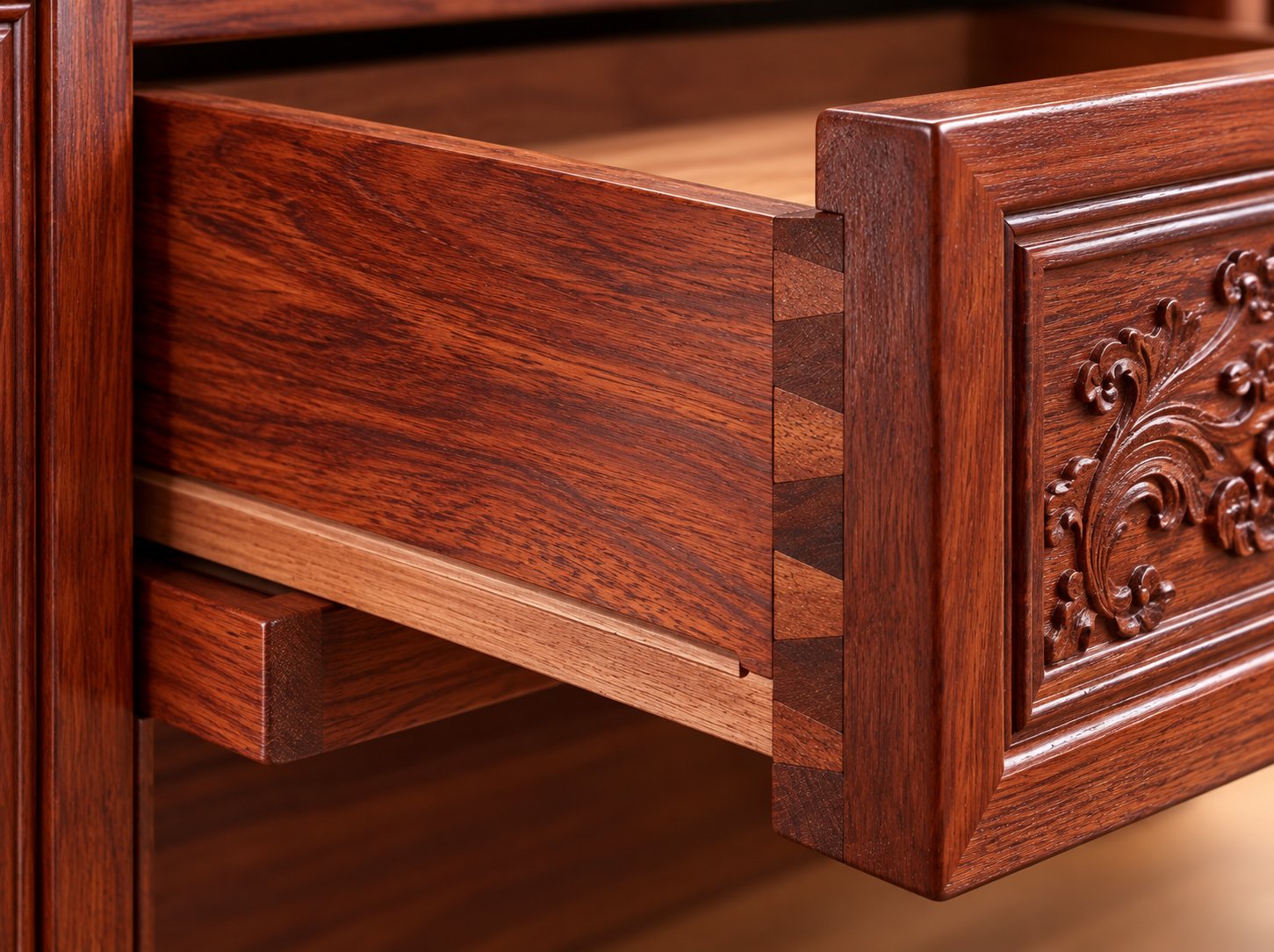
How do you verify any of this before the furniture ships? Ask for the numbers and the evidence. Our internal quality control on every set includes a 24-hour static load test of the assembled bed frame with 150 kg of distributed weight — covering the frame and slat base, not the mattress — with any joint showing separation re-fitted before packing, and each drawer cycled 50 times on its runner. A deeper background on why this joinery system suits overseas climates is covered in our article on solid rosewood bed frames with mortise-and-tenon joinery. For your specification, write the joint type, the tenon depth, the runner material and the test method into the purchase order, and require the batch test records with the quotation. Suppliers who build for hotels will answer those lines without hesitation.
What Should You Check on a Hotel Headboard Before Acceptance?
The hotel headboard deserves its own acceptance checks, because it is the most touched surface in the room and the most frequently disappointed expectation in delivered projects. Four things decide whether a headboard survives commercial service.
Panel construction. The headboard panel should be a solid board set into a grooved frame — never veneered MDF or finger-jointed offcuts, which telegraph their seams under hotel lighting and fail at the first humidity swing. In our bedroom sets the headboard panel is a single solid Siamese rosewood board housed in a frame that allows seasonal movement; the carving is executed in the panel itself, not applied on top of it.
Height and proportion. Height is a comfort decision with a structural footnote. Our compact four-piece set uses a 110 cm low headboard designed for rooms with standard 240 cm ceilings, while our four-poster and canopy designs extend the vertical line for suites with taller volumes. Measure ceiling height, doorway widths and staircase landings before ordering — four-poster posts ship as single solid sections and cannot be broken down for tight stairwells, a constraint worth confirming with any supplier before the container is booked, not after.
Mattress interface. The headboard's long-term enemy is mattress movement. Confirm the mattress standard you will actually use — North American king (193 × 203 cm) differs from European and Asian king sizes — and the slat specification. Our slat bases sit recessed into the side rails at approximately 90 mm centres and are designed for standard innerspring or latex mattresses used directly on the slats, without a box spring; confirm mattress depth at order so headboard height and frame proportions match what your housekeeping team will actually make up every morning.
Stability and attachment. Whatever the attachment method — frame-integrated, wall-mounted, or bed-attached — a headboard in a guest room must not shift when leaned against, because a moving headboard transmits noise into the wall and loosens its own connections over hundreds of stays. Ask how the headboard anchors to the bed or wall, what hardware is supplied, and how the joint is accessed for tightening. On our sets the headboard panel is integrated into the frame structure itself, so the load path runs from panel to posts to floor without wall dependence — a detail worth confirming for any wall-mounted alternative in seismic or high-occupancy properties.
Which Surface Finishes Survive Housekeeping Carts and Luggage?
Finish is where durable furniture most often loses its durability, because finish is the layer everything touches. Two finish families dominate hotel casegoods, and they fail differently.
Thick sprayed film coatings — the standard approach on volume-produced hotel furniture — form a hard plastic-like shell. They look uniform and resist the first hundred impacts, but once the film is chipped or cracked by a cart corner or a suitcase edge, the substrate underneath is exposed, moisture enters, and the damage spreads under the surrounding film. Repairing a film finish on site means sanding and re-spraying, which is rarely practical in an occupied hotel.
Traditional hand-rubbed raw lacquer works on the opposite principle, and it is the finish system on all of our bedroom collections. Multiple thin coats are applied by hand, each cured for 24 hours and rubbed with pumice stone before the next — six coats on our four-piece set — building a penetrating finish that becomes part of the wood surface rather than a brittle film over it. Minor handling marks in daily service blend into the satin sheen instead of peeling, and when a surface dulls after years of use, it can be restored with a light hand-rubbed wax or a fresh raw-lacquer coat applied on site — a maintenance action, not a refinishing project. The trade-off is heat: a raw lacquer surface is easily damaged by sustained contact with hot items in the 60–110°C range, so guest room standards should include the same coasters and mats your care instructions already require for dining surfaces.
Compliance is the other half of the finish decision. Finishing materials on our furniture are stated by the company to meet EU REACH and US CARB requirements, and the frame construction uses no added urea-formaldehyde adhesives; batch emission test records are provided with the quotation at the inquiry stage. For hotel projects in the EU and North America, ask every shortlisted supplier to state exactly which compliance documents travel with the shipment and which are available on request — and treat any supplier who answers vaguely on finish chemistry as a durability risk, because the same vagueness usually extends to the coats, cure times and rub steps that decide how the finish ages.
How Should You Run a Guest Room Furniture Acceptance Inspection?
Durability requirements only become real at acceptance — the moment your team signs that the delivered furniture meets the specification. The inspection habit that separates smooth hotel projects from troubled ones is simple: verify against the purchase order, not against impressions. A structured acceptance flow for hotel bedroom furniture looks like this.
- Documentation first. Before opening crates, check that the CITES export permit, FSC chain-of-custody certificate, commercial invoice with the correct HS code, and wood drying certificate are present for the shipment. For controlled species like Siamese rosewood, these documents are not optional extras; they are what your customs broker and any green-building certification will ask for.
- Moisture verification. Spot-check moisture content on arrival with a pin-type meter. Our factory standard is 8 to 12 percent, verified at three points per piece before packing; readings far outside your specified range on arrival indicate either a drying failure or a storage problem in transit, and either way they belong in the acceptance record before installation begins.
- Structural checks. Assemble one sample bed fully and apply your agreed static load — ours is tested at 150 kg distributed for 24 hours at the factory — and inspect every joint line under load. Check drawers through 20 to 30 full cycles each: they should run on their runners without binding or racking, since factory cycling (50 cycles per drawer on every set we pack) should leave a measurable margin over showroom handling.
- Surface and finish review. Inspect finishes under 5000K lighting at close distance — the same standard our workshop uses — distinguishing genuine defects (runs, uncured spots, joint separation) from the natural characteristics of hand-applied lacquer, where fine dust particles under strong light are part of the hand-rubbed process, not flaws.
- Consistency across rooms. Compare pieces from different crates side by side for grain tone and colour, since batch allocation should have fixed this at the workshop. For carved orders, confirm batch-matched carving expectations in advance; hand-turned details such as post finials vary slightly by design, and the specification should say so.
Pre-shipment is the cheaper point to catch problems, and a fuller general checklist for that stage is covered in our pre-shipment inspection checklist for importers. We also support third-party inspection before shipment: inspectors can review production records, drying records and material documentation on site, and we provide packaging photos, loading photos and a packing list before the container closes. Acceptance at the hotel should then be a confirmation exercise, not an investigation.
When Should Hotel Bedroom Furniture Be Refurbished Instead of Replaced?
Every hotel group plans guest room refurbishment in multi-year cycles, and the interval varies widely with brand tier, occupancy and climate — the useful planning question is not "how many years?" but "what condition triggers what action?" Understanding that decision tree changes how you should evaluate furniture at purchase, because refurbishability is a specifiable property.
Solid hardwood furniture with traditional joinery is fundamentally repairable in a way that laminated and veneered casegoods are not. A loose tenon can be re-seated and re-dowelled by a competent local carpenter with access to the joint; a chipped spray-film panel cannot be meaningfully repaired, only replaced. Surface dulling on hand-rubbed raw lacquer responds to a re-wax or an additional raw-lacquer coat, restoring depth of colour rather than applying a new skin — which is why properties furnished with penetrating-finish hardwood routinely extend service life through surface renewal alone. Drawer runners carved from wood can be re-fitted; metal slides corroded by coastal air usually mean replacing the whole drawer box.
The economics also depend on what the warranty actually covers, so read it as an operational document. Our bedroom sets carry a 24-month structural warranty from receipt, covering structural cracking, severe deformation, loosened mortise-and-tenon joints and hardware damage from non-human causes, with response within 48 hours and a solution within 7 working days; normal wood shrinkage, natural colour variation and grain differences are explicitly not defects, because they are properties of solid wood, not failures. Buyers comparing suppliers should normalise warranty documents on exactly those dimensions — what is covered, what is excluded, response times, and whether installation labour is included — because two identical-sounding "2-year warranties" can describe very different obligations.
A practical refurbishment strategy for a multi-room property: specify furniture that is repairable (solid wood, distributed-load joinery, penetrating finish), keep the care instructions active with housekeeping from day one, and schedule a light surface-renewal pass on the natural dulling cycle of your property's usage rather than waiting for visible damage. Properties that follow this sequence typically stretch the interval between major room refits considerably — and the furniture that makes it possible is decided at the purchase order, not the renovation tender.
Where Do Hotels Buy Their Furniture — and What Should a Buyer Verify First?
It is one of the most common real-world searches in this category: where do hotels buy their furniture? The honest answer is that sourcing models divide into three paths — local FF&E contractors who bundle furniture with installation, regional wholesalers holding stock from multiple factories, and direct factory programs for projects that want specification control. Each has trade-offs in lead time, customization depth and cost, and the detailed channel comparison is covered in our B2B guide to sourcing hotel furniture wholesale. The same durability logic applies across all three paths, and the verification questions do not change: who manufactured the furniture, what species and moisture range was used, what joinery and finish system, and what documentation travels with it.
Direct factory programs suit buyers who want the specification to match the property rather than the catalogue — which is the normal situation for classical hardwood guest rooms, where carving, dimensions and finish are all order-specific. If you are weighing a full project move in that direction, the end-to-end process, from layout drawings through container delivery, is described in our article on how a rosewood furniture factory supports hotel and villa projects, and a market-level view of the 2026 sourcing landscape is in our luxury hotel project sourcing guide. The durability requirements in this article are exactly the lines to transfer into whichever sourcing route you choose — and any supplier, direct or indirect, should be able to answer them in writing.
One adjacent note: the same commercial-wear logic that governs guest rooms applies to public areas, and buyers researching hotel lobby furniture for sale should apply the same verification questions — public-area pieces simply concentrate the traffic into fewer, higher-contact surfaces, so finish and edge durability matter even more there than in the bedroom.
How Does a Rosewood Factory Support FF&E Durability Requirements?
It is worth closing the loop between specification and production, because the durability features described above are only deliverable by a factory that controls the full chain. Our workshop in Xianyou County, Putian City, Fujian — a region with generations of classical hardwood craft — covers timber drying, woodworking, mortise-and-tenon assembly, hand carving, finishing and export packing in-house across approximately 12,000 square metres. Vertical control matters for hotel buyers for one specific reason: the 36-day constant-humidity drying, the density sorting, and the per-set load and cycle tests only happen if the factory performs them, not if they are subcontracted away.
For FF&E projects, our standard support structure looks like this. Custom dimensions, carving motifs and finishes are handled under OEM and ODM with a 15-day design approval cycle; production can be scheduled in batches against your room-count and delivery schedule, with projects of 20 suites or more arranged as dedicated batch production with phased delivery; a standard 40-foot container loads approximately 6 to 10 complete bedroom suites, and standard lead time runs about 45 to 60 working days from deposit. Every shipment carries the documentation set hotel procurement expects — CITES export permits issued for Dalbergia cochinchinensis, FSC chain-of-custody certificates, ISPM-15 heat-treated packaging, and the drying and inspection records described above.
Our current bedroom collections give project buyers a tested starting point: the compact four-piece bed and dresser set with a 110 cm low headboard for standard-ceiling guest rooms; the five-piece four-poster suite for signature rooms and suites; the six-piece wardrobe suite where in-room storage is part of the brief; and the three-piece canopy bed set for compact installations. All four share the same batch-allocated Siamese rosewood, joinery system and finish process, so mixed-room orders stay visually and structurally consistent. Buyers can engage us at international furniture fairs including the Canton Fair and the Shanghai International Furniture Fair, or arrange a workshop visit covering timber storage, joinery stations and the lacquer curing area.
Buyer FAQ: Hotel Bedroom Furniture Durability and Acceptance
How much longer does solid hardwood furniture last in a hotel room than veneer casegoods?
There is no single multiplier, because service life depends on usage intensity, climate and maintenance — but the failure modes differ structurally. Veneer and laminated casegoods fail by surface breach that cannot be repaired on site, so their end of life is a replacement event. Solid hardwood with traditional joinery fails gradually and repairably: joints can be re-seated, surfaces re-waxed or re-coated. For high-turnover rooms, that repairability gap is worth more than any single lifespan number, and it is the reason we build guest room furniture the way we do.
Can a hotel style bed frame be built to North American king dimensions?
Yes — bed size is selectable at order, and OEM custom dimensions are part of our standard process with a 15-day design approval cycle. Confirm the exact mattress standard at order (193 × 203 cm North American king differs from 180 × 200 cm Asian/European sizing) so the frame, slat base and headboard proportions match the mattress your property will use.
What documentation should an FF&E durability spec require from the supplier?
At minimum: named species with CITES export permit and FSC chain-of-custody, the moisture-content range in writing, the joinery specification (joint type, tenon depth, runner material), the finish system with its compliance statements, internal or third-party test records for load and cycling, and warranty terms that name what is covered and excluded. Every one of those lines is answerable in writing by a factory that actually performs the work, and we provide batch records with the quotation.
What is the minimum order for hotel bedroom furniture, and can one room be ordered as a trial?
Our minimum order is one complete set, and trial single sets are a standard way to validate a supplier before a multi-room commitment — a 20-foot container fits approximately 8 of the compact four-piece sets, and refundable samples are available. For projects, volume pricing applies from 5 sets upward with lead times of 60 to 75 days for batch orders.
How do you keep carving and colour consistent across dozens of rooms?
Consistency is fixed at production, not at delivery: all components in an order are cut from allocated timber batches, grain tone is matched at the workshop, and carving teams work from the same master patterns. Hand-worked details such as turned finials vary slightly by design — that is a property of hand carving, and projects needing near-uniform looks across rooms should confirm batch-matched carving when ordering so production plans for it.
Plan Your Guest Room Durability Specification with Us
Durability in hotel bedroom furniture is not a slogan — it is timber named and dried to a range, joinery specified to a depth, finishes built in cured coats, tests recorded per batch, and documents that travel with the crate. If you are preparing an FF&E package for a hotel, resort or villa project, send us your room count, bed-size standard, destination port and target timeline, and our export team will return a quotation with the batch test records, compliance documentation and packaging specifications described in this article. You can also visit our Xianyou workshop to see the drying, joinery and finishing operations behind every claim above, or meet us at the Canton Fair and Shanghai International Furniture Fair. Start the conversation through the inquiry form on our Yunxiao Rosewood Furniture homepage — include your durability requirements in the first message, and we will answer them line by line.